
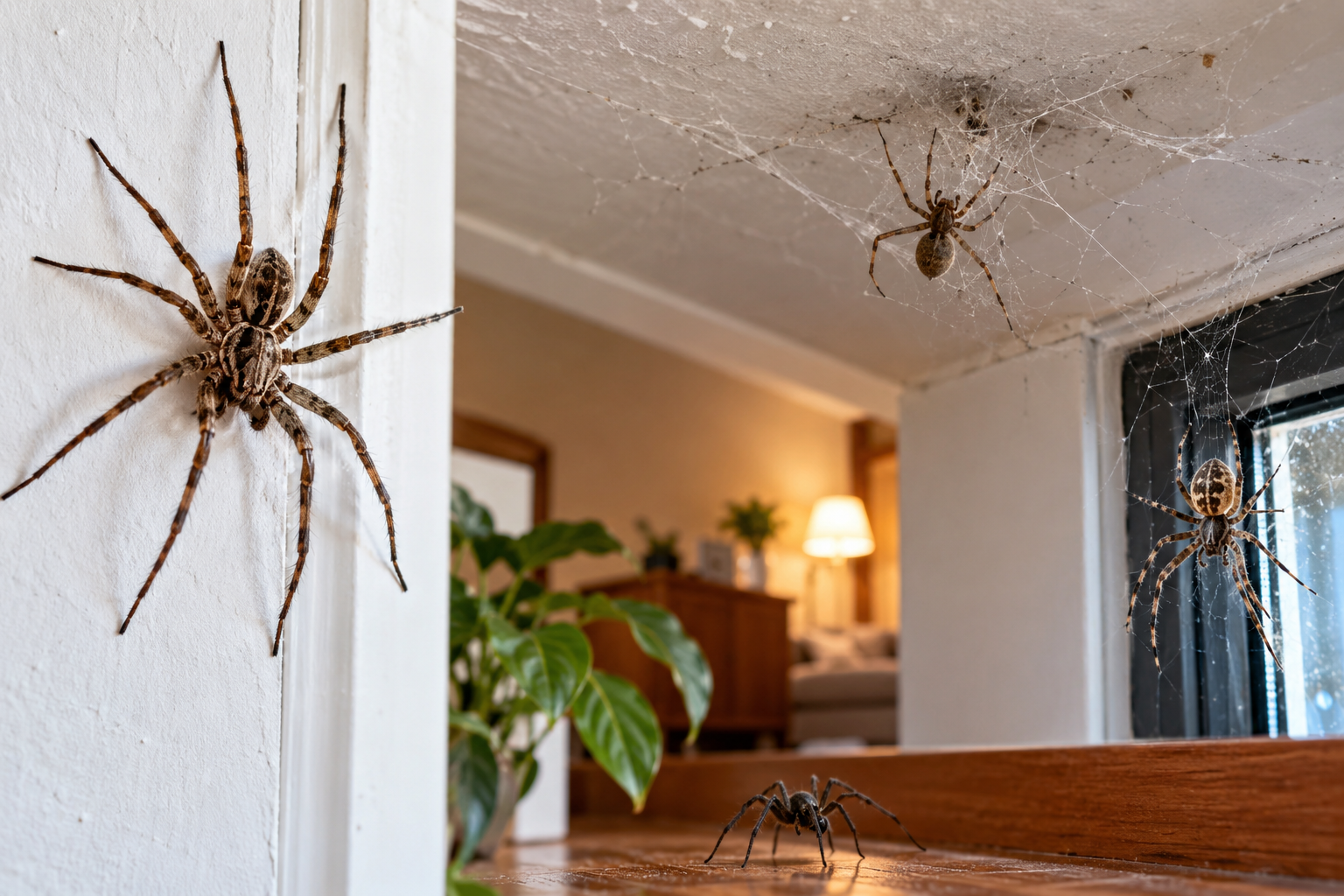
You pull back the shower curtain and a long-legged spider is sitting in the tub. A web stretches across the garage door that wasn’t there on Friday. Then a large, fast brown spider crosses the living room floor at nine at night, and it’s the third one this week.
The cause is usually less alarming than it feels. The number of spiders around a house rarely jumps in October. What changes is where they are, how much they move, and how many end up on the inside of your walls. Once you understand the timing and the routes, you can see which fixes are worth the effort and which are mostly folklore.
Why Spiders Become Noticeable in Fall
Spiders have been living around your house all summer. Most of that time they were outside, growing, hunting and staying put. By late summer and early fall, many common species have reached adult size, and their behavior changes.
The change that matters most is that adult males of many species leave their webs or hiding spots to search for females. A spider sitting in a web is easy to ignore. A spider crossing an open floor in a straight line is not. In many cases, the spider you see wandering across a wall or carpet in fall is a male on a mating search, not a resident that has been nesting in your house. This is also why you see them in odd places like bathtubs, sinks and the middle of rooms.
Cooler nights add a second push. As temperatures drop, outdoor insects decline, and the spiders that feed on them lose both food and shelter. Some drift toward warm, sheltered spots, and a house offers both. Spiders also follow their food. If insects are clustering around a warm foundation or a lit doorway, spiders will be there too, and a few will end up inside.
A third factor is simply that you’re paying attention. You’re indoors more, lights come on earlier, and dust-covered webs in corners become visible when the evening light is low. Large orb webs on porches also reach their biggest size around this time, which makes them hard to miss.
Which Spider Is It? A Quick Field Guide
Identification matters because the right response depends on what you’re dealing with. Most spiders found in homes are harmless to people and eat other pests. A handful of species deserve more care. The list below covers the most common ones, though the mix varies a lot by region.
| Spider | Where you’ll usually see it | What gives it away |
| Common house spider (cobweb spider) | Corners of ceilings, behind furniture, basements | Tangled, messy web; small, brownish body with a rounded abdomen |
| Cellar spider (“daddy longlegs” in the U.S.) | Basements, crawl spaces, ceilings, garages | Very long, thin legs; hangs upside down in loose webs |
| Wolf spider | Garages, basements, ground-level doors | Large, hairy and fast; no catching web; hunts on the ground |
| Funnel weaver (grass spider) | Lawn edges outdoors; occasionally indoors | Flat sheet web with a funnel-shaped retreat; fast runner |
| Jumping spider | Sunny windowsills, walls | Compact and stocky, large forward-facing eyes, moves in short leaps |
| Orb weaver | Porches, eaves, doorways, light fixtures | Classic round web, often built fresh each night, larger in fall |
Two spiders cause more worry than they should, or in some cases less than they should.
Brown recluse. Many people assume any brown spider is a recluse. In reality, recluses are found mainly in parts of the central and southern United States, and many regions have none at all. The “violin mark” is an unreliable identifier. A more dependable feature is the eye arrangement: recluses have six eyes in three pairs, while most spiders have eight. That needs a magnifier and a dead or captured specimen to check. If you’re unsure, your local cooperative extension office can often identify a spider from a clear photo.
Black widow. The adult female is glossy black with a red hourglass marking underneath, and it builds an irregular, tangled web low to the ground. Those webs tend to be in dark, undisturbed spots like woodpiles, meter boxes, garage corners and stacked pots. Wear gloves when moving stored items and firewood.
Wolf spiders deserve a mention because they cause more false alarms than any other. They’re big, they move fast, and they sometimes appear on the floor in the middle of a room. They’re ground hunters, so they wander in rather than build webs, and they usually come in through gaps at ground level.
Where They’re Getting In (and Why)
Spiders don’t need large openings. A gap you can see daylight through is already wider than most of them require. The more useful question is which parts of the house offer both a way in and a reason to stay. The sections below cover the usual suspects. Specific sealing methods come later, so they aren’t repeated here.
Window and Door Edges
The area around windows and doors is the most common route. The weatherstripping dries out and shrinks. The caulk where the frame meets the siding cracks after a few seasons of temperature swings. Torn or loose screens leave open spots, and screens that don’t sit flush against the frame leave a thin slot at the edge.
Look at the bottom of exterior doors in particular. If you can see light under a door in the daytime, or feel a draft on your ankles, the gap is big enough for spiders and for the insects they eat.
Windows also draw spiders for a second reason. Warm glass attracts insects, particularly flies, midges and moths that have drifted in with the dusk. A web in the upper corner of a window frame often means insects are getting in there too.
Garages
Garages are probably the number one source of spiders in houses with attached garages. They have large gaps at the bottom of the overhead door, rarely have decent weatherstripping, and are full of hiding spots: cardboard boxes, stacked buckets, shelves, tools, folded tarps and old paint cans. They are also usually dim and rarely cleaned.
The connecting door between the garage and the house matters as much as the garage door itself. If a spider can cross the garage floor, it can reach the gap at the bottom of that interior door. Check both.
Cardboard deserves its own warning. It looks harmless but gives spiders crevices to hide in and egg sacs somewhere to sit unnoticed. Moving stored items into sealed plastic bins makes a visible difference to what lives in a garage over time.
Basements and Crawl Spaces
Basements attract spiders through moisture and darkness, and cellar spiders and house spiders especially like them. Foundation cracks, gaps where pipes and wires pass through the wall, and window wells all work as entrances. A window well is a particular culprit because it collects leaves, damp debris and insects, then sits right at the glass.
Excess moisture draws other pests, such as silverfish, springtails and small flies, and spiders follow them. If the basement smells musty or the walls feel damp, humidity is part of the spider problem. Running a dehumidifier and fixing any leaks or poor drainage near the foundation helps with more than just spiders.
Attics
Spiders in the attic are harder to deal with because you rarely look there. Attic vents, soffit gaps, gaps around chimneys and roof penetrations, and spots where the roofline meets the siding are all entry points. Attics also hold insects: wasps, clothes moths, beetles and flies that overwinter in the warm space.
Webs in an attic are often a symptom, not the problem. If you see a lot of them, check for dead insects on the floor or insulation, which indicates an active population of prey.
Take care with any work up there. Attic vents exist for ventilation and moisture control, and covering them to keep spiders out can cause condensation and damage. Use fine insect screening that still lets air flow, and check for wasp nests, bats or rodents before you seal anything. If you suspect any of those, it’s a job for a professional.
How Outdoor Lighting Pulls Spiders Toward Your Door
Outdoor lights are one of the least-discussed causes. The spiders aren’t attracted to light itself so much as to what the light draws in. Moths, flies, beetles and midges swarm around porch lights and the glow from windows. Orb weavers in particular build webs near the light because the food supply is right there. Then every time you open the door, a few insects and the spiders hunting them get a free ride inside.
A few changes can reduce this, though not eliminate it:
- Switch to warmer bulbs. Insects tend to be more attracted to cool white and blue-rich light than to warm yellow or amber light. Warm-toned LED bulbs are widely used for this reason. The effect is real but partial, so don’t expect insects to vanish.
- Move the light away from the door. A light fixed directly above an entrance concentrates insects where people walk through. Lights on a pole a few meters from the door, aimed at the path, pull the activity away.
- Use motion sensors or timers. A light that is only on when needed attracts fewer insects over a night.
- Close blinds in the evening. Interior light spilling through windows draws insects to the glass, and the spiders arrive soon after.
- Clear webs regularly. Knocking down webs from fixtures every few days discourages spiders from settling in. They often rebuild, but a spider that has to start over each night spends its energy there instead of on your front step.
Leaf Piles, Mulch and Wood Piles
Yard debris gives spiders somewhere to shelter close to the house, and fall is when it builds up.
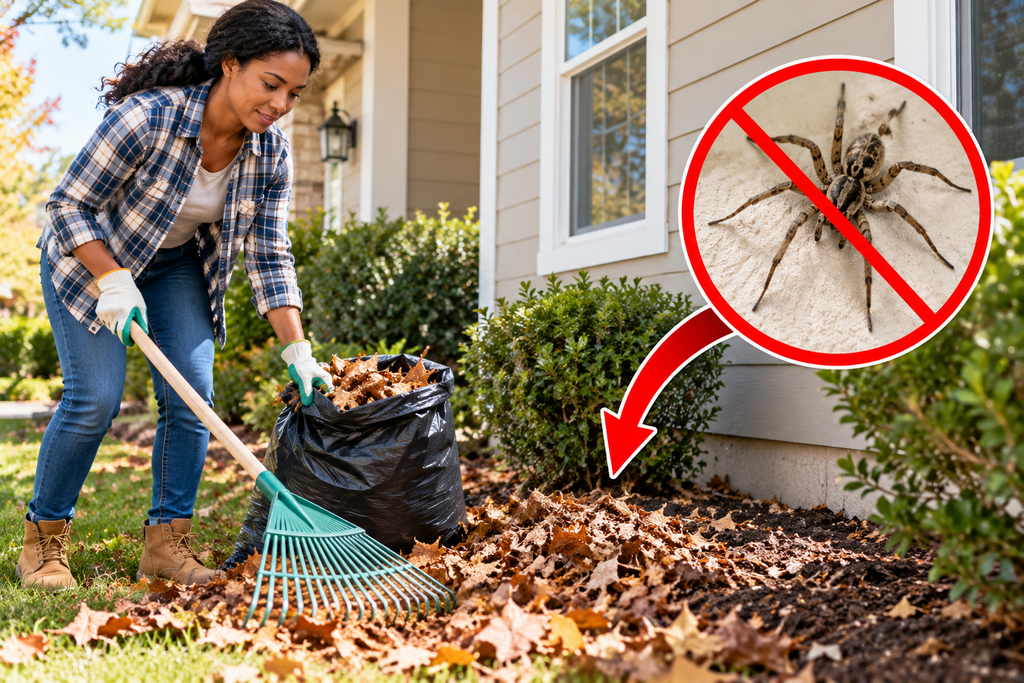
Leaves. A thick layer of leaves against the foundation holds moisture, supports insects and provides cover. It’s the same thing that makes a leaf pile a good habitat in a garden: it’s damp, protected and full of small prey. Raking leaves away from the foundation, window wells and the base of doors removes the shelter closest to your entry points. You don’t need a bare yard, just a clear strip next to the house.
Mulch. Mulch is useful for plants, but when it is piled deep against siding or foundation walls, it creates a protected corridor that insects and spiders can use. A common recommendation is to keep mulch to a modest depth and pull it back from the foundation, leaving a visible gap. Exact depths and distances vary by source, so check your local extension service’s guidance for your region.
Wood piles. Firewood stacked against a wall is close to an ideal spider habitat, and it’s often where black widows are found in areas where they live. It’s also a transport system: you carry the wood inside, and anything in it comes along. Better practice is to keep the stack off the ground on a rack or pallet, and as far from the house as is practical. You’ll often see 20 feet quoted as a distance, mostly in termite guidance, so confirm what applies in your area. Even a few feet of separation is better than a stack against the wall.
When you bring wood inside, bring only what you’ll burn in a day or two. Knock each piece against something hard outdoors first. Wear gloves, because a black widow in a woodpile can bite when the wood is moved. Storing a week’s supply by the fireplace is how spiders and other insects spread through the house.
The Insects That Bring the Spiders
A house with few insects will have few spiders. This is the part of the problem that sealing and cleaning alone won’t solve, and it’s why a single treatment often fails.
Spiders eat flies, mosquitoes, moths, ants, beetles, small roaches, silverfish and even other spiders. If your home has a steady supply of any of these, spiders will keep arriving to hunt them.
Think of the web or the spider as a pointer. Where are the webs concentrated?
- Around windows: flies and small flying insects are entering through gaps or open windows.
- In bathrooms and basements: moisture-loving prey like silverfish and springtails.
- In the kitchen or pantry: fruit flies, ants, or stored-food pests.
- Near light fixtures: moths and midges drawn in by the light.
- In the attic: overwintering insects like cluster flies or moths.
Fixing the prey problem means ordinary housekeeping and moisture control. Take out trash promptly, keep ripening fruit covered or refrigerated, store dry foods in sealed containers, fix leaky pipes, and run a dehumidifier in damp areas. Reducing the insects makes the house less appealing than a neighbor’s, and the spiders move on over time.
One caution: spiders are doing a useful job. A house with no spiders at all would likely have more flies, mosquitoes and pantry pests. The goal is to reduce the number indoors, not eliminate every spider from the property. Outdoors, they’re doing you a favor.
Natural Deterrents: What Has Evidence and What Doesn’t
This is the area where popular advice is weakest. Plenty of articles recommend peppermint oil, vinegar, citrus peels and chestnuts. Some of these may have a mild effect, but the evidence for most is thin, and it’s worth being straightforward about that.
What reliably works
The most dependable “natural” methods are the physical ones:
- Removing webs and egg sacs with a vacuum or broom
- Reducing clutter so there are fewer hiding spots
- Cutting off the food supply
- Sealing gaps
None of this is glamorous, but it addresses the cause instead of the symptom.
Peppermint and other essential oils
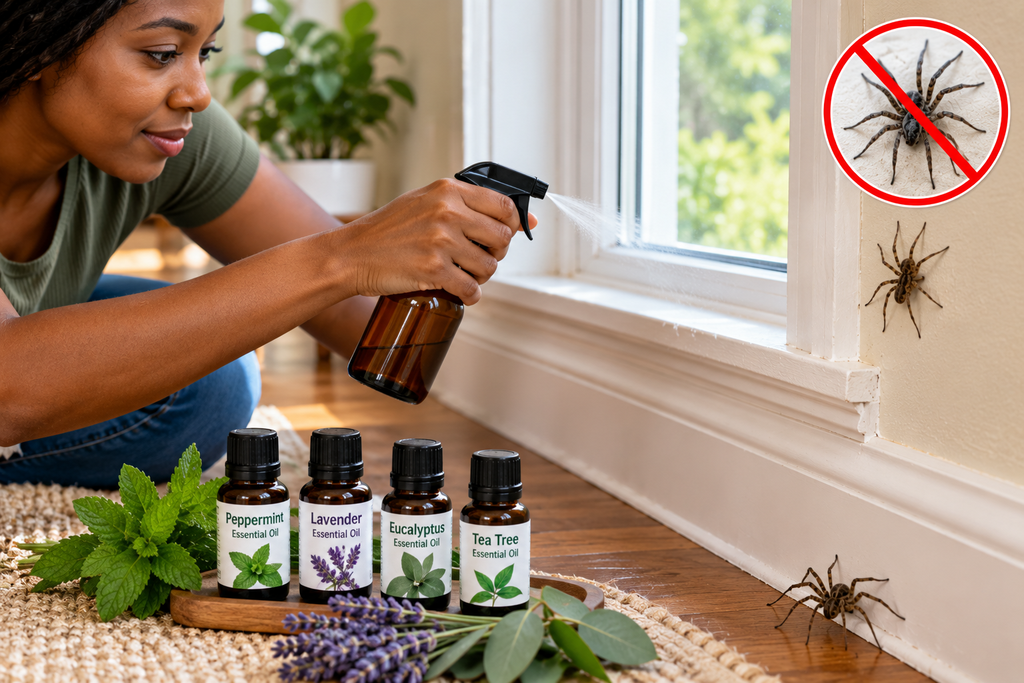
Peppermint oil is the most popular spider repellent in home advice, and some people report fewer spiders after using it. The research behind it is limited and mixed, and any effect probably wears off as the scent fades. It may help in a limited area such as around a doorframe, but treat it as a short-term supplement, not a solution.
Two cautions apply. First, many essential oils are harmful to pets, cats in particular, and can irritate skin and airways in people. Be careful about where you spray them and don’t diffuse oils in closed rooms where pets live. Second, follow the directions on any product you buy, and don’t mix your own concentrations on the basis of internet recipes. The exact amounts that work, if any do, aren’t well established.
Vinegar
Vinegar spray is sometimes recommended as a spider deterrent, and vinegar can kill some small soft-bodied insects on direct contact. As a repellent for spiders walking across a surface, the evidence is weak. It can also damage finishes, stone and some metals, so test it on a small area first.
Citrus peels, chestnuts and hedge apples
These are folk remedies. Controlled evidence that they keep spiders out is lacking, and a pile of peels in a window sill mostly attracts fruit flies. They’re harmless to try, but don’t depend on them.
Diatomaceous earth
Diatomaceous earth is a fine powder made from fossilized algae. It works by damaging the outer coating of insects and drying them out, so it can affect spiders that crawl through it. It only works while dry and loses effect when damp, which rules out many basements and exterior spots. The dust is also an inhalation hazard. Choose a product intended for pest control (pool-grade versions are different and not suitable), wear a dust mask when applying, and keep it away from pets and children. Apply it lightly in dry, out-of-the-way places, such as along the base of a garage wall or inside a wall void, where it won’t be disturbed.
Sticky traps
Glue traps placed along baseboards and in corners won’t keep spiders out, but they’re useful for monitoring. A few days of trap results show where spiders are entering and what species you have, and that helps you target your sealing. They also catch a lot of the insects spiders feed on.
Sealing Entry Points Properly
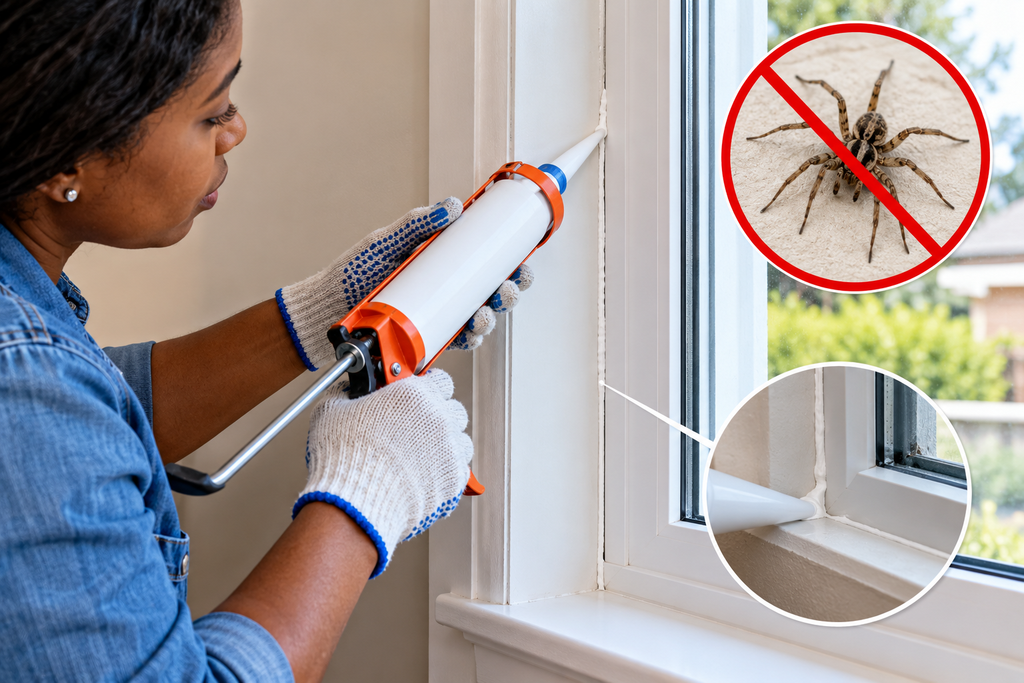
Sealing is the most lasting fix, and also the one most often done halfway. The rule is simple: if you can see a gap from outside, close it, and work from the outside in so you don’t trap anything inside the wall.
Start with a daytime walk around the house, looking at the base of the walls, windows, doors, utility penetrations and the roofline. A flashlight held on one side of a gap, viewed from the other side in a dim room, can reveal gaps you wouldn’t otherwise notice.
Matching the Material to the Gap
| Opening | What typically works |
| Hairline cracks and gaps around window and door frames | Exterior-grade caulk (silicone or a high-quality polyurethane), applied to clean, dry surfaces |
| Wider gaps than caulk can bridge | Foam backer rod pushed into the gap, then caulked over |
| Gaps around pipes, wires and AC lines | Copper mesh packed into the opening, then sealed over with caulk or foam (steel wool rusts and breaks down) |
| Bottom of doors | Door sweep or threshold seal, replaced when it wears |
| Garage door bottom | Rubber or vinyl bottom seal |
| Torn screens | Patch or replace the screen; check that frames are snug |
| Attic and soffit vents | Fine insect screening that still allows airflow |
| Dryer and exhaust vents | Covers or flaps that close properly |
Check the manufacturer’s label for the maximum gap each product can handle, because that varies, and caulk applied beyond its rated width tends to crack or pull away.
Mistakes That Undo the Work
Sealing weep holes. Brick veneer walls have small openings near the base, called weep holes, that let moisture drain from behind the brick. Plugging them can trap water inside the wall. If spiders are coming through them, cover the opening with a vent cover or fine mesh that still allows drainage, rather than caulking it shut.
Sealing vents entirely. As noted earlier, vents control moisture in the attic and crawl space. Screening is fine. Blocking is not.
Caulking over dirt. Caulk won’t bond to dust, old caulk or a damp surface. Clean the joint and let it dry first, or the seal will fail within a season.
Ignoring the interior door to the garage. Sealing the exterior openings but leaving a gap under the garage-to-house door only moves the problem.
Skipping the small utility penetrations. The hole around an outdoor faucet, a gas line or an air-conditioner line is often large enough for spiders and insects, and is easy to forget.
Doing it all in one weekend and then never again. Caulk and weatherstripping degrade. A quick yearly check each late summer, before spiders become active, catches problems early.
Timing
Early fall is the sensible time to seal, since it’s before spiders and insects are looking for winter shelter. Check the temperature range on the caulk label, because many products don’t cure properly in cold or damp weather.
Dealing With the Spiders Already Inside
Sealing keeps new ones out. For the ones already inside, a few practical steps work.
- Vacuum them up, including webs and egg sacs, and empty the canister or bag outdoors afterward. Vacuuming an egg sac matters because a single sac may hold many spiderlings.
- Catch and release is workable for most species: a cup and a piece of card will do for a spider on a wall. Don’t do it with a spider you suspect is a black widow or recluse; kill those or call a pro.
- Clear corners and ceiling edges regularly. A long-handled duster or a vacuum attachment keeps webs from becoming established.
- Reduce clutter under beds, in closets and behind furniture, where spiders hide during the day.
Spray insecticides are rarely the best answer for general house spiders. Many of them walk across surfaces only briefly, and a spider that isn’t contacting a treated surface isn’t affected. If you do use a product, read the label carefully, check that it’s permitted for the location, and keep it away from food areas, pets and children.
When Professional Help Makes Sense
Most spider sightings don’t need an exterminator. Call one if:
- You’ve confirmed or strongly suspect black widows or brown recluses in living areas
- Spider numbers stay high after you’ve sealed gaps and reduced prey
- You find signs of a larger insect problem, such as a wasp nest or heavy infestation in the attic
- You can’t safely reach the problem areas, such as a high roofline or a crawl space
If someone is bitten and develops serious symptoms, such as spreading pain, a growing lesion, muscle cramps, fever or difficulty breathing, get medical care promptly. If it’s possible to do so safely, keep the spider for identification. Most spider bites are minor, and many skin problems blamed on spiders turn out to have other causes, but a medical professional should make that call.
Questions Readers Actually Ask
Does seeing one spider mean I have an infestation?
No. A single spider, especially a wandering male in fall, usually reflects the season, not an infestation. Concern is warranted if you keep seeing many, find several egg sacs, or find webs in many rooms.
Why do I keep finding spiders in the bathtub?
They often wander in looking for moisture or end up there while crossing the room. The smooth sides of a tub are difficult for them to climb, so they stay trapped until you find them.
Will they leave when winter arrives?
Not entirely. Some die off as temperatures drop, but spiders that settled inside, such as house spiders and cellar spiders, can live in a heated home all winter. Sealing and prey reduction matter more than waiting for the cold.
Is it better to kill them or put them outside?
For common harmless species, relocating or vacuuming both work, and spiders do consume other pests. For a suspected black widow or brown recluse, don’t handle it; call a professional or follow local guidance.
Key Takeaways
The spiders you notice in fall are mostly a mix of wandering males, shelter-seekers and the usual indoor residents, and the surge you perceive is mainly a change in behavior and visibility. The routes in are ordinary: gaps around doors and windows, an unsealed garage, damp basements, attic vents and debris piled against the house. The reason they stay is food, so reducing insects, light attractants and clutter matters as much as caulk.
A practical order of work: walk the exterior in early fall and seal the gaps you find, rake leaves and move firewood away from the walls, switch to warmer lighting and move it from the door, deal with damp and food sources inside, and vacuum what’s already in. Treat natural repellents as a minor supplement, and call a professional if you suspect a dangerous species or the numbers don’t drop.

About Syprose Kiche
Syprose Kiche is the creator and writer behind My Besuited Home, a practical home and garden website covering DIY projects, gardening, lawn care, landscaping, home improvement, and outdoor living. She focuses on turning everyday homeowner questions into clear, practical guides backed by careful research and useful real-world considerations.