
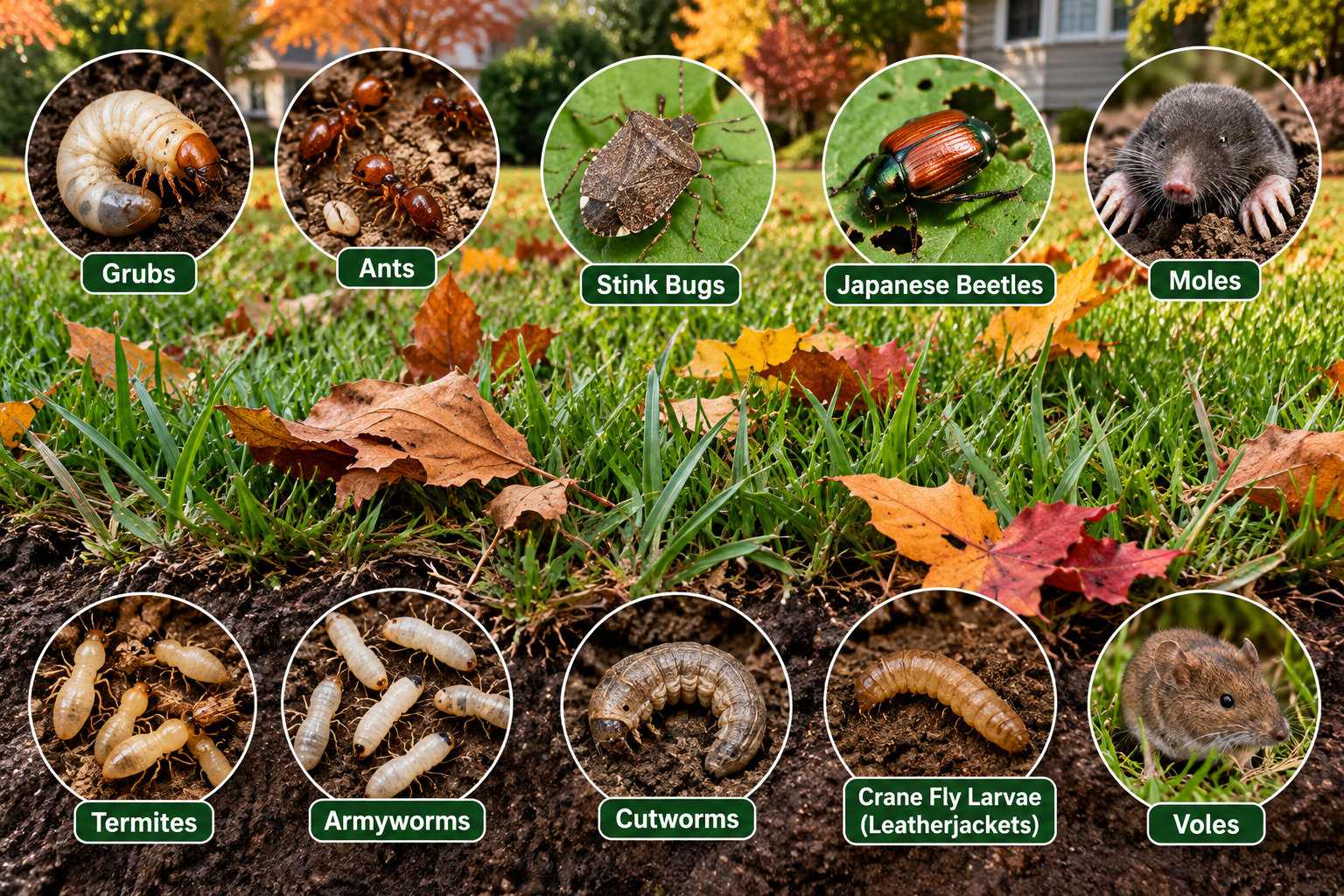
A lawn can look fine on a Monday and have bare, chewed-off patches by the weekend. That speed is the first clue. Drought damage and fungal disease usually creep across turf over weeks, but a caterpillar outbreak can strip a stretch of grass in days. Often the first thing anyone notices is birds. Starlings and robins start working the lawn in numbers, in daylight, pecking at the surface of grass that otherwise looks normal.
By the time brown patches appear, the caterpillars have usually been feeding for a while, and they have been doing it mostly at night and from hiding places in the thatch. The good news is that most caterpillar damage is less permanent than it looks, because the grass crowns often survive. The less good news is that several different pests cause nearly identical damage, and the right response depends on which one you have. This guide covers how to tell them apart and nine natural ways to deal with them.
Which Pest Is Eating the Lawn?
Armyworms, sod webworms and cutworms are all moth larvae. They chew grass blades, they feed mostly under cover of darkness, and they hide in thatch or just below the soil surface during the day. Chinch bugs and grubs also cause patchy dieback and are often mistaken for caterpillar damage. Treating the wrong one wastes money, and some natural products only work on one group.
| Pest | What the larva looks like | What the damage looks like | Where to look |
| Fall armyworm | Green, tan, brown or nearly black, up to about 1½ inches. A pale inverted “Y” on the head and four dark dots in a square on the second-to-last segment | Grass chewed down to short stubble in irregular patches that spread fast | Surface of the lawn at dawn or dusk; in thatch by day |
| Sod webworm | Tan to gray-green with dark spots, up to about ¾ inch; lives in a silk-lined tunnel | Small brown patches that merge; ragged, notched blades; green pellets of droppings in the thatch | Thatch layer, especially in sunny, dry areas |
| Cutworm | Plump, greasy gray to black, up to about 2 inches; curls into a tight “C” when disturbed | Small sunken spots, or newly sown seedlings cut off at the base | Just under the soil surface near damage; active at night |
| Chinch bug | Tiny sucking insects, not caterpillars | Yellowing, then straw-colored patches in hot, sunny spots | Where green grass meets the dead patch |
| White grub | C-shaped, white, in the soil | Turf that feels spongy and peels back like carpet | Soil, 1 to 2 inches down |
Cutworm damage shows up as scattered small spots, while armyworms and webworms produce larger patches. Many lawns have more than one pest at once.
The soapy water flush
This is the standard way to check a suspicious patch, and extension services recommend it widely. Mix about one to two tablespoons of mild liquid dish soap into a gallon of water. Pour it slowly over roughly one square yard of lawn at the edge of the damaged area, where the grass is still green. The soap irritates the insects, and within a few minutes any caterpillars living in the thatch crawl up to the surface. Count them. Then rinse the area with plain water so the soap does not stress the turf.
Check at the edge of the damage, not the middle. Larvae move outward toward fresh grass, and the dead center of a patch is usually empty.
The tug test
Grab a handful of the damaged turf and pull. If it lifts like a carpet with no roots holding it down, the cause is grubs or another root-feeding problem, and caterpillar controls will not help. If the grass stays firmly anchored but the blades are chewed off above the crown, suspect a surface feeder like armyworms or sod webworms.
What the birds are telling you
Birds, and sometimes wasps, gather where caterpillars are abundant. Flocks of starlings, grackles or robins probing a lawn in daylight, especially in late summer, are worth taking seriously as an early warning. Skunks, raccoons and armadillos digging holes in the lawn point to grubs rather than caterpillars, because grubs live in the soil and caterpillars feed on top of it.
A Short Guide to the Life Cycles
Timing matters because the controls below work best against small larvae.
Fall armyworms do not survive hard winters in most of the United States. They overwinter in the far south, and the moths migrate north each summer, which is why outbreaks tend to appear in late summer and early fall, and why they can seem to come out of nowhere. A generation takes roughly a month in warm weather, so populations can build quickly. A hard frost ends the feeding.
Sod webworms are the larvae of small, buff-colored lawn moths that rest with their wings folded tightly around the body. At dusk the moths fly in a zigzag pattern low over the grass, dropping eggs as they go. In many regions there are two generations a year, and partly grown larvae overwinter in the thatch. That means webworm damage is sometimes visible again in spring.
Cutworms vary by species, but the black cutworm is the usual culprit in lawns. The larvae feed at night and bury themselves in soil during the day. They are most damaging to new seedlings, which matters if you are overseeding this fall.
1. Mow High and Keep the Blades Sharp
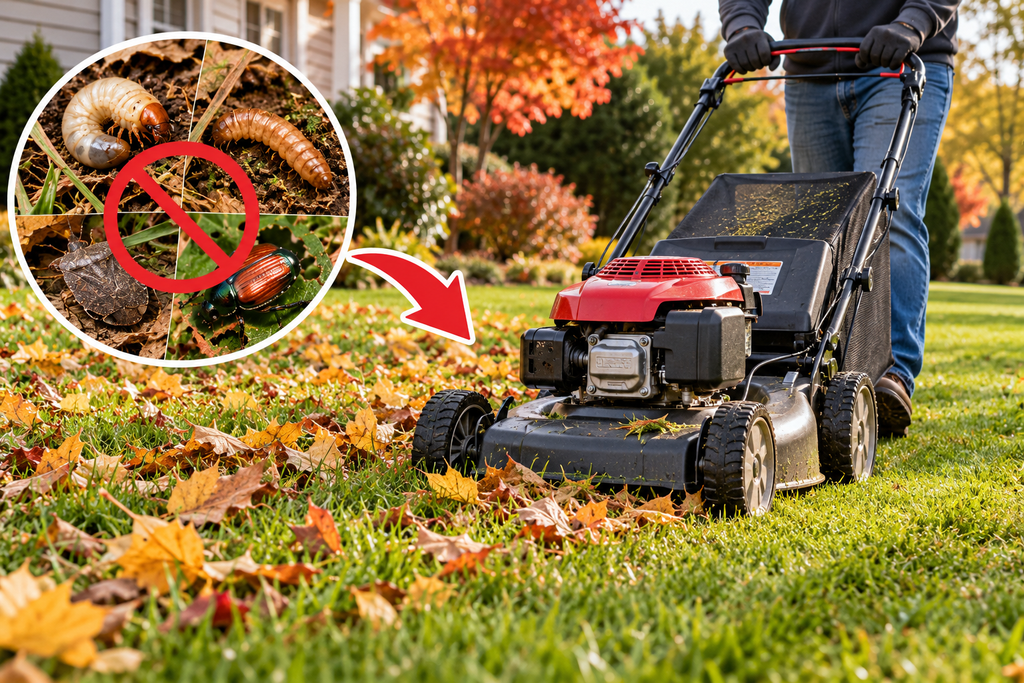
Mowing does not kill caterpillars. What a proper mowing height does is leave the grass with more leaf surface and deeper roots, so it recovers faster from chewing. Grass that is cut short has little energy reserve left to push out new growth after a feeding spree.
For most cool-season lawns such as tall fescue, Kentucky bluegrass and perennial ryegrass, a height of roughly 3 to 4 inches is a reasonable target. Warm-season grasses vary considerably: bermudagrass and zoysia are generally kept shorter than St. Augustine, and the right height for your variety is worth looking up for your region. Whatever you grow, follow the one-third rule and never remove more than a third of the blade in a single mowing.
Dull mower blades tear grass rather than cutting it cleanly. Torn tips turn brown and are an entry point for disease, and they can make a lawn look worse than it is, confusing diagnosis. Sharpen blades at least once a season.
During an active infestation, mow as you normally would, but avoid scalping the lawn in an attempt to “get rid of” the caterpillars. Cutting the grass very short exposes some larvae to birds, but it also stresses the turf you are trying to save.
2. Reduce Thatch Where It Has Built Up
Sod webworms build their silk tunnels in thatch, and armyworms shelter there during the day. A thin layer of thatch is normal and even useful. Once it exceeds about half an inch, it becomes a protected habitat for pests, a barrier that holds water and products away from the soil, and a weak point for the lawn itself.
To measure it, cut a small wedge out of the lawn and look at the brown, spongy layer between the green blades and the soil. If it is well over half an inch thick, it deserves attention.
Timing is where people go wrong. Dethatching during an active infestation puts further stress on grass that is already being eaten. Wait until the feeding has stopped and the lawn has had time to recover. The best window for dethatching cool-season lawns is early fall, before the first frost, while the grass is still growing vigorously. Warm-season lawns are usually dethatched in late spring or early summer, which makes fall the wrong time for them.
Core aeration also helps break up thatch over time and improves water movement, and it pairs well with overseeding.
3. Water Deeply and Early, Not Lightly and Often
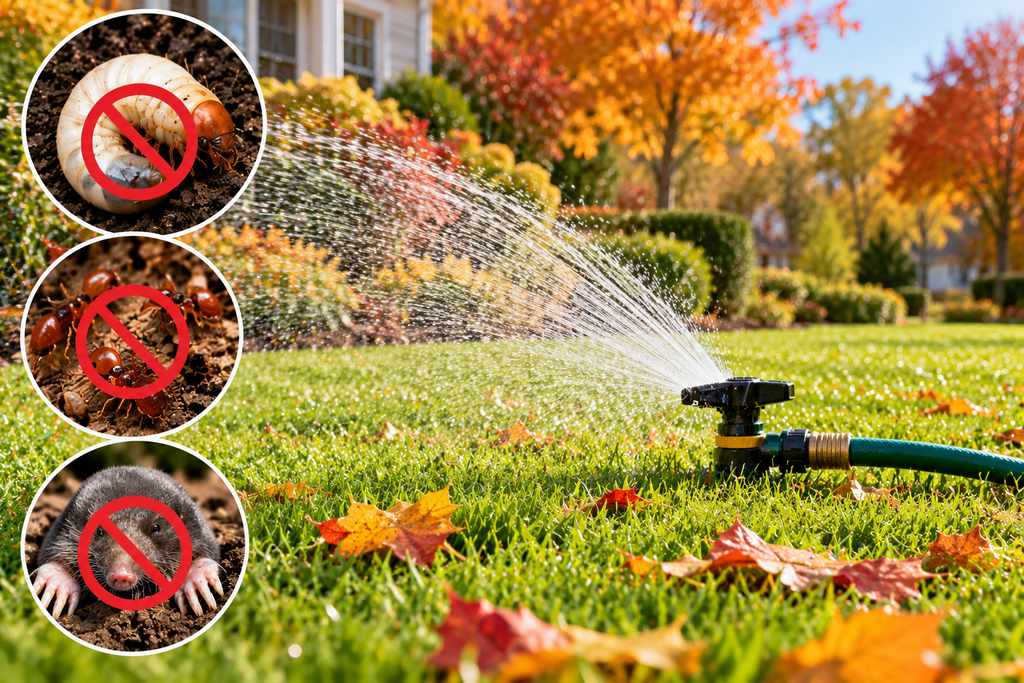
Caterpillar damage is hardest on lawns that are also short of water. Sod webworms in particular cause the most visible damage in sunny, dry spots, where stressed turf cannot grow fast enough to outpace the feeding.
A general guideline is about an inch of water per week, counting rainfall, delivered in one or two deep soakings rather than daily sprinklings. Deep watering encourages deeper roots. Shallow watering keeps roots near the surface, where they dry out first.
Water in the early morning. Grass that stays wet overnight invites fungal disease, which compounds any insect damage.
Irrigation also matters once you have identified a problem and applied a control. Two of the biological products below, beneficial nematodes and Bt, depend on conditions you set with water. Nematodes need moist soil to move, and many products call for watering before and after application. Check the label for the specific instructions on your product.
One caution: watering does not drown caterpillars or wash them out, so a flooded lawn will not solve the problem.
4. Go Easy on Quick-Release Nitrogen in Late Summer
Lush, fast-growing grass is tender, and moths looking for a place to lay eggs are often described as preferring it, although the strength of that effect is not firmly established, so treat it as a sensible precaution rather than a proven fix. The more solid reason to avoid heavy late-summer nitrogen is that a big flush of soft growth, in turf already under insect pressure, gives the caterpillars more to eat and leaves the lawn weaker going into winter.
This does not mean skipping fall fertilizer. For cool-season lawns, early to mid fall is the most important feeding of the year. What matters is the form and the rate. Slow-release nitrogen applied at label rates is much less likely to produce a sudden burst of tender growth than a heavy dose of a quick-release product.
If caterpillars have already damaged the lawn, hold off on fertilizer until the feeding stops. Feeding a lawn that is still being eaten simply supplies more food for the pests. Once they are gone, a modest application helps the grass regrow.
5. Let Birds and Natural Enemies Do Their Share
Natural predators and parasites keep caterpillar populations in check in most lawns most of the time. They do not stop a major outbreak, but they are a reason to avoid treatments that wipe out everything.
Birds are the most visible. Starlings, robins, grackles and blackbirds all feed on lawn caterpillars, and they will work an infested lawn heavily. Birds are also a diagnostic tool, as noted earlier. If you notice them clustering, take that as the cue to scout the lawn.
Less visible are the ground beetles, ants, spiders and predatory bugs that eat eggs and small larvae, and the parasitic wasps and flies that lay their eggs in caterpillars. Tachinid flies and braconid wasps are common examples. The adults of many parasitic wasps feed on nectar from small flowers, which is one reason gardens with flowering plants, such as sweet alyssum, dill, yarrow and fennel, tend to support more of them. Planting a small flower bed along the edge of the lawn does not guarantee fewer caterpillars, but it costs little and helps beneficial insects survive.
Broad-spectrum insecticides, including some that are plant-derived, can kill these helpers along with the pests. A natural origin does not make a product gentle: pyrethrins, for example, are derived from chrysanthemum flowers and still kill a wide range of insects, including beneficial ones.
Avoid bird scare devices and netting on the lawn until you know the cause of the damage. In many cases, the birds are helping.
6. Treat Young Caterpillars With Bt (Bacillus thuringiensis var. kurstaki)
Bt kurstaki, often sold simply as “Bt” or “Btk,” is the standard biological control for caterpillars. It is a naturally occurring soil bacterium. When a caterpillar eats grass that has been sprayed with it, the bacterium’s protein toxin damages the gut. The caterpillar stops feeding within hours and usually dies within a few days.
Where it works well: Against young larvae of armyworms, sod webworms and cutworms, when applied to the grass they are eating. This is where scouting pays off. Bt is considerably less reliable on large caterpillars, and extension guidance generally recommends treating while larvae are still small. A caterpillar around three-quarters of an inch or longer may need a higher dose or a different product.
Timing: Sunlight breaks Bt down within a few days, so apply it in the late afternoon or evening, when the caterpillars are about to start feeding. Because it only works when ingested, it should be on the blades, not washed into the soil. Check the product label about watering. Reapplication after several days is often needed, since new larvae hatch and old residue degrades.
What it will not do: Bt does not kill caterpillars on contact. It does nothing to eggs, pupae or moths. It also does not work on chinch bugs or grubs, which is why correct identification comes first.
Safety: Bt kurstaki is considered low-risk to people, pets, birds, bees and most beneficial insects when used as labeled. It does affect other moth and butterfly caterpillars, so keep it off host plants for species you want to protect, including milkweed and any flowering plants nearby. Follow the label directions on re-entry for children and pets.
7. Apply Beneficial Nematodes to Moist Soil
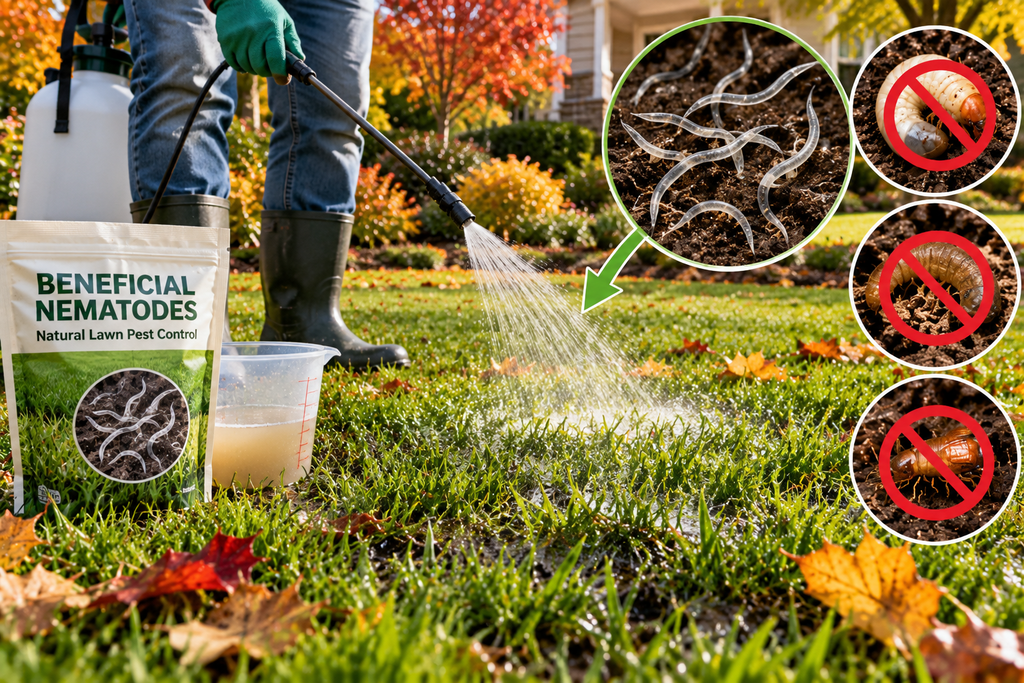
Beneficial nematodes are microscopic worms that hunt insects in the soil. They enter a host, release bacteria that kill it, and reproduce inside the body. Different species target different pests. For lawn caterpillars, Steinernema carpocapsae is the species most often recommended, since it ambushes prey near the soil surface. Heterorhabditis bacteriophora is more commonly used against grubs, so check the label for the species you are buying.
When it works: Nematodes are most useful against armyworms, sod webworms and cutworms that spend time in the thatch and upper soil. They are particularly useful if you want to avoid spraying anything on the grass itself.
What they need: Moist soil is essential, since nematodes move through a thin film of water. They are generally applied in the evening or on a cloudy day because ultraviolet light kills them, and the soil should be warm enough, with many sources suggesting roughly 50°F or above, so check the temperature range on your product. Water the lawn before and after application. Nematodes are living organisms with a limited shelf life, so buy them fresh from a reputable supplier and apply them promptly.
Limits: Results are less consistent than with Bt, and cool fall temperatures slow them down. They target larvae, not pupae or moths. A late-fall application on a cold lawn can be disappointing for these reasons. They are probably best for a lawn with a moderate, ongoing problem rather than an emergency in which patches are vanishing by the day.
8. Use Spinosad When the Infestation Is Heavy
Spinosad is made from a soil bacterium, Saccharopolyspora spinosa, and formulations are available that are approved for organic use. It acts as both a stomach and a contact poison and works on a broad range of caterpillars, including larger ones that Bt struggles with. That makes it the stronger natural option when numbers are high and damage is spreading.
The tradeoff is that it is broader and more hazardous than Bt. Spinosad is highly toxic to bees while the residue is wet, and it can harm some beneficial insects, including parasitic wasps. It is also toxic to aquatic life, so keep it away from ponds, ditches and storm drains.
If you use it:
- Read the label to confirm it is approved for lawns and lists the pest you have
- Apply in the evening, when bees are not foraging
- Mow or remove flowering weeds like clover first, since blooming plants attract bees
- Wear the protective equipment the label specifies
- Keep children and pets off the lawn until the product has dried, or as long as the label directs
An organic label means the product is permitted in organic production, not that it is harmless. If the label directions are unclear for your situation, your local cooperative extension office can help.
9. Overseed With Endophyte-Enhanced Grass
This is the most useful long-term step, and many lawn articles skip it. Some varieties of perennial ryegrass, tall fescue and fine fescue contain a beneficial fungus, called an endophyte, that lives inside the plant and produces compounds that deter insects feeding on leaves and stems. Endophyte-enhanced turfgrass is known to resist surface-feeding pests including sod webworms, armyworms, chinch bugs and billbugs.
There are limits. Endophytes do little against root-feeding pests such as grubs. They are found only in certain grass species, so Kentucky bluegrass, bermudagrass, zoysia and St. Augustine do not have them. And the fungus is carried in the seed, so it dies if the seed is stored too long or in hot conditions. Look for seed labeled “endophyte-enhanced” and buy it fresh.
Fall is the best time to overseed cool-season lawns, so this ties neatly into recovery. Because new seedlings are vulnerable to cutworms and other pests, scout the lawn before and after overseeding. Tall fescue endophytes are toxic to grazing livestock, which matters mainly if horses or other animals have access to the area.
Over several seasons, an endophyte-enhanced lawn becomes more resistant, because it gradually replaces the more vulnerable grass.
Will the Lawn Come Back?
Often, yes. Armyworms and sod webworms feed mainly on the leaf blades, and the crowns at the base of the plant frequently survive. A lawn that looks brown and dead can send up new green shoots within two to three weeks once the feeding stops and the grass gets water.
Before reseeding, check for new growth by gently pulling on a patch and looking for green at the base. Reseed only the areas that stay bare.
For recovery:
- Water regularly so the grass can regrow
- Avoid heavy fertilizer until the feeding has stopped
- Wait until the caterpillars are gone before overseeding, so new seedlings do not become the next meal
- Keep mowing at the right height once growth resumes
Cutworm damage can be more serious in seedling areas, where the grass has not yet established. Warm-season lawns that go dormant in fall can be harder to read, so check for green at the crown before deciding the lawn is dead.
When Natural Methods Are Not Enough
Natural controls work best on small larvae and moderate infestations. There are cases where they fall short:
- Damage is spreading by the day across a large area
- You find high numbers per square foot in the soap flush
- The lawn is heavily used, such as a sports field or high-value turf
- Larvae are large and past the stage where Bt works well
Extension services in many states give treatment thresholds for armyworms and webworms, expressed as a number of larvae per square foot or yard. These vary by region, grass and use, so your state’s extension office is the best place to check.
In those cases, a lawn-care professional or a conventional insecticide labeled for lawn caterpillars may be appropriate. If you go this route, read and follow the entire label. Pay attention to what it says about application timing, mowing before and after, watering, protective equipment, and how long children and pets must stay off the lawn.
Frequently Asked Questions
How can I tell armyworms from grubs?
Use the tug test. If the turf peels back with no roots, it is grubs. If the grass stays rooted but the blades are chewed off, it is a surface feeder. The soapy water flush confirms caterpillars.
Are armyworms dangerous to pets or people?
Armyworms do not bite or sting and are not known to pose a health risk to people or pets. The risks come from any products used to control them, so follow label directions.
Should I treat the lawn after the first frost?
A hard frost generally ends armyworm feeding. Sod webworm larvae may overwinter in the thatch, so if you had serious webworm damage, watch for it again in spring.
Do bird feeders attract the pests?
Feeders do not cause the problem, and birds that visit lawns eat caterpillars. If you are seeing heavy bird activity on one patch of lawn, check it.
Can I just wait it out?
Sometimes. A light infestation near the end of the season, particularly after the first frost, may not justify treatment. If damage is spreading, treating small larvae early is much easier than waiting.
Key Takeaways
Identify the pest first, using the soapy water flush at the edge of the damage and the tug test. Most of the nine methods above work best against small caterpillars, so scouting early matters more than any particular product.
If you need a first step this week, scout the lawn at dusk, make sure it is getting about an inch of water, and if you find young caterpillars, apply Bt in the evening. Keep spinosad in reserve for heavier outbreaks, and consider endophyte-enhanced seed when you overseed. Between those steps and a few weeks of regrowth, many lawns recover completely.

About Syprose Kiche
Syprose Kiche is the creator and writer behind My Besuited Home, a practical home and garden website covering DIY projects, gardening, lawn care, landscaping, home improvement, and outdoor living. She focuses on turning everyday homeowner questions into clear, practical guides backed by careful research and useful real-world considerations.