
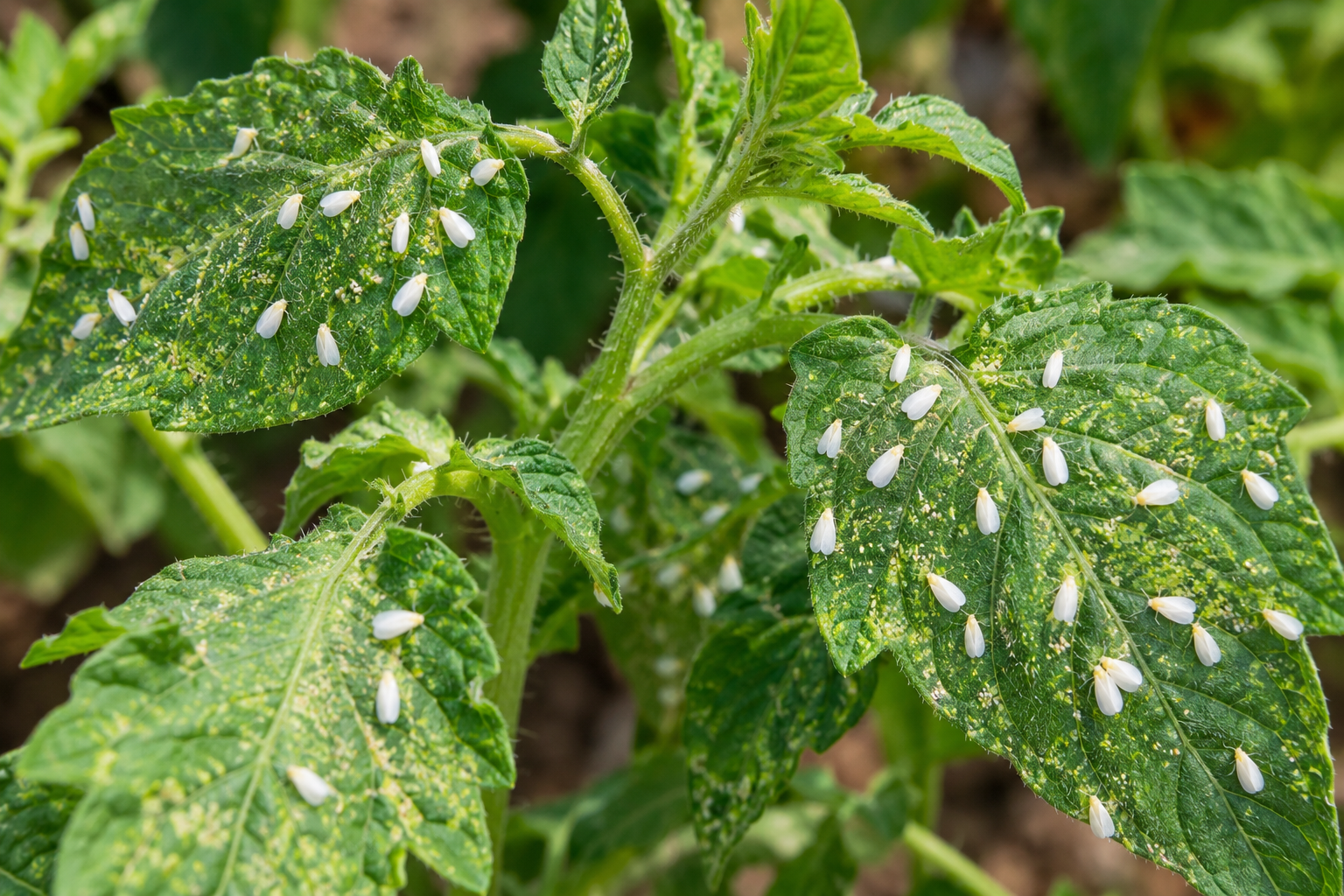
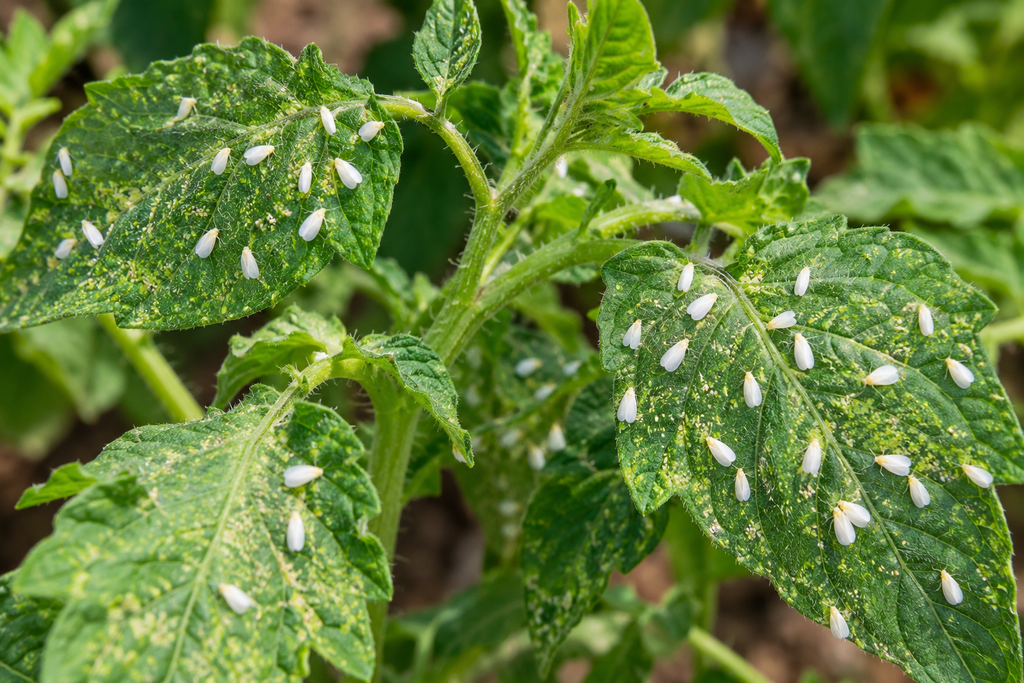
Brush a tomato or hibiscus branch and a small cloud of white specks lifts off the leaves, circles for a few seconds, and settles back down. That is usually how people first notice whiteflies. By then the insects have often been feeding for weeks. Adults are only about 1/16 inch (1.5 to 2 mm) long, and most of the population at any moment isn’t flying at all. It is eggs, nymphs, and pupae stuck to the undersides of leaves where nobody looks.
That hidden majority is why whiteflies are so frustrating to control. A spray that kills every adult you can see leaves the immature stages largely untouched, and the next generation emerges a week or two later. Natural methods can work well against whiteflies, but only when the timing and the repetition match the insect’s life cycle. Most of what follows is about getting that right.
Confirming It’s Whiteflies and Not Something Else
Several problems produce yellowing leaves and sticky residue, and the wrong diagnosis leads to the wrong treatment.
The shake test. Hold a container or a sheet of paper beneath a branch and tap the stems. Whiteflies fly up in a small cloud and resettle quickly. Aphids drop or stay put. Fungus gnats hover near the soil, not the foliage. Powdery mildew doesn’t move at all.
The leaf underside. Turn leaves over, starting with the newer growth, because adults tend to gather and lay eggs on young leaves. You may see:
- Adults: tiny, moth-like, with powdery white wings held roofwise over the body.
- Eggs: very small, often arranged in a circle or arc, pale yellow to tan.
- Nymphs: flat, oval, scale-like, translucent green or yellow, and mostly immobile after their first stage. They look like tiny scales or blisters, and people often mistake them for dirt.
- Empty pupal cases: whitish shells left behind after adults emerge. Finding these is a sign that a generation has already completed.
Honeydew and sooty mold. Whiteflies feed on plant sap and excrete a sugary liquid called honeydew. It makes leaves sticky, and over time a black sooty mold grows on it. The mold doesn’t infect the plant, but it blocks light and looks bad. Sticky leaves with a black film point to a sap-feeding insect, and whiteflies are among the usual suspects, along with aphids, soft scales, and mealybugs.
Ants. Ants farm honeydew-producing insects and defend them from predators. A steady line of ants climbing a plant is a good clue that something is producing honeydew, and it is also a reason treatment sometimes fails (more on that below).
Different species behave a little differently. The greenhouse whitefly is common on houseplants, tomatoes, and greenhouse crops. The silverleaf (sweetpotato) whitefly is a heavier feeder on vegetables and ornamentals in warm regions and can spread plant viruses. Ash and citrus whiteflies are more tree-specific. The control methods below apply broadly, but if you’re in a region with a known problem species, your local extension office can confirm which one you have.
Why Whiteflies Are Hard to Wipe Out
A few biological facts shape every method in this article.
Whiteflies reproduce quickly in warm conditions. Development from egg to adult commonly takes roughly three to four weeks, though it varies with species and temperature, and warmer weather shortens it. Females lay many eggs over their lifespan. So a small infestation can expand fast in a greenhouse, a sunroom, or a hot summer garden.
The life stages also respond differently to treatment. Eggs and the later pupal stage are not very vulnerable to soaps and oils, and nymphs sit tight on the leaf underside where sprays need to physically reach them. Adults are the easiest to disturb but also the quickest to flee and return.
The practical conclusion is simple. One treatment will not finish the job. You are aiming to break the cycle by hitting each stage repeatedly over several weeks, while making the plant less hospitable to the next wave.
The Nine Methods
1. Inspect Leaf Undersides on a Schedule
This is the least dramatic method and the one that decides how hard everything else will be.
Pick a day or two each week and check the undersides of leaves, concentrating on the newest growth and on the plants whiteflies like best. Tomatoes, peppers, squash, cucumbers, beans, hibiscus, fuchsia, lantana, poinsettia, and many citrus and ornamental shrubs are frequent targets. A hand lens helps, and so does a phone camera zoomed in on a leaf.
What you are looking for is the first adult or two, or a small patch of eggs. Whiteflies caught at that stage can often be dealt with by removing a few leaves and spraying with water. Caught after sooty mold has appeared, they usually mean weeks of repeated treatment.
Check new plants before they join the rest. A single infested plant from a nursery can seed an entire collection, and quarantining new purchases for a week or two is one of the most effective prevention steps there is. Keep them apart, inspect them, and only then move them next to your other plants.
2. Prune Away the Worst of It
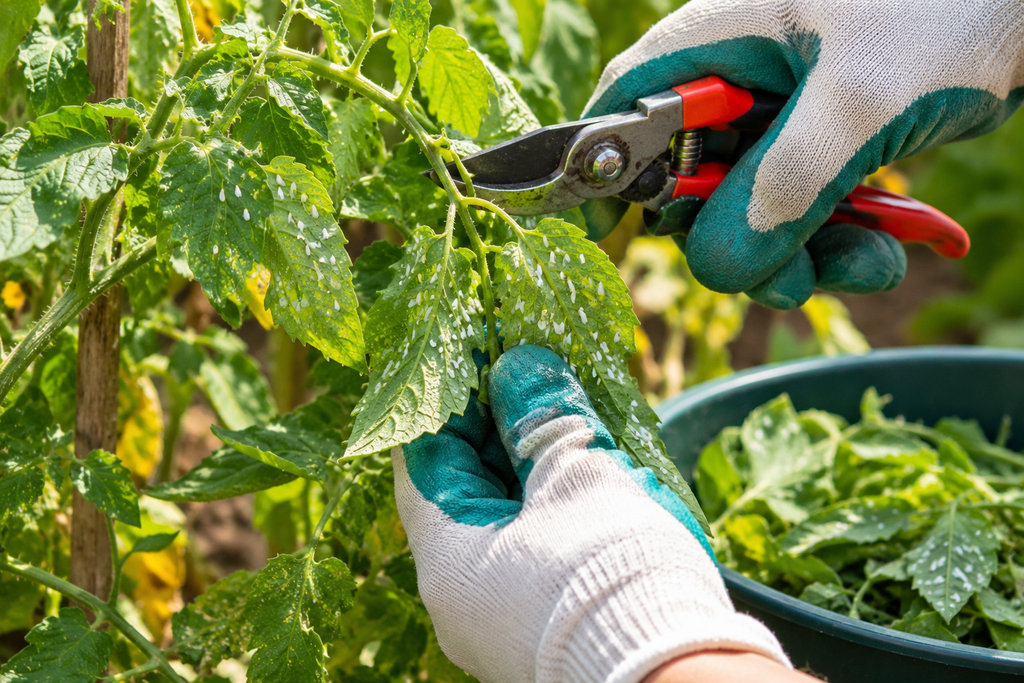
Pruning does not solve the problem on its own, but it can reduce the population at once, and it makes later sprays far more effective.
Leaves carrying dense clusters of nymphs and pupae are better removed than treated. Most of the insects on a heavily colonized leaf are in stages that soaps and oils kill poorly, and a thick layer of sooty mold shields what’s underneath. Cutting that leaf off removes thousands of insects in one move.
Some practical points:
- Prune lightly. Removing more than a modest portion of the foliage stresses the plant and can slow its recovery. If most of the leaves are infested, remove the worst ones and rely on repeated spraying for the rest.
- Handle infested clippings with care. Whiteflies on a cut leaf can fly off, so drop clippings straight into a sealed bag as you cut, then dispose of them in the trash. Composting them risks reinfesting the garden.
- Clean pruners between plants, especially if a virus is suspected. Wiping the blades with rubbing alcohol is a common precaution.
- Pruning also opens up the canopy. Dense, shaded growth holds humidity and gives whiteflies sheltered places to settle, and thinner foliage lets sprays and airflow reach the undersides.
If a plant has been badly infested for a long time, is stunted, and shows distorted growth that doesn’t improve after treatment, consider whether it is worth keeping. Silverleaf whitefly in particular can transmit viruses that treatment cannot cure. In that case, removing the plant protects its neighbors.
3. Knock Them Back With Water
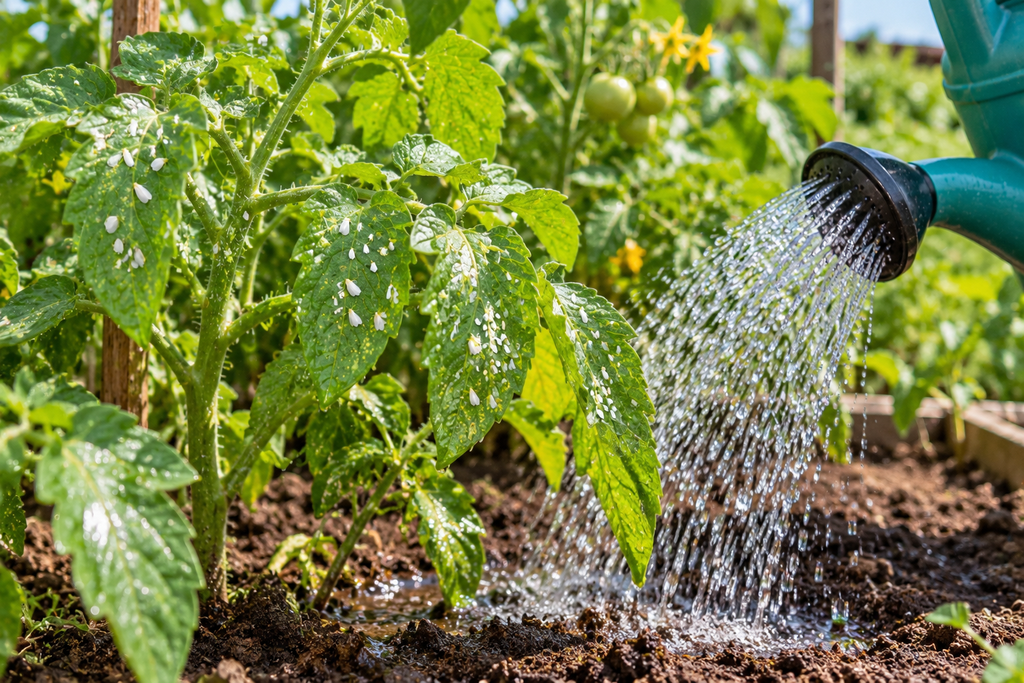
A strong stream of water is the simplest first response for outdoor plants and sturdy houseplants, and it costs nothing.
Whiteflies are soft-bodied and fragile. A firm spray from a hose, aimed at the undersides of leaves, dislodges adults and nymphs, and many of those that fall off do not make it back. Water also rinses off honeydew.
How to do it well:
- Aim at the undersides. Most of the population is there. Spraying the tops of leaves accomplishes very little.
- Do it in the morning. Foliage dries during the day, which reduces the risk of fungal problems. It is also when adults are cooler and slower.
- Repeat every few days for a couple of weeks. Each pass takes out whatever has hatched since the last one.
- Match the pressure to the plant. Seedlings, flower buds, and tender growth can be damaged by a hard jet. A hose nozzle on a “shower” setting, or a pressure sprayer held at a distance, is a safer start.
Water works best at low to moderate infestation levels. It won’t remove the eggs and pupae stuck firmly to leaf surfaces, so think of it as a way to keep numbers down while other methods do the heavier work. Indoors, plants that can handle it can go into a shower or be rinsed in a sink. Take care that waterlogged soil doesn’t become a different problem.
4. Use Yellow Sticky Traps, Mainly to Monitor
Adult whiteflies are attracted to yellow, which is why yellow sticky cards are standard equipment in greenhouses.
Their best use is as an early warning system. A card placed just above the plant canopy, or clipped to a stake, will show you whether adults are present and how the numbers are changing from week to week. Counting adults on a card before and after you start treatment tells you whether what you’re doing is working.
As a control on their own, sticky traps are limited. They catch adults but do nothing about eggs, nymphs, or pupae, so a heavy infestation will outpace them. In a small space like a sunroom or a few houseplants they can noticeably reduce flying adults, but they rarely clear the problem by themselves.
Some cautions:
- Outdoors, sticky cards also catch bees, hoverflies, lacewings, and other insects you don’t want to lose. Use them sparingly near flowering plants, and consider restricting them to enclosed or lightly populated areas.
- Place cards at or just above the height of the foliage. A trap hung too high or too low misses most of the traffic.
- Keep sticky surfaces away from your skin and your pets’ fur. They are hard to remove.
- If you plan to release beneficial insects (see method 8), be aware that the cards can catch the beneficials too. Remove or reduce them before releases.
5. Vacuum the Adults Off
This method isn’t on every list, but university extension programs have long described it as a practical option for small infestations, especially on houseplants and small garden areas.
Early in the morning, when adults are cool and sluggish, hold a handheld vacuum near the plant and gently pass it over the foliage. Disturbing the leaves lifts adults, and the suction takes them. Empty the vacuum right afterward by sealing the bag or contents in a plastic bag and discarding it, otherwise they can crawl out.
Keep the suction low or hold the nozzle slightly away so the leaves aren’t damaged. Like water spray, this reduces adults but not the immature stages, so it needs repeating every few days.
6. Insecticidal Soap for Nymphs and Adults
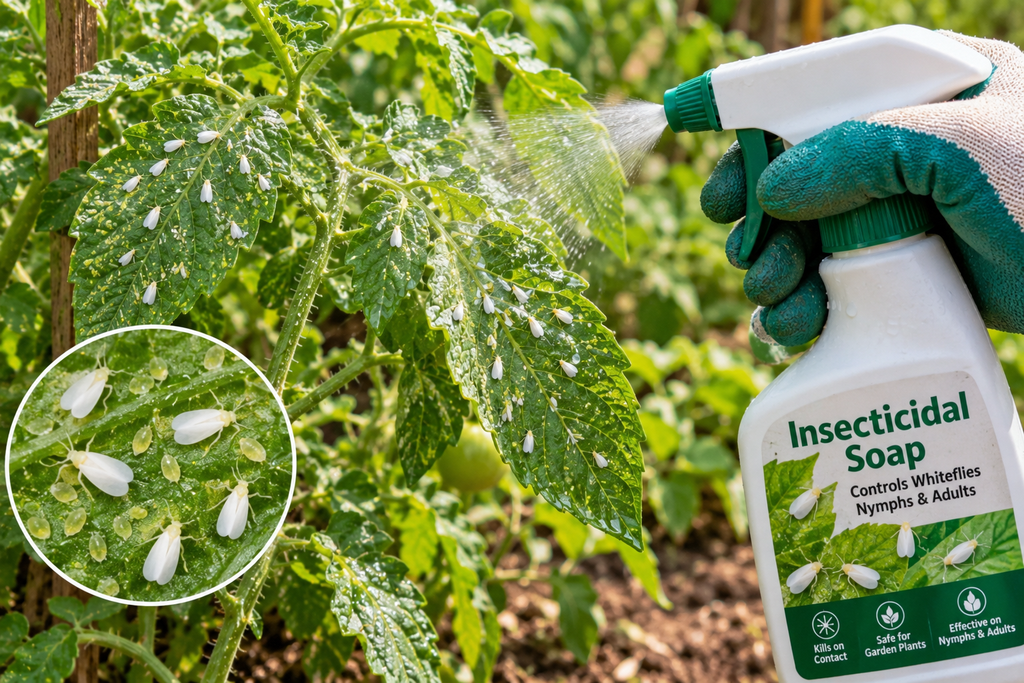
Insecticidal soap is made from potassium salts of fatty acids and works by contact. It breaks down the outer coating of soft-bodied insects. That makes it one of the better natural options for whitefly nymphs, which can’t escape, as well as for adults that happen to be hit.
The words “by contact” are the whole story. Soap leaves no lasting residue that kills insects arriving later. If a droplet doesn’t land on a whitefly, it does nothing. So the technique matters more than the product:
- Cover the undersides thoroughly. Spray until leaves are wet on the underside, not just a light mist from above.
- Repeat. Many labels suggest repeating every few days to a week for several applications, so that newly hatched nymphs and emerging adults are caught. Follow the label for your product.
- Test first. Some plants are sensitive to soaps, including certain ferns, some succulents, and plants with hairy or waxy leaves. Spray a few leaves, wait a day, and check for browning or spotting before treating the whole plant.
- Avoid heat and direct sun. Spraying in the hot part of the day, or when temperatures are high, raises the risk of leaf burn. Evening or early morning is safer. Labels typically give a temperature limit, so check yours.
- Don’t treat a drought-stressed plant. Water first and spray later.
Use a product sold as insecticidal soap, not dish detergent. Household detergents contain additives that can damage foliage, and the strength is unpredictable. Plant damage from homemade mixtures is a common reason people think soap “doesn’t work” or “burns everything.”
Soap sprays kill beneficial insects too if they land on them directly, though they break down quickly. If you have predators or parasitic wasps working on the infestation, spray only the areas that need it.
For edible plants, check the label for the waiting period before harvest and rinse produce before eating.
7. Neem Oil: Useful, but Not Magic
Neem oil comes from the seeds of the neem tree. It contains azadirachtin and other compounds that affect insects in several ways: it can deter feeding, interfere with growth and molting in immature insects, and smother soft-bodied pests on contact. Clarified hydrophobic neem oil products are the ones commonly sold for garden use.
Neem is often described as a miracle cure, and it isn’t. It works slowly compared to soap, mostly on immature stages, and, like soap, it has to touch the insect. That makes it a good choice for a repeated routine, not a one-time rescue.
Practical points:
- Follow label dilution and frequency exactly. Neem products vary in strength, and I’m not giving a mixing ratio here because it differs between brands. Overly strong mixes can burn leaves.
- Mix fresh and shake often. Oil and water separate, so the sprayer needs agitating as you go.
- Apply in the evening or on a cool, overcast day. Oil on leaves under strong sun can cause burn.
- Test a few leaves first. Some plants are sensitive.
- Protect pollinators. Avoid spraying open flowers, and apply when bees are not active. Neem products can harm bees on contact when wet.
- Don’t combine with sulfur-based products or apply within the interval the label warns about. Oils and sulfur together can injure plants.
- Edible crops: check the label for the harvest interval, and wash produce.
Soap and neem are not meant to be mixed together unless a label says so. Alternating them, as the label permits, can be a reasonable way to vary your approach through a multi-week schedule, but follow each product’s guidance and spacing.
8. Bring in Beneficial Insects, When the Setting Suits Them
Natural enemies of whiteflies exist and can be very effective, particularly in enclosed spaces.
- Encarsia formosa is a tiny parasitic wasp widely used against greenhouse whitefly. It lays its eggs inside whitefly nymphs, and parasitized nymphs turn dark or black. The wasps are harmless to people and pets.
- Eretmocerus species are other parasitoids used commercially against some whitefly species, including silverleaf whitefly.
- Delphastus catalinae is a small lady beetle that feeds on whitefly eggs and young nymphs.
- Green lacewing larvae and some predatory bugs eat whitefly stages along with other soft-bodied pests.
These work best where conditions are controlled: greenhouses, sunrooms, and enclosed growing spaces. Outdoors, released insects tend to disperse, and results are less predictable. Many are also temperature-sensitive, performing best in warm conditions and poorly in cold ones.
Some things to understand before you order:
- Releases usually need to start while the whitefly population is still modest. Parasitoids won’t rescue a plant covered in sooty mold.
- You generally need multiple releases over weeks, not a single shipment.
- Insecticides undermine the whole plan. Soaps, oils, and especially broad-spectrum sprays can kill the beneficials you’ve released. If you plan to use biological control, avoid spraying or time any sprays carefully, and ask the supplier how long to wait.
- Ants protect whiteflies from predators. If ants are present, control them (for example with bait stations placed according to the label) before or alongside releases.
Native beneficial insects may already be present in your garden. Planting small-flowered species such as alyssum, dill, or yarrow can feed adult predators and parasitoids with nectar, and avoiding unnecessary broad-spectrum sprays helps them persist. This is a long-term strategy rather than a quick fix, and it fits well alongside the prevention measures in the next section.
9. Prevention: Make Your Plants Less Attractive
Prevention is where you can do the most good with the least effort.
Quarantine new plants for at least a week or two and inspect them closely before they join the others. This single habit prevents a large share of houseplant infestations.
Don’t over-fertilize with nitrogen. Soft, lush growth fed by heavy nitrogen applications is easier for sap-feeding insects to exploit and often supports faster population growth. Moderate, balanced feeding keeps plants growing without producing the tender flush whiteflies prefer.
Use reflective mulch for vegetables. University extension programs have reported that silver or aluminized reflective mulch can repel whiteflies and some other flying insects from young vegetable plants, in part by confusing them as they approach. It works best when plants are small and the mulch covers a large share of the ground, and the effect fades as the foliage grows and shades the mulch. Treat it as extra protection for vulnerable seedlings and not a complete answer.
Control weeds and old crop residue. Whiteflies live on many weeds and can move onto crops from them. In mild climates they can persist year-round on host plants, so removing finished crops promptly and clearing nearby weedy hosts reduces the number waiting to move in.
Manage ants. If ants are guarding honeydew producers, whitefly control becomes much harder. Treat the ant problem too.
Keep plants healthy but not crowded. Good airflow, adequate light, appropriate watering, and spacing that lets you see and reach leaf undersides all make infestations easier to catch and treat.
Mind the season. Outdoors in cold climates, frost knocks populations back, but whiteflies can persist on indoor plants, in greenhouses, and on plants moved inside for winter. Before bringing container plants indoors in autumn, inspect them, rinse the undersides, and consider isolating them for a couple of weeks.
A Realistic Schedule
Here is one way to combine these methods for a moderate infestation on a vegetable or ornamental plant. Adjust it to your plant, climate, and product labels.
- Day 1: Prune off the most heavily infested leaves and bag them. Hang one or two yellow sticky traps to track adult numbers. Rinse the plant with water, focusing on leaf undersides.
- Days 3 to 7: Repeat the water rinse or vacuum adults in the morning. In the evening or on a cool day, spray the undersides with insecticidal soap according to the label.
- Weeks 2 to 4: Continue soap or neem applications at the label-recommended interval, rotating or alternating as the label permits. Keep checking undersides and replacing sticky traps as they fill.
- After week 4: If trap counts are falling and new leaves look clean, reduce treatments and move to weekly inspections. If numbers are not falling, reconsider your coverage, since missed undersides are the usual culprit, or consider whether ants, nearby host plants, or a source of reinfestation are involved.
If an infestation persists despite several weeks of careful, repeated treatment, a local extension office, nursery, or a licensed pest-management professional can help identify the species and suggest options suited to your region and crop.
Common Mistakes That Keep Whiteflies Coming Back
- Spraying only the tops of leaves. The insects are underneath.
- Treating once and stopping. Eggs and pupae survive, and a fresh generation arrives in days to weeks.
- Using dish soap or homemade oil mixtures at random strengths. Leaf burn can look like the infestation getting worse.
- Spraying in strong sun or high heat. Both soap and oil can scorch leaves under those conditions.
- Killing the beneficials. Broad-spectrum insecticides can flare whitefly numbers by removing the predators that were holding them back.
- Ignoring ants and weeds. These keep the problem supplied.
- Skipping the quarantine. New plants are a common entry point.
Safety Notes for Home Use
“Natural” does not mean harmless. Even products approved for organic gardening are pesticides in the legal sense, and the label is the rule.
- Read and follow the label for dilution, frequency, target plants, temperature limits, and any pre-harvest interval for edibles.
- Wear gloves and eye protection when mixing and spraying, and avoid breathing mist.
- Keep children and pets away until sprays have dried, and store products out of reach.
- Spray indoors only where ventilation is good, and consider moving plants outside or to a garage or bathroom for treatment.
- Avoid spraying when bees and other pollinators are active or on open blooms.
- Don’t mix products unless a label says you can.
Questions Readers Often Ask
Do whiteflies bite people or pets?
They feed on plant sap and don’t bite. Large numbers can be a nuisance when they fly up from disturbed plants, but they are not a direct health threat to people or animals.
Why did they come back a week after I sprayed?
Usually because eggs or pupae survived and hatched, or because some leaf undersides were missed. A second generation emerging on schedule is normal after a single treatment. This is why repeated applications matter more than any single product.
Will whiteflies die off on their own in winter?
Outdoors in cold climates, freezing weather reduces populations, though they may survive on sheltered or indoor hosts. Indoors, in greenhouses, and in mild regions they can continue through winter.
Is it safe to eat vegetables from plants I’ve treated?
It depends on the product. Labels list a harvest interval for food crops, and it’s wise to wash produce thoroughly before eating. If you aren’t sure, check the label or contact the manufacturer.
Key Takeaways
Whiteflies are beatable, but not in one treatment. The insects you see flying are a small fraction of the population, so success depends on reaching leaf undersides, repeating treatments for several weeks, and making the plant and its surroundings less welcoming. Start with inspection, pruning, and water. Add soap or neem as needed, bring in beneficial insects where the setting suits them, and keep ants, weeds, and new plants from restarting the cycle. Your next step is easy: turn over a few leaves today and see what’s there.

About Syprose Kiche
Syprose Kiche is the creator and writer behind My Besuited Home, a practical home and garden website covering DIY projects, gardening, lawn care, landscaping, home improvement, and outdoor living. She focuses on turning everyday homeowner questions into clear, practical guides backed by careful research and useful real-world considerations.