
You’ve walked outside in the morning, coffee in hand, only to find your pristine patch of green looking like a war zone. Brown spots are spreading, holes are appearing overnight, and the culprit is nowhere to be seen. You’ve tried those expensive, chemical-heavy bags from the big-box store, but the bugs just seem to be hosting a party on your lawn.
I know the frustration. I remember one July, I spent weeks babying a new sod installation, only to have a legion of sod webworms turn it into a desert in three days. I was ready to rip it all out and pour concrete. That was before I stopped trusting the marketing hype and started using diatomaceous earth (DE). It’s not magic, and it’s not an overnight fix, but it works—if you know how to handle it.
Why Diatomaceous Earth is My Go-To Lawn Pest Control
Forget those neon-colored sprays. Diatomaceous earth is essentially the fossilized remains of tiny aquatic organisms called diatoms. Their skeletons are made of silica, and under a microscope, they look like jagged shards of glass. To a soft-bodied insect, crawling over DE is like walking barefoot through a field of broken mirrors.
It doesn’t poison the bug; it shreds their exoskeleton and dries them out. Because it works mechanically rather than chemically, pests can’t develop an immunity to it. I’ve found that most synthetic pesticides are a total waste of money because you end up killing the good bugs along with the bad, leading to a lawn that needs constant intervention.
When you apply DE, you’re creating a physical barrier. It’s non-toxic to my dog, Leo, and I don’t have to worry about the neighborhood kids playing on the grass right after I’ve treated it. I stopped using harsh sprays years ago, and my lawn has never been healthier.
The biggest mistake I see beginners make? They buy the wrong kind. You need Food Grade Diatomaceous Earth. If you accidentally pick up the stuff used for pool filters, put it back. The pool variety is heat-treated, which changes the crystalline structure and makes it dangerous to breathe. Food grade is what you want for the garden, every single time.

Preparing Your Lawn for DE Application
Before you start dusting your entire yard, you need to set the stage. DE is useless if it’s washed away by the first breeze or drizzle. I learned this the hard way during a light afternoon shower; I treated the whole backyard, and by sunset, it was all clumped up in the gutters.
First, mow your grass. You want the DE to reach the soil surface where the grubs, ants, and webworms are actually hanging out. If your grass is three inches long, the powder is just going to sit on the blades and do absolutely nothing. Keep it short for the treatment phase.
Next, identify your problem areas. Don’t waste your energy treating the whole lawn if the pests are localized. Use a trowel to dig a small test hole in a brown patch. If you see movement or larvae, that’s your target. Focus your efforts there first.
Check your weather forecast. You need at least 48 hours of dry weather. If it rains, the DE turns into a useless paste. If the forecast shows a thunderstorm, save your energy and wait for a dry stretch.
- Quick Side Note: If you have an automated sprinkler system, turn it off for two days. You need the grass blades and the soil surface to be dry as a bone so the powder clings to the pests.
How to Apply DE Effectively Without Making a Mess
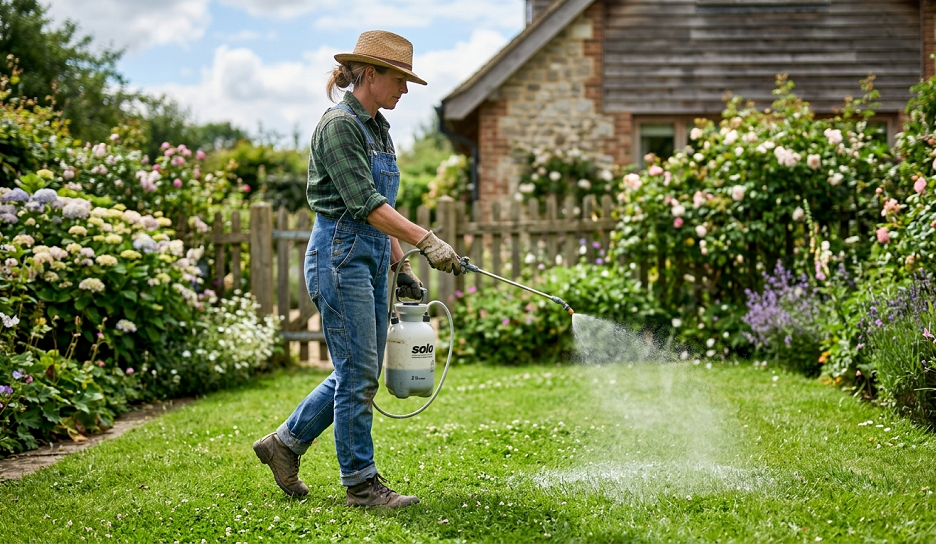
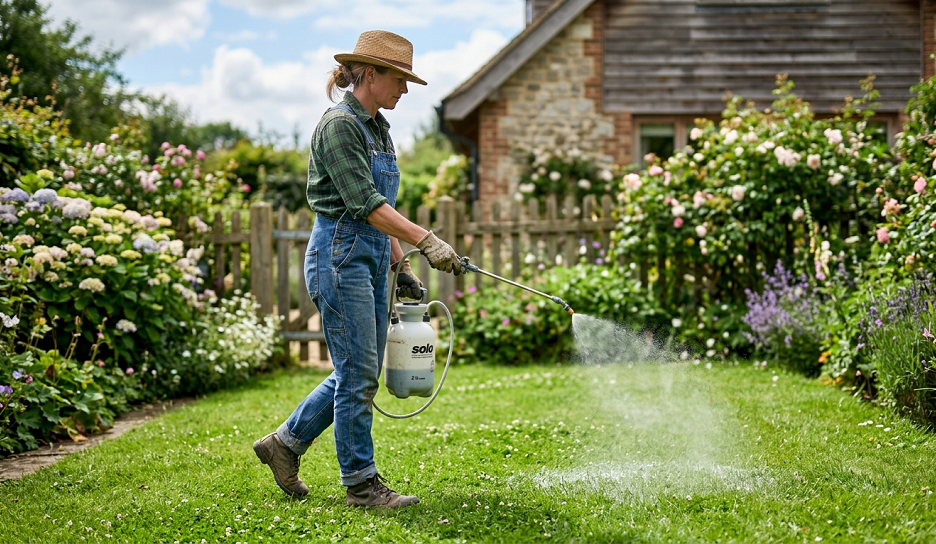
Applying DE is a dusty business. I’ve ended up looking like a powdered donut more than once because I tried to hand-scatter it on a windy day. Please, wear a mask. Even though food-grade DE is safe, nobody wants to be breathing in fine dust particles for an hour.
Use a dedicated duster or a shaker bottle. I’ve seen people use old flour sifters, but those tend to dump way too much in one spot. You want a fine, even layer—not a pile. Think of it like dusting a cake with powdered sugar. If you can see a thick white layer, you’ve used too much.
Start at the edges of your lawn and work your way toward the center. This helps you avoid walking over the areas you’ve already treated, which just kicks the powder back into the air or clumps it up on your shoes.
After you’ve dusted the area, walk away. Don’t go back out there with the leaf blower five minutes later. The wind is the enemy of a successful application. Let it sit, let it settle into the thatch layer, and let the bugs do the work of walking through it.
The Reality of When DE Fails
Let’s be honest: DE isn’t a silver bullet. If you have a massive, out-of-control infestation, DE might just be a speed bump. Sometimes, the damage is so far gone that you need a stronger solution to stop the bleeding, and that’s okay.
Also, it’s not great for flying insects. If you’re trying to stop moths or wasps that are just hovering over the grass, DE is going to leave you disappointed. It works on the crawlers. It’s a ground-level solution.
I once tried to use it to stop a swarm of aphids on my rose bushes nearby, and it was an absolute nightmare. It blew everywhere, killed my beneficial ladybugs, and looked terrible on the leaves. Use it where it works—on the ground, for the ground-dwellers. Keep it off the flowers if you want to keep your pollinators happy.
- Another Reality Check: Don’t expect instant death. You won’t see a pile of dead beetles in an hour. It takes time for the DE to dehydrate the insects. Give it three to five days before you start panicking and looking for another solution.
Keeping Your Lawn Healthy Long-Term
Once the bugs are under control, don’t just forget about the lawn. I used to think the job was done once the pests were gone. Now, I know that a healthy, thick lawn is the best defense against future invasions.
Core aeration is your best friend. It helps water and nutrients get down to the roots, making your grass strong enough to survive a few bugs. A stressed, thin lawn is a buffet for pests.
Stop over-fertilizing with nitrogen. I know, we all want that deep, dark green, but high-nitrogen grass is succulent and weak—basically a neon sign that says “eat here” to every grub in the county. Focus on compost and balanced, slow-release organic fertilizers.
Finally, introduce beneficial nematodes. I started doing this every spring, and the number of soil-dwelling pests has dropped significantly. It’s a biological approach that pairs perfectly with the physical control of DE.
Parting Wisdom
Gardening is a cycle of trial and error. You are going to make mistakes, and you are going to lose a patch of grass every now and then. Don’t let a few bugs ruin your peace of mind. Use the DE, keep your grass thick, and try to enjoy the process rather than fighting for total chemical warfare.
What’s the most stubborn pest you’ve dealt with this season? Have you tried DE before, or are you still relying on those toxic sprays from the garden center? Drop a comment below—I’d love to hear what worked for you!

About Syprose Kiche
Syprose Kiche is the creator and writer behind My Besuited Home, a practical home and garden website covering DIY projects, gardening, lawn care, landscaping, home improvement, and outdoor living. She focuses on turning everyday homeowner questions into clear, practical guides backed by careful research and useful real-world considerations.