
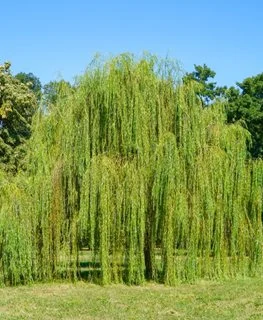
Your yard has good bones but something’s missing. Maybe you’ve got a lawn that looks fine, a few shrubs doing their job, and yet the whole thing feels flat. No drama. No “wow” moment when you pull into the driveway.
That’s usually a tree problem, not a lawn problem.
A weeping tree fixes this faster than almost anything else you can plant. Those cascading branches create instant movement and elegance, and they do it in every season, not just when the flowers show up. I’ve planted weeping varieties in three different yards over the years, and every single time, they’ve become the plant neighbors ask about.
This guide walks you through seven of the best weeping tree varieties for home landscapes, what makes each one worth the money, and where they tend to go wrong. My goal is to help you pick the right one the first time, since these trees aren’t cheap and moving a mature tree is a nightmare nobody wants.
What Makes a Tree “Weeping” Anyway?
A weeping tree has branches that grow downward instead of up and out. Botanically, it’s usually a genetic mutation or a grafted cultivar bred specifically for that cascading shape. Garden centers call this growth habit “pendulous,” which is just a fancy word for droopy in the best possible way.
Weeping trees work as focal points because they break up the visual monotony of upright shrubs and rounded hedges. Put one near a pond, at the end of a walkway, or as a standalone specimen in the front yard, and it does the heavy lifting on curb appeal without you needing to plant twelve other things around it.
Before you pick one, think about three things: your climate zone, how much space you actually have, and whether you want a flowering tree, an evergreen, or something with year-round foliage color. A lot of people get seduced by a pretty photo online and skip this step entirely, then end up with a tree that’s fighting their yard instead of complementing it. Weeping willows want water. Japanese maples want dappled shade. Conifers want full sun and patience. Match the tree to the site, not the other way around.
It’s also worth calling your local extension office or a nearby nursery before you buy anything. Hardiness zones matter a lot with this category of tree, and a variety that thrives two states over might struggle badly in your specific microclimate. A five-minute phone call can save you a few hundred dollars and a season of disappointment.
Now let’s get into the varieties.
1. Weeping Willow (Salix babylonica)
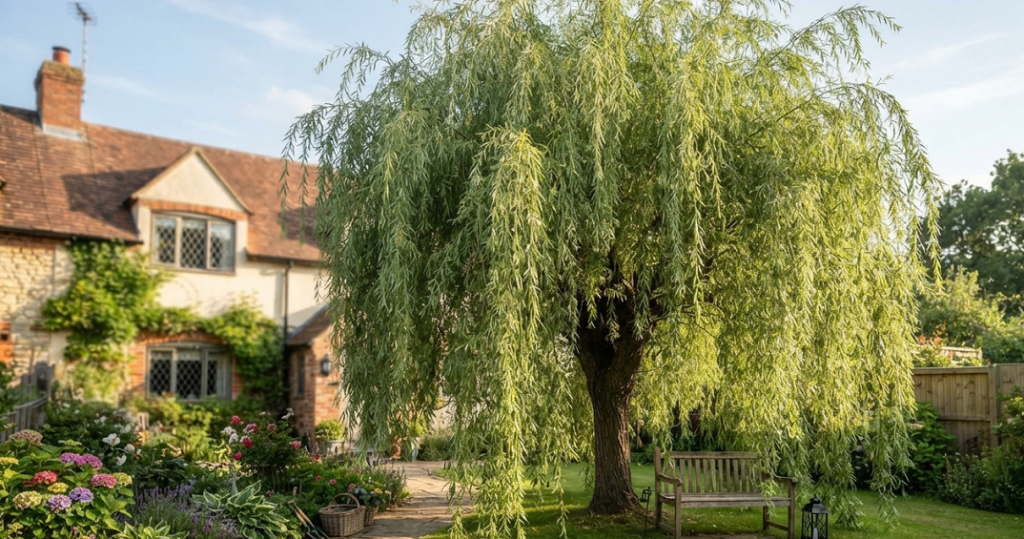
This is the tree most people picture first when they hear “weeping tree,” and for good reason. The long, thin branches sway in even the slightest breeze, and the fresh green leaves in spring are almost neon.
Weeping willows grow fast. I mean genuinely fast, sometimes three to four feet a year once established. If you want quick shade and a dramatic silhouette without waiting a decade, this tree delivers.
Here’s the catch, and I say this as someone who planted one too close to a septic line: weeping willows have aggressive, thirsty roots that chase water sources. They do best near ponds, streams, or low spots in the yard that stay a little soggy. Keep them at least 50 feet from any septic system, water line, or foundation.
They also need room. A mature weeping willow can reach 40 to 50 feet tall with a canopy just as wide, so this isn’t a tree for a small suburban lot unless you’ve got serious acreage to work with. Give it space, give it water, and it will reward you with fast, dramatic growth for decades.
2. Weeping Cherry Tree (Prunus subhirtella ‘Pendula’)
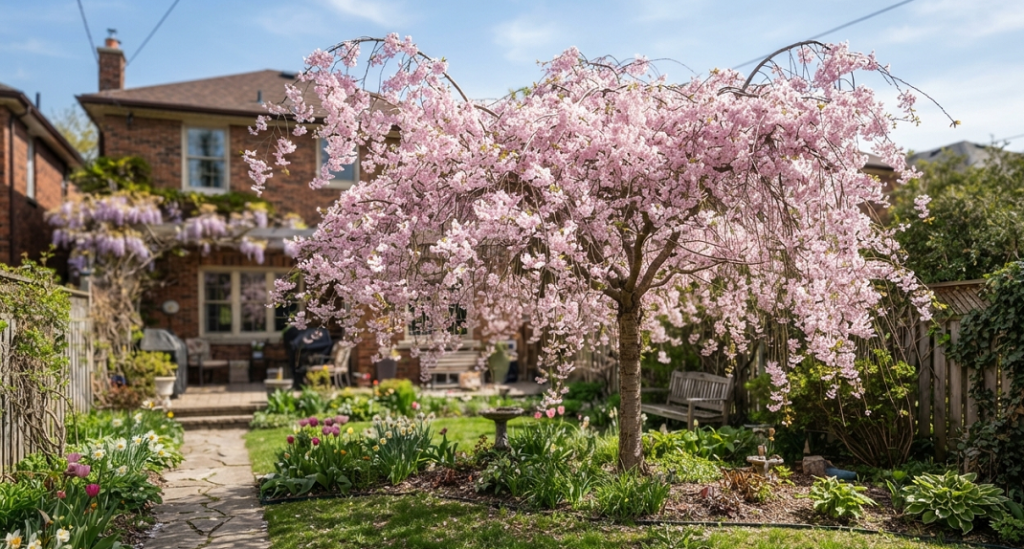
If you want spring drama without the size commitment of a willow, the weeping cherry tree is the answer. For about two weeks every spring, this tree explodes into a fountain of pink or white blossoms that stops traffic. I’m not exaggerating. My neighbor’s weeping cherry gets more Instagram attention than her actual landscaping budget probably deserves.
Weeping cherries typically top out around 15 to 25 feet tall, which makes them a realistic fit for most residential yards. They work beautifully as a specimen tree near a patio, by an entryway, or flanking a driveway.
Care-wise, these trees want full sun, well-draining soil, and a spot with decent air circulation. Cramped, humid conditions invite fungal issues like black knot and brown rot, which are honestly the biggest threat to this tree’s long-term health.
Prune weeping cherries right after they finish blooming, not in fall or winter. Cutting at the wrong time removes next year’s flower buds, and there’s nothing sadder than a weeping cherry that skips its big spring show because of a pruning mistake made months earlier.
3. Weeping Japanese Maple (Acer palmatum var. dissectum)
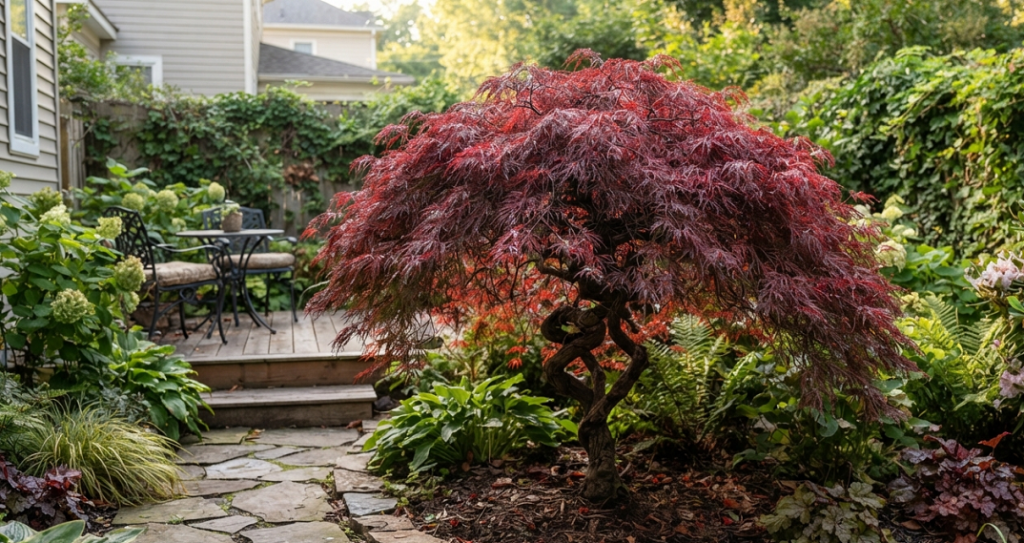
This is the tree I’d plant if I only had room for one. Weeping Japanese maples bring texture, color, and elegance that most other trees simply can’t match. The deeply cut, lacy leaves come in shades of red, purple, orange, and green depending on the cultivar, and they shift color again in fall.
These trees stay small, usually 6 to 10 feet tall and wide, which makes them perfect for smaller yards, courtyards, or as an anchor in a mixed border. I’ve got a ‘Crimson Queen’ in my own front bed, and it’s the single most complimented plant on my property.
Weeping Japanese maples prefer partial shade, especially protection from harsh afternoon sun in hot climates. Full sun in a place like Texas or Arizona can scorch the leaves badly by midsummer. They also want consistent moisture and soil that drains well, since soggy roots kill these trees faster than almost anything else.
One quirk worth knowing: these trees are slow growers. You’re paying a premium price for a tree that might only put on 6 to 12 inches a year. That’s not a flaw exactly, it’s just something to budget for mentally before you see the price tag at the nursery and flinch.
4. Weeping Blue Atlas Cedar (Cedrus atlantica ‘Glauca Pendula’)
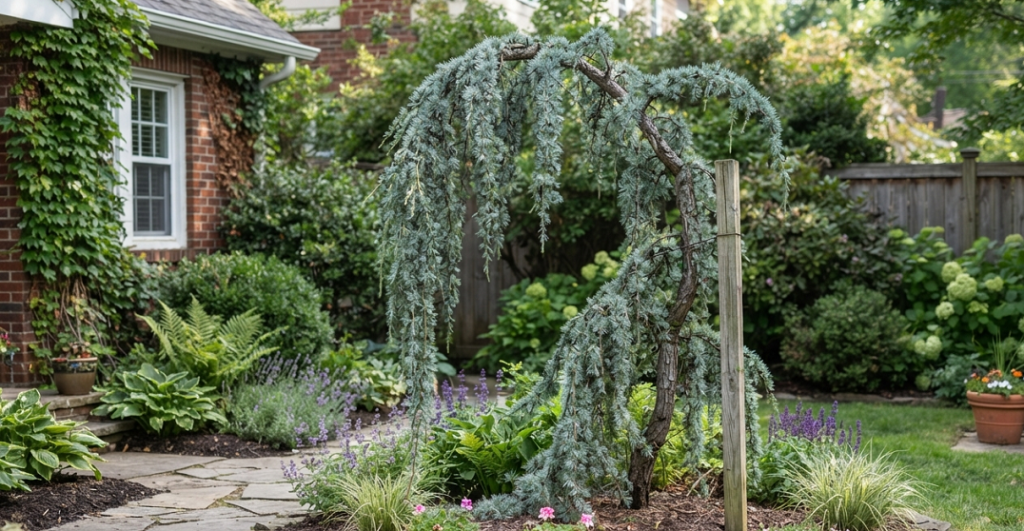
For year-round structure and a genuinely sculptural look, the weeping blue Atlas cedar is hard to beat. This conifer keeps its striking silver-blue color all twelve months of the year, which matters a lot if you live somewhere with long, gray winters and want something other than bare branches to look at from November through March.
Unlike most weeping trees on this list, this one doesn’t naturally cascade in a predictable shape. Its form depends heavily on how it’s staked and trained while young. Left untrained, it sprawls along the ground like a blue-green river. Staked upright, it grows into a dramatic, twisting spire with branches draping off a central trunk.
This flexibility is actually the best part. You can shape a weeping blue Atlas cedar to fit almost any design vision, whether that’s a formal vertical accent or a wild, ground-hugging feature near a rock garden. Talk to your nursery about staking options before you plant, since the shape gets much harder to change once the tree matures.
Give this tree full sun and well-draining soil, and expect it to eventually reach impressive size if left unpruned, sometimes 15 to 20 feet tall with an even wider spread. It’s slow-growing in its early years, so patience is part of the deal here too.
5. Weeping European Beech (Fagus sylvatica ‘Pendula’)
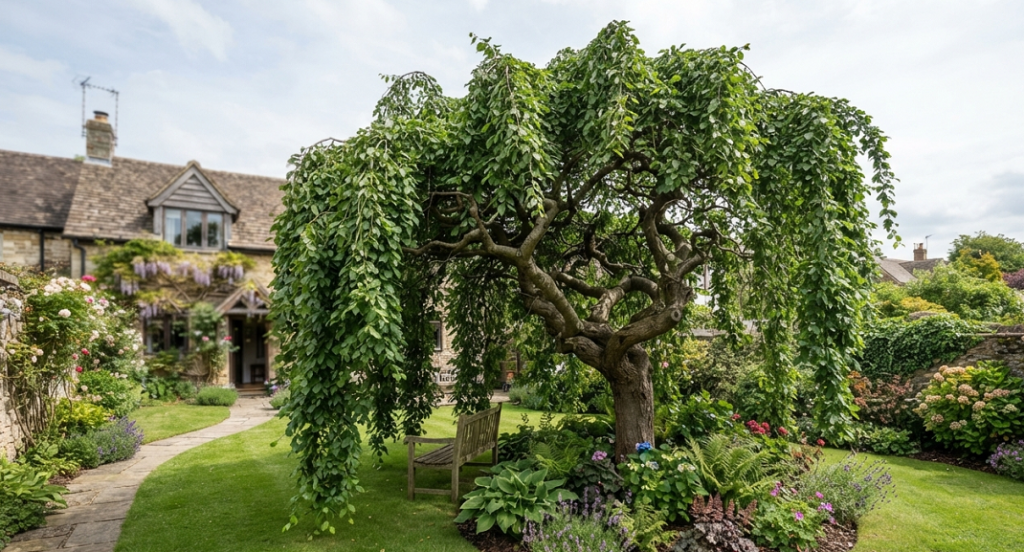
This tree is a showstopper, and I mean that in the most literal sense. A mature weeping European beech looks like something out of a fantasy novel, with massive, sweeping branches that touch the ground and create a cave-like space underneath the canopy.
Kids love these trees. There’s a weeping beech in a public garden near where I live, and it’s basically a natural fort. The branches form a living tent, and the deep purple or green foliage (depending on the cultivar) blocks enough light that the space underneath stays cool and shaded all summer.
The tradeoff is size and patience. Weeping European beeches can eventually reach 40 to 70 feet tall with a canopy just as wide, though it takes many decades to get there. This is a legacy tree, one you plant knowing your grandkids might be the ones who really get to enjoy its full size.
Give it deep, fertile, well-draining soil and full sun to partial shade. Once established, this tree is remarkably low-maintenance and tolerant of a wide range of conditions. Just make sure you’re planting it somewhere with serious room to grow, because moving or removing a mature beech is not a small job.
6. Weeping Redbud (Cercis canadensis ‘Lavender Twist’ or ‘Ruby Falls’)
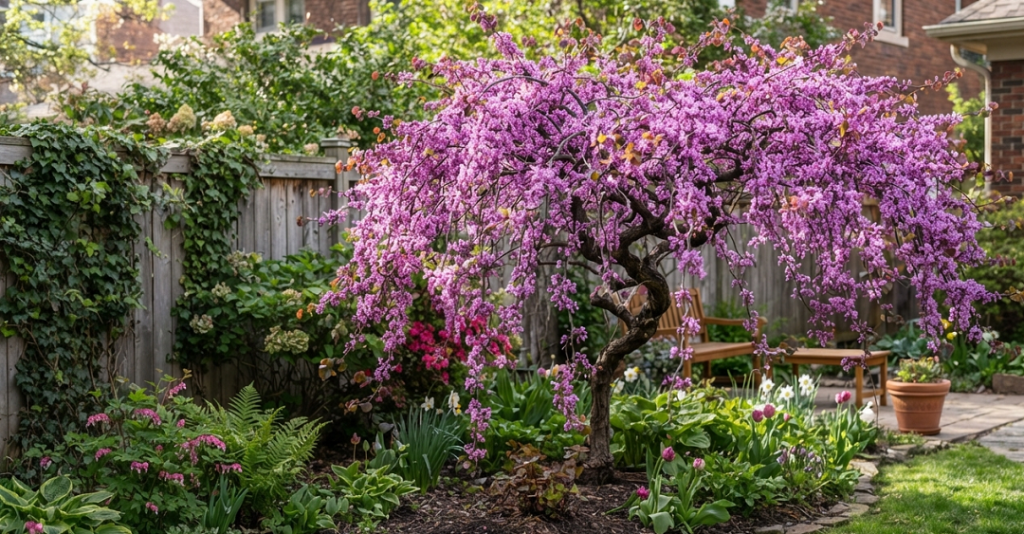
Redbuds already have gorgeous spring flowers, and the weeping cultivars take that beauty and add a cascading, almost sculptural form on top of it. ‘Lavender Twist’ produces a tumble of purple-pink blooms along twisted, weeping branches before the leaves even emerge, and ‘Ruby Falls’ pairs that same weeping habit with deep burgundy foliage all season long.
These trees stay compact, usually 5 to 8 feet tall, which makes them one of the best weeping tree options for small yards or tight urban lots. You genuinely don’t need much space to make a big visual statement with a weeping redbud.
Plant them in full sun to partial shade with well-draining soil. Redbuds are native to a big chunk of North America, so they tend to handle regional weather swings better than some of the more finicky ornamentals on this list. That native toughness is a real advantage if you’ve had bad luck keeping fussier trees alive.
The one thing to watch is canker disease, which redbuds are somewhat prone to, especially in stressed or poorly drained soil. Good drainage and avoiding trunk damage from mowers or trimmers goes a long way toward keeping this tree healthy for the long haul.
7. Weeping Norway Spruce (Picea abies ‘Pendula’)
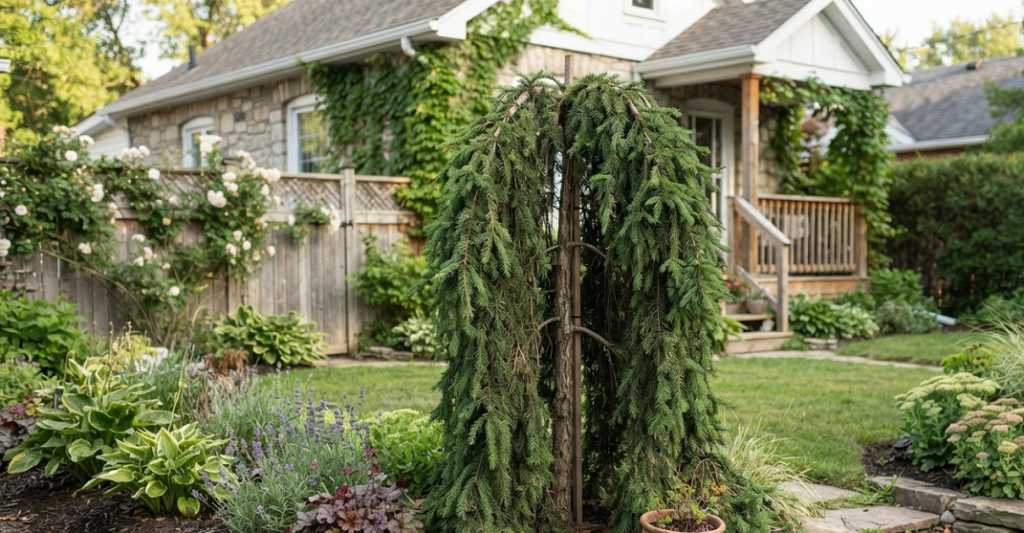
If you want evergreen structure with a genuinely wild, artistic shape, the weeping Norway spruce delivers something none of the deciduous options on this list can. This conifer doesn’t grow in a neat, symmetrical form. It sprawls, twists, and drapes in whatever direction its branches decide to go, which sounds chaotic but actually looks intentional and striking once it matures.
Like the weeping blue Atlas cedar, this tree’s ultimate shape depends a lot on staking when young. Staked tall, it becomes a narrow, weeping column. Left alone, it hugs the ground and spreads outward, which some homeowners actually prefer for rock gardens or as a groundcover-style specimen near a boulder or retaining wall.
This tree tolerates cold climates exceptionally well, arguably better than any other tree on this list, which makes it a favorite for northern gardeners who want year-round green without worrying about winter dieback. It handles full sun and prefers moist, well-draining soil, though established trees are fairly forgiving once they’ve settled in.
Growth is slow but steady, and the tree keeps its unusual form for decades without much intervention. It’s a low-drama, high-reward evergreen choice if the rest of your yard already has enough seasonal color and you want something interesting to look at in January.
Bonus Pick: Weeping Mulberry (Morus alba ‘Pendula’)
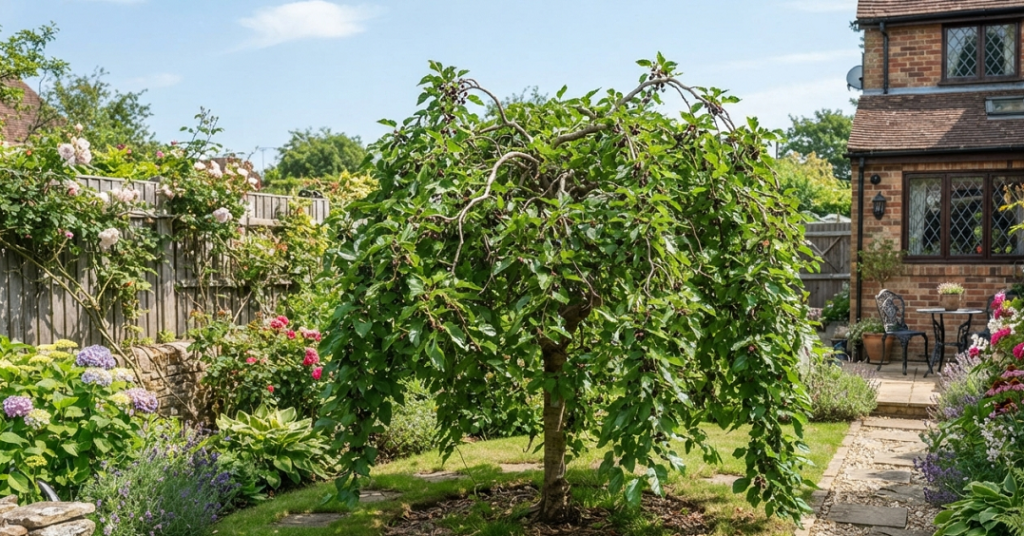
Quick side note here because this tree deserves a mention even though it’s not for everyone. The weeping mulberry has a tight, umbrella-like canopy of glossy leaves that cascade almost to the ground, giving it a neat, tidy look that’s different from the wilder shapes on this list.
It stays small, usually 6 to 10 feet tall, and grows fast for its size. The catch is the fruit. Female cultivars drop berries that stain patios, driveways, and anything parked underneath them, so most nurseries sell fruitless male cultivars specifically to avoid that mess. Ask before you buy, because this detail matters a lot more than people expect once August rolls around.
Real Talk: Where Weeping Trees Go Wrong
Weeping trees aren’t difficult exactly, but they’re not foolproof either. Here’s where I’ve seen people, myself included, run into trouble.
- Planting too close to structures. Those graceful, sweeping branches need room to reach the ground without scraping against siding, fences, or walkways. Give every weeping tree on this list at least 10 to 15 feet of clearance from anything you don’t want scratched up.
- Ignoring mature root spread. Weeping willows are the worst offenders, but honestly, most trees on this list develop wider root systems than their canopy suggests. Never plant near septic fields, sewer lines, or foundations without checking the mature spread first.
- Pruning at the wrong time. Flowering weeping trees, like the cherry and redbud, set next year’s buds shortly after this year’s bloom ends. Prune in fall or winter, and you accidentally cut off next spring’s entire show. Always prune spring bloomers right after flowering, full stop.
- Underestimating the price tag. Weeping trees cost more than standard varieties because they’re often grafted, which is a labor-intensive process. A mature, well-shaped weeping Japanese maple can run several hundred dollars easily. Budget accordingly instead of getting sticker shock at checkout.
- Skipping the staking conversation. For conifers like the weeping blue Atlas cedar and weeping Norway spruce, the shape is basically locked in based on early staking decisions. Skip that conversation with your nursery, and you might end up with a tree sprawling across your lawn when you wanted a vertical accent, or vice versa.
- Forgetting about mowing and foot traffic. Trees like the weeping European beech and weeping willow eventually create a canopy that touches the ground on all sides. That’s beautiful, but it also means you can’t mow under them or walk through them once they mature. Plan the surrounding bed or mulch ring now, not after you’re already trying to squeeze a mower through a two-foot gap.
None of these problems are dealbreakers. They’re just things to plan around before the tree goes in the ground, because fixing a mistake after year three is a lot harder than getting it right on day one.
Final Thoughts
A weeping tree is one of the highest-impact, lowest-effort upgrades you can make to a yard that feels a little flat. Pick the right variety for your climate and space, give it room to do its thing, and it will carry the whole landscape on its own for decades.
My honest advice: don’t buy the biggest, cheapest one you find at a big-box store on impulse. Visit a real nursery, ask about the mature size and root spread, and picture where that tree will actually stand in fifteen years, not just where it looks nice in a five-gallon pot today.
Which one caught your eye? Drop a comment below and let me know which weeping tree you’re planning to add to your yard, or tell me about one that didn’t work out. I read every comment, and I’d genuinely love to hear what’s growing in your corner of the world.

About Syprose Kiche
Syprose Kiche is the creator and writer behind My Besuited Home, a practical home and garden website covering DIY projects, gardening, lawn care, landscaping, home improvement, and outdoor living. She focuses on turning everyday homeowner questions into clear, practical guides backed by careful research and useful real-world considerations.