
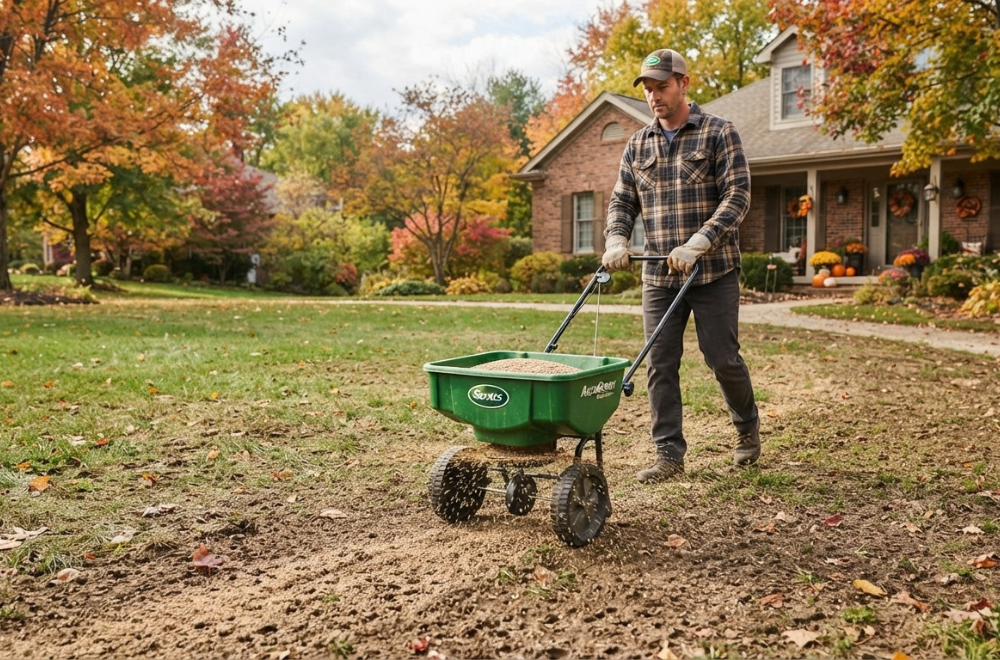
By late August, a lot of lawns start showing the wear of a long growing season. Bare patches where the dog runs the same path every day. Thin spots under the shade of a maple that got denser over the summer. Areas that just never quite filled back in after a hot, dry stretch in July. The instinct is to throw grass seed down as soon as the problem is noticed, but timing this wrong is one of the most common reasons overseeding fails to deliver a thicker lawn by the following spring.
Fall isn’t just a convenient season for reseeding — for most of the country, it’s the single best window of the year to do it, and understanding why changes how the whole process should be approached.
Why Fall Beats Spring for Most Lawns
Grass seed germinates based on soil temperature, not air temperature or the calendar date. Cool-season grasses — the ones grown across the northern two-thirds of the U.S. and much of the transition zone, including Kentucky bluegrass, perennial ryegrass, and the fescues — germinate best when soil temperatures sit between roughly 50°F and 65°F. In most regions, that happens twice a year: once in spring as the ground warms, and again in fall as it cools.
Fall has three advantages spring doesn’t. Soil that’s been warmed by a full summer holds heat longer into autumn, so germination tends to be faster and more even than it is in the often cold, wet soil of early spring. Weed pressure is also much lower — crabgrass, foxtail, and most other summer annual weeds have already germinated and are on their way out, so new grass seedlings aren’t competing with a fresh wave of weed seedlings for light, water, and space the way they would in spring. And new grass planted in fall gets a full season to establish a root system before it has to face the stress of summer heat, rather than being asked to survive its first heat wave within a few months of germinating.
None of this applies the same way to warm-season lawns. Bermudagrass, zoysia, and St. Augustine go dormant in fall and won’t establish new growth from seed at that point — overseeding a warm-season lawn with its own grass type in autumn generally doesn’t work. What some warm-season lawn owners do instead is overseed with annual or perennial ryegrass purely for winter color, since ryegrass germinates in cool conditions and will stay green through a period when Bermuda or zoysia has gone brown. That’s a cosmetic strategy, not a way to thicken the permanent lawn, and it’s worth knowing the difference before buying seed.
Finding the Actual Window for Your Region
The often-repeated advice to seed “six weeks before the first frost” is a reasonable starting point, but it’s a rule of thumb, not a fixed date, and it can mislead someone who takes it too literally. What matters is that the new grass gets enough time with warm-enough soil to germinate and then several more weeks of growth before winter dormancy sets in — frost itself isn’t what kills a struggling seedling, a lack of root development before cold weather arrives is.
In practical terms, that puts most of the cool-season zone somewhere in a window from late August through early October, with northern states and higher elevations toward the earlier end and the warmer parts of the transition zone able to push into mid-October. Checking a local extension office’s average first-frost date is more useful than any generic date on a seed bag, since it accounts for regional variation that a national calendar can’t.
Seeding too late is a more common mistake than seeding too early. A homeowner who gets busy in September and finally gets around to it in late October may see some germination, but the seedlings won’t have built enough of a root system to survive winter, and much of that seed and effort is wasted. If the safe window has clearly passed, it’s usually better to wait for spring than to gamble on a late fall seeding.
Matching the Seed to the Lawn You Actually Have
Grass seed selection causes more disappointing results than almost any other step in the process, mostly because people buy whatever bag is on sale rather than matching the seed to their site conditions.
Tall fescue is the workhorse choice for much of the transition zone and parts of the cool-season zone further north. It has a deep root system that handles drought and heat better than most other cool-season grasses, tolerates moderate shade, and — critically for overseeding — germinates relatively quickly, typically in 7 to 14 days under good conditions. Modern turf-type tall fescue blends have largely replaced the coarse, clumpy fescue varieties from decades ago.
Perennial ryegrass germinates the fastest of the common cool-season species, often within 5 to 10 days, which makes it useful in blends where quick cover matters or for filling small bare patches. On its own it has less heat and drought tolerance than tall fescue and can struggle in a hot summer, so it’s more commonly used as part of a blend than as the sole seed.
Kentucky bluegrass produces some of the densest, finest-textured lawns and spreads through underground rhizomes, meaning it can actually fill in small bare spots on its own over time rather than staying confined to where it was seeded. The tradeoff is a slow germination period — often 14 to 30 days — and it needs more water and fertility than fescue to look its best. Seeding it alone in fall means accepting that visible results will take longer to show up.
Fine fescues (creeping red fescue, chewings fescue, hard fescue) are the best choice for dense shade where almost nothing else will grow well, and they need less water and fertilizer than the other options. They don’t hold up as well to heavy foot traffic, so they’re a poor match for a high-use backyard even if the shade level would otherwise suit them.
Many bagged seed products sold for overseeding are blends — often a mix of turf-type tall fescue with a smaller percentage of Kentucky bluegrass, or a blend of several fescues — specifically because blending species gives some resilience against conditions that might stress any single species. Reading the label’s seed analysis is worth the extra minute: a bag that’s mostly “annual ryegrass” or has a high percentage of “crop” or inert filler material is a lower-quality product than one listing certified turf-type perennial cultivars.
The single most useful piece of information before buying seed is matching it to sun exposure. A lawn with a mostly shaded backyard and full-sun front yard may genuinely need two different seed products, not one bag used everywhere.
What the Lawn Needs Before Any Seed Goes Down
Seed that lands on top of existing thatch, compacted soil, or a mat of dead grass rarely germinates well, because it never makes contact with soil. This is where a lot of overseeding attempts fail quietly — the seed was fine, the timing was fine, but it simply couldn’t reach the ground.
Mowing the lawn shorter than usual — down to around 2 inches for most cool-season grasses — before seeding helps sunlight reach the soil surface and keeps existing grass from shading out new seedlings. Bagging the clippings for this mow, rather than leaving them, avoids adding another layer between the seed and the soil.
Core aeration is one of the more impactful steps for lawns with compacted soil or a thatch layer thicker than about half an inch. A core aerator pulls small plugs of soil out of the ground, creating openings where seed can settle in and make direct soil contact, along with loosening compaction that would otherwise restrict root growth. Renting a core aerator for an afternoon, or hiring a lawn service to do it, is often the difference between seed that germinates well and seed that mostly washes away or gets eaten by birds. Dethatching with a power rake is a separate step useful specifically where thatch buildup is the main issue rather than soil compaction, and the two problems don’t always occur together.
For lawns that are more bare dirt than existing grass — after removing a dead patch of grass, for instance — the same principle applies at a smaller scale: the soil surface should be loosened with a rake so seed can settle into the top quarter-inch or so rather than sitting on a hard crust.
Getting Seed and Fertilizer Down Correctly
Seeding rates vary by species and are usually printed on the bag, but as a general guide, overseeding an existing lawn with tall fescue typically calls for somewhere around 4 to 8 pounds of seed per 1,000 square feet, while a bare-soil renovation calls for a higher rate, often 6 to 10 pounds. Using less than the recommended rate leaves the lawn thin; using significantly more doesn’t speed up results and can cause seedlings to compete with each other for space and nutrients.
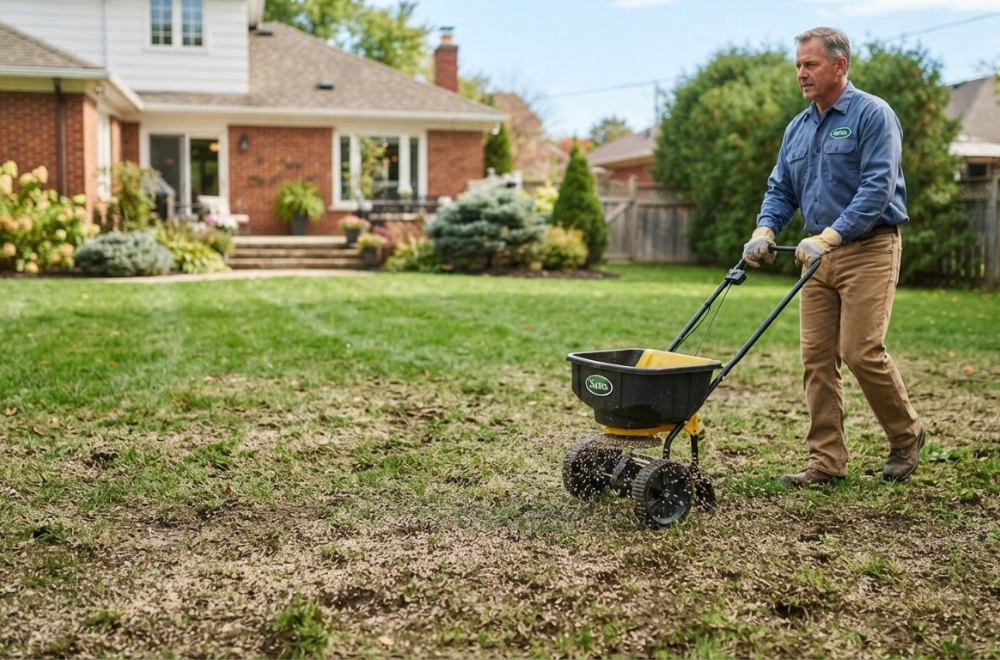
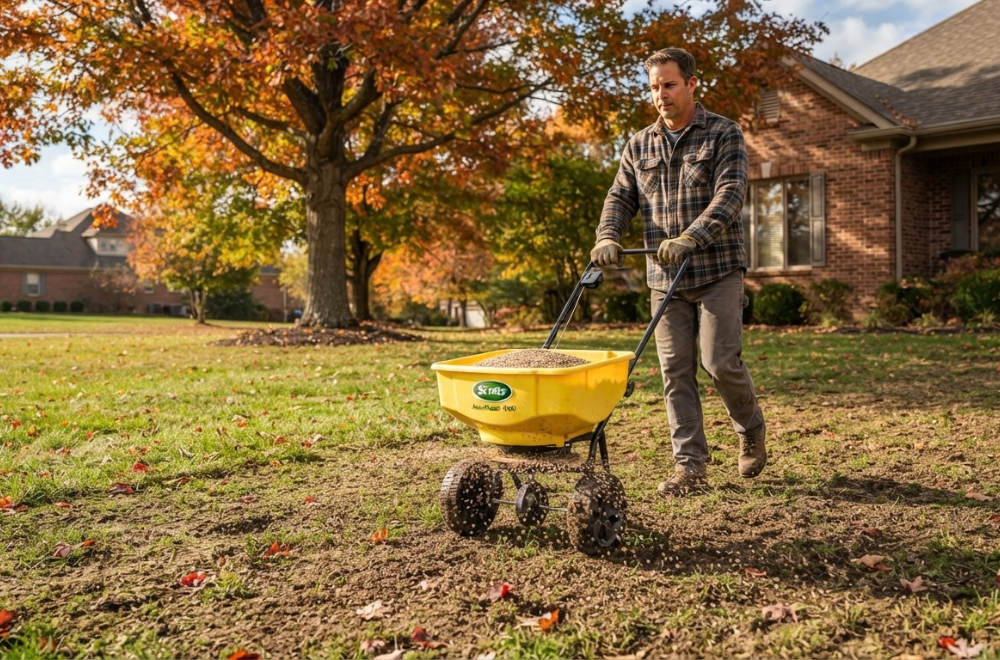
A broadcast or drop spreader gives more even coverage than seeding by hand, particularly across a larger area. Splitting the total seed amount in half and making two passes in perpendicular directions — one north-south, one east-west — helps avoid the streaky, uneven coverage that comes from a single pass with a spreader that doesn’t throw seed in a perfectly even pattern.
A starter fertilizer formulated for new grass, which is typically higher in phosphorus than a standard lawn fertilizer, supports root development in young seedlings. This is different from a regular fall lawn fertilizer application and from a weed-and-feed product — weed-and-feed products contain pre-emergent herbicide that will also prevent grass seed from germinating, so applying one anywhere near the time of seeding defeats the purpose of overseeding entirely. If pre-emergent crabgrass control was applied earlier in the year, most product labels specify a waiting period — often several months — before the treated area can be safely seeded, and it’s worth checking that label rather than assuming enough time has passed.
Lightly raking the seeded area afterward, or rolling it with a lawn roller, improves soil contact without burying the seed too deep. Most cool-season grass seed germinates best at a shallow depth — around a quarter inch — so seed that gets buried an inch or more under soil may simply fail to come up.
The Watering Schedule Most People Get Wrong
New seed needs consistent surface moisture to germinate, which is a different watering pattern than an established lawn needs. For the first one to two weeks, light watering once or twice a day — enough to keep the top half-inch of soil consistently moist without pooling water or washing seed away — supports germination better than a single deep watering.
Once germination has occurred and seedlings are visibly growing, watering frequency should decrease while the amount per session increases, gradually shifting toward the deeper, less frequent watering pattern an established lawn is managed with. Keeping the light, frequent watering pattern going for weeks after germination actually works against the lawn, because it encourages shallow root growth instead of pushing roots deeper into the soil where they’re more resilient.
This is also where local weather matters more than any generic schedule. A stretch of rainy fall weather may mean skipping irrigation entirely for several days; a warm, windy week can dry the surface out within hours and call for watering twice a day. Checking the soil surface directly — it should look and feel damp, not muddy or bone-dry — is more reliable than following a fixed schedule regardless of conditions.
When to Mow New Grass for the First Time
Mowing too early can pull young seedlings out of loose soil before their roots have anchored. The general guideline is to wait until new grass reaches about a third taller than the intended mowing height, then mow it down by no more than a third of its height in that first cut. For most cool-season lawns kept around 3 inches, that means waiting until new growth is roughly 4 inches tall before the first mow.
A sharp mower blade matters more for new grass than for an established lawn — a dull blade tears seedlings out of soft, not-yet-established soil rather than cutting them cleanly, which can damage or uproot young plants that don’t yet have a strong enough root system to resist the pull.
Mistakes That Undo an Otherwise Good Overseeding Job
Skipping soil preparation is the most common one, covered above, but a few others come up repeatedly:
Seeding into full shade with a sun-loving seed blend, rather than choosing a shade-tolerant fine fescue mix for those specific areas, leads to seed that either doesn’t germinate well or germinates and then thins out again within a season as the existing tree canopy fills back in.
Applying a pre-emergent herbicide in early fall for weed control and then overseeding a few weeks later, without checking the product’s label for its required waiting period, is a mistake that wastes the cost of the grass seed. The pre-emergent doesn’t distinguish between weed seeds and grass seeds.
Walking on newly seeded areas, or letting pets do the same, compacts the soil right when loose surface contact matters most and can uproot seedlings that haven’t developed roots yet. Keeping foot traffic off a seeded area for at least the first few weeks, even if that means temporarily fencing off a section of yard, protects the investment.
Expecting a thick, uniform lawn within a couple of weeks sets up disappointment more than it reflects a real problem. Depending on the species seeded, full germination and establishment can take anywhere from two weeks to over a month, and a lawn that looks thin and patchy right after germination will often fill in considerably over the following month as seedlings mature and begin to spread or thicken.
When It Makes Sense to Call a Lawn Care Service
A homeowner dealing with a small lawn, decent existing soil, and a handful of bare patches can usually handle overseeding with basic rented or owned equipment. Core aeration equipment, slit seeders (which cut small grooves into the soil and drop seed directly into them, often giving better seed-to-soil contact than a broadcast spreader alone), and soil testing are all areas where a professional lawn service brings equipment or expertise that’s harder to access otherwise. A lawn with severe compaction across a large area, a persistent drainage problem, or soil that hasn’t been tested in years and may need pH correction before seed will establish well are situations where a consultation is often worth the cost, even if the actual seeding work is still done DIY.
Common Questions
Can I overseed and apply regular lawn fertilizer at the same time? A starter fertilizer is a better match for new seed than a standard nitrogen-heavy lawn fertilizer, which is formulated for the needs of established turf rather than developing seedlings. Applying regular fall fertilizer at the same time as overseeding isn’t dangerous to the seed, but it isn’t giving the new grass what it specifically needs during germination either.
Does grass seed need to be covered with straw or mulch? A light straw covering can help retain surface moisture and reduce erosion on slopes, but it isn’t required on flat, well-prepared soil where watering is consistent. Straw that’s applied too thickly can actually block light and airflow to seedlings, so a thin, even layer — enough to see roughly half the soil surface through it — is more useful than a heavy blanket.
How long until an overseeded lawn looks normal again? This depends heavily on the seed species used and the weather that fall. Perennial ryegrass may show visible green within a week or two; Kentucky bluegrass can take a month or more to reach the same point. A realistic expectation for most blends is a noticeably thicker lawn within four to six weeks of seeding, with continued filling in through the following spring as the grass matures.
The Practical Takeaway
Getting fall overseeding right comes down to three things happening in the right order: seeding early enough in the fall window for the region, preparing the soil so seed actually reaches it, and matching the seed itself to the specific light and traffic conditions of the lawn. Skipping any one of those tends to matter more than which brand of seed ends up in the spreader.

About Syprose Kiche
Syprose Kiche is the creator and writer behind My Besuited Home, a practical home and garden website covering DIY projects, gardening, lawn care, landscaping, home improvement, and outdoor living. She focuses on turning everyday homeowner questions into clear, practical guides backed by careful research and useful real-world considerations.