
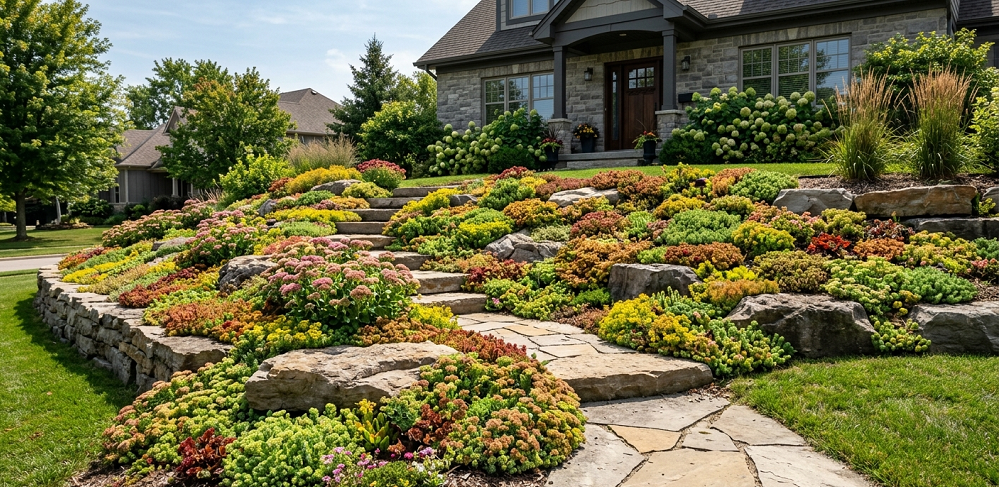
Your sloped front yard is actively trying to destroy your weekends. Every time it rains, you watch your topsoil migrate to the sidewalk. Every summer, you’re dragging a mower sideways up a hill like you’re auditioning for a circus act. And every spring, the bare patches from erosion taunt you from the street.
I’ve been there. The first house I owned had a front slope so steep that my neighbor called it “the ski jump.” I planted grass seed three times. Three. Times. I watched it wash away, dry out, and generally mock me before I finally accepted the truth: grass on a slope is a punishment, not a lawn.
The good news? Once you plant the right things on a slope, you barely have to think about it again. The plants below are ones I’ve either grown myself, ripped out and replaced (lessons learned, all of them), or watched thrive in my neighbors’ yards through brutal summers and ice storms alike. They hold soil, look great from the curb, and don’t require you to show up every week with a watering can.
Let’s get into it.
Why Sloped Front Yard Landscaping Is Different From Flat Yard Planting
Before we talk plants, I need to give you one piece of context that changes everything: a slope drains fast and dries out fast. Water doesn’t sit — it runs. That means plants that love consistent moisture will suffer, while drought-tolerant, deep-rooted plants will thrive.
The second thing slopes do is erode. Until your plants are established (usually 1–2 full growing seasons), their roots aren’t deep enough to hold soil during heavy rain. That’s why I always recommend laying a thin layer of erosion-control netting or straw over bare soil right after planting on a slope. I skipped this step once and lost about 40% of my newly planted ground cover in a single thunderstorm. Don’t be me.
With those two facts in mind, every plant on this list has been chosen because it either has a deep or spreading root system, handles dry spells without drama, or both.
1. Creeping Juniper (Juniperus horizontalis) — The Workhorse of Slope Ground Cover
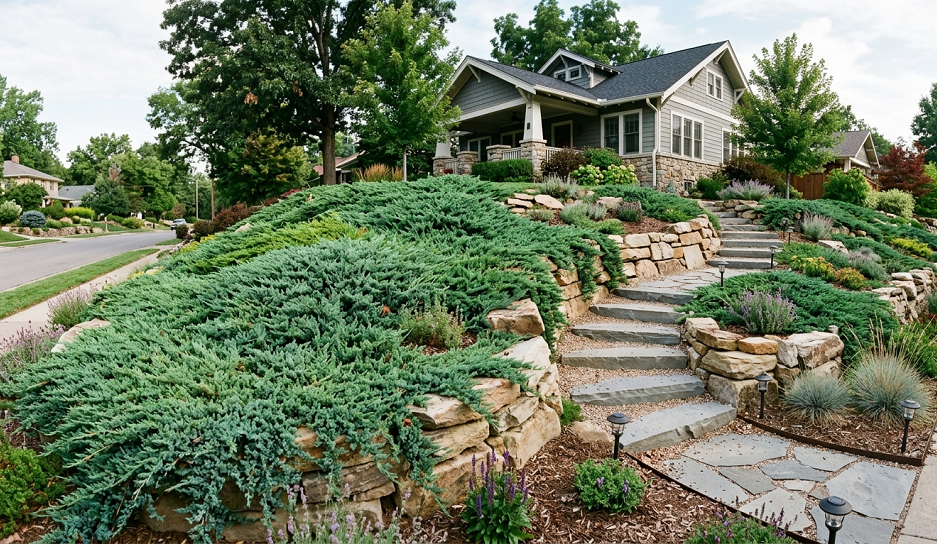
Creeping juniper is the plant I recommend first to literally everyone with a problem slope. It’s not glamorous. It won’t show up on a fancy garden Instagram. But this thing? It works.
Creeping juniper spreads low and wide — typically 6 to 8 feet across but only 1 to 2 feet tall — which means it smothers weeds and locks in soil without creating a visual wall. The blue-green foliage turns a pretty bronze-purple in winter, so it actually has four-season interest if you care about that sort of thing. I’ve had patches of creeping juniper go through two-week droughts in July without so much as a dramatic wilting moment.
Plant it in full sun and well-drained soil and then genuinely leave it alone. No deadheading, no regular pruning, no feeding frenzy. The only thing I do is cut back any runners that creep past where I want them, maybe once a year.
One warning: do not plant creeping juniper if you have dogs who love to dig. My neighbor Mark lost an entire hillside planting when his golden retriever decided the juniper bed was his personal excavation project. For dog owners, skip to number 4.
2. Daylilies (Hemerocallis spp.) — The Slope Plant That Actually Looks Like You Tried
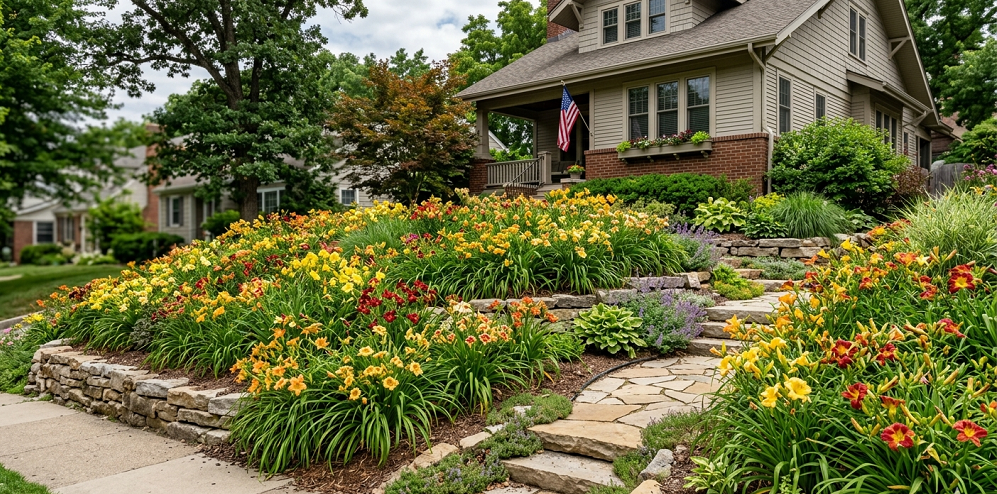
Every summer, without fail, someone stops in front of my yard and asks what those orange flowers are. Daylilies. Planted six years ago. Touched approximately four times since then.
Daylilies get a bad reputation for being “common,” and yes, you’ll see them everywhere — roadsides, old farmhouses, the forgotten corners of every church parking lot. But here’s the thing: they’re everywhere because they work. Their thick, tuberous root systems grip soil like a fist and spread steadily each year, slowly filling in a slope without running rampant.
The blooming window is mid-summer, and individual flowers last only one day (hence the name), but a mature clump will push up dozens of blooms over several weeks. You don’t deadhead them, though I sometimes cut the spent stalks down to the base just to keep things tidy. Varieties like ‘Stella de Oro’ repeat-bloom into fall, which gives you more bang for essentially zero extra effort.
Plant them in full to partial sun, water them in, and walk away. They’ll divide and expand on their own. Every few years, if a clump gets crowded, you can dig and split it — but that’s a “when you feel like it” task, not a required one.
3. Creeping Phlox (Phlox subulata) — The Spring Show-Off With Zero Drama
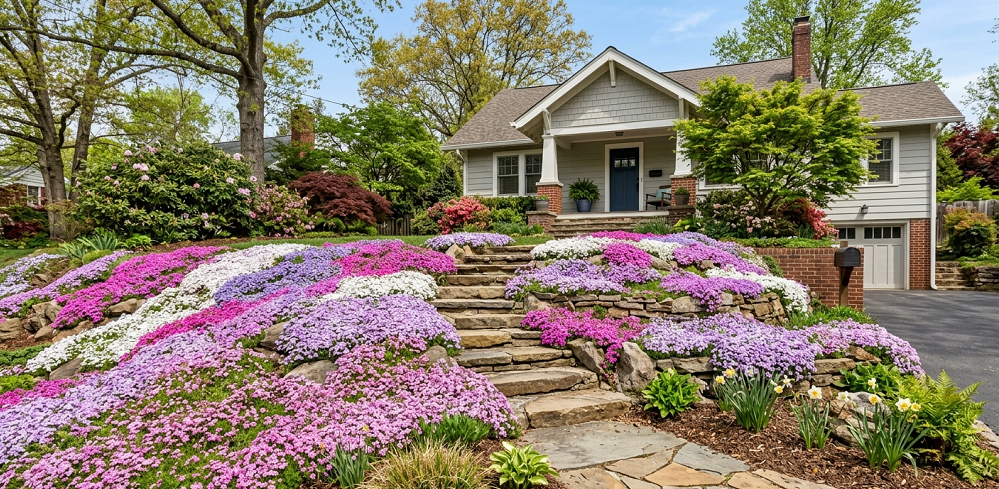
If you want your slope to stop traffic in April and May, creeping phlox is your plant. This low-growing perennial cascades down slopes in a solid carpet of pink, purple, or white blooms that honestly looks like someone painted the hillside. My mother-in-law saw mine for the first time and immediately demanded cuttings.
Outside of bloom time, creeping phlox is a pleasant evergreen mat — nothing flashy, but it covers ground and holds it well. It tops out at about 6 inches tall and spreads 2 feet or more over time. Once established, it handles drought better than it handles overwatering, so don’t be tempted to coddle it.
The only real maintenance it needs is a light trim right after the flowers fade. I do a rough shearing with hedge clippers — takes about 10 minutes — and it comes back fuller and better the following year. Skip the trim and it gradually gets woody and bare in the center, which looks rough.
Plant in full sun. I tried phlox in partial shade once based on a tag that said “tolerates some shade,” and I can tell you it produced maybe a dozen blooms instead of the usual wall of color. Full sun, or don’t bother.
4. Ornamental Grasses (Native Varieties) — The Low-Maintenance Slope Anchor With Big Visual Impact
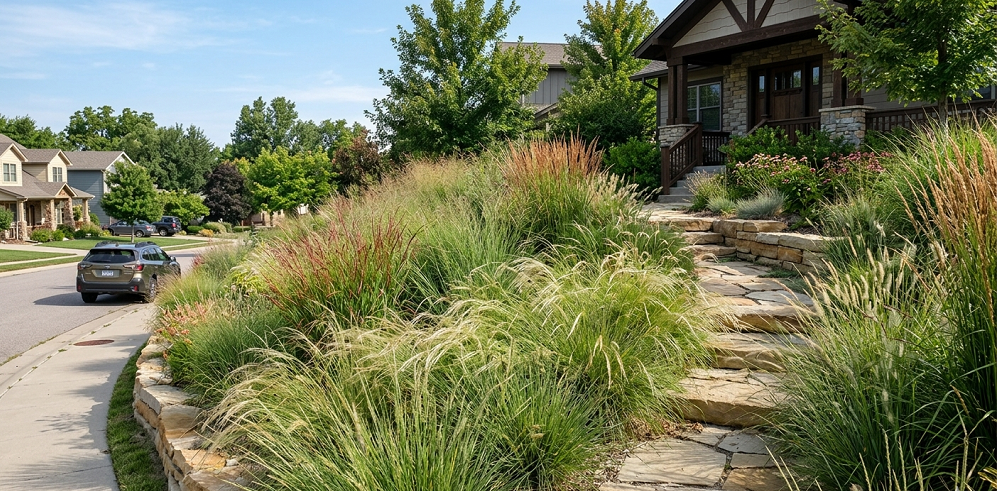
I’m going to be specific here because “ornamental grasses” is a category wide enough to drive a truck through, and not all of them belong on your slope. I’m talking about native or well-behaved varieties like Little Bluestem (Schizachyrium scoparium), Prairie Dropseed (Sporobolus heterolepis), and Karl Foerster Feather Reed Grass (Calamagrostis × acutiflora).
These grasses do three things beautifully: their deep fibrous roots prevent erosion better than almost anything else on this list, they move in the wind in a way that makes even a basic front slope look intentional and designed, and they require almost no care after year one.
Little Bluestem is my personal favorite for sunny, dry slopes. It turns a stunning copper-red in fall and holds that color through winter, giving you months of visual interest. Karl Foerster is taller (3 to 5 feet) and more upright — better for anchoring the top of a slope or creating a backdrop than covering ground, but spectacular when planted in drifts.
The one thing you must do with ornamental grasses: cut them back to about 4 to 6 inches in late winter before new growth starts. I use a pair of hedge shears, and yes, it takes about two minutes per plant. If you skip this step, the new growth has to push through the old dead stuff and the whole clump looks messy by midsummer.
5. Forsythia (Forsythia spp.) — The Early Spring Anchor Shrub That Won’t Quit
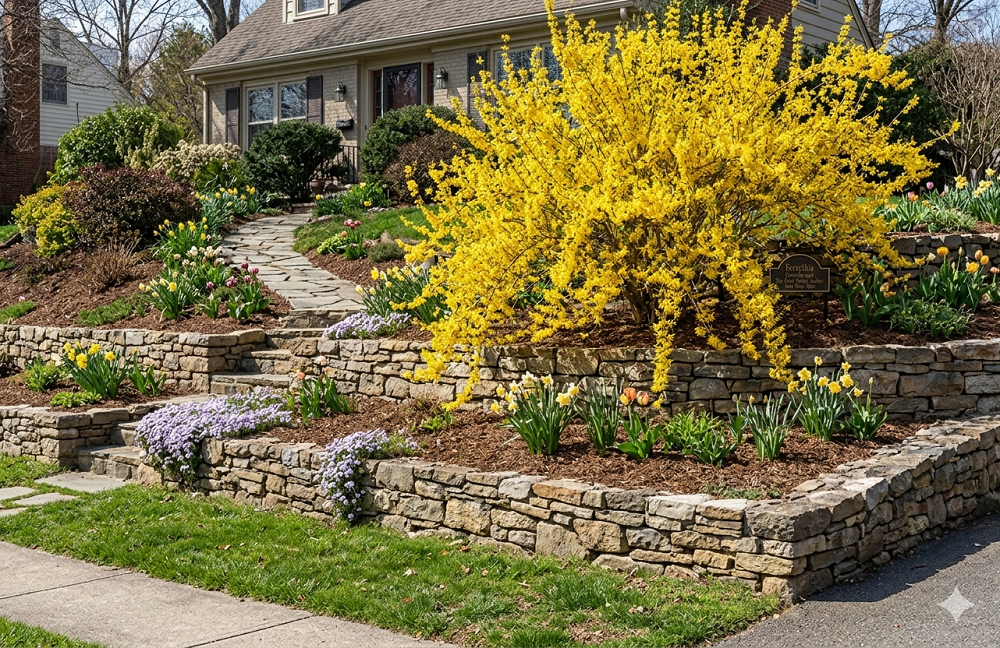
Forsythia is the shrub that blooms yellow in early spring before the rest of the world has even woken up, and it does it reliably, every single year, without you having to do anything. I have a large forsythia at the top of my slope that I planted as a stick-looking bare-root shrub a decade ago. It now anchors about 30 square feet of hillside with a root system I would honestly be afraid to excavate.
What makes forsythia great for slopes is its habit of “layering” — stems that touch the ground will root where they make contact, slowly expanding coverage and knitting the slope together. You can encourage this by pegging a few arching stems to the soil, or you can just leave it alone and let it happen naturally.
The bad news: forsythia blooms on old wood, which means if you prune it in fall or late winter, you cut off your spring show. Prune immediately after flowering in spring, and only prune the oldest, woodiest stems all the way to the ground. Never give it the “meatball” treatment — I’ve seen it done, and the results are deeply upsetting.
6. Black-Eyed Susan (Rudbeckia hirta) — Native Wildflower That Seeds Itself Into Problem Areas
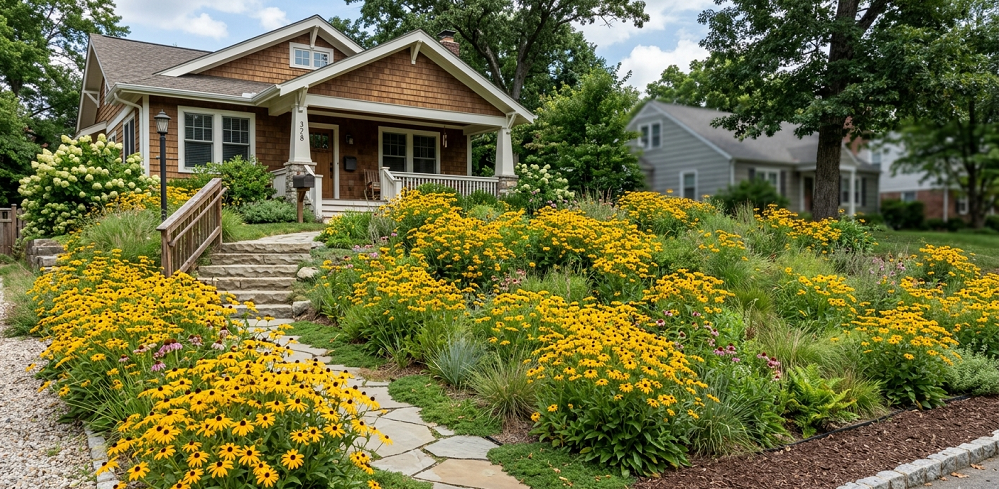
Black-eyed Susans are the plant that will quietly colonize your slope while you’re busy ignoring it, and you will be grateful. These bright yellow native wildflowers bloom from midsummer through fall, require absolutely no supplemental watering once established, and self-seed freely — meaning the patch gets bigger every year for free.
I originally planted one flat of these on a dry, rocky slope where I’d killed two previous plantings of other things. By year three, they had spread to cover twice the original area. I did nothing. They did everything.
They’re also a magnet for native bees and butterflies, so if you care about supporting pollinators — and at this point in gardening history, I think we all should — these pull serious weight. The dried seed heads over winter feed goldfinches, so I leave them standing until late winter and get a bonus bird show out of it.
Plant in full sun to light shade. They tolerate poor, rocky, dry soil better than rich, amended soil — overly fertile ground makes them floppy and reduces flowering. One of the rare plants where not improving your soil works in your favor.
7. Spreading Cotoneaster (Cotoneaster horizontalis or C. dammeri) — The Evergreen Slope Cover With Four-Season Value
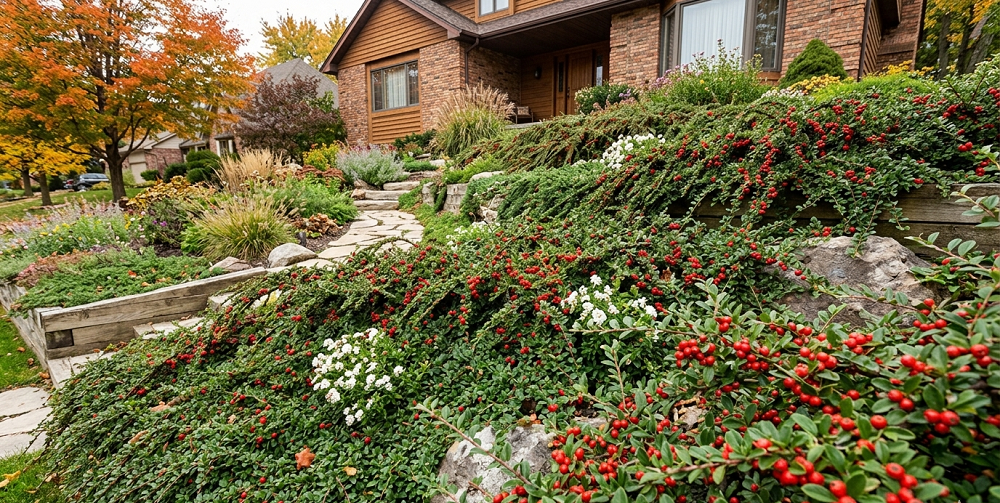
Cotoneaster (pronounced “koh-TOE-nee-aster,” and yes, I mispronounced it for two years) is one of those shrubs that earns its keep twelve months a year. In spring it has tiny white flowers. In summer, glossy dark green leaves. In fall, bright red berries. In winter, an interesting branching structure that’s visible under light snow.
The spreading varieties hug the ground and cascade beautifully over the edge of a slope, which makes them look deliberate and designed even when you’ve done nothing to maintain them. Bearberry Cotoneaster (C. dammeri) stays under a foot tall but spreads 6 feet wide, making it excellent for mid-slope coverage. Rockspray Cotoneaster (C. horizontalis) grows in a distinctive herringbone pattern and looks fantastic tumbling over a retaining wall.
These are slow growers, so be patient the first year or two. But once established, they’re essentially indestructible. I’ve seen cotoneaster survive road salt exposure, compacted clay soil, and being hit by a snowplow (slightly — it bounced back). They don’t need feeding, rarely need pruning, and handle drought without complaint.
8. Sedum / Stonecrop (Sedum spp.) — The Drought-Proof Ground Cover for Rock and Sun
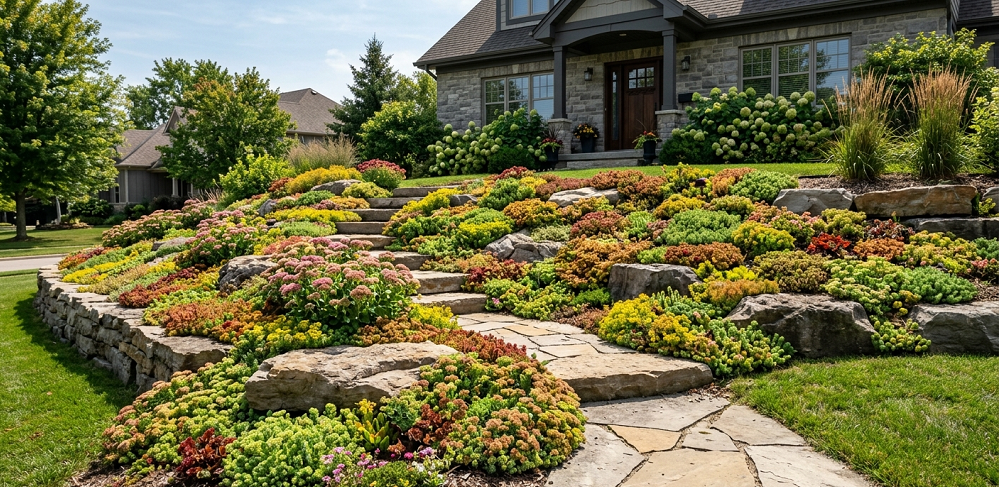
If your slope is hot, dry, rocky, and generally inhospitable to normal plants, sedum is your answer. These succulent-like perennials store water in their fleshy leaves and can survive conditions that would kill almost anything else on this list.
For slope coverage, the low-growing varieties are what you want: Sedum spurium (Dragon’s Blood is a popular red-leafed variety), Sedum kamtschaticum, and Sedum rupestre ‘Angelina’ (a chartreuse-yellow variety that genuinely glows in the sun). These form dense, weed-suppressing mats only 3 to 6 inches tall.
My favorite use for sedum is filling the gaps between steppingstones or rocks on a slope — the kind of spot where nothing else will grow. They creep in, root readily, and soften hard edges in a way that looks completely natural.
One note: sedum doesn’t like wet feet. If your slope has heavy clay soil that holds moisture, amend it with gravel or coarse sand before planting, or choose a different option from this list. Rotting roots are the one failure mode I’ve seen with otherwise bulletproof sedum.
9. Native Viburnum Shrubs (Viburnum spp.) — The Underrated Woody Anchor for Upper Slopes
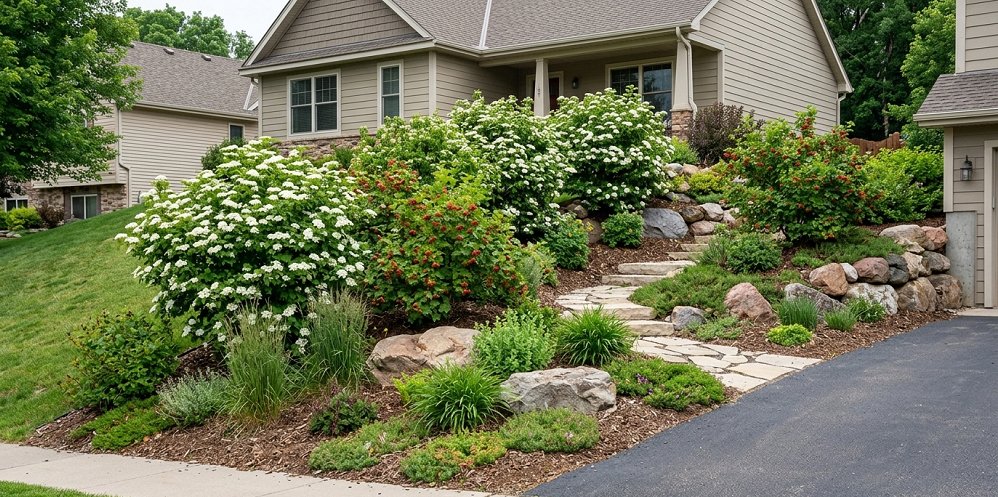
Most people think of viburnum as a background shrub, and they’re missing out. Arrow Wood Viburnum (V. dentatum) and Blackhaw Viburnum (V. prunifolium) are native shrubs with deep, spreading root systems that make them exceptional at holding the tops of slopes where erosion starts.
They bloom in late spring with clusters of white flowers, produce berries that birds absolutely mob in fall, and turn rich purple-red in autumn. Arrowwood viburnum handles both sun and partial shade, which makes it more flexible than most woody plants on this list.
I use viburnum as the structural backbone of a slope — planted at the top and along the edges to anchor the hard-working ground covers planted in between. They’re medium-fast growers (1 to 2 feet per year once established) and need minimal pruning. Just remove dead or crossing branches once a year and call it done.
10. Creeping Thyme (Thymus serpyllum) — The Fragrant, Foot-Traffic-Tolerant Slope Cover
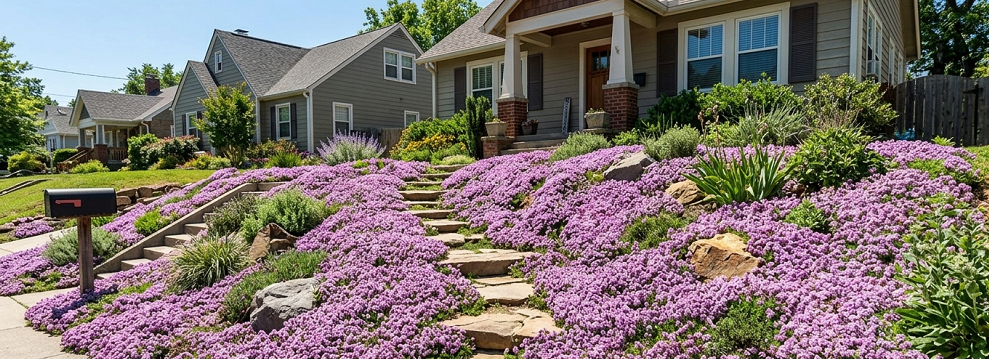
Quick side note before we wrap up: I want to include creeping thyme separately because it does something none of the other plants on this list do — it handles light foot traffic. If your slope has a path, a shortcut, or an area where people (or kids) will inevitably walk, creeping thyme can take it.
It’s a tiny-leaved, low-growing perennial that blooms pink-purple in early summer, smells wonderful when you brush against it or walk on it, and spreads steadily in full sun. It’s genuinely weed-suppressing once established because it grows so densely.
I planted a 4-foot strip of creeping thyme between my front slope and the sidewalk where people were cutting across the corner of my yard, and within two seasons it was thick enough to handle the traffic and fill in fully. It came back every year and even self-seeded slightly to fill gaps.
The only downside: it’s slow in its first year and needs watering until it’s established. Don’t skip that first-season irrigation — I tried, lost half a flat, and learned my lesson the expensive way.
Real Talk: What Can Go Wrong (And What’s Not Worth Your Time)
I’d be doing you a disservice if I didn’t say this plainly: ivy is not the answer to a sloped yard, even though the internet will tell you otherwise. English ivy looks great in photos and spreads fast — both of which are true — but it becomes an ecological nightmare that spreads into natural areas, climbs and stresses trees, and is nearly impossible to eradicate once it’s established. I helped a neighbor remove it from a slope three years ago. We are still finding it. It’s the gardening equivalent of glitter.
Ground cover roses — another popular slope suggestion — are a trap. Yes, they’re beautiful. They’re also covered in thorns, require disease management (black spot, rust, and various fungi), need annual pruning that will absolutely shred your forearms, and are frequently browsed to stubs by deer in any suburban area. I’ve found that roses on a slope are a total waste of money and effort, even if they look incredible on Pinterest. Save them for a raised bed you can reach without falling over.
Be realistic about establishment time. Every plant on this list takes 1 to 2 full growing seasons to really take hold. During that time, you’ll still have some erosion, some weeds, and moments of doubt. I’ve texted my nursery contact in a panic more than once because something looked half-dead in August only to come roaring back the following May. Slopes are stressful environments for young plants. Give them time before you declare failure.
Also: mulching a steep slope is harder than it looks. Standard shredded bark will slide right down in a heavy rain. Use shredded hardwood bark (it knits together better than wood chips), apply it 2 to 3 inches deep, and consider mixing in some biodegradable erosion netting to hold it while your plants establish.
Putting It Together: My Suggested Approach for a Low-Maintenance Slope
You don’t need to plant all ten of these. The most effective slope plantings I’ve seen use:
- One or two woody anchors at the top and edges (viburnum, forsythia, or creeping juniper)
- A mid-slope spreading perennial or ground cover to fill in the bulk of the area (daylilies, creeping phlox, ornamental grasses, or cotoneaster)
- A low, weed-suppressing mat plant at the bottom edge or between stones (sedum, creeping thyme, or black-eyed Susan as self-seeders)
Layer these in drifts rather than spotty individual plants, and you’ll get coverage faster and a more natural, intentional look without needing a designer.
Parting Wisdom
The best slope planting I ever did was the one I stopped overthinking. I picked three plants, bought enough to plant densely (because sparse planting on a slope just means more weeding in year two), got them in the ground in early fall, watered through dry spells that first season, and then deliberately left them alone.
The slope I once dreaded now genuinely delights me from the window. It costs me about an hour of attention per year. That’s the whole promise of the right plant in the right place.
Now I want to hear from you: do you have a specific slope challenge I haven’t addressed — odd shade, heavy clay, deer pressure, or a particularly brutal microclimate? Drop your question or your own hard-won experience in the comments below. I read every one, and sometimes the best advice in the thread comes from readers who’ve been exactly where you are.

About Syprose Kiche
Syprose Kiche is the creator and writer behind My Besuited Home, a practical home and garden website covering DIY projects, gardening, lawn care, landscaping, home improvement, and outdoor living. She focuses on turning everyday homeowner questions into clear, practical guides backed by careful research and useful real-world considerations.