
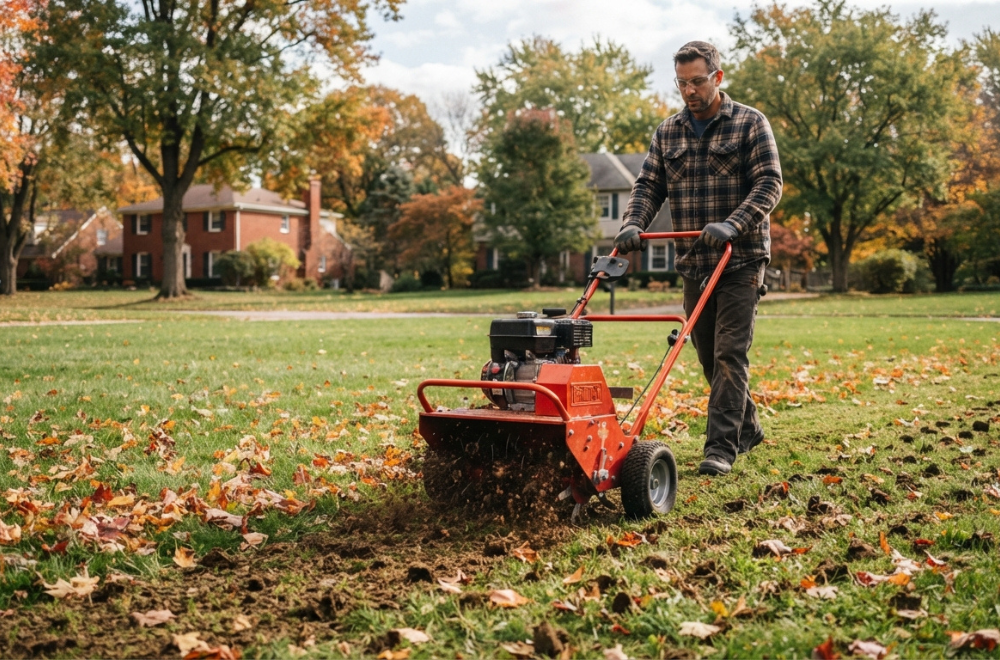
You water on schedule. You fertilize in spring and fall. You mow at the right height. And the lawn still looks tired by late summer — thin in the high-traffic areas, slow to green back up, puddling near the patio after a hard rain. That pattern usually points to one thing: the soil underneath the grass has become too compacted for roots, water, and air to move through it properly. No amount of fertilizer fixes that on its own. Aeration does, and September is when it does the most good for the widest range of lawns.
Why Grass Struggles Even When You’re Doing Everything Else Right
Healthy turfgrass needs three things to move freely through the soil: water, oxygen, and nutrients. In loose, well-structured soil, there’s enough pore space between soil particles for all three to reach the root zone. Foot traffic, mowing equipment, kids’ trampolines, parked cars, and even heavy rainfall gradually press those particles closer together. The pore space shrinks. Water starts running off instead of soaking in. Roots, unable to push down through dense soil, stay shallow.
Shallow roots are the real problem. A lawn with roots confined to the top inch or two of soil dries out faster in summer, thins out under normal foot traffic, and struggles to outcompete weeds that tolerate compacted soil better than turfgrass does — plantain, knotweed, and annual grasses are common examples. Fertilizing a compacted lawn can even make the visual problem worse in the short term, because it pushes leaf growth without giving the plant the root capacity to support it.
Clay soils compact faster and more severely than sandy soils, because clay particles are flatter and pack together more tightly. If your yard has heavy clay, or if it was part of a new housing development where topsoil was scraped and subsoil compacted by construction equipment, aeration isn’t optional maintenance — it’s closer to a requirement.
How to Tell If Your Lawn Actually Needs Aeration
A few checks are more reliable than guessing from the surface:
The screwdriver test. Push a standard flathead screwdriver into moist soil. If it slides in with light hand pressure to a depth of six inches, compaction probably isn’t severe. If it stops well short of that, or you need real effort to get it in even a couple of inches, the soil is compacted enough to benefit from aeration.
Water pooling or running off. If water sits on the surface for more than a few minutes after rain or irrigation, or if it runs toward the street instead of soaking in, that’s a compaction signal, not just a grading issue.
Thatch thicker than half an inch. Thatch is the layer of dead and living organic matter between the soil surface and the green grass blades. A thin layer is normal and even beneficial. More than about half an inch starts blocking water and nutrients from reaching the soil, and aeration helps break that layer up along with addressing compaction.
Heavy use areas. Paths worn into the lawn, spots where a dog runs the same line every day, or areas near a gate or driveway that see repeated foot traffic are almost always more compacted than the rest of the yard, even if the lawn looks fine elsewhere.
Not every lawn needs aeration every year. Sandy soil, low-traffic yards, and lawns that were aerated within the past year or two may not need it again immediately. The signs above are a better guide than a fixed yearly schedule.
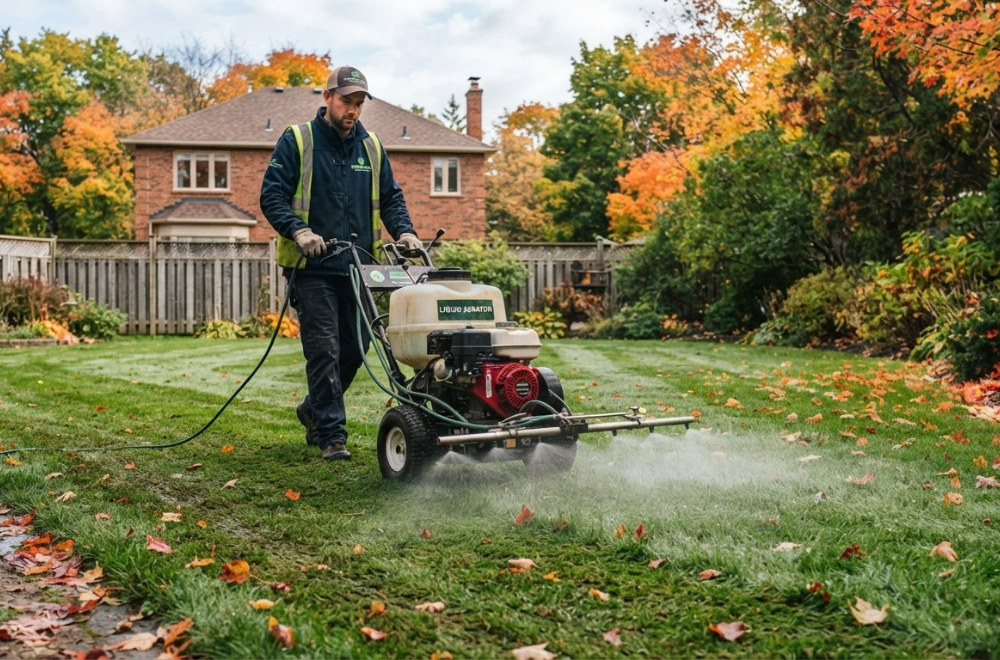
Why September Beats Spring for Most Cool-Season Lawns
Timing matters as much as the decision to aerate at all, and it depends heavily on what kind of grass is growing. Cool-season grasses — Kentucky bluegrass, tall fescue, perennial ryegrass, and fine fescue — are the ones for which early fall, roughly September into early October depending on region, is considered the ideal aeration window.
A few things line up in September that don’t line up as well at other times of year:
Soil and air temperatures have cooled from summer highs, which reduces stress on the grass plant during and after the aeration process. Aerating in the heat of July or August, by contrast, pulls the plant’s energy toward root repair at exactly the time it’s already struggling with heat and drought stress.
Cool-season grasses naturally shift into a period of active root and rhizome growth in early fall as temperatures drop, even though top growth slows. Aerating right before or during that window means the plant has weeks of favorable growing conditions to recover and use the loosened soil before winter dormancy sets in.
Weed pressure is typically lower in fall than in spring. Aeration opens up bare soil and improves light penetration at the surface — conditions that summer annual weeds like crabgrass exploit readily in spring but that are less hospitable to germinating weed seed in fall.
There’s also more time before winter for any overseeding done alongside aeration to establish, which matters enough that it gets its own section below.
Spring aeration isn’t wrong, exactly, but it comes with a tradeoff: spring is also when crabgrass and other warm-season weed seeds are germinating, and freshly aerated soil with good seed-to-soil contact is just as welcoming to weed seed as it is to grass seed. Fall largely avoids that competition.
Core Aeration vs. Spike Aeration: What’s Actually Happening Underground
These two methods are often presented as interchangeable options, but they solve the compaction problem in fundamentally different ways, and one of them can make compaction worse rather than better.
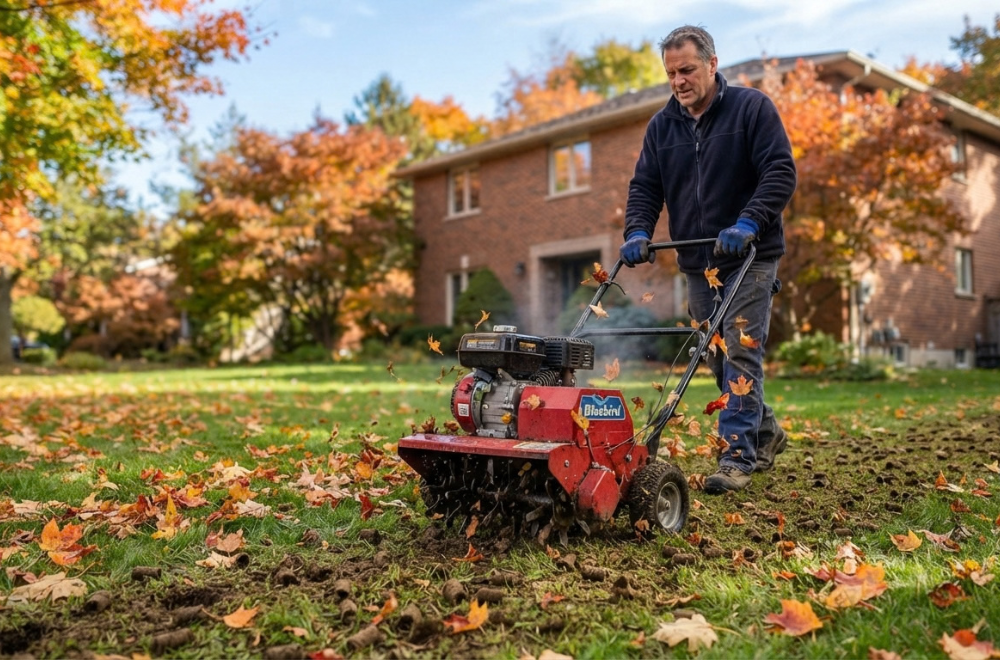
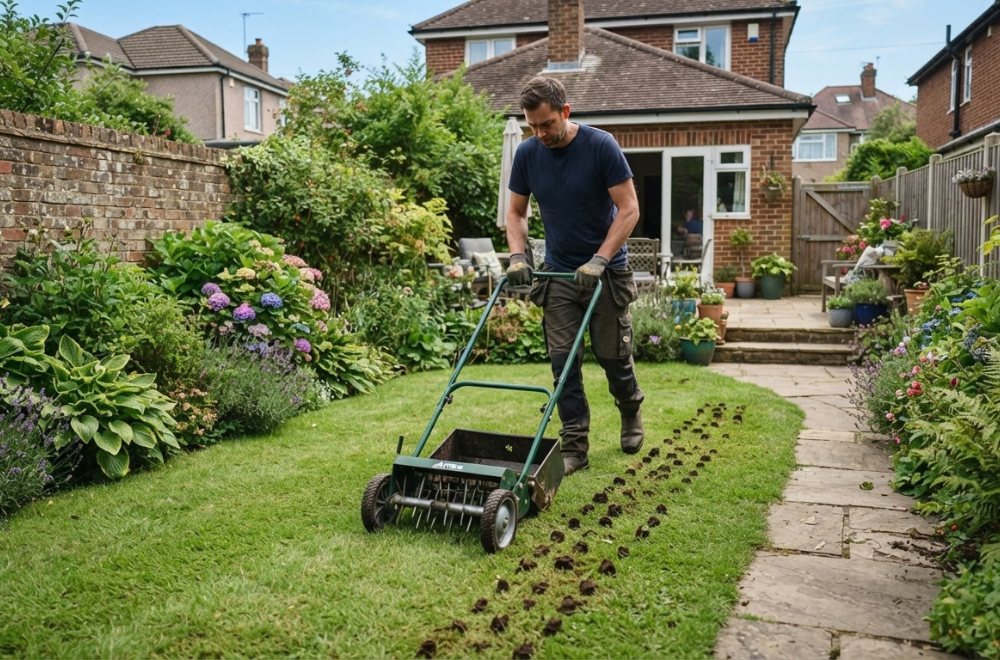
Core aeration uses hollow tines that physically remove small plugs of soil, typically two to three inches deep, and deposit them on the lawn surface. Removing material is the key mechanism. That extracted soil leaves real air pockets and channels behind, giving roots, water, and nutrients somewhere to go. The plugs left on the surface look messy for a week or two, but they break down on their own with rain, watering, and mowing, returning organic matter and beneficial microbes to the lawn in the process.
Spike aeration uses solid tines or spikes to poke holes into the soil without removing anything. The soil that was there is simply pushed sideways and compressed further around the new hole. In loose or sandy soil, this can create short-term channels that help water infiltration. In compacted or clay soil, it tends to compress the surrounding soil even more tightly, which can worsen the underlying problem it was meant to fix.
For a lawn showing genuine compaction — the screwdriver test, pooling water, thin high-traffic areas — core aeration is the method that actually addresses the cause. Spike aeration (including the aerator sandals sometimes sold for this purpose) is better thought of as light surface maintenance for lawns with minimal compaction, not a fix for a genuinely compacted yard.
There’s a mechanical reason core aeration works on a deeper level than the two- to three-inch holes suggest. Compacted soil doesn’t just resist roots at the surface — the whole profile down to several inches is denser than it should be, with fewer air pockets throughout. Removing plugs relieves pressure across the surrounding soil structure as well as inside the hole itself, similar to how loosening one section of tightly packed material lets the material next to it settle into a slightly less compressed arrangement. Spike aeration, by only displacing soil sideways, doesn’t relieve that pressure anywhere — it just relocates it to the soil immediately around the hole.
Rental core aerators are widely available at hardware stores and equipment rental centers for a day or half-day rate, and many lawn care companies offer core aeration as a standalone seasonal service if the equipment or effort isn’t practical to manage directly.
DIY Rental vs. Hiring a Lawn Care Service
For a lawn under roughly a quarter acre, a rented walk-behind core aerator is usually manageable in an afternoon, and rental costs for a half-day are typically lower than a single professional visit. The tradeoff is physical effort — walk-behind aerators are heavy, especially on slopes, and loading and transporting one requires a vehicle that can handle it, which some rental locations account for with delivery options at extra cost.
Hiring a lawn care company removes the equipment logistics and is often worth it for larger properties, for multiple properties, or where slopes and obstacles make maneuvering a rented machine impractical. It’s also the more practical route when aeration is being paired with other fall services like fertilization and overseeding on the same visit, since many companies bundle those services together. Neither option is inherently better; the decision usually comes down to lawn size, physical practicality, and whether the time saved is worth the added cost.
Reading Your Soil Before You Decide
Soil type changes how much aeration a lawn needs and how often.
Clay-heavy soil compacts more severely and holds onto that compaction longer, so lawns on clay generally benefit from aeration every year, sometimes twice a year in especially high-traffic yards. Sandy soil drains and re-loosens more naturally over time and may only need aeration every two to three years, or after a specific compacting event like construction equipment or a season of heavy use.
A simple way to get a rough read on soil type without lab testing: take a handful of moist soil and squeeze it into a ball. Clay soil holds a tight ball shape and feels sticky. Sandy soil falls apart almost immediately and feels gritty. Loam — the ideal middle ground — holds a loose shape but crumbles with light pressure. If there’s real uncertainty about soil composition or nutrient levels, a soil test through a local university extension office is inexpensive and gives more specific guidance than visual inspection alone, particularly if fertilizing decisions are also on the table.
What Happens to the Plugs Core Aeration Leaves Behind
The soil plugs scattered across the lawn after core aeration look, for lack of a better description, like a lot of small clumps of dirt — and that surprises people who expect a cleaner result. Leaving them in place is the correct move, not an oversight. As they break down over roughly two to three weeks with rain, irrigation, and regular mowing, the organic matter and microbial life in them gets redistributed across the lawn surface, which has a mild soil-conditioning benefit beyond the aeration itself.
Raking or bagging the plugs immediately after aerating removes that benefit for no real gain in appearance, since the lawn will look uneven for a short period either way. Running a mower over them once they’ve dried out somewhat helps break them down faster and is a reasonable middle ground for anyone bothered by the look.
Timing Aeration With Overseeding So the Seed Actually Establishes
Fall is also the preferred overseeding window for cool-season lawns, and pairing it with aeration is one of the more effective combinations in lawn care — but only when the sequence and timing are right.
Core aeration creates holes and loosened soil that give grass seed something it rarely gets when broadcast onto an undisturbed, compacted lawn: real seed-to-soil contact. Seed that lands on hard, unbroken soil surface mostly gets lost to birds, wind, or uneven moisture and never germinates in meaningful numbers. Seed that falls into or near an aeration hole has soil contact on multiple sides, retains moisture better, and germinates at a noticeably higher rate.
The practical order is aerate first, then overseed immediately afterward, while the holes are still open. Waiting several days after aerating before overseeding means the holes have already started to close from watering, rain, or foot traffic, and the germination benefit drops off.
After overseeding, consistent light watering matters more than the aeration itself for the first two to three weeks. New grass seed needs the top half-inch of soil to stay consistently moist, which usually means watering once or even twice a day in light sessions rather than a single deep watering, until the new grass has germinated and reached mowing height. Letting the surface dry out during this window is one of the more common reasons overseeding fails even when the aeration and seeding were done correctly.
Starter fertilizer applied at or shortly after overseeding, formulated with higher phosphorus to support root development in new seedlings, is worth considering here — though it’s a separate decision from the aeration itself and label rates should be followed rather than estimated.
Warm-Season Lawns: Why September Isn’t the Right Window
Everything above about September timing applies specifically to cool-season grasses. Warm-season grasses — bermudagrass, zoysia, St. Augustine, centipede, and bahiagrass — have a different growth cycle entirely, and aerating them in September works against that cycle rather than with it.
Warm-season grasses grow most actively in late spring through summer and begin slowing down and moving toward dormancy as fall approaches, roughly the opposite pattern of cool-season grass. Aerating a warm-season lawn in September means disturbing the root zone right as the plant is losing its ability to recover before winter dormancy, which can leave the lawn weaker heading into cold weather rather than stronger. For warm-season lawns, late spring into early summer, once the grass is fully green and actively growing, is the better aeration window.
Anyone unsure which category their lawn falls into can usually tell from a simple observation: grass that goes fully brown and dormant in winter and greens up again in late spring is almost always a warm-season variety; grass that stays green through winter in a temperate climate and struggles most in peak summer heat is typically cool-season.
Mistakes That Waste an Aeration Pass
Aerating dry, hard soil. Core aerators need some moisture in the soil to pull clean plugs. Aerating bone-dry, hard-packed soil often results in tines that barely penetrate, or plugs that crumble instead of coming out intact. Watering the lawn thoroughly a day or two beforehand, so the soil is moist but not soggy, makes a real difference in how effective the pass is.
Mowing too short right before aerating. Scalped grass has less leaf area to photosynthesize and recover with, right at the moment the plant is also dealing with root disturbance. A normal mowing height in the days before aerating is fine; an unusually short one is not.
Skipping a second pass on badly compacted areas. A single pass with a core aerator typically covers 20 to 25 percent of the lawn surface with holes. For lawns with significant compaction, a second pass in a different direction (aerating in a north-south line, then again east-west) roughly doubles that coverage and produces noticeably better results, particularly in high-traffic zones.
Aerating a lawn less than a year old. New sod or a newly seeded lawn hasn’t developed the root mass to handle the disturbance well. Most guidance suggests waiting at least one full growing season, often closer to a year, before aerating a new lawn.
Not marking irrigation lines or shallow utilities beforehand. Core aerator tines go two to three inches deep, which is enough to catch shallow sprinkler lines, invisible dog fence wire, or irrigation valves in some yards. A quick check of where these run, especially near the edges of the lawn, avoids an expensive repair.
Treating spike aeration as a substitute for core aeration on compacted soil. As covered above, this is less a mistake of effort and more a mistake of method — it can leave the lawn feeling like something was done without addressing the actual compaction.
Applying weed preventer (pre-emergent herbicide) at the same time as overseeding. Pre-emergent herbicides work by preventing seed germination broadly, which means they’ll block new grass seed from germinating just as effectively as they block weed seed. If pre-emergent weed control is part of the fall program, it needs to happen either well before or well after the aeration-and-overseed window, not during it. Checking the product label for its specific restrictions around seeding is worth the few minutes it takes.
Assuming one aeration will fix long-standing severe compaction. A single core aeration pass helps, but soil that has been compacted for years — under a swing set, along a well-worn path, in the strip next to a driveway — usually needs more than one season of annual aeration before the improvement really shows. Expecting a dramatic transformation after one fall pass sets up disappointment that isn’t really a reflection of whether aeration worked.
Overseeding with the wrong grass type for the site. Aeration creates the opportunity for new seed to establish, but that opportunity is wasted if the seed mix doesn’t match the light and traffic conditions of the area being overseeded. A shaded side yard overseeded with a sun-loving bluegrass blend, for instance, will struggle regardless of how well the aeration and watering were handled. Matching seed to sun exposure, foot traffic level, and regional climate matters as much as the timing.
What a Lawn Looks Like in the Weeks After Aerating
Immediately after core aeration, a lawn typically looks worse, not better — scattered soil plugs across the surface, visible holes, and if overseeding was done at the same time, bare patches where new seed hasn’t germinated yet. This is a normal, temporary stage, not a sign that anything went wrong.
Within one to two weeks, mowing and watering start breaking down the soil plugs and the lawn surface begins to even out. If overseeding was part of the process, new grass typically germinates within one to three weeks depending on the species — perennial ryegrass and tall fescue germinate faster, often within five to ten days, while Kentucky bluegrass can take two to four weeks. By four to six weeks after aerating, most lawns show visibly improved density and color compared to before, assuming watering was consistent during that window.
Full root system recovery and the deeper benefits of aeration — better drought tolerance, less compaction-related thinning, stronger competition against weeds — tend to become more apparent over the following growing season rather than immediately, which is part of why fall aeration is considered a long-term investment in lawn health rather than a quick fix.
Frequently Asked Questions
Can I aerate and dethatch at the same time? Yes, and doing both in the same fall session is common. Dethatching (using a rake or a power dethatcher to remove built-up thatch) and core aeration address related but different problems, and combining them before overseeding gives new grass seed the best possible contact with soil rather than a mat of dead organic material.
Do I need to rent a machine, or can I aerate a small lawn by hand? Manual core aerators exist — foot-operated tools with hollow tines — and they can work for very small lawns or isolated high-traffic spots. For anything beyond a small yard, they’re slow and physically demanding compared to a rented walk-behind or tow-behind core aerator, which most hardware stores and equipment rental centers carry by the day.
Will aeration hurt my grass? Some short-term stress and a rougher appearance are normal, but on the whole aeration is a repair process, not a damaging one, provided it’s done during the appropriate growing season for the grass type and not during a drought or extreme heat.
How often should I aerate? For most lawns with any degree of clay soil or regular foot traffic, once a year in early fall is a reasonable default. Sandy soil or low-traffic lawns can often go two to three years between aerations. The signs covered earlier in this article — the screwdriver test, water pooling, visible thinning in high-traffic areas — are a more reliable guide than a fixed calendar interval.
What’s the earliest and latest I can aerate in fall and still get good results? There’s some flexibility, but it narrows as the season goes on. Aerating too early, while soil and air temperatures are still summer-hot, adds stress at a bad time. Aerating too late, closer to the first hard frost, leaves too little of the growing season for cool-season grass to recover and for overseeded grass to establish before dormancy. As a general guide, most regions with cool-season lawns have roughly a six-week window in early fall where conditions are close to ideal; checking typical first-frost dates for the specific area is a more reliable way to narrow that window than a fixed date on a calendar.
Can I fertilize right after aerating? Yes, and it’s often a good pairing. The holes left by core aeration give fertilizer, like seed, better access to the root zone than it would have on unbroken soil. If overseeding at the same time, a starter fertilizer formulated for new grass is the more appropriate choice over a standard lawn fertilizer, since the two are formulated for different growth stages.
The Practical Takeaway
If a cool-season lawn is showing thin patches, slow recovery, or standing water after rain, September is the month to address it, not spring. Core aeration, not spike aeration, is the method that actually loosens compacted soil rather than compressing it further. And if overseeding is part of the plan, doing it immediately after aerating — followed by consistent light watering for the first few weeks — is what turns that combination from a good idea into new grass that actually establishes before winter.

About Syprose Kiche
Syprose Kiche is the creator and writer behind My Besuited Home, a practical home and garden website covering DIY projects, gardening, lawn care, landscaping, home improvement, and outdoor living. She focuses on turning everyday homeowner questions into clear, practical guides backed by careful research and useful real-world considerations.