
By late September, a lot of lawns start sending mixed signals. The grass still looks reasonably green, but it’s thinning in the high-traffic spots, water seems to run off instead of soaking in, and the mower is kicking up more dust than clippings. That combination — thin turf, hard soil, and a slowing growth rate — is exactly what fall lawn care is meant to fix, and it’s also why so many homeowners get the timing wrong. Spring feels like the obvious season to “fix” a lawn, but for most of the country, fall is when the real repair work actually holds.
Why Fall Does More for Your Lawn Than Spring Does
This matters enough to explain before getting into specific tasks, because it changes almost every decision below.
Most lawns in the northern two-thirds of the U.S. are planted with cool-season grasses — tall fescue, Kentucky bluegrass, perennial ryegrass, or a blend of these. These grasses have two growth peaks: a shorter one in spring and a longer, more important one in fall, once daytime temperatures drop into the 60s and 70s Fahrenheit while soil is still warm. During that window, the grass channels energy into roots and rhizomes rather than top growth, which is why fall seeding, fertilizing, and aeration have a much better success rate than the same work done in spring. Spring fertilizing on cool-season lawns often just feeds leaf growth right before summer heat stresses the plant anyway.
Warm-season grasses — Bermuda, zoysia, centipede, St. Augustine — work the opposite way. They’re heading into dormancy in fall, not a growth phase, and pushing new growth or heavy nitrogen at the wrong time can actually leave them more vulnerable to winter injury. If you have a warm-season lawn, several of the practices below (especially fertilizing and overseeding with cool-season seed) need to be approached differently, and that’s noted in each section.
If you’re not sure which type you have, check your region: cool-season grasses dominate the northern U.S. and transition zone states like Virginia or Missouri; warm-season grasses dominate the Deep South, the Gulf Coast, and much of Texas and the Southwest.
Aeration: Fixing the Soil Before You Fix the Grass
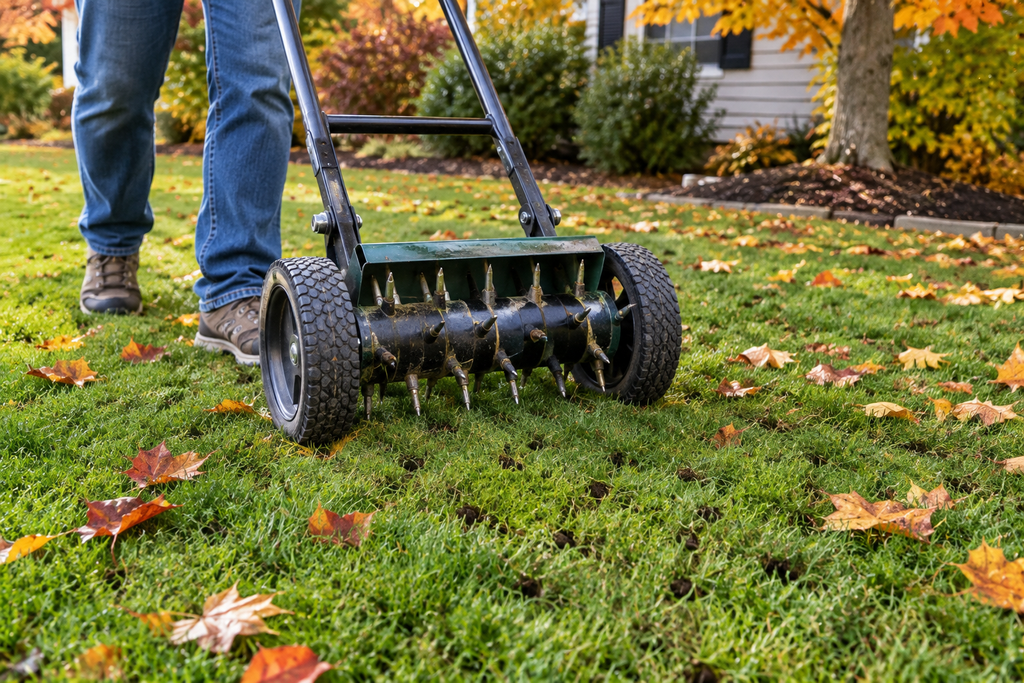
Grass roots need oxygen, water, and nutrients to move through the soil freely. Over a season of foot traffic, mowing, and rain, soil particles compact and press together, closing off the pore space roots depend on. Aeration — mechanically pulling small plugs of soil (or, less effectively, punching holes) — relieves that compaction and lets air, water, and fertilizer reach the root zone instead of running off the surface or sitting in a shallow layer of thatch.
How to Tell If Your Lawn Actually Needs It
Not every lawn needs annual aeration, and doing it on soil that doesn’t need it wastes effort without much benefit. A few signs point toward compaction:
- Water pools on the surface or runs off quickly after rain instead of soaking in.
- The lawn feels hard underfoot, almost like walking on packed dirt with a thin layer of grass on top.
- Grass struggles in high-traffic areas — along a regular walking path, near a gate, under a swing set — while the rest of the lawn looks fine.
- A screwdriver or garden trowel is difficult to push a few inches into the soil when it’s moderately moist.
- The lawn sits on clay soil, which compacts far more readily than sandy or loamy soil.
Lawns that were recently established, sit on sandy soil, or get light foot traffic may not need aeration every year. Clay soils, lawns with kids or dogs running on them regularly, and any lawn that hasn’t been aerated in two or more years are good candidates.
Core Aeration vs. Spike Aeration
There are two common tools, and they are not equally effective. A core (or plug) aerator physically removes small cylinders of soil and deposits them on the surface, creating real space for roots to expand into. A spike aerator simply pokes holes into the ground without removing material — in compacted clay, this can make the compaction slightly worse around each hole, since the soil gets pushed sideways rather than removed. For anything beyond very light, sandy soil, core aeration is the method worth using. Core aerators can be rented from most hardware or equipment rental stores for a day; for larger properties, hiring a lawn care company to aerate is often more cost-effective than renting and operating a heavy machine yourself.
When to Aerate
For cool-season lawns, early to mid-fall is the preferred window — timed so the grass has several weeks of active growth afterward to recover and, ideally, close in before overseeding if that’s part of the plan. For warm-season lawns, aeration is better done in late spring or early summer, while the grass is actively growing; aerating a warm-season lawn in fall, right before dormancy, gives it little time to recover and can leave it more exposed to winter stress.
A practical note: aerate when the soil is moist but not soaked — a day or two after rain or irrigation. Bone-dry compacted soil is difficult for the aerator to penetrate cleanly, and waterlogged soil tends to smear rather than pull clean plugs.
Leave the soil plugs on the lawn to break down naturally; they’ll disappear within a couple of weeks with mowing and rain, returning organic matter and microbes to the surface. Raking them up removes a benefit for no real gain.
Fertilizing: Feeding Roots, Not Just Leaves
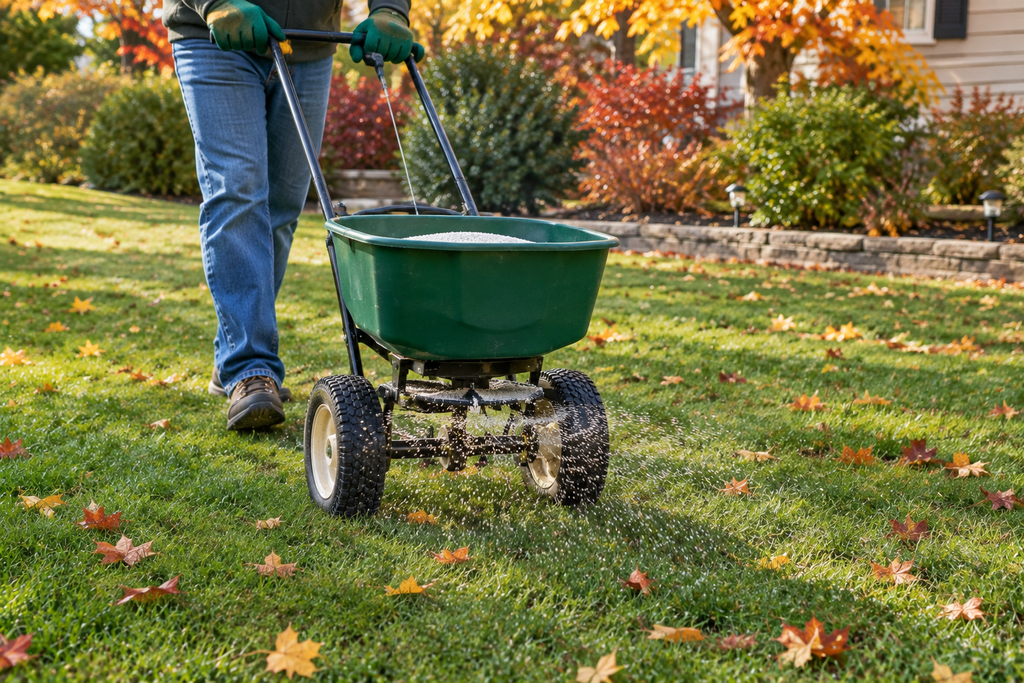
Fall fertilizing works differently from a summer feeding, and the goal is different too. Instead of pushing visible leaf growth, a fall application is meant to support root development and let the plant store carbohydrates it will draw on to green up quickly the following spring.
What to Look for in a Fall Fertilizer
Fertilizer bags list three numbers separated by dashes — nitrogen (N), phosphorus (P), and potassium (K), in that order, by percentage of weight. For a fall application on cool-season grass, a blend moderate in nitrogen and higher in potassium is generally recommended, since potassium supports cold tolerance and stress resistance heading into winter. Phosphorus needs vary a lot by soil — many established lawns already have adequate phosphorus, and some states restrict phosphorus fertilizer use except when a soil test shows a deficiency, so it’s worth checking local regulations before buying a high-phosphorus product.
A soil test, available through most state university extension offices for a modest fee, is the only reliable way to know what a specific lawn actually needs rather than guessing from a bag label. This matters more than it sounds — over-fertilizing doesn’t just waste money, it can burn grass, contribute to nutrient runoff into local waterways, and in some cases feed fungal diseases that thrive on excess nitrogen.
Timing for Cool-Season Lawns
Most extension guidance for cool-season grasses recommends one to two fall applications: an early fall feeding (roughly early-to-mid September in much of the transition zone and northern U.S., though local timing varies with climate) and, in many programs, a second “winterizer” application in late fall, several weeks before the ground is expected to freeze. That second application is the one most closely tied to the potassium-for-cold-hardiness benefit described above. Applying fertilizer too late — after the ground has essentially stopped absorbing nutrients — wastes product and risks runoff.
Fall Fertilizing on Warm-Season Lawns
This is where fall fertilizing needs the most caution. Warm-season grasses are shutting down growth as temperatures drop, and a heavy nitrogen application in early fall can push new, tender growth right before the first frost — growth that’s poorly cold-hardened and more likely to be damaged or killed over winter. Most extension recommendations for warm-season lawns call for stopping nitrogen fertilization several weeks before the average first frost date in your area, and some programs skip fall nitrogen altogether, relying instead on a properly timed late-summer feeding.
A Mistake Worth Naming
A common mistake is treating “fall fertilizer” as one product applied once, on a schedule copied from a bag or a neighbor’s routine, regardless of grass type or region. The same bag of “fall lawn food” that’s ideal for a fescue lawn in Ohio in September can be poorly timed for a Bermuda lawn in Georgia the same month. Matching the product and timing to the actual grass species is a bigger factor in outcome than the specific brand of fertilizer used.
Overseeding: Filling In Thin Turf While Conditions Favor It
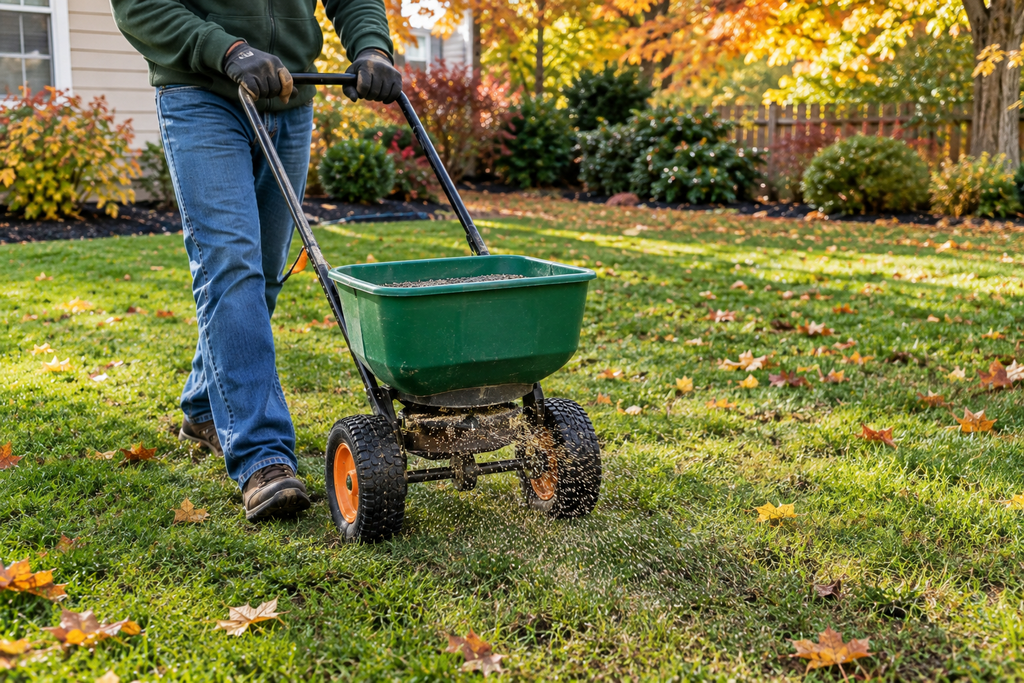
Overseeding — spreading grass seed over an existing lawn rather than starting from bare soil — is how most cool-season lawns thicken up and recover from summer thinning, drought stress, or disease damage. Fall is by far the most reliable time to do it, for the same reason fall favors root growth generally: warm soil, cooling air, and typically more consistent rainfall create conditions new seedlings need without the heat stress or weed competition that spring seeding runs into.
Pairing Overseeding With Aeration
Seed needs direct contact with soil to germinate — seed that lands on a dense mat of existing grass or thatch mostly dries out or gets eaten before it ever roots. This is why aeration and overseeding are usually done together: the holes and loosened soil from core aeration give a portion of the seed somewhere to actually settle in and make contact, dramatically improving germination compared to spreading seed over undisturbed turf. Aerate first, then seed, ideally on the same day or shortly after, while the holes are still open.
Choosing Seed
Match the seed to the existing lawn and to light conditions, not just to what’s on sale. A few practical distinctions:
- Tall fescue blends handle heat, drought, and foot traffic well and are a common choice for transition-zone lawns, but they’re bunch-forming rather than spreading, so bare patches need direct seeding rather than relying on the surrounding grass to fill in.
- Kentucky bluegrass spreads via rhizomes and can self-repair small bare spots over time, but it’s slower to germinate (often two to four weeks) and less drought-tolerant than fescue.
- Perennial ryegrass germinates fast — often within a week to ten days — which makes it useful for quick cover, but it doesn’t tolerate extreme cold or heat as well as fescue or bluegrass and is often blended with them rather than used alone.
- For shaded areas, look specifically for a shade-tolerant fescue blend; standard sun-formulated mixes will struggle and thin out again regardless of how well the rest of the process is done.
Buying seed labeled for the specific region and light conditions matters more here than almost any other step, since even perfect timing and watering can’t compensate for seed that’s poorly suited to the site.
Seeding and Watering
After spreading seed at the rate listed on the product label (rates vary significantly by species and by whether it’s a bare-spot repair or full overseeding), a light layer of straw, seed-starter mulch, or peat moss helps retain moisture and reduce seed washing away in heavy rain, though it’s not strictly required on a properly aerated lawn.
New seed needs consistently moist — not soaked — soil to germinate, which typically means light watering once or twice a day for the first one to two weeks, tapering to less frequent, deeper watering as seedlings establish and develop deeper roots. Letting the surface dry out during germination is one of the most common reasons overseeding fails; a single missed day in hot, windy conditions can kill a batch of just-sprouted seedlings that had barely broken the surface.
New grass generally shouldn’t be mowed until it reaches about three inches tall and only then with a sharp blade, since a dull blade can pull up shallow-rooted young seedlings rather than cutting them cleanly.
When Overseeding Won’t Work
Overseeding fails or underperforms in a few predictable situations: seeding too late in fall, leaving too little time for roots to establish before the ground freezes; seeding into a lawn with an unaddressed weed or grub problem, where the new seedlings compete poorly against established weeds or get eaten before they root; and seeding warm-season lawns with cool-season seed for winter color (a practice called “winter overseeding,” common with ryegrass over dormant Bermuda in warmer climates) without understanding that it requires ongoing mowing and watering through winter and a deliberate transition back to the warm-season grass in spring.
Leaf Management: Why “Just Leave Them” and “Rake Every Weekend” Are Both Oversimplified
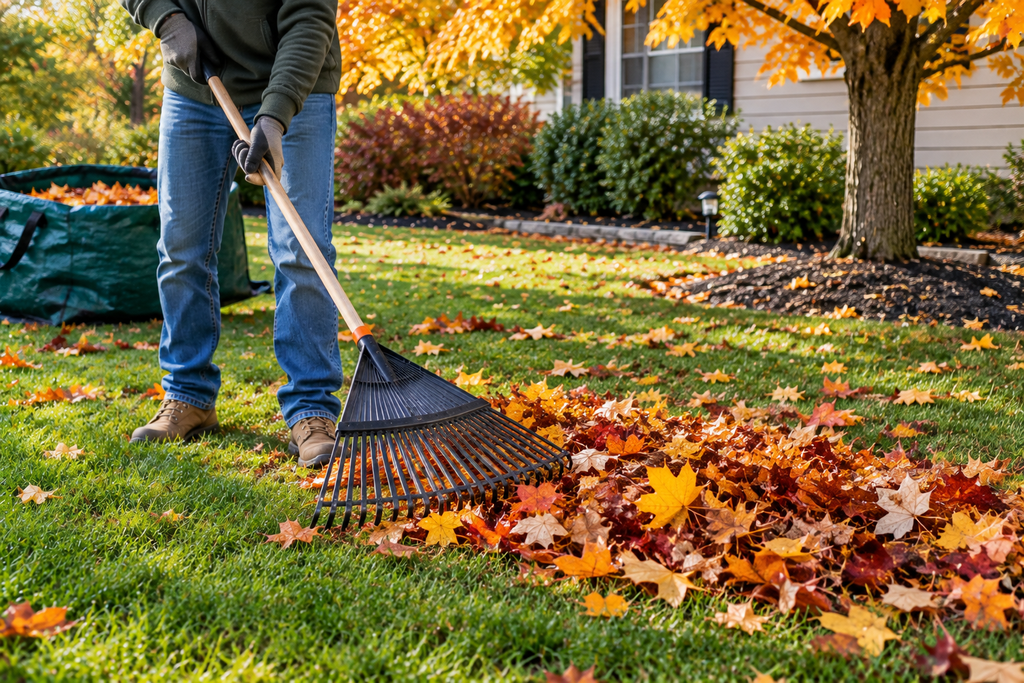
Fallen leaves get treated as either harmless (leave them, they’re natural) or uniformly bad (rake constantly), and neither extreme fits most yards well.
A thin, scattered layer of leaves mulched into small pieces with a mower is genuinely beneficial — it breaks down over winter, adds organic matter, and can suppress some weed seeds from germinating in spring. Research from several university turf programs has found that regularly mulching moderate leaf litter directly into the lawn with a mulching mower doesn’t harm turf and can reduce spring weed pressure.
The problem is a thick, wet mat of whole leaves sitting on the grass for weeks. That kind of cover blocks sunlight, traps moisture against the grass blades, and creates conditions favorable to fungal diseases like snow mold, while also smothering grass that’s trying to photosynthesize through its last weeks of active growth before dormancy.
A Practical Rule
If leaf cover is light enough that grass is still visible through it, mulching with the mower on a regular pass is usually sufficient — run over the leaves a couple of times with a mulching blade until pieces are dime-sized or smaller. If leaves are piling up thick enough to fully hide the grass, especially after a heavy drop or a windy week, that layer needs to come off, either by raking, blowing to a collection area, or a more aggressive mowing pass with bagging.
Leaves that land on newly overseeded areas deserve extra attention regardless of thickness — even a light layer can smother young seedlings that don’t yet have the root system to push through.
What to Do With Collected Leaves
Whole leaves are slow to break down and can mat together in a compost pile if added in a thick layer all at once. Shredding them first — running them through a mower or leaf shredder before composting or using them as mulch in garden beds — speeds decomposition considerably and prevents the matting that can otherwise create anaerobic, smelly spots in a compost pile.
Preparing the Lawn and Yard for Winter
Winter prep isn’t a single task so much as a handful of small ones, each addressing a different way lawns and outdoor systems get damaged over the cold months.
The Last Mow of the Season
Cutting grass too short going into winter exposes the crown of the plant — the part just above the soil line where new growth originates — to cold stress and desiccation. Cutting it too tall, on the other hand, can leave long blades that mat down under snow and create the damp, dark conditions snow mold thrives in. Most turf programs recommend gradually lowering mowing height over the final few cuts of the season, landing on a final cut somewhat shorter than the summer mowing height but not scalped — generally in the range of two to two-and-a-half inches for most cool-season lawns, though the ideal figure varies by grass species. Keep mowing as long as the grass is actively growing, even if that stretches into late fall; stopping too early just means longer grass going into winter.
Irrigation Shutoff
In climates where the ground freezes, irrigation systems left full of water risk cracked pipes, valves, and backflow preventers when that water expands as it freezes. Shutting off the system’s water supply and draining or blowing out the lines with compressed air (a service many irrigation companies offer, since it requires specific equipment and technique to do without damaging sprinkler heads) before the first hard freeze prevents a repair bill in spring. Anyone unfamiliar with their system’s shutoff valve or backflow preventer is generally better served hiring this out rather than guessing, since a mishandled blowout can cause the exact damage it’s meant to prevent.
Protecting Equipment
Mowers, trimmers, and other gas-powered equipment sitting unused over winter benefit from a few basic steps: running the engine until the fuel tank is empty or adding a fuel stabilizer to prevent gas from degrading and gumming up the carburetor, changing the oil if it’s due, and either removing the battery on electric-start equipment or keeping it on a maintainer, since batteries drain and can be damaged by sitting fully discharged in cold temperatures over several months.
De-Icing Products and Lawn Edges
Rock salt and other chloride-based de-icers used on driveways and walkways commonly run off or get shoveled onto adjacent lawn edges, and that salt buildup in the soil can damage or kill grass along the border — a pattern that often shows up as a dead strip along a driveway the following spring with no obvious cause until the connection to winter de-icing is made. Where possible, using calcium chloride or a lawn-safe de-icer near turf edges, or simply shoveling before ice forms to reduce how much product is needed, limits this damage. Sand can be used for traction on walkways without the salt-related soil impact, though it doesn’t melt ice the way chloride products do.
Snow Mold Prevention
Snow mold is a fungal disease that develops under snow cover, particularly where snow falls on grass that wasn’t mown short enough or where leaf litter or debris trapped moisture against the turf. The final mow at a proper height, combined with clearing leaf debris before the ground freezes, are the two most effective preventive steps available to a homeowner without resorting to fungicide, which is typically reserved for lawns with a documented history of severe snow mold damage and is applied in late fall before snow cover, per label and often per a lawn care professional’s recommendation.
Putting the Fall Schedule Together
For a cool-season lawn, the order these tasks happen in matters almost as much as the individual steps. A reasonable sequence, adjusted for local climate:
- Early fall: first fertilizer application; core aerate.
- Immediately after aeration: overseed, using the aeration holes for seed-to-soil contact.
- Through the following weeks: water new seed frequently and lightly; continue mowing at a normal height as the lawn and new seedlings grow, raising the mower to avoid scalping tender new grass.
- Mid-to-late fall: manage leaf litter on an ongoing basis rather than letting it accumulate; apply a second “winterizer” fertilizer application several weeks before the ground typically freezes.
- Late fall, before the ground freezes: final mow at reduced height; irrigation system shutoff and blowout; equipment winterizing.
Warm-season lawns follow a different calendar almost entirely — aeration and any overseeding of the permanent turf happen in late spring or early summer, not fall, and fall attention shifts mainly toward reduced nitrogen, gradual mowing height increases before dormancy, and leaf management, with winter ryegrass overseeding as an optional separate project for anyone wanting green color through the cold months.
Frequently Asked Questions
Can I aerate and fertilize on the same day? Yes — in fact, applying fertilizer right after aeration is generally beneficial, since the open holes let nutrients reach the root zone more directly instead of sitting on top of thatch or compacted soil.
Is it too late to overseed if the first frost has already happened? A light frost doesn’t necessarily end the window, since cool-season grass seed can still germinate in cool soil, but germination slows considerably once soil temperatures drop much below the mid-50s Fahrenheit, and seed spread too close to a hard freeze may not establish enough root before winter dormancy to survive. Checking local soil temperature (many state extension offices publish this) is more reliable than going by calendar date alone.
Do I need to bag grass clippings in fall the way I might avoid it in summer? Not specifically because of the season — the usual reasoning for mulching clippings (returning nitrogen and organic matter to the soil) still applies in fall. The exception is if clippings are being deposited on top of a thick layer of fallen leaves, in which case both should probably be collected together rather than left to mat down on the lawn.
Where to Start
If only one task on this list gets done this fall, addressing compaction with core aeration will do the most to help everything else work — fertilizer absorbs better, water reaches roots instead of running off, and overseeded grass actually makes contact with soil instead of sitting on top of it. Everything else on this list works better once that step is handled first.

About Syprose Kiche
Syprose Kiche is the creator and writer behind My Besuited Home, a practical home and garden website covering DIY projects, gardening, lawn care, landscaping, home improvement, and outdoor living. She focuses on turning everyday homeowner questions into clear, practical guides backed by careful research and useful real-world considerations.