
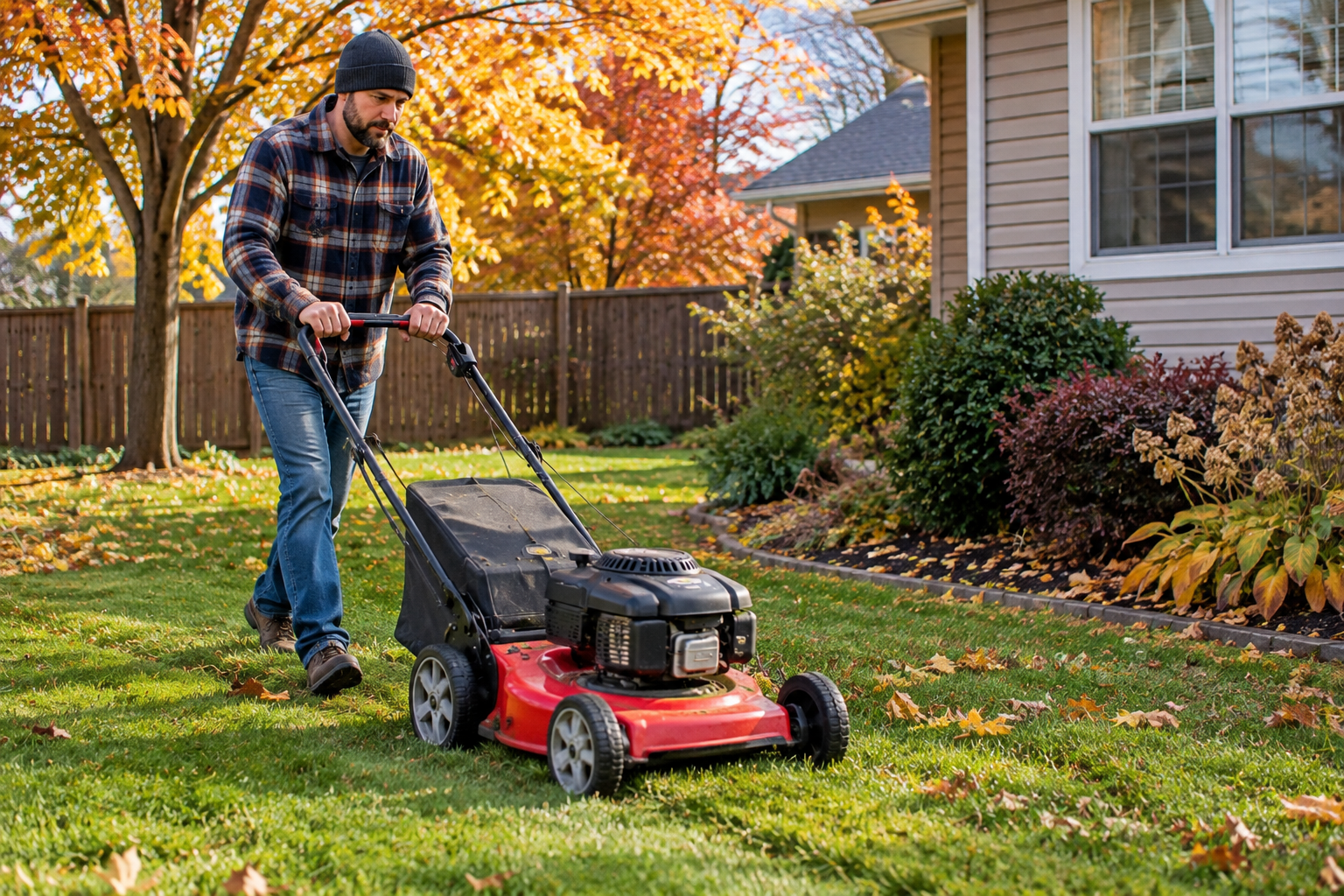
Two pieces of fall lawn advice make the rounds every year, and they point in opposite directions. One says to drop the mower deck for the final cut so the grass can’t flop over under snow and rot. The other says a short cut leaves the plant exposed just when it’s storing energy for winter. Both warnings come from real problems. Both go wrong when taken to extremes.
The most defensible answer, based on university extension guidance, is a modest one. In regions with cold, snowy winters, a cool-season lawn can go into winter slightly shorter than its summer height, usually around 2 to 2.5 inches, reached over several mowings. None of the extension material cited below recommends a buzz cut. For warm-season grasses such as bermudagrass, zoysia, and St. Augustine, the advice often runs the other way. Where you live and what you’re growing decide which rule applies, so the reasoning matters more than any single number.
A quick way to decide
- Cool-season grass (Kentucky bluegrass, tall fescue, fine fescue, perennial ryegrass) with snowy winters: lower the deck in steps over the last few mowings, ending around 2 to 2.5 inches. If you already mow at 2.5 to 3 inches, some extension specialists see little reason to change.
- Cool-season grass with mild winters and little lasting snow: keep your normal fall height.
- Warm-season grass: don’t lower it for winter. Sources tend to say keep the usual height, or raise it slightly.
- Every lawn: keep mowing while the grass is still growing, and never remove more than a third of the blade height in one pass.
The rest of this article explains the reasoning behind each line, including the places where experts disagree.
Why the experts don’t fully agree
Compare what a few university sources say.
The University of Minnesota’s turf program has advised keeping the lawn at the same height it’s had through fall. Its reasoning is that cutting too short stresses the grass more than the snow mold or rodent damage it’s meant to prevent. For lawns that run 3 inches or taller, it suggests bringing the height down to about 3 inches over several mowings, so the grass adjusts to the new height before winter instead of being cut down once at the very end.
Ohio State University’s BYGL bulletin takes a slightly different line. It suggests about 3 inches during the season, then a return to roughly 2 inches for the last few mowings in areas where snow cover is common, specifically to head off snow mold. The University of Nebraska–Lincoln’s fall turf tips also point to a final mow of 2 to 2.5 inches. Karl Danneberger, a turfgrass professor at Ohio State, has been quoted recommending that cool-season lawns be mowed at the same height through summer and fall and that the key is to keep going until the mower stops picking up clippings.
So the range runs from “change nothing” to “go down to about 2 inches.” It looks like a contradiction, but most of the gap comes from two different worries. Minnesota’s concern is stress on the plant. Ohio State’s bulletin and Nebraska’s tips are concerned with a wet, matted canopy under snow. The positions overlap more than they seem to. Nobody in this group suggests scalping, everyone says to keep mowing until growth stops, and the sources that do favor a shorter final height want it reached gradually and only modestly below the normal height.
A workable reading: the taller your normal mowing height, the more sense it makes to bring it down before snow. A lawn that’s been at 4 inches through September has far more blade to collapse than one kept at 2.5. If you already sit at the low end of the recommended range for your grass, there’s little to gain from going lower.
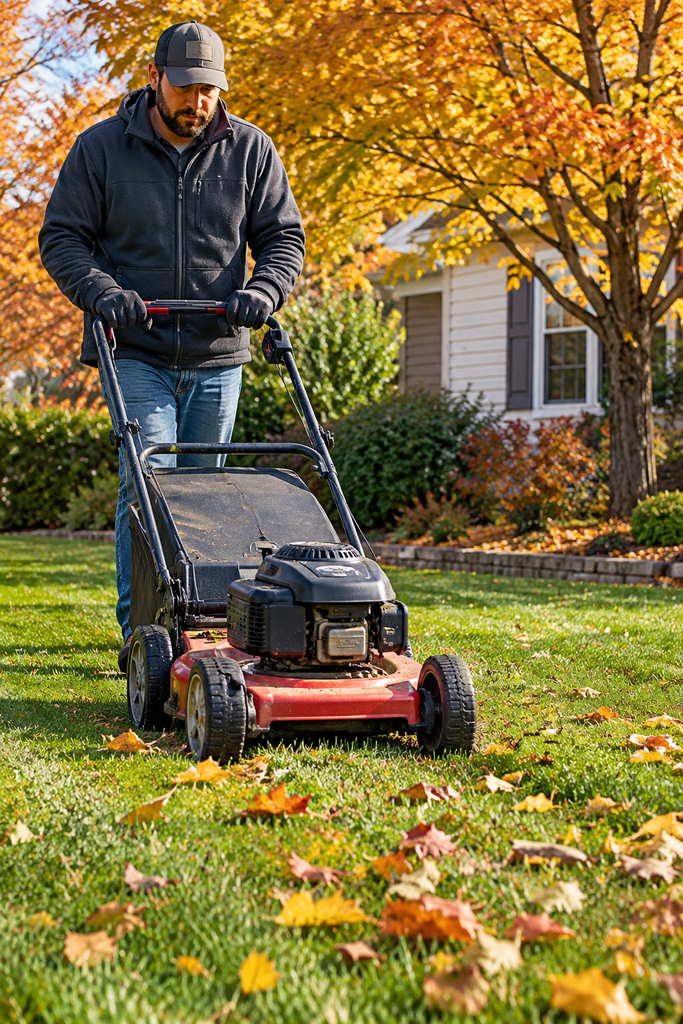
What tall grass does under snow
Long, fine leaf blades fold over under the weight of snow and form a dense mat against the soil. That mat holds moisture and cuts airflow at the surface for as long as the snow lasts, which is close to ideal for snow mold, a group of fungal diseases that develop under snow cover. Gray snow mold generally needs a lasting blanket of snow. Pink snow mold can show up in cool, damp weather even when snow cover is thin.
When the snow melts, the damage shows as roughly circular patches of matted, straw-colored or grayish grass, sometimes with a thin, webby crust of fungus across the surface. Pink snow mold may carry a pinkish tint. In many cases the crowns of the plants survive and the lawn grows out of it as the weather warms, but it can look rough for weeks, and badly hit patches may need raking and overseeding.
Height is only one contributor. Heavy layers of unraked leaves, thick thatch, a large dose of nitrogen applied late in fall (which pushes soft, lush growth right before dormancy), and poorly drained or shaded spots all add to the risk. That’s why a lawn cut very short but buried under leaves can still develop mold, while a moderately shorter lawn kept clear of leaf piles usually fares better.
Voles are the other winter problem attributed to long grass. These small rodents travel in shallow runways beneath the snow, and in spring their work shows up as narrow, winding trails of chewed or thinned turf. Tall grass gives them cover, though so do leaf piles and thick mulch along a lawn’s edge, so mowing height is just one piece of it.
There’s a smaller cost as well: matted grass tends to dry out and green up more slowly in spring, since the dead, flattened layer sits between the soil and the sun.
What scalping does to grass heading into winter
Scalping means cutting low enough to expose stems and growing points, leaving a brown, stubbly surface and sometimes bare soil at the high spots. It usually happens when a lawn has been allowed to grow long and is then cut down in one pass, or when the deck is set lower than the grass type tolerates.
The trouble in fall is timing. Cool-season grasses do a lot of their food storage in autumn, when mild temperatures let the leaves photosynthesize while growth above ground slows. The sugars produced go into roots, crowns, and stems, and that reserve is what carries the plant through winter and fuels spring regrowth. Take away most of the leaf area and the plant has less to store.
Scalping has other effects that show up later:
- Exposed crowns and soil. A dense canopy softens temperature swings and wind at the soil surface. Scalped turf has less of that protection.
- More weeds. A thin canopy lets light reach the soil, which helps winter annual weeds such as chickweed and henbit, both of which germinate in fall, get established.
- Warm-season stress. Mississippi State University Extension notes that St. Augustine cut below about 2 inches can lose density because its stolons (the above-ground runners) are exposed and there’s less leaf area. Bermudagrass and zoysia lawns scalped late in the season head into dormancy with less cover than they’d otherwise have.
Scalping also isn’t purely a matter of the height setting. A mower deck is a fixed-length flat surface, so ridges, humps, and the crown of a slope get cut lower than the flat ground around them. A deck set at 2.5 inches can scalp a bump. If the lawn has uneven spots, raise the deck a notch for the last passes, or take those areas more slowly.
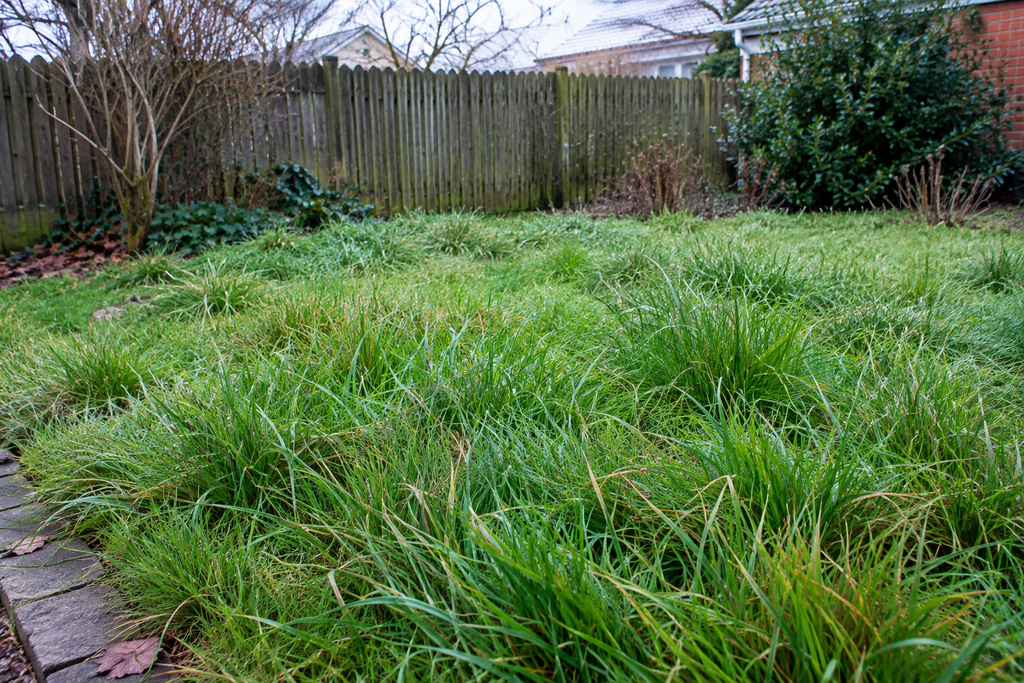
How to lower the height without shocking the lawn
The standard guardrail is the one-third rule: never remove more than about a third of the blade length in a single mowing. It applies in fall like any other time, and it’s the reason a “last cut” should really be the end of a sequence of two or three lower cuts.
An example with real numbers. Say a fescue lawn has been mowed at 3.5 inches all summer.
- First fall mow: cut at 3.5 inches, as usual.
- Next mow: drop to about 3 inches.
- Final mow: drop to about 2.5 inches.
Fall growth is slow, so the grass may only gain a half inch or so between mows. Going from roughly 3.5 down to 2.5 removes about 29 percent of the blade, which is inside the one-third limit. Contrast that with a lawn that’s been skipped for a few weeks and stands 5 inches tall. Cutting it straight to 2.5 inches takes off half the blade. That lawn needs two passes several days apart, with the first only bringing it down to about 3.5 inches.
The University of Minnesota’s advice fits this approach: if you lower the height, mow at the new height several times so the lawn adapts, rather than making it a one-time drop.
Two practical checks make this work better:
- Measure the actual cut. Deck height settings on many mowers are approximations. Cut a test pass on a flat, firm spot, then push a ruler down to the soil and read the height of the grass. If the ruler says 2 inches and the dial says 2.5, you know how far to adjust.
- Mow dry, on thawed grass. Wet grass clumps and smears, and frozen blades are brittle and tear rather than cut. If the lawn is crunchy with frost in the morning, wait until it thaws and dries.
Mowing heights by grass type, and what changes in fall
Mowing height ranges differ between sources and between cultivars, and university guidance for one state doesn’t always match another’s. The figures below are typical ranges drawn from extension guidance. Where your local extension office publishes a specific recommendation for your grass and region, follow that one.
Cool-season grasses
These stay green through light frost and grow most actively in spring and fall.
| Grass | Typical mowing height | Final mows in snowy climates |
| Kentucky bluegrass | 2.5 to 3.5 in | about 2 to 2.5 in |
| Tall fescue | 3 to 4 in | about 2.5 to 3 in |
| Fine fescues | 2 to 3.5 in | about 2 to 2.5 in |
| Perennial ryegrass | 2 to 3.5 in | about 2 to 2.5 in |
Read the last column as a target for people who want a shorter final height, not a requirement. Where a source (Minnesota, for instance) says to keep the height you’ve had, that’s a reasonable choice too, especially if your lawn is already at or under 3 inches. In climates with little snow, there’s less reason to drop.
Tall fescue deserves a note. It has a coarser, wider blade and is usually mowed toward the taller end of the cool-season range. If you’re bringing it down for winter, spread the drop over extra mowings.
Warm-season grasses
These turn tan after frost and grow most actively in summer.
| Grass | Typical mowing height | Before winter |
| Bermudagrass | 0.5 to 1.5 in (hybrids toward the low end; common types often 1 to 2 in) | Keep usual height; a slight raise at the cold edge of its range |
| Zoysia | roughly 1 to 2.5 in, depending on cultivar | Keep usual height |
| St. Augustine | 2.5 to 4 in (dwarf varieties around 2 to 2.5 in) | Keep usual height; don’t cut below 2 in |
| Centipedegrass | 1.5 to 2 in | Keep usual height |
| Bahiagrass | 3 to 4 in | Keep usual height |
| Buffalograss | about 2 to 4 in, depending on how often it’s mowed | Keep usual height |
Zoysia shows the widest gap between sources, from around 1 to 1.5 inches in Mississippi State’s figures to 2 to 2.5 inches in University of Florida guidance for many home lawns. Cultivar matters here, and so does whether the variety is fine-bladed or coarse.
The reason warm-season lawns are treated differently comes down to how they winter. Frost sends them dormant, and dormant turf doesn’t need mowing at all. The concern is the stretch before dormancy, when the leaf canopy helps insulate stems and stolons. Danneberger has been quoted suggesting that bermudagrass mowing height be raised a little going into fall, particularly in the northern part of its range. Lowering it, by contrast, removes leaf area at a time when the plant has little chance to make it back.
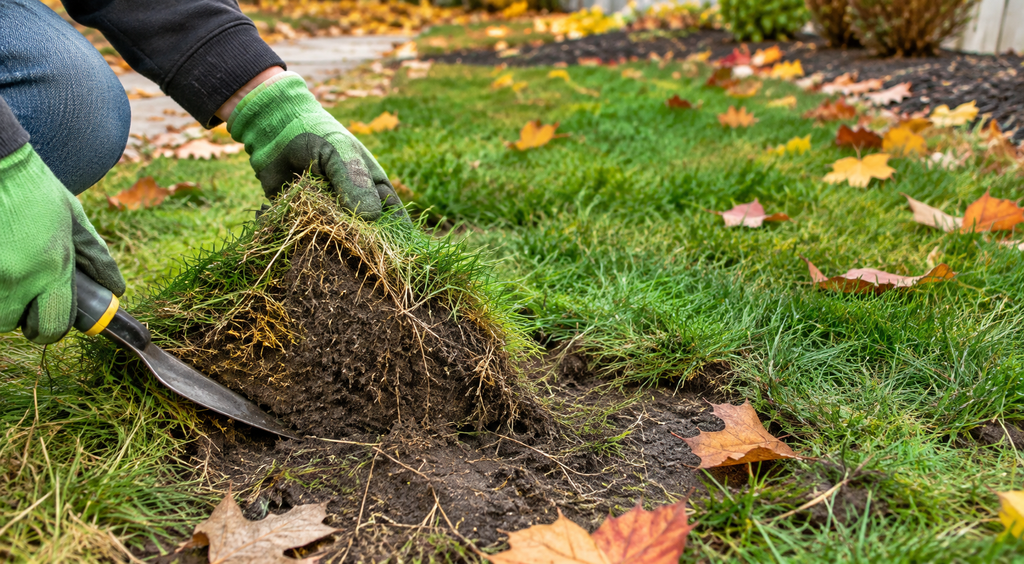
One exception: overseeding
Bermudagrass and zoysia lawns in the southern US are often overseeded with perennial ryegrass for a green winter lawn, and that process does call for a lower cut than usual so seed reaches the soil. It’s done in early fall, while the warm-season grass is still growing, and before the ryegrass goes down. It’s a separate practice from the final mow of the year, and the exact height and timing depend on the overseeding guide for your region, so check your extension office’s instructions.
Not sure which type you have?
A cool-season lawn stays green through the first frosts and looks best in spring and fall. A warm-season lawn is at its best in midsummer and turns straw-colored after frost. In the transition zone, roughly the band from Kansas east through the Mid-Atlantic, lawns are sometimes mixed or planted with either type, and a local extension office can identify a sample if the two are hard to tell apart.
When to make the last mow
The date matters less than what the grass is doing. If the mower is still collecting clippings, the lawn is still growing and still needs cutting. That’s the test Danneberger’s advice comes down to, and it’s more reliable than a calendar.
In cool-season lawns, growth slows sharply as daytime highs settle into the 40s Fahrenheit and stops when the soil approaches freezing. In much of the northern US that puts the last mow somewhere between late October and mid-November, but the range is wide, and the date can shift by several weeks between a cold fall and a warm one. Further south, cool-season lawns in mild-winter areas may need a trim occasionally through December.
The most common timing error is stopping too early. A lawn left alone at the end of September can keep growing slowly through October and November, and it will be well over the height you meant to leave it at by the time snow comes. Mowing gets less frequent as growth slows, weekly in early fall, then every two weeks, then possibly longer, but it doesn’t stop until the grass does.
Leaves change the timing as well. A thin scattering of leaves can be shredded by the mower and left to break down in the turf. A thick layer can smother it. Try to make the final mow after most of the leaves have fallen, so the last pass also chops the remaining ones, and rake up any heavy piles that the mower can’t handle without leaving mats.
For warm-season lawns, the last mow comes when growth stops, usually around the first frost. In frost-free parts of the South, some grasses never fully go dormant and keep growing, slowly, all winter. There the answer is to continue mowing at the usual height, just less often.
When the standard advice needs adjusting
The lawn got tall while you weren’t paying attention
If it’s mid-October and the grass is 5 or 6 inches tall, the instinct is to fix it in one dramatic cut. Resist that. Take off no more than a third, wait several days, and take off another third. If the first frost is close and there’s only time for one pass, it’s better to cut the lawn to a moderate height (say, 3 to 3.5 inches) and leave it than to scalp. Heavy clippings from a long lawn can clump and smother the grass below, so rake or bag them.
Snow mold has hit the lawn before
A history of snow mold argues for the lower end of the range, around 2 to 2.5 inches for the final mows, on a cool-season lawn. It also argues for staying on top of leaves, skipping heavy late-fall nitrogen, and improving drainage in wet spots. Ohio State’s guidance ties the shorter final mows to areas where snow cover is common, which is the situation where snow mold is a concern.
Little or no snow cover
Where winters are mild and snow doesn’t stay on the ground, the matting argument mostly disappears. Keeping the normal height makes sense here, especially for a lawn that’s on the thin side.
Shady lawns
Grass under trees and beside buildings gets less light all year and has less capacity to recover from stress. It generally does better mowed at the higher end of its range. Fine fescues, which are common in shade mixes, tolerate lower cutting but don’t need it. If you have leaf-heavy trees over the lawn, the bigger fall issue is keeping leaves off it.
A lawn seeded or sodded this fall
New grass should not be cut short. Seedlings should be mowed only once they’re tall enough that removing a third still leaves them at the target height, and sod should have rooted well enough that it doesn’t lift when tugged. If a new lawn hasn’t reached that stage before growth stops, leave it and mow in spring rather than risk pulling at shallow roots.
A dormant warm-season lawn
Once the grass has turned tan and stopped growing, there’s nothing to cut. Mowing dormant turf takes off protective cover for no benefit. Winter weeds may be growing in it, which is worth a look, but those belong to spring weed control, not to a winter mowing plan.
Details that matter as much as the number
- Blade sharpness. A dull blade tears grass instead of cutting it. The ragged leaf tips turn brown and give disease an easier way in. Sharp blades matter in fall too, when the lawn is heading into winter and every cut counts.
- Clippings. Fall clippings from a lawn that’s been mown on schedule are short and break down quickly, so leaving them on the lawn is fine and returns some nutrients. Bag or rake them only if they’re heavy enough to lie in clumps.
- Mowing pattern. Alternating the direction each time helps grass stand up more evenly and reduces wheel ruts. It’s a small thing that adds up over a season.
- Putting the mower away. After the final cut, follow the owner’s manual for fuel: either run the tank dry or add a fuel stabilizer, since old gasoline can gum up a carburetor over winter. Disconnect the spark plug wire before scraping off packed clippings or working near the blade, and let the engine cool first. Handle fuel outdoors, away from flames and hot surfaces.
Questions that come up around the last mow
Can I mow if there’s a light frost on the grass? It’s best to wait. Frosted blades are brittle, and mowing them can damage the leaf tissue and leave brown tips. Wait until the frost has melted and the grass is dry, even if that means mowing in the afternoon.
Should I bag the last cut? Usually not. Thin, fresh clippings drop between the blades and decompose. Bag them if they’re heavy or wet enough to clump, or if the lawn has had disease, since clumps can smother turf and carry the problem elsewhere.
I missed the final mow and there’s snow on the ground. What now? Don’t mow over snow or frozen grass. Wait for spring. When the snow melts, rake matted areas gently to lift the blades and let air in. Gray snow mold in particular often clears up as the lawn grows, though thin or dead patches may need overseeding once the weather is reliably warm.
Does lowering the height help if I’m not in a snowy climate? Probably not. The main argument for a lower final cut is preventing matting under snow, so where snow doesn’t linger, the case for lowering is weak and the normal mowing height is the safer choice.
What to do this week
Measure the grass with a ruler. If it’s a cool-season lawn in a snowy region and it’s sitting at 3.5 inches or more, drop the deck a half inch every mowing until you reach about 2.5 inches, and keep mowing until the clippings stop. If you have a warm-season lawn, leave the height alone and let the frost end the season. In either case, get the leaves off the grass before the snow arrives, because that matters more than the last half inch of height.
Sources and further reading
Mowing heights and winter recommendations vary by region and grass variety. The sources below are worth checking against your local extension office’s guidance.
- University of Minnesota Extension, Turf: “Q & A: Fall Lawn Care”
- Ohio State University, BYGL: “Turfgrass 101”
- University of Nebraska–Lincoln, Backyard Farmer: “Fall Turf Tips”
- Mississippi State University Extension: “Enhance Lawn Health and Beauty with Proper Mowing”
- University of Florida IFAS Gardening Solutions: “Mowing Your Florida Lawn”

About Syprose Kiche
Syprose Kiche is the creator and writer behind My Besuited Home, a practical home and garden website covering DIY projects, gardening, lawn care, landscaping, home improvement, and outdoor living. She focuses on turning everyday homeowner questions into clear, practical guides backed by careful research and useful real-world considerations.