
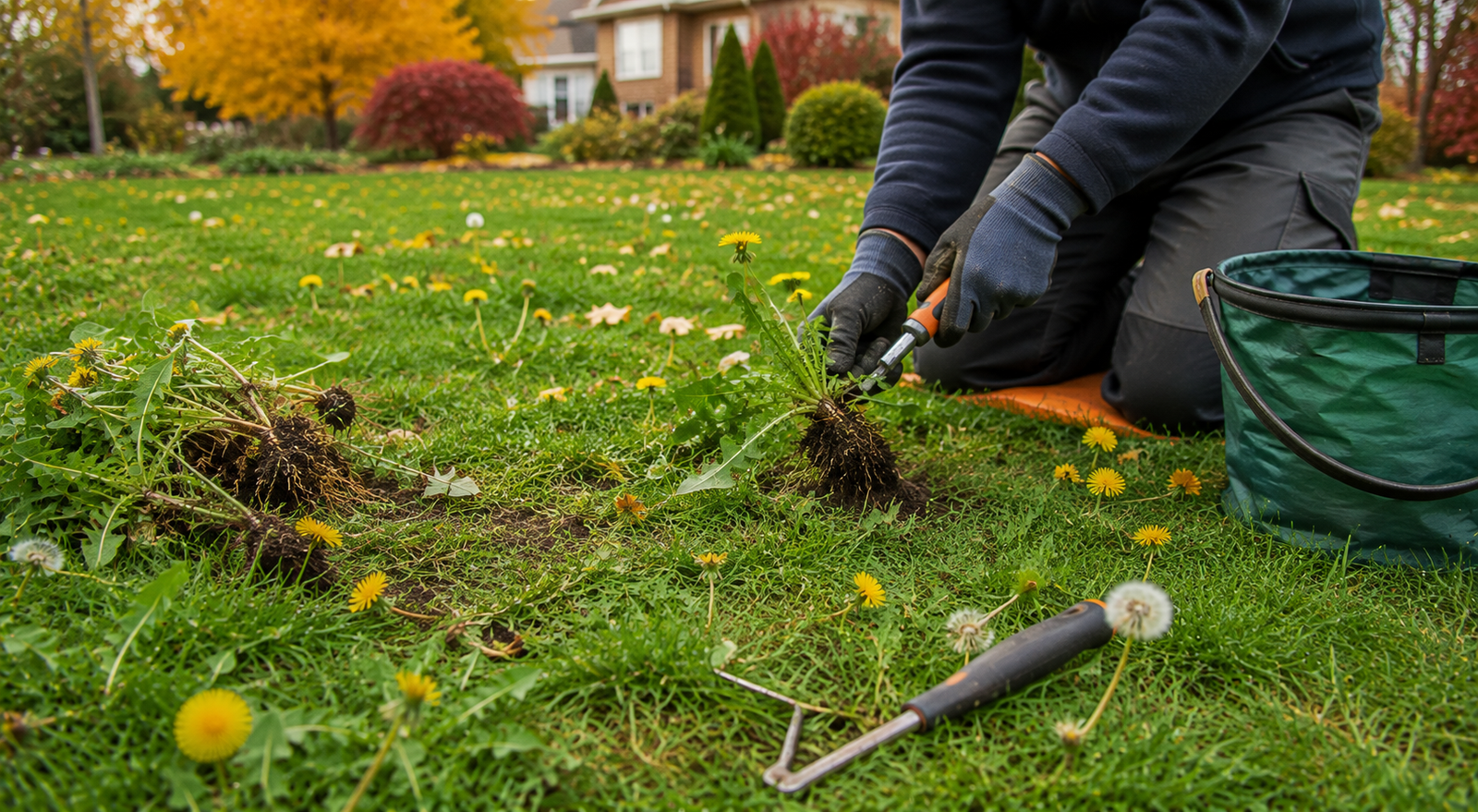
You know that moment in April when your lawn suddenly looks like it’s covered in a thousand tiny yellow suns? By June, half of them have turned into fuzzy white seed heads, and one gust of wind later, you’ve got dandelions in every corner of the yard, including the neighbor’s yard, because you were too polite to mention it.
Here’s the thing nobody tells you: spring is the worst time to fight dandelions. By the time you see those yellow flowers, the plant has already won. Fall is when you actually get the upper hand, and it’s not even close.
I’ve been pulling, digging, and cussing at dandelions for over a decade now, and fall is the season I’ve come to actually enjoy this fight. The weeds are weaker, the ground is softer, and I’m not sweating through my shirt just walking out to the mailbox. Let me walk you through exactly why fall works and how to do it without reaching for a jug of chemical herbicide.
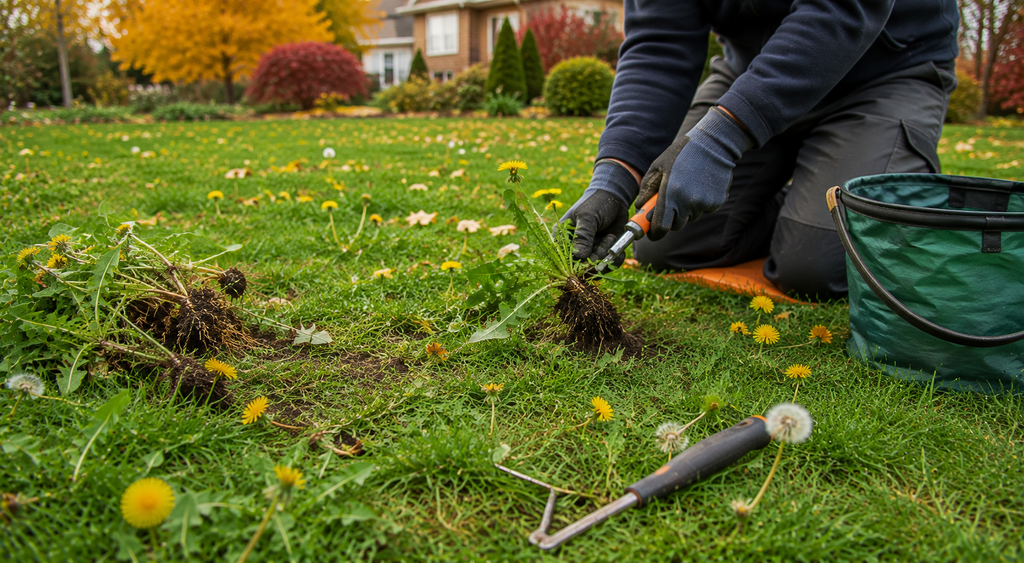
Why Fall Is the Best Time to Kill Dandelions Naturally
Dandelions are perennials, which means that fat taproot you see when you pull one out isn’t just decoration. It’s a storage tank. All summer long, the plant pulls energy up from the roots to grow leaves and flowers.
But in fall, something flips. As the days get shorter and the temperatures drop, the dandelion reverses course. It starts pulling nutrients and energy down into the roots to survive winter and come back swinging next spring.
This is your window. Any natural treatment you apply in fall — whether it’s a targeted vinegar spray, a hand-dug root removal, or even boiling water — gets pulled down into the root system along with everything else the plant is storing. In spring or summer, that same treatment mostly just kills the leaves you can see, and the root shrugs it off and sends up new growth within a couple weeks.
I didn’t believe this the first few years I gardened. I’d spray dandelions in June, feel very accomplished, and then wonder why they were back by the Fourth of July. Once I switched my main dandelion push to September and October, my dandelion population dropped by more than half the following spring. Same effort, way better timing.
How to Identify Dandelions Before They Go to Seed
Before you start any removal plan, you need eyes on your actual dandelion population, not just the flashy yellow ones.
Dandelion leaves have that jagged, tooth-like edge — that’s literally where the name comes from, “dent-de-lion,” French for lion’s tooth. In fall, you might not see many flowers at all, but the rosette of leaves close to the ground is still there, quietly photosynthesizing and feeding that taproot.
Walk your yard in the early morning or evening when the light is low and hits the lawn at an angle. Rosettes that blend in during midday sun suddenly pop out because of the shadows they cast. Mark them with little flags or golf tees if you’ve got a big lawn — trust me, you will forget where half of them are by the time you’re back with your tools.
Pay special attention to thin or bare patches in your grass. Dandelions love weak turf because there’s less competition for sunlight and root space. If you see a cluster of dandelions in one spot, that’s usually a sign your grass is struggling there for another reason too, like compacted soil or poor drainage.
Hand-Pulling Dandelions in Fall: The Right Way to Do It
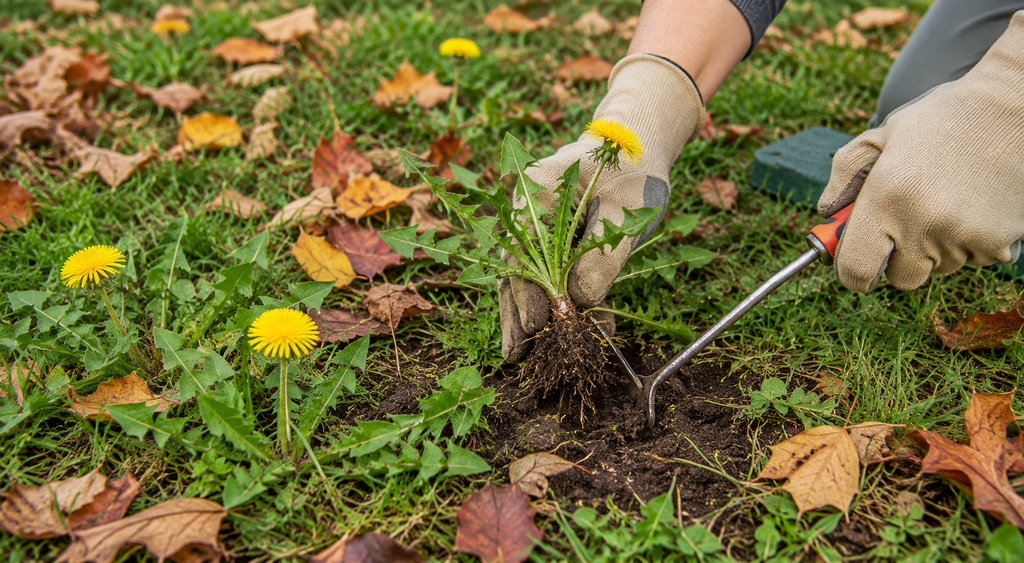
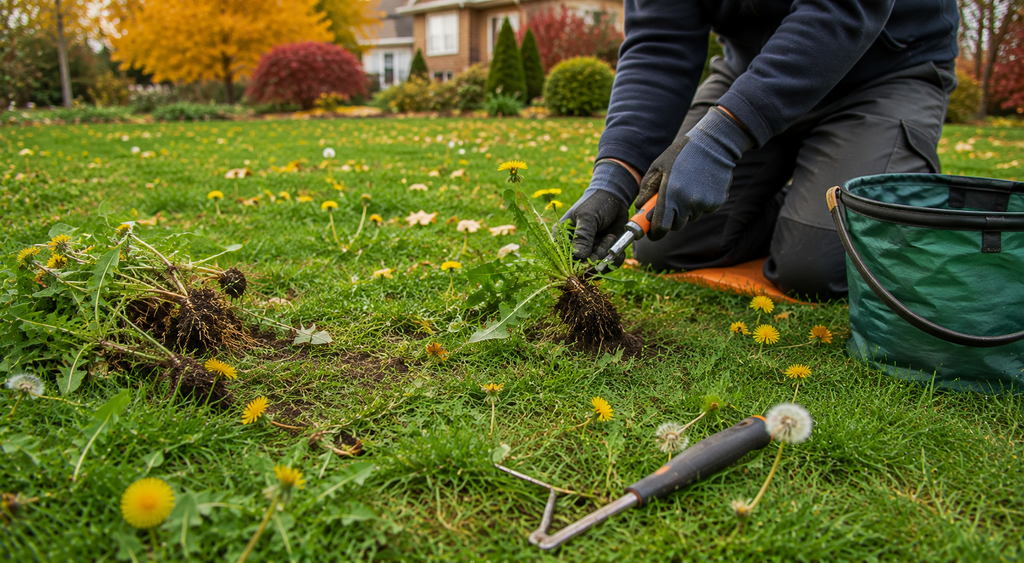
Hand-pulling gets a bad reputation because most people do it wrong. They yank the top off, leave two inches of taproot in the ground, and then act shocked when the dandelion regrows within three weeks. The root doesn’t care that you won round one.
Step 1: Water the area first.
Give the soil a good soak the night before, or pull after a fall rain. Dry, compacted soil grips that taproot like concrete. Wet soil lets it slide out cleanly.
Step 2: Use a dandelion weeder or a long flathead screwdriver.
You want a tool that can dig down four to six inches alongside the root without you having to wrestle the whole plant out with your bare hands. A dedicated dandelion puller (sometimes called a “weed popper” or “cobra weeder”) has a forked end built exactly for this job.
Step 3: Loosen the soil around the taproot, then pull straight up.
Wiggle the tool a bit to break the soil’s grip, then pull slow and steady. Yanking fast is how you snap the root and leave a chunk behind.
Step 4: Check the hole for leftover root fragments.
If you see a broken white root end still in the ground, dig it out with your fingers or the tool tip. Any fragment thicker than a pencil can regrow.
Step 5: Fill the hole with soil or compost and reseed if needed.
An empty hole is an invitation for the next weed seed that blows through. Fill it in and toss some grass seed on top if it’s in your lawn.
I do this on a Saturday morning with a travel mug of coffee and a five-gallon bucket, and honestly, it’s become one of my favorite fall chores. There’s something satisfying about pulling up a taproot in one clean piece. It’s the small wins, people.
Natural Dandelion Killer Recipes That Actually Work
If you’ve got a bigger area to cover, or your back isn’t up for an afternoon of digging, a few natural sprays can do real damage to dandelions in fall.
- Vinegar and dish soap spray. Mix one gallon of white household vinegar (5% acetic acid) with one tablespoon of dish soap. The soap breaks the surface tension on the leaves so the vinegar actually sticks instead of beading up and rolling off. Spray directly onto the leaves on a dry, sunny day — this stuff needs sunlight to work its magic, and rain within a few hours will wash your effort right down the drain.
- Regular grocery-store vinegar will brown the leaves but usually won’t kill the root outright, especially on an established dandelion. For a stronger hit, horticultural vinegar (20% to 30% acetic acid) does a much better job of reaching the crown, but you need gloves and eye protection with that stuff — it’s genuinely harsh and will burn skin.
- Boiling water. This is the cheapest option in your entire arsenal, and I mean free. Boil a kettle, carry it outside, and pour it directly onto the dandelion’s crown, the spot where the leaves meet the root. This scalds the plant tissue and can kill smaller dandelions in one shot. It’s best for weeds growing in cracks, along driveways, or in isolated spots where you’re not worried about cooking your good grass along with the weed, since boiling water isn’t picky about what it kills.
- Salt-based solutions. I’ll be straight with you here — I don’t love this method, and I use it sparingly. Salt does kill dandelions, but it also sterilizes the soil for a good while afterward, so nothing else grows there either. Save this one for weeds in gravel, between pavers, or along a fence line where you don’t want anything growing anyway.
Improving Your Lawn So Dandelions Can’t Come Back
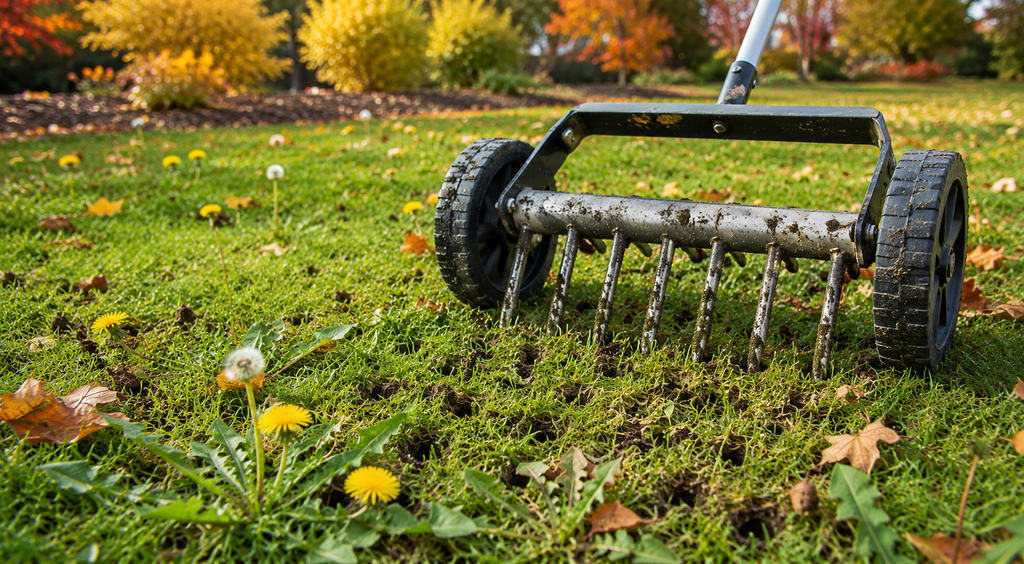
Killing the dandelions you have is only half the job. If you don’t fix why they showed up in the first place, you’re basically mowing the lawn for next year’s crop.
- Aerate compacted soil. Dandelions thrive where grass roots are struggling to breathe. Fall is prime aeration season anyway, so rent a core aerator or hire it out, and you’ll open up the soil for your grass while making it a lot less hospitable for weed seeds to settle in.
- Overseed thin or bare patches. Every patch of bare dirt is basically a welcome mat for dandelion seeds blowing in on the wind. Fall overseeding gives grass a full season to establish roots before the heat of next summer, and thick grass is genuinely the best natural dandelion prevention there is.
- Mow at the right height. I used to scalp my lawn because I thought shorter meant tidier. Big mistake. Grass mowed too short can’t shade the soil, and sunlight hitting bare dirt is exactly what dandelion seeds need to germinate. Keep your mower deck around 3 to 3.5 inches for most cool-season grasses.
- Feed your lawn with a fall fertilizer. A nitrogen-rich fall feeding helps grass build thick root systems over winter, which means less room and light for weed seeds come spring. This is honestly the single most underrated dandelion prevention step, and most homeowners skip it entirely.
- Quick side note: mulch your garden beds too. A two- to three-inch layer of mulch around your garden beds blocks the sunlight dandelion seeds need to sprout in the first place. It’s not glamorous, but it works, and it saves you an entire season of weeding later.
Best Tools for Natural Dandelion Removal (What I Actually Use)
You don’t need a garage full of gear for this. I’ve narrowed my fall dandelion kit down to a handful of tools that earn their spot in the shed.
- A dandelion weeder or cobra weeder. This is non-negotiable if you’re hand-pulling more than a couple dozen weeds. The forked, serrated tip slides down alongside the taproot and lets you pry it up with leverage instead of your lower back. Mine cost less than a large pizza and has outlasted three other “as seen on TV” weed pullers I wasted money on.
- A pump garden sprayer. For vinegar treatments, a one- or two-gallon pump sprayer with an adjustable nozzle beats a spray bottle every single time. You want a steady, even mist that coats the leaf surface without soaking the surrounding grass, and a spray bottle just can’t cover ground fast enough if you’ve got more than a few dandelions.
- A kneeling pad. I resisted this for years because I thought it made me look old. I was wrong, and my knees agree. If you’re going to be down at ground level pulling weeds for an hour, spend the ten bucks.
- A hand cultivator or hori-hori knife. For dandelions growing in tight spots — along a fence, tucked next to a shrub, wedged in a garden bed — a narrow hori-hori knife gets into places the bigger weeder can’t reach.
One thing I’d skip: those “dandelion killer” natural sprays sold in fancy bottles at the garden center for twenty dollars a pop. Read the ingredient label. Nine times out of ten it’s diluted vinegar and citric acid, the same stuff you can mix at home for a fraction of the price. I made this mistake exactly once.
When to Call In Professional Help
Most home lawns don’t need this, but I’ll say it anyway because I’ve seen it happen. If you’ve got dandelions covering the majority of your yard, mixed in with other aggressive perennial weeds like plantain or clover, and your soil is so compacted that aerating barely makes a dent, you might be past the point where DIY natural methods alone will get you where you want to be in a reasonable timeframe.
A lawn care professional who offers organic or natural treatment programs can assess whether your issue is really about dandelions, or whether it’s a bigger soil health problem that’s inviting every weed in the neighborhood to move in. That’s a conversation worth having before you sink another three fall seasons into a losing battle.
For the average yard with a scattered dandelion problem, though, you genuinely don’t need to spend a dime on professional help. This is a weekend-warrior job.
Real Talk: What Doesn’t Work (and What’s Not Worth Your Time)
I’ve tried a lot of dandelion remedies over the years, and I want to save you some wasted weekends.
- Cornmeal gluten as a “natural pre-emergent” gets way more credit than it deserves. It can suppress some seed germination, but the timing window is so narrow and the results so inconsistent that I stopped bothering with it years ago. If you want a real pre-emergent effect, thick healthy grass does the job better and for free.
- Mowing off just the flowers before they seed is a losing battle. I get it, it feels productive. But the root system doesn’t care that you cut the flower. It’ll just send up another one in a week, and you’ll be back out there mowing flower heads every few days all season. That’s not weed control, that’s a chore loop.
- Flame weeding looks incredibly satisfying on video, and I’ll admit I bought a propane torch attachment because of it. It does kill the top growth fast. But established dandelion roots usually survive and regrow, plus you’re now doing open-flame work near dry fall leaves and mulch, which is a genuinely bad combination. I use mine on driveway cracks only, nowhere near anything flammable.
- One vinegar spray session is not going to finish an established dandelion. I see people get frustrated and give up on natural methods after one round because the dandelion “came back.” Of course it did — you’re up against a taproot that can go a foot or more into the ground. Plan on two or three applications spaced a week or two apart for anything with a mature root system.
And honestly, if you’ve got a truly massive dandelion infestation covering most of your yard, natural methods alone might take a full season or two to get you where you want to be. That’s not a failure on your part. That’s just how perennial weeds with deep taproots work. Set your expectations at “steady improvement,” not “gone by next Tuesday.”
Frequently Asked Questions About Fall Dandelion Removal
Will fall dandelion removal stop them completely next spring?
Not completely, but it’ll cut your population way down. Dandelion seeds travel from neighboring yards and empty lots, so you’ll likely see a few strays no matter how thorough you are. The goal is management, not a permanent zero.
Can I compost the dandelions I pull?
Only if your compost pile gets hot enough to kill the seeds and root fragments, which most backyard piles don’t reliably do. I toss mine in yard waste bags instead, just to be safe.
Is it too late to work on dandelions once the ground freezes?
Pretty much, yes. Once the soil hardens up, digging becomes nearly impossible and sprays won’t absorb properly. Aim to get your main fall push done before your first hard frost.
Do I need to treat my whole lawn, or just the spots with dandelions?
Just the spots, honestly. Blanket-spraying an entire lawn with vinegar will hurt your grass along with the weeds, since vinegar isn’t selective about what it kills. Spot-treat individual dandelions and put your broader effort into thickening the grass instead.
Does baking soda kill dandelions?
It can dry out small seedlings if you pack it directly onto the crown, but it’s slow, inconsistent, and mostly just changes the soil pH in that spot. I’ve tested it a few times and honestly got better, faster results from plain hand-pulling. Don’t waste a weekend on it.
Final Thoughts on Beating Dandelions the Natural Way
Fall dandelion control isn’t flashy, and it won’t give you an instantly perfect lawn overnight. But it’s the quiet, unglamorous work that actually pays off, because you’re hitting these weeds exactly when they’re weakest and least able to fight back.
Pull what you can, spray what you can’t, and spend a little time this fall thickening up your grass so next year’s dandelions have a much harder time finding a foothold in the first place.
What’s your go-to method for dealing with dandelions? Have you tried the boiling water trick, or are you strictly a hand-pulling purist? Drop your tips (or your dandelion horror stories) in the comments below — I read every one.

About Syprose Kiche
Syprose Kiche is the creator and writer behind My Besuited Home, a practical home and garden website covering DIY projects, gardening, lawn care, landscaping, home improvement, and outdoor living. She focuses on turning everyday homeowner questions into clear, practical guides backed by careful research and useful real-world considerations.