
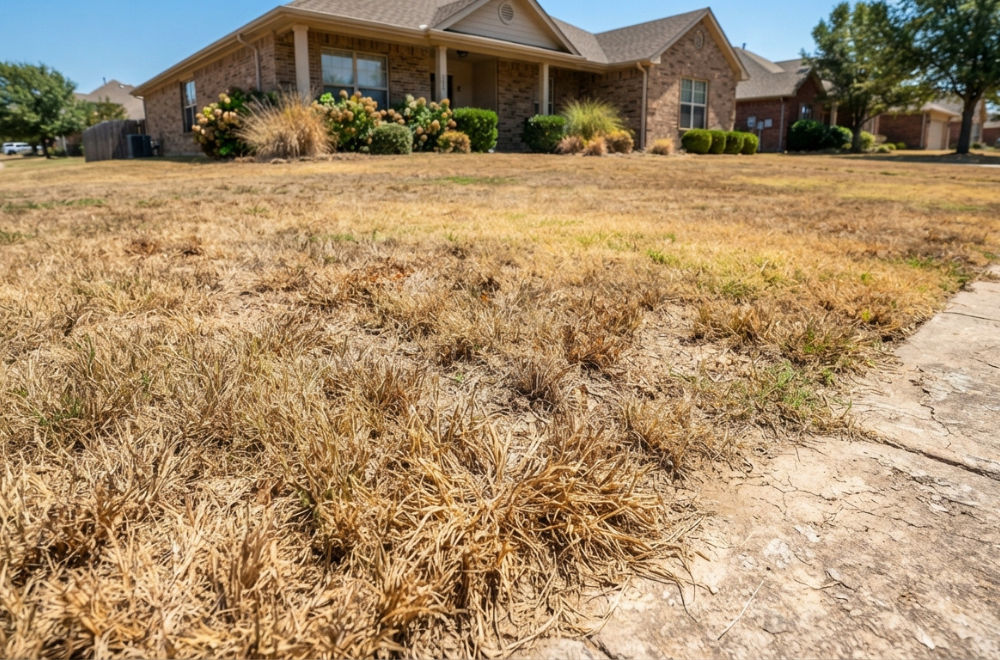
Your lawn looks like a bag of stale potato chips. Crunchy, brown, and giving off a sad little dust cloud every time you walk across it. You water it, you stare at it, you water it some more, and nothing changes. Meanwhile your neighbor’s grass is somehow still green and you’re starting to take it personally.
I get it. A heat-stressed lawn feels like a personal failure, but it almost never is. Grass goes dormant to protect itself, the same way you’d curl up under a blanket instead of running a marathon in 95-degree heat. The good news is that you’ve still got a window before the first frost to bring it back without dumping a truckload of chemical fertilizer on it. Here’s exactly how I do it on my own patchy, stubborn quarter-acre.
Why Your Lawn Looks Half-Dead (And Why That’s Not the End)
Before you panic and rip out the whole yard, understand what’s actually happening underground. Most lawns, especially cool-season grasses like fescue, bluegrass, and rye, go into survival mode once soil temperatures climb past 85 degrees for an extended stretch. The blades brown out on purpose. The crown of the plant, the part that matters, is usually still alive and just waiting for cooler weather to wake back up.
I nearly killed a perfectly healthy lawn one August because I assumed it was a goner and tore out half the bed to reseed early. Total waste of a Saturday. If you tug on the grass and the roots stay put, it’s dormant, not dead. If it pulls up easily like a toupee, you’ve got a different problem, and we’ll get to that in the Real Talk section.
The trick to reviving a heat-stressed lawn naturally is working with the plant’s own recovery instincts instead of forcing new growth while it’s still too hot outside. That means timing matters just as much as technique.
Step 1: Fix Your Watering Schedule (Most People Get This Wrong)
Everyone assumes more water equals faster recovery. It doesn’t. Shallow, frequent watering is one of the biggest lawn-killers I see, and I did it for two full summers before I figured out why my grass had roots about as deep as a Post-it note.
Here’s the actual approach that works:
- Water deeply, not often. Aim for 1 to 1.5 inches of water per week, delivered in one or two sessions, not a daily ten-minute sprinkle.
- Water early in the morning, between 5 and 9 a.m. Evening watering invites fungus, and midday watering just evaporates before it soaks in.
- Check depth with a screwdriver. If it slides into the soil easily down to 6 inches, you’ve watered enough. If it stops at 2 inches, keep going.
- Cut back as fall approaches. Once nighttime temps consistently drop below 60, ease off frequency so the grass isn’t sitting in soggy soil during cool, damp nights.
Deep watering pushes roots downward, searching for moisture instead of loitering near the surface. Deeper roots mean a lawn that handles the next heat wave better, and honestly, that’s the whole game with drought-stressed grass. You’re not just reviving it for today, you’re building a root system that won’t panic next July.
Step 2: Raise Your Mower Height (Seriously, Stop Scalping It)
I know a shaggy lawn feels lazy. But mowing your heat-stressed grass short is basically kicking it while it’s down. Longer blades shade the soil, keep roots cooler, and reduce water loss through the leaf surface.
Set your mower to the highest setting, usually 3.5 to 4 inches for most cool-season grasses. Yes, it’ll look a little wild for a couple weeks. Your lawn will thank you by actually surviving.
A few mowing rules I stick to religiously now:
- Never cut more than one-third of the blade height at once
- Keep your mower blade sharp — a dull blade tears grass instead of cutting it, and torn tips turn brown and invite disease
- Mow in the early evening when it’s cooler, so the fresh cuts aren’t sitting exposed during peak heat
- Leave the clippings on the lawn (more on that below)
That last point surprises people. Bagging clippings feels tidier, but you’re literally throwing away free nitrogen.
Step 3: Topdress With Compost Instead of Reaching for Synthetic Fertilizer
This is where I get opinionated, so bear with me. I think synthetic quick-release fertilizer on a heat-stressed lawn is one of the worst things you can do, even though it’s marketed as a miracle fix. It forces the plant to push new top growth while its root system is already exhausted and the soil is basically an oven. You’re asking a marathon runner who just collapsed to sprint another mile.
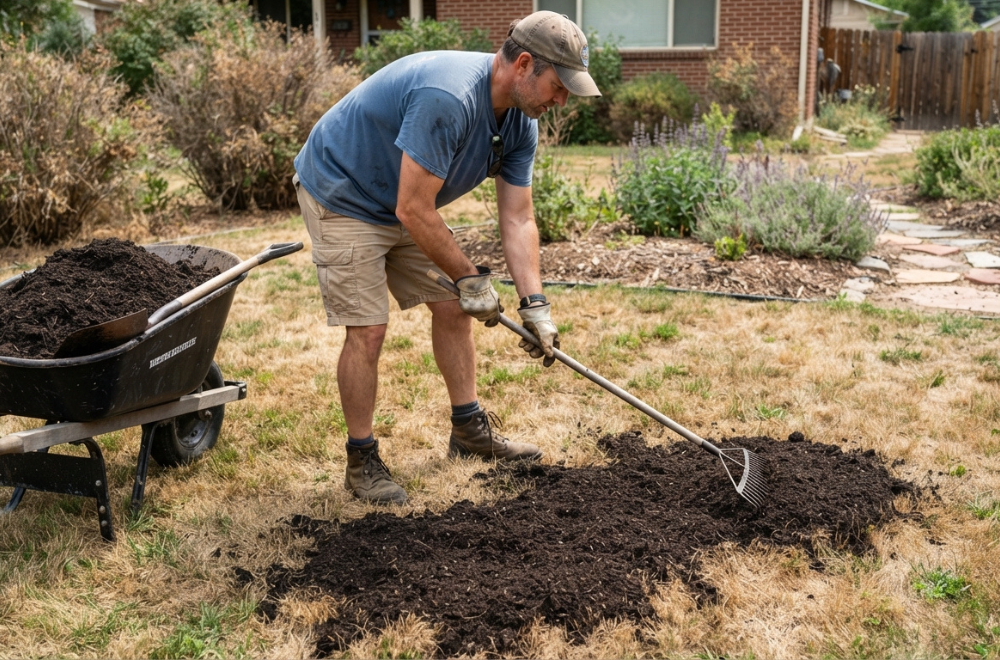
Compost does the opposite. It feeds the soil biology slowly, improves water retention, and doesn’t shock the plant.
Here’s my go-to method:
- Rake out the dead thatch and debris first so the compost makes contact with soil, not a mat of dead grass.
- Spread a quarter-inch layer of finished compost across the lawn using a shovel and the back of a rake.
- Water it in lightly so it settles into the turf instead of sitting on top like mulch.
- Repeat every 4 to 6 weeks through the cooler part of fall.
If you don’t have your own compost pile, bagged compost from a garden center works fine. Skip the “lawn food” bags with a giant NPK number on the front until temperatures cool down. Save the synthetic stuff, if you use it at all, for a light fall application once the grass is actively growing again.
Step 4: Aerate Compacted Soil So Water Actually Reaches the Roots
Heat stress and foot traffic team up to compact your soil into something closer to concrete. Compacted soil means water runs off instead of soaking in, which makes your heat-stressed lawn even harder to revive no matter how carefully you water it.
Core aeration, where you physically pull small plugs of soil out of the lawn, opens up channels for water, air, and nutrients to reach the roots. You can rent a walk-behind aerator from most hardware stores for less than $50 a day, or hire it out if your yard is large.
Best time to aerate a cool-season lawn is late summer into early fall, right as temperatures start dropping. That timing lines up perfectly with lawn recovery season anyway, so knock it out while you’re already doing the compost topdressing.
Leave the little soil plugs on the lawn to break down naturally. I know it looks messy for a week or two. Raking them up is a waste of your time, and they’ll work back into the soil on their own.
Step 5: Overseed Bare and Thin Patches Before It Gets Too Cold
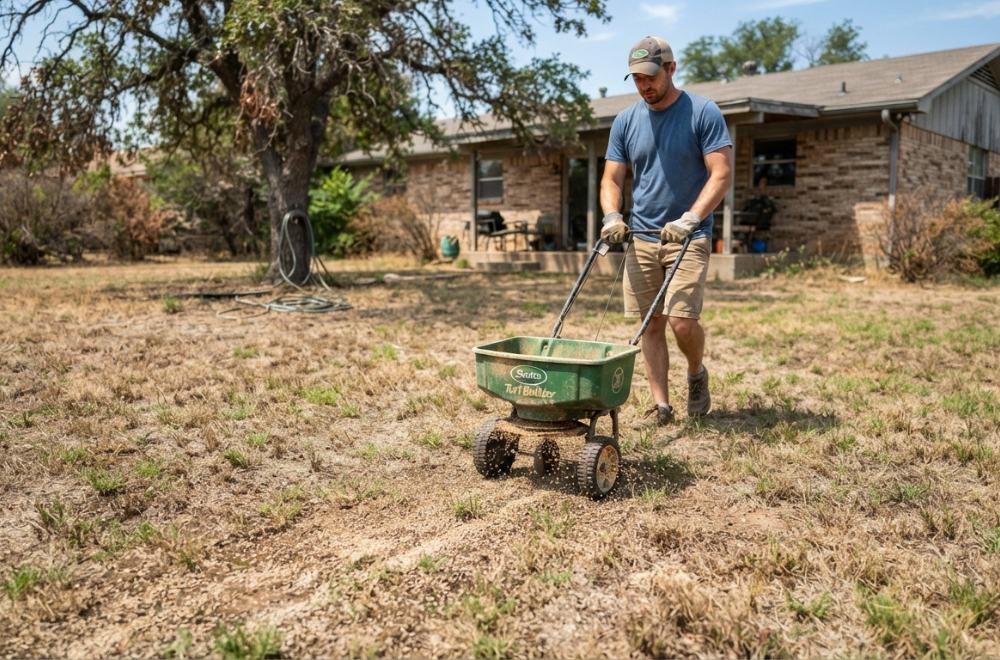
If your lawn has bald spots from the heat, this is your window to fix them, but timing is everything. Overseed too early and the seedlings fry in the last heat wave. Wait too long and they won’t establish roots before frost hits.
The sweet spot for most of the U.S. is 45 days before your average first frost date. Check your local extension office site if you don’t know that date offhand.
Quick overseeding checklist:
- Mow the existing lawn short (this is the one time I break my own “mow high” rule) so seed makes contact with soil
- Rake bare patches to loosen the top layer
- Spread grass seed at the rate listed on the bag for your grass type
- Cover lightly with a thin layer of compost or peat moss
- Water daily, lightly, until seedlings are about 2 inches tall, then transition to deep watering
Quick side note: don’t bother overseeding with a totally different grass species than what’s already growing unless you’re planning a full renovation. Mixing bluegrass patches into a fescue lawn just gives you a two-toned yard that looks worse than the bare spot did.
Step 6: Skip the Weed Killer for Now
I’ll admit this one’s tempting. Crabgrass and clover love to move into weak, heat-stressed turf, and it’s annoying to watch them thrive while your good grass struggles. But most broadleaf herbicides stress the lawn further, and applying them while your grass is already recovering is like kicking someone while they’re doing physical therapy.
Hand-pull what you can. Focus your energy on thickening up the healthy grass instead, since a dense lawn crowds out weeds on its own better than any spray ever will. Save chemical weed control, if you use it, for next spring when the lawn is strong enough to handle it.
The Real Talk Section: What’s Not Worth Your Time (Or Money)
Here’s where I’ll save you some frustration, because I’ve wasted plenty of both.
- Lawn tonics and “miracle” foliar sprays. I fell for a beer-and-molasses lawn tonic recipe that made the rounds online a few summers back. My grass looked exactly the same, but my yard smelled like a dive bar for two days. Skip it.
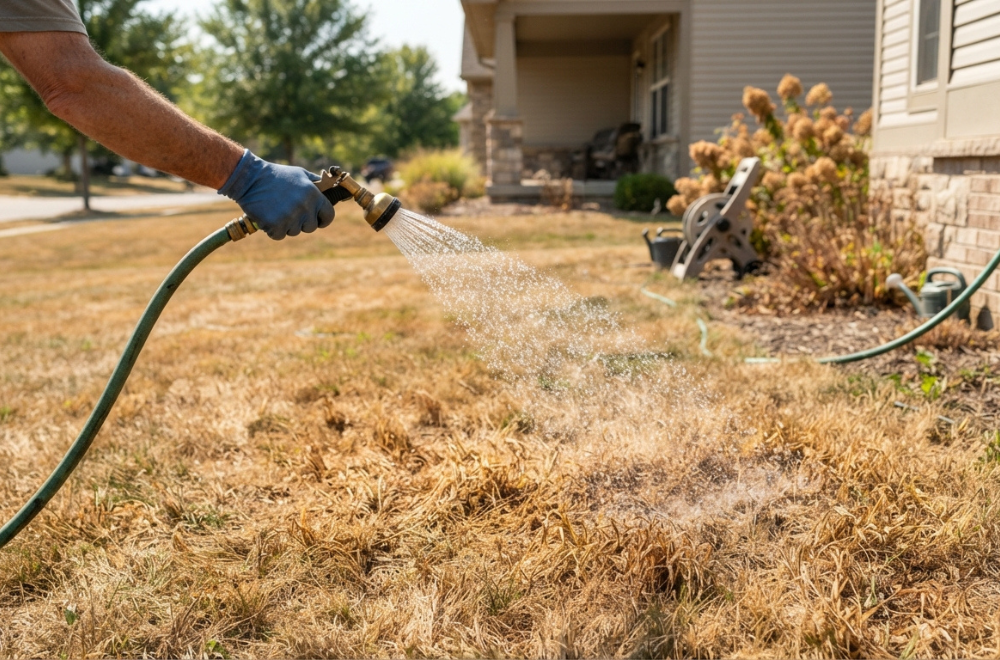
- Reseeding in the middle of a heatwave. If daytime temps are still hitting the high 80s or 90s, new seed will germinate and then die within days. Wait for your window, even if it’s frustrating to look at bare dirt a little longer.
- Overwatering to “make up for” the summer. Soggy soil in cooler fall weather invites fungal disease, particularly brown patch and pythium. More water is not automatically better, and I’ve drowned more grass than I’ve ever saved with underwatering.
- Assuming every brown patch is heat stress. Grubs, chinch bugs, and fungal disease can all mimic drought stress. If you pull on the grass and it lifts up in a mat like a loose carpet, you likely have grub damage, not heat stress, and none of the steps above will fix that. Dig a small square of turf and check for white C-shaped grubs before you assume it’s just the weather.
- Expecting overnight results. Natural recovery methods work with the plant’s biology, not against it, which means they’re slower than synthetic quick fixes. You’re looking at 3 to 6 weeks of visible improvement, not 3 to 6 days. If you need instant green for a one-time event, natural recovery isn’t your answer this week, and that’s just being honest with you.
Parting Wisdom
A stressed lawn isn’t a failure, it’s just a plant doing exactly what it’s supposed to do to survive a rough season. Give it deep water, taller blades, real compost instead of synthetic shortcuts, some breathing room in the soil, and the right timing on seed, and it’ll come back greener than it was before summer started. I’ve watched lawns I thought were completely finished bounce back into something I was actually proud of by the time the first frost hit.
What’s your lawn dealing with right now, bare patches, an all-over brown tint, or something weirder? Drop a comment below and tell me what you’re seeing. I’ll do my best to help you figure out what’s actually going on before you spend money fixing the wrong problem.

About Syprose Kiche
Syprose Kiche is the creator and writer behind My Besuited Home, a practical home and garden website covering DIY projects, gardening, lawn care, landscaping, home improvement, and outdoor living. She focuses on turning everyday homeowner questions into clear, practical guides backed by careful research and useful real-world considerations.