
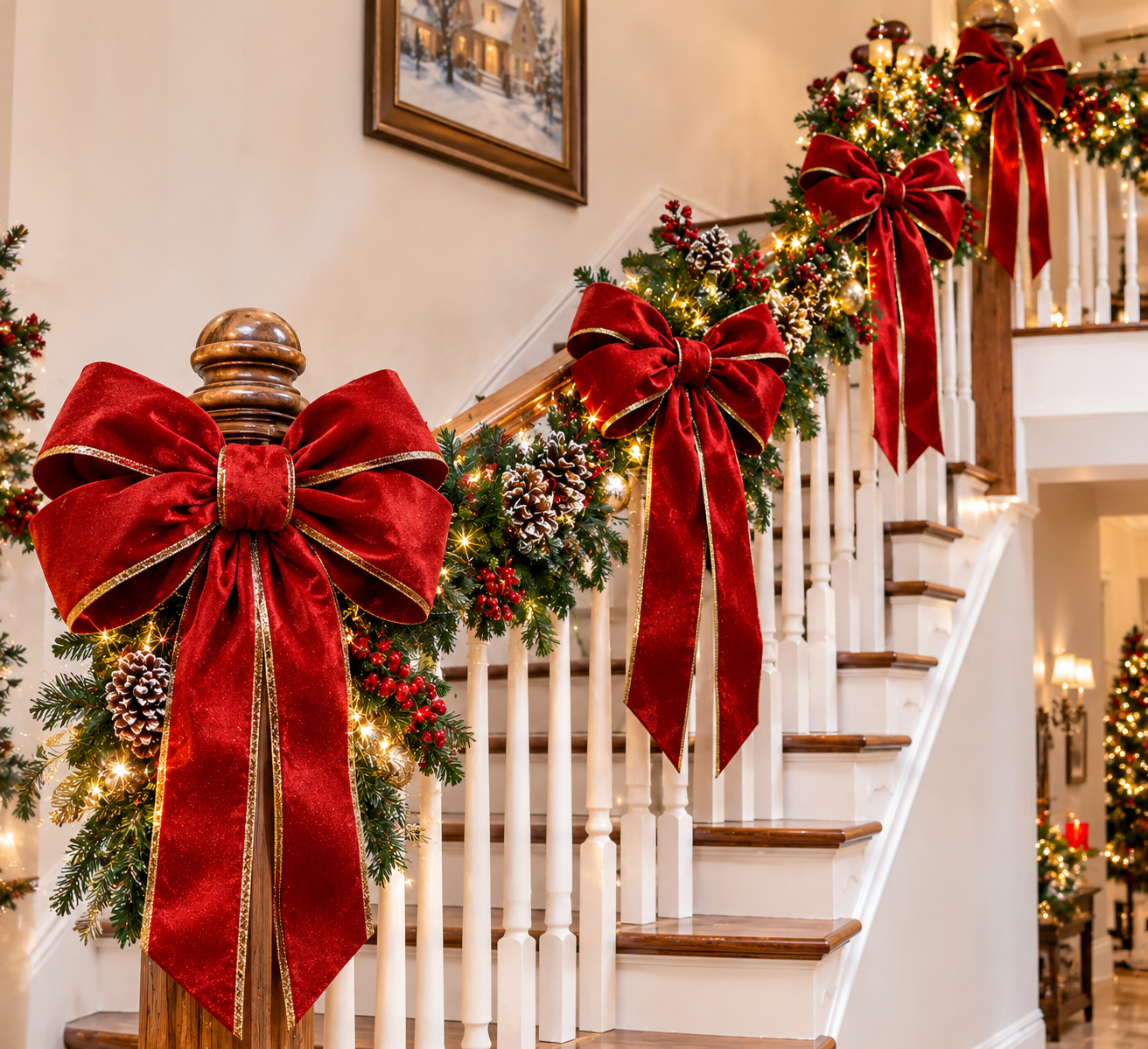
A staircase is the one place in a house where decoration and daily traffic collide. Garland that looks perfect from the front hall can leave the handrail slick and unusable. A row of candles on the treads becomes a hazard the first time someone heads downstairs in socks. A swag that was pinned up on December 1 is sagging by the tenth. Most Christmas staircase ideas that disappoint fail for the same reasons: nobody checked what the railing is made of, where the nearest outlet is, or which parts of the stairs have to stay clear.
The thirteen ideas below are arranged with those practical limits in mind. Some work on any railing, some suit only certain staircases, and a few come with a real caution. Before the ideas, though, a short section on the decisions that make or break the whole project.
Four Things to Settle Before You Buy a Single Strand
Your railing material decides how everything attaches
A traditional wood railing with vertical balusters is the easiest surface to decorate. There are gaps to thread wire through, the posts are sturdy, and nothing needs to be glued. Wrought iron balusters work well too, though the garland will slide unless it is tied at intervals. Cable rails and glass panels are harder because there is nothing to wrap around, and they get a few words in the FAQ at the end.
Painted and stained finishes matter as well. Bare craft wire can scratch a clear coat or leave marks on white paint, so the wire you choose should be coated, covered in paper, or replaced with ribbon or clear zip ties.
Measure the slope, not the floor
Stair railings run on a diagonal, which makes them longer than the horizontal distance they cover. The simplest way to measure is to run a piece of string or a soft tape along the rail from the bottom newel post to the top, following the slope. For a typical single flight with around 13 risers, the result often lands somewhere in the neighborhood of 12 to 14 feet, but that is an estimate and not a rule, so measure your own. Add roughly 20 to 30 percent if you want the garland to drape in swags between balusters rather than run in a straight line, since swagging uses up length quickly.
Garland is usually sold in sections of about 9 feet, and sections can be joined end to end by twisting the built-in wires together. Joining two sections at a post is easy to hide with a bow.
Find the power before you choose the lights
Pre-lit garland with a plug is convenient only if there is an outlet within reach of the bottom or top of the staircase. Many staircases have none. Extension cords across a hallway floor are a tripping risk, and running one up the side of the stairs is worse. Battery-powered strands with built-in timers solve the problem, though the batteries need replacing every couple of weeks if the lights run six hours a day. Rechargeable USB battery packs are an alternative worth considering, since they can be tucked behind a bow or a newel post.
Whichever route you take, check the packaging. Lights should be UL-listed or carry a similar recognized safety mark, be rated for indoor use if they are going inside, and come with a stated limit on how many strands can be connected end to end. Following that limit matters, because overloading a chain of light strings is a known cause of overheating.
Keep the handrail and the treads usable
A staircase is also an escape route, and for many households it is the way the youngest and oldest members get between floors. Building codes generally require a handrail to be graspable along its length, and while the exact rules depend on where you live, the practical point is the same everywhere: if a hand cannot slide along the rail, someone will grab something else on the way down. Keep the decoration on the outside face of the rail and against the balusters, and leave the top surface clear wherever possible. Treads should stay free of anything a foot can catch, roll, or kick. Several of the ideas below use the treads, and each one notes how to do it without creating an obstacle.
How to Attach Decorations Without Damaging the Finish
A few materials cover almost every situation:
- Paper-covered or green coated floral wire. Thin, flexible, and gentle on most finishes. Twist it around the garland’s own wire core and then around a baluster, trimming the ends and folding them toward the garland so they do not poke.
- Clear or green zip ties. Fast, secure, and invisible against evergreen. Clip the tail flush. Zip ties can be cut off at the end of the season without leaving marks, though they are single use.
- Ribbon or twine. Works for lightweight pieces and doubles as decoration. Wire-edged ribbon holds a bow’s shape far better than satin ribbon.
- S-hooks and wreath hangers. Slide over a rail or hang from a baluster cap. Good for wreaths, lanterns, and stockings.
- Adhesive hooks. Useful on walls, but only up to the weight printed on the package. Clean the surface first, press for the full time listed in the directions, and remove them slowly by pulling the tab parallel to the wall. Textured paint, wallpaper, and recently painted walls can peel when the hook comes off, so test a small hidden spot first.
For rented homes, skip anything that requires a nail or screw unless your lease allows it. Everything below can be done without them.
13 Christmas Staircase Ideas That Work in Real Homes
1. Layered Garland That Looks Full Instead of Stretched
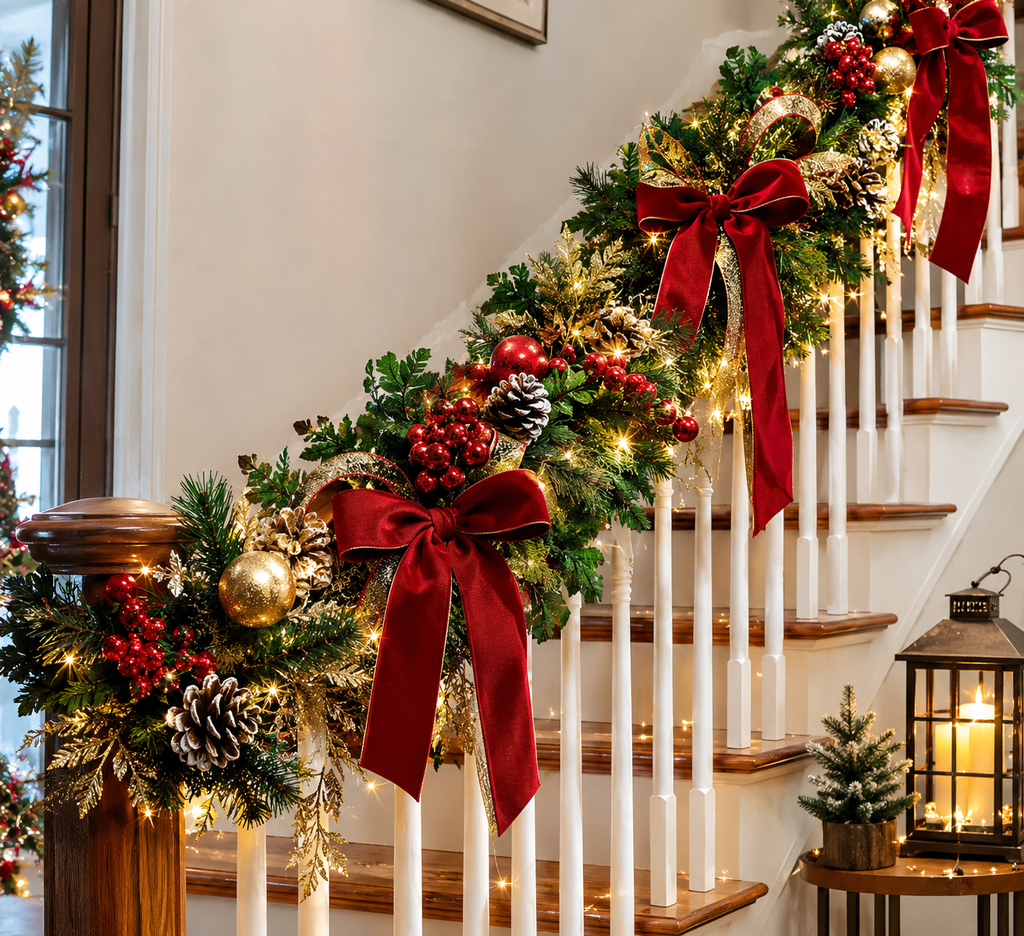
A single strand of garland on a long rail tends to look thin, like a pipe cleaner wrapped around a banister. The fix is layering. Use two strands for each stretch of rail: attach the first along the baluster line, then weave the second over and slightly forward of it so the branches overlap. Fluff each branch tip individually, pointing some up and some outward, because most artificial garland arrives compressed and flat.
Mixed textures add depth. A base of plain pine or fir can be accented with cedar, eucalyptus, or boxwood stems, plus a few picks of berries or faux pine cones tucked in at intervals. The goal is an uneven, slightly wild look, not a uniform tube.
One caution: garland wrapped tightly around the top of the rail leaves nowhere for a hand to go. Run it along the balusters instead, or loop it in shallow swags that rise to the rail only at each post.
2. Warm White Lights Wired Into the Garland
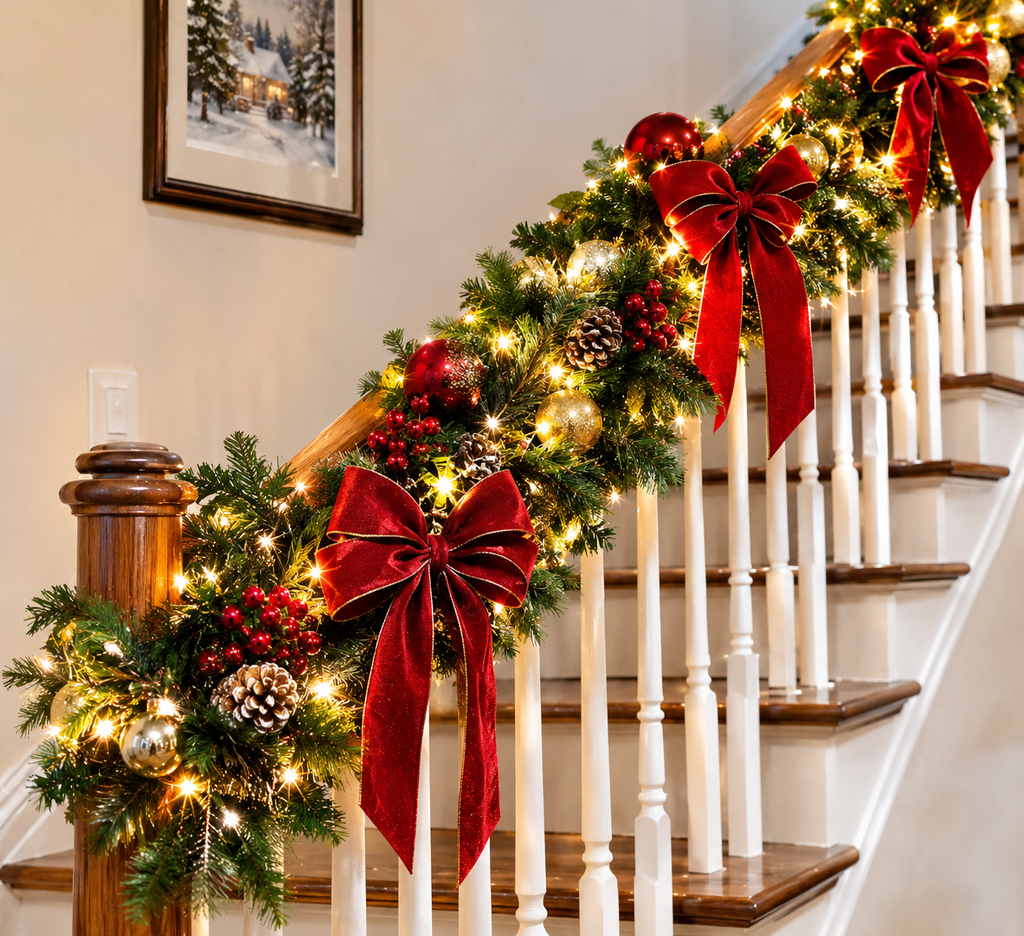
Lights change how a staircase reads at night, when most people actually see it. Warm white micro LEDs on a thin wire disappear into the greenery during the day and glow rather than glare in the evening. Cool white tends to look harsh against greenery and wood tones, though it suits a white or silver theme (see idea 10).
Thread the lights through the garland in a zigzag, not a straight line, so the glow is spread across the depth of the branches. A common planning guide is about 100 bulbs per 3 to 4 feet of garland for a full effect, but treat that as a starting point and adjust for the brightness of your bulbs.
If the garland is pre-lit, check how many strands can be linked together before buying a second. And if the outlet is at the bottom, put the battery pack or plug end there and hide the cord behind the newel post.
3. Oversized Bows on the Newel Posts and Along the Rail
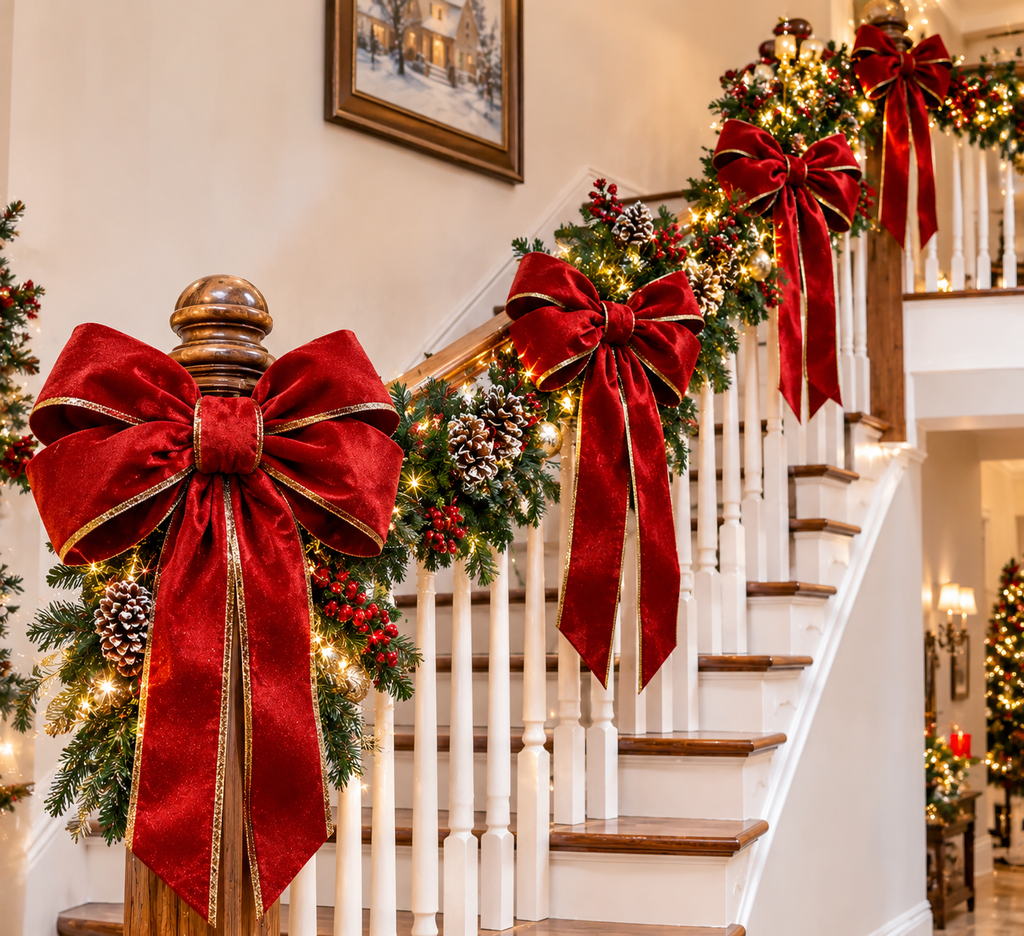
Bows are one of the oldest Christmas staircase decor moves and still among the most effective, because they cover joins, anchor garland, and add a single bold color. The mistake is going too small. A bow that looks generous in the store can vanish on a stair rail, so aim for 8 to 10 inches wide at the largest points, and bigger on a thick newel post.
Wire-edged ribbon is worth the extra cost. It holds loops open instead of collapsing into a limp knot. Velvet looks rich on dark wood. Plaid suits a farmhouse or lodge feel. A simple red grosgrain works on almost anything.
Place a large bow at the bottom newel and the top, then smaller ones at every third or fourth baluster. Odd numbers and uneven spacing look more natural than a perfectly regular row. Secure each bow with floral wire at the back, not just a ribbon tie, because bows pull forward under their own weight.
4. A Rising Line of Wreaths on the Stairway Wall
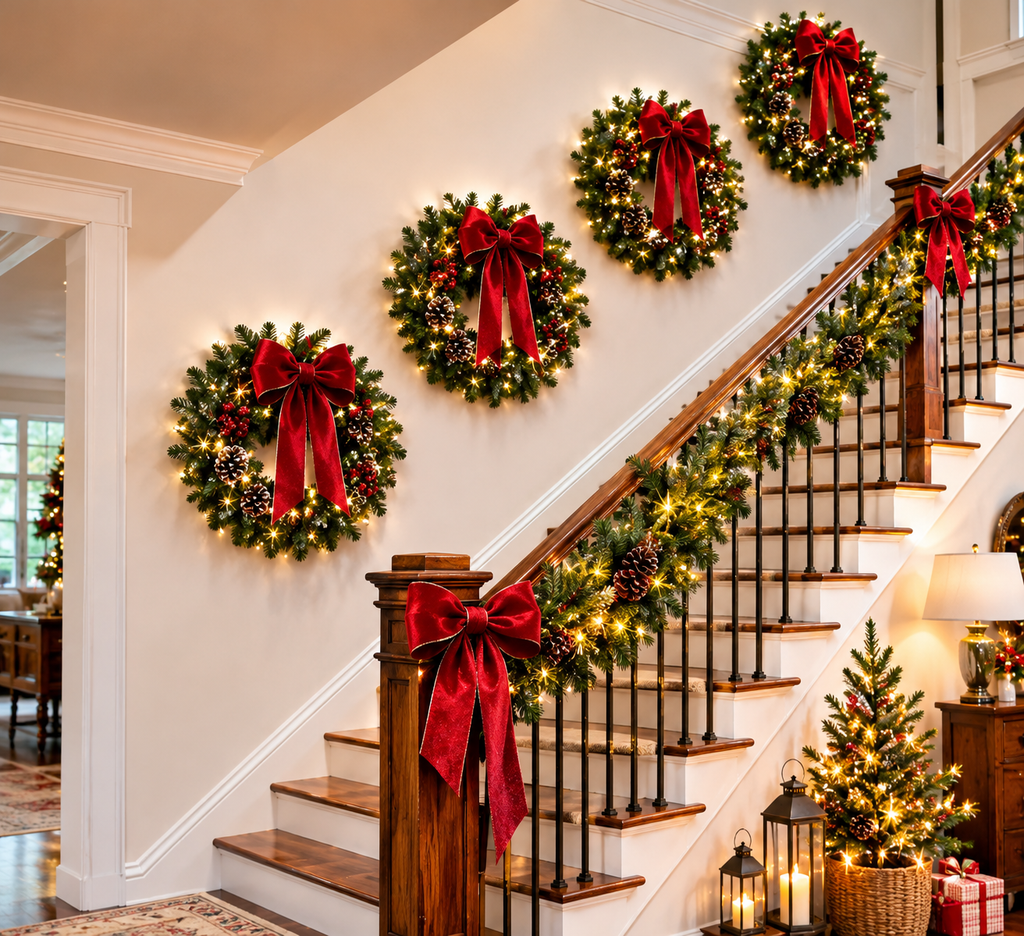
When the garland handles the rail, the wall beside the stairs is a missed opportunity. A line of wreaths climbing the wall, each one stepped up to follow the angle of the stairs, turns a blank slope into a feature. Choose the same size for all of them, or alternate two sizes, and hang each one with a matching ribbon so the repetition looks planned.
There is a practical decision to make first: weight. Real wreaths and large faux ones can be heavy, and adhesive hooks have limits, so check the rating and use a hook rated well above the wreath’s weight. Lightweight options like grapevine wreaths, felt wreaths, or small boxwood rings are safer on a rented wall.
Start from the top wreath and measure down, using painter’s tape to mark where each one sits. Stairs rise at a constant angle, so spacing them an equal distance apart along the slope keeps the line clean. If your staircase wall is narrow, keep wreaths small enough that no one brushes against them on the way up. Fresh greenery on a wall at shoulder height sheds needles, so faux or dried is usually the sensible choice here.
5. Stockings on the Balusters
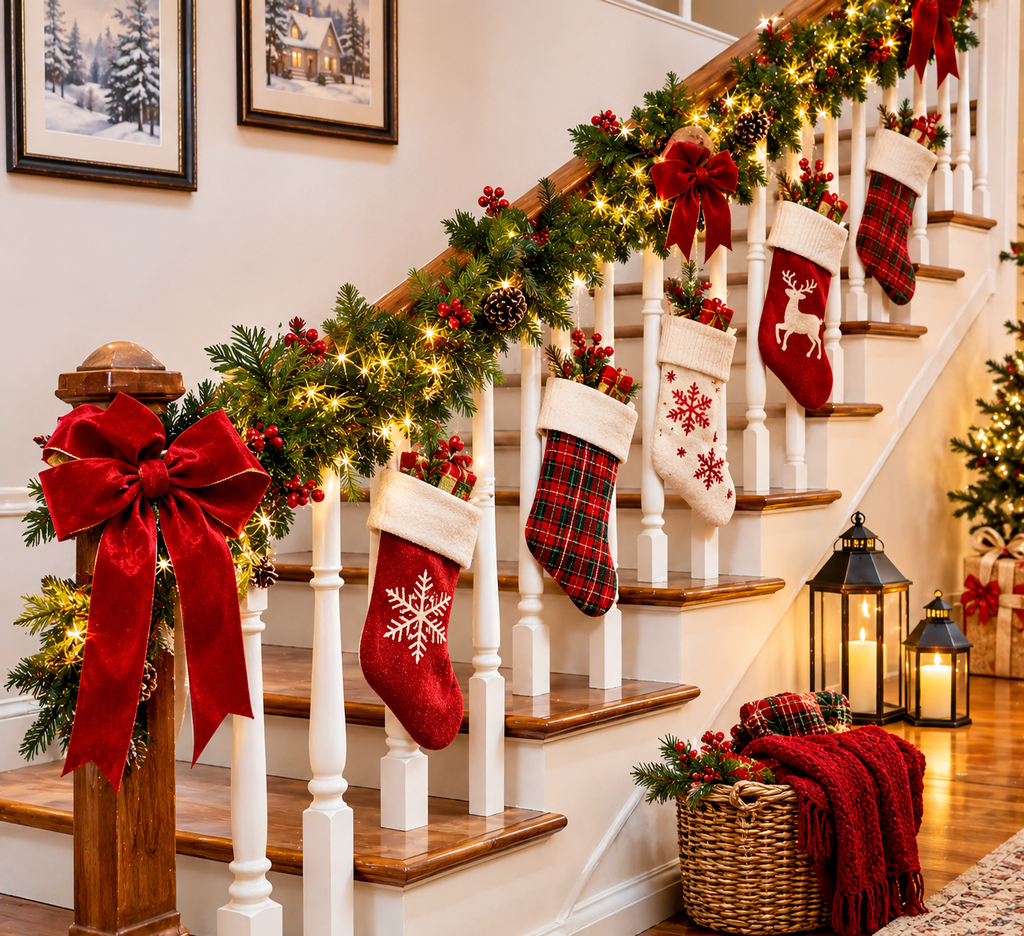
Hanging stockings from the stair rail is a staple in homes without a fireplace and a fun alternative in homes with one. Use S-hooks or sturdy ribbon loops over the balusters, and space the stockings out far enough that they hang freely and do not tangle.
A few real-world details matter. Fill them lightly: a stocking packed with gifts can pull a baluster loose or sag onto the stair beneath it. Hang them on the baluster side of the rail, so they do not interfere with a hand running along the top. If small children are around, hang them high enough that they cannot be yanked down onto the stairs. Matching stockings look polished, but mismatched ones in coordinated colors look more collected and are easier to personalize with names embroidered or tagged.
This idea also pairs well with a garland, since the stockings add the color and the greenery supplies the backdrop.
6. Lanterns With Flameless Candles on the Wall Side of the Steps
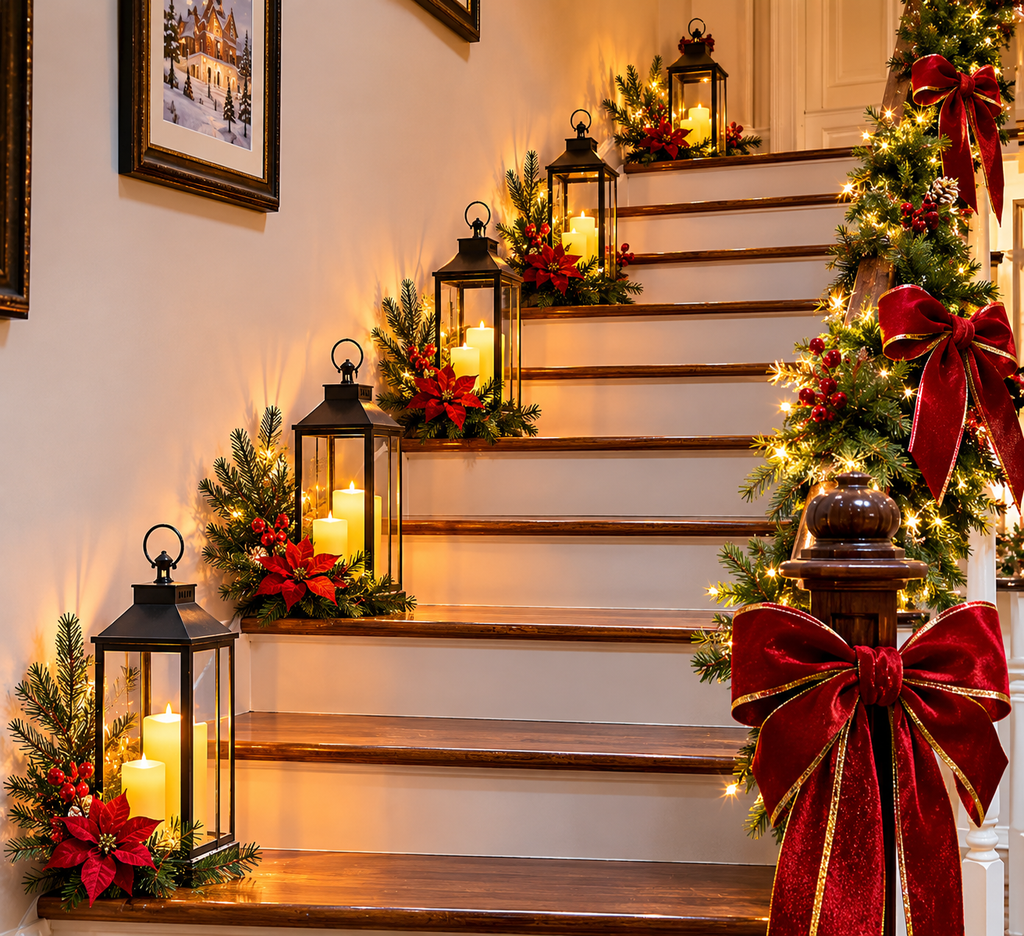
Lanterns lined up on stair treads are a popular image on Pinterest, and they are also the idea that most needs a safety edit. Real candles on stairs are a fire risk, and any lantern on a tread is a risk to feet. Fire safety organizations consistently recommend flameless candles around greenery and decorations, and for stairs they are the only sensible choice.
If you want the look, keep it limited. Place lanterns only on the wall side of a few treads, never in the center or on the handrail side, and leave a clear path of at least the width of a foot. Choose wide, stable lanterns that cannot tip, not tall, narrow ones. Put them on treads that are deep enough, and skip staircases with narrow or winding steps.
Flameless LED candles with flickering bulbs and built-in timers look convincing from a distance, and a few sprigs of greenery inside the lantern adds texture without blocking the light. For stairs where the walkway is tight, hang lanterns from wall hooks or from the rail instead of setting them on the steps.
7. Potted Mini Trees and Greenery at the Landing and Bottom Step
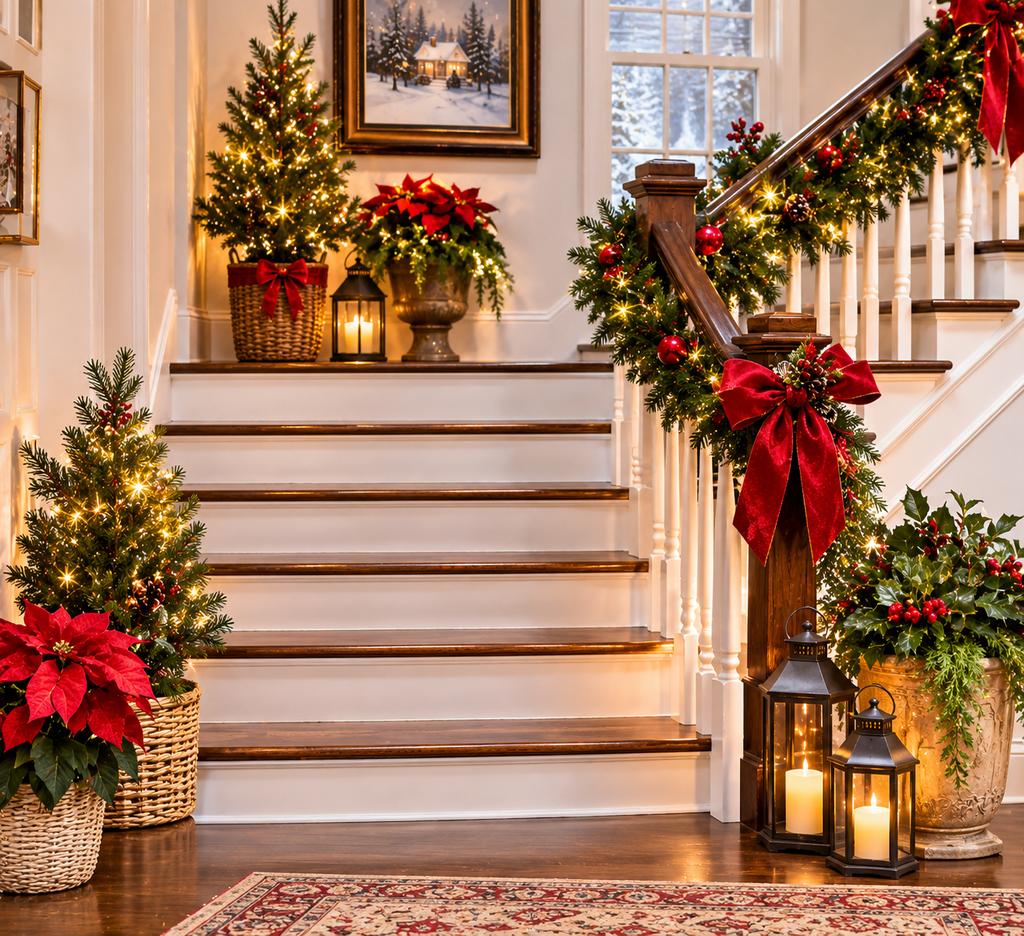
The bottom of the stairs and any landing are the safest spots on the staircase for freestanding decor. A pair of slim potted trees flanking the bottom newel post makes an entrance. On a landing, a single taller tree or a cluster of three in different heights can fill the corner without crowding the path.
Live dwarf conifers like Alberta spruce are common choices, and they can be moved outside after the holidays, though they need light and cool temperatures to survive indoors for more than a few weeks. Check the plant tag for care and do not leave them next to a heating vent. Faux trees avoid the issue entirely, and pre-lit narrow trees save the work of adding lights.
Wrap the pots in burlap, galvanized buckets, or baskets to match the rest of the decor. A stack of empty wrapped boxes beside the trees adds the gift look without filling the tread space. Keep a clear path of walking width: the decoration belongs beside the stairs, not in front of them.
8. Ornament Clusters That Cascade From the Rail
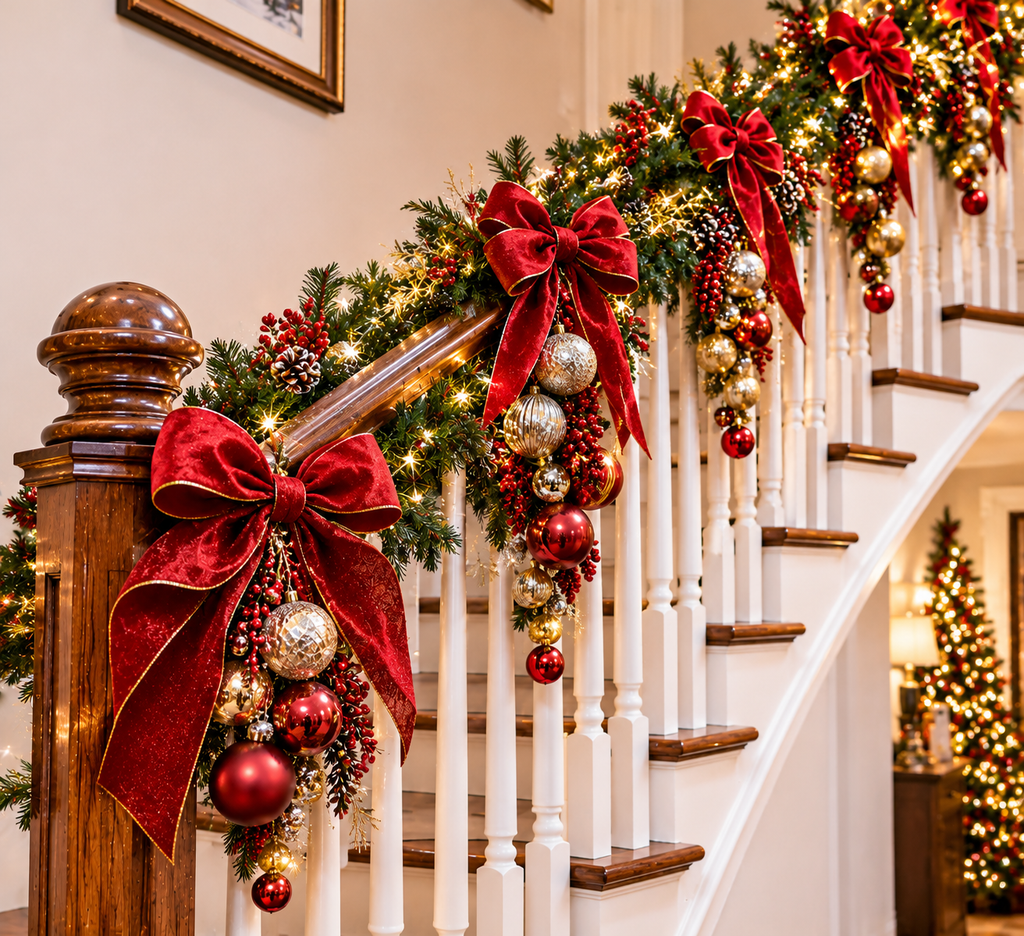
Glass and shatterproof ornaments are usually kept on the tree, but a staircase can hold them too. Hang clusters of three to five ornaments at different lengths from the rail using ribbon, so they dangle at varied heights between baluster gaps. Vary the sizes and finishes: matte, glossy, and glittered pieces catch the light differently.
Shatterproof plastic is the right choice for anywhere the ornaments could swing or fall, and for homes with kids or pets. Glass breaks on hard floors, and fragments on a stairway are dangerous.
The ribbon can be adjusted to fit the staircase. In a tall stairwell with a view from the entry, longer drops look dramatic. In a narrow staircase, shorter ones keep the decor from swinging into passersby. Stay inside a limited color palette of two or three tones, such as deep red with gold, or navy with silver, because mixed ornaments in too many colors look busy against the greenery.
9. Natural Pieces: Pinecones, Dried Orange Slices, Cinnamon, and Herbs
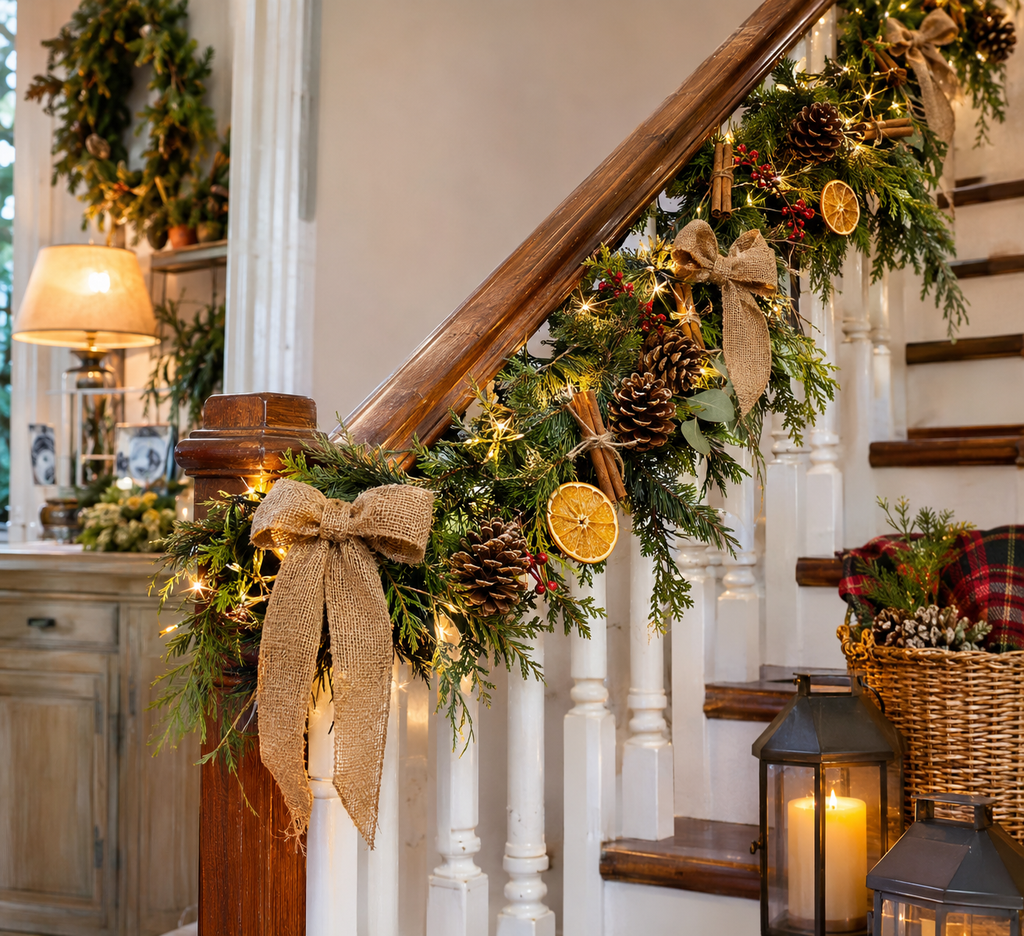
A natural scheme feels different from a glitter-and-ribbon staircase, and it can be assembled cheaply. Tuck pinecones into garland, tie bundles of cinnamon sticks with twine, and thread dried orange slices on ribbon to hang from the rail. Sprigs of rosemary, eucalyptus, and bay leaves add scent and shape.
Some preparation is required. Oven-dried orange slices need a low temperature and several hours to dry properly, and slices that are still damp can mold. Pinecones collected outdoors may carry insects or sap, so baking them on a lined sheet at a low temperature for a short time is a common way to clean them. Check a trusted crafting source for the exact method, as times vary by pinecone size.
This look suits wood-toned staircases and neutral spaces. It also ages gracefully, since a little browning or dryness reads as part of the style, unlike fading synthetic flowers.
10. A Flocked or Snowy White Winter Palette
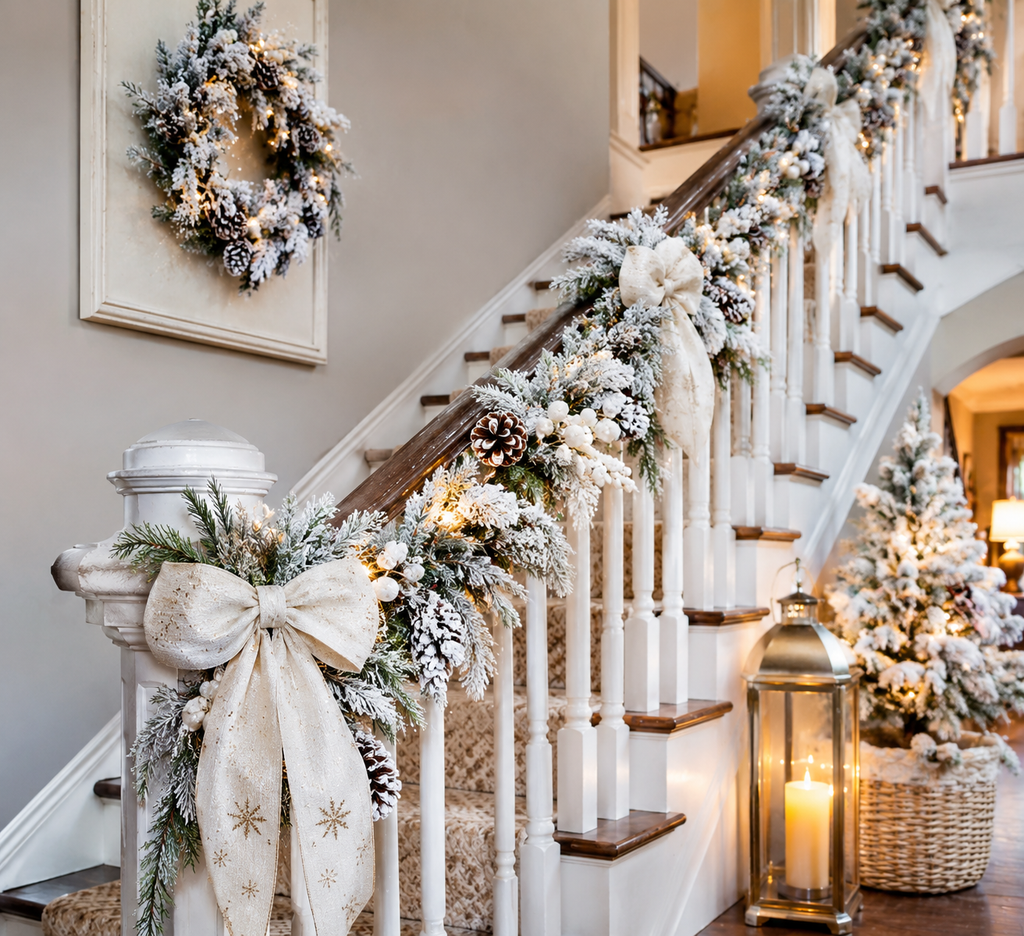
White flocked garland, silver ornaments, and cool white lights make a quieter, frostier staircase. It works especially well against dark wood or a painted white railing, where the contrast is sharp.
Flocked garland sheds, which is the main drawback. The white coating can drop onto stair treads, runners, and floors, so it is better in homes with hard floors or where a vacuum is easy to reach. Artificial snow spray is also messy and can damage some finishes, so check the label before using it near wood or paint.
To keep the look from feeling flat, mix in texture. Faux fur or knit ribbon, white berries, pearl-like ornaments, and frosted pinecones keep a white scheme from looking sterile. Add a touch of green or metallic for warmth, and consider warm white lights even with a cool palette, since the contrast softens the whole picture.
11. Plaid, Burlap, and Rustic Farmhouse Touches
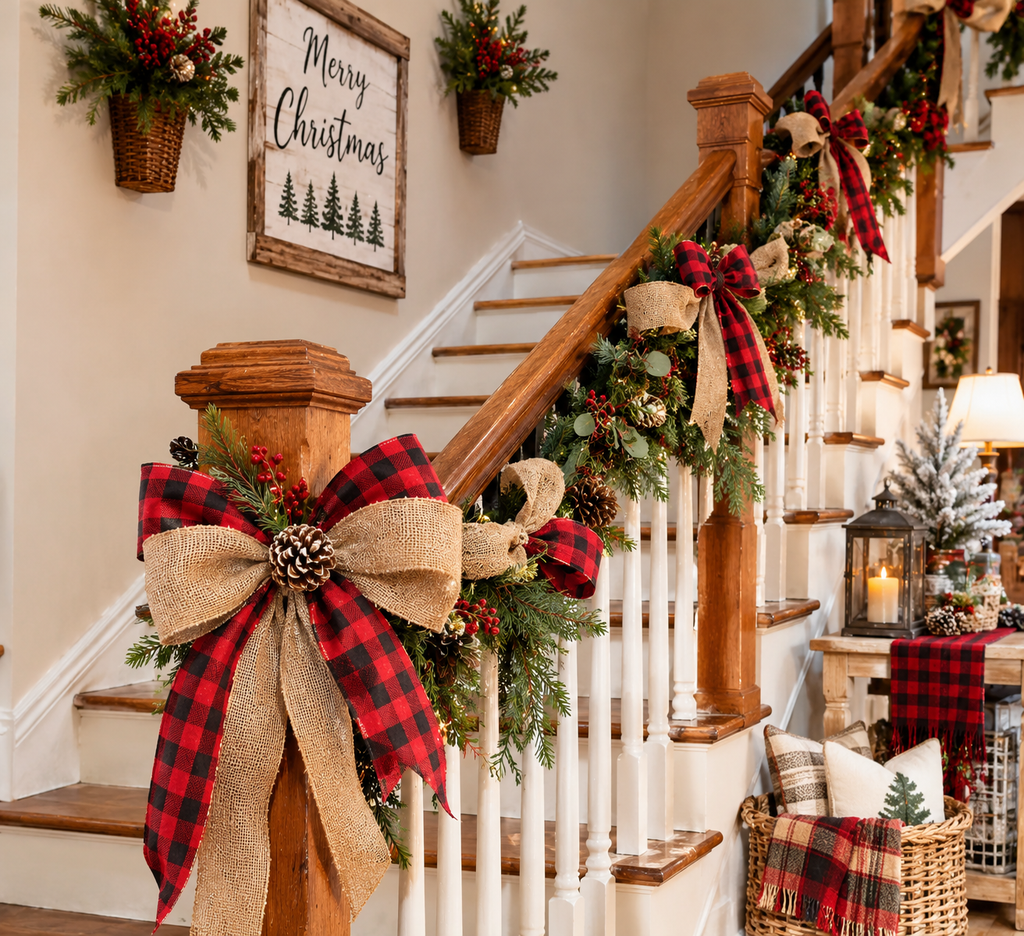
Buffalo check and tartan plaid ribbon, burlap bows, and wooden ornaments give a staircase a farmhouse or cabin feel. This style forgives imperfection, which makes it the easiest of the thirteen for a first-time decorator. A slightly messy bow looks intentional.
Some tips for getting it right: pick one plaid and stick with it, since two competing patterns look accidental. Use wired ribbon in widths of 2.5 to 4 inches for bows, and use burlap ribbon as a layering base under a plaid ribbon for depth. Wooden ornaments, sleigh bells on leather straps, and small galvanized buckets complete the look.
Burlap sheds fibers, so avoid it directly over carpet runners or dark floors, and keep lighter pieces away from heat sources.
12. Removable Riser Decorations
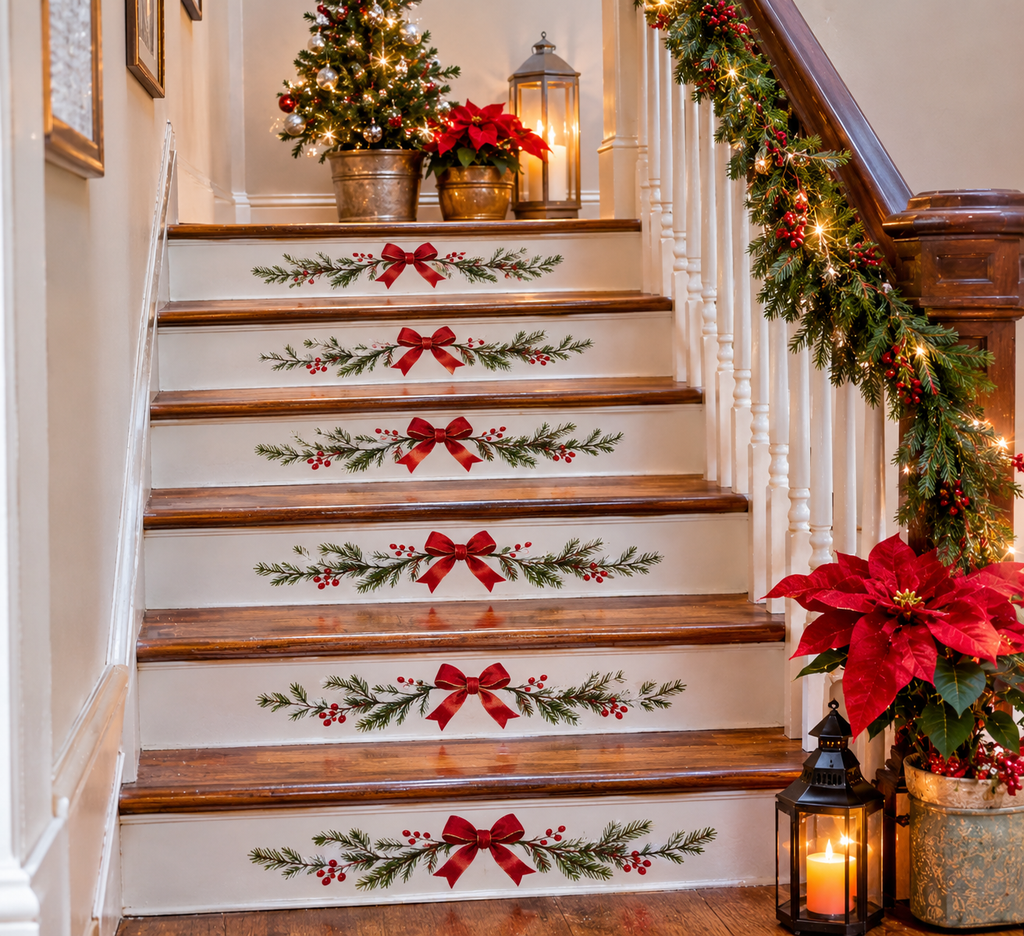
The vertical face of each step, called the riser, is a long strip of blank space that is easy to overlook. Removable decals, printed vinyl strips, or fabric panels can turn each riser into a line of Christmas pattern, a message spelled out one word per step, or a repeating illustration.
This idea needs more caution than the others, because adhesive on a stair surface has to hold firmly and come off cleanly. Test on a hidden area of the riser first and wait a day or two to see whether the finish is affected. Painted or varnished surfaces can lift when the adhesive is removed, and old paint can peel off with it. Raw wood and glossy finishes behave differently, so a small test patch gives better information than any package claim.
Keep the pieces flat against the riser so no edge curls into a toe. Never cover the front edge of the tread itself, and avoid any material that makes the stairs more slippery. Decorations on risers should look good from a distance and cause no one to look down at them.
13. Hanging Pieces From Above in a Tall Stairwell
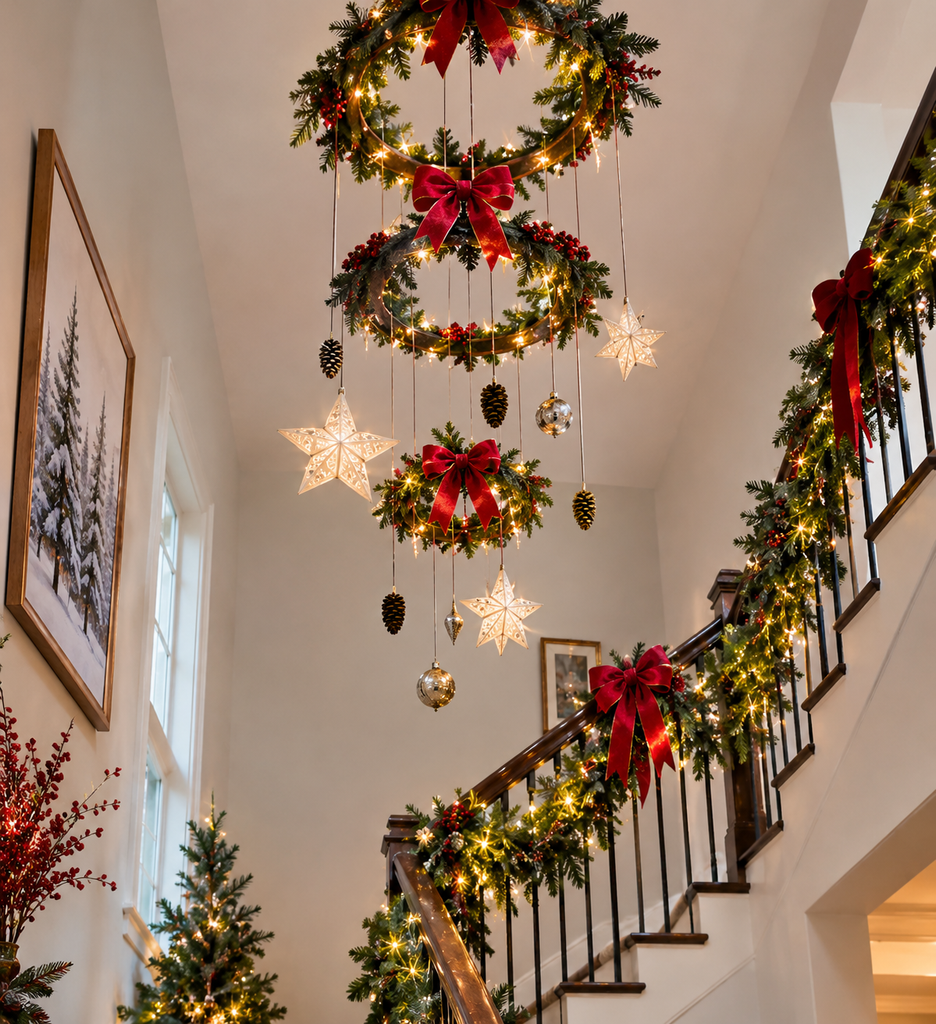
In a home with a tall open stairwell, the empty space above the stairs can be the most dramatic part. Paper stars, clusters of ornaments on long ribbons, or a wreath hung from a chandelier or ceiling hook can fill the air above the staircase.
The key concern is attachment. Anything hung overhead should be light, and the fixture or hook must be capable of holding the load. Use ceiling hooks rated for the weight, and avoid hanging anything from a light fixture unless the manufacturer says it can carry the extra load. If installing a ceiling hook requires a ladder on the stairs, that is the moment to call someone to help or hire a professional, because working on a ladder at stair height is a common way to get hurt.
Paper and fabric decorations are lightweight and cheap. Keep them away from bulbs and heat, and out of reach of anyone who could swing at them. Hang at staggered heights so the arrangement looks like falling snow, not a row.
Fresh Greenery vs. Faux: What to Expect
Fresh greenery smells wonderful, but it has limits indoors. In a heated home, cut evergreens can dry out in a few weeks depending on the species, the humidity, and how close the garland is to a vent or sunlit window. Dry needles are more flammable, and they drop on stairs and carpets. If you use fresh garland, keep it away from heat, check it regularly, and replace it when needles turn brittle.
Faux garland is reusable, tidy, and predictable. Its weakness is appearance: cheap versions look flat and uniform. Better ones have varied branch shapes and different needle textures. If budget is tight, buy a couple of good sections and fill out the rest with fresh trimmings from a tree lot. Many lots give away or sell cheaply the lower branches they cut off, which makes a mixed arrangement affordable.
Safety Checks Worth Doing Once Everything Is Up
Walk the staircase before calling it finished. Go up and down once with your hand on the rail, then again carrying something, as people tend to do. If anything catches a sleeve, blocks a hand, or sits in the walking line, move it.
Check cords and light strings for damage before using them, and replace any that are frayed or have exposed wire. Never run cords under rugs or runners, where heat can build up and damage goes unnoticed. Turn lights off when no one is home, or use a timer. Keep lights and greenery away from heating vents, fireplaces, and radiators. If you have a smoke detector at the top or bottom of the stairs, keep decoration clear of it.
Homes with toddlers, large dogs, or elderly relatives need the most careful setup. For these households, the safest choices are the ideas that stay off the treads and out of reach: garland on the balusters, wall wreaths, and bows.
Frequently Asked Questions
How do I decorate a staircase with cable rails or glass panels?
Wrapping or tying garland to cables does not work well, because there is no solid anchor and the cables can be damaged by tight wire. A more reliable option is to hang lightweight garland from the top rail only, using clips or hooks made for the rail’s profile, and let it hang loose. For glass panels, adhesive suction hooks rated for glass can hold a light wreath, but check the weight rating and clean the glass first. Another approach is to put the decoration on the wall side and at the newel posts instead.
Can I leave stair garland up with lights on all day?
It is better not to. Even LED strings are designed for limited run time in many cases, and unattended lights on dry greenery are the combination fire-safety groups warn about. A plug-in timer or the built-in timer on battery strands gives the same visual effect with fewer risks. Always turn them off overnight and when leaving the house.
How do I protect a carpet runner from fallen needles and sticky residue?
Brush or vacuum the runner every few days if you use fresh greenery. If you use adhesive hooks or tape, keep them away from the runner. For stairs with a runner, a faux garland is generally cleaner.
When should I take everything down, and how should I store it?
There is no single date. Many households remove fresh greenery by early January because it dries out, while faux decor can stay up as long as the household likes. For storage, loosely coil garland in a large bin without crushing it, label which pieces go where, and save a small bag of zip ties, wire, and hooks with it so next year’s setup starts from the same hardware.
Key Takeaways
Start by measuring the rail along its slope, locating the nearest outlet, and deciding what must stay clear for hands and feet. Everything else follows from those choices. Layered garland with warm lights and a few oversized bows is the dependable base, and wreaths, stockings, natural pieces, or a riser treatment can be added one at a time depending on the style. Keep candles flameless, keep treads clear, and keep the handrail graspable. A staircase that looks good and works well is better than one that photographs well for a day.

About Syprose Kiche
Syprose Kiche is the creator and writer behind My Besuited Home, a practical home and garden website covering DIY projects, gardening, lawn care, landscaping, home improvement, and outdoor living. She focuses on turning everyday homeowner questions into clear, practical guides backed by careful research and useful real-world considerations.