
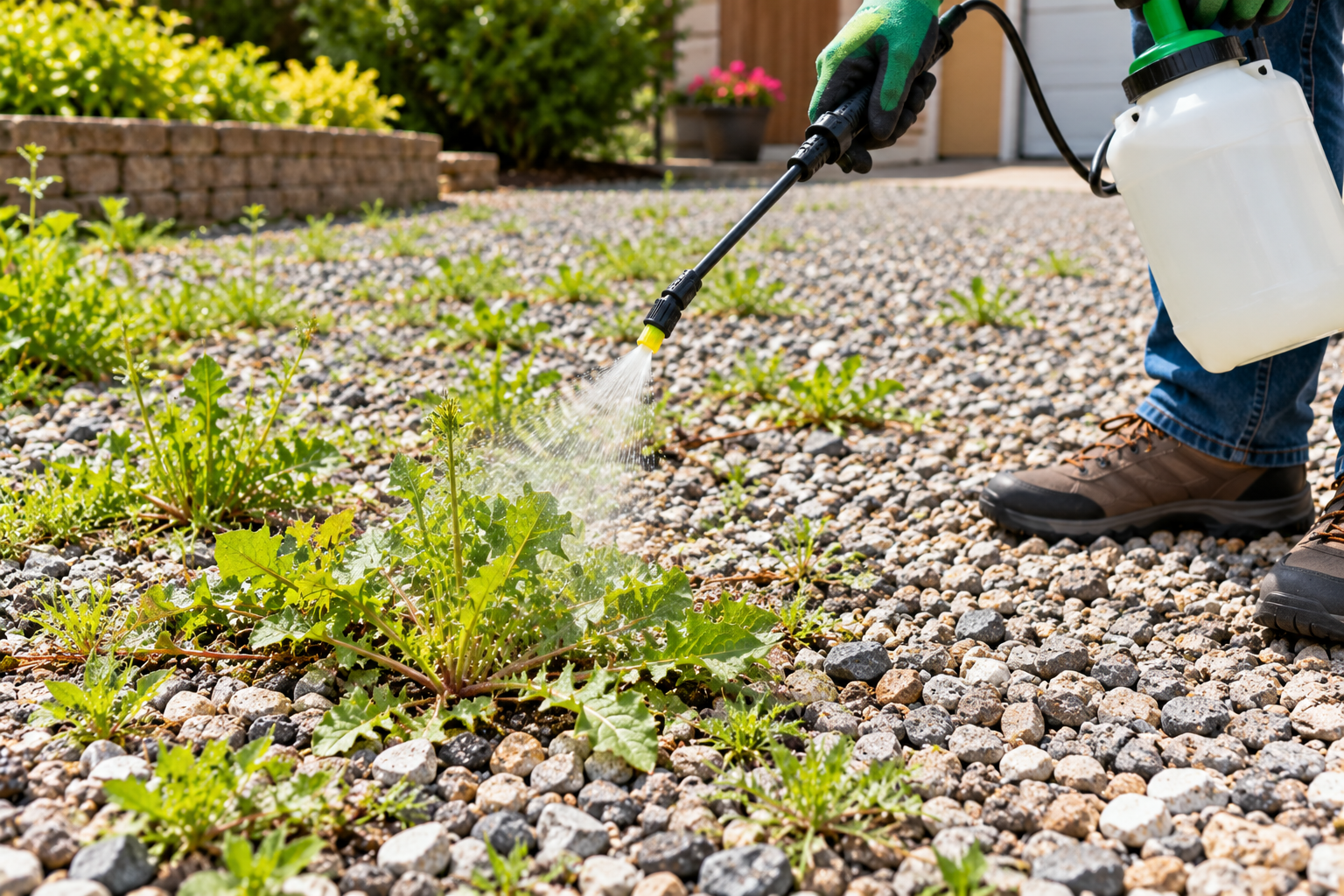
Most weeds in gravel aren’t growing up from the soil underneath. They’re growing in the thin layer of dust, leaf litter, and decayed organic debris that settles between the stones. Seeds blow in, land in that debris, and sprout with very little to hold them back. Fallen leaves, dirt, and other debris collect in the crevices and feed emerging weeds.
That’s why a bare gravel path can look clean in May and green by July, and why killing the weeds you can see only solves part of the problem. The method that works depends on three things: how big the weeds are, whether they have deep roots, and how much of the gravel they’ve colonized.
Check What You’re Dealing With First
Spend a minute looking closely before you pick a method.
Seedlings with thread-like roots (tiny grasses, chickweed, young broadleaf weeds) are the easy case. Almost anything works on them, including a rake.
Weeds with taproots (dandelions, thistles, dock) are harder. Cut or burn the top and they can regrow from the root.
Creeping or spreading weeds (bindweed, quackgrass, bermudagrass) often come in from the edge of the gravel along the lawn or a planting bed. If they’re running in from the border, killing what’s in the gravel without dealing with the edge is a short-term fix.
Woody seedlings (maple, elm, mulberry) can look harmless at three inches tall. Pull them early, because their roots thicken quickly.
Pulling and Raking: Slower, but Dependable
Hand-pulling gets a bad reputation for being tedious, but in gravel it’s often the most reliable option. Loose stone means roots slide out easily when the ground is damp, so pull a day or two after a good rain.
A few details make it work better:
- Grip the weed low, at the base, rather than by the leaves. Leaves snap off and leave the crown behind.
- For taproots, use a narrow tool such as a dandelion weeder or a hori-hori knife, and work it down alongside the root before levering.
- Remove the pulled weeds from the area. Many will re-root, and seed heads that ripen on the ground will drop their seeds right back into the gravel.
For a driveway or wide path where individual pulling isn’t realistic, raking helps with seedlings. Dragging a landscape rake through the surface layer uproots very young weeds and exposes them to sun and air. It only works while they’re small, so raking every couple of weeks during the growing season does more than one big raking in midsummer. Raking also moves the stones around, which keeps debris from settling into a seedbed.
Boiling Water: Good for Cracks and Small Patches
Pouring boiling water directly on a weed scalds the foliage and the upper part of the plant. It’s free, there’s no residue, and it works best on small, shallow-rooted weeds.
The limits are worth knowing:
- Water cools quickly as it hits the stone, so deeper roots often survive. Iowa State University horticulture extension specialist Aaron Steil recommends a follow-up treatment about 7 to 10 days later for the weeds that come back.
- It’s non-selective. Water that runs into a nearby lawn edge or flower bed will damage those plants too.
- It’s not practical for large areas.
- There’s a real scald risk. Carry the kettle in a stable, low position, wear closed shoes, and keep children and pets out of the area until it cools. Pouring from a kettle with a long spout puts the water where you want it with less splashing.
Vinegar: Better Than Nothing on Seedlings, Weak on Anything Else
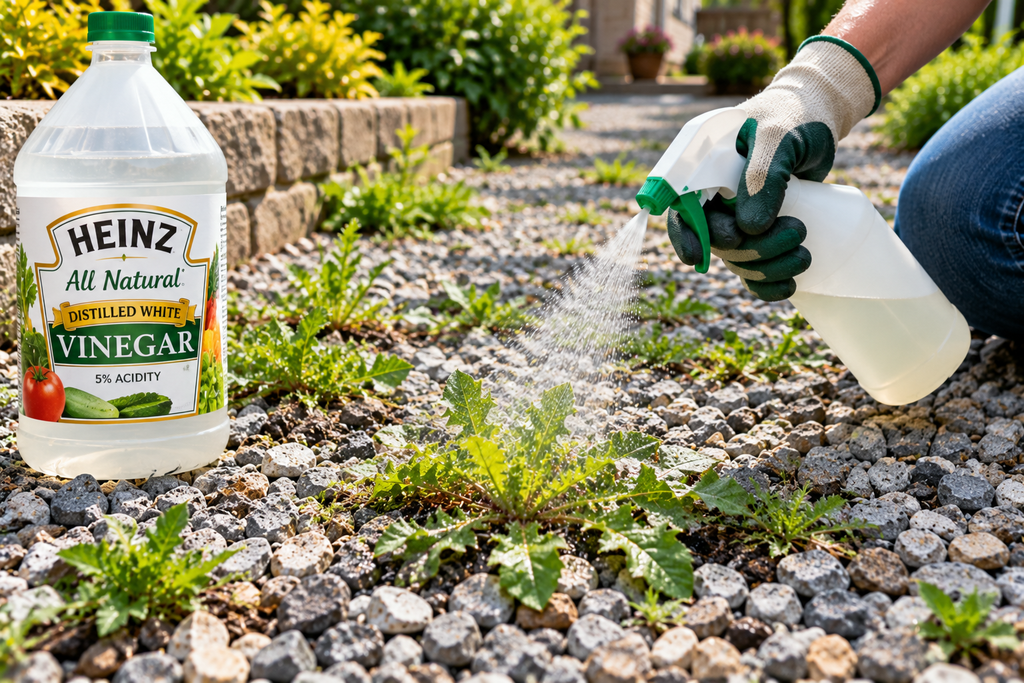
The vinegar-as-weed-killer idea is everywhere, so it’s worth being precise about what it can do.
Acetic acid is a contact herbicide. It burns whatever leaf surface it touches, but it doesn’t move down into the root. Because acetic acid doesn’t translocate through the plant, any perennial or well-established weed can regrow.
Strength matters a great deal too. Ordinary kitchen vinegar is about 5% acetic acid. Extension guidance notes that concentrations of roughly 10 to 20% are needed for real weed control, and that household vinegar won’t do much against weeds like dandelions or purslane. The stronger products sold as horticultural vinegar are a different material. They can burn skin and damage eyes, so goggles, gloves, and long sleeves are the minimum, and the label should be read as carefully as a pesticide label (because it is one).
Realistically, vinegar is a spot treatment for young weeds on a sunny, dry day. It won’t give you lasting control of a gravel area.
Why Salt Is a Poor Choice for Gravel
Salt is often recommended for gravel because it’s cheap and gravel doesn’t seem to care. The trouble is that gravel doesn’t hold salt in place. It dissolves and moves with rainwater. University of Illinois Extension notes that salt breaks down soil structure and is mobile, so it can migrate into nearby planting areas and damage them.
If the gravel sits next to a lawn, a tree, or a garden bed, you’re likely to end up with dead edges and stressed roots farther away than you intended. Salt also leaves the area hostile to anything you might want to grow there later. For most households, it’s the method most likely to cause problems elsewhere.
Herbicides: When They Make Sense and How to Pick One
If a path or driveway is badly overgrown, or you’re clearing a large area, a labeled herbicide is usually the most efficient route. There are two different jobs to think about.
Post-emergent (kills weeds that are already growing). A systemic product, such as one containing glyphosate, is taken in through the leaves and moves through the plant, which makes it more effective on established perennials than contact killers. Apply it on a calm, dry day, to actively growing weeds, and give it the rainfree window stated on the label. Results usually take days to show, and large weeds may need a second application.
Pre-emergent (stops seeds from sprouting). This is applied to the gravel surface before seeds germinate, usually in early spring, and sometimes again later in the season depending on the product. Pre-emergent granules applied in early spring prevent weed seeds from germinating. They don’t affect weeds that are already up, so they work best after you’ve cleared the area. Timing matters. Applying after weeds have emerged mostly wastes the product.
A few cautions that apply to both:
- Check that the label allows use on gravel, driveways, or non-crop areas. Many lawn and garden products aren’t labeled for this.
- Look at what’s nearby. Some herbicides have soil activity that can affect tree and shrub roots, and gravel drains quickly, so product can move. Be careful on slopes, near storm drains, and over the root zones of trees.
- Follow the label on mixing, rates, protective equipment, and re-entry time. Keep children and pets off treated areas until the label says it’s safe.
- Don’t mix products or add household chemicals. Combining things in a sprayer is how people end up with ineffective mixtures, damaged equipment, or worse.
Corn gluten meal is often suggested as a natural pre-emergent. Results are inconsistent, it needs careful timing, and it contains nitrogen, which can feed whatever does get through. One guide notes that no organic approach permanently kills weed roots and seeds. Treat it as a modest help, not a fix.
What About a Weed Torch?
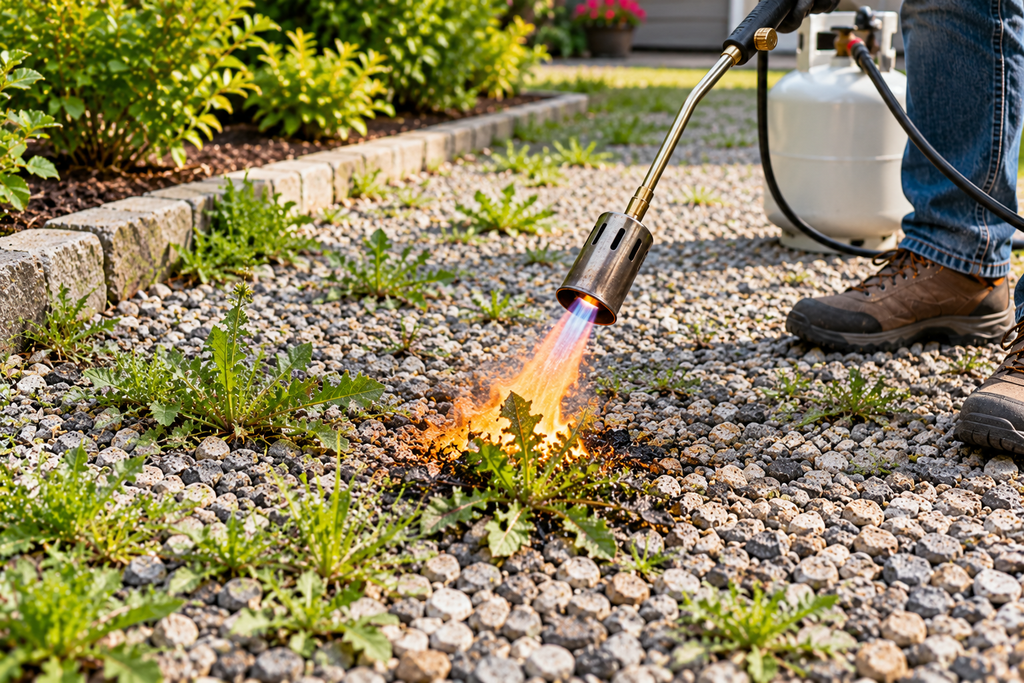
Flame weeders can kill small weeds quickly, and the gravel itself won’t burn. But the risks are considerable: dry leaf debris in the gravel can ignite, nearby wood, mulch, or siding can catch, and many areas restrict open flame during dry spells. It’s also a contact method that only damages the top growth. If you consider one, check local fire rules and stay away from anything flammable.
Stopping the Next Round: Why Weeds Return
Once the gravel is clear, prevention is where most of the long-term difference gets made.
Remove debris regularly. Since weeds feed on the organic layer that builds up, a leaf blower or stiff rake used in fall and spring takes away the seedbed itself. This is probably the single most overlooked step.
Keep the gravel deep enough. Thin gravel lets light and moisture reach the soil below, and traffic mixes the layers together. Topping up periodically, so the stone layer stays well above the soil, helps. A common recommendation is a few inches of depth, though the right amount depends on the stone size and what the area carries (foot traffic or vehicles).
Use fabric correctly. Landscape fabric (or a woven or non-woven geotextile) is most useful when it’s laid down under new gravel on cleared, graded ground, with overlapping edges. It’s much less useful pushed under existing gravel, and over time debris collects on top of the fabric, where weeds root happily in it anyway. Fabric slows weeds from coming up from below. It doesn’t stop seeds from landing and sprouting at the surface.
Edge the borders. A defined edge (steel, stone, or a clean trench) keeps lawn grass and creeping weeds from running into the gravel.
Fill weak spots promptly. Ruts, bare patches, and low spots hold water and silt, and those are the places weeds find first.
Which Method for Which Situation
| Situation | Reasonable approach |
| A few weeds in a small path | Pull after rain; spot-treat with boiling water if needed |
| Seedlings across a wide area | Rake regularly; follow with a labeled pre-emergent |
| Established taproots or perennials | Dig out the root, or use a systemic herbicide and repeat if needed |
| Near a lawn, tree, or bed | Avoid salt and soil-active products; hand-pull and edge |
| Entire driveway overgrown | Clear with a labeled herbicide, remove debris, then regrade and consider fabric under fresh gravel |
Questions Readers Often Ask
Will weeds really never stop growing in gravel?
They tend to keep coming as long as seeds and a little debris are present. The goal is to reduce how often and how many, which is realistic.
Can I just replace the gravel?
For a seriously overgrown area, stripping the old stone, regrading, laying fabric, and adding clean gravel is the most thorough reset. It costs more in time and materials, so most people try the other methods first.
Are homemade weed killer recipes worth it?
Mostly for seedlings, and mostly as a spot treatment. Recipes that rely on salt or borax carry soil risks, and extension specialists generally advise caution with them.
Key Takeaways
Gravel weeds grow in the debris on top, so the most lasting control comes from keeping that layer clean, not just killing what’s up. Pull or rake while weeds are small, use boiling water or strong vinegar only as spot treatments, and skip salt. For large or deep-rooted infestations, a herbicide labeled for gravel or non-crop areas is usually more effective, as long as you follow the label and watch where runoff goes. Finish with edging, adequate gravel depth, and fabric laid under fresh stone if you’re resurfacing.

About Syprose Kiche
Syprose Kiche is the creator and writer behind My Besuited Home, a practical home and garden website covering DIY projects, gardening, lawn care, landscaping, home improvement, and outdoor living. She focuses on turning everyday homeowner questions into clear, practical guides backed by careful research and useful real-world considerations.