
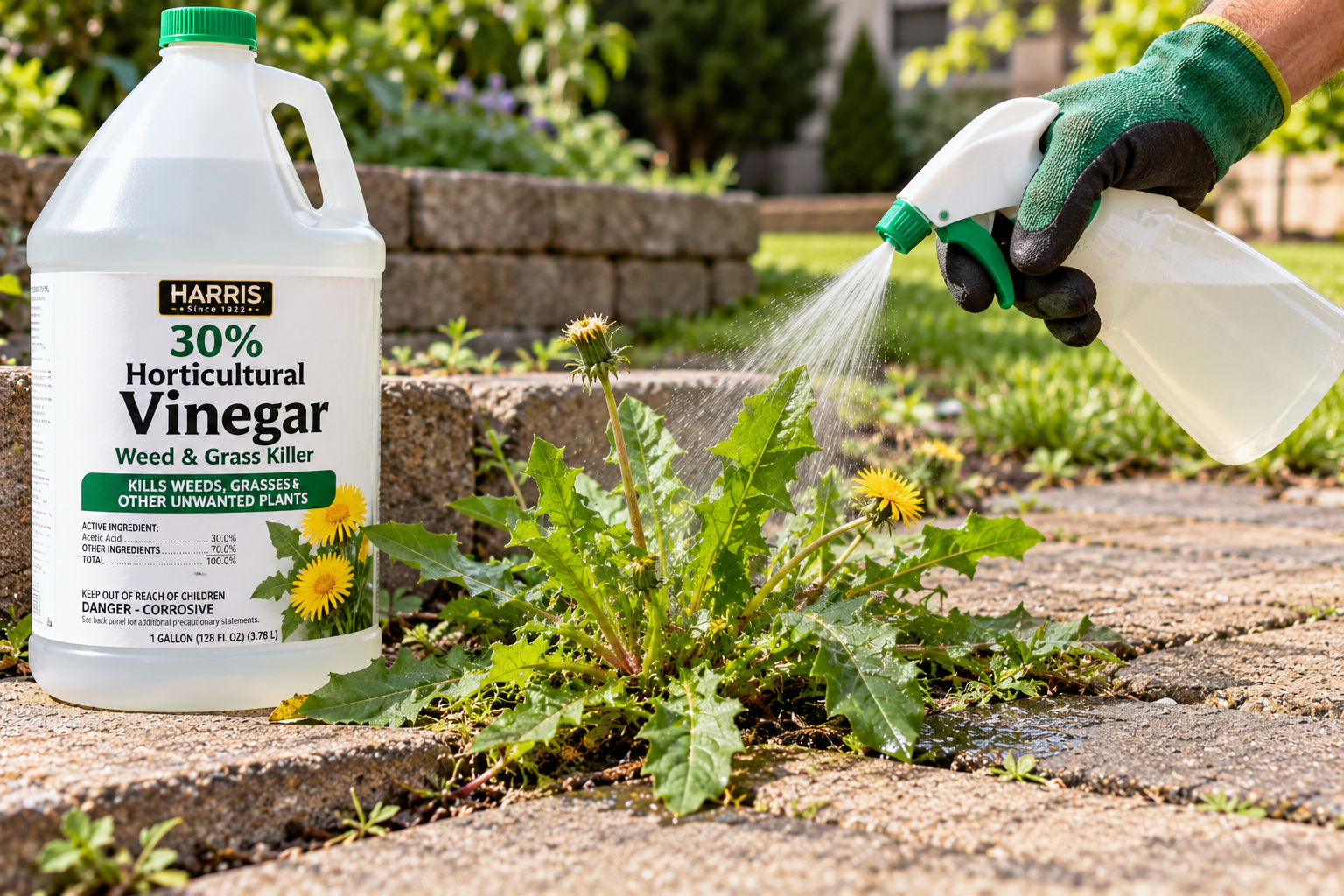
The vinegar in your pantry and the vinegar sold as a weed killer are not the same product, and the difference decides whether you get a wilted patch of weeds or nothing at all. Standard white vinegar is about 5% acetic acid. Bottles labeled as horticultural or herbicidal vinegar run much higher, commonly 20% or more. Most disappointing results with vinegar trace back to that gap, and to a second problem that no concentration fixes: vinegar burns whatever leaves it touches, but it does not travel down to the roots.
So the best vinegar for weed control depends on the weed. For small annual seedlings on a driveway or patio, a high-strength product can work well. For dandelions, thistles, or anything with a serious root system, even the strongest vinegar mostly delivers a temporary haircut.
The Short Answer: Horticultural Vinegar, Used on Small Weeds
If you want one recommendation, it is a horticultural-strength vinegar of roughly 10% to 20% acetic acid, applied to young weeds on a warm, dry, sunny day. Research from the USDA Agricultural Research Service found that 10%, 15%, and 20% solutions killed 80% to 100% of several common annual weeds, while 5% vinegar gave inconsistent results. The weeds that responded best were small: giant foxtail up to about 3 inches tall, lambsquarters up to 5 inches, pigweed up to 6 inches, and velvetleaf up to 9 inches.
That last detail matters more than the percentage on the label. Vinegar is a contact herbicide. It damages the plant tissue it lands on, and a small seedling has little tissue to protect it.
Household, Cleaning, and Horticultural Vinegar Compared
| Type | Typical acetic acid | Realistic use for weeds |
| Household white vinegar | About 5% | Tiny seedlings, repeated applications, inconsistent results |
| Cleaning vinegar | Often 6% to 10% (check the label) | Slightly stronger, but sold as a cleaner, not a weed killer |
| Horticultural or herbicidal vinegar | Commonly 10% to 30% | Best performance on young annuals; requires real protective gear |
A few notes on that table.
Household vinegar is the cheapest option and the weakest. Washington State University extension staff reviewed the research and noted that 5% vinegar did not produce reliable control, and their own preliminary field tests with ready-to-use products at around 7% showed similarly erratic results. It can work on very young seedlings, especially in cracks where you can soak the whole plant, but expect to spray again.
Cleaning vinegar varies by brand, so the label is the only reliable guide. It is tempting because it is stronger than the kitchen bottle, but a cleaning product is not packaged or labeled with weed control directions. If you go this route, treat it with the caution you would give a stronger acid.
Horticultural vinegar is where the research results come from. A field study in Oklahoma tested concentrations from 5% to 20% and found control rose with every step up in strength. Broadleaf weeds were hit hardest, with 84% or better control at 10% or 20%, depending on how much spray was applied. Grasses were much tougher: even the best treatment, 20% acetic acid at a heavy application volume, controlled roughly 44% to 63% of grass and crabgrass.
There is a practical lesson hiding in that study. Heavier application volumes improved control across the board. A light misting wastes product. Weeds need to be thoroughly wetted.
Why Vinegar Fails on Dandelions, Thistle, and Bindweed
Montana State University Extension describes acetic acid as a non-selective contact herbicide with no translocation (it does not move through the plant) and no residual activity in soil. Those two facts explain nearly every complaint about it.
When a dandelion is sprayed, the leaves brown within hours. The taproot, which stores energy, is untouched. Within a couple of weeks the plant sends up new leaves from the crown. The same thing happens with perennial weeds that spread from roots or rhizomes, such as bindweed and Canada thistle. The ARS work noted that Canada thistle shoots died after 5% vinegar, but killing shoots is not the same as killing the plant, and extension guidance is plain that perennials are unlikely to be controlled because they resprout from the roots.
Grass-type weeds add a separate complication. Their growing point sits low, near the soil surface and wrapped in leaf sheaths, so spray often fails to reach it. That is consistent with the weaker grass control in the Oklahoma trial, and with an Indonesian study in which a crabgrass-type weed (Digitaria) was not controlled by vinegar up to eight weeks after treatment.
A Cornell Cooperative Extension trial summarized by Northern Virginia Master Gardeners found both household and herbicidal-strength vinegar gave short-term control but not lasting control.
The decision rule: if you can pull the weed and its roots with a hand tool, do that. If the weed is a seedling or lives where nothing else grows, vinegar is a reasonable choice. If it is a deep-rooted perennial, plan on repeated cutting, mulching, or a different product altogether.
Where Vinegar Makes the Most Sense
Vinegar suits places where you do not want anything to grow and where collateral damage is not a worry:
- Gaps in driveways, walkways, and patio pavers. Small seedlings in cracks are the ideal target. Because vinegar leaves no soil residue, it will not wash into nearby planting beds the way a residual product might, though overspray will still burn any plant it touches.
- Gravel areas. Annual weeds sprouting in gravel are usually young and shallow-rooted.
- Fence lines and edges with bare soil, as long as desirable plants are shielded.
- Newly sprouted weeds in a bed you are about to replant, sprayed before anything you want to keep emerges.
It is a poor fit for lawns, because it kills grass as readily as weeds, and a poor fit for beds crowded with ornamentals, where wind drift and drips are hard to control.
Getting the Most From a Vinegar Spray
The product matters, but technique matters nearly as much.
Spray young weeds. Aim for seedlings roughly in the two- to four-leaf stage. A weed that has already flowered or set a thick root crown will recover.
Choose the weather. A warm, sunny, still day with no rain in the forecast for several hours gives the best contact and drying. Cool, cloudy conditions tend to reduce results. Wind increases drift, which is a safety issue as much as an efficacy one. (Specific temperature thresholds appear in some student and informal sources, but check the product label for its own guidance.)
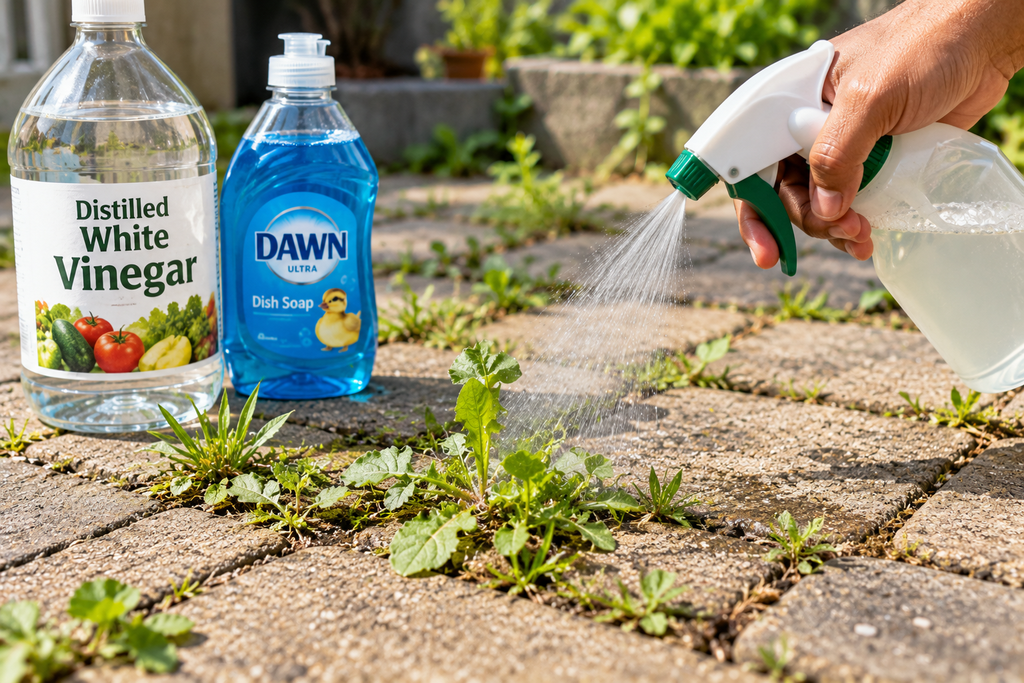
Wet the whole plant. Cover the leaves and growing point until they glisten. Use a dedicated sprayer with a coarse setting, not a fine mist that drifts.
Consider a surfactant. Dish soap acts as a wetting agent, helping spray cling to waxy leaves. The Oklahoma researchers tested orange oil and canola oil as additives; total control peaked at 74% with 20% acetic acid applied heavily along with canola oil. That is a modest ceiling, and it shows additives help but do not transform the result. Check any commercial product’s label before mixing anything into it.
Plan to reapply. Even good results on annual weeds can need a second pass when missed plants or new seedlings appear. This is normal for contact products.
Safety: Strong Vinegar Is Not a Kitchen Product
It is easy to underestimate vinegar because it sits in a salad cupboard. At herbicidal strength, it is a corrosive acid. The Master Gardener review of the research noted that many high-concentration products carry a “Danger” signal word on the label and can cause severe, permanent injury to skin and eyes.
If you use a horticultural product:
- Wear splash-proof goggles, chemical-resistant gloves, long sleeves, and closed shoes. Ordinary garden gloves may soak through.
- Mix and spray outdoors with the wind at your back. Fumes irritate the nose and throat.
- Keep children and pets away until the area is fully dry. Store the container sealed, labeled, and out of reach.
- Never mix vinegar with bleach. The combination can release toxic chlorine gas. Also avoid mixing vinegar with hydrogen peroxide, which can form corrosive peracetic acid.
- Rinse skin or eyes immediately with plenty of water if you get a splash, and seek medical care for eye exposure.
- Read the label. For a registered product, the label directions are the legal instructions for use.
Pollinators deserve a thought as well. Contact sprays can harm insects directly, so avoid spraying weeds that are in bloom and actively visited by bees.
What to Skip: Salt and Overkill Recipes
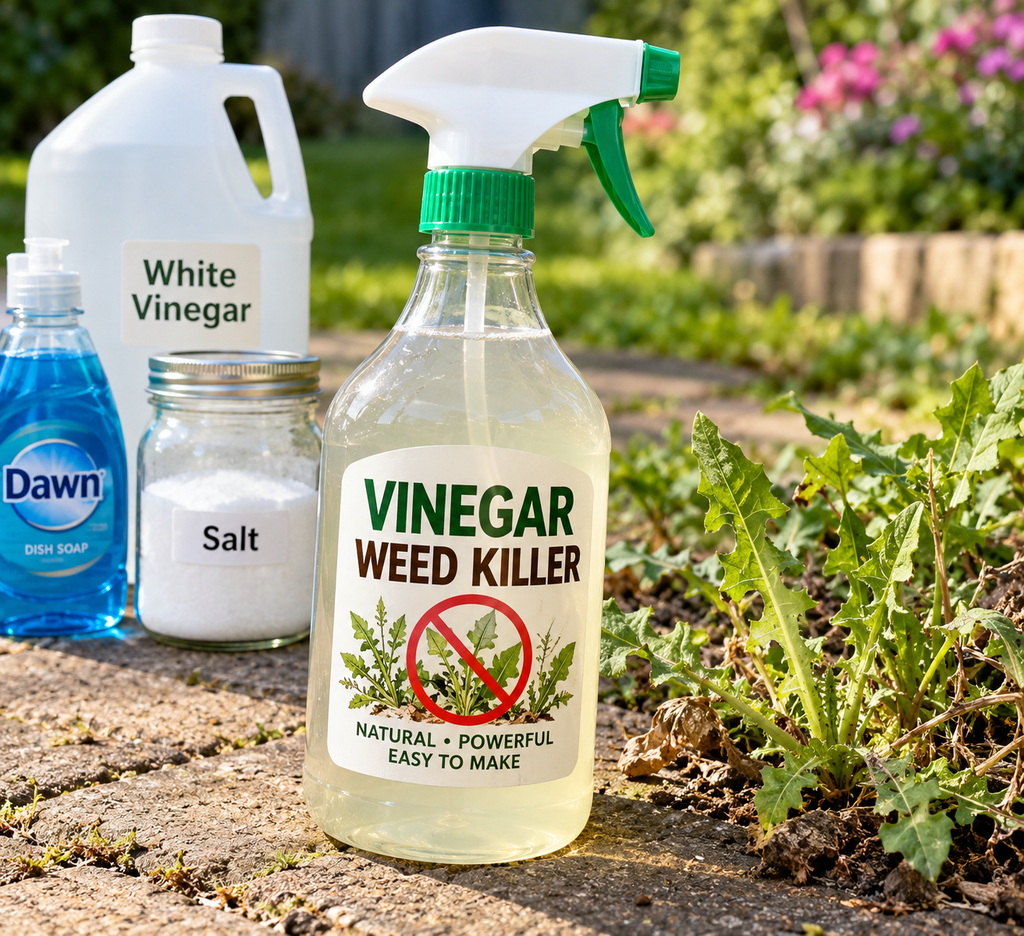
Recipes that add salt to vinegar circulate widely. The soap in those recipes does help with wetting, but salt is a different matter. It lingers in soil and can make the spot unable to support plants for a long time, and it can wash toward nearby plantings. If anything you want to grow is within reach of runoff, leave the salt out. The no-residue quality is one of vinegar’s few real advantages, and salt erases it.
There is also little reason to chase extreme strengths. Going from 20% to 30% adds hazard and cost, and it does nothing about the root problem with perennials.
Questions Readers Often Ask
Will vinegar kill weeds near my vegetables?
Only with great care. It is non-selective, so any leaf it touches can burn. A shield, such as a piece of cardboard held beside the plants, and a low-pressure sprayer help, but hand-weeding is usually safer in a vegetable bed.
How soon will I see results?
Contact damage typically shows within hours on a sunny day, with browning and wilting. Whether the weed stays dead is a separate question that depends on its age and root system, so check back after a week or two.
Does vinegar change the soil permanently?
The research summaries reviewed here describe no soil residual activity, meaning it is not expected to persist. Heavy, repeated applications in one spot are a different situation, and the evidence on that is thinner, so spreading treatments around is a sensible precaution.
Wrapping It Up
Choose the vinegar by the job. Household 5% vinegar is a weak option that suits only tiny seedlings. Horticultural vinegar of 10% to 20% gives dependable control of young annual broadleaf weeds, with gear and caution to match, and it gets weaker results on grasses. For anything with a taproot or creeping roots, treat vinegar as a way to knock the top growth back while you pursue a method that reaches the roots, such as repeated cutting, digging, or mulching. Spray small weeds, coat them thoroughly, skip the salt, and keep the stronger products well away from skin, eyes, and anything you plan to keep alive.

About Syprose Kiche
Syprose Kiche is the creator and writer behind My Besuited Home, a practical home and garden website covering DIY projects, gardening, lawn care, landscaping, home improvement, and outdoor living. She focuses on turning everyday homeowner questions into clear, practical guides backed by careful research and useful real-world considerations.