
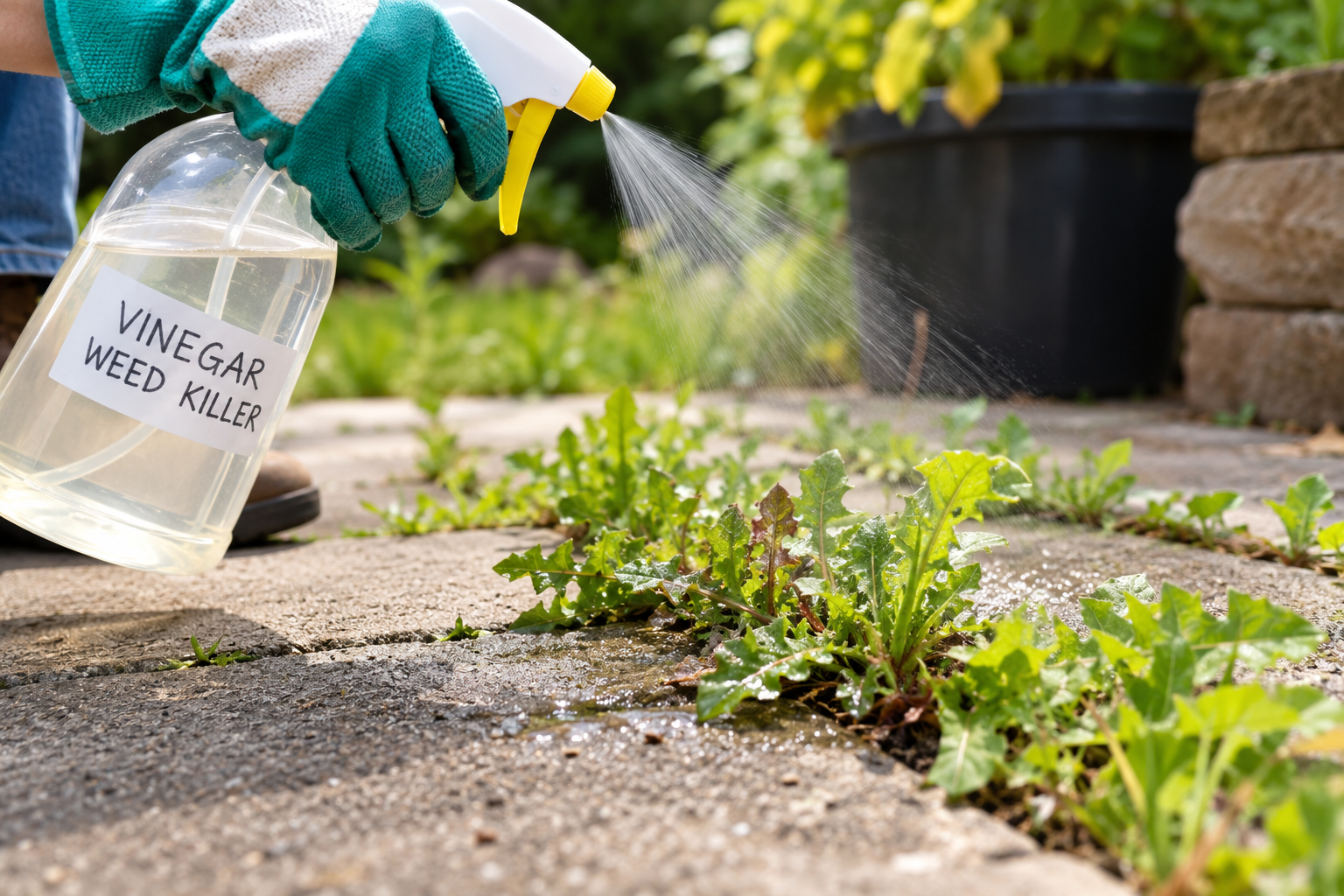
A few hours after a vinegar spray, the leaves on a dandelion can look cooked: curled, brown, and limp. Two weeks later there may be fresh green growth coming from the same spot. That gap between how fast vinegar works and how long the result lasts is what most people are really asking about when they search this question.
The short answer is that vinegar kills the parts of a plant it touches, and little else. Whether that amounts to “permanent” depends almost entirely on what kind of weed you’re spraying, how old it is, and how strong the vinegar is.
What Vinegar Actually Does to a Weed
Acetic acid is a contact herbicide. It ruptures plant cells, so fluids leak out and the tissue dries out. That’s why a sunny day produces such dramatic browning so quickly.
Two limitations follow from how it works. Acetic acid doesn’t translocate, meaning it isn’t carried down through the plant to the roots. And it has no residual activity in the soil, so it gives no control beyond the moment it hits leaves and shoots.
Compare that with a systemic herbicide, which is absorbed through the leaves and moves through the plant, reaching the roots. Vinegar stays on the surface. If the plant has the energy reserves in its roots to push out new shoots, it will.
It also means vinegar does nothing to seeds waiting in the soil. Spraying a bed clear today doesn’t stop the next flush of seedlings. Repeated applications are needed to deal with new weeds as they germinate.
Why the Bottle in Your Kitchen Is the Weak Version
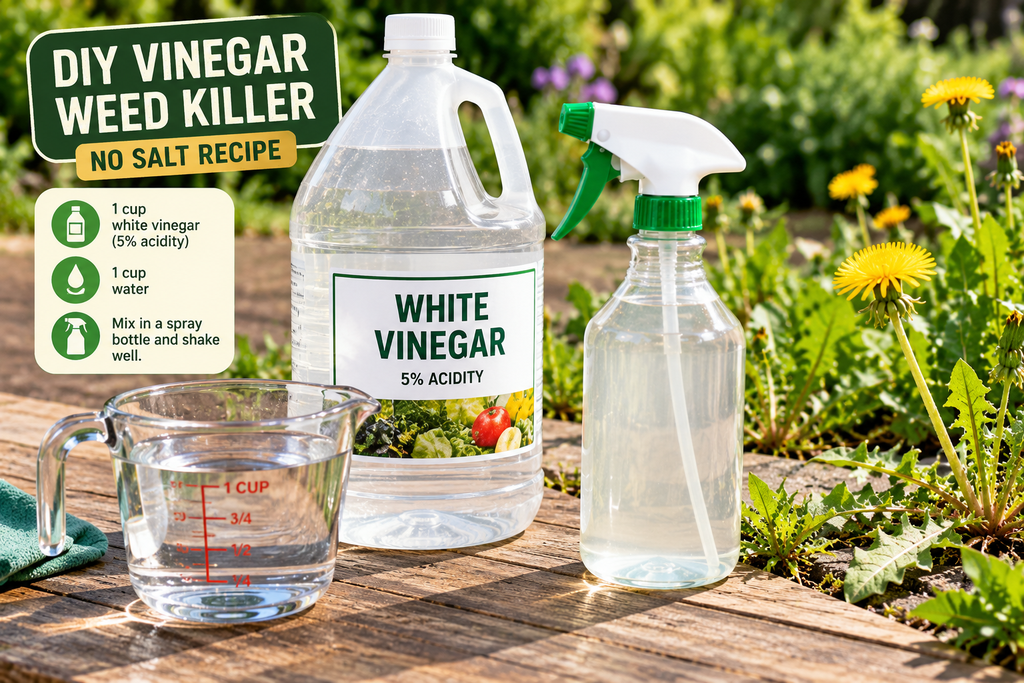
Not all vinegar is the same product. Household vinegar is generally 5% acetic acid, while some herbicidal vinegar products are 20% or 30%. That’s a four- to six-fold difference in strength, and it changes the results considerably.
Research from the USDA’s Agricultural Research Service, summarized by Washington State University, found that 5% vinegar didn’t give reliable weed control, while 10, 15, and 20% solutions controlled 80 to 100% of certain annual weeds, including foxtail, lambsquarters, pigweed, and velvetleaf. University of Illinois Extension reports a similar range, 10 to 20% acetic acid giving 80 to 100% control.
For household vinegar, the realistic window is narrow. University of Maryland Extension, as cited by one summary, puts 5 to 10% acetic acid as workable only on very small weeds with one or two leaves, roughly within two weeks of germination. Past that stage, the plant has more leaf area, a more protected growing point, and often a root system that can support regrowth.
Washington State’s field tests of registered homeowner products, which contain only about 6 to 7% acetic acid, showed results similar to the 5% research, namely a lack of reliable weed control. Buying a product off the shelf doesn’t guarantee a stronger result if its concentration is only modestly above kitchen vinegar.
Annual Weeds vs. Perennial Weeds: Where “Permanent” Breaks Down
This distinction decides most outcomes.
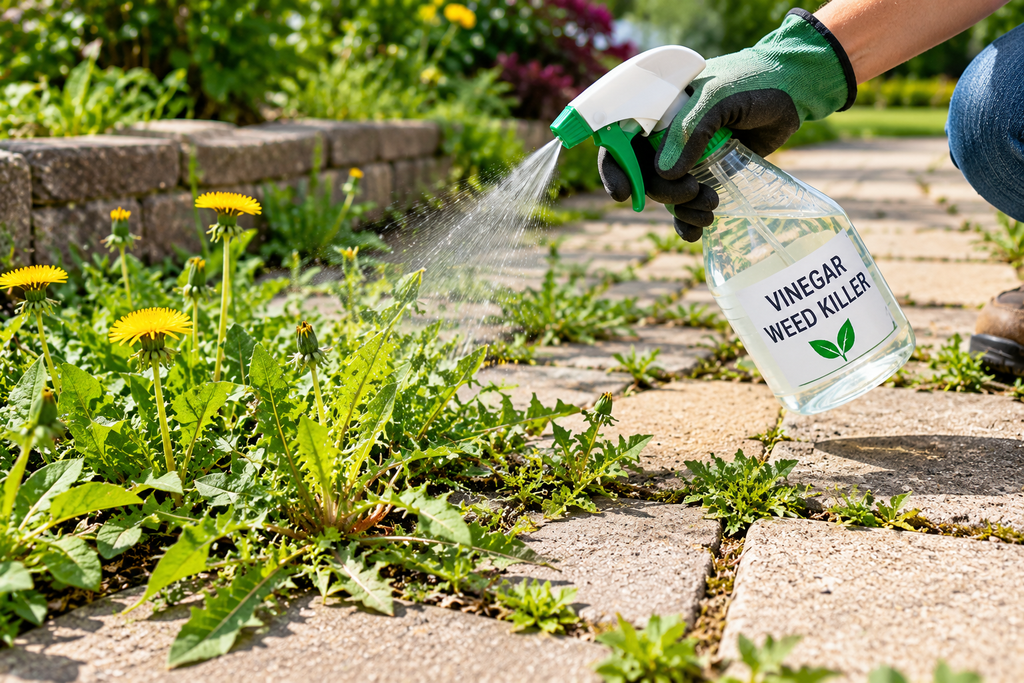
Annual weeds complete their life cycle in one season. Many of them have shallow, fibrous roots and no stored energy to start over. If you kill the above-ground growth while the plant is young, there’s nothing left to regrow. Crabgrass, pigweed, and chickweed are familiar examples. For these, vinegar can finish the job, though only for the individual plants you hit.
Perennial weeds survive from year to year by storing energy in roots, rhizomes, or tubers. Dandelion, Canada thistle, bindweed, and dock all fall in this group. For these, vinegar removes the leaves and leaves the storage organ intact.
The USDA-ARS work shows this clearly. Canada thistle treated with 5% vinegar showed 100% shoot burndown, but the roots were unaffected, so the shoots always regrew. The spray looked like a complete success for days. It wasn’t.
There’s one more wrinkle, which is that repeated treatment can weaken a perennial. Each time the leaves are destroyed, the plant has to spend stored energy to rebuild them. Done persistently over a season, that can exhaust some weeds. But it’s a slow, labor-intensive process, and there’s no guarantee for deep-rooted species. Pulling or digging the root out is usually faster.
The Grass Problem
Grassy weeds like crabgrass behave differently from broadleaf weeds, partly because the growing point sits low at the base, protected by the surrounding leaf sheaths. Vinegar can burn the blades without reaching it.
The evidence here is mixed, which is worth admitting. A Cornell Cooperative Extension trial reported that all the acetic acid treatments gave excellent control of crabgrass and broadleaf plantain. Another summary describes a USDA-ARS result where 20% acetic acid applied at high volume controlled crabgrass only about 28 to 45%. A study in Lampung, Indonesia, found that a grass weed, Digitaria longiflora, couldn’t be controlled by vinegar up to 8 weeks after application.
Those results differ because the studies used different species, ages, volumes, and conditions. The takeaway is that grass weeds are inconsistent, and you shouldn’t expect vinegar to work reliably on them.
What Changes the Result: Four Variables
Concentration. Covered above. The stronger the acid, the more of the plant it damages, and the older the weed it can handle.
Weed size and age. Smaller, younger weeds are generally more susceptible. A seedling with two leaves can be completely wetted. A mature plant with layers of leaves, hairy or waxy surfaces, and a dense crown can’t.
Coverage. Because the acid works only where it lands, thorough wetting matters. A light mist that beads on a waxy leaf achieves little. The spray needs to coat the foliage, including the base of the plant near the soil.
Weather. Heat and sun speed up the damage, which is why vinegar is typically applied on a warm, dry, sunny day. Rain soon after application can wash it off before it works, and cool, overcast conditions tend to give slower, weaker results. I haven’t found a reliable extension figure for an ideal temperature, so treat any specific number you see online with caution.
Does Adding Salt or Dish Soap Make It Permanent?
Recipes for vinegar, salt, and dish soap circulate widely, and they’re the reason many people believe vinegar can be made permanent. Part of that is true and part isn’t.
A small amount of dish soap acts as a surfactant: it helps the spray spread and stick to leaves, particularly waxy ones. That can improve coverage. It doesn’t make the acid reach the roots.
Salt is a different matter. Salt will knock weeds down, but the long-term effects are the question. Salt stays in soil. It can damage or kill nearby plants, harm soil structure, and wash into lawns and beds. Illinois Extension notes that some gardeners still salt asparagus beds, a practice that Extension once recommended. The persistence is the very thing that makes salt “permanent,” and it’s also why it’s a poor choice anywhere you want to grow something later. If you’ve got a gravel driveway or a patio crack with nothing planted nearby, the trade-off is different, but runoff can still carry salt to places you didn’t intend.
Where Vinegar Is a Reasonable Choice
Vinegar earns its place in a few specific situations:
- Young seedlings in paving cracks, gravel, or patios. These are small, the surface is hard, and there’s no lawn or flower bed to damage.
- Spot treatment of newly germinated annuals in a bare bed, when you can cover the weed completely and keep spray off desirable plants.
- Areas where you want a short-term knockdown and you’re willing to repeat the treatment.
Where It Will Disappoint You
- Established dandelions, thistles, bindweed, dock, and other perennials with deep or spreading roots. The tops die and the roots survive.
- Weeds in the lawn. Acetic acid is non-selective. It damages grass as readily as weeds, so spraying a weedy lawn leaves brown patches. A selective lawn herbicide, hand-weeding, or improving the turf’s density is more reliable.
- Large areas. The volume needed for good coverage, the repeat applications, and the cost of horticultural-strength vinegar add up quickly.
- Anything you expect to stay gone for a full season. There’s no residual effect.
Safety: Stronger Vinegar Is Not a Kitchen Ingredient
This is the part that gets underplayed in a lot of online advice.
Household 5% vinegar is mild. But the concentrations that actually work well are a different category of product. Illinois Extension warns that acetic acid at those levels is highly harmful to humans. One source puts it more specifically: at 30%, acetic acid can cause severe skin burns and permanent eye damage. Treat horticultural vinegar the way you’d treat any corrosive chemical.
Practical precautions for the stronger products:
- Wear eye protection (goggles, not just glasses), chemical-resistant gloves, long sleeves, and closed shoes.
- Spray when it’s calm. Drift can reach your face and neighboring plants.
- Keep children and pets away until the treated area is dry, and store the container where they can’t reach it.
- Read the label and follow it, since a product’s directions are part of the legal use. Rules on which products can be sold and used vary by country and region, so check what applies where you live.
- Be careful near water and wildlife. Illinois Extension’s discussion mentions long-lasting effects for the occasional unlucky amphibian exposed to vinegar herbicides, which is a reason to keep it away from ponds, streams, and drains.
Two more points that aren’t specific to any one source but are well established in general chemical safety:
- Never mix vinegar with bleach. The combination releases chlorine gas.
- Don’t mix it with hydrogen peroxide in a closed container. The two can form peracetic acid, which is corrosive and an irritant.
Mix only what you need, use clean containers, and label them.
What to Use When Vinegar Isn’t Enough
If the weed is a perennial, the most dependable non-chemical option is removing the root:
- Dig or pull after rain, when the soil is loose, and take as much of the root as you can. A long-handled weeding tool helps with taproots. Leftover root fragments of some species can regrow.
- Smother large patches. Layers of cardboard or heavy mulch block light, and over a season can exhaust weeds underneath. This is slower but doesn’t involve chemicals.
- Cut off regrowth repeatedly. Like repeated vinegar, this drains root reserves, though it takes persistence.
- Use a systemic herbicide for severe infestations of deep-rooted weeds, following the label closely. This is where a professional can help if the problem covers a large area or involves invasive or protected plants.
For prevention, the principle is the same whichever method you use: stop weeds from getting established. Dense plantings, a thick layer of mulch, and fixing bare or compacted patches reduce the space available for seedlings.
Common Questions
Will vinegar kill weeds down to the root?
Generally not. It damages the tissue it touches and doesn’t move to the roots, so perennials usually regrow.
Will vinegar kill weeds in one day?
It can burn the leaves of small weeds within hours, particularly in hot, sunny weather. Visible browning isn’t proof the plant is dead, so check again after a week or two for new growth.
Is it safe to use on a driveway or patio?
It’s less risky than on a lawn or bed, but runoff can still reach plants, and horticultural-strength vinegar needs protective equipment. Avoid salt-based mixtures near anything you want to keep.
Does vinegar change the soil permanently?
Acetic acid doesn’t have residual soil activity according to the Montana State Extension source cited above, which is why it doesn’t prevent regrowth. I didn’t find reliable data on long-term soil effects from repeated heavy use, so it’s reasonable to avoid soaking soil where you plan to plant.
The Practical Takeaway
Use vinegar for small, young weeds in places where a quick burn-back is enough, and expect to repeat it. For anything with a real root system, plan to remove the root itself, because the visible damage vinegar causes is not the same as killing the plant.

About Syprose Kiche
Syprose Kiche is the creator and writer behind My Besuited Home, a practical home and garden website covering DIY projects, gardening, lawn care, landscaping, home improvement, and outdoor living. She focuses on turning everyday homeowner questions into clear, practical guides backed by careful research and useful real-world considerations.