
A weed that has browned by lunchtime has not necessarily been killed. That is the catch with most homemade weed killers: they scorch whatever leaves they touch, and a dandelion, thistle, or patch of bindweed with a healthy root system simply sends up fresh growth a couple of weeks later. The recipe gets blamed, or the weed does, when the real problem was a mismatch between the method and the plant.
Each of the seven methods below does a narrow job well. Boiling water suits a crack in the driveway and does little for a deep-rooted weed in a flower bed. Vinegar handles seedlings and struggles with anything established. Three of the most dependable options involve no spray at all. The sections that follow explain what each one can and cannot do, when it makes sense, and how to use it without harming yourself, your soil, or the plants you want to keep.
Start by Working Out Whether the Weed Will Regrow
Almost every choice here comes down to one question: can this weed come back from its roots?
Annual weeds such as crabgrass, purslane, and chickweed live for one season and depend on seed to return. If the top growth dies before seed forms, that plant is finished. Perennial weeds such as dandelion, clover, bindweed, and Canada thistle store energy underground and regrow from it. Dandelions are difficult to remove completely because the taproot can regenerate if much of it remains in the soil, and creeping perennials can sprout again from small root fragments.
This matters because nearly every homemade spray is a contact killer. Montana State University Extension describes acetic acid, the active ingredient in vinegar, as a non-selective contact herbicide that does not move into the roots and leaves no residual activity in the soil. Boiling water has the same limitation. University of Illinois Extension points out that it destroys green leaves while the roots below stay protected.
A quick field test helps. Pull one plant on a day when the soil is damp. A thin, fibrous root that slides out easily usually belongs to an annual or a young seedling. A thick central root, or white runners traveling sideways underground, points to a perennial, and that changes the plan: expect repeat treatments, or choose smothering over spraying.
Size counts too. USDA research on vinegar found that 5 percent and 10 percent solutions killed weeds during their first two weeks of life, while older plants survived. Every spray below works best on small, young plants, and that window closes faster than most people expect.
1. Boiling Water for Cracks and Gaps in Patios and Driveways
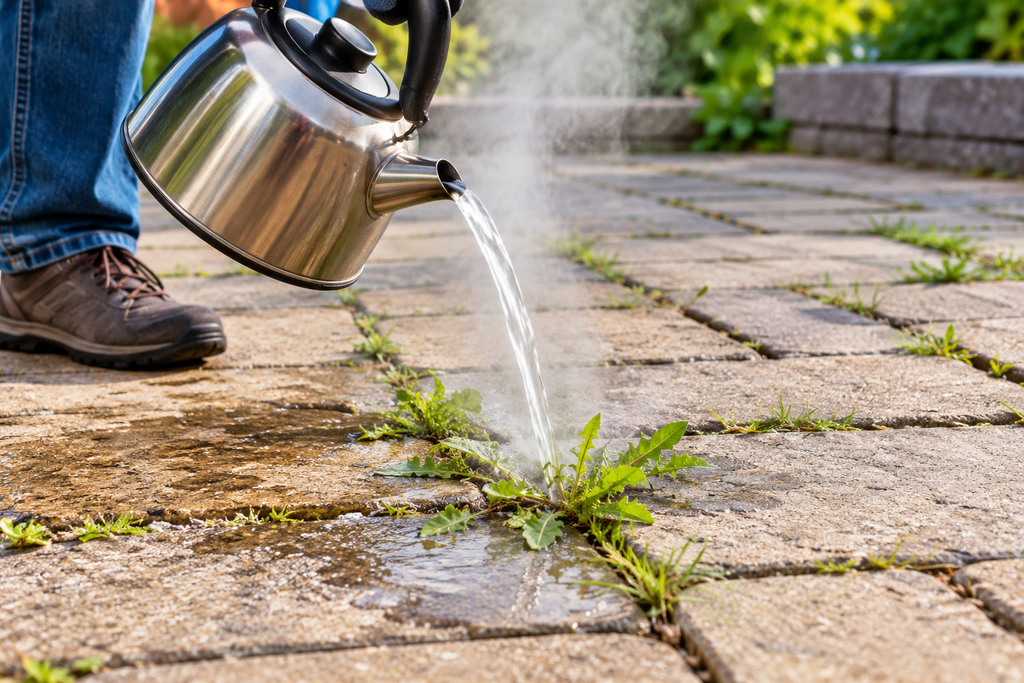
Boiling water ruptures plant cells on contact. Leaves and stems wilt and darken within hours, and small annual weeds growing in paver joints, gravel, or pavement cracks rarely return once the crown has been thoroughly soaked.
Hard surfaces are where it earns its place. In a crack, the water reaches the crown and shallow roots of a seedling while it is still very hot. In garden soil, it loses heat as it sinks in, deeper roots survive, and the shallow roots of any plant nearby can be damaged along with the weed. For that reason, skip it in planted beds.
To use it:
- Bring a kettle or pot to a full boil and carry it in a container with a spout, such as a metal watering can, rather than a wide pot that can slosh.
- Pour slowly onto the base of the weed so the water soaks the crown and the gap beneath it.
- Wear closed shoes and long pants, and keep children and pets away until the water has cooled.
- Return every few weeks to catch new seedlings.
The limits are real. Perennials with deep taproots will regrow, and treating a long driveway one kettle at a time is slow. Scalding is the main hazard; the Illinois Extension weed specialist who wrote about home remedies specifically questioned how safe it is to carry large pans of boiling water outdoors. Some recipes suggest adding salt to the water. Leave it out, for the reasons covered in the section on salt below.
2. Household Vinegar and Dish Soap for Newly Sprouted Weeds
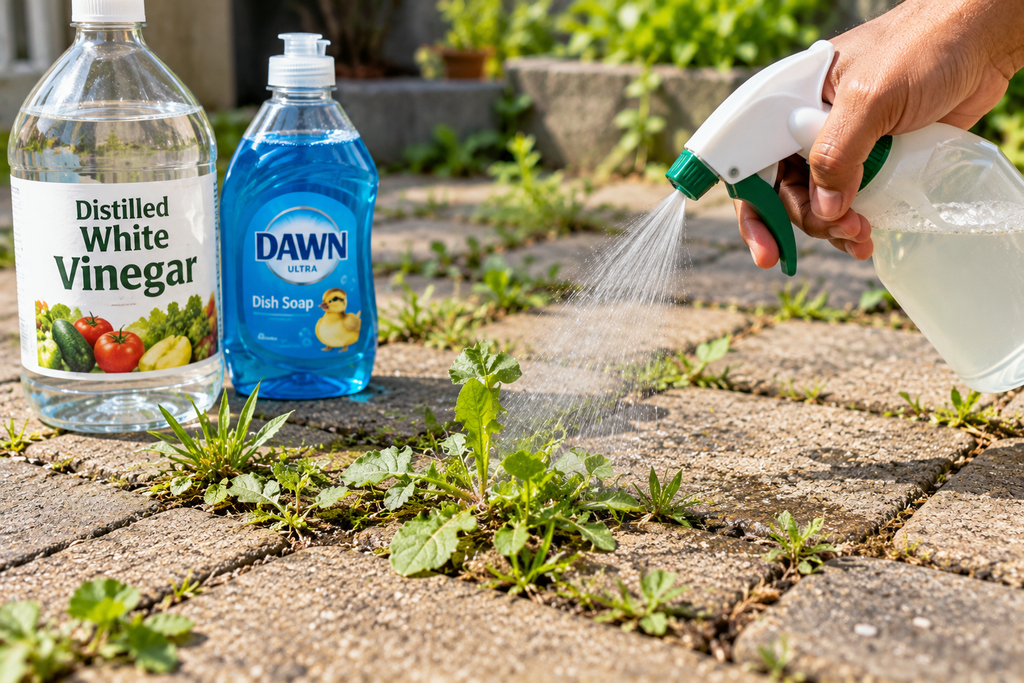
The basic mix is one gallon of ordinary white vinegar (about 5 percent acetic acid) with roughly one tablespoon of liquid dish soap, shaken gently and poured into a sprayer used only for weed control. The soap acts as a surfactant. It lowers surface tension so the spray clings to waxy or hairy leaves instead of beading up and rolling off. That tablespoon-per-gallon ratio is the commonly circulated version rather than a figure from an extension trial, so treat it as a starting point.
What the evidence supports is modest. Cornell Cooperative Extension compared 5 percent acetic acid with stronger products and found it gave only short-term control of most perennial weeds, though it did control crabgrass and broadleaf plantain, both annuals, effectively. In practice, that makes kitchen vinegar a tool for seedlings sprouting in sidewalk cracks, gravel, and along fence lines.
A few details make a difference:
- Pick a dry, sunny, calm day. Wind carries spray onto plants you want to keep, and rain within hours of spraying rinses it off.
- Wet the leaves thoroughly. Because vinegar only burns what it touches, a light misting leaves the weed with plenty of undamaged tissue.
- Shield nearby plants with a piece of cardboard held beside the weed.
- Expect browning within hours and new growth within a couple of weeks if the weed was anything more than a seedling. Reapplying is normal.
Vinegar is non-selective, so it will brown lawn grass as readily as a weed. It is a poor choice for weeds growing inside a lawn. Never mix vinegar with bleach or any product containing it, because the combination releases chlorine gas.
3. Horticultural Vinegar for Tougher, Larger Weeds
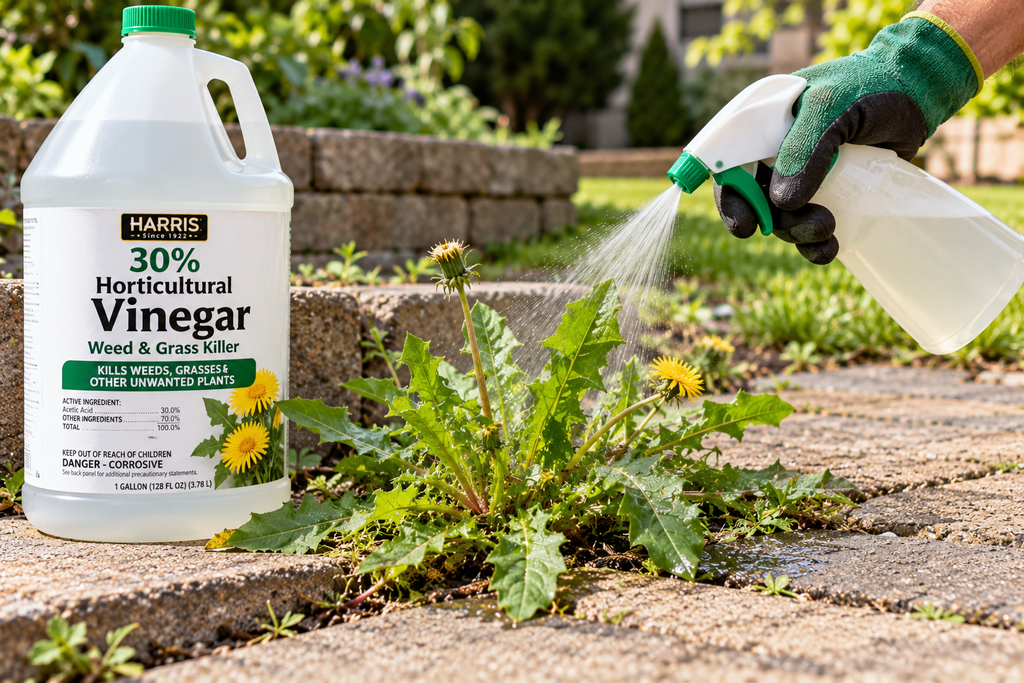
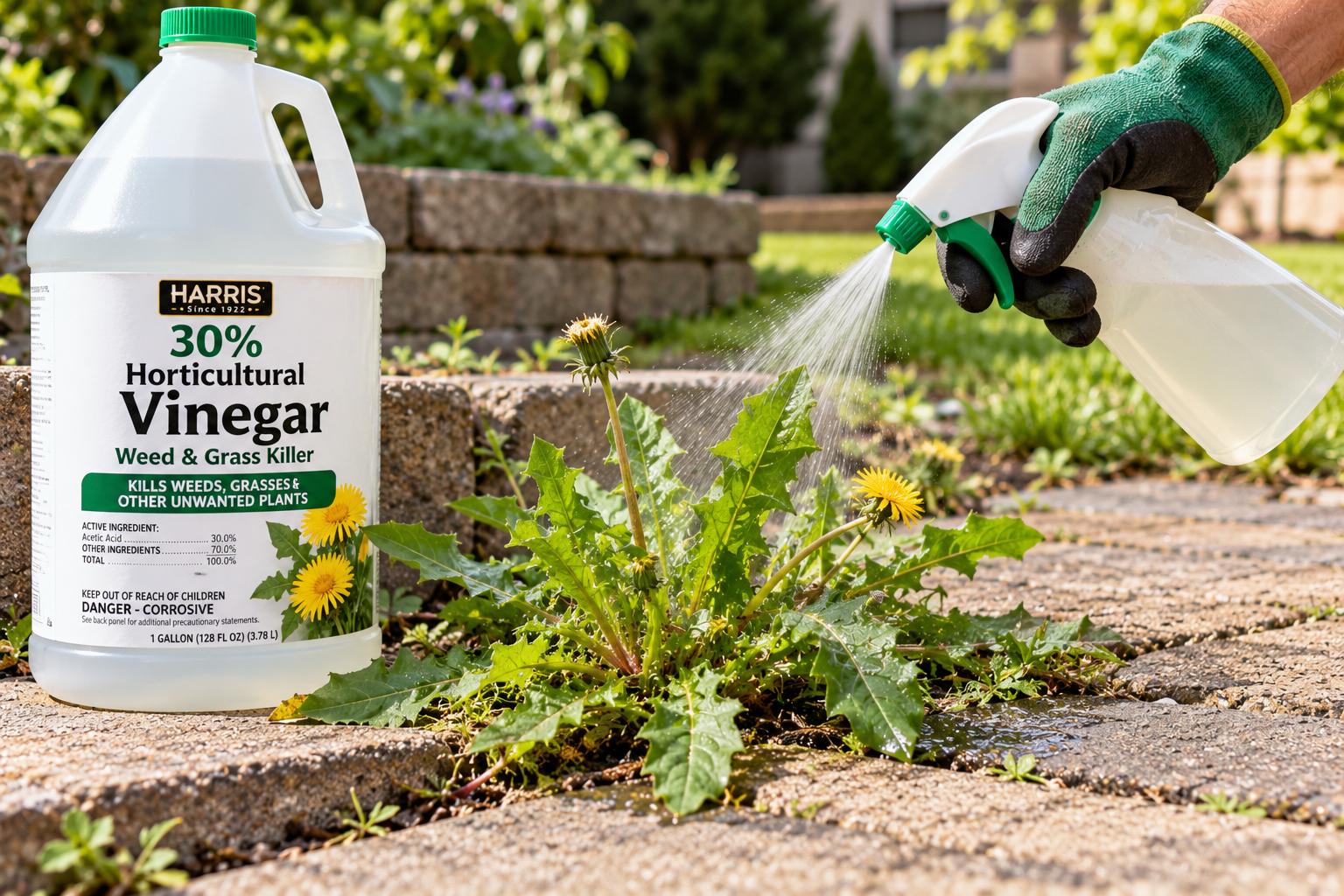
Horticultural vinegar is sold at 20 percent acetic acid or higher, which is four times the strength of the bottle in the pantry. University of Illinois Extension reports that studies of concentrations in the 10 to 20 percent range showed roughly 80 to 100 percent control, a result that kitchen vinegar cannot match. Oregon State University Extension notes that the best results come on young plants that have recently germinated.
The same sources are blunt about what it will not do. Because acetic acid does not travel well, if at all, to the roots, deep-rooted perennials such as dandelion, morning-glory, horsetail, and Canada thistle are a challenge. The tops die back; the roots send up new shoots. Fair expectations for a single treatment are a clean-looking patch for a few weeks, followed by regrowth that needs another round.
The handling matters more than the recipe. Illinois Extension warns that acetic acid above about 11 percent can burn skin and cause permanent corneal injury, and the USDA cautions that vinegar above 5 percent may be hazardous. Wear chemical splash goggles, not just sunglasses, along with waterproof gloves, long sleeves, and closed shoes. Spray at low pressure close to the ground, never in wind, and keep it in its original container, out of reach of children.
Buy a product labeled for weed control and follow its directions. Some are ready to use, and adding soap or anything else may not be permitted by the label. Strong acids can also etch some natural stone and fresh concrete, so keep overspray off pavers and test a hidden spot if the surface is valuable.
4. Corn Gluten Meal for Preventing Seeds From Rooting
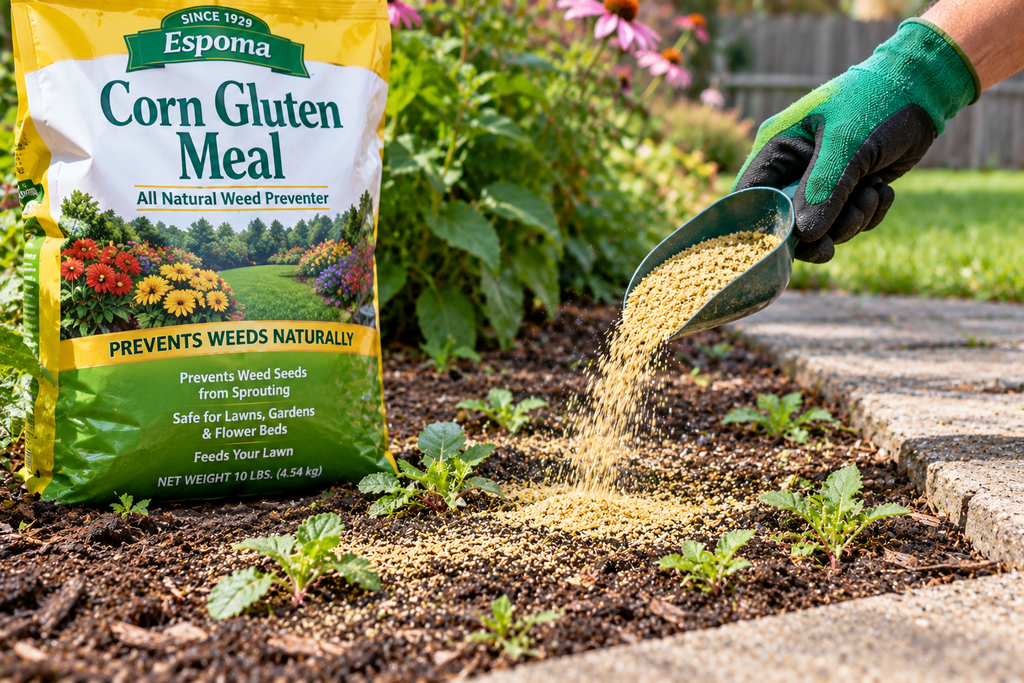
Corn gluten meal, a byproduct of corn milling, does not kill weeds that are already growing. It works earlier: Iowa State University researchers, who first documented its effect, found it interferes with root formation in germinating seeds. The seed sprouts, forms a shoot, and then fails to anchor, which is why a dry spell after germination matters for it to work.
Timing decides everything. Garden writer Jeff Rugg describes applying it four to six weeks before weeds are expected to germinate, at about 20 pounds per 1,000 square feet, then watering it in. For crabgrass in spring, that means getting it down before soil warms into the mid-50s Fahrenheit, which is roughly when germination begins. Miss the window and it does nothing useful against that crop of seedlings. A rainy spring can also reduce results, since the product needs to dry out after germination.
Some practical caveats are worth knowing before buying a 50-pound bag:
- It also blocks roots on desirable seedlings, so do not use it where you plan to seed a lawn or sow a flower or vegetable bed.
- Corn gluten meal is roughly 10 percent nitrogen by weight. At 20 pounds per 1,000 square feet, that works out to about 2 pounds of nitrogen, double the 1 pound per 1,000 square feet that Illinois Extension recommends for a single lawn application. Count it as fertilizer, not just weed control.
- It is more expensive than many alternatives, and most home spreaders struggle to deliver the heavy rate in one pass.
- It will not clear weeds that are already up. Remove those first.
It fits best in established lawns and in beds that will not be seeded, where the goal is to cut down on next year’s seedlings rather than rescue this year’s.
5. Cardboard Sheet Mulching to Take Back a Weedy Bed or Lawn
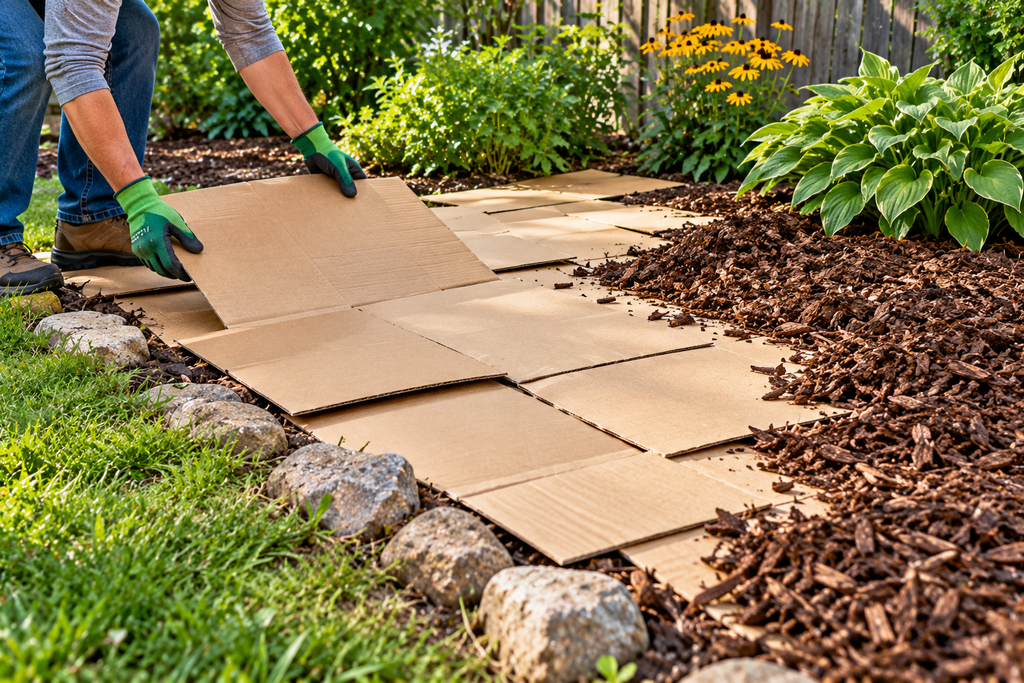
This method uses no chemicals. It blocks light so thoroughly that the plants underneath exhaust themselves, and it leaves behind soil enriched by the decomposing layers.
The city of Davis, California, describes the sequence this way: lay cardboard or newspaper with overlapping edges so nothing can grow through the seams, wet it thoroughly, cover it with 2 to 3 inches of compost, then add at least 4 inches of organic mulch such as wood chips. Remove tape and plastic labels from boxes first. Mowing grass or weeds as short as possible beforehand helps the cardboard sit flat.
What to expect from the timeline: smothering a lawn usually takes about two months, according to Prairie Moon Nursery, while some stubborn perennials need to be covered for much longer, in some cases up to two years. The weed seeds already in the soil remain, so new seedlings will appear on top of the mulch, but they root shallowly and pull easily.
Sheet mulching suits large areas where speed is not critical: converting lawn to a garden bed, reclaiming an overgrown corner, or starting a new planting. It is a poor fit if you need to plant tomorrow, and it needs a steady supply of cardboard. Do not put plastic underneath organic mulch in a permanent bed; Davis cautions that plastic holds too much moisture against the soil and restricts oxygen exchange.
6. Clear Plastic Solarization for Large, Sunny Patches
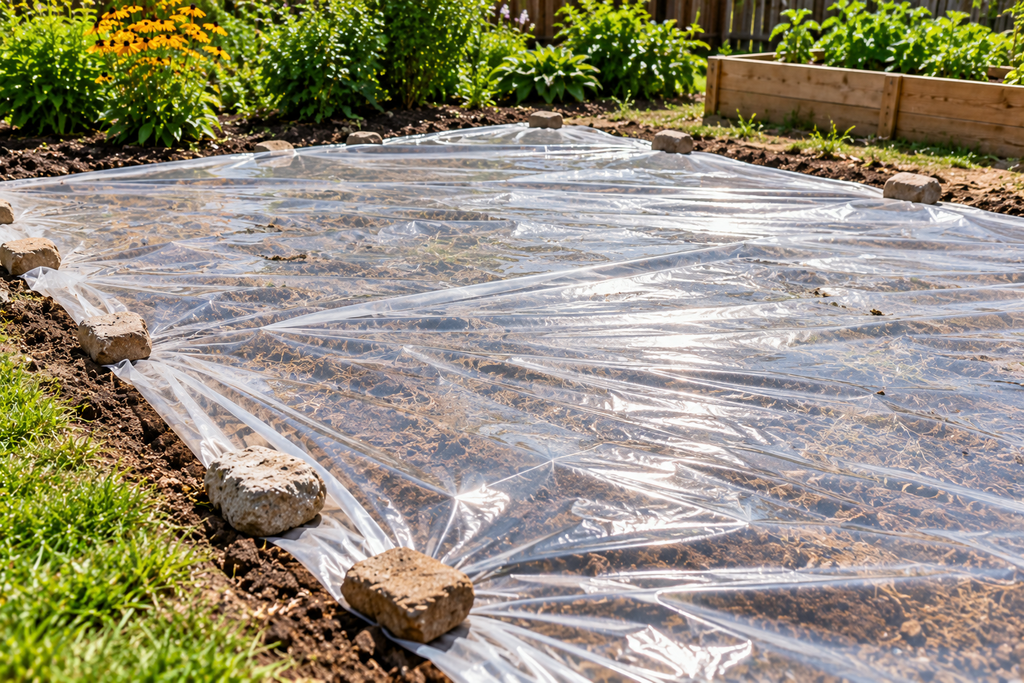
Solarization uses the sun’s heat instead of a spray. Clear plastic sheeting traps heat, and soil under it climbs to temperatures that kill weeds and many weed seeds near the surface.
University of Tennessee and University of Florida extension publications describe the same core steps:
- Clear the area of debris and sharp objects that could puncture the plastic, and remove or cut down existing growth. Clear plastic does not stop plants beneath it from growing the way black plastic does.
- Moisten the soil, because water helps conduct heat.
- Cover it with clear plastic, about 2 to 4 mil thick. Black or colored plastic does not work for solarization.
- Stretch it tight and bury every edge in soil. UF/IFAS photos show weeds thriving under loose edges.
- Leave it in place for at least six weeks during the hottest part of the year.
It works best in full sun where daytime temperatures stay above 80°F for several weeks, according to Sunset’s gardening editors. In shade, in a cool climate, or in a cloudy summer, results are weak, and weeds can flourish beneath the warm, humid plastic. Florida’s extension service reported that solarization killed nutsedge, a notoriously difficult weed, though a few plants emerged through the plastic.
Be cautious near trees. A Master Gardener program in California advised against heating soil above tree roots and recommended sheet mulching there instead. That is advice from one program rather than a universal rule, but it is worth checking with a local extension office before covering ground near large trees or shrubs.
7. A Thick Layer of Mulch to Keep Cleared Ground Clear
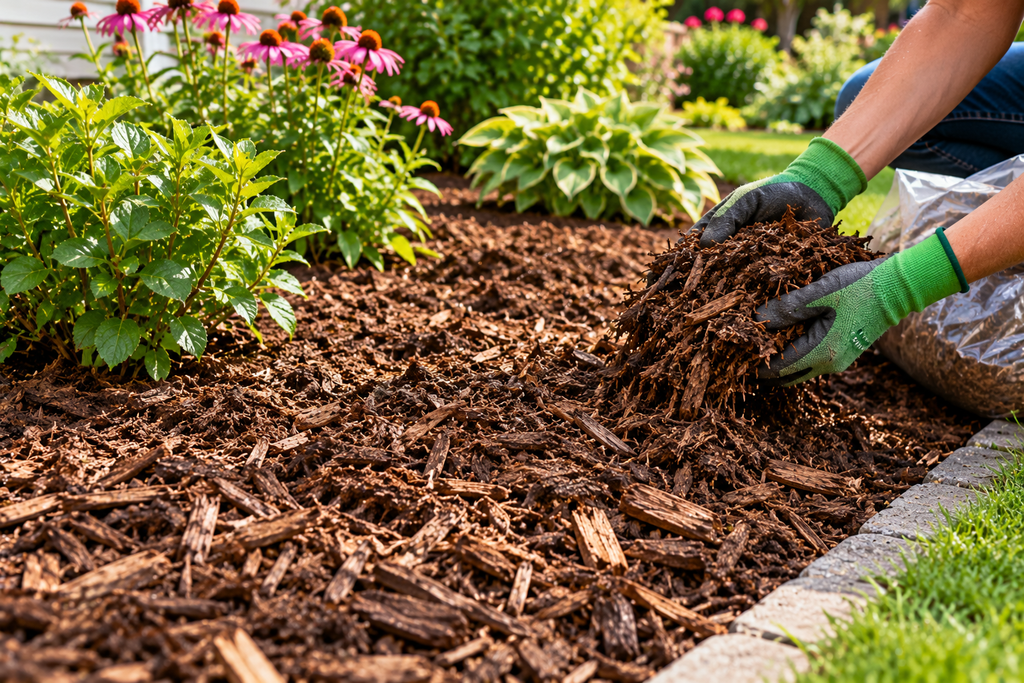
Once a bed has been cleared by hand, by sheet mulching, or by solarization, mulch is what keeps it that way. Light does not reach the soil, so most weed seeds that land on top cannot establish. Those that do root in loose mulch rather than compacted soil and tend to pull out easily, a point made in Long Island’s Caumsett Foundation demonstration of these techniques.
Depth matters. Wood chips or shredded bark applied several inches deep suppress weeds well, while a thin sprinkling mostly decorates. Replenish it as it breaks down. Keep mulch a few inches away from tree trunks and shrub stems, because piled mulch holds moisture against the bark. Leaves and grass clippings, which Prairie Moon lists as covers for newspaper or cardboard, work in out-of-the-way beds, though clippings from a lawn treated with herbicide should not go on vegetable or flower plantings.
Mulch is prevention, not a cure. It will not stop quackgrass or bindweed shoots from pushing up from established roots, and it does nothing for a weed that is already tall.
Why the Vinegar-Salt-Soap Recipe Is Not on This List
It is the most widely shared homemade weed killer online, so its absence deserves an explanation. The recipe adds salt for extra killing power. Illinois Extension warns that salt destroys soil structure and is mobile, meaning rain and irrigation can carry it into nearby lawn and garden areas where it damages plants you meant to protect. Tree roots often extend well beyond the canopy, which makes planting areas around driveways and patios riskier than they look.
Salt also removes the main advantage of vinegar. University of Maryland Extension notes that vinegar breaks down quickly in the environment provided it is not mixed with salt. Once salt is added, the ground can stay hostile to plants for a long time, and the weeds that eventually return are often salt-tolerant species. Borax, another popular add-in, has a similar problem: the boron it contains does not break down, so repeated use can leave bare areas where nothing grows.
If the goal is simply to kill the top of a small weed, the plain vinegar-and-soap spray works about as well, without the side effects.
Matching the Method to the Situation
- Seedlings in pavement cracks or gravel: boiling water or household vinegar with soap.
- Larger annual weeds in a driveway or gravel area: horticultural vinegar, applied with proper protective gear, or repeated rounds of boiling water.
- Established perennials such as dandelion or thistle: digging out as much root as possible, followed by smothering. Repeated sprays only burn the tops.
- Weeds inside the lawn: hand removal for scattered plants, and corn gluten meal in early spring to reduce next year’s crabgrass. Avoid vinegar, which will brown the grass around the weed.
- A whole bed or lawn section you want to replant: sheet mulching in spring or fall, or solarization in midsummer.
- A bed you just cleared: mulch, immediately.
Rules That Apply to Every Spray
- Label any sprayer used for weed control and never reuse it for anything else.
- Do not mix vinegar with bleach. Do not combine products unless the label says it is allowed.
- Wear gloves and eye protection even with household vinegar. Concentrated products demand splash goggles.
- Avoid spraying clover, dandelions, or other weeds when they are in flower and visited by bees, since contact sprays can kill insects.
- Keep children and pets out of the area until the spray has fully dried. Check the label for specific re-entry guidance on any concentrated product.
- Do not pull or spray poison ivy, giant hogweed, or other plants that can cause skin injury without researching the safe approach first. A licensed professional is a sensible choice for large infestations, invasive species, or weeds near ponds, wells, and storm drains.
Questions Readers Actually Ask
Can I replant right after using vinegar?
Plain vinegar and soap sprays leave no residual activity in soil, according to Montana State University Extension, so replanting is generally possible once the area has dried and the weeds are cleared. That does not apply to any mixture containing salt or borax, which can linger. Concentrated products may carry their own planting restrictions on the label.
Why did the weed grow back within two weeks?
Most likely the roots survived. Contact sprays and boiling water kill the visible plant, and perennials and larger annuals regrow from what remains underground. Switch to digging, smothering, or repeated treatments timed to exhaust the plant, rather than a stronger spray.
Is it worth buying horticultural vinegar for a few weeds?
For small numbers of seedlings, household vinegar or boiling water is cheaper and far safer to handle. Horticultural vinegar makes sense for larger hardscape areas, but only if you will actually wear the protective gear every time.
Key Takeaways
No single homemade weed killer handles every weed, so the useful skill is matching the method to the plant. Check whether it is an annual or a perennial, treat small plants early, and use sprays only where their limits do not matter. Keep salt and borax out of the recipe, since both can damage soil long after the weeds are gone. For anything with deep roots or a large footprint, smothering and solarization take longer but solve the problem more thoroughly than repeated spraying.
A sensible next step is to identify the single worst weed in your yard, pull one plant to look at its roots, and choose the method from the list above that fits what you find.

About Syprose Kiche
Syprose Kiche is the creator and writer behind My Besuited Home, a practical home and garden website covering DIY projects, gardening, lawn care, landscaping, home improvement, and outdoor living. She focuses on turning everyday homeowner questions into clear, practical guides backed by careful research and useful real-world considerations.