
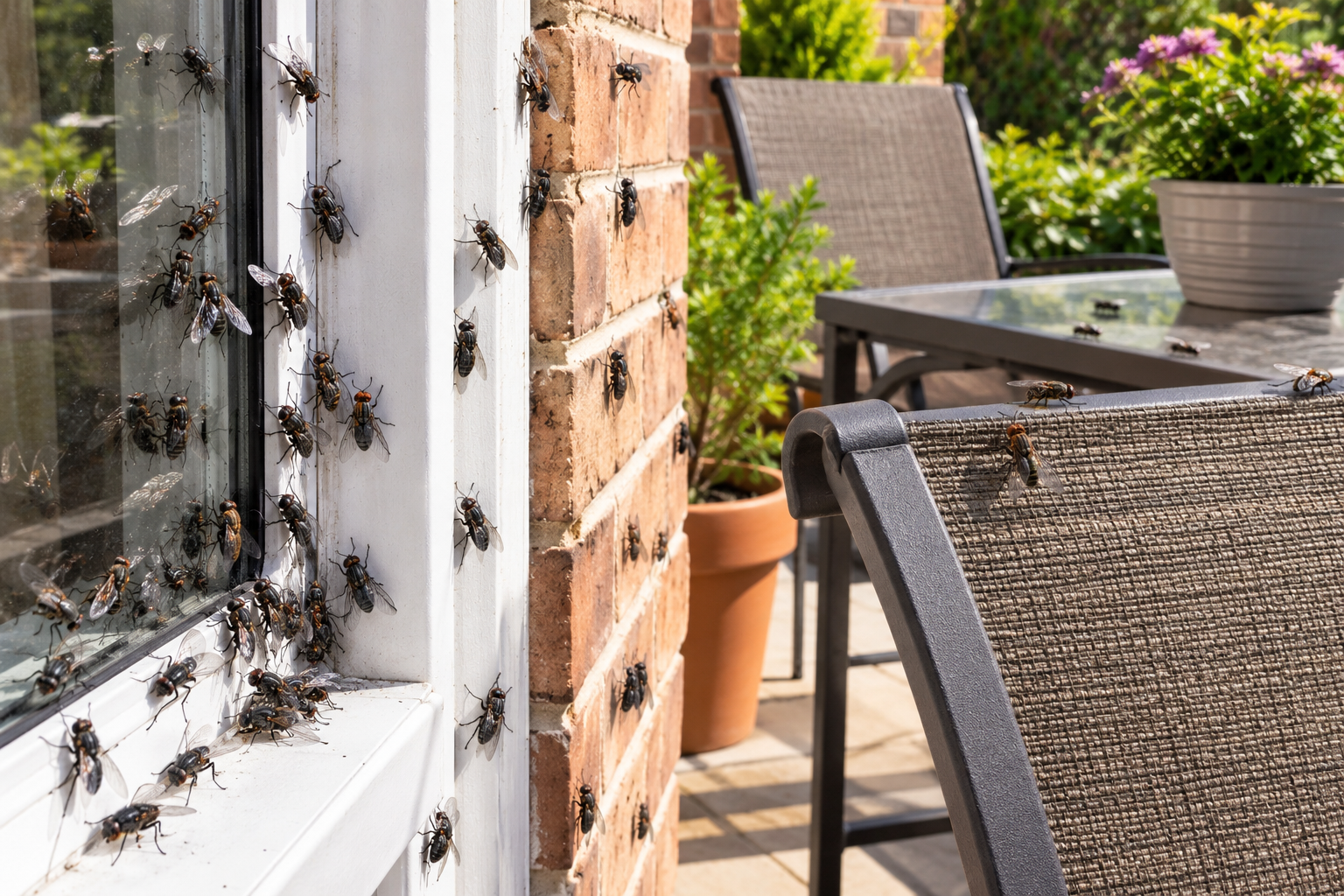
The first sign is usually one fly on a sunny window in early fall. It’s a little larger than a house fly and slow enough to pick up with a tissue. It seems drawn to the glass, not to anything on the kitchen counter. A week later there are five. By midwinter, a few dozen may crawl out of a ceiling light on a mild afternoon, buzz against the window, and drop onto the sill.
These are almost certainly cluster flies, and they came to your house on purpose. They were looking for a place to spend the winter, and a gap under the siding or a loose attic vent looked like a good one. They don’t breed indoors, they don’t bite, and food doesn’t interest them. That also means the fix is closer to carpentry than pest spray.
What Cluster Flies Are, and How to Tell Them From Other Flies
Cluster flies (Pollenia species, most often Pollenia rudis) are about 7 mm long, or roughly 0.3 inches. That makes them a bit bigger than a common house fly. The body is dull gray to brownish, with a faint checkerboard pattern on the abdomen. The thorax carries fine golden-yellow hairs, which show up under a lamp or a magnifying glass. At rest, the wings overlap across the back instead of sitting apart.
Behavior is the quickest clue. A house fly is jittery and launches the moment your hand moves. A cluster fly is sluggish. It crawls, flies in short clumsy hops, and often lets you walk right up to it. You’ll see that most on the glass of a sunny window.
A few lookalikes are worth knowing:
- Blow flies and bottle flies are usually shiny metallic green or blue. Cluster flies aren’t.
- Face flies look very similar and also overwinter in buildings. They’re tied to cattle and horses, so they’re more common near pasture. The prevention steps are the same.
- Fruit flies and fungus gnats are tiny. Cluster flies are not.
The nicknames explain a lot. “Attic flies” comes from where they’re usually found. “Cluster” comes from the tight groups they form in wall voids and attics while overwintering.
Cluster flies are not a sign of a dirty house. As larvae, they parasitize earthworms. As adults, they feed on flower nectar. Extension fact sheets are consistent that they aren’t associated with garbage or animal waste. They are thought to be native to Europe and to have reached North America a long time ago.
They don’t damage the structure, bite, or sting. The real problems are smaller:
- Large numbers of dead flies in wall voids and attics can smell unpleasant.
- Dead flies attract carpet beetles, whose larvae feed on dead insects and can then move on to wool, feathers, and other natural fibers.
- Crushed flies can leave a smear on paint and fabric.
Why They Show Up in Fall
The life cycle explains the timing. In spring and summer, adult females lay eggs singly in cracks in the soil near earthworm burrows. The tiny larvae hatch and go looking for an earthworm. They burrow in, feed inside the host, and eventually pupate in the soil. The whole cycle from egg to adult takes roughly four to six weeks. That’s why several generations can pass in one warm season. Extension sources in the northeastern U.S. mention three to four or more.
In late summer, as days shorten, adult behavior changes. Instead of feeding and breeding, flies look for sheltered crevices where they can wait out the cold. The upper parts of buildings suit them: attics, wall voids, false ceilings, the space behind siding. Once inside, they settle into loose clusters.
Two practical points follow from this.
First, you can’t fix this at the source. The flies come from soil in lawns, pastures, and fields, possibly yours but also your neighbors’. Earthworms in your lawn aren’t something to get rid of, and larvae aren’t known to cut earthworm numbers enough to disrupt soil health. All the control happens at the building.
Second, repeat visits are the norm. Connecticut’s agricultural experiment station notes that the same buildings tend to become overwintering sites year after year. Sources don’t spell out why, but the likely answer is simple. A house with the right gaps and the right sun exposure keeps having both.
The timing varies with climate. In much of the northern U.S. and Canada, flies start gathering in late August through October. This guide assumes a Northern Hemisphere fall. In the Southern Hemisphere, the seasons are reversed, so shift the calendar by about six months.
Why They Gather Around Sunny Windows
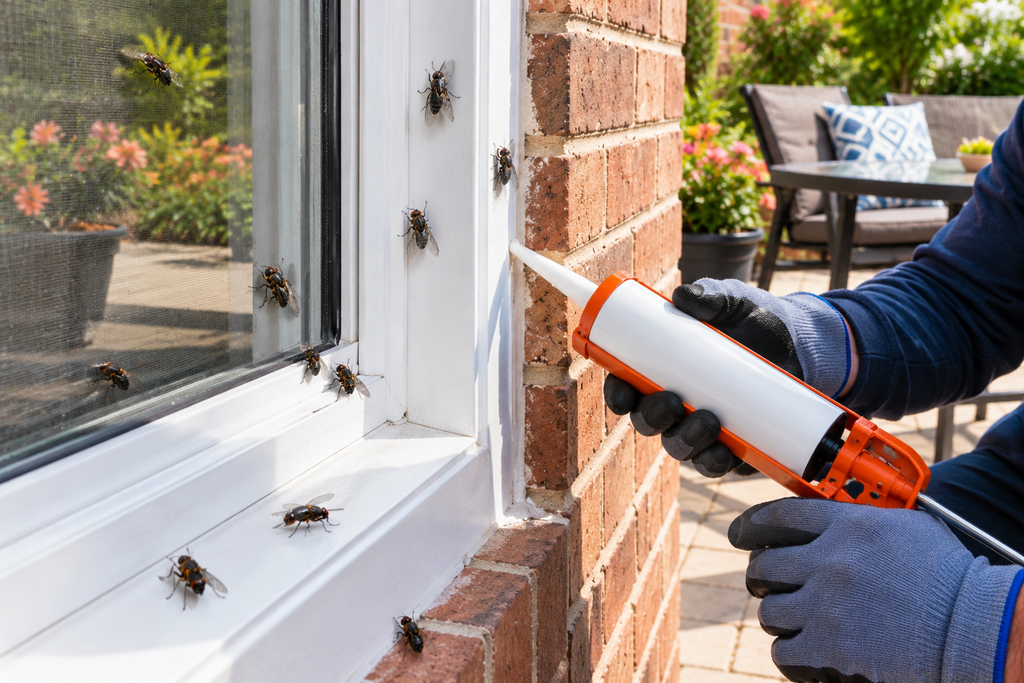
The windows aren’t where the flies come in. They’re where the flies end up.
In autumn, cluster flies tend to concentrate on the sunniest sides of a house. In the Northern Hemisphere, that usually means south- and west-facing walls. Flies are cold-blooded. A wall that holds afternoon heat gives them the warmth to stay active while they hunt for a crack to crawl into. This is also why light-colored or sun-baked siding and trim see more traffic.
Once the flies are in the walls, winter behavior takes over. On a warm spell, or whenever the heating warms an exterior wall, flies wake up and move toward light. Inside a house, the brightest things are windows. The flies are making what Penn State’s extension describes as a confused attempt to get back outdoors. They crawl out of wall voids, light fixtures, or gaps around trim and end up bumping against glass.
The location of the flies tells you something useful. If most of them turn up on one window or one room, the wall behind it, or the attic directly above, is probably the route. It’s worth noting where and when you see them, because that map becomes your repair list.
Utah State’s extension adds a monitoring tip. In fall, check the outside of sunny walls for flies landing and crawling along siding and trim. Where they disappear into a gap is an entry point. Watching for ten minutes on a warm, sunny afternoon in September can find more openings than an hour of random inspection.
Where Cluster Flies Get In
Flies are small and thin. As a rough working rule, treat any gap you can slide a butter knife blade into as usable. That’s practical judgment, not an extension specification. Common entry points include:
- Siding and trim: loose or warped siding, gaps where siding meets corner boards, cracked caulk at trim joints
- Soffits and fascia: the underside of the roof overhang, and gaps between fascia boards and the wall
- Window and door casings: especially on the sunny sides
- Roof-to-wall junctions: where a lower roof meets a wall, or at dormers
- Vents: gable vents, ridge vents, soffit vents, and the louvers on any of them if the screening is torn or missing
- Utility penetrations: pipes, cables, gas lines, hose bibs, dryer vents, and the openings around them
- Chimneys: the flashing and the gap where the chimney meets the roof or siding
The pattern is that flies prefer the upper levels. A gap in the foundation matters less than a gap under the eaves. Start your inspection high.
Seal the Outside First: Caulk, Screening, and Trim
Exclusion is the one thing every extension source agrees on. Mechanical barriers beat everything else. Other methods are supplements.
Timing. The best window is late summer, before flies start looking. If flies are already landing on your walls, sealing still helps. It blocks new arrivals and can close routes from wall voids into living areas. Caulk needs dry weather and temperatures within the range on the cartridge. Many types cure poorly in cold or damp conditions.
Choosing materials.
- Use exterior-grade caulk. Paintable acrylic latex or siliconized acrylic suits trim joints and siding.
- Use 100% silicone around window and door frames where you need flexibility and don’t plan to paint. It won’t take paint.
- For gaps wider than the caulk’s rated width, push in foam backer rod first and caulk over it. Check the label for the maximum gap.
- Use expanding foam sealant for larger gaps around pipes and cables. Exposed foam breaks down in sunlight, so cover it with trim, paint, or caulk.
Vents. Gable, soffit, and ridge vents exist to ventilate the attic, so don’t cover them with solid material. Instead, make sure fine insect screening is in place behind the louvers and in good repair. Very fine mesh can restrict airflow, and that matters for attic moisture and heat. If you aren’t sure what mesh your vents can take, ask a roofer or ventilation specialist.
Don’t seal these:
- Weep holes at the base of brick veneer, which let moisture drain
- Soffit or ridge vent openings
- Drainage holes in window frames or storm windows
If any of those are the entry point, cover them with screening instead of caulk.
Safety.
- Work on a level, stable ladder and keep three points of contact. Have someone foot it for you. For second-story work or steep roofs, hiring a contractor is often the safer choice.
- In homes built before 1978 in the U.S., trim paint may contain lead. Test before scraping or sanding, and look up the EPA’s lead-safe work guidance.
- Wear eye protection and gloves when using caulk guns and foam.
Window Screens and Window Frames: What They Do and Don’t Do
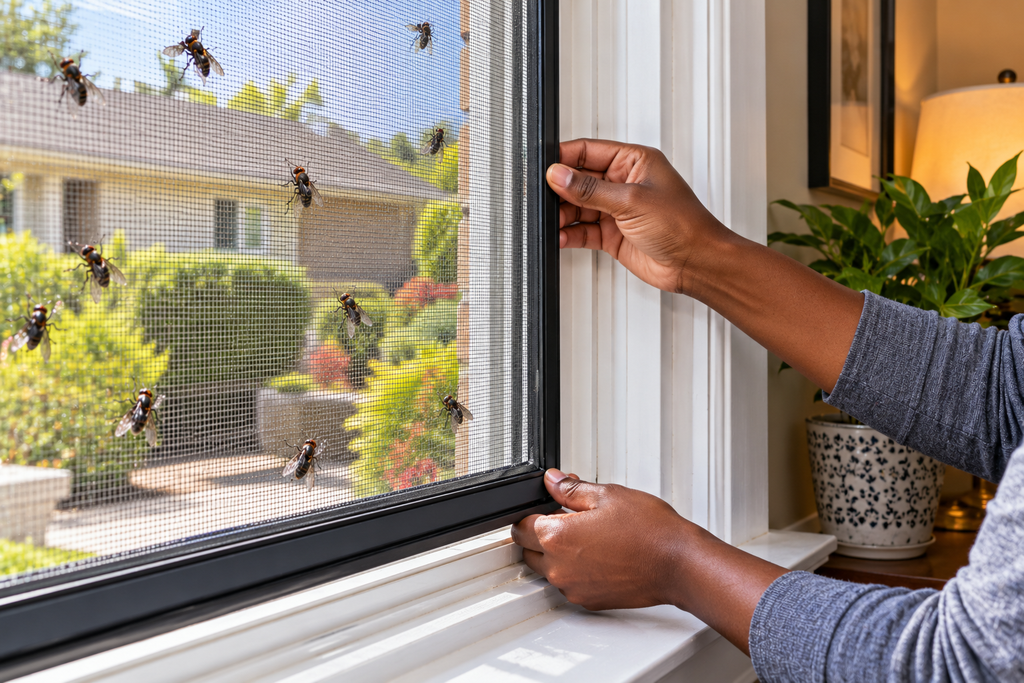
A good screen stops flies from drifting in through an open window on a warm late-summer day. That’s worth having. But most cluster fly problems start inside the walls, not at the open window, so screens only partly address them.
Check each screen anyway:
- Look for holes and tears. Small ones can be patched with a screen repair kit; large ones call for a new screen.
- Check the fit. Frames that don’t sit tight against the window track leave a slot flies can use.
- Look at storm windows. The gap between storm window and main window is a favorite resting spot. Drainage holes need to stay open, but fine mesh over them can keep flies out without blocking water.
The more valuable work happens inside, where the goal is to stop flies that have already reached the wall from entering the room:
- Caulk the gap between the interior window casing and the wall with paintable acrylic caulk.
- Replace worn weatherstripping on window sashes.
- Look at baseboards, ceiling-to-wall joints, and cracks around light fixtures on the sunny walls.
- Consider foam gaskets behind outlet and switch plates on exterior walls. They’re inexpensive and made for this. Turn off the breaker first, and if you’re not comfortable working around electrical boxes, hire an electrician.
None of this kills a single fly. It changes where the flies end up, which is often the real complaint.
Attic Prevention: Where Most of the Flies Are Waiting
Attics are the classic cluster fly address. They sit at the top of the building, they hold warmth, and they often have gaps at vents, rooflines, and ceiling penetrations. This is also the one place where inspection has a payoff beyond flies. Most of the same sealing work reduces drafts and heat loss.
What to look for.
- On a bright day, turn off the attic lights and let your eyes adjust. Pinpricks of daylight at the roof deck, wall junctions, or around the chimney are openings.
- Look for piles of dead flies on the attic floor. They mark where flies clustered.
- Check the vents’ screening for tears.
- Inspect the attic hatch or pull-down stairs. A weatherstripped hatch keeps flies, heat, and drafts from moving between attic and living space.
What to seal from inside.
- Gaps around plumbing stacks, wiring holes, and other ceiling penetrations. Caulk or foam works for most, but follow the product’s guidance.
- Around chimneys and flues, use only materials rated for the heat and clearances. Ordinary foam isn’t suitable. This is a job for a mason or roofer.
- Recessed ceiling lights need care. Non-IC-rated fixtures need clearance from insulation and shouldn’t be covered. If you want to air-seal around recessed lights, ask an electrician which fixtures you have and which cover boxes are appropriate.
Attic safety.
- Step only on joists or on boards laid across them. Ceiling drywall won’t hold your weight.
- Summer attics can get dangerously hot. Work in cooler parts of the day and take breaks.
- Wear a dust mask, gloves, and eye protection. Insulation irritates skin and lungs.
- If the insulation looks like loose gray-gold pebbles, it may be vermiculite. Some vermiculite insulation contains asbestos. Leave it undisturbed and call a professional for testing.
Light traps. Colorado State’s extension lists light traps among the supplementary tools for attics and wall areas. They use a lamp to draw the flies to a sticky surface. Look for products designed for indoor insect use, follow their instructions, and keep them clear of insulation and anything combustible. Treat them as a way to reduce numbers, not as a fix.
Cleaning up. After the flies leave in spring, clear dead ones from the attic. A shop vacuum works. Wear a mask, since old insect debris and dust can be irritating. This also removes food for carpet beetles.
Vacuuming: What Extension Services Recommend
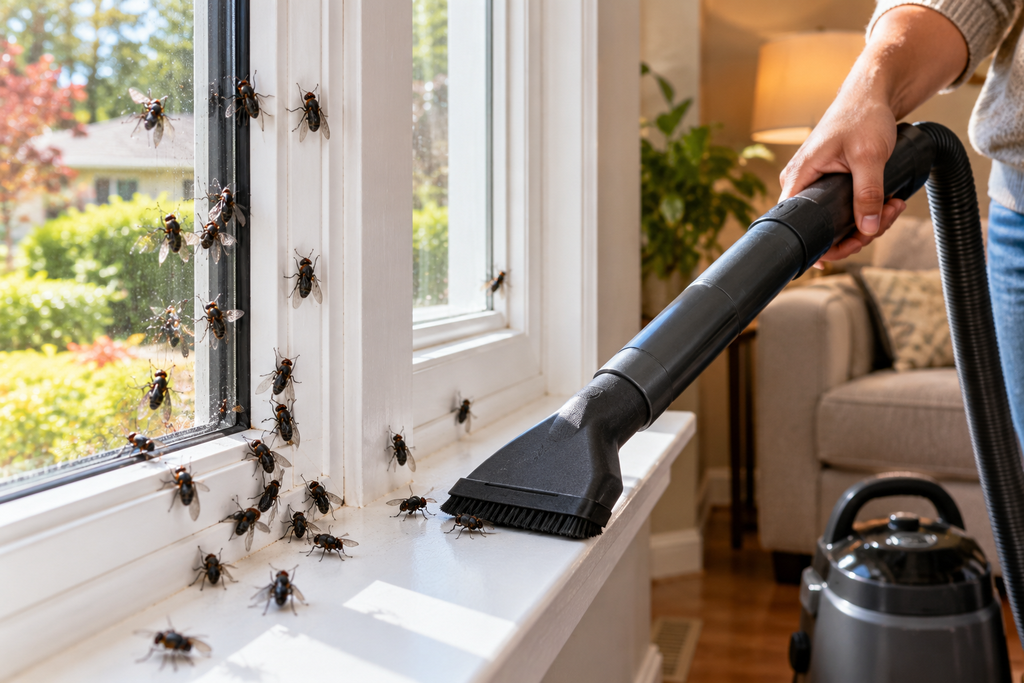
Vacuuming is the one removal method nearly every university fact sheet names. Cluster flies are slow, so they’re easy to catch. A hose attachment lets you reach window frames, light fixtures, and high corners without chasing anything.
There’s one common mistake. Don’t leave the flies in the machine. University of New Hampshire’s extension advises removing the bag and placing it outdoors, because flies can crawl back out of the vacuum. For a bagless vacuum, empty the canister outside straight away, into a sealed bag, and put it in an outdoor bin.
A fly swatter works too, but crushed flies can smear paint or fabric. Dead flies left on sills or in light fixtures draw carpet beetles. Clean them up promptly.
Where and when.
- Windowsills and glass on sunny walls
- Ceiling light fixtures, especially dome-style covers where flies collect
- Curtains and the tops of window frames
- Warm winter days, when flies become active and cluster at windows
- Early spring, when flies leave wall voids in numbers
A few minutes with the vacuum on those days keeps the population down without chemicals.
Natural Deterrents: What’s Worth Trying and What Probably Isn’t
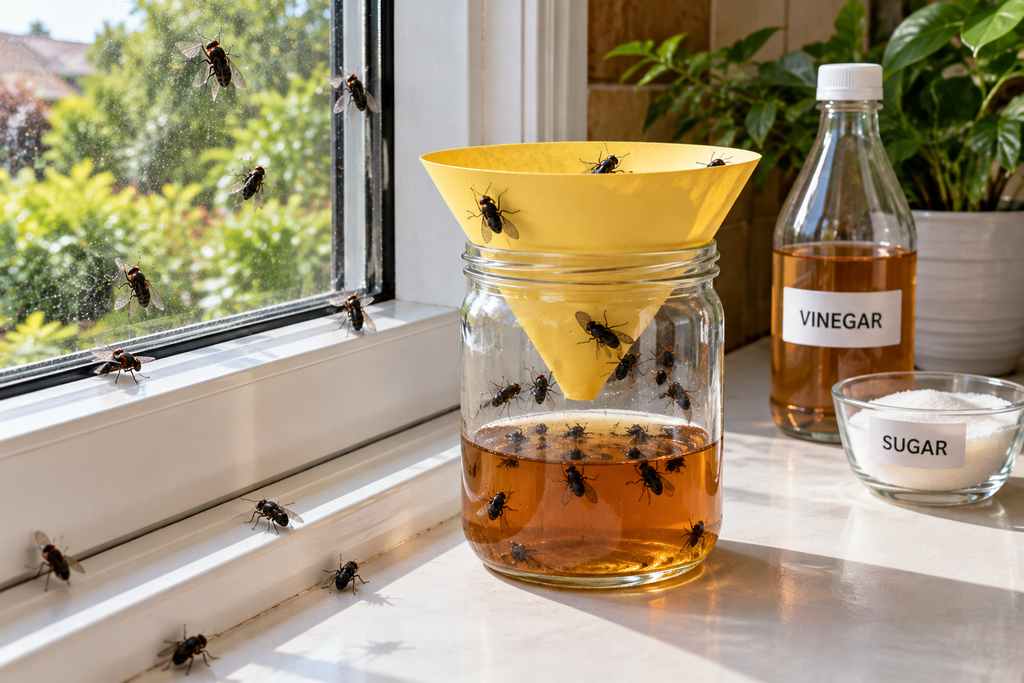
Be skeptical here. The extension fact sheets reviewed for this article put their weight on exclusion, vacuuming, and some traps. None of them list a repellent as a proven control. That doesn’t mean nothing helps, but the evidence for home remedies is thin.
Essential oils. Peppermint, cedar, lavender, eucalyptus, and clove are popular suggestions. They may make a treated spot less pleasant for a while. They can’t reach wall voids, and the scent fades quickly. If you try them, apply a diluted solution to window frames or sills, never inside walls or electrical boxes, with good ventilation, and test a hidden patch first, since oils can mark paint and finishes. Some oils are hazardous to pets, especially cats, and to birds, and can irritate young children. If you have either, skip them.
Vinegar and sugar traps. These work on fruit flies because they target fermenting food. Cluster flies aren’t drawn to fermenting food, so a bowl of vinegar is unlikely to help.
Sticky traps or fly paper. Placed near sunny windows, they catch some flies. They’re cheap and unattractive. Keep them away from pets and small children.
Foggers and aerosol bombs. Penn State’s extension notes that pyrethrum foggers can kill flies clustered in an attic. They won’t stop flies from emerging from wall voids, and the dead flies still need cleanup. “Pyrethrum” is plant-derived, but it’s still an insecticide, and pyrethrins are toxic to fish and harmful to bees. Aerosols can also create fire hazards near pilot lights and electrical equipment. Whatever product you consider, read the label and follow it exactly.
Professional treatment. If flies return heavily despite sealing, a licensed pest professional can treat exterior walls or wall voids. Ask what products they use, whether they treat wall voids or only surfaces, and what outcome to expect. Once flies are inside a wall void, they’re hard to control, so prevention remains the better bet.
What to Expect: A Realistic Timeline
- Late summer to fall: Flies move into buildings. Sealing works best now.
- Winter: Flies in wall voids and attics stay mostly inactive, but warm spells wake them. Expect a few at windows and fixtures.
- Late winter to spring: Colorado State’s extension notes that most flies that overwinter in a building end up moving outdoors in early spring. The rest are the ones that wandered into your rooms.
If flies are already inside your walls this fall, sealing the outside won’t remove them. It will block newcomers, and interior sealing will cut how many reach your rooms. The goal for this winter is managing a nuisance.
Preventing Next Year’s Infestation: A Seasonal Checklist
Early spring. Note where flies appeared and where they came out. Vacuum the attic and clean light fixtures after the flies have left.
Early to mid-summer. Do the main repairs in dry, warm weather: recaulk trim, replace damaged siding, fix screens, patch vent screening, seal ceiling penetrations from the attic.
Late summer. Walk the sunny sides of the house. Touch up caulk, check the vents again, and confirm screens fit tightly.
Fall. Watch the sunny walls for flies landing and crawling. If you find a gap, seal it that day if the weather allows.
Fly numbers vary from year to year, and neighbors’ lawns and nearby fields are outside your control. A well-sealed house may still see a few flies in a heavy year. The aim is a handful instead of dozens.
Questions Readers Actually Ask
Do cluster flies lay eggs in the house?
No. Larvae need earthworms, which aren’t found indoors. If you see maggots inside, a different fly is involved, usually breeding in rotting food, garbage, or a dead animal in a wall or attic. Find and remove the source.
Is it safe to leave them alone?
Cluster flies don’t bite, and they don’t damage the structure. The reasons to act are the nuisance, the odor from large numbers of dead flies, and carpet beetles drawn to the remains.
Will they come back next year?
They often do, because the same buildings tend to be used year after year. Sealing the entry points is the best way to change that.
Why are so many dying on my windowsill?
They’re the flies that wandered out of the walls into rooms. They can’t find a way outdoors and run out of energy. Most flies that overwinter in a building leave in spring, so the ones on the sill are the minority.
Key Takeaways
- Cluster flies come to your house to overwinter. They don’t breed indoors, and they aren’t a sign of a dirty house.
- Sealing gaps before they arrive, especially up high, is the most reliable control.
- Windows are where flies end up, not where they enter. Use their location to find the route.
- Vacuum flies promptly and empty the vacuum outside.
- Natural repellents have thin evidence behind them. Use them with care around pets, and don’t count on them.
- Plan next year’s repairs for summer, and recheck the sunny walls in early fall.

About Syprose Kiche
Syprose Kiche is the creator and writer behind My Besuited Home, a practical home and garden website covering DIY projects, gardening, lawn care, landscaping, home improvement, and outdoor living. She focuses on turning everyday homeowner questions into clear, practical guides backed by careful research and useful real-world considerations.