
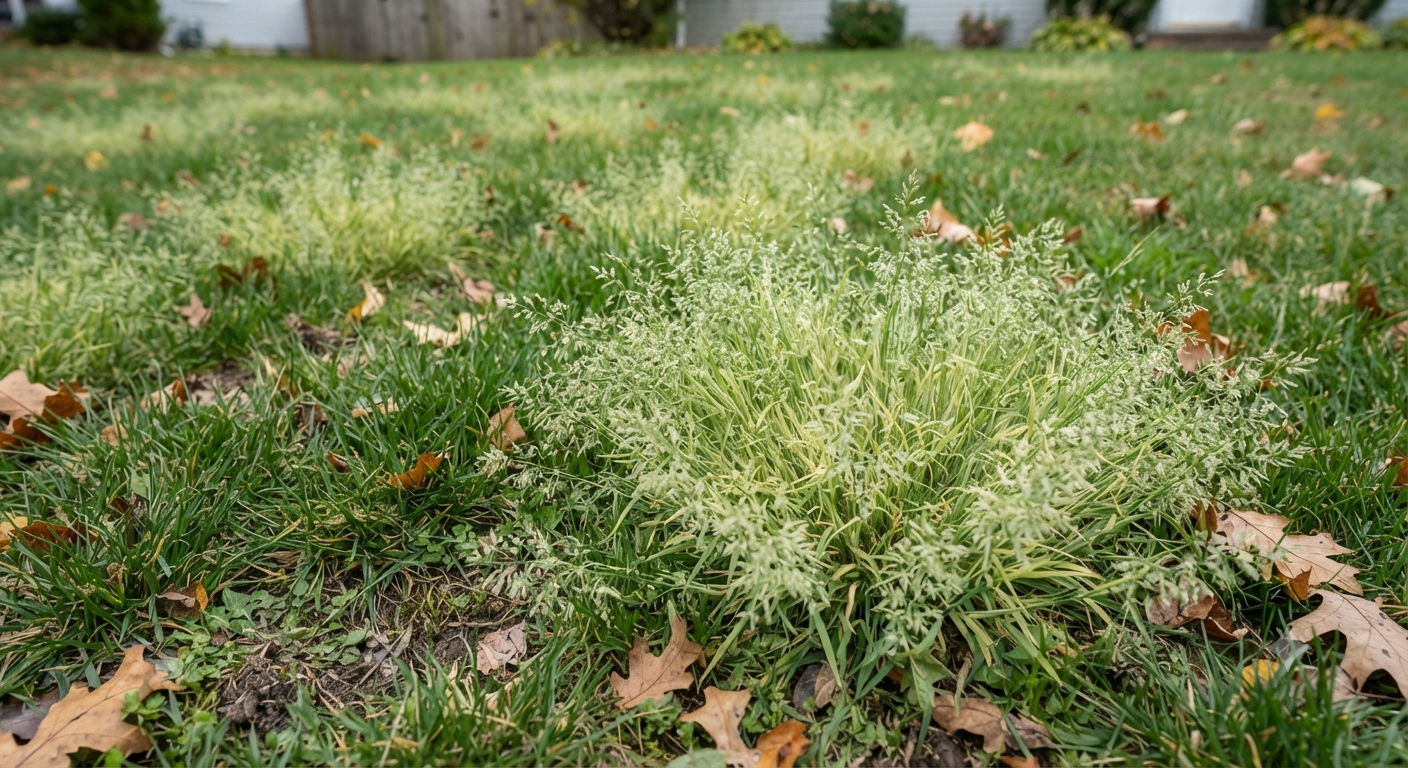
A lawn that looked fine in August can start filling in with low, spreading growth by the time the first cool nights arrive. Some of that new growth is grass recovering from summer stress. A lot of it isn’t. Cooler temperatures and shorter days trigger germination in several weed species that spend the following spring flowering and setting seed before most homeowners even notice them. Catching them now, while they’re small and the lawn is still actively growing, is one of the few genuinely high-leverage moments in a weed-control calendar.
This matters because fall weeds fall into two very different categories, and mixing up the category changes what actually works.
Winter Annuals vs. Perennials: Why the Distinction Changes Your Strategy
Some of the weeds that show up in fall are winter annuals — chickweed and henbit are the two most common examples. Their entire life cycle runs from a fall germination through overwintering as a low rosette, followed by rapid growth and seed production in early spring. Once they’ve set seed, the plant dies, and the seed waits for the following fall to start again. Because the plant is young and hasn’t developed a deep root system in autumn, this is genuinely the easiest point in the year to remove them, either by hand or with a properly timed herbicide.
Others are perennials that are simply resuming active growth after summer dormancy or heat stress — dandelions, clover, creeping Charlie, plantain, and oxalis all fall into this group in most climates. These plants don’t die off each year. They store energy in roots, rhizomes, or tubers and will regrow from that stored tissue if the removal method doesn’t address it. For perennials, fall is valuable less because the plant is more vulnerable and more because it’s actively pulling energy down into its root system to prepare for winter, which means any systemic herbicide applied now moves more efficiently to the root than it would during a summer application.
Identifying which category you’re dealing with is the first practical decision, because pulling a winter annual before it seeds solves the problem for that season. Pulling a perennial without removing the root or using a systemic product usually means it comes back.
Common Fall Weeds and How to Eliminate them from Your Yard
1. Dandelions (Taraxacum officinale)
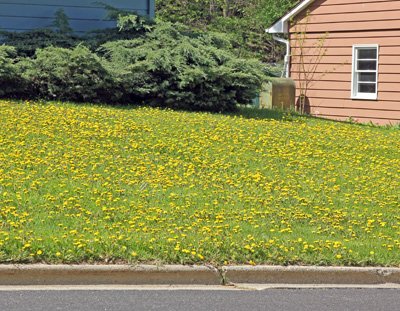
Dandelions are easy to identify and hard to argue with once they’re established: a basal rosette of deeply toothed leaves, a hollow flower stalk, and the familiar yellow flower that later becomes a seed head. In fall, dandelions may not be flowering much, but the rosettes are often visibly greener and more vigorous than they were in the heat of summer.
The reason dandelions are difficult to remove completely is the taproot. A mature dandelion’s taproot can extend six to eighteen inches into the soil, and the plant can regenerate from any root fragment left behind that’s roughly two inches or longer. Hand-pulling works reasonably well on young plants in loose or recently rained-on soil, where the whole root tends to come up intact. In compacted clay, snapping off the top of the root without removing the crown is the most common mistake, and it simply results in regrowth within a few weeks.
A long-handled weeding tool with a forked tip, pushed straight down alongside the taproot before pulling, removes significantly more of the root system than pulling by hand alone. For lawns with a heavy dandelion population, a fall application of a broadleaf selective herbicide containing an active ingredient like 2,4-D, triclopyr, or a three-way combination product is generally considered more effective than spring application, because the plant is translocating nutrients toward the root rather than up toward new leaf and flower growth. Always follow label instructions for temperature range, since many broadleaf herbicides lose effectiveness or risk damaging turf outside a specific temperature window, typically above 50°F and below 85°F.
2. Chickweed (Stellaria media)
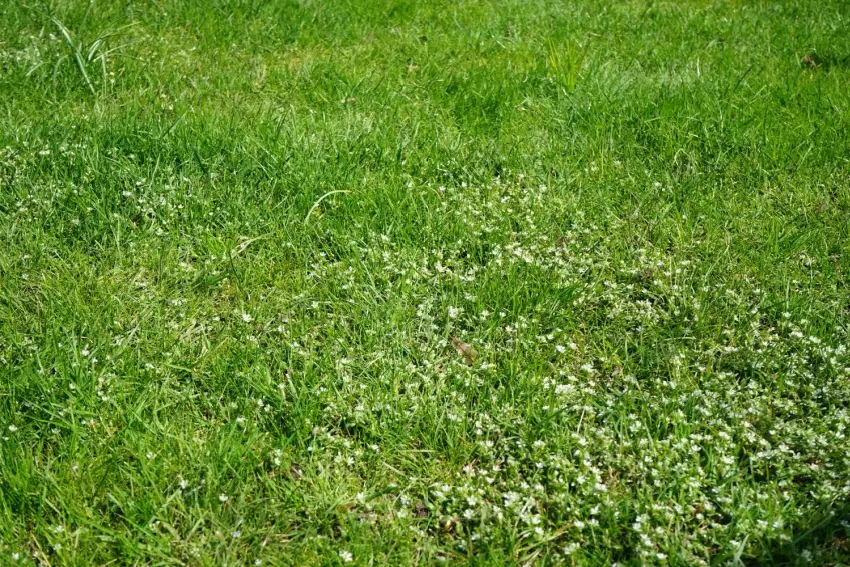
Chickweed forms dense, low mats with small, oval, opposite leaves and tiny white star-shaped flowers. It spreads both by seed and by rooting at the stem nodes where they touch soil, which is why a small patch can turn into a thick mat within a few weeks under the right conditions — cool, moist, and often shaded areas of the lawn.
Because chickweed is a winter annual, hand-pulling in fall is genuinely effective, particularly while the mat is still thin. The shallow, fibrous root system pulls out easily, especially after rain or irrigation has softened the soil. The catch is thoroughness: any rooted stem fragment left behind can reestablish, so pulling needs to include the full mat rather than just the visible flowering stems.
Pre-emergent herbicides applied in early fall, before germination begins, are often more efficient than post-emergent control for larger lawns with a chickweed history, since they prevent the seed bank from germinating in the first place. Once chickweed has already emerged and spread into a mat, a post-emergent broadleaf herbicide labeled for chickweed will still work, but dense mats can shield inner growth from spray contact, so thin patches respond better to spot treatment than thick ones.
3. Henbit (Lamium amplexicaule)
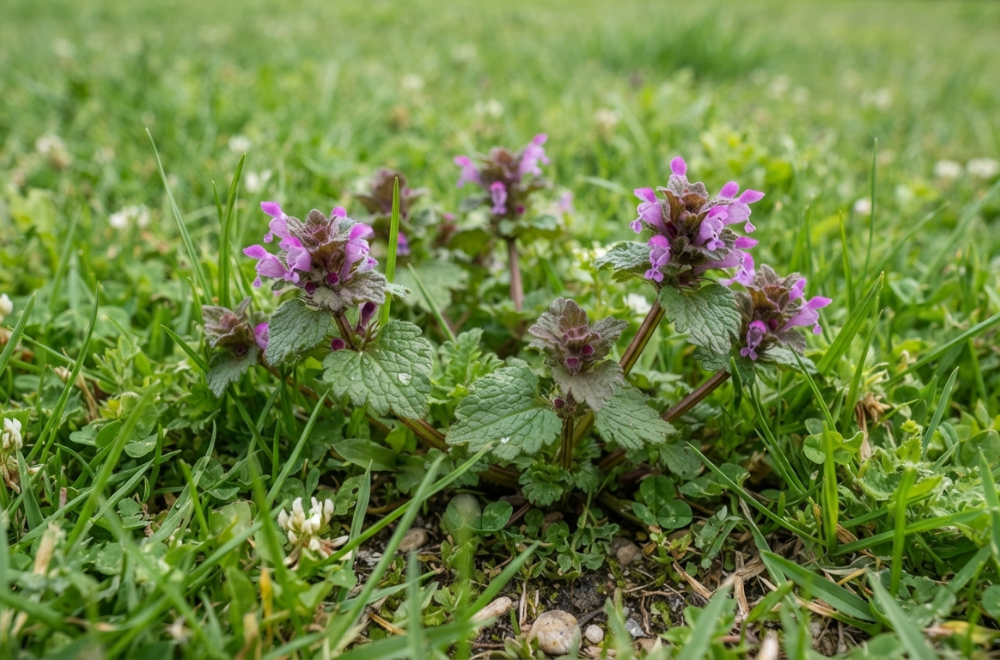
Henbit is often mistaken for clover or ground ivy at a glance, but its square stems (a signature of the mint family it belongs to) and its scalloped, somewhat fuzzy leaves that clasp directly around the stem set it apart. Its small purple, tubular flowers appear in late winter to early spring, but the plant itself germinates and establishes through fall.
Like chickweed, henbit is a winter annual, so fall control focuses on preventing it from surviving to set seed rather than fighting an established perennial root system. Hand-pulling young henbit is straightforward since it lacks the extensive rooting-at-nodes habit of chickweed, but for lawns with a persistent henbit problem year after year, that persistence usually means seed is already present in the soil in large enough quantities that manual removal alone won’t keep up.
A fall pre-emergent application timed to soil temperatures around 55–60°F at a two-inch depth (this is when most winter annual weed seeds begin germinating) tends to be the most efficient long-term approach for lawns with a recurring henbit population. Local extension services often publish soil temperature tracking for this exact purpose, and checking those figures is more reliable than guessing based on the calendar date, since germination timing shifts from year to year and by region.
4. Clover (Trifolium repens, white clover being most common in lawns)
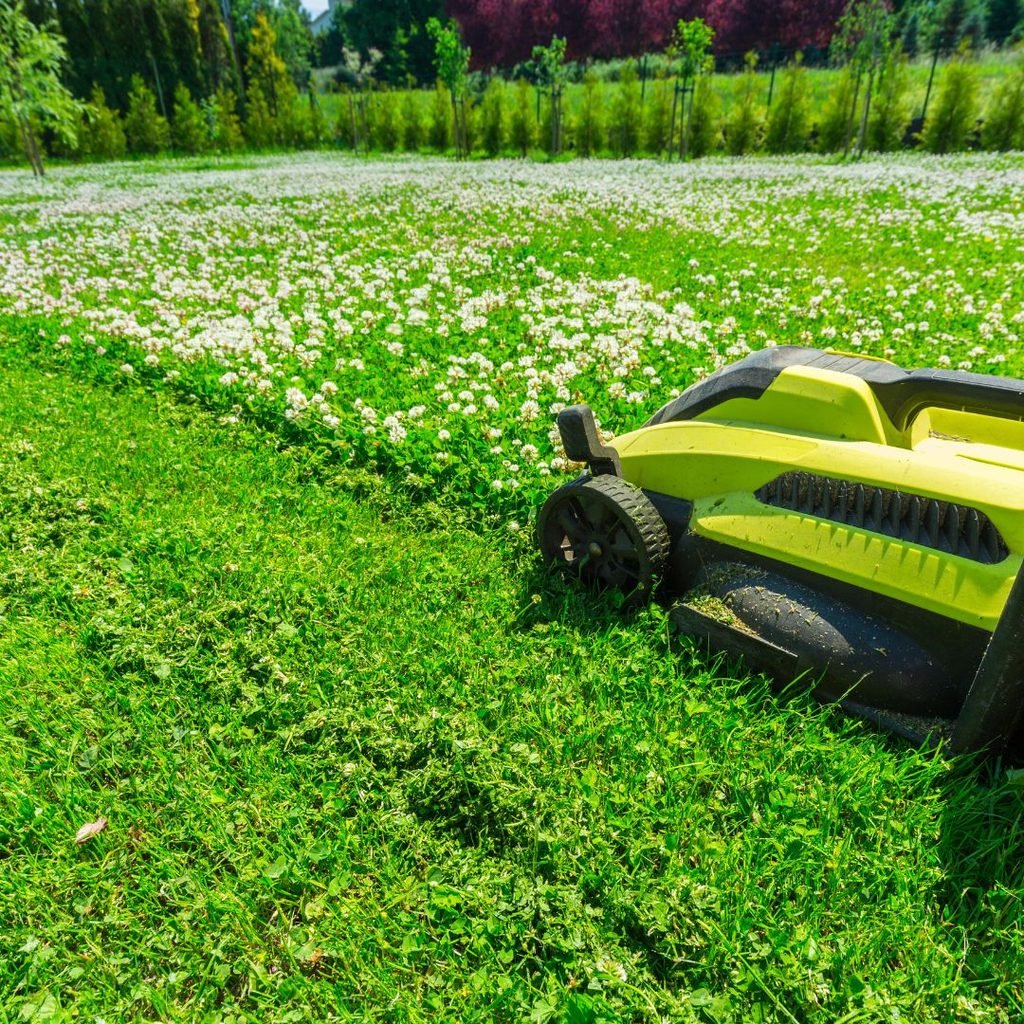
Clover identification rarely causes confusion: three (occasionally four) rounded leaflets, often with a pale chevron marking, and white or slightly pink globe-shaped flower clusters. It spreads by both seed and creeping stolons that root at nodes along the ground.
Clover occupies an unusual place in lawn care because it isn’t purely a nuisance from an agronomic standpoint. It’s a nitrogen-fixing legume, meaning it can actually improve soil nitrogen availability for surrounding grass, and some homeowners intentionally overseed it into lawns for pollinator support and reduced fertilizer need. Whether clover is a “weed” in a given lawn is genuinely a matter of preference rather than a fixed horticultural fact, which is worth mentioning because a lot of generic advice treats it as an unambiguous problem.
For lawns where clover isn’t wanted, hand-pulling is only practical for small, isolated patches, since the stoloniferous growth habit means an established patch has usually rooted at many points and regrows readily from any section left in place. Broadleaf herbicides containing a combination of 2,4-D, dicamba, and mecoprop (often labeled as “three-way” or “weed and feed” combination products) are commonly used for larger infestations, applied when clover is actively growing in fall. One frequently overlooked cause of clover spread is thin, undernourished turf — clover often moves into lawns where grass density has dropped due to compaction, low fertility, or mowing too short, so addressing those underlying conditions matters as much as the herbicide application itself.
5. Creeping Charlie / Ground Ivy (Glechoma hederacea)
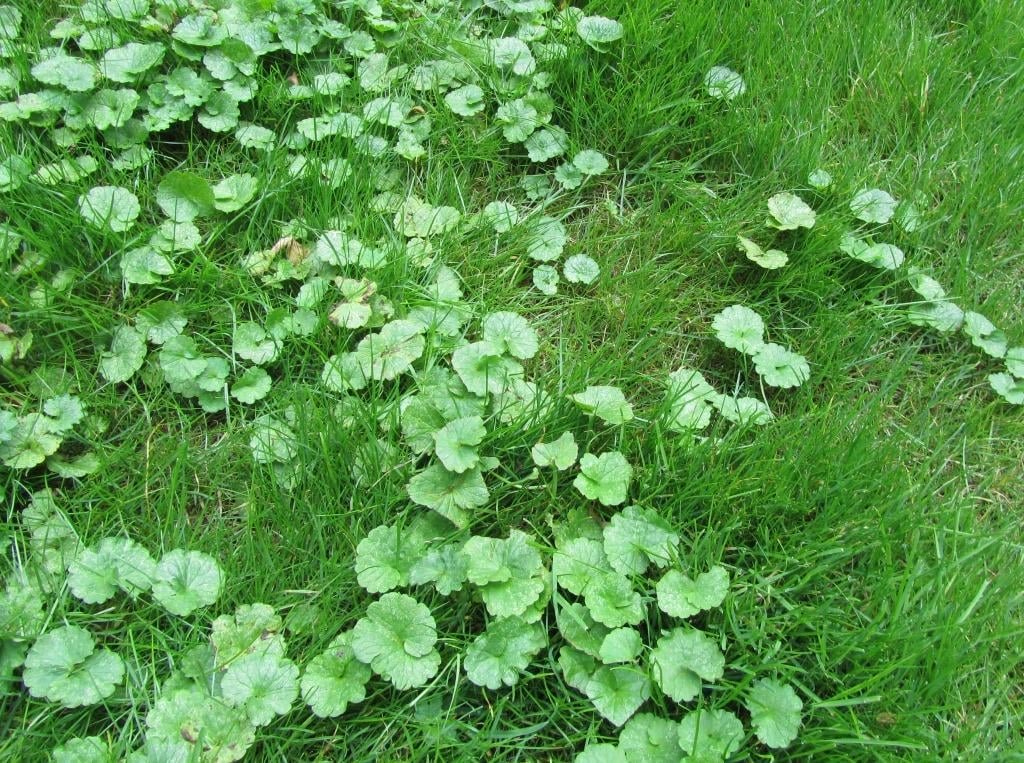
Creeping Charlie is a low, sprawling plant with scalloped, kidney-shaped leaves and a minty scent when crushed, another member of the mint family with square stems. Its small purple-blue flowers appear in spring, but the plant itself is visible and spreading well before then, particularly in shaded, moist areas where turf grass tends to struggle anyway.
This is one of the more frustrating lawn weeds to control because of how it spreads: long stolons that root at almost every leaf node, forming a dense mat that can extend outward far faster than most homeowners expect. Hand-pulling can reduce a small patch, but for anything beyond a square foot or two, the amount of rooted material makes manual removal impractical as a sole strategy, and any stolon fragment left in contact with soil can reroot.
Herbicides containing triclopyr are generally considered more effective against creeping Charlie than 2,4-D alone, and fall application is specifically recommended by several university extension programs because the plant is storing energy for winter dormancy at that time, which improves herbicide translocation into the root system. Because creeping Charlie often colonizes shaded areas where turf grass is already thin due to lack of light, controlling the weed without addressing the underlying shade and turf density issue tends to produce only temporary results — the same conditions that let it establish in the first place will usually let it return.
6. Plantain (Broadleaf and Buckhorn, Plantago major and Plantago lanceolata)
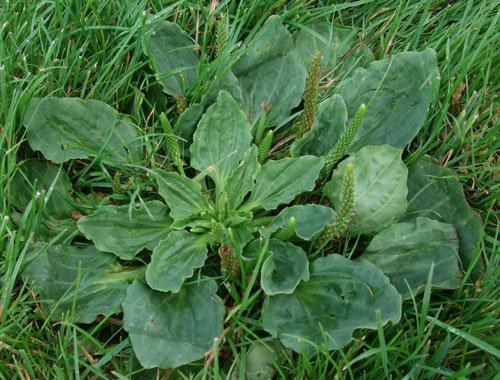
Broadleaf plantain forms a low rosette of oval, ribbed leaves with a tough, fibrous root crown; buckhorn plantain has narrower, lance-shaped leaves but the same rosette growth habit. Plantain tends to thrive in compacted soil, which is one reason it often appears in heavily used lawn areas — along walkways, near gates, in play areas, or anywhere foot traffic has packed the soil down over time.
The fibrous, somewhat shallow root system means hand-pulling is often more effective on plantain than on taprooted weeds like dandelion, especially in moist soil. A weeding tool that can loosen the crown before pulling reduces the chance of leaving root fragments behind. Because compaction is so consistently linked to plantain’s presence, core aeration in fall — pulled at the same time as broadleaf weed removal — addresses the underlying condition rather than just the visible symptom. Removing plantain from a compacted area without aerating or otherwise loosening the soil often just creates open space for the next compaction-tolerant weed to move in.
For larger infestations, broadleaf selective herbicides effective on dandelion are generally effective on plantain as well, applied under the same fall timing logic.
7. Oxalis (Yellow Woodsorrel, Oxalis stricta)
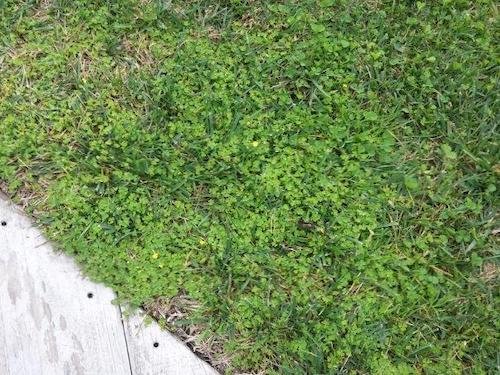
Oxalis is frequently mistaken for clover because of its three-part leaves, but the leaflets are heart-shaped rather than rounded, and the small yellow flowers and distinctive upright seed capsules distinguish it clearly once you know to look for them. Those seed capsules are worth paying attention to specifically: when mature, they explode on contact and can eject seed several feet, which is a major reason oxalis populations can expand quickly if left unmanaged even for a single season.
Oxalis spreads by seed, by creeping stems that root at nodes, and by small underground bulb-like structures, which makes it more persistent than its clover-like appearance might suggest. Hand-pulling young plants before seed capsules form is effective and prevents the explosive seed dispersal problem, but established patches with underground bulbils regenerate readily from fragments left in the soil, similar to how dandelion regrows from a partial taproot.
Because oxalis tolerates a fairly wide range of soil and light conditions, it isn’t reliably linked to one specific underlying lawn problem the way plantain is linked to compaction or creeping Charlie is linked to shade. Broadleaf herbicides labeled specifically for oxalis control tend to be more reliable than general three-way mixes, since oxalis has some natural tolerance to 2,4-D alone at typical label rates — checking the product label for oxalis specifically, rather than assuming any broadleaf herbicide will work, avoids a common source of frustration.
8. Wild Violet (Viola sororia)
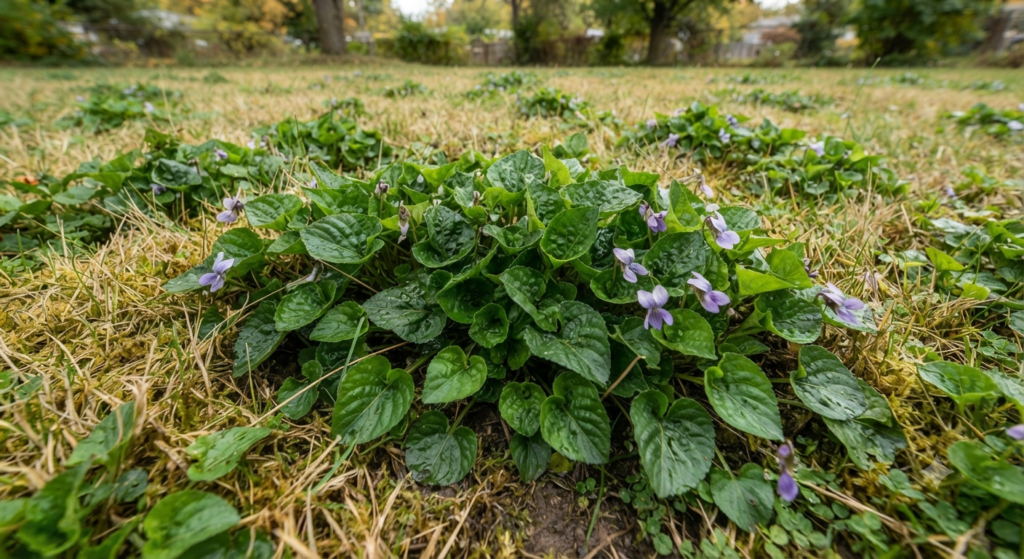
Wild violet is stubborn in a way that’s almost impressive. Heart-shaped leaves, a purple or white flower, and a root system that laughs at most standard treatments. It spreads through both seeds and rhizomes underground, which means pulling the visible plant barely slows it down.
Tackling wild violet in fall:
- Use a triclopyr-based herbicide specifically, since standard 2,4-D formulas are notoriously weak against violet.
- Apply in fall when the plant is moving nutrients down into its rhizomes, same logic as with dandelion.
- Expect to need two or three applications spaced a few weeks apart. One treatment almost never finishes the job.
- Improve soil drainage, since wild violet loves the same damp, partly shaded spots that struggle to grow thick grass anyway.
Wild violet is one of those weeds where I’ve genuinely told friends: don’t waste money on the cheap store-brand weed killer. Spend the extra few dollars on something with triclopyr, or you’ll be back at the garden center in three weeks buying the same thing you should have bought the first time.
9. Annual Bluegrass (Poa annua)
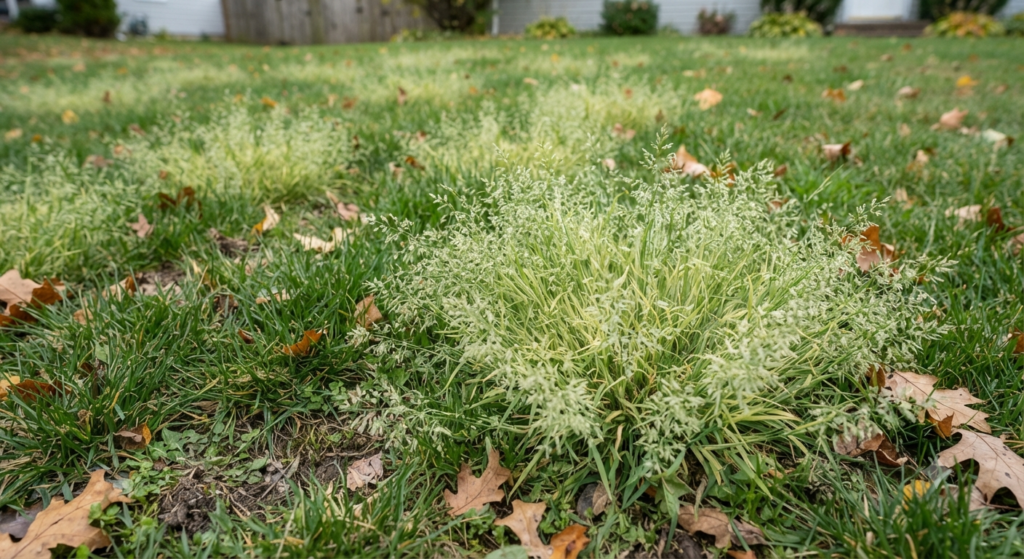
This one trips people up because it looks like grass. Not weed-shaped, not flower-shaped, just a lighter green, clumpy patch of what looks like regular grass that’s growing at a different rate than everything around it.
Annual bluegrass germinates in fall, grows through winter, then produces a huge number of seed heads in spring before dying off in summer heat, leaving bare, ugly patches right when you want your lawn looking its best.
How to manage annual bluegrass:
- Apply a pre-emergent herbicide in early-to-mid fall, timed with soil temperature drops, the same as chickweed and henbit.
- Avoid overwatering in fall. Annual bluegrass thrives in consistently moist soil, so cutting back slightly helps tip the balance toward your actual lawn grass.
- Core aerate in fall to reduce soil compaction, since annual bluegrass loves compacted ground that your regular turf struggles in.
- Overseed with a dense, competitive grass variety suited to your climate to crowd it out over time.
I’ll be honest, this is the one fall weed on this list I don’t bother hand-pulling. It blends in too well, and by the time you’re sure what you’re looking at, it’s already seeded.
10. Common Mallow (Malva neglecta)
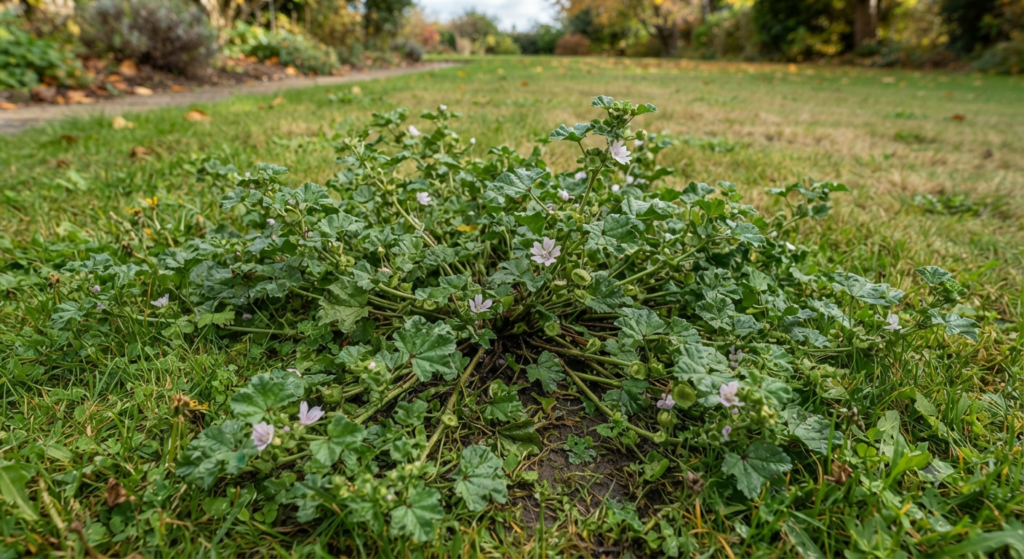
Common mallow doesn’t get talked about as much as dandelion or clover, but if you’ve got it, you already know it’s a pain. Round, scalloped leaves, a sprawling growth habit, and a taproot almost as stubborn as a dandelion’s.
Dealing with mallow before it gets out of hand:
- Hand-pull young seedlings while the taproot is still shallow enough to come out whole.
- Use a broadleaf herbicide with triclopyr or a three-way blend (2,4-D, MCPP, dicamba) for established plants.
- Apply fall treatments while the plant is storing energy for winter, which again gives you a much cleaner kill than spring spraying.
- Mow high and fertilize properly, since thick, healthy grass is genuinely the best long-term defense against mallow establishing in the first place.
I ripped out a mallow plant in my side yard three years running before I finally treated the root instead of just yanking the top growth. Turns out pulling the leaves off a mallow plant just makes it mad. It comes back thicker.
Choosing Between Hand-Pulling, Spot Treatment, and Broader Herbicide Application
The right method depends less on which weed you’re looking at and more on how established the infestation already is and what kind of root or spreading system the plant relies on.
Hand-pulling makes the most sense for winter annuals caught early, for taprooted perennials in soft or recently watered soil, and for isolated patches of any weed before they’ve had time to spread widely. It has essentially no downside for the surrounding lawn and works immediately, but it’s labor-intensive at scale and unreliable against extensive stoloniferous growth like established creeping Charlie or clover.
Spot treatment with a selective herbicide is generally the right call for scattered individual weeds or small patches spread across an otherwise healthy lawn, since it limits herbicide use to where it’s actually needed rather than treating the entire yard.
Broader lawn-wide application makes sense when a weed has spread extensively enough that individual spot treatment would mean dozens of separate applications, or when a pre-emergent strategy is being used to prevent winter annual germination across the whole lawn rather than reacting to existing plants.
Regardless of method, timing and conditions affect outcomes more than most people expect. Most selective broadleaf herbicides need the target plant to be actively growing to translocate the product effectively, and many labels specify not applying within a certain window before or after mowing, before rain is expected, or when temperatures fall outside a stated range. Applying a systemic herbicide right before a heavy rain, for instance, often washes it off leaves before it’s absorbed, wasting the application and potentially causing unintended runoff into nearby soil, storm drains, or waterways.
Common Mistakes That Undo Fall Weed Control Efforts
Pulling perennial weeds without removing enough of the root system is probably the single most common mistake, and it’s an easy one to make because the plant often looks removed even when a viable root fragment remains underground.
Treating winter annuals and perennials with the same strategy is another frequent issue — applying a pre-emergent to control an already-established dandelion population, for example, does nothing, since pre-emergent products work by preventing seed germination, not by killing existing plants.
Applying herbicide too late in fall, after a hard frost has already slowed the plant’s growth and nutrient movement, reduces effectiveness significantly, since the systemic transport that carries the product to the root depends on the plant actively growing.
Ignoring the underlying lawn condition that let the weed establish in the first place — compaction for plantain, shade and moisture for creeping Charlie and chickweed, thin turf for clover — means the weed, or a similar one, often returns even after a successful removal, because the conditions that favored it in the first place haven’t changed.
When Overseeding and Soil Care Matter More Than Herbicide
A thick, healthy lawn is one of the more effective long-term weed deterrents available, simply because it leaves less open soil and light for weed seeds to germinate into. Fall is also the optimal season for overseeding cool-season grasses in most of the U.S., which makes it a natural point to combine weed removal with turf thickening.
One timing conflict worth being aware of: many pre-emergent herbicides that prevent weed seed germination will also prevent grass seed from germinating, since they don’t distinguish between weed seed and turf seed. If overseeding is part of the plan, either the pre-emergent application needs to happen well before seeding (check the specific product label for the required interval, which is often 6 to 12 weeks) or a product specifically labeled as safe for use with overseeding needs to be used instead.
When Professional Help Is Worth Considering
A lawn with multiple established perennial weed species covering more than roughly a quarter of the total area, chronic drainage or compaction problems contributing to weed pressure, or a history of DIY treatments not holding past one season are all reasonable signals that a professional lawn care assessment could save time and money compared to repeated retail herbicide purchases. Professionals also have access to some products and application equipment not available to homeowners, which can matter for particularly stubborn or widespread infestations.
Frequently Asked Questions
Is it better to pull weeds by hand or use herbicide in fall? It depends on the weed and how established it is. Hand-pulling works well for winter annuals and young perennials in soft soil, but established perennials with extensive root or stolon systems — creeping Charlie and clover in particular — are usually more reliably controlled with a properly timed selective herbicide.
Will fall weeds die on their own once winter arrives? Winter annuals like chickweed and henbit will eventually die after setting seed in spring, but the seed they produce germinates the following fall, so the cycle continues unless the plant is removed before it seeds. Perennial weeds go dormant in winter but don’t die back completely; they regrow from stored root energy the following season.
Can I treat my whole lawn for weeds and overseed at the same time? Not usually with the same product on the same day. Pre-emergent herbicides that stop weed seed from germinating typically also prevent grass seed from germinating, so the two need to be timed apart according to the specific product label.
Why do the same weeds keep coming back in the same spot every year? This is usually a sign that an underlying lawn condition — compaction, shade, poor drainage, or thin turf — is favoring that particular weed. Removing the weed without addressing the condition tends to produce only a temporary fix.
If you’re dealing with compacted soil that keeps favoring plantain, our guide to fall lawn aeration walks through when and how to aerate before overseeding. And if creeping Charlie or chickweed keeps showing up in the same shaded corner of the yard, it may be worth reading through options for shade-tolerant grass varieties rather than fighting the weed indefinitely in a spot where turf was always going to struggle.
Fall weed control isn’t a single afternoon task so much as a short window where timing, plant biology, and soil condition line up in your favor. Identify what you’re actually looking at, match the method to the type of weed, and use this season’s momentum to fix the underlying lawn condition rather than just the weed sitting on top of it.

About Syprose Kiche
Syprose Kiche is the creator and writer behind My Besuited Home, a practical home and garden website covering DIY projects, gardening, lawn care, landscaping, home improvement, and outdoor living. She focuses on turning everyday homeowner questions into clear, practical guides backed by careful research and useful real-world considerations.