
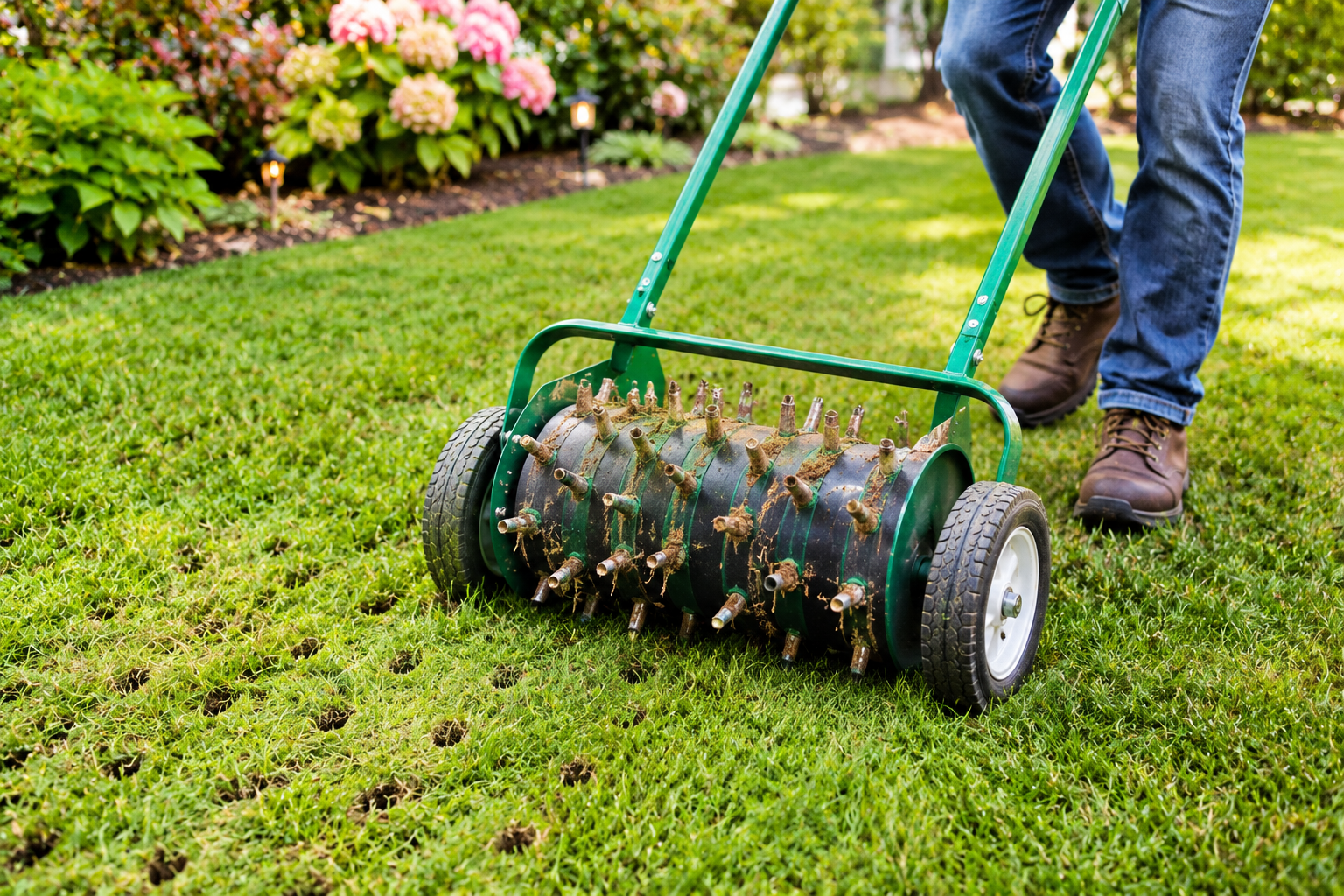
Most lawns that look tired are not short on fertilizer or water. Plenty of them are short on room. When soil is packed tight, grass roots can’t push down, rain runs off or sits on the surface, and the fertilizer you spread never reaches the root zone. Aeration, which pulls small plugs of soil out of the lawn, is the standard fix for that.
But aeration is not a cure for every thin or yellow lawn, and doing it at the wrong time of year can set a lawn back instead of helping it. The good news is that you can check for compaction yourself with a screwdriver and about a minute of effort. Start with that test, then use the signs below to decide whether your lawn really needs the job, and when to schedule it.
The One-Minute Test Worth Doing Before Anything Else
A screwdriver at least 4 to 6 inches long (or a garden fork) is the most commonly recommended compaction check. Push it into the lawn a few days after a good soaking rain or watering, when the soil is moist but not muddy. Dry ground fools the test, because even healthy soil resists a screwdriver in midsummer drought.
If the tool slides in easily to its full length, compaction is probably not your main problem. If you have to lean on it and it stops after an inch or two, the soil is dense. Try it in at least four or five places, including a spot you rarely walk on, such as near a back fence. That comparison matters. A lawn where the whole yard resists the screwdriver points to a soil problem, often clay or construction-era compaction. A lawn where only the path to the shed resists it points to traffic.
A second quick check is the wedge test. Cut a small wedge of turf about 3 inches deep with a spade, lift it out, and look at the side profile. You’ll see green blades, a brown spongy layer (thatch), then soil. You’ll also see how deep the roots actually go. Keep both tests in mind as you read the signs below, because several of them are really clues that point back to one of these two measurements.
11 Signs Your Lawn Needs Aeration
1. The Screwdriver Won’t Go In
This is the sign that matters most, and the rest are largely different ways of noticing the same thing. Compacted soil has lost much of the pore space that holds air and water. Roots need both. When the soil is dense enough that a screwdriver stalls in the top inch or two, roots have the same trouble.
Resistance in moist soil is the key condition. If the soil is bone dry, water the lawn deeply, wait a day, and retest before drawing conclusions.
2. Water Puddles or Runs Off Instead of Soaking In
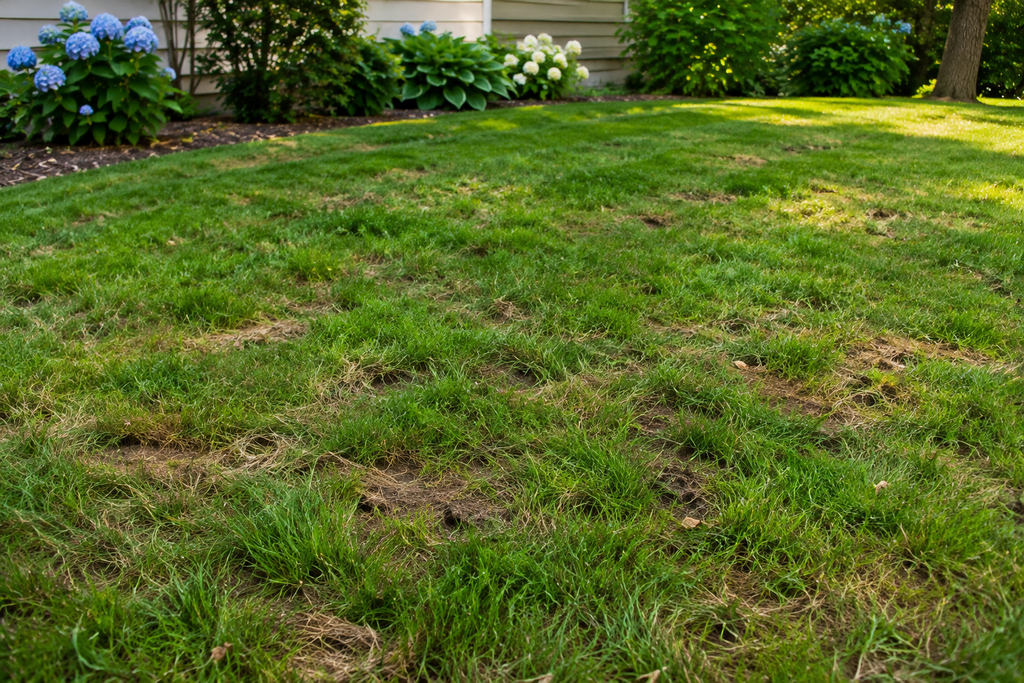
Watch what happens during a sprinkler cycle or a moderate rain. If water collects in shallow pools on flat ground, or streams off a gentle slope into the street, the soil surface is not accepting water fast enough. Compaction is a common cause, because the tiny channels water normally follows downward have been squeezed shut.
Keep in mind that puddles can have other causes, including a low spot, poor grading, or a hardpan layer deeper than an aerator can reach. If puddles persist in the same low area after you’ve aerated, the problem is probably grading or drainage, and a few more passes with the aerator won’t solve it.
3. The Ground Feels Hard Underfoot
Healthy turf over reasonably loose soil has a slight give. Compacted ground feels firm even when it’s been wet, and a shovel or trowel bounces or needs real force to break the surface. Heavily compacted lawns are often most obvious in midsummer, when the soil bakes into something closer to a brick than a sponge.
If you notice this only in the strip where the mower wheels run, or where the dog makes the same lap every day, you’re looking at localized compaction. You may be able to aerate only that area rather than the entire lawn.
4. Roots Are Shallow
Pull up a small wedge of turf and check the roots. A rough rule of thumb is that roots only 1 to 2 inches deep suggest a lawn that is struggling to push downward. Shallow roots can’t reach moisture deeper in the soil, so the lawn browns quickly in heat even when the soil several inches down still holds water.
Shallow roots have other causes too, including frequent light watering, which teaches grass to root near the surface. If your watering habit is a few minutes every evening, changing to deeper, less frequent watering is part of the fix regardless of whether you aerate.
5. The Lawn Feels Spongy and Thatch Is Over a Half Inch
Thatch is the layer of stems, roots, and other organic material that builds up between the grass blades and the soil. A thin layer, up to about half an inch, is considered normal and even helpful, since it insulates the soil and holds some moisture. Past that thickness it can block water and air and create a comfortable home for pests and disease.
Compaction doesn’t directly cause thatch, but it can make thatch worse by slowing the microbial activity that breaks it down. That is one reason regular core aeration is often credited with reducing the need to dethatch. Penn State Extension, among others, points out that aeration encourages those microbes, so many lawns do fine with aeration alone and never need a separate dethatching job.
The sequence matters when both problems are present. If thatch is well past half an inch and the soil is also compacted, the usual advice is to dethatch first, then aerate once the lawn has begun recovering. If thatch is thin and the soil is hard, skip the dethatcher entirely. A power rake on a lawn that doesn’t need one tears up healthy turf and does nothing about compaction.
6. Bare, Worn Strips Where People or Pets Walk
Shortcuts across the lawn, the lap around the swing set, the strip beside the patio door, the path the mower always takes: all of these tend to thin out first. Foot and equipment traffic squeezes soil particles together, and grass growing in squeezed soil is already stressed before it’s walked on.
Iowa State University Extension recommends aerating lawns with heavy foot or pet traffic, and lawns growing in heavy clay, twice a year rather than once. Lawns on well-drained soil with light use generally need it only once a year.
If the worn area is a true footpath, aeration will help the grass hold on, but it won’t make a lawn survive daily foot traffic indefinitely. A stepping-stone path or a few pavers where people actually walk is a more permanent solution.
7. Weeds That Thrive in Hard Soil Keep Showing Up
Certain weeds tolerate compacted ground better than turfgrass does, so they gradually take over the stressed areas. Plantain, prostrate knotweed, and goosegrass are commonly cited examples. Seeing them concentrated along paths, driveway edges, or other compacted spots is a useful clue about the soil underneath.
There’s a trap here. Killing the weeds without changing the soil usually just clears space for the next round of the same weeds, because the compacted conditions that favored them are still in place. Aeration addresses the cause. Herbicide only addresses the symptom. Weed species can also point to other conditions such as low fertility or poor drainage, so treat them as a clue to confirm with the screwdriver test, not as proof of compaction on their own.
8. Thin, Pale Patches That Don’t Respond to Fertilizer or Water
A lawn that stays thin or washed-out despite regular fertilizer and watering is often telling you the inputs aren’t reaching the roots. Dense soil sheds water, and fertilizer dissolved in that water runs off with it. Thatch can act as a barrier too, tying up some of what you apply before it reaches the soil.
This sign is the easiest to misread. Thin, yellowing turf has a long list of possible causes, including insects, disease, shade, low nitrogen, and dog urine. Before assuming compaction, check the other likely suspects. If the screwdriver test passes easily and thatch is thin, aeration is not the answer, and you’ll want to look elsewhere.
9. The Lawn Browns Quickly in Dry or Hot Weather
Grass with shallow roots in compacted soil often shows drought stress days before a neighbor’s lawn does. The soil can’t take up much water during irrigation, and the roots can’t reach what little gets in. The result is a lawn that needs watering constantly, and still looks stressed.
A useful test: water the lawn for a normal cycle, wait an hour, and push the screwdriver in. If the soil is dry just a couple of inches down, the water is running off or evaporating rather than soaking in. That points to compaction, thatch, or both.
10. The Lawn Sits on Clay or Builder-Graded Soil
Some lawns are set up for compaction from the start. Clay soils are made of very fine particles that pack together easily, especially when walked on or mowed while wet. And on new-construction lots, heavy equipment often compacts the subsoil, and topsoil may be stripped or only a thin layer is added before sod or seed goes down. The grass then sits on dense ground with little room for roots.
If your house is fairly new and the lawn never seemed to establish properly, test in several places. Newer lawns with this history are often candidates for aeration earlier and more often than the typical once-a-year schedule. Sandy soils, on the other hand, compact less readily, and many sandy lawns do well with less frequent aeration.
11. Overseeding and Topdressing Don’t Seem to Take
Seed that lands on top of thatch or hard soil often fails to make contact with the ground, and the seedlings that do sprout have trouble rooting. If you’ve overseeded a thin lawn and got only patchy results, a hard surface may be part of the explanation.
This is one of the reasons aeration and overseeding are commonly paired in cool-season lawns. The holes give seed a protected place to sit and germinate, and the loosened soil gives the new roots somewhere to go. It also explains why a lawn that is being renovated is a better candidate for aeration than one that is already thick and healthy.
When Aeration Won’t Help
A few conditions can look like compaction and aren’t. It’s better to rule them out than to rent a machine and be disappointed.
A lawn that is thin because of shade will not thicken from aeration. Most turfgrasses need substantial sun, and a patch under a mature tree will keep struggling no matter how loose the soil is. Brown patches that pull up like a rug, with white grubs underneath, are an insect problem. Circular patches with a distinct edge or a grayish ring may be disease. Soil that is low in nutrients or has a pH well outside the range grass prefers needs a soil test, not aeration. A lab test from your state’s cooperative extension service is inexpensive and will tell you more about a thin lawn than guessing.
A healthy lawn on loose soil also doesn’t gain much from aeration. If the screwdriver slides in easily, thatch is thin, and water soaks in, a machine pass is more disruption than help.
Timing: Aerate When the Grass Is Growing Fast
The single most important timing rule is simple. Aerate when your grass is actively growing, so it recovers quickly and fills in the holes. Core aeration injures turf a little, and healthy growth is what repairs it.
Cool-Season Grasses: Early Fall First, Early Spring Second
Kentucky bluegrass, tall fescue, perennial ryegrass, and fine fescues grow most vigorously in fall and spring. Fall is the preferred time. Missouri Botanical Garden recommends late August through September for cool-season lawns in the St. Louis area, and Iowa State Extension names September and April as best for Iowa. Fall also has a practical advantage: weeds are less likely to sprout in the open holes than in spring, and seed laid down at the same time has cooler weather and months of root growth ahead of winter.
Spring is a workable second choice, especially if you missed the fall window or the lawn is badly compacted. The tradeoff is weed seeds. Spring aeration opens soil just as crabgrass and other summer annuals are starting to germinate, so plan around any pre-emergent herbicide you’ve applied, a point covered further below.
If you’re reading this in November in a northern climate, the fall window has probably closed. Turf is heading toward dormancy, and seed put down this late may not establish before hard freezes. Waiting until early spring is usually the better move.
Warm-Season Grasses: Late Spring Through Early Summer
Bermudagrass, zoysia, centipede, and St. Augustine grow best in heat. Clemson Extension advises aerating them in late spring or early summer, and a University of Maryland extension page suggests June through July. The point is to catch the lawn after it has fully greened up and while it still has a long growing season left to heal.
Aeration in late summer or early fall is a poor bet for warm-season lawns, because growth is slowing and the grass won’t fill the holes before dormancy. Many warm-season types spread by stolons and rhizomes, which also means overseeding after aeration is less commonly needed than with cool-season lawns.
Times to Skip Aeration Altogether
Don’t aerate a dormant lawn. Don’t aerate during a drought, when the grass is stressed and the soil is too hard for tines to penetrate anyway. And don’t aerate in the middle of a heat wave on a cool-season lawn. Colorado State Extension and others advise waiting until the grass wakes up and recovers.
Soil moisture matters as much as the season. Iowa State’s guidance is to aerate when the soil is moist, and to avoid dry or soggy soil. In dry soil the tines can’t push in deeply. In wet soil they clog with mud and pull poor plugs. A day or two after a good rain, or after deep watering the day before, is usually about right.
How Often Is Often Enough?
For a lawn on well-drained soil with little traffic, once a year is generally enough, and some warm-season lawns can go two or three years between sessions unless they get heavy use. For heavy clay, high traffic, or a lawn with thatch problems, twice a year (fall and spring for cool-season grasses) is the more common recommendation. If you aerate once and the screwdriver test still fails the following season, that’s useful information too: the lawn may be one of the stubborn ones that needs a regular schedule.
Core, Spike, or Liquid: Which Kind of Aeration Counts
These three are not equal.
Core aeration uses hollow tines that remove plugs of soil. This is the method university extension services recommend. Iowa State specifically warns against spike-type devices that simply punch holes, because pushing a solid spike into dense soil can compact the walls of the hole further rather than loosen anything.
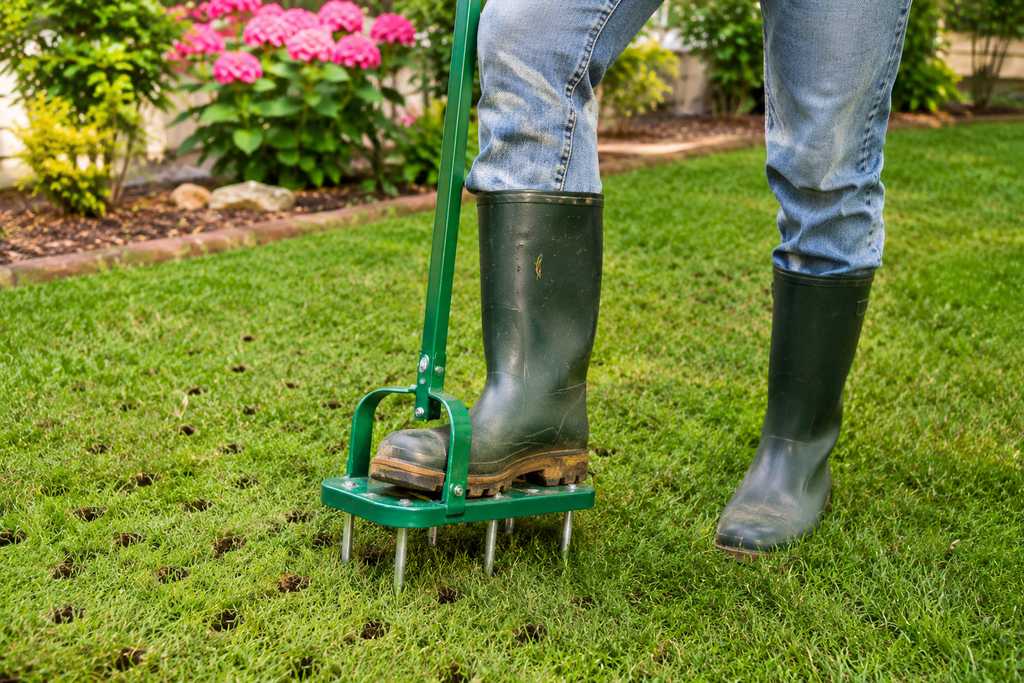
Spike aerators, including the spiked shoes and rolling spike drums sold at hardware stores, are better than nothing for a very small, lightly compacted patch, but they won’t deliver real relief on a compacted lawn.
Liquid aeration products are sold as soil conditioners that claim to loosen soil chemically. Independent, university-level evidence for them is thinner and less consistent than for core aeration, so treat marketing claims with caution. If you’re considering one, check what your local extension service says, and don’t use it as a replacement for core aeration on a lawn that has clearly failed the screwdriver test.
How to Core Aerate Without Making a Mess of It
Iowa State gives specific targets worth knowing: plugs about three-quarters of an inch in diameter and up to 3 inches long, and 20 to 40 holes per square foot. One pass with most machines doesn’t reach that density, so two or three passes in different directions are common. If you’re hiring a lawn service, ask what tine size they use and how many passes they make.
A rental machine is the usual DIY route. Before starting:
- Mark what’s underground. Sprinkler heads, shallow irrigation lines, and invisible dog-fence wires are easy to hit and expensive to repair. Utilities buried deeper aren’t usually in range, but it’s worth calling 811 before any digging project. That service doesn’t cover private irrigation or pet-fence lines, so flag those yourself.
- Mow shorter than usual a day or two beforehand, and clear sticks and toys.
- Check the soil moisture with a screwdriver. It should push in without a fight.
- Wear closed-toe, sturdy boots and hearing protection. Core aerators are heavy and loud, and they’re harder to control on slopes. Ask the rental counter to demonstrate the controls before you leave, and never reach near the tines while the machine is running.
Work in straight overlapping lines, then make a second pass at a right angle. Leave the plugs on the lawn. They break down in a few weeks, returning soil and microbes to the surface, and a pass with a leaf rake or drag mat breaks them up faster. Removing them is unnecessary.
What to Do in the Days Afterward
The window right after aeration is a good time to help the lawn, because the holes give seed, water, and nutrients a direct path in.
Overseed cool-season lawns. Spread seed right after aeration so it falls into the holes, and keep the top inch of soil consistently moist until it germinates. Warm-season lawns are usually left to fill in on their own.
Fertilize, with attention to timing. Sources differ here. Iowa State suggests fertilizing about a week before aeration, while Missouri Botanical Garden says both cool- and warm-season lawns can be fertilized immediately afterward. The difference is minor. What matters is that you use the right rate for your grass type, and ideally one based on a soil test.
Top-dress with compost, if you want. A thin layer of fine compost, roughly a quarter inch according to Iowa State, worked into the turf with a leaf rake before aerating, is a good way to add organic matter. Heavier layers can smother grass.
Water. If the weather is dry, water after aeration, especially if you’ve seeded. Newly seeded areas need frequent light watering until the seedlings establish. Seedlings need that near-constant surface moisture, and mature turf does not.
Mind your herbicides. Aeration can break a pre-emergent herbicide barrier by opening treated soil, and most pre-emergents also prevent grass seed from germinating. Read the label of any product you’ve applied, which usually includes instructions for waiting periods before seeding or disturbing the soil. If you plan to overseed, a different weed-control strategy may be necessary, and your local extension office can suggest one for your region.
Expect the lawn to look rough for a bit. Soil plugs scattered across the grass aren’t pretty. Recovery generally takes a few weeks of good growing weather. Stay off the lawn as much as possible while it recovers.
Four Mistakes That Waste an Aeration
Aerating at the wrong time. A fall job on a cool-season lawn or a late spring job on a warm-season lawn works with the grass. The reverse works against it.
Doing it on dry or soaked ground. Shallow plugs from dry soil and mud-clogged tines from wet soil both lead to poor results.
Using spikes and calling it done. If the lawn failed the screwdriver test, a spike drum won’t fix it.
Treating aeration as the whole plan. If you aerate and then keep mowing wet soil, watering lightly every day, and driving the mower on the same line every week, the soil will repack. Aeration works best alongside deeper, less frequent watering, mowing at the recommended height for your grass, and varying your mowing pattern and traffic routes.
When to Call a Professional
A lawn care company is worth considering if the screwdriver won’t go in at all, the lawn is large or steeply sloped, you don’t have a truck for a rental, or you aren’t comfortable running heavy equipment. Pros also tend to have machines that remove more plugs per pass. Ask about the tine size, the number of passes, and whether the quote includes overseeding.
If compaction is severe and puddles persist after aeration, or if you suspect buried debris, a drainage problem, or a deeper hardpan, a landscape contractor or soil professional can assess it. Core aerators reach only a few inches, and they can’t fix problems below that depth.
Questions Readers Commonly Ask
Can I aerate and dethatch at the same time? It’s better to do them separately. If both are needed, dethatch first and wait a couple of weeks for the lawn to recover before aerating, so you aren’t stressing it twice at once. Also confirm that thatch is actually over half an inch before renting a dethatcher.
Should I pick up the soil plugs? No. Leaving them lets them break down on the lawn, and a rake or drag mat will speed that up.
Do I need to aerate a brand-new lawn? Not usually in the first year, and seeded or sodded turf should be well rooted first. The exception is a new lawn built over compacted subsoil, where aeration once the grass is established may help. A local extension office can tell you how long to wait for your grass type.
Can I aerate in the rain? A day after steady rain is fine if the soil is moist but not soggy. If the ground is saturated and tines are pulling up mud, wait.
How long until I see results? Expect holes to fill in over a few weeks. Changes in rooting and thickness often take a full season, and cool-season lawns aerated in fall typically show the difference the following spring.
Wrapping It Up
Compaction is the main reason lawns need aeration, and the screwdriver test is the fastest way to confirm it. Push it into moist soil in several places. If it stops within an inch or two, and you see signs such as runoff, shallow roots, thatch past half an inch, or hard-soil weeds like plantain, aeration is likely to help.
Then match the timing to your grass. Cool-season lawns do best with a core aeration in early fall, with early spring as the backup. Warm-season lawns do best from late spring into early summer, once they’re growing hard. Do it when the soil is moist, use a core aerator rather than spikes, and follow with overseeding for cool-season lawns, light fertilizing, and watering as needed.
If the screwdriver slides in easily and the lawn still looks poor, look at shade, soil nutrients, insects, or disease before spending a weekend on an aerator. Your state’s cooperative extension service can help with testing and local timing advice.

About Syprose Kiche
Syprose Kiche is the creator and writer behind My Besuited Home, a practical home and garden website covering DIY projects, gardening, lawn care, landscaping, home improvement, and outdoor living. She focuses on turning everyday homeowner questions into clear, practical guides backed by careful research and useful real-world considerations.