
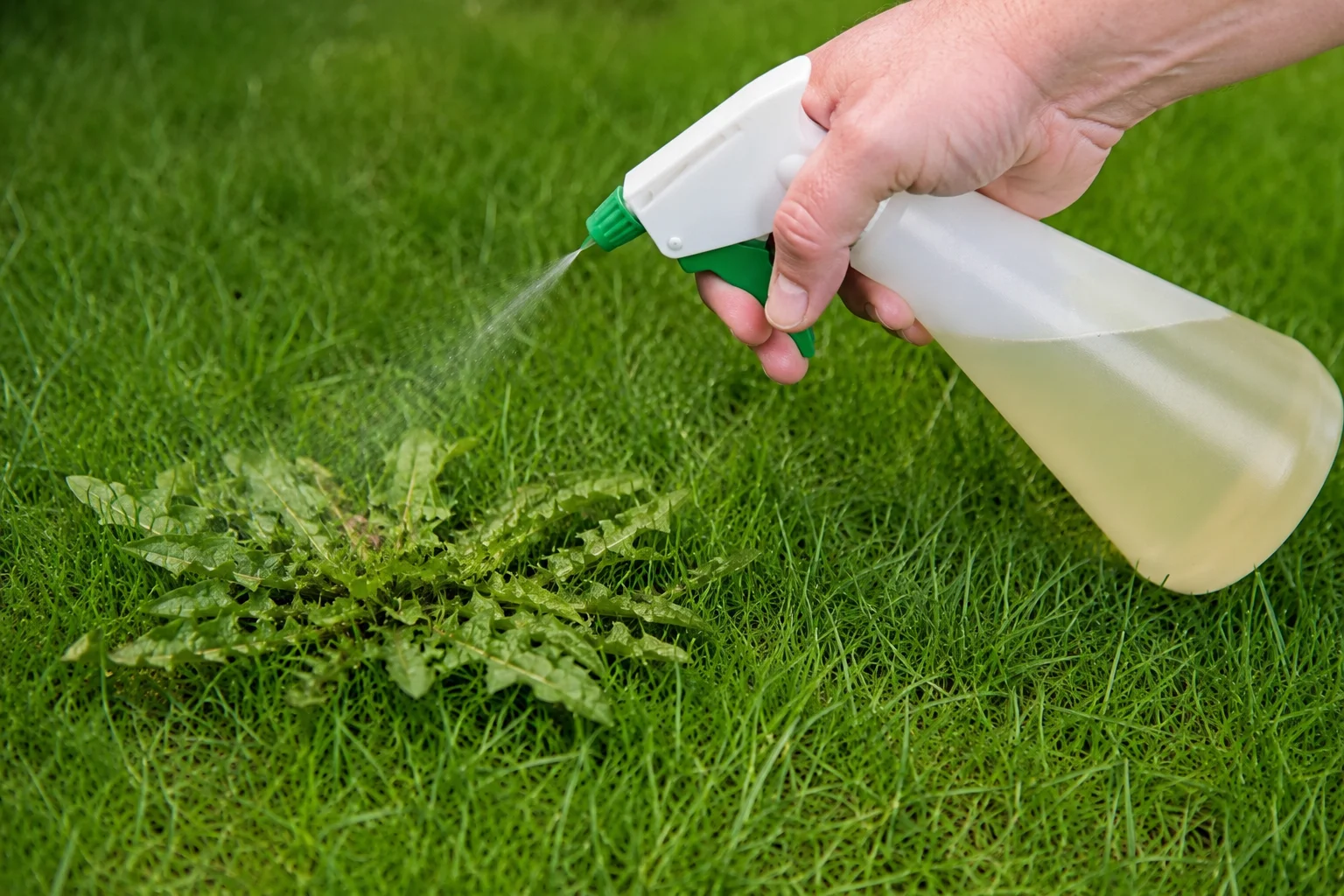
Spray vinegar on grass and the foliage should brown within 24 hours, whatever the concentration. That quick result is why so many people think vinegar is a reliable grass killer. What happens over the next few weeks is less impressive. The brown blades often stay brown, but the plant underneath frequently survives and sends up new growth.
So yes, vinegar kills grass blades. Whether it kills the grass plant depends on how strong the vinegar is, how old the grass is, and what kind of grass you’re dealing with.
How Vinegar Damages Grass
The active ingredient is acetic acid. It’s a contact herbicide, which means it burns the plant tissue it touches. It doesn’t travel through the plant the way systemic herbicides do. Extension guidance summarized by Montana State notes that vinegar has no translocation and no soil residual, and perennials tend to resprout.
That has two practical consequences:
- Coverage matters more than quantity. Acetic acid works best when it touches every leaf, so it’s especially effective on young seedlings and weaker on overgrown weeds.
- Roots are mostly spared. A plant with a large root system can burn back to the ground and regrow, as long as the roots weren’t affected.
Neither point is a flaw in vinegar. A contact burn is simply a different kind of tool from a product that moves down to the roots.
Why Household Vinegar and Horticultural Vinegar Behave Differently
The vinegar in your pantry is about 5% acetic acid. Horticultural vinegar is 20% acetic acid, four times stronger than household vinegar. Products labeled for weed control run from 20 to 30%.
A Cornell Cooperative Extension trial in New York compared the two on weeds over several months. The table below shows the percentage of control after one application, as reported in a Master Gardener summary of that study.
| 24 hours | 2 weeks | 5 weeks | 9 weeks | 13 weeks | |
| 5% acetic acid | 93.3% | 74.7% | 46.7% | 33.3% | 33.3% |
| 20% acetic acid | 98.3% | 96.0% | 92.7% | 76.0% | 66.0% |
| Glyphosate | 53.3% | 97.7% | 99.3% | 96.7% | 95.0% |
These figures come from a trial published in 2002 by Cornell Cooperative Extension of Rensselaer County.
The pattern is the useful part. Both strengths look equally dramatic after a day. Within weeks, the 5% vinegar had lost much of its effect, while the 20% product held up longer. Glyphosate worked slowly but was still the most effective at the end of the trial. So the quick browning tells you very little about the final result.
Keep in mind that this was one trial, run on weeds in test plots rather than on a maintained lawn. Treat the numbers as a pattern, not a prediction.
Why Grass Is Harder to Kill Than Broadleaf Weeds
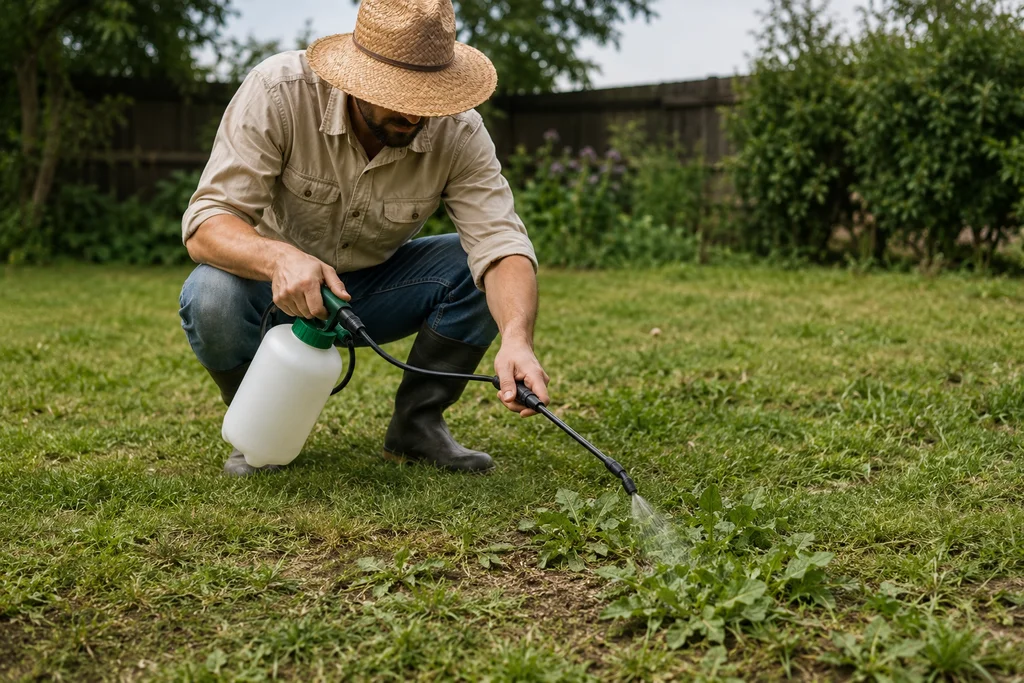
Vinegar tends to do better on broadleaf weeds than on grasses. USDA Agricultural Research Service work on acetic acid found that it was more effective on broadleaf weeds than on grasses. In that study, the best total grass and crabgrass control, using 20% acetic acid at a high application volume, ranged only from 44% to 63%.
A plausible reason is grass anatomy. Grasses keep their growing point at or just below the soil surface, so a spray that burns the blades doesn’t necessarily reach the part of the plant that makes new growth. A mowed lawn is built to survive losing its top growth, and a vinegar burn is not very different from a bad scalping.
The type of grass matters too. Annual grasses like crabgrass die at the end of the season anyway, and vinegar can set back young plants. Perennial grasses that spread by rhizomes or stolons, such as quackgrass or bermudagrass, store energy underground and are far more likely to bounce back. The Cornell trial noted that quackgrass percentages for many treatments actually increased beyond what was seen at the start, which is consistent with regrowth from below ground.
When Vinegar Makes Sense for Killing Grass
Vinegar fits best in small, contained jobs where you can accept repeat applications:
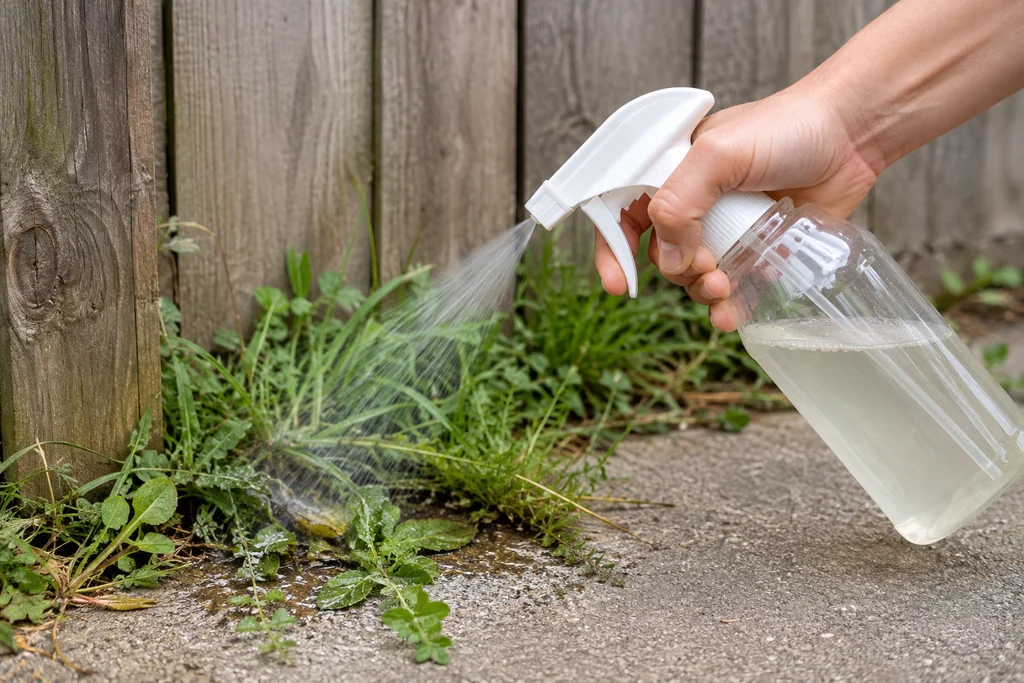
- Grass and weeds in pavement cracks. Driveways, walkways, and paver joints are good candidates, because there’s no desirable lawn to damage and the plants are often small.
- Young crabgrass or other annual grass seedlings. If annual weeds like foxtail, crabgrass, or ragweed are small, a single treatment with a labeled 20% vinegar product may kill them. Larger plants are a much tougher target.
- Edging along a bed or fence line. Careful application can take out a narrow strip of grass, though overspray and drift are real concerns.
- Preparing a small area. If you plan to clear grass for a new bed, vinegar can knock back top growth, but expect it to take more than one pass.
For these jobs, plan on retreating. A University of Florida field comparison found that the 20% and 30% products needed 3 to 5 retreatments in a year, while 5% vinegar needed 5 to 9. A single spray won’t clear the area for the season.
When Vinegar Is the Wrong Tool
Weeds in a lawn you want to keep. Vinegar is non-selective. As one gardening site puts it, if you spray it all over the grass around the weed, you’ll end up with a brown patch in your lawn. A dandelion in the middle of healthy turf is better dug out by hand than sprayed.
Established perennial grass. If the goal is to remove a patch of bermudagrass, quackgrass, or another rhizomatous grass completely, vinegar will probably burn the top growth and leave the roots alive.
Large areas. The cost and the number of repeat sprays add up quickly, and a 20% product is a hazardous chemical to handle in volume.
Cool, wet, or cloudy conditions. Contact herbicides tend to work better when the plant is dry at spraying and the weather is warm and sunny. Check the product label for its recommended conditions.
Using Vinegar Safely
Horticultural vinegar is not like the bottle in your kitchen. OSHA considers a 20% vinegar weed killer a hazardous substance, and it carries a Danger label. The same source says protective clothing and eye and face protection are critical at that strength.
A few precautions apply:
- Wear eye protection, gloves, and long sleeves. Splashes at 20% can injure skin and eyes. Follow the first-aid instructions on the label.
- Spray on a calm day. Wind carries droplets onto plants you want to keep.
- Keep children and pets away until the spray has dried, or for as long as the label says.
- Never mix vinegar with bleach. The combination releases chlorine gas.
- Read the label and follow it exactly. Some concentrated products are labeled only for non-crop and right-of-way areas and must be diluted. A product that’s legal in one state may not be registered in another, so check the label and your state’s rules.
- Skip homemade high-strength mixes. Some extension sources discourage making your own weed killer. They recommend buying a labeled horticultural-vinegar product instead.
Common Mistakes
- Judging success after 24 hours. The brown look is real, but regrowth shows up in the following weeks.
- Using pantry vinegar on mature grass. At 5%, the effect fades quickly on older plants.
- Adding salt to boost the effect. Salt can linger in soil and harm the ground you may want to plant in later. If you want a weed-free surface for a gravel path, that’s a different decision from clearing a spot for new grass.
- Spraying before rain. Rinsed-off vinegar does little.
- Skipping the second pass. Most vinegar jobs need follow-up.
Better Options for Removing Grass Completely
If the real goal is a bare patch, a new bed, or a lawn replacement, other methods are more dependable than repeated vinegar sprays:
- Smothering with cardboard and mulch. Layer overlapping cardboard over mown grass, wet it, and cover it with several inches of mulch. Over time the grass dies from lack of light.
- Solarizing with clear plastic. In a hot, sunny season, clear plastic sealed over the area can heat the soil enough to kill grass and many seeds.
- Digging or sod cutting. For small areas, removing the sod with a spade or rented sod cutter takes out the roots along with the top growth.
- A labeled systemic herbicide. Products containing glyphosate move into the roots and were the most effective in the Cornell trial over the long term. They carry their own label requirements and are a personal choice. Follow the product instructions closely.
FAQ
Will vinegar kill grass permanently?
Rarely. Annual grass seedlings may die, but established perennial grass usually regrows from the crown or roots.
Can I use household vinegar on lawn weeds?
It may burn very young weeds, but the effect is short-lived, and it will also brown any grass it touches. For a few weeds in turf, hand-pulling or spot-treating with a lawn-safe product is usually less damaging.
Is it safe for pets and children?
Dilute household vinegar is a mild irritant, while 20% products are hazardous. Keep pets and children away from any treated area until it’s dry, and follow the label.
Final Thoughts
Vinegar kills grass blades quickly but often fails to kill the plant, especially with household-strength vinegar on established or spreading grass. If you decide to use it, choose a labeled horticultural product, wear protection, spray small or young growth, and expect to repeat the treatment. For clearing a large area or getting rid of perennial grass for good, smothering, solarizing, or digging will usually give you a better result.

About Syprose Kiche
Syprose Kiche is the creator and writer behind My Besuited Home, a practical home and garden website covering DIY projects, gardening, lawn care, landscaping, home improvement, and outdoor living. She focuses on turning everyday homeowner questions into clear, practical guides backed by careful research and useful real-world considerations.