
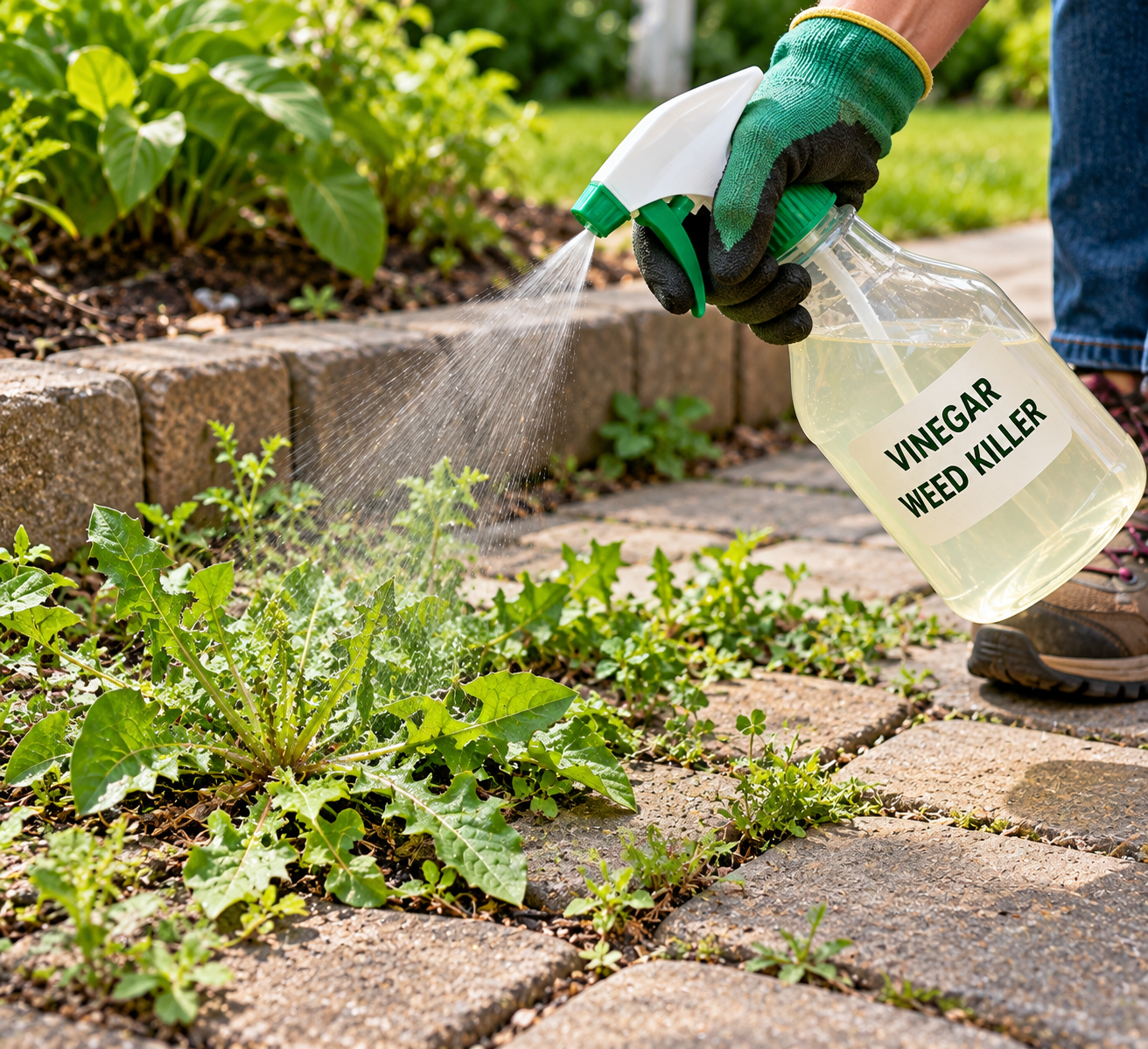
Spray vinegar on a weed in the morning sun, and the leaves can look scorched by afternoon. That fast result is why vinegar has such a reputation as a weed killer. It is also why people get frustrated a week later, when the same weed is putting out fresh green growth.
Both outcomes are real. Vinegar breaks through the outer cell walls of leaves and stems on contact, so the plant loses moisture and dries out, and results are usually visible within 24 hours. But “the top looks dead” and “the weed is dead” are different things, and the gap between them depends on the weed’s age, its type, and the strength of the vinegar.
The Short Answer: Hours to a Day for Burndown, Weeks for the Truth
Here is a realistic timeline for what you will see after a good application on a sunny, dry day:
- Within a few hours: Leaves start to wilt, darken, or look water-soaked. Stronger horticultural vinegar tends to act faster than the kitchen kind. One source puts household vinegar at about a day and horticultural vinegar at about two hours. Treat those as rough figures, since weather and spray coverage shift them.
- Within 24 hours: Small, young weeds are usually brown and collapsed.
- After 3 to 7 days: This is when you find out whether the root survived. A perennial with a healthy root system often starts sending up new shoots in this window. One source describes a flowering dandelion’s leaves browning within a day, with the root pushing new growth back within a week.
- After 2 to 3 weeks: Any weed that was only top-killed has usually regrown enough that you will want to spray again, dig it out, or change tactics.
So the honest answer to “how long does vinegar take to kill weeds” is: hours for the leaves, and sometimes never for the roots.
Why Vinegar Works Fast but Often Doesn’t Finish the Job
Vinegar is a contact herbicide. The active ingredient is acetic acid, and it only damages the tissue it physically touches. Montana State University Extension describes it as non-selective, with no translocation to the roots and no soil residual activity.
That single fact explains most of the disappointment people have with it.
A systemic herbicide, such as glyphosate, is absorbed by the leaves and carried down into the roots, which is why it can take a week or two to show full results but kills the whole plant. Vinegar does the opposite. It works quickly on what it touches and never travels. If a weed has a big root or crown full of stored energy, it can simply grow a new set of leaves.
This is also why vinegar tends to look best on weeds with little underground reserve. Seedlings have almost nothing stored. A mature dandelion, thistle, or patch of bindweed has a lot.
Weed Age and Type Matter More Than Almost Anything Else
Two weeds can receive the same spray and have completely different outcomes.
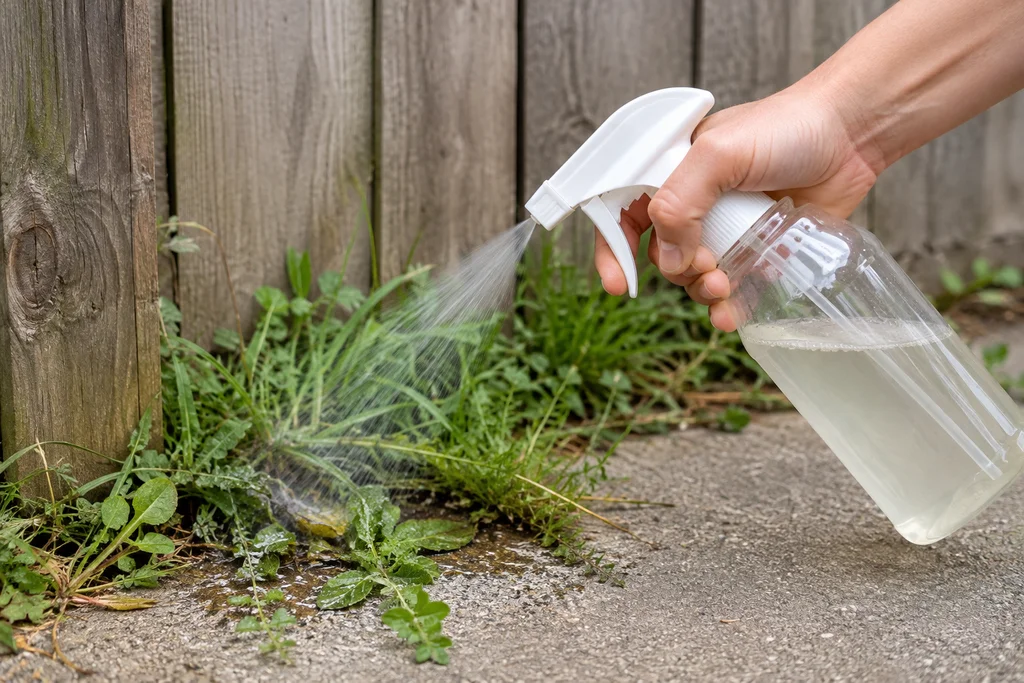
Young annual broadleaf weeds are the best case. Household vinegar works on very young weeds, ideally within about two weeks of sprouting, when they have just one or two leaves, and it does its best work on broadleaf weeds. If a flush of seedlings has popped up in a driveway crack or between patio pavers, vinegar can clear them out.
Weeds past the seedling stage are a gamble. Extension guidance summarized by one source suggests weeds beyond three or four leaves are likely to survive household-strength vinegar.
Grasses are harder to kill than broadleaf weeds. Even at 20% acetic acid, one cited USDA study reported only about 28% to 45% control of crabgrass. Grass blades are narrow and upright, and the growing point sits low, near or below the soil surface, where spray has a harder time reaching it.
Perennials are the weeds most likely to make vinegar look like it failed. In USDA-ARS research summarized by Washington State University, 5% vinegar produced 100% shoot burndown on Canada thistle, but the roots were not affected, so the shoots always regrew. That is a good illustration of the “fast but not final” pattern. The spray worked on everything above ground. It just was not enough.
Household Vinegar vs. Horticultural Vinegar
This is where most of the confusion starts, because the bottle in your pantry and the bottle sold as weed killer are very different products.
Household white vinegar is about 5% acetic acid. Horticultural vinegar is sold at 20% to 30%. That is four to six times stronger, and some products go higher.
What does the strength change?
According to a University of Illinois Extension weed specialist, studies indicate that 10% to 20% acetic acid gives 80% to 100% control. That is the range where results start looking dependable. At 5%, the same USDA-ARS research found vinegar did not produce reliable weed control, and Washington State field tests with 7% solutions showed similarly erratic results.
In practical terms:
- 5% kitchen vinegar can handle tiny seedlings and little else. If you are trying to clear a few sprouts from a paver joint, it is a reasonable low-risk option.
- Horticultural vinegar (20% to 30%) kills faster and works on somewhat larger broadleaf weeds. It still won’t reliably kill an established perennial’s roots.
Higher strength also changes the safety picture, which is covered below.
Conditions That Speed Up Results or Make Them Worse
The same spray can look dramatic one day and underwhelming the next. A few things affect the outcome.
Coverage. Because vinegar only affects what it touches, thorough wetting matters more than the number on the label. In one USDA study, plain 5% vinegar killed young broadleaf weeds, but only when sprayed heavily. A light mist leaves untouched leaf surface that stays green. Wet the foliage until it is thoroughly coated, without drenching the soil or runoff-prone areas.
Sun and heat. General herbicide behavior suggests hot, sunny, dry weather helps contact products work faster, and rain shortly after spraying can wash the product off. I did not find an extension source that put numbers on this for vinegar, so treat it as practical reasoning and not a measured result.
Waxy or hairy leaves. Leaves with a thick coating can cause spray to bead up and roll off. Some sources recommend adding a small amount of dish soap as a surfactant so the acid can penetrate rather than bead off. Published amounts vary a lot between sources, so check the product label or your local extension office before mixing anything, and do not add other ingredients to horticultural vinegar unless the label says it’s fine.
Wind. Spray drift will brown ornamentals, lawn edges, and vegetables just as easily as weeds, because vinegar does not discriminate.
What Vinegar Will Do to Everything Else
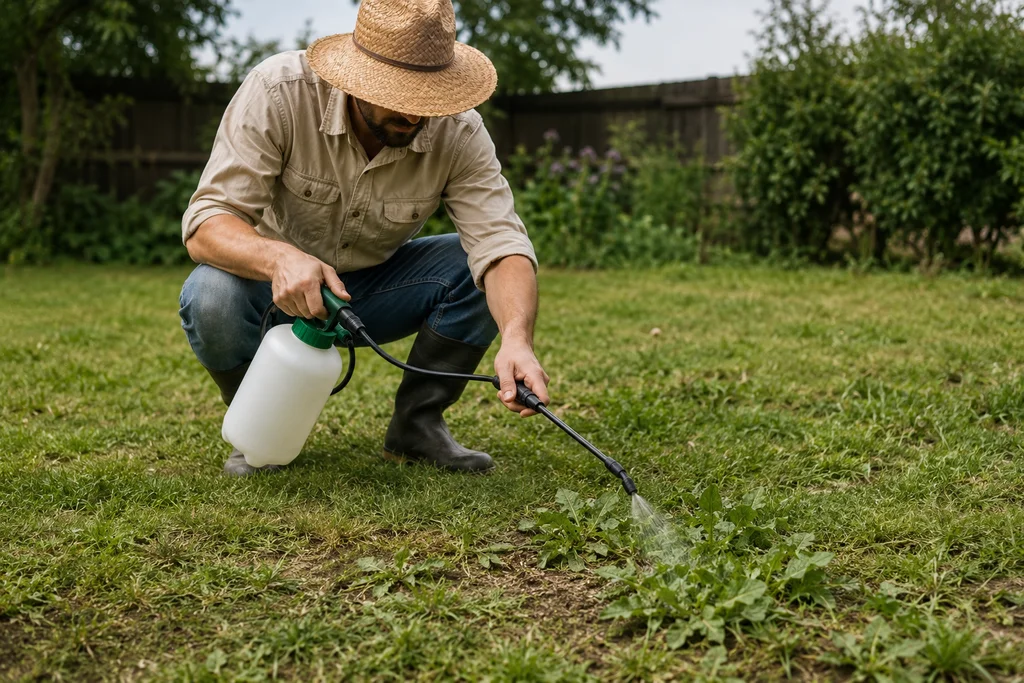
Because vinegar is non-selective, it harms any green tissue it contacts. That includes your lawn, nearby flowers, and vegetable plants. A weed growing through the middle of a perennial bed is a poor candidate for spraying. A weed in a gravel driveway is a good one.
The soil question is less clear-cut. Since vinegar has no soil residual activity according to Montana State, it does not linger the way some herbicides do. Some garden writers note that repeated heavy use can shift soil pH slightly, but I did not find solid numbers for this, so it is best treated as a reason to avoid soaking the ground around plants you care about.
Safety: Stronger Vinegar Is Not a Kitchen Product
Household 5% vinegar is low-risk for most people, though it can still irritate eyes. Horticultural vinegar is a different matter.
At concentrations of 11% or higher, acetic acid can cause severe chemical burns on skin and permanent eye injury. If you use a 20% or 30% product:
- Wear chemical-resistant gloves, long sleeves, and eye protection, preferably splash-proof goggles.
- Spray on a calm day so drift does not reach you, pets, or neighboring plants.
- Keep children and pets out of the area until the spray has dried.
- Follow the label directions exactly. Do not dilute or modify it based on internet recipes.
- Store it in its original container, away from children and out of the heat.
- Keep it away from metals, since acetic acid can stain or corrode aluminum and iron.
Never mix vinegar with bleach or other cleaning products. The combination can release toxic gas.
When Vinegar Is the Right Tool, and When It Isn’t
Vinegar makes sense when:
- The weeds are seedlings or very young annuals.
- They are growing in hard surfaces like driveways, walkways, or patio joints.
- You are willing to re-spray as new growth appears.
It makes poor sense when:
- The weed is a mature perennial, such as dandelion, thistle, or bindweed.
- The weed is growing in your lawn or a planted bed.
- You want a one-time fix.
For perennials, the dependable options are to remove the root by hand or with a digging tool, or to use a systemic herbicide as directed on the label. A systemic post-emergent product, or repeated manual removal, is what extension-style guidance points to for permanent control of deep-rooted perennials. Repeated vinegar applications can also exhaust a perennial over time by forcing it to keep spending stored energy on new leaves, though that takes persistence and many treatments.
Common Questions
Why did my weeds turn brown and then come back?
Most likely the leaves were killed but the root was not. This is the standard result with vinegar on any weed with an established root system.
Does the vinegar need to be applied at a particular time of day?
No specific time is established in the sources I found. Applying on a dry, calm, sunny day, when no rain is forecast for several hours, is the sensible approach.
Can I just use more vinegar?
More volume helps coverage up to the point of runoff, but it does not change the fundamental limit. Stronger concentration helps more than extra volume does, and that comes with the safety requirements above.
Key Takeaways
Vinegar works on the part of the weed you can see, and it works quickly, typically within hours to a day. Whether the weed stays dead depends on its age and root system. Seedlings and young annual broadleaf weeds are realistic targets for plain kitchen vinegar. Older weeds, grasses, and perennials usually need either stronger vinegar plus repeat treatments, or removal of the root itself. If you do move up to horticultural vinegar, handle it like the chemical it is.

About Syprose Kiche
Syprose Kiche is the creator and writer behind My Besuited Home, a practical home and garden website covering DIY projects, gardening, lawn care, landscaping, home improvement, and outdoor living. She focuses on turning everyday homeowner questions into clear, practical guides backed by careful research and useful real-world considerations.