
My neighbor once asked me why her fence line looked like a sad stretch of bare lumber wrapped in weeds. I walked over, took one look, and said, “You’ve got about six hours of shade back here and you’ve been planting sun-lovers.” She’d been fighting that fence for three years. We fixed it in one season.
That’s the thing about a shady fence line — it feels like a problem, but it’s actually one of the best opportunities in your entire backyard. You just have to stop trying to put sun plants in a shade spot and start working with what you’ve got.
I’ve been gardening for over 12 years, and my back fence has gone through more makeovers than I care to admit — including the year I planted a row of knockout roses along it and watched every single one sulk itself to death. Shade does funny things to plants that weren’t built for it. But get the right plants in there? Your fence line goes from eyesore to showstopper, fast.
Here are the 11 best plants for a shady fence line, ranked and real-talked from someone who’s lost money on the wrong ones.
1. Climbing Hydrangea (Hydrangea anomala petiolaris) — The King of Shady Fence Plants
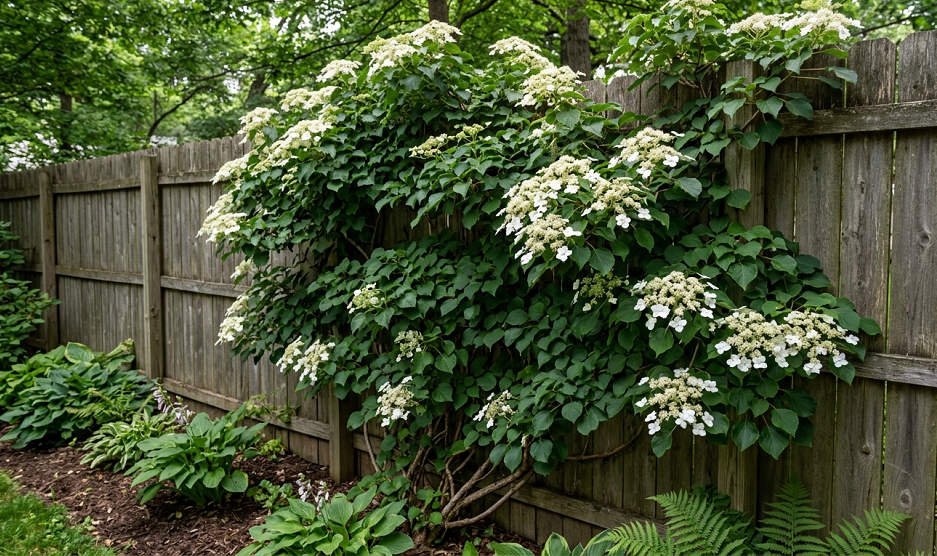
If you’ve ever typed “flowering vine for shade fence” into a search bar, climbing hydrangea is the answer Google is trying to get you to. And for good reason — this is hands-down my favorite plant for a shaded fence. It’s a self-clinging deciduous vine that eventually covers an entire fence panel in creamy white lacecap flowers every June.
Here’s what I love most: it tolerates deep shade better than almost anything else with actual flowers. My north-facing back fence gets maybe two hours of dappled light, and my climbing hydrangea has been absolutely thriving on it for seven years. The exfoliating cinnamon-red bark it shows off in winter is a bonus most people don’t even know about until their first year with it.
The honest caveat — and I’d rather tell you upfront than let you get frustrated — is that climbing hydrangea is slow to establish. Years one and two, you’ll think it’s dead. It’s not. It’s building roots. By year three, it starts moving. By year five, you’ll be handing cuttings to everyone in your neighborhood.
Plant it in moist, well-drained soil, give it a good drink during dry spells in the first two years, and then mostly leave it alone. It doesn’t need babying once it gets going. USDA zones 4–8.
2. Japanese Forest Grass (Hakonechloa macra) — Best Low-Growing Ornamental Grass for Shade
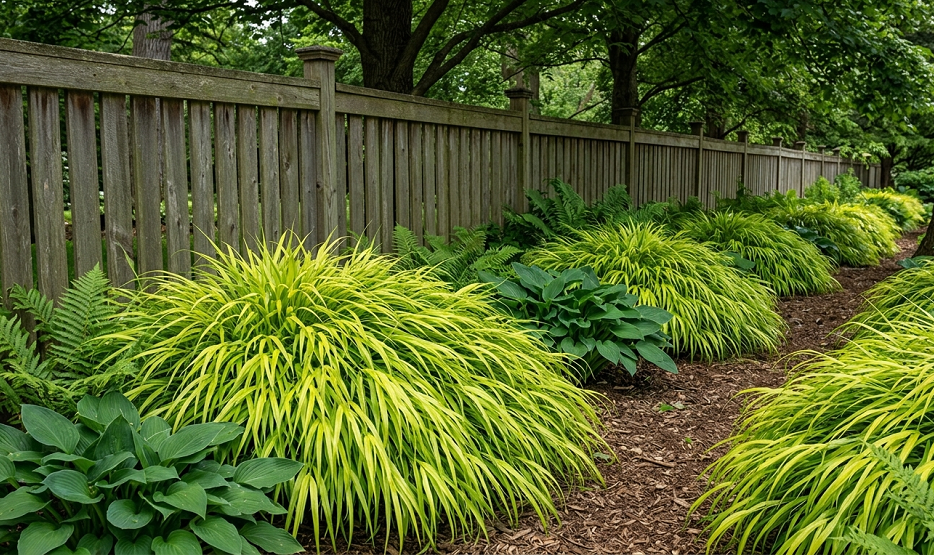
Most ornamental grasses are sun hogs. Japanese forest grass is the rare exception, and it is genuinely beautiful — cascading, golden-green or chartreuse mounds that shimmer even in dim light. Along a fence line, I plant it in drifts of three or five, and the effect is like flowing water at the base of the fence.
‘Aureola’ is the cultivar I always recommend. The yellow-and-green variegated foliage practically glows in shade, which does a lot of the visual heavy lifting on a dark fence line. In fall, the leaves flush pink and orange before going dormant, so you get three seasons of real interest.
It’s slow-spreading but not invasive — an important distinction. I’ve had clumps in the same spot for four years and they’ve expanded politely, not aggressively. Divide them in spring every few years and you’ll have new plants for free.
One thing: it wants consistently moist soil. I lost a clump one August because I didn’t water during a heat wave and the soil dried out completely. Don’t make my mistake. Zones 5–9.
3. Hostas — The Workhorse of the Shade Garden (But Not All of Them Are Equal)
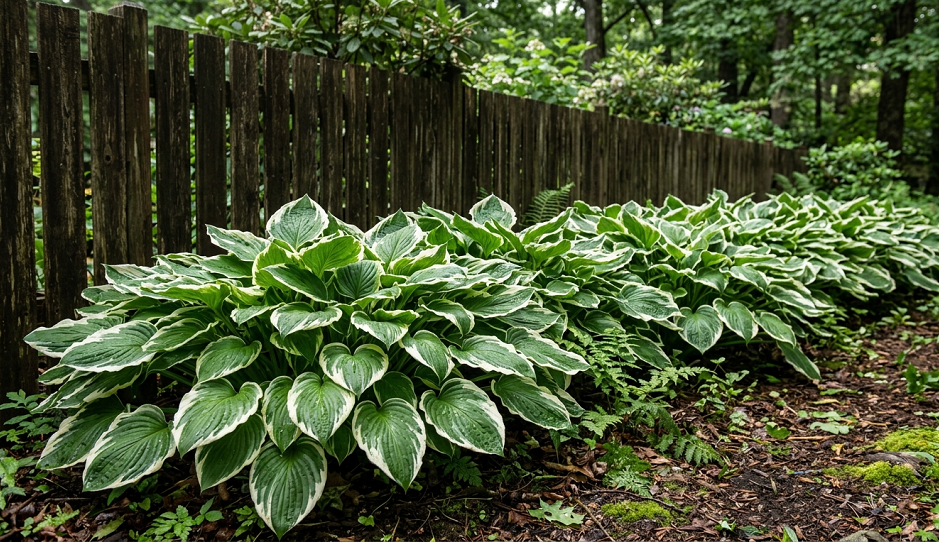
Everyone says hostas and everyone is right, but here’s the opinion I’ll actually commit to: most hostas sold at big box stores are boring, and you can do so much better. Skip ‘Patriot’ and ‘Sum and Substance’ from the clearance bin and seek out varieties with interesting textures.
My current obsession is ‘Halcyon’ — a steel-blue mounded hosta that holds its color all season and looks absolutely stunning against a dark wood or vinyl fence. For dramatic foliage, ‘Sum and Substance’ is a massive lime-yellow beast that earns its space. For tight spots, ‘Blue Mouse Ears’ is a miniature gem.
Along a fence line, I plant hostas in clusters rather than a straight line. A straight line of identical hostas looks like a landscaping mistake from 1987. Cluster three different sizes and textures together, and it looks intentional and lush.
Slugs. We have to talk about slugs. If you have hostas and you have moisture, you have slugs. I use iron phosphate bait (Sluggo) around my hosta beds every spring. It’s safe around pets, kids, and wildlife, and it actually works. Forget the beer trap — I’ve tried it, it’s a mess, and it’s barely effective. Zones 3–9.
4. Astilbe — Best Flowering Perennial for a Shady Fence Line
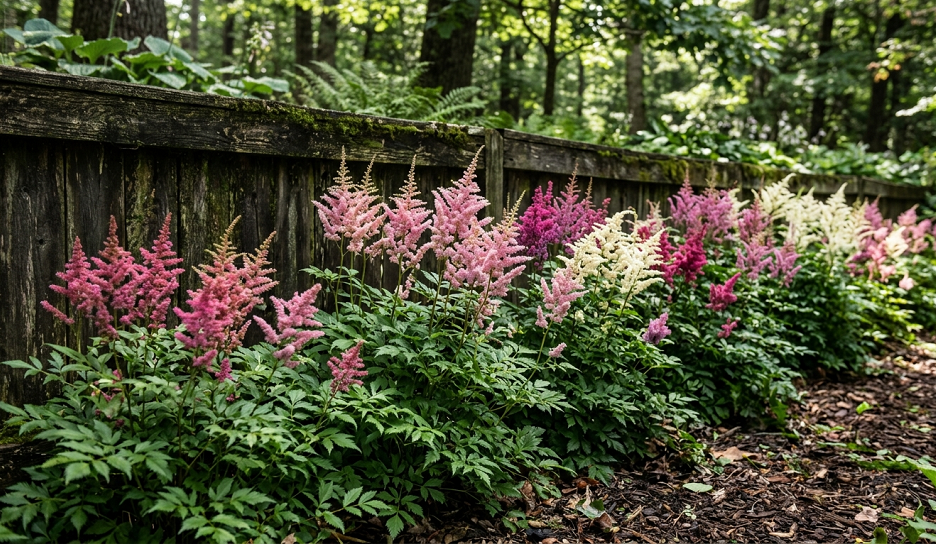
Astilbe is the plant I recommend to everyone who says, “I want color, but my fence is in shade.” It produces feathery plumes in pink, red, white, and lavender from early to late summer depending on variety, and it does all of this in partial to full shade.
I’ve got a row of ‘Fanal’ (deep red) mixed with ‘Bridal Veil’ (white) along my side fence, and the contrast is stunning. The flowers dry on the plant and hold their shape through fall, which gives you extra weeks of interest without doing anything. I call that a win.
Astilbe wants moisture — it hates dry soil more than almost anything. If your fence line is near a downspout or you have consistently moist soil, astilbe will reward you enormously. If your soil dries out fast, either amend it heavily with compost or skip astilbe and go with something more drought-tolerant.
Dividing astilbe every three to four years keeps it blooming at its best. I dig mine in early spring before growth starts, split the crowns with a sharp spade, and replant immediately. It takes maybe 20 minutes and gives me double the plants. Zones 3–9.
5. Virginia Creeper (Parthenocissus quinquefolia) — Best Fast-Growing Native Vine for Shade Fences
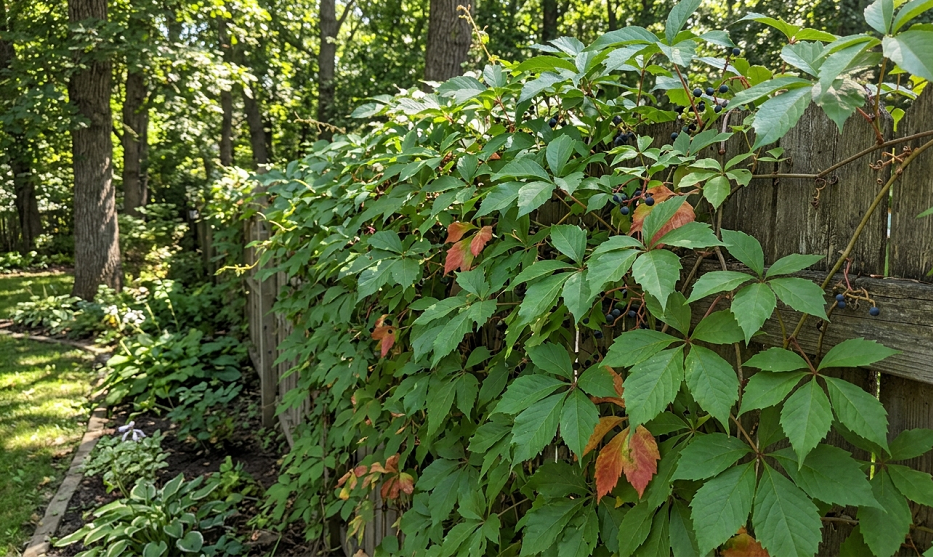
If you need something to cover a fence fast — and I mean fast — Virginia creeper is your plant. This North American native will run 10 feet in a single season, clings to wood and vinyl fencing with adhesive tendrils, and puts on a fall color display that rivals anything in New England. Deep scarlet red, wall-to-wall, every October.
It grows in everything: deep shade, part shade, even full sun. It tolerates poor soil, drought once established, and neglect. I have it covering my back garage wall where nothing else would grow, and it’s been doing its thing for five years without a single complaint.
The real talk: Virginia creeper is vigorous, which is a gardener’s polite word for “it will try to take over if you don’t manage it.” I trim mine back hard every spring with loppers, keeping it off the roof and out of the gutters. If you want a plant you never have to touch, this isn’t it. But if you want something that will transform a bare fence line in one summer, nothing beats it. Zones 3–9.
6. Sweet Woodruff (Galium odoratum) — Best Groundcover to Fill In Under Fence Line Plantings
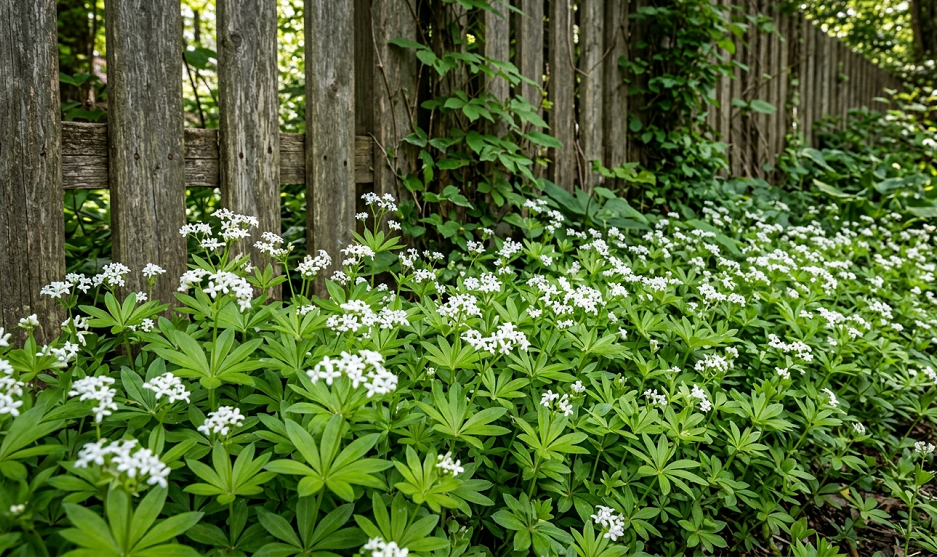
Here’s where I’ll be a bit more specific than most gardening articles: don’t think of sweet woodruff as a standalone fence line plant. Think of it as the filler that makes everything else look better.
This low-growing perennial spreads by runners into a soft green carpet covered in tiny white star-shaped flowers in spring. It fills in bare soil under taller fence line plants beautifully, suppresses weeds, and smells faintly of vanilla when you brush against it. My kids used to run through it just to smell their shoes afterward.
It is a spreader. In rich, moist soil, it will move. I planted a six-pack along 15 feet of fence six years ago, and it now covers the full 15 feet about two feet deep. That’s exactly what I wanted. If you want containment, plant it inside a buried edging barrier. Zones 4–8.
7. Coral Bells (Heuchera) — Best Foliage Color for a Shaded Fence Line
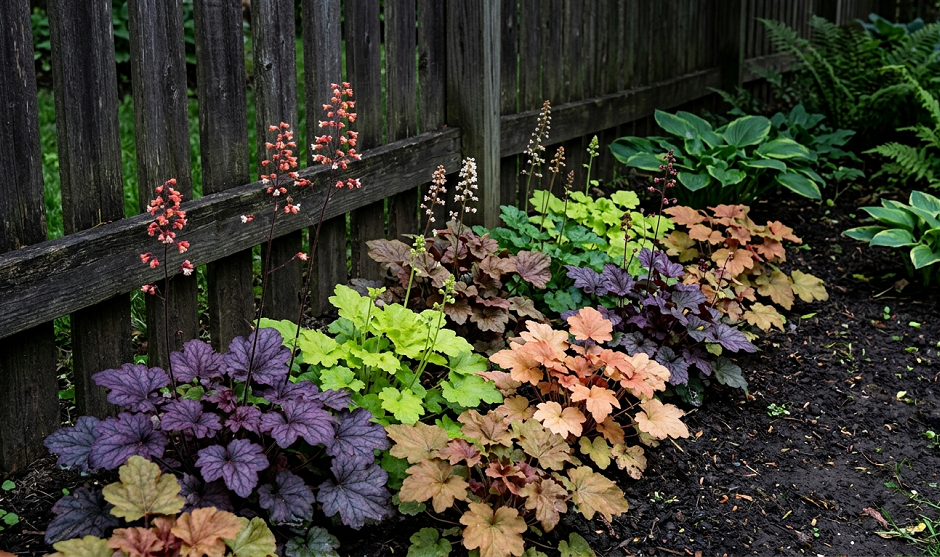
Coral bells have had a serious makeover in the last decade of plant breeding, and if you haven’t looked at them lately, you’re missing out. Modern heuchera varieties come in caramel, burgundy, silver, black, and lime green — all colors that pop beautifully against a fence.
My current favorites: ‘Caramel’ for its warm amber tones, ‘Obsidian’ for near-black drama against a white fence, and ‘Lime Rickey’ for bright chartreuse that glows in shade. I mix them together in groups of three along the fence base, and the color tapestry they create requires zero flowers to look spectacular.
They’re not as tough as hostas. Heuchera can heave out of the ground in winter freeze-thaw cycles, so I make a point of checking and firming them back in early spring every year. I lost three plants one winter before I figured this out. They also resent wet feet in winter, so decent drainage matters. Zones 4–9 depending on variety.
8. Ferns — The Most Underrated Texture Plant for Shady Fence Lines
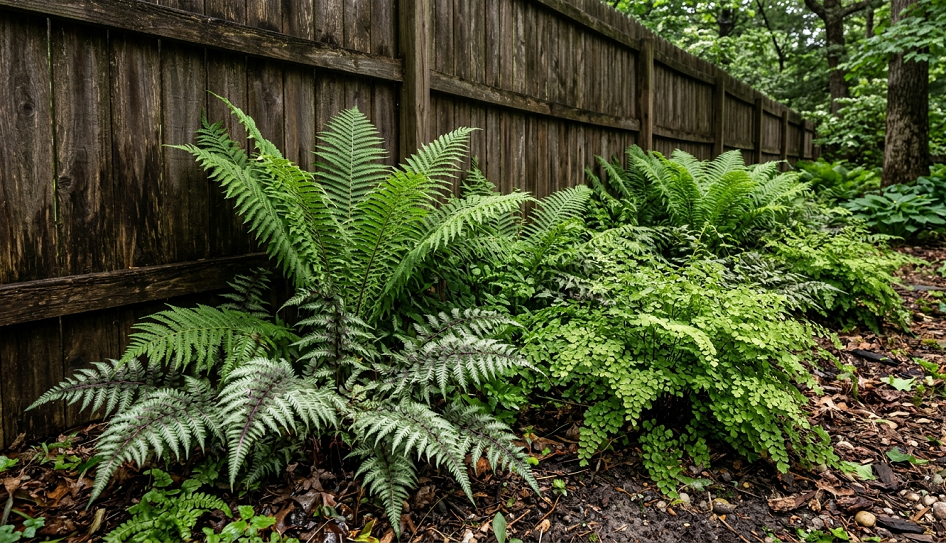
Gardeners either love ferns or they ignore them entirely. I’m firmly in the love camp, particularly for fence lines, because ferns do something almost no other plant does: they add movement. Every slight breeze makes them dance, and that makes a static fence line feel alive.
My top pick for fence lines is the Autumn fern (Dryopteris erythrosora). The new fronds emerge coppery-orange in spring before maturing to glossy green — it’s one of the most striking foliage progressions of any shade plant I grow. Japanese painted fern (Athyrium niponicum) is my second choice for its silver-and-green variegation that literally shimmers in low light.
Ferns want consistent moisture and organic-rich soil. I top-dress mine with an inch of compost every spring, and they reward me with lush, full growth. Skip this step and they get sparse and scrappy-looking — I know this from experience.
A quick side note: don’t cut ferns back in fall. Leave the old fronds. They protect the crown through winter and the new growth emerges through them in spring. I used to clean mine up every October like a neat freak and wonder why they came back weak. Leave them alone until you see new growth emerging in spring, then clean up the old stuff. Zones vary by species (4–9 for most common varieties).
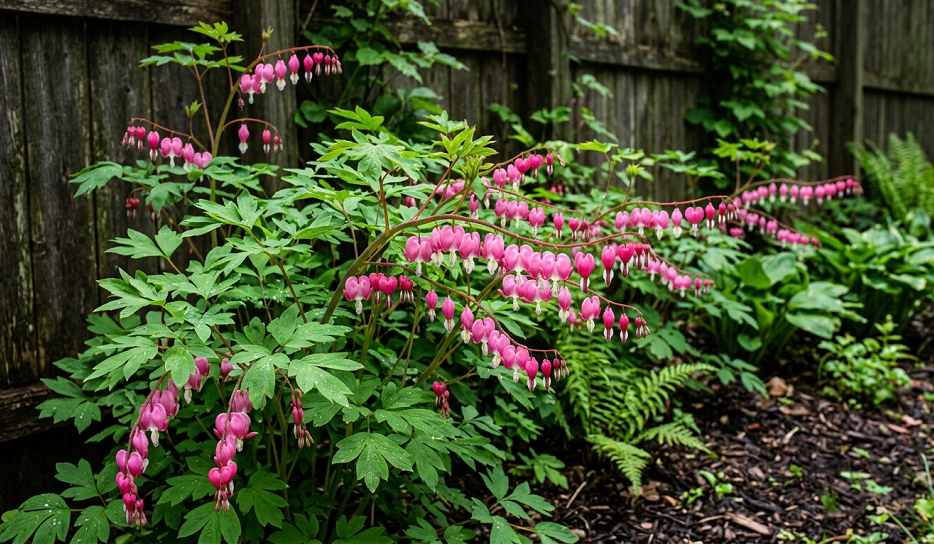
9. Bleeding Heart (Lamprocapra spectabilis) — Most Charming Spring Show on a Shade Fence
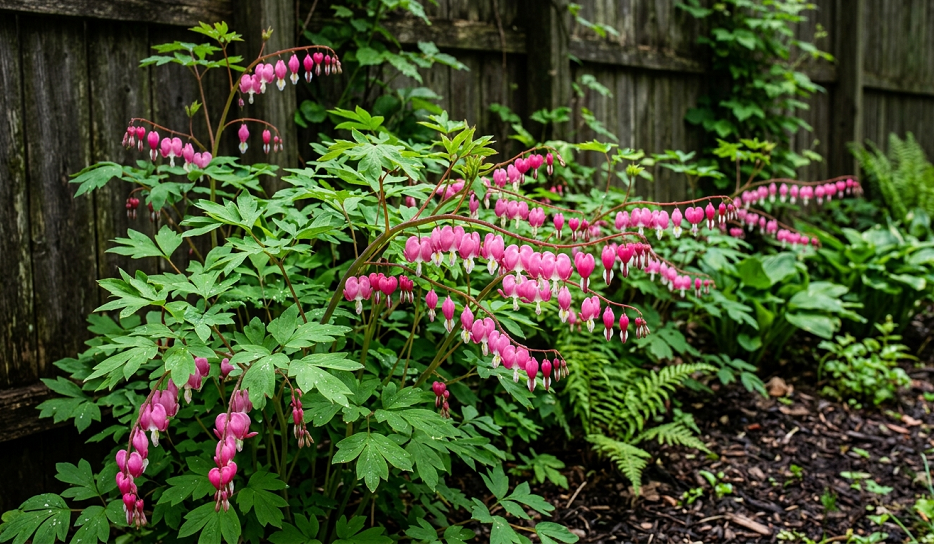
Bleeding heart is one of those plants that makes even non-gardeners stop and stare. The arching stems hung with heart-shaped pink or white flowers in spring are genuinely spectacular, and they do all this in part to full shade without complaint.
The catch — and it’s worth knowing upfront — is that classic bleeding heart is a spring ephemeral. It blooms hard in May, looks great into June, and then goes dormant in summer heat. By July, it’s gone. This is fine as long as you plan around it by pairing it with hostas or ferns that fill in the gap.
The fringed bleeding heart (Lamprocapra eximia) is a different animal. It blooms spring through frost, stays semi-evergreen, and is more compact. If you want continuous color, plant the fringed type. If you want a spectacular spring show and don’t mind the summer disappearing act, go classic. Zones 3–9.
10. Black-Eyed Susan Vine (Thunbergia alata) — Best Annual Vine for Shaded or Part-Shade Fences
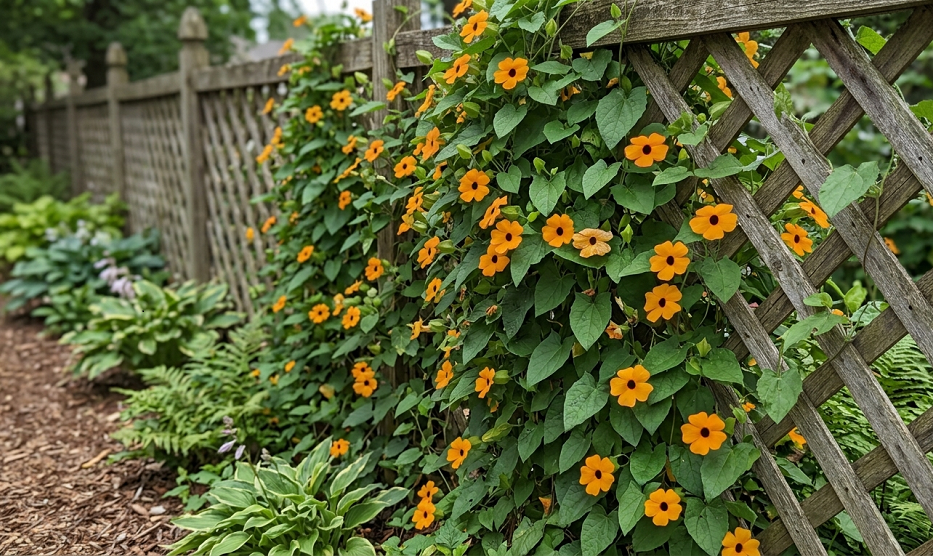
This one is a little different from the rest of this list: it’s typically grown as an annual in most of North America. But I include it because it is stunningly effective and grows incredibly fast — covering six to eight feet of fence in a single season with cheerful orange, yellow, or cream flowers with dark centers.
In zones 10–11 it overwinters as a perennial. For the rest of us, it’s a warm-season annual that earns its place. I start seeds indoors eight weeks before last frost and transplant after danger has passed. It also takes partial shade far better than most annuals, which are useless in anything under six hours of sun.
I’ve found it to be a total waste of money in deep shade — it’ll grow but won’t bloom well without at least three to four hours of light. In dappled shade or at the transition from shade to sun, it’s spectacular. Pair it with the climbing hydrangea and let them share the fence for a summer show.
11. Oakleaf Hydrangea (Hydrangea quercifolia) — Best Shrub for a Shady Fence Line
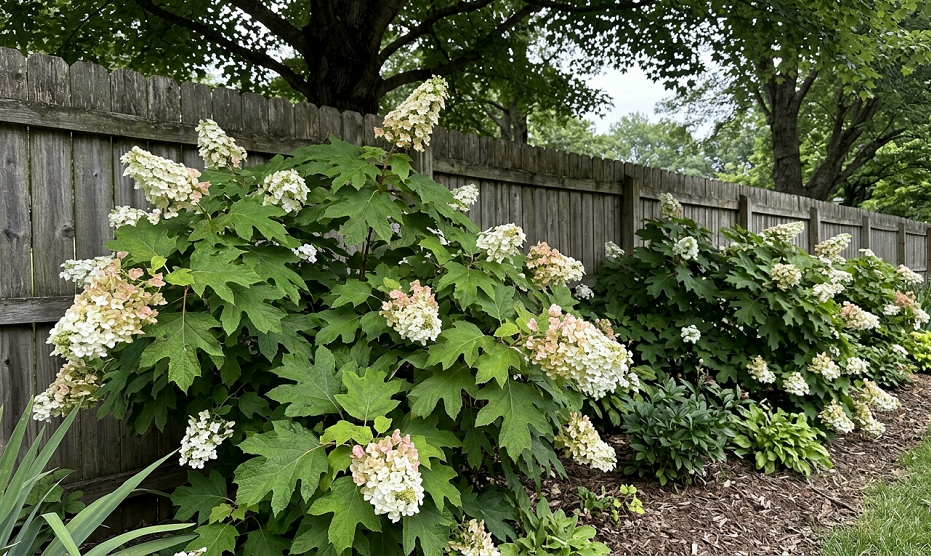
If you have the space for a large shrub along your fence line, oakleaf hydrangea earns every inch. It grows four to six feet tall and wide, produces large cone-shaped white flowers that dry to a papery parchment in fall, and puts on a fall foliage show in deep burgundy and orange that rivals ornamental trees.
What I appreciate most: it’s native to the southeastern US, which means it supports local wildlife and is far more drought-tolerant once established than most hydrangeas. It also handles deep shade better than smooth or bigleaf hydrangeas — another reason I keep recommending it to frustrated gardeners.
Pruning tip that took me a while to learn: oakleaf hydrangea blooms on old wood. Prune it in fall or early spring and you’re cutting off next year’s flowers. Prune it — if at all — immediately after flowering. I gave mine a hard shaping one October and had almost no blooms the following summer. Lesson learned the expensive way. Zones 5–9.
Real Talk: What Can Go Wrong with a Shady Fence Line Garden
I’d be doing you a disservice if I just handed you a plant list and sent you off. Here’s the honest version of what goes sideways.
Assuming “shade” is one thing. Dry shade under a big tree is completely different from moist shade on a north-facing fence. Most of the plants above want moisture. If your fence line is under a tree canopy with root competition and dry soil, your list shortens considerably. Focus on ferns, hostas, and sweet woodruff if that’s your situation, and amend the soil heavily with compost.
Planting too small. One gallon plants along a fence line look sad for two to three years. If the budget allows, buy three-gallon plants or plug in more one-gallon plants at tighter spacing. I’ve been guilty of spacing things out “for when they grow” and ending up with a patchy fence line for half a decade.
Ignoring the fence surface. If your fence is in bad shape — rotting wood, peeling paint — deal with it before you plant. I once trained a beautiful Virginia creeper over a fence that needed replacing, and pulling it off to do repairs was a nightmare.
Skipping soil prep. The number one reason shade gardens fail isn’t the plants — it’s that people stick them in compacted, depleted soil and expect miracles. Work in two to three inches of compost before you plant anything. Every time. It’s the single highest-return investment in your garden.
The Parting Wisdom
Here’s what 12-plus years of dirt-under-the-fingernails gardening has taught me about shady fence lines: stop fighting your light conditions and start designing for them. The most beautiful fence line I’ve ever grown didn’t have a single sun plant in it. It was all climbing hydrangea, hostas, astilbe, and ferns — and people asked me if I had a professional landscape it.
Shade isn’t a limitation. It’s a design brief. Work with it, choose plants that are actually suited to it, prep your soil, and give things a season or two to settle in. The payoff is real.
I’d love to know — what’s the trickiest spot along your fence line? Are you dealing with dry shade, deep shade, or something else entirely? Drop your question or situation in the comments below, and let’s figure it out together. Someone else in the comments is probably dealing with the exact same thing.

About Syprose Kiche
Syprose Kiche is the creator and writer behind My Besuited Home, a practical home and garden website covering DIY projects, gardening, lawn care, landscaping, home improvement, and outdoor living. She focuses on turning everyday homeowner questions into clear, practical guides backed by careful research and useful real-world considerations.