
Your fence line is basically a blank canvas baking in the sun — and most gardeners waste it on a scraggly hedge that looks defeated by July. I’ve been gardening for over fifteen years, and the fence line is where I’ve had some of my greatest triumphs and my most spectacular failures. The summer I planted a row of rhododendrons along my south-facing picket fence? Every single one of them fried to a crispy brown skeleton by August. Expensive lesson. Great mulch.
The good news is that the right plants absolutely love a hot, full-sun fence line. We’re talking tough, beautiful, sometimes downright dramatic plants that treat all-day sun like a free spa treatment. Whether you want flowering vines to cover an ugly chain-link, bushy perennials to create a living privacy screen, or a mix of textures that looks like it was designed by a professional — this list has you covered.
Let me save you the plant graveyard in your backyard and get straight to what actually works.
What “Full Sun” Really Means for Fence Line Plants
Before I get into the list, let me be honest about something that garden center tags rarely are: “full sun” on a tag means at least 6 hours of direct sunlight. A south- or west-facing fence can deliver 8 to 10 hours, which crosses from “full sun” into “blast furnace” territory, especially with the fence reflecting and trapping heat.
I’ve killed a lot of “full sun” plants on a west-facing fence because I assumed the tag told the whole story. The plants on this list can handle reflected heat, dry soil between waterings, and the kind of punishing afternoon exposure that turns most gardens into dust.
1. Trumpet Vine (Campsis radicans) — The Crowd-Pleasing Powerhouse
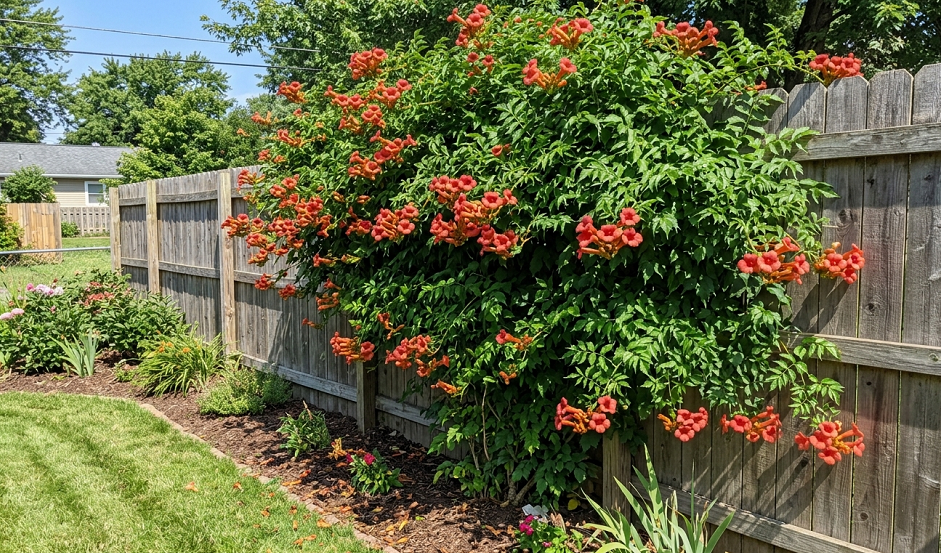
If you want fast coverage on a fence and you want hummingbirds showing up like it’s an all-you-can-eat buffet, trumpet vine is your answer. This native North American climber puts on showy orange-red trumpet-shaped flowers from early summer right into fall, and it laughs at heat and drought once it’s established.
I planted one on my back fence about eight years ago thinking I’d keep it tidy. By year three, it had eaten half the fence, part of the shed, and was eyeing the neighbor’s satellite dish. So, fair warning: this plant is aggressive. You need to be willing to cut it back hard every spring — like, “remove an entire garbage can’s worth of growth” hard. If you do that, it stays gorgeous. If you don’t, it becomes a botanical takeover.
Plant it in well-draining soil and basically ignore it after the first season. No fertilizer needed — that actually makes it grow more foliage and fewer flowers. Full sun is where it performs best; shade makes it leggy and stingy with blooms.
It’s deer resistant, drought tolerant, and incredibly low maintenance once established. Just don’t plant it near anything you’re not okay with it eventually trying to climb.
2. Knockout Rose (Rosa ‘Knockout’ series) — Full Sun Roses That Actually Survive
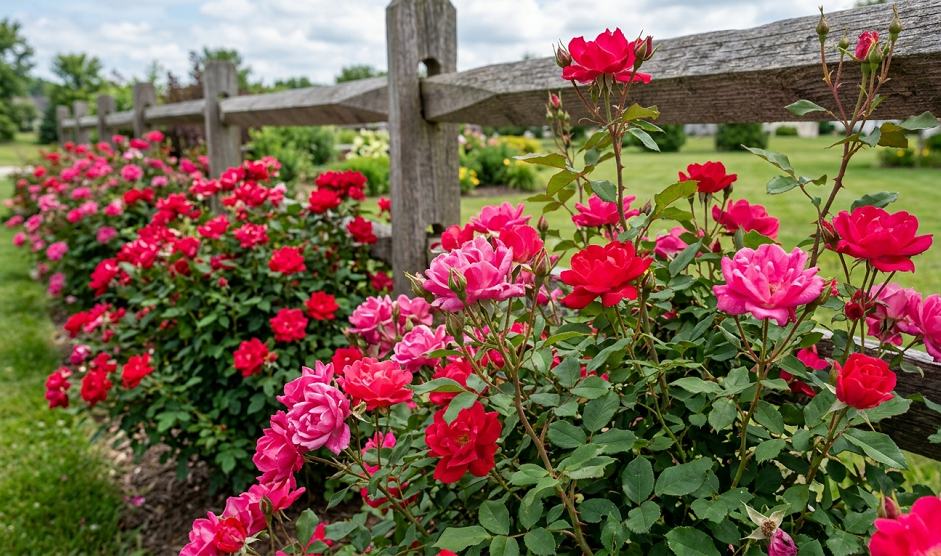
I used to be a rose snob. Hybrid teas only, I said. Then I spent three summers fighting black spot, aphids, and Japanese beetles on plants that required more attention than a newborn. Knockout Roses changed my entire perspective on what a rose can be.
These aren’t your grandmother’s high-maintenance roses. The Knockout series was bred specifically for disease resistance and repeat blooming, and they deliver. They bloom in flushes from spring all the way until the first hard freeze, and in a full-sun fence line they are genuinely spectacular — dense, bushy shrubs covered in bright blooms in shades of red, pink, coral, and yellow.
They reach 3 to 4 feet tall and wide at maturity, so plant them about 3 feet apart along a fence for a full hedge effect within two seasons. Prune them back by about a third in early spring before new growth starts. That’s basically it. No spraying, no fussing. They handle heat, humidity, and brief dry spells with zero drama.
I’ve had a row of double red Knockouts along my side fence for six years. My neighbor, who has a background in horticulture, stopped to ask what variety they were. That’s the kind of result we’re going for.
3. Salvia (Salvia nemorosa or S. greggii) — The Pollinator Magnet That Doesn’t Quit
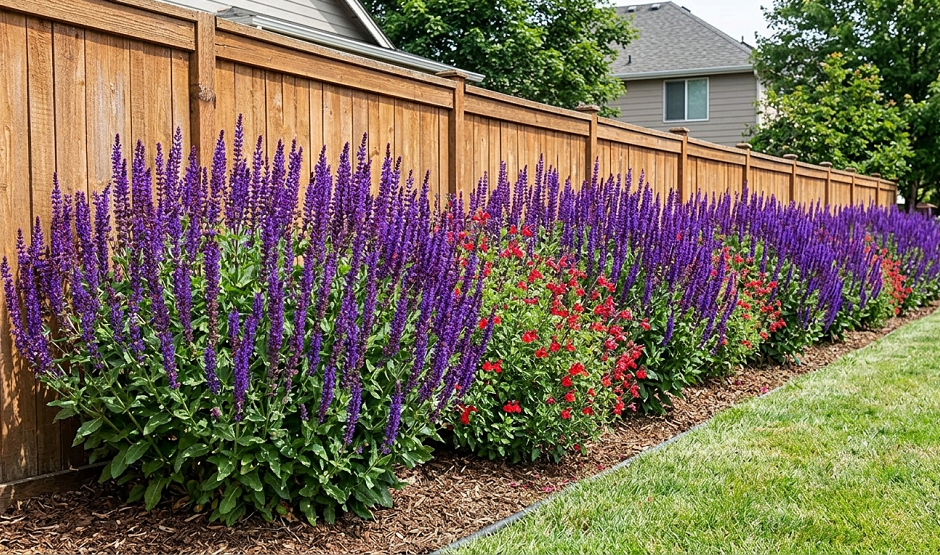
If you’re not growing salvias on a sunny fence line, you’re leaving a lot of free beauty on the table. Hardy salvias — specifically the perennial types like Salvia nemorosa ‘May Night’ or the heat-loving Salvia greggii — thrive in exactly the conditions that kill softer plants.
The flowers are spiky columns of deep purple, blue, red, or coral that butterflies and bees absolutely cannot resist. I had a ‘Hot Lips’ Salvia greggii at the base of my garden fence for four summers, and from July through October it was essentially a drive-through for every pollinator in a quarter-mile radius. Two-toned red-and-white blooms, silver-green foliage, and zero complaints from the plant even during a three-week dry stretch.
Plant salvias about 18 inches apart for a dense row. Cut them back by half after each major bloom flush and they’ll recharge and rebloom within a few weeks. In cooler climates, S. nemorosa is reliably hardy to Zone 4; S. greggii prefers Zones 6-9.
The thing I love most about salvias is that deer practically never touch them. The aromatic foliage is a built-in deterrent, which, if you garden near any kind of green space, is worth its weight in gold.
4. Black-Eyed Susan (Rudbeckia hirta and R. fulgida) — Native Wildflower That Owns the Heat
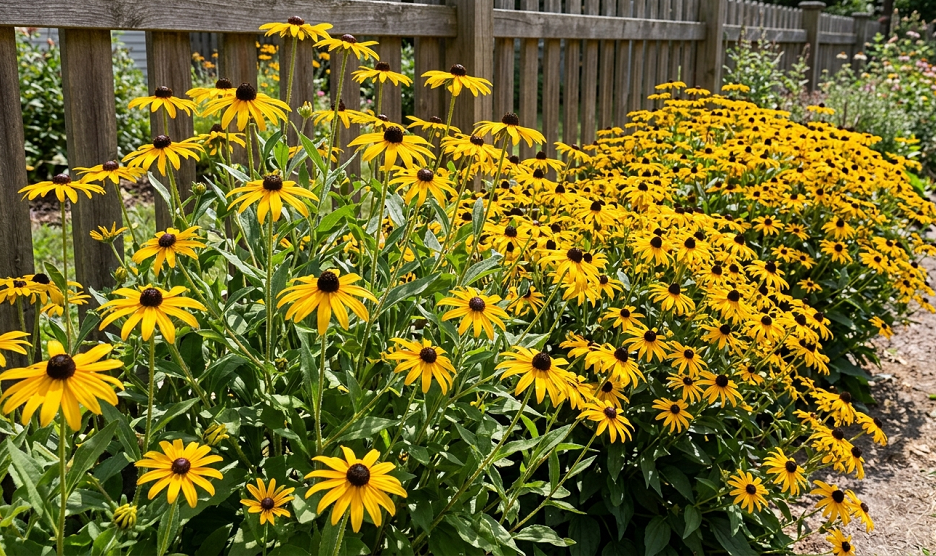
Few plants are as genuinely cheerful as a row of black-eyed Susans in full bloom along a fence. The golden-yellow petals around that dark center are practically the visual definition of summer, and they thrive in full sun with almost embarrassing ease.
Rudbeckia fulgida ‘Goldsturm’ is my go-to variety for a fence line planting. It’s a compact, tidy perennial that forms dense clumps 18 to 24 inches tall, blooms heavily from midsummer into fall, and spreads slowly to fill in gaps over a couple of seasons. It self-seeds lightly — enough to fill in bare spots, not enough to become a problem.
One thing I want to be clear about: don’t over-water these. I made that mistake my first year thinking they’d bloom more with extra irrigation. What I got was floppy stems and root rot in one corner of the bed. Black-eyed Susans are native to open meadows and prairies; they’re built for dry, average soil. Let the soil dry out between waterings once they’re established.
Leave the seed heads standing in fall and early winter. Goldfinches go absolutely wild for them, and you’ll have birds working the fence line like a snack bar from October through December.
5. Climbing Hydrangea (Hydrangea anomala petiolaris) — Worth the Wait
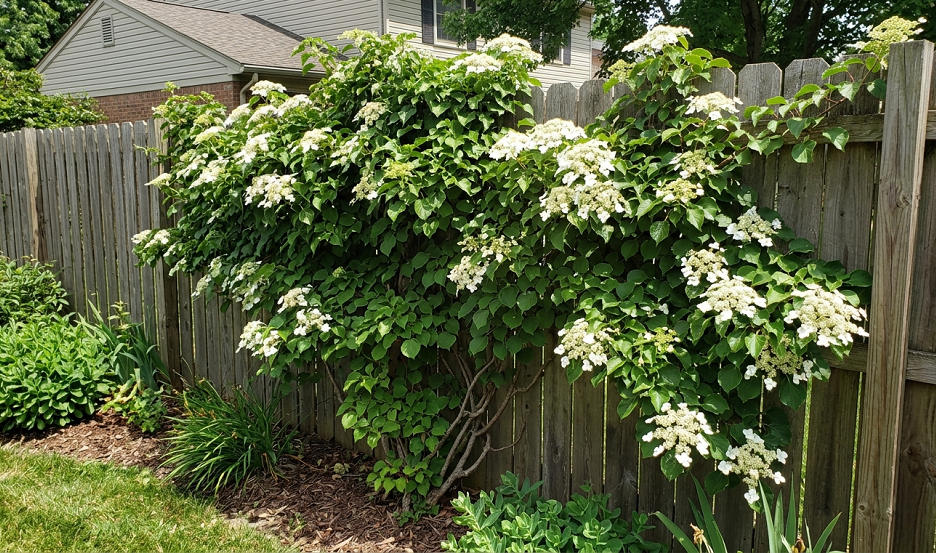
Here’s where I’ll be upfront about one significant catch: climbing hydrangea is slow to establish. The old gardener’s saying goes “first year it sleeps, second year it creeps, third year it leaps” — and that’s accurate. I planted one on a north-facing fence once and it sulked for two years. Then I planted one on a sunny, east-facing fence and by year four it was absolutely glorious.
The lacecap white flowers in early summer are stunning, the exfoliating bronze bark looks great in winter, and once established this thing is remarkably tough. It clings to fences with aerial rootlets and can eventually cover a very large span — 30 to 40 feet isn’t unusual for a mature plant.
For a fence line, I’d recommend it only if you’re thinking long-term and can give it some supplemental water the first couple of years. After that, established plants are quite drought tolerant and handle full to partial sun with ease. The payoff is a fence that looks like it belongs in a period garden magazine spread — zero exaggeration.
6. Ornamental Grasses (Miscanthus, Pennisetum, Panicum) — The Low-Maintenance Screen
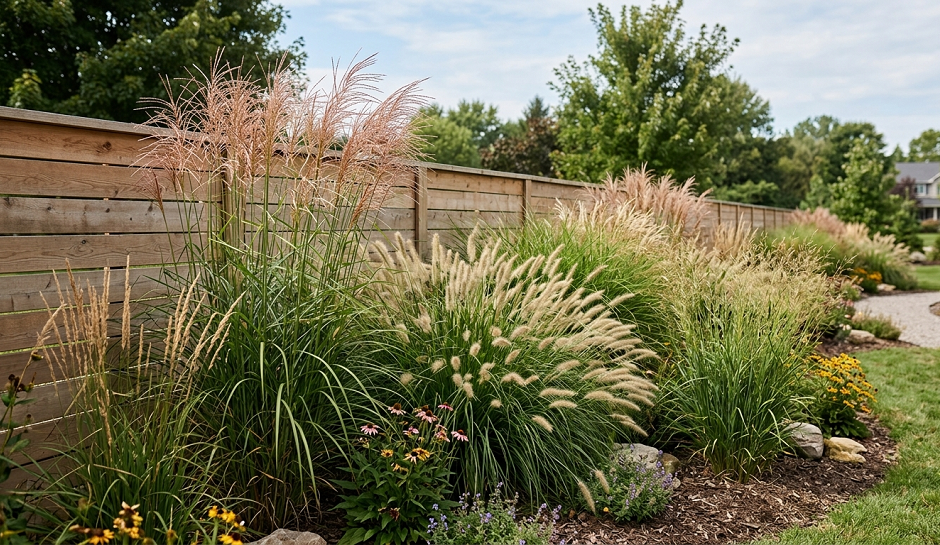
This is a category, not just one plant, because the right ornamental grass for your fence line depends on your space. But in general, ornamental grasses in full sun along a fence are one of the smartest things you can plant. They’re essentially bomb-proof.
Miscanthus sinensis ‘Morning Light’ or ‘Gracillimus’ gives you 4 to 6 feet of fine-textured, arching silver-green foliage that moves beautifully in the breeze and produces feathery plumes from late summer through winter. Pennisetum alopecuroides ‘Hameln’ (fountain grass) is more compact at 2 to 3 feet and blooms earlier. Panicum virgatum (switchgrass) is a native prairie grass that handles wet or dry soil equally well and turns brilliant orange-red in fall.
The single most important thing with ornamental grasses: cut them back hard in late winter or very early spring — down to about 4 to 6 inches from the ground. I use hedge shears and it takes about 10 minutes per plant. Skip this step and you get a dead brown center surrounded by new growth, which looks exactly as bad as it sounds. Other than that, zero maintenance.
I’ve found Miscanthus to be a total privacy screen solution by mid-June. By July you genuinely can’t see through it, which, if you have neighbors who think your fence line is their personal viewing gallery, is invaluable.
7. Bougainvillea — For Warm Climates, Nothing Comes Close
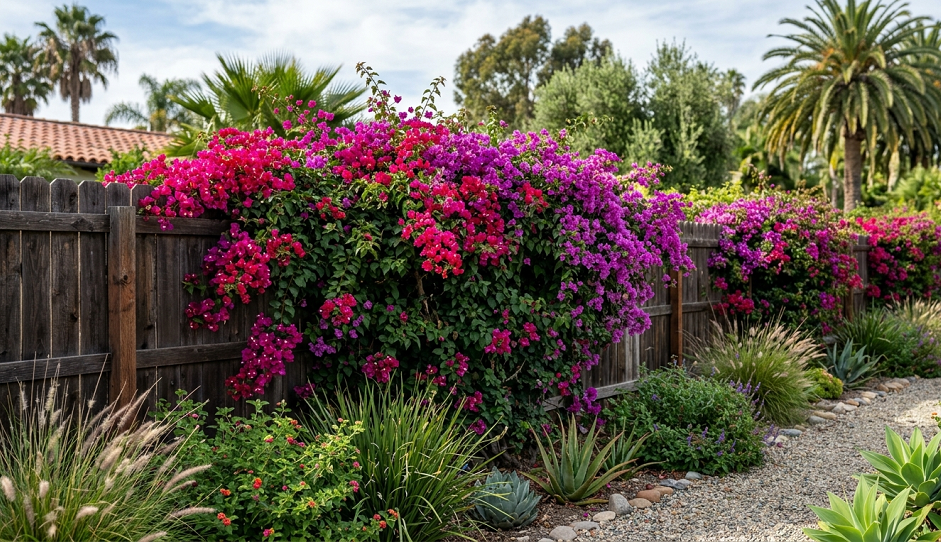
If you’re gardening in Zones 9-11, stop reading other lists and plant bougainvillea on your fence immediately. Nothing — and I mean nothing — produces that kind of color saturation in full sun. The “flowers” are actually modified leaves called bracts in shades of hot pink, magenta, orange, red, purple, and white, and a mature plant in full bloom is genuinely breathtaking.
The secret to maximal blooming that most people don’t know: bougainvillea blooms on stress. Let it dry out between waterings. Don’t fertilize heavily with nitrogen — that pushes leafy green growth at the expense of bracts. Light pruning after each bloom cycle encourages reblooming. I ignored all of this my first bougainvillea and got a giant green blob with barely any color. Once I switched to a low-nitrogen, high-phosphorus fertilizer and dramatically reduced watering frequency, the blooms came in waves.
For fence line training, use plant ties to attach new growth horizontally along fence rails. Horizontal stems bloom far more prolifically than vertical ones — this is a tip that legitimately doubled my bloom production. Wear gloves; the thorns are serious.
8. Lantana (Lantana camara) — Heat-Proof, Butterfly-Approved
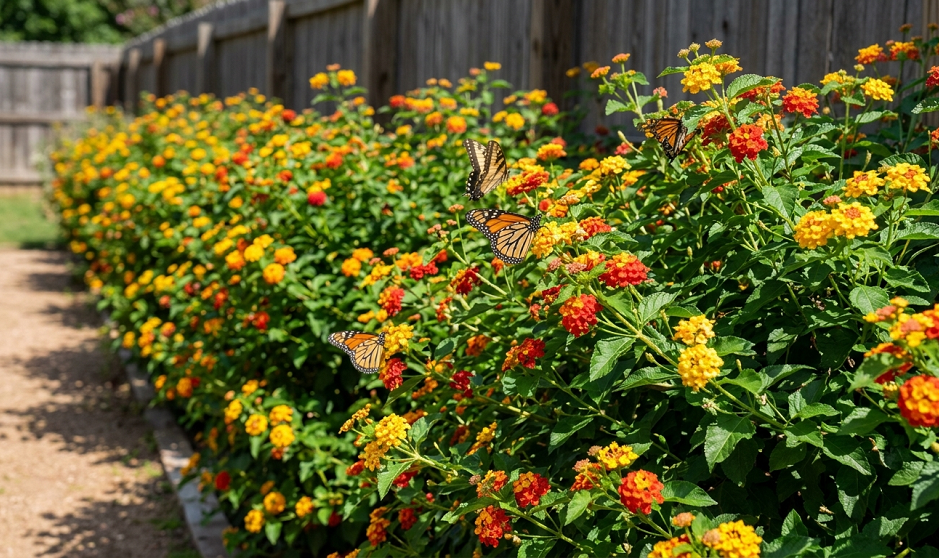
Lantana is almost unfairly easy in a hot, sunny fence line. The clusters of small flowers — usually multi-colored, shifting from yellow to orange to red or pink to purple as they age — bloom from late spring through the first frost without stopping. Not slowing down. Not pausing. Just constant color.
It grows as an annual in zones below 8 and as a perennial shrub in zones 8 and above, where it can get quite large — 3 to 5 feet tall and wide. Even as an annual, it fills in fast and provides an extraordinary season of color for the cost. I plant it along my fence every year in late May and by July it’s a solid wall of bloom attracting butterflies by the dozens.
One honest note: the berries are toxic, so if you have young children who treat the garden like a snack bar, plant it out of reach. Also, in warm climates it can become invasive in some regions — check your local invasive species list before planting.
Otherwise, this plant is a full-sun workhorse that I recommend to every beginner gardener I know because it is essentially failure-proof.
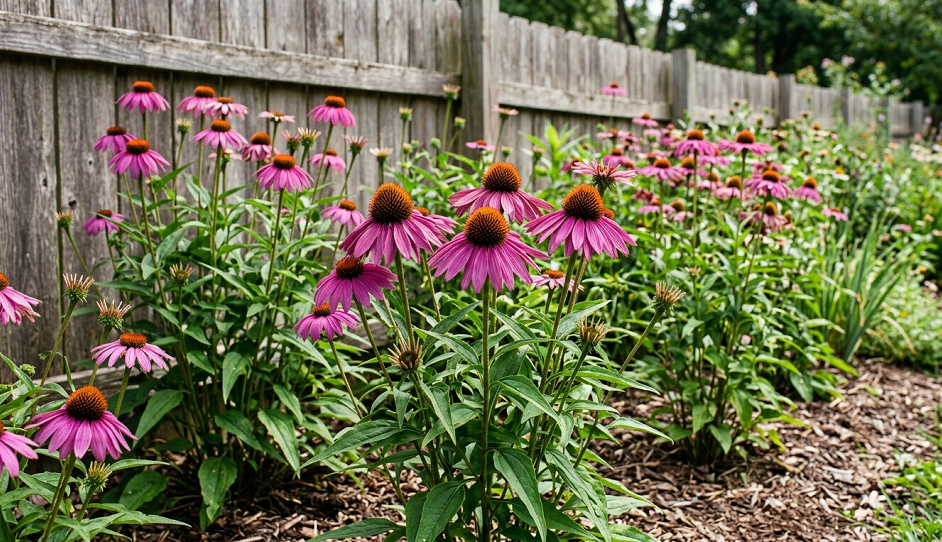
9. Coneflower (Echinacea purpurea) — The Native Perennial That Does Everything Right
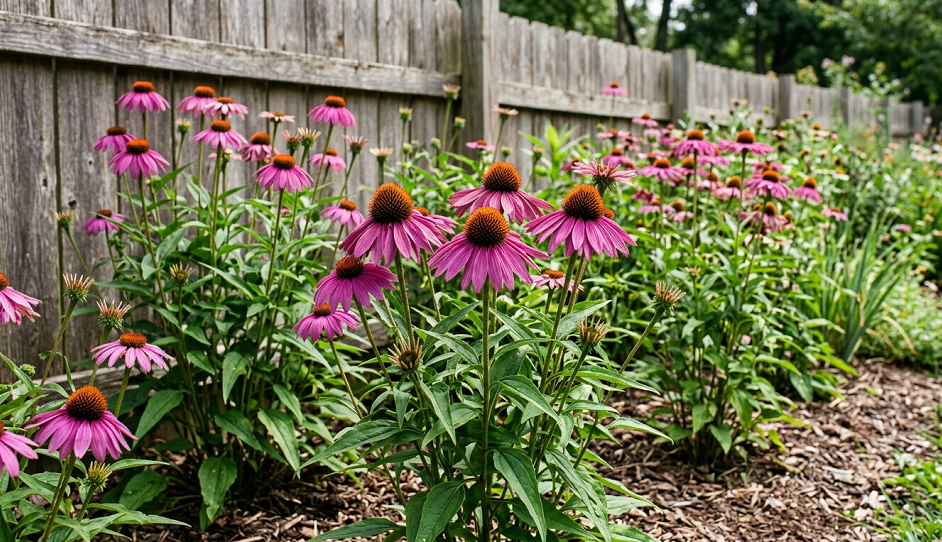
Coneflowers have earned their place in basically every garden list ever written, and they’ve earned it by actually being excellent. Native to North American prairies, they’re built for exactly the conditions a sunny fence line delivers: heat, lean soil, occasional drought, and full sun.
The classic purple-pink variety is timeless, but modern breeding has given us gold, white, orange, red, and deep burgundy options — so you can actually plan a color scheme rather than just defaulting to lavender-pink. ‘Magnus,’ ‘White Swan,’ and ‘Hot Papaya’ are three varieties I’ve grown and would plant again without hesitation.
They bloom from midsummer through fall, then the seed heads become a major winter food source for birds. I leave mine standing all season and watch goldfinches, chickadees, and house finches work through them every morning from November through February. That’s four full seasons of value from one plant.
Plant in average to lean soil — rich, heavily amended soil produces floppy growth. Space plants 18 to 24 inches apart. Divide clumps every 3 to 4 years when flowering declines. That’s the entire maintenance program.
10. Climbing Rose (Rosa climbing varieties) — High Reward, Medium Effort
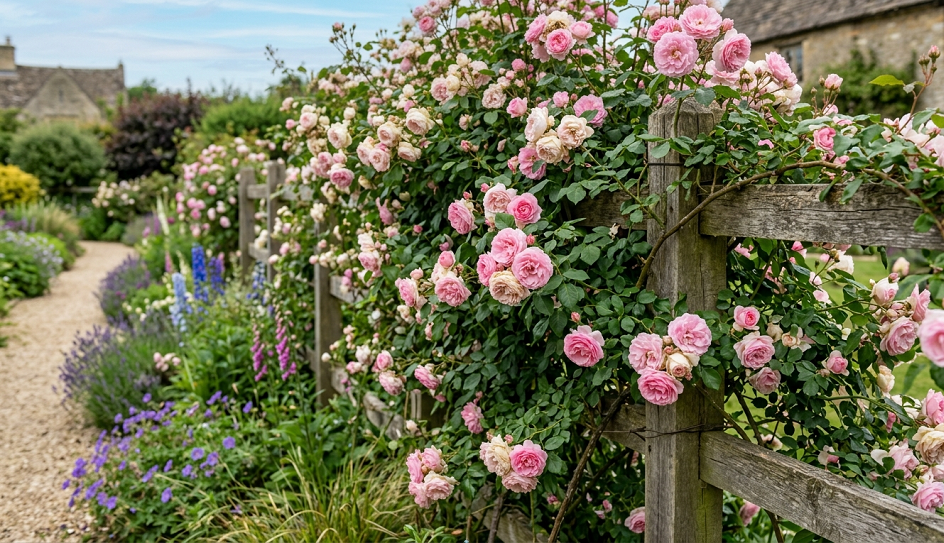
Yes, climbing roses require more work than Knockouts. I’m including them because the payoff — a fence draped in blooms — is one of the most beautiful things a home garden can produce, and a few modern climbing varieties make it genuinely achievable without a horticulture degree.
‘New Dawn’ is my top recommendation for a sunny fence line. It’s vigorous, repeat-blooming, disease-resistant compared to old hybrid climbers, and produces soft pink blooms with a subtle fragrance. ‘Don Juan’ gives deep red, velvety blooms and an amazing scent. ‘Fourth of July’ blooms in striped red-and-white and is one of the most disease-resistant climbers available.
The key to success is training, not just planting. Fan the canes horizontally or diagonally along fence rails and tie them loosely with soft plant ties. This horizontal training is what triggers abundant blooming — vertical canes mostly just grow more vertical canes. I spent two years wondering why my climber barely bloomed before someone finally told me this. Now I tell everyone immediately.
Prune in late winter, fertilize with a rose-specific formula in spring and again after the first bloom flush, and watch for black spot in humid climates. Not effortless, but absolutely worth it.
11. Russian Sage (Perovskia atriplicifolia) — The Drought-Tolerant Statement Plant
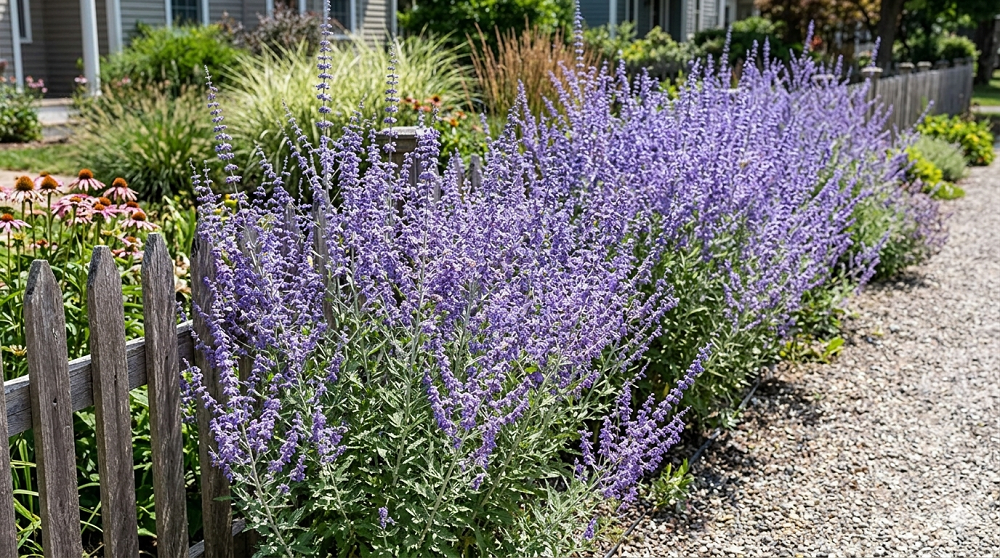
Russian sage has a silhouette unlike anything else in the garden: tall, airy wands of tiny lavender-blue flowers on silver-white stems that sway in the slightest breeze. From midsummer through fall, it creates a haze of soft purple that photographs beautifully and looks exceptional against a wood or metal fence.
It thrives on neglect. Seriously — the worse your soil and the less you water, the better it tends to perform. I planted a row of five plants along my back fence in almost pure clay amended with gravel for drainage, gave them almost no supplemental water after the first season, and they have returned every year for six years growing larger each time. Now they’re 4 feet tall and 3 feet wide and absolutely spectacular in August.
Quick side note: Russian sage is technically a subshrub, not a true perennial — which means you need to cut it back to about 6 inches in early spring and leave a bit of woody stem (don’t cut all the way to the ground). I made that mistake once, cutting it flush like a herbaceous perennial, and lost two of my five plants. Leave the base intact.
Deer completely ignore it, it’s drought tolerant once established, and the silvery foliage looks attractive even when it’s not blooming. Zones 4-9. Truly one of my most-planted fence line recommendations.
Real Talk: What Can Go Wrong (And What’s Not Worth the Effort)
Here’s the section nobody includes but everyone needs.
Invasive plants can ruin your yard. Trumpet vine, I mentioned, can get out of hand — but it’s manageable with annual pruning. Do not plant wisteria on a fence unless you are fully committed to aggressive pruning twice a year. I watched a neighbor’s wisteria consume an entire wooden fence structure in five years. The fence had to be demolished. Beautiful flowers, genuine menace.
“Full sun” plants still need water during establishment. Every plant on this list, once established, handles drought well. But “established” means at least one full growing season of regular watering — ideally two. I have watched people plant drought-tolerant perennials in June, water them twice, and then wonder why they’re dead in August. Water them consistently the first year. You’re building a root system.
Cheap soil amendments are a false economy. I’ve tried the bargain-bin “garden soil” from big-box stores and it’s largely composted wood chips with very little nutritional value. If you’re going to amend your fence line soil once, do it right with quality compost.
Bougainvillea in pots is a total waste of money if you live below Zone 9 and think you’ll overwinter it indoors. I tried this twice. It dropped every leaf both times, sulked in the garage all winter, and came back as a sad stick. If you’re in a cold climate, treat it as a very expensive annual or skip it.
Climbing plants need real support. A flimsy trellis zip-tied to a chain-link fence will not hold a mature trumpet vine or climbing rose. Either attach plants directly to the fence with proper ties, or invest in a solid trellis structure before you plant.
Parting Wisdom: Work With Your Fence, Not Against It
A sunny fence line is one of the best gardening assets you can have. It provides vertical structure, a microclimate that extends the growing season, and a backdrop that makes every plant in front of it look intentional.
My biggest piece of advice after all these years: choose plants that match your actual commitment level, not your Pinterest aspirations. If you want zero maintenance, go with ornamental grasses, Russian sage, and coneflowers. If you want maximum showmanship and don’t mind putting in some work, add climbing roses and bougainvillea. There’s no wrong answer — just honest self-assessment.
Plant generously, water through establishment, and prune without fear. Your fence line will reward you season after season.
Now I want to hear from you — what’s currently growing on your fence line, and what’s been your biggest win or worst failure? Drop your questions or suggestions in the comments below. I’ve probably killed whatever plant you’re thinking about, so let me help you avoid doing the same.

About Syprose Kiche
Syprose Kiche is the creator and writer behind My Besuited Home, a practical home and garden website covering DIY projects, gardening, lawn care, landscaping, home improvement, and outdoor living. She focuses on turning everyday homeowner questions into clear, practical guides backed by careful research and useful real-world considerations.