
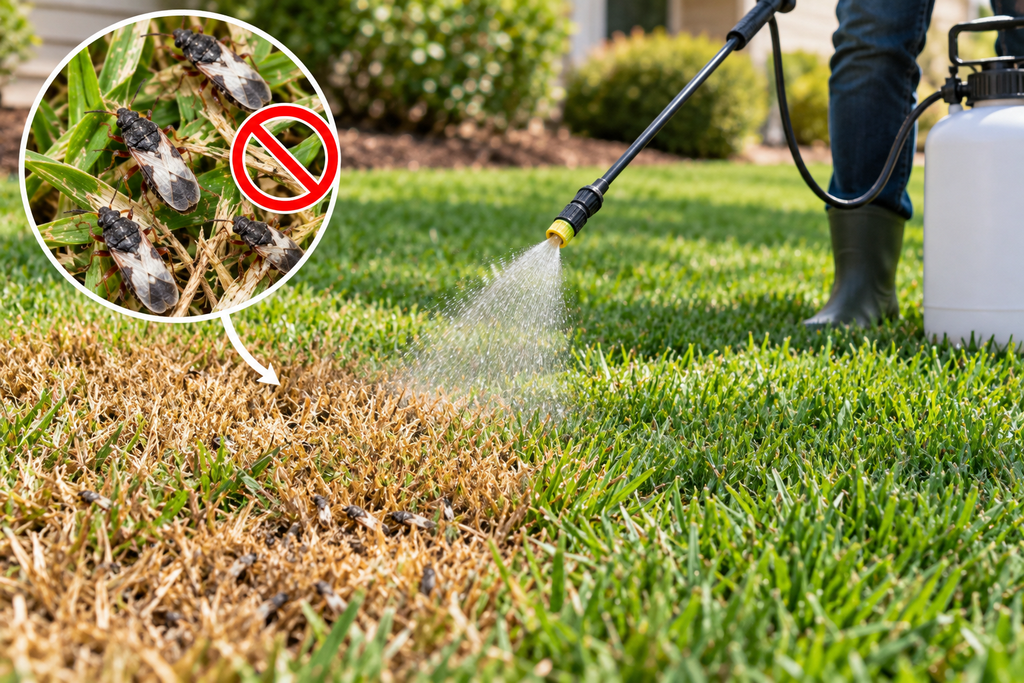
A patch of lawn turns yellow, then straw-brown, in the sunniest, hottest part of the yard, usually beside a driveway or sidewalk. The obvious diagnosis is drought, so you water. The patch keeps growing anyway. That is the classic chinch bug story, and the confusion is costly because chinch bug damage will not respond to extra watering the way a drought-stressed lawn would.
Chinch bugs are tiny sap-feeding insects, and a heavy infestation can kill large areas of turf. Getting rid of them without a broad-spectrum insecticide is realistic in many lawns, but only if you confirm they are the problem first, understand which species you have, and accept that “natural” mostly means changing the conditions they thrive in rather than spraying something.
First, Make Sure It’s Chinch Bugs
Several problems mimic chinch bug damage: drought, dog urine, fungal disease, grub feeding and compacted soil. Treating the wrong one wastes weeks, and the damage keeps spreading in the meantime.
What the damage looks like
Feeding shows up as patchy areas that turn yellow and dry to a straw-brown color as feeding progresses. The patches tend to start small and expand outward. Chinch bugs are most concentrated at the edge of the damaged area, where dying grass meets healthy grass. The centre of a patch is often bug-free because they have moved on to fresh turf. This is why checking the middle of a dead patch is a common mistake.
Infestations are most often first noticed during hot, dry periods in sunny areas of the lawn. A brown patch in deep shade is less likely to be chinch bugs, though not impossible.
What the insects look like
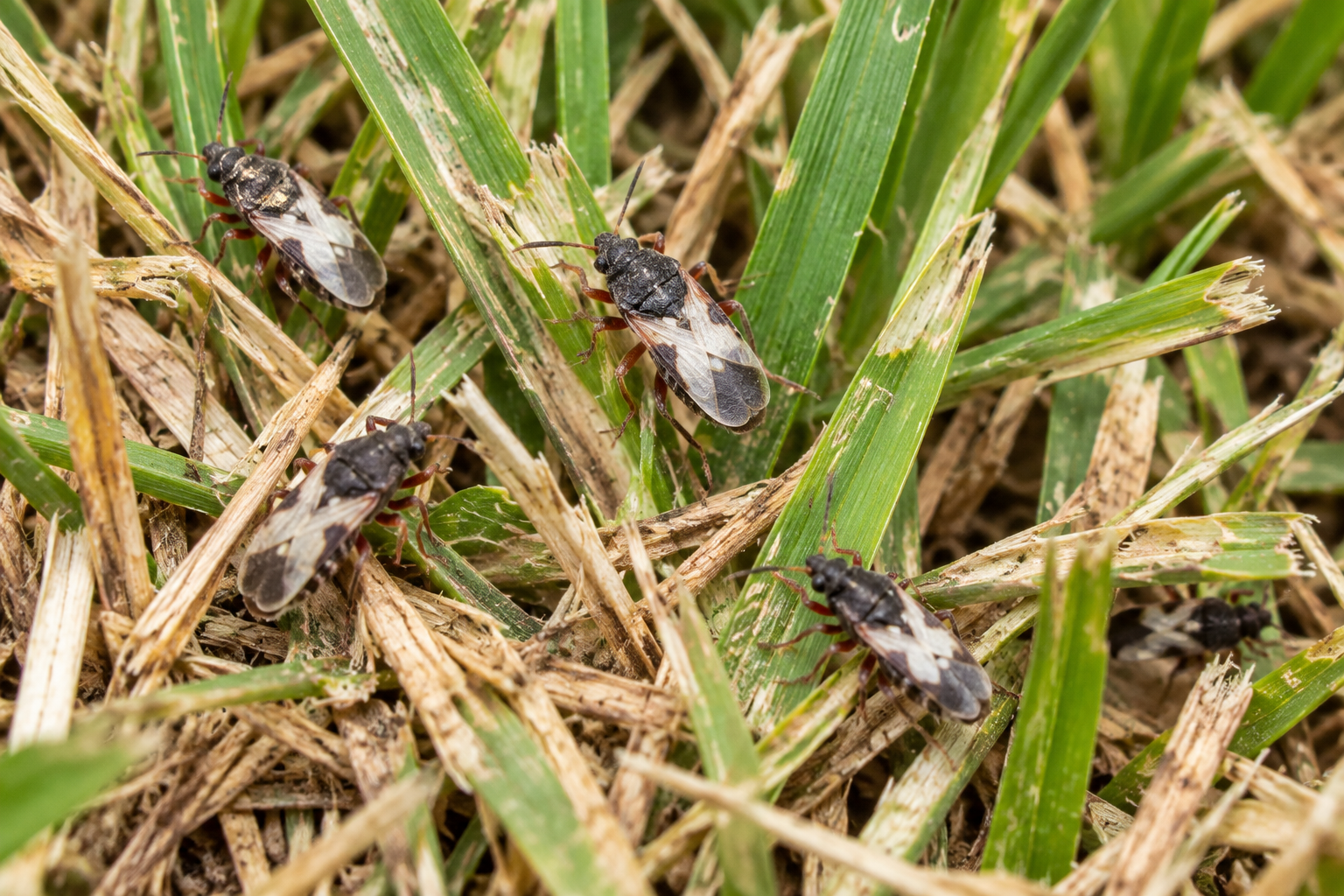
Size matters here. Adults are about a fifth of an inch long, with black triangular patches on the wings, and the wings are folded over the back. The young are smaller and change color as they grow, from reddish with a white band across the back to black as they near adult size. A bright red nymph with a white stripe is easy to miss by eye, but it is a strong clue once you know to look.
Chinch bugs are true bugs, and when crushed they give off an odor similar to stink bugs.
Don’t confuse them with big-eyed bugs
This is the most important identification point for anyone avoiding chemicals. Big-eyed bugs and minute pirate bugs look similar to chinch bugs but are beneficial predators. Big-eyed bugs are recognizable because their large eyes are the widest part of their body. A chinch bug’s head is narrower than the body behind it. If you spray everything that looks like a chinch bug, you will kill the insects that keep chinch bug numbers down.
The two confirmation tests
Hands-and-knees check. Pull back the grass blades along the border of a damaged area and look at the crowns and the thatch just above the soil. As weather gets warmer and drier, chinch bugs may move deeper into the thatch, so part the grass carefully and give it a minute. In hot weather, you may also see them running across adjacent pavement.
Flotation test. This is the more reliable method:
- Cut both ends off a coffee can or similar metal can.
- Push it two to three inches down into the turf at the edge of a damaged patch, not in the dead center.
- Fill it with water. Wait 5 to 10 minutes for bugs to float to the surface (UC IPM gives this timing; other sources say they surface more quickly).
- Count what rises. Repeat in several spots.
Compare your count to the damage threshold. Extension sources in the South put it at 20 to 25 chinch bugs per square foot as the level that can cause damage. Thresholds vary somewhat by species and region, so check your local extension office for the number that applies to you. A handful of bugs in one can is not an emergency.
You can also shake a small section of turf vigorously over white paper, which works well for spotting the nymphs against the contrast.
Which Chinch Bug Do You Have?
“Chinch bug” covers a few different species, and the species affects the timing and the grass at risk.
- Southern chinch bug. The major pest of St. Augustinegrass in warm regions. Other lawn grasses, including zoysia, bermuda, bahia and centipede, can also be attacked, though less severely. In California, chinch bugs are active from April through October, especially in full sun. In the warmest regions, populations can keep developing for much of the year.
- Hairy chinch bug. A pest of cool-season lawns in the northern US. Adults overwinter at the base of grass stems and in the thatch, and females lay eggs in the thatch or in the folds of grass blades.
- Western chinch bug. A more recent concern in the Plains states. It was first found infesting a damaged buffalograss lawn in Lincoln, Nebraska, and has more recently become a serious pest of zoysiagrass.
If you are unsure which applies to you, your state extension service will know. What works in a Florida St. Augustine lawn is not always what works in a Massachusetts fescue lawn.
Why Some Lawns Get Chinch Bugs and Others Don’t
Chinch bugs are not random. They favor specific conditions, and every natural control strategy below works by taking those conditions away.
Thatch. This layer of dead and living stems and roots between the soil and the green blades gives chinch bugs shelter from weather and predators. Extension guidance from Texas describes it as a protective home and notes that lawns with heavy thatch are more vulnerable. Utah State’s guidance likewise says lawns with excessive thatch are especially susceptible to damage.
Heat and dryness. Texas A&M notes that chinch bugs prefer hot, dry conditions, and a drought-stressed lawn is also a weaker lawn. Beyond that, dry thatch is a poor environment for the fungus that attacks them (more on that below).
Heavy nitrogen. Lush, fast-growing grass is more appealing to sap feeders. University of California guidance recommends that where southern chinch bugs occur, you reduce fertilizer rates and maintain adequate moisture, noting that the low end of the recommended nitrogen range slows chinch bug reproduction.
Fungicide use. This one is overlooked. Utah State notes that fungicide applications may suppress Beauveria and favor the build-up of chinch bug populations. If you routinely treat for turf disease, you may be removing one of the chinch bug’s main natural enemies.
Start With the Lawn, Not a Spray
Extension entomologists consistently put cultural practices ahead of treatments, and the Nebraska guidance is blunt about it: the best defense against chinch bugs is sound cultural practices that keep the turf in optimal condition. For homeowners wanting to avoid chemicals, this is the foundation.
Reduce thatch
For a lawn with a history of chinch bugs, thatch removal is probably the single highest-value step. Colorado State notes that in lawns with thick thatch and a history of chinch bug activity, removing the thatch can help limit activity for one or two years. That is a realistic expectation: a reprieve, not a permanent fix.
Options include:
- Core aeration. Pulls small plugs from the lawn, which helps thatch break down and improves water movement. Rental machines are widely available.
- Dethatching or vertical mowing. More aggressive. Texas A&M notes that vertical mowing can temporarily harm a lawn’s appearance and is best done when the grass is actively growing so it can recover.
- Mowing regularly. Infrequent mowing contributes to thatch buildup, and a mulching mower that shreds clippings finely is generally less of a problem than letting long clippings pile up.
Timing matters. Dethatching during an active infestation can stress turf that is already being drained by feeding. If you already have confirmed damage, deal with the insects first and dethatch once the lawn can recover.
Rethink your watering
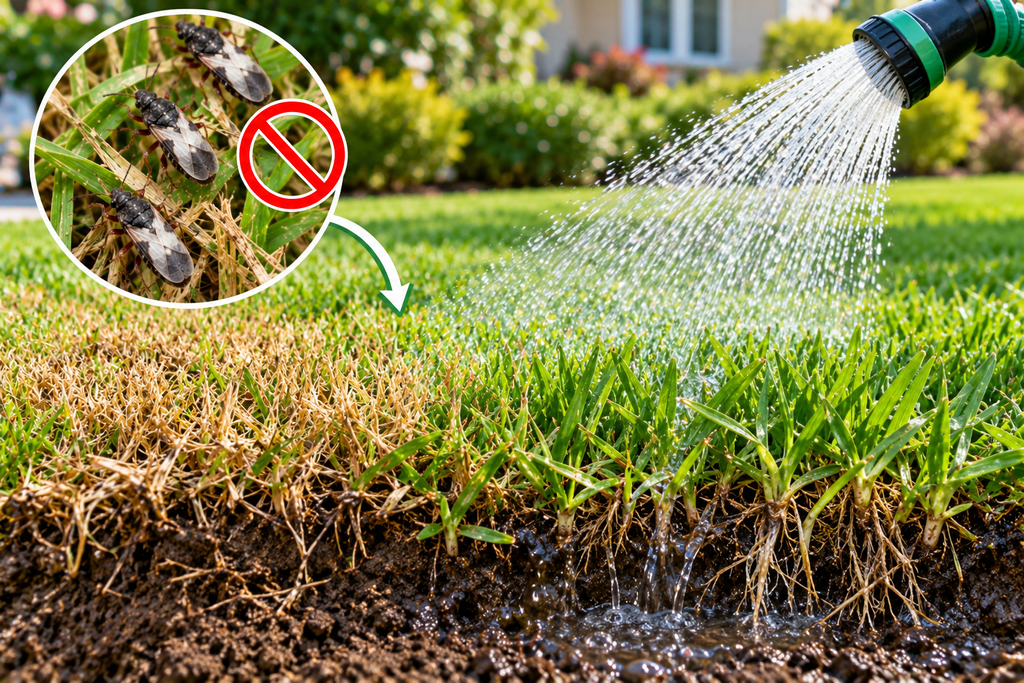
A stressed lawn tolerates feeding badly. Texas A&M advises watering when grass blades begin to curl or fail to spring back when stepped on, so you are responding to the lawn rather than the calendar.
The aim is deep, infrequent watering rather than daily light sprinkling. Frequent light watering encourages shallow roots and keeps the thatch surface damp without helping the soil. Deep watering keeps the soil and the lower thatch moist, which, as covered below, benefits the fungus that attacks chinch bugs.
One caution: watering will not cure chinch bug damage. If you water a damaged patch and it still declines, that is information, not a failure of technique.
Go easy on nitrogen
Cut back to the lower end of the range your grass type needs, and consider slow-release products. Texas A&M’s guidance warns that excess nitrogen increases thatch formation and makes grass more attractive as a food source for chinch bugs. Exact rates depend on grass species and region, so check your local extension recommendation rather than a generic number.
Choose resistant grass
For many homeowners this is the best long-term fix, because it works on a lawn year after year without ongoing effort.
- St. Augustinegrass in the South: UC IPM recommends selecting resistant varieties and names Floralawn, Floratam or FX-10. One caution from Texas A&M: some varieties that were once resistant no longer appear to be, because chinch bug populations can adapt. Check with your local extension office for what currently holds up in your area.
- Cool-season lawns in the North: Perennial ryegrasses, fine fescues, and tall fescues with endophytes are resistant to hairy chinch bug feeding. Overseeding a lawn that keeps getting hit with these types is one of the most effective long-term moves.
Overseeding takes a season or two to shift the lawn’s makeup, so it is a prevention strategy, not a rescue.
Using the Chinch Bug’s Natural Enemies
Chinch bugs have real predators and pathogens. This is where “natural” control has the strongest scientific backing.
Big-eyed bugs and other predators
Big-eyed bugs, minute pirate bugs, ground beetles and ants all feed on chinch bugs. UC IPM lists big-eyed bugs, ants, and the fungus Beauveria bassiana as the most important natural enemies of southern chinch bugs. Michigan State research also found big-eyed bugs prey on chinch bugs at all life stages.
The practical consequence is that avoiding broad-spectrum insecticides matters even when you are not trying to be organic. A lawn sprayed with a persistent product loses its predators along with the pests, and chinch bugs often rebound faster than the predators do.
The fungus Beauveria bassiana
This naturally occurring fungus infects and kills chinch bugs. Colorado State notes it can reduce hairy chinch bug numbers below damaging levels, especially earlier in the season during cool, wet springs. UC IPM lists it among the natural enemies and says maintaining moist conditions favors its development.
There are two ways to use this:
- Encourage what is already there. Keep the soil and thatch reasonably moist, avoid unnecessary fungicides, and avoid letting the lawn dry out completely during chinch bug season.
- Apply a commercial product. Beauveria bassiana is sold as a biological insecticide. It works best when conditions are right: it needs humidity and moisture, and results can be slower and less consistent than with a conventional insecticide. Whether a given product is labeled for chinch bugs in turf, and in your state, varies, so read the label.
Be realistic about the limits. Beauveria is a pathogen that depends on weather. In a hot, dry spell, which is exactly when chinch bugs explode, it may not do much.
Direct Treatments Allowed Under “Natural”
When cultural changes aren’t enough, or you have a confirmed infestation that is actively killing turf, you may want to do something more immediate.
Insecticidal soap
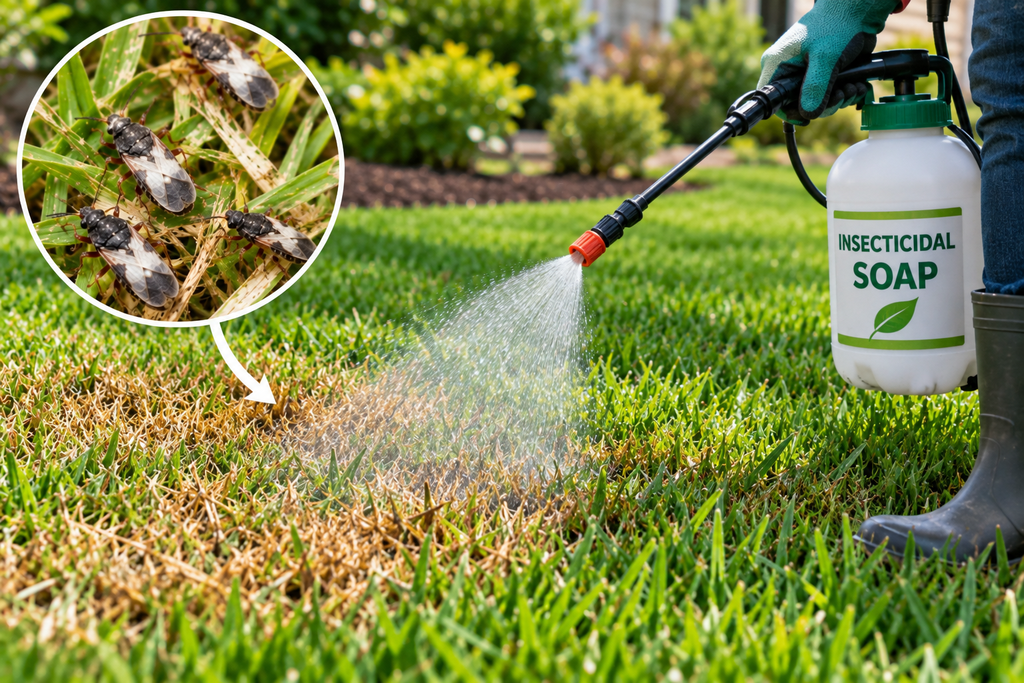
Insecticidal soaps kill by contact, which creates a real limitation: the spray has to physically reach the insect. Chinch bugs live down in the thatch and crown, not on the blade tips. Michigan State’s review of alternative controls noted that testing of low-toxicity products like insecticidal soap has been only partially successful for chinch bugs and other turf pests.
If you try it:
- Use a product made for insect control, labeled for use on lawns, and follow the label for dilution. Do not substitute dish soap, which is not formulated for plants and can injure grass.
- Apply when it is not extremely hot, since soaps can burn foliage under heat stress.
- Soak the thatch layer rather than misting the surface. Utah State’s guidance on liquid insecticides advises avoiding irrigation for a few days afterward, so the product stays in contact with the blades and thatch.
- Expect to repeat. Soap leaves no residue, so it does nothing to nymphs that hatch afterward.
- Understand that it kills beneficial insects too, if they are hit.
Treat soap as a spot treatment for a small, confirmed area, not as a lawn-wide solution.
Other home remedies: what to be cautious about
You will see recommendations for diatomaceous earth, neem oil, pepper sprays, vinegar, and homemade soap mixtures. I did not find strong extension-based evidence that any of these reliably control chinch bugs in lawns, so treat them skeptically, and flag these for verification before publishing any specific claims. Some add real risk:
- Vinegar is a broad-spectrum burn product. It can damage or kill the grass you are trying to save.
- Diatomaceous earth is a dust that kills by abrasion and dehydration, but it works poorly on a large turf area and is damaging to beneficial insects as well. It also needs to stay dry, which is hard in a lawn.
- Homemade mixtures combining multiple ingredients are unpredictable. Do not mix chemicals or household products to make a stronger treatment.
When “natural” isn’t enough
If a large part of the lawn is already dying, waiting for a slow biological control may cost you the lawn. Extension guidance generally supports a targeted conventional insecticide as a rescue step when damage is severe and chinch bugs are confirmed above the threshold. Applying it to a limited area, following the label, and avoiding the whole lawn is consistent with a lower-chemical approach. A licensed lawn care professional can also help if you are not sure of the diagnosis or the dose.
Whatever you choose, apply products to the right place. Chinch bugs live in the thatch, so a spray that only wets the leaf tips will miss them.
A Seasonal Approach
Timing changes what works.
Early season (spring). Scout the sunniest spots and the edges beside pavement. Lighter infestations are easiest to deal with before populations build. Cool, wet springs favor Beauveria, so this is a good window to avoid fungicides and keep moisture steady. If thatch is thick, core aerate when the grass is actively growing.
Peak heat (summer). This is when damage becomes visible. Check the borders of any expanding patches with the flotation method, and water deeply rather than often. Hold off on heavy nitrogen. Avoid dethatching during a drought.
Fall. Adults move to overwintering sites, which Utah State lists as thatch, clumps of grass, the edges of buildings and sidewalks. Fall is often a good time for overseeding with resistant varieties in cool-season lawns, since grass establishes well in cooler weather, and for repairing damaged patches. Cleaning up heavy debris at the edge of the lawn reduces overwintering shelter.
Winter. In cold regions there is little to do. In warm regions, chinch bugs may remain active longer, so keep checking.
Check your local extension calendar for exact timing, since seasons vary widely.
Repairing Damaged Patches
Once the insects are gone, the dead patches will not recover by themselves if the grass has been killed rather than just stressed.
- Confirm the bugs are gone. Re-run the flotation test at the patch edge. Re-seeding into an active infestation just feeds the bugs.
- Remove the dead grass. Rake out dead material and thatch in the damaged area.
- Reseed, sod or plug. For cool-season lawns, reseed with endophyte-enhanced or resistant types. For St. Augustinegrass, which is generally spread by sod or plugs rather than seed, use a resistant variety.
- Keep it moist while it establishes. New seedlings and plugs need consistent moisture.
If the patch is surrounded by the same susceptible grass that got attacked, consider whether the same thing will happen again. A resistant variety in the repair area is a sensible choice, even if the rest of the lawn is unchanged.
Common Mistakes
Treating drought that is not drought. If extra water does not help, check for insects before you increase watering.
Checking the wrong place. Look at the margins of the damage, not the dead center.
Spraying beneficial insects. Big-eyed bugs look similar to chinch bugs. Confirm what you have before you spray.
Applying fungicide out of habit. It may remove a natural check on chinch bugs.
Over-fertilizing a stressed lawn. Lush growth and extra thatch both favor the pest.
Expecting one fix. Natural management is cumulative. Thatch reduction, resistant grass and balanced watering all contribute, and no single one is usually enough alone.
Dethatching at the wrong time. Do it when the grass can recover, not during active feeding in a heat wave.
Safety Notes
- Read and follow every product label, including products described as natural or organic. Labels specify where the product can be used, how much to apply, and how long to keep people and pets off the treated area.
- Keep children and pets out of treated areas until the product has dried or the label’s waiting period has passed.
- Wear gloves and eye protection when mixing or spraying, even with soap-based products.
- Never mix products to make them stronger, including vinegar, soap, bleach or other household chemicals.
- Do not apply liquid products during peak heat or when rain is expected, unless the label says to.
- If you are unsure about the diagnosis or the product, your local extension office or a licensed lawn care professional can help.
Frequently Asked Questions
Can I get rid of chinch bugs with just water?
No. Water does not kill them. Moisture helps in two ways: a lawn that is not drought-stressed tolerates feeding better, and moist conditions favor Beauveria. But a lawn that is being actively fed upon will not green up from watering alone.
Will chinch bugs come back after I treat them?
Often, yes, especially if thatch, heat, and susceptible grass are still present. Colorado State’s guidance suggests that thatch removal gives one or two years of relief in problem lawns, which suggests the problem can return unless the conditions change.
How do I tell chinch bugs from big-eyed bugs?
Look at the head. Big-eyed bugs have large eyes that are the widest part of the body, as UC IPM describes. If the insects are plentiful in a healthy area and you do not see damage, they may well be beneficial predators. When in doubt, send a sample or photo to your extension office.
Does grass recover after chinch bugs?
Lightly stressed grass often does once the feeding stops. Grass that is brown and dead will not, and needs reseeding or replanting.
Are chinch bugs harmful to people or pets?
They feed on grass, not on people or animals. The risks come from what you treat them with, so follow product labels.
Key Takeaways
Confirm chinch bugs before you treat anything. Check the border of the damage with the flotation test and compare your count to the threshold for your region. Then work on conditions rather than on the insects alone: reduce thatch, keep nitrogen moderate, water deeply, and choose resistant grass when you reseed. Protect big-eyed bugs and the Beauveria fungus by avoiding broad-spectrum sprays and unneeded fungicides. Use insecticidal soap or a biological product as a spot treatment for a confirmed, limited infestation, and call local extension or a licensed professional if damage is spreading quickly.

About Syprose Kiche
Syprose Kiche is the creator and writer behind My Besuited Home, a practical home and garden website covering DIY projects, gardening, lawn care, landscaping, home improvement, and outdoor living. She focuses on turning everyday homeowner questions into clear, practical guides backed by careful research and useful real-world considerations.