
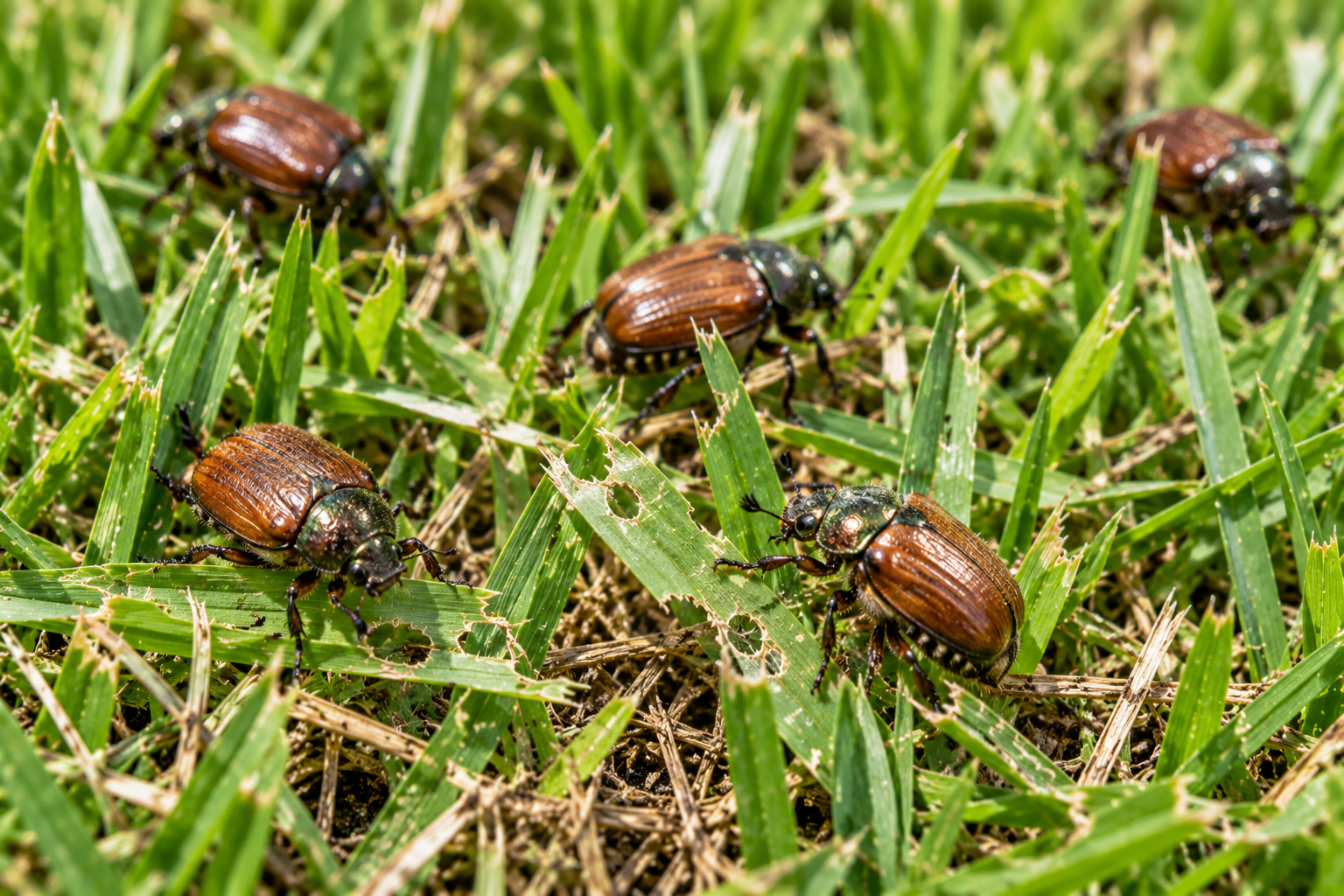
A patch of lawn turns straw-colored in late summer, but the sprinklers have been running and the neighboring grass is fine. Grab a handful of the dead turf and pull. If it lifts like a loose piece of carpet, with no roots holding it down, the problem is almost certainly underground. Pale, C-shaped grubs are eating the roots, and they will become beetles next summer.
That is the usual sequence with lawn beetles. The damage shows up months after the beetles laid their eggs, and by the time the grass looks bad, most of the feeding has already happened. This makes timing the biggest factor in whether a natural method works at all. Most of the biological controls described below are effective against young grubs in late summer, and they do very little against large grubs in spring.
This guide covers how to confirm what is in the soil, when treatment is worthwhile, which natural products do something useful, and which popular advice is weaker than it sounds.
Which Beetle Is Actually in the Lawn?
“Lawn beetle” covers several insects with similar habits. In North America the usual culprits are:
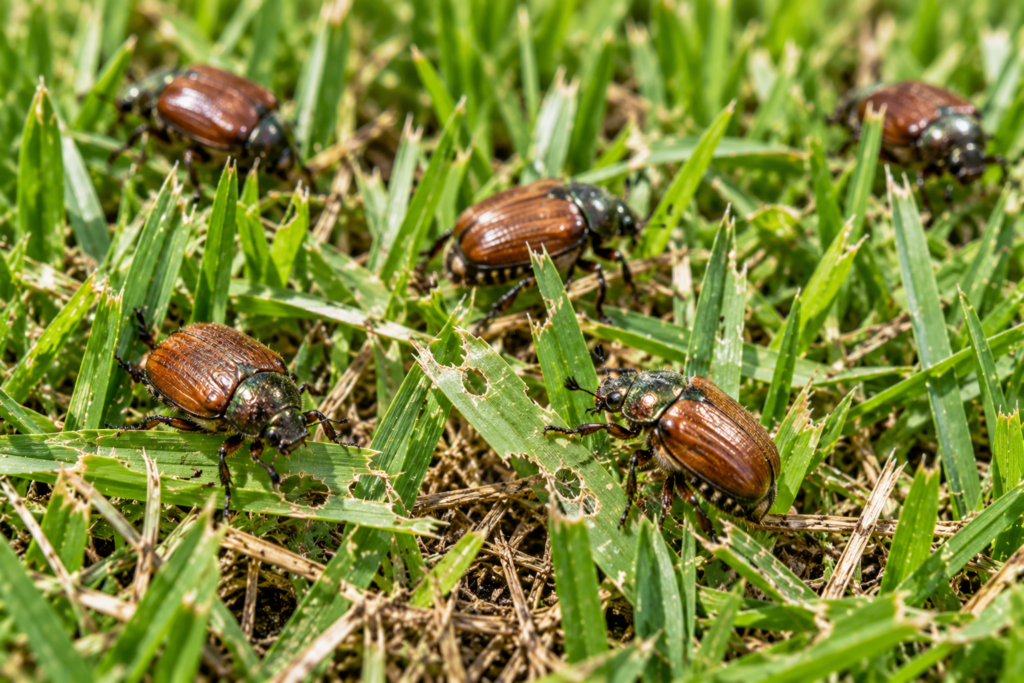
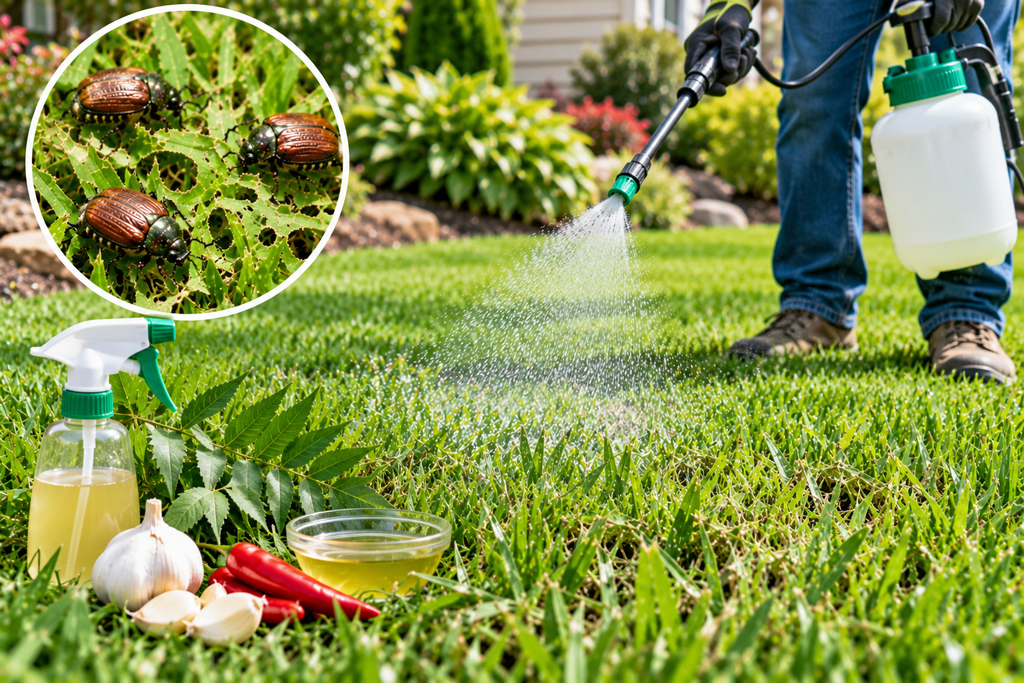
- Japanese beetle. Adults are metallic green and copper, about half an inch long, and feed on roses, lindens, grapes and many other plants. The grubs feed on turf roots.
- European chafer, Oriental beetle and masked chafers. The adults are tan to brown and mostly active at dusk. The grubs look very much like Japanese beetle grubs.
- May and June beetles. These are larger, dark brown beetles that bang into porch lights. Their grubs are bigger and, in many regions, take more than one year to mature.
- Billbugs. These are weevils with a snout, not true grubs. The larvae are legless and tunnel inside grass stems at the crown.
All the scarab beetles in that list (every one except billbugs) have larvae called white grubs. They are cream-colored with a brown head, curl into a C when disturbed, and have six visible legs near the head. The raster pattern, a small arrangement of bristles on the underside of the rear end, is how entomologists tell species apart. A homeowner usually does not need that level of detail, but it matters in one case: milky spore only works on Japanese beetle grubs, so a wrong guess can waste a season (more on that below).
Beyond North America the species differ. African black beetle, for example, is a lawn pest in parts of southern Africa, Australia and New Zealand. The general approach of confirming the larvae, timing treatment to the young stage and improving turf health carries over, but a local extension office, agricultural service or garden center can name the regional species and its calendar.
If the grass is dying but the grubs turn out to be absent or sparse, look for other causes before treating anything. Chinch bugs, sod webworms, drought, dog urine, fungal disease and compacted soil can all produce brown patches. Those problems have their own treatments, and a grub product will not help.
How to Confirm Grubs Before Spending Anything
Checking takes ten minutes and prevents most wasted treatments.
The pull test. Tug a handful of damaged turf. Grass that has lost its roots to grubs comes up easily, and the sod can sometimes be rolled back.
The square-foot count. With a flat spade, cut a square about one foot on each side, three sides only, to a depth of 3 to 4 inches. Fold the flap back like a lid and look at the roots and the top inch or two of soil. Count the grubs. Do this in at least three or four spots, including the edge between healthy and damaged grass, because that is where grubs are most likely to be actively feeding.
What the count means. Extension services generally treat roughly 5 to 10 grubs per square foot as the point where a healthy, well-watered lawn may start to show injury. The exact figure varies by species, grub size, region and the vigor of the lawn, so check your local extension recommendation. A lawn with 2 or 3 grubs per square foot usually needs no treatment, and a stressed lawn can show damage at lower counts.
Size and timing. Check the grub size too. Small grubs, less than half an inch, are in the early feeding stage when biological controls work best. Fat grubs over an inch long are close to the end of their feeding period.
Two other warning signs deserve attention. Birds such as crows and starlings probing the lawn in clusters, and torn-up patches where skunks or raccoons have dug, often mean a heavy grub population. Both are covered in a later section.
Why Many Lawns Can Tolerate Some Grubs
A common assumption is that any grub in the lawn must be eliminated. Dense, deep-rooted turf can lose a share of its roots and keep growing, provided it gets enough water. A lawn with a handful of grubs per square foot and consistent moisture often shows no symptoms at all.
That reasoning has a practical use. If the count is low, the sensible move is to improve turf health and recheck next season. If the count is well above the local threshold, or the lawn has a history of damage in the same area, treatment is justified. Treating at low numbers spends money and, in the case of nematodes and other living products, uses up a product with limited shelf life.
The Beetle Calendar and What It Means for Timing
The yearly cycle of a typical one-year species like the Japanese beetle runs roughly like this, with dates shifting by climate:
- Early to mid summer: Adult beetles emerge and feed on foliage. They mate and females lay eggs in the soil, usually in turf that stays moist.
- Late summer: Eggs hatch. The tiny grubs feed on fine roots near the surface. This is the best window for biological controls.
- Early fall: Grubs grow and keep feeding. Damage becomes visible. As soil cools, grubs burrow deeper.
- Winter: Grubs stay deep in the soil and do not feed.
- Spring: Grubs move back up and feed for a few weeks, but they are large by now and much harder to kill with natural products.
- Early summer: Grubs pupate and emerge as adults, and the cycle restarts.
For this reason, advice to “apply beneficial nematodes in spring” tends to disappoint. The grubs are big, the soil is often cool, and the window before pupation is short.
If it is already early October in a cool-climate region, most grubs are probably large and heading deeper. A natural treatment now will have limited effect. The better use of the next few weeks is to confirm the count, repair damaged turf, and plan an application for next late summer. In warmer regions where soil stays warm longer, there may still be a workable window, and local extension guidance is worth checking.
Beneficial Nematodes: The Most Practical Biological Option
Beneficial nematodes are microscopic worms that seek out soil insects, enter their bodies and release bacteria that kill the host within a few days. For white grubs, the species most often recommended is Heterorhabditis bacteriophora. Some products use Steinernema species, which are generally less effective on grubs and better suited to surface-feeding insects.
When they work well
- Grubs are young, small and near the surface, typically late summer.
- Soil is warm enough for the nematodes to move. Many product labels specify a minimum soil temperature in the range of 12 to 13°C (about 55°F), and warmer is usually better. Follow the label.
- The soil is moist before, during and after application.
Applying them
- Order close to application time. Nematodes are alive, so they ship refrigerated and have a limited shelf life. Do not store them for weeks.
- Water the lawn first, so the soil is damp.
- Apply in the evening or on an overcast day. Ultraviolet light and heat kill them quickly.
- Mix with water per the label and apply with a watering can, hose-end sprayer or backpack sprayer. Remove screens and fine filters that could trap the nematodes, since the label will say what is compatible.
- Water in lightly afterward, enough to move them into the soil without flooding the area.
- Keep the soil moist for a couple of weeks. If the weather turns hot and dry, irrigate.
Limitations
Nematodes are not a guaranteed fix. Results vary with soil texture, temperature, moisture and the quality of the product. Dead or weakened nematodes from poor shipping or storage are a common reason for failure, and the buyer usually cannot tell until it is too late. Buying from a supplier that ships fresh and gives a use-by date helps.
Nematodes also persist only for a short time in soil unless they find hosts. They work as a seasonal treatment, not a permanent one. And they do not discriminate in a way that causes concern for people, pets or bees, but they will attack other soil insects, including some beneficial ones, so avoid applying them where beneficial insects are being deliberately encouraged and protected.
Milky Spore: Slow, Specific and Often Oversold
Milky spore is a bacterium, Paenibacillus popilliae (formerly Bacillus popilliae), that infects Japanese beetle grubs. Grubs eat the spores along with roots, the bacteria multiply in their bodies and the grubs die. As infected grubs decompose, they release more spores into the soil.
That spread is the appeal. A well-established population of spores can, in theory, offer control for years. The drawbacks are real, though:
- Only Japanese beetle grubs are affected. If the lawn has European chafers, masked chafers or June beetles, milky spore does nothing to them.
- It takes time to build up. Many sources describe two to four years before the spore population is high enough to matter, and it depends on there being enough grubs to carry the infection forward. Some commonly cited timelines are optimistic, so treat any promise of results in one season with skepticism.
- Soil temperature matters. The spores generally need warm soil to establish, so application is usually done in summer through early fall. Check the label.
- Results are inconsistent. Extension sources note mixed field performance, which is why milky spore is better described as a long-term background measure than a rescue treatment.
Milky spore makes the most sense for someone who has confirmed Japanese beetle grubs, has a long time horizon, and also wants adult beetle numbers to drop in the surrounding neighborhood over time. For a lawn actively losing turf this year, it is the wrong tool.
Bacillus thuringiensis galleriae and Other Biological Products
Bacillus thuringiensis subspecies galleriae (Btg) is a soil bacterium, sold under several brand names, that targets scarab larvae. It is one of the more recently available natural-origin grub controls and is used on lawns in late summer when grubs are young. Like other Bt products, it is considered selective, which means it affects a narrow range of insects rather than all of them.
Practical points:
- Apply when grubs are small and feeding actively, and follow the label on timing, rates and watering in.
- Effects are not instant. The grubs stop feeding, then die over days to a couple of weeks.
- Products and registrations differ by country and sometimes by state or province. Check what is legally available locally.
Other natural-origin products show up on shelves too. Neem-based products and the fungus Beauveria bassiana are sometimes marketed for grubs. Evidence for lawn grub control with these is thinner and results tend to be less consistent than with nematodes or Btg, so they are worth considering mainly as a supplement, not a first choice. Read the label to confirm that grubs in turf are actually listed as a target. If grubs are not mentioned, the product is not intended for this use.
None of these treatments, natural or otherwise, should be applied casually. “Natural origin” does not mean harmless. Follow the label for protective equipment, keep children and pets off treated areas for as long as it directs, and avoid applying when rain is forecast if the label warns against runoff.
Lawn Care That Makes a Lawn Less Appealing and More Resilient
Cultural practices will not eliminate grubs, but they change how much damage a given population can cause and, to a degree, how attractive the lawn is for egg laying.
Mowing height
Cut grass at around 3 inches (7.5 cm), or the upper end of the recommended range for the species. Taller grass develops deeper roots, shades the soil and tolerates root feeding better. Short mowing reduces root depth and stresses the turf.
Watering with the beetle calendar in mind
Female Japanese beetles and several other species lay eggs preferentially in moist soil. In regions where midsummer dry spells are normal, some extension sources suggest that letting the lawn go partly dormant during peak egg-laying can reduce the number of eggs deposited and survival of the first-stage grubs. The trade-off is that a stressed lawn has fewer reserves, and in many places municipal watering rules or heat make this impractical. Where it fits, it can be a reasonable choice. Where lawn health is already poor, it is a risk.
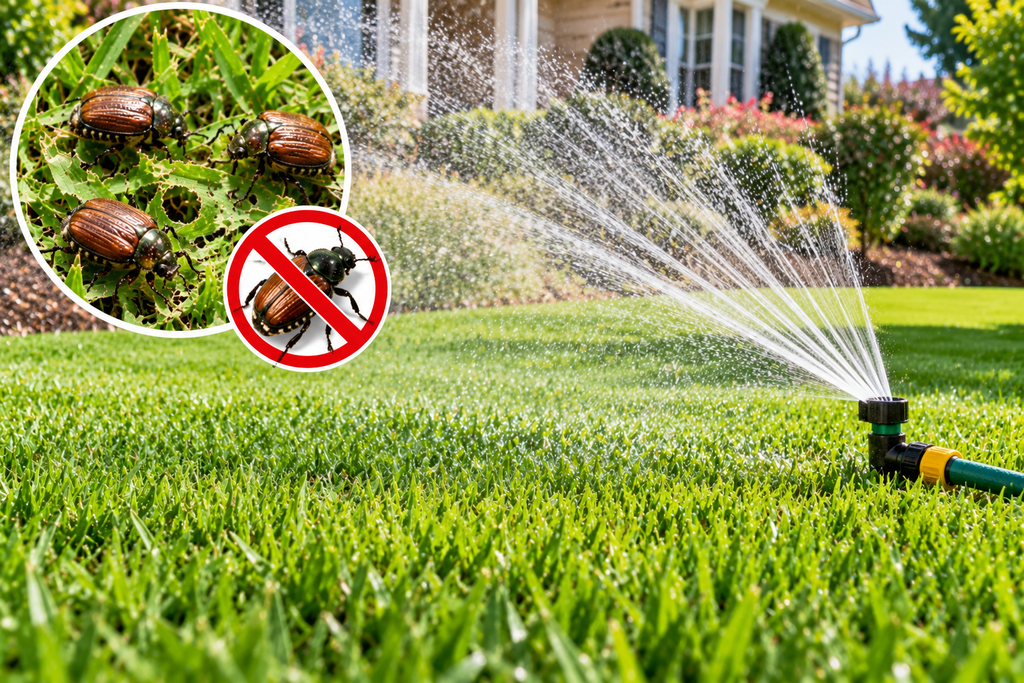
When grubs are present, the opposite applies. Deep, infrequent watering, roughly an inch a week including rainfall unless local guidance says otherwise, helps damaged turf keep growing while roots are being eaten.
Fertilizing
Over-fertilizing with nitrogen can produce lush, shallow-rooted growth that is appealing to insects and easily damaged. A modest, well-timed program based on a soil test is generally better. A soil test through a local extension office or a lab also reveals pH or nutrient problems that undermine root growth.
Thatch and compaction
A thick thatch layer can shelter insects and impede the movement of water and biological products into the soil. If thatch exceeds about half an inch, core aeration and topdressing can help. Aeration also improves root depth, which makes the lawn more tolerant of feeding.
Grass selection
Some turfgrass species and cultivars tolerate grub feeding better than others because of deeper or more extensive roots. Tall fescue tends to be more tolerant than Kentucky bluegrass in many comparisons. Endophyte-enhanced perennial ryegrass and fescue are marketed for insect resistance, but the protection is strongest against surface-feeding insects such as chinch bugs and billbugs, with weaker or inconsistent effects on white grubs. They are useful as part of a broader program, not a grub solution.
Adult Beetles: Handpicking, Traps and Why They Don’t Fix the Lawn
Adult beetles are visible and chewing on leaves, so they get most of the attention. It helps to separate two problems:
- Protecting plants from adult feeding.
- Reducing grubs in the lawn.
Dealing with the first does not reliably solve the second, because beetles fly in from neighboring properties and lay eggs wherever the soil is suitable.
Handpicking
On small plants, picking beetles off in the morning, when they are slower, and dropping them into a container of soapy water is a legitimate non-chemical method. It requires persistence and works best for a few shrubs, not an entire yard.
Pheromone and floral lure traps
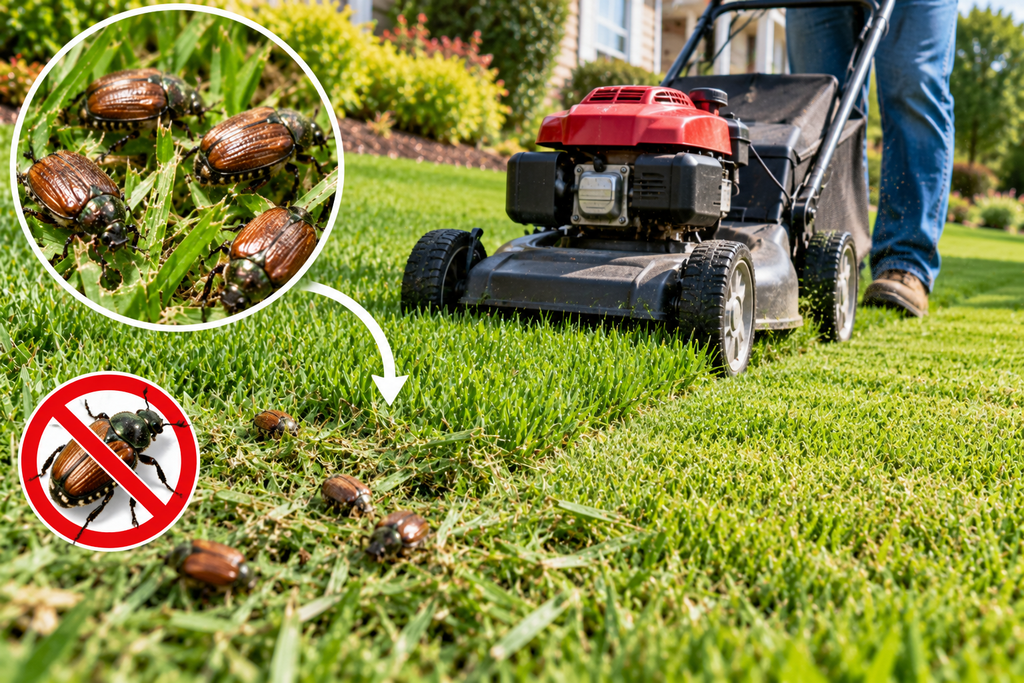
Commercial Japanese beetle traps use scent lures to draw beetles in. Research has repeatedly shown that traps can attract more beetles than they catch, which may increase feeding on nearby plants. If used at all, they should be placed far from the plants and lawn you want to protect, ideally at the property edge and downwind. Many extension services advise against them.
Plants
Some plants, including roses, grapes, lindens and Virginia creeper, are strongly favored by Japanese beetles. Others, including boxwood, lilac, many conifers and ash, are rarely bothered. Where a bed is being replanted, choosing less attractive species reduces the beetle load in that spot, though it will not change what happens in the neighbor’s yard.
Skunks, Raccoons, Crows and Moles
Animals digging in the lawn are a symptom, not the problem itself. Skunks and raccoons tear up turf in search of grubs, and the damage can be worse than the grub injury. Crows pull up patches.
Trapping or scaring the animals away will not help if the grubs remain, because new animals will come. The reliable fix is to reduce the grub population. Fencing or netting can protect small areas temporarily. Local wildlife rules vary, and handling skunks and raccoons carries risks, including bites and rabies exposure, so where trapping is considered, contact a licensed wildlife control professional.
Moles feed on earthworms and other soil invertebrates, including grubs. Their tunnels often appear when grub populations are high. Eliminating grubs may reduce mole activity, but moles can also persist on earthworms alone.
Repairing Damaged Turf
Once grubs are controlled or have gone, dead patches need attention.
- Rake out dead turf and loosen the top inch of soil.
- Check the soil for compaction or pH problems, and amend if a test shows a need.
- Seed or sod. In cool-season regions, early fall is the best time to seed. Choose a grass type suited to the site. Sod is faster but more expensive.
- Keep the seedbed moist with light, frequent watering until germination, then gradually shift to deeper watering.
- Avoid herbicides on newly seeded areas, and read the labels of any weed-and-feed products, since many prevent seed germination.
If the damage is in the same place year after year, look for conditions that make the spot attractive, such as a sunny, irrigated area near a streetlight, or an area with thin, weak turf.
When a Natural Approach Isn’t Enough
Natural controls have limits. They tend to work best when the population is moderate, the timing is right and the lawn is otherwise healthy. They are less reliable in these situations:
- Severe infestations, with counts well above the local threshold, large grubs and turf already collapsing.
- Wrong timing, such as spring treatment for big grubs.
- Mixed species, where a species-specific product like milky spore misses the main culprit.
- Neighboring properties with heavy populations, which keep replacing the grubs.
In those cases a conventional insecticide may be appropriate. Products used for grubs fall into two broad categories: preventive types applied in early to midsummer before or at egg hatch, and curative types applied once grubs are present. Some active ingredients are toxic to bees and other pollinators or to aquatic life, so they should not be applied to flowering plants or near water, and mowing flowering weeds before application is a standard precaution on many labels. Label instructions are legally binding, and local restrictions apply in some areas. A licensed lawn care professional or the local extension office can advise on what is permitted and appropriate, and professional help is sensible when the lawn is large, valuable or heavily damaged.
A Quick Way to Choose a Method
- Confirmed Japanese beetle grubs, long-term outlook, moderate numbers: nematodes in late summer, with milky spore as a background measure.
- Mixed or unidentified grubs, early to mid August through September: nematodes or Btg, applied to moist soil with young grubs.
- Large grubs in spring or already in fall: repair turf, confirm numbers, and plan treatment for next late summer. Do not expect biological products to rescue the lawn.
- Low counts (a few per square foot): no treatment, with better watering, mowing and aeration.
- Digging animals as the main complaint: treat the grubs, protect small areas with netting, and call a wildlife professional if needed.
Questions Readers Often Ask
Will the lawn recover on its own?
Sometimes. If roots were only partly eaten and the grass is watered, new roots can form. If the turf pulls up easily and the soil underneath is bare, reseeding or sodding is usually needed.
Can the nematodes and the milky spore be used together?
They can be, since they target grubs by different routes, but nematodes may kill grubs before they have a chance to carry milky spore forward. For a lawn that needs help this year, nematodes are the more practical choice.
Are natural treatments safe for dogs and children?
Nematodes, milky spore and Bt products are considered low risk to people and pets when used as directed, but safety statements vary by product. Follow the label, keep pets off until treated areas have dried or the label says otherwise, and wash hands after handling.
How long until I see results?
Nematodes and Btg may kill grubs within days to a few weeks, but the lawn itself will not look better until the grass regrows. Milky spore may take years.
Is it worth treating if the neighbors don’t?
Adult beetles fly between properties, so a treated lawn can still receive eggs. Better turf health and timely treatment still reduce damage on your property, but results are more consistent when nearby lawns are treated too.
Key Takeaways
Confirm the grubs and count them before treating anything, because many brown patches are not grub damage and low counts rarely justify treatment. Aim natural controls at young grubs in late summer, when nematodes and Btg work best, and expect little from spring applications. Use milky spore only for Japanese beetle grubs and only as a slow, long-term measure. Keep the lawn mowed high, watered deeply and aerated so it can tolerate some root loss. Skip beetle traps near the plants you care about. If counts are high and timing has passed, repair the turf now and plan a late-summer treatment for next year, and call a professional if the lawn is heavily damaged.

About Syprose Kiche
Syprose Kiche is the creator and writer behind My Besuited Home, a practical home and garden website covering DIY projects, gardening, lawn care, landscaping, home improvement, and outdoor living. She focuses on turning everyday homeowner questions into clear, practical guides backed by careful research and useful real-world considerations.