
A leaf with a few ragged holes tells you very little. The same hole could come from a slug last night, a caterpillar this morning, or a beetle that has already moved on. Most “natural pest control” advice fails at this step, because it hands you a remedy before you know who you are dealing with. Neem oil won’t stop a slug. Beer traps do nothing for aphids. A row cover applied after the squash bugs have already laid eggs just seals the problem in.
So this article is organized by pest. Find the damage you’re looking at, confirm the culprit, and use the method that fits the pest’s biology. Where a method has limits, they’re stated plainly. Where a fact varies by region or product, it’s flagged so you can check it locally.
Before You Treat Anything: Three Rules That Apply to Every Pest
Identify first. Look at the damage pattern, the time of day the damage appears, and the underside of leaves. A cheap hand lens helps with the tiny pests (thrips, spider mites, whiteflies). Your local cooperative extension office can identify a pest from a photo or specimen, usually for free.
Start with the least disruptive option. Hand removal, water sprays, barriers, and sanitation cost almost nothing and leave beneficial insects alone. Soaps and oils come next. They kill on contact, which means they also kill ladybugs and lacewings if sprayed carelessly.
Natural does not mean harmless. Insecticidal soaps, horticultural oils, neem products, and diatomaceous earth can all injure plants, bees, or the person applying them. Read the label, wear eye protection and gloves, and avoid spraying open flowers where pollinators are working. Homemade mixtures (dish soap and water, for example) are less predictable than commercial soap products. Household dish detergents contain additives that can burn leaves, and extension services generally recommend products labeled as insecticidal soap. If you do try a homemade spray, test it on one leaf and wait a day or two before treating the whole plant.
1. Aphids: Knock Them Off, Then Protect the Predators
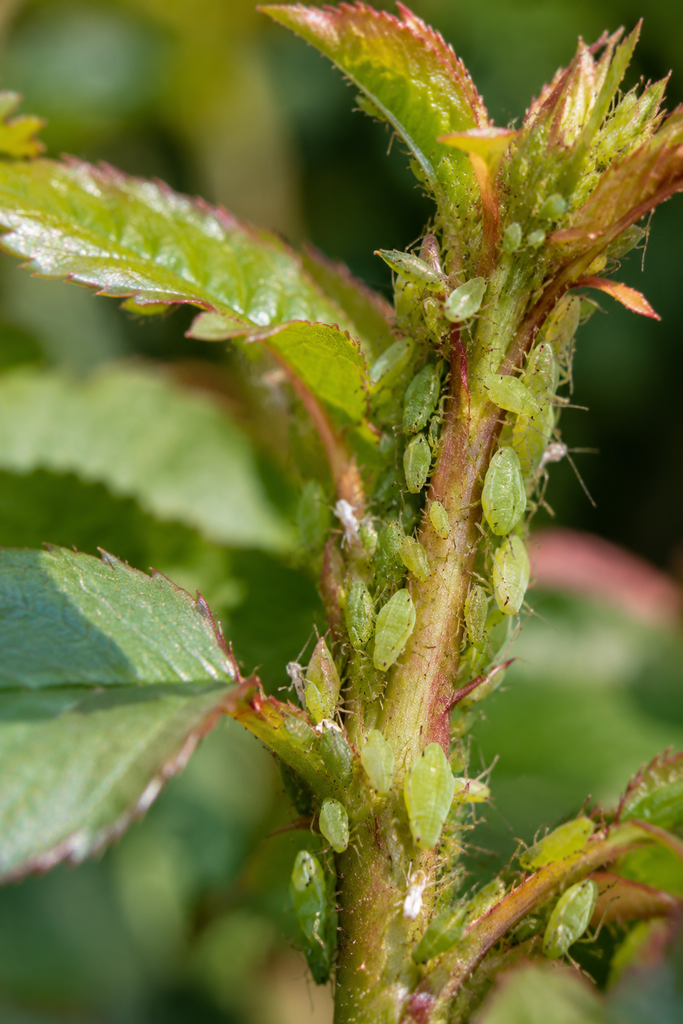
Aphids cluster on new growth and flower buds, and they leave behind sticky honeydew that attracts ants and can grow sooty mold. Curled, distorted leaves and a glossy film on the leaf surface are the usual clues.
A hard stream of water is the first move. Aphids that get knocked off a plant rarely climb back up, and the method costs nothing. Do it in the morning so leaves dry before evening, which matters for plants prone to fungal disease. Repeat every few days while the colony rebuilds.
Insecticidal soap works for colonies the water doesn’t clear. It only kills what it touches, so coverage of the leaf undersides is the whole game. It leaves no residual effect once dry, which is why repeat applications are normal.
Beneficial insects are the long-term answer. Ladybug larvae, lacewing larvae, and hoverfly larvae all eat aphids. Small-flowered plants such as alyssum, dill, and yarrow feed the adult stages and help keep the predators nearby. Note that purchased ladybugs often disperse quickly after release, so many extension sources suggest habitat planting over buying them.
Watch the fertilizer. Heavy nitrogen produces soft, fast-growing tissue that aphids favor. If the problem keeps recurring on a lushly fed plant, cutting back on nitrogen is part of the fix.
When it won’t work: Ants farm aphids for honeydew and defend them from predators. If ants are climbing the plant, deal with the ants (see below) or the aphids will keep bouncing back.
2. Slugs: They Feed at Night, So Fight Them on Their Schedule
Slugs leave irregular holes in leaves, often with silvery slime trails across the soil and foliage. They feed mostly at night and in damp weather, and they hide by day under boards, mulch, and dense groundcover. If you see the damage but never the culprit, a flashlight check an hour or two after dark settles the question.
Reduce their shelter. Thick, moist mulch, boards, and pots resting on soil are perfect daytime hideouts. Pulling mulch back a few inches from vulnerable plants like hostas and lettuce removes the hiding place at the exact spot where it matters.
Water in the morning. Wet soil overnight invites slugs. Morning watering lets the surface dry by dusk.
Use board traps. Lay a flat board or overturned flowerpot near affected plants. Slugs shelter underneath during the day, and you can collect and dispose of them each morning. It’s tedious but effective in a small bed.
Beer traps attract slugs, but the results are inconsistent. They work best as a monitoring tool: a trap sunk to soil level with its rim slightly above the surface tells you whether slugs are present and how many. Expect to refresh them often, and don’t count on them to clear a heavy infestation.
Iron phosphate baits are generally labeled for use around edible plants and are considered a lower-risk option than the older metaldehyde baits, which are toxic to pets and wildlife. Check the label for your crop and your pets.
Copper tape is sold as a barrier, but it works only if the slug must cross it, and it fails when plants touch the ground outside the ring, or when soil bridges the gap. It suits raised beds and containers better than open ground.
3. Snails: Same Family, Different Habits
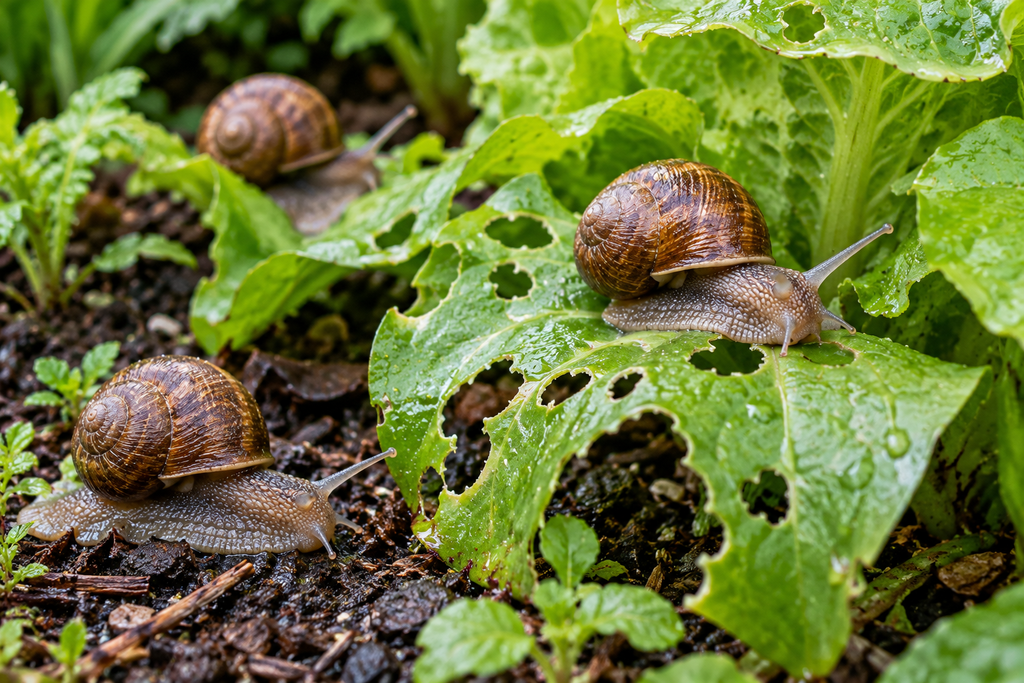
Snails cause nearly the same damage as slugs and respond to many of the same controls, so everything above applies. A few differences are worth knowing.
Snails need calcium for their shells and prefer shelter that stays cool and humid. They climb more readily than slugs, so you’ll find them on fences, pots, and stems, not just on the soil. That makes hand-picking easier: check pots, lower fence rails, and the undersides of container rims.
Drip irrigation helps here as it does for slugs. It keeps the soil surface drier than overhead sprinklers and reduces the humid surface film both pests travel on.
One caution on egg-shell and sand “barriers”: these are widely repeated, but evidence that they stop slugs or snails reliably is thin, and rain breaks them down. Treat them as a minor supplement at best.
4. Caterpillars: Match the Response to the Species
Caterpillars range from the garden’s worst enemies (cabbage worms, tomato hornworms) to future butterflies you may want to keep (swallowtails on parsley and dill, monarchs on milkweed). Before removing anything, identify it.
Handpicking works well for large caterpillars like hornworms, which blend into tomato foliage but leave obvious dark droppings and stripped leaves. A flashlight at dusk, or a UV light after dark, can help locate them.
Bacillus thuringiensis var. kurstaki (Btk) is a naturally occurring bacterium sold for caterpillar control. It must be eaten by young caterpillars to work, so it won’t harm adults or most other insects, but it will affect any caterpillars that eat the treated leaves, including butterfly larvae. Don’t spray it on plants where you’re trying to support butterflies. It breaks down in sunlight, so repeat applications and good leaf coverage matter. Always follow the label.
Row covers keep egg-laying moths and butterflies off brassicas. Put them on right after planting, before the first eggs appear, and seal the edges. They fail if the pest overwintered in the soil beneath the cover or if the cover goes on late.
Parasitoid wasps are the reason you shouldn’t kill a hornworm covered in small white cocoons. Those are the pupae of braconid wasps that fed on the caterpillar. Leaving it lets the next generation emerge to protect your plants.
5. Beetles: Different Species, Different Strategies
“Beetle” covers Japanese beetles, flea beetles, Colorado potato beetles, and many others. Treating them as one pest is a common reason a remedy disappoints.
Japanese beetles skeletonize leaves in summer. Handpicking into a jar of soapy water is effective on small infestations, and early morning is best because the beetles are sluggish. Be cautious with pheromone traps: they can draw more beetles into your yard than they catch. If you use them, place them well away from the plants you want to protect.
Flea beetles make tiny shotgun-pattern holes, especially in young brassicas and eggplants. Row covers at planting are the dependable defense. Healthy established plants usually tolerate the damage; it’s seedlings that suffer most.
Colorado potato beetles lay orange egg clusters on the undersides of leaves. Crush the clusters, hand-pick adults and the humpbacked larvae, and rotate potatoes and related crops to a different bed each year, since adults overwinter in soil near the previous crop.
Grubs (the larvae of some beetles) live in lawns and soil. If that’s the issue, the controls are different, and beneficial nematodes or milky spore products are matched to specific species. Confirm the species before buying.
6. Whiteflies: A Cloud When You Brush the Plant, a Problem on the Undersides
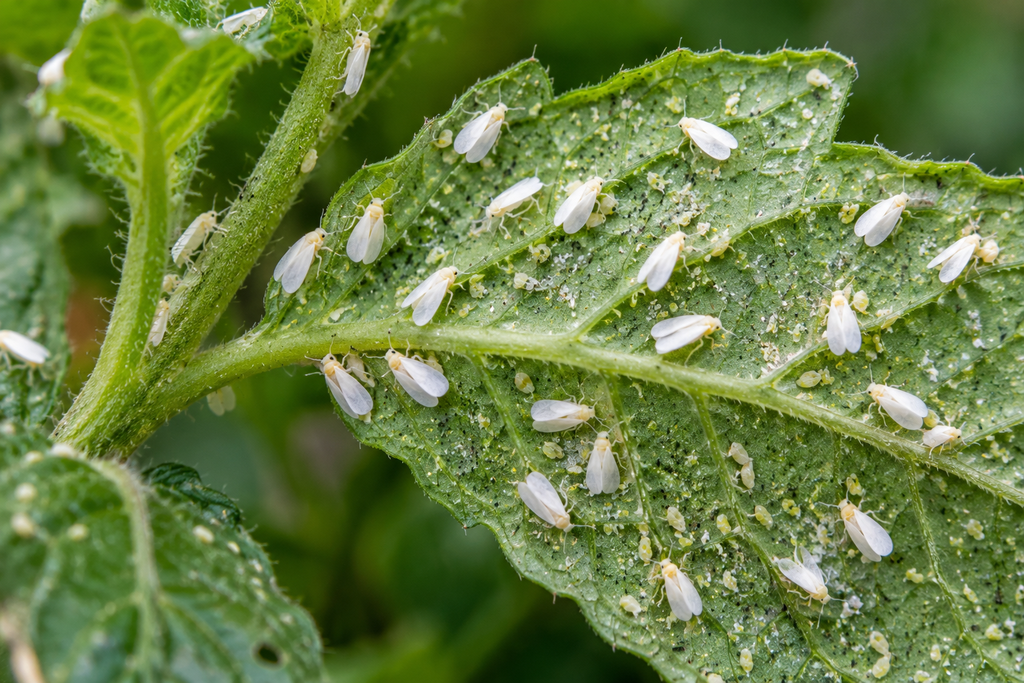
Tiny white insects flutter up when you disturb the foliage, and leaves may yellow and feel sticky. Check the undersides, where nymphs and eggs sit.
Yellow sticky traps are useful for monitoring and for catching adults, but they won’t clear an infestation alone. Hang them just above the plant canopy.
Spray the undersides with insecticidal soap or a horticultural oil, repeating at intervals according to the label. Whiteflies develop through several stages, and sprays hit the soft immature stages best. Adults fly off and return, which is why single treatments disappoint.
Remove heavily infested leaves and dispose of them away from the garden. In a greenhouse or indoors, encourage airflow and avoid moving infested plants beside healthy ones.
Reflective mulch, such as silver or metallic film, can confuse whiteflies and some other insects. It’s more practical in vegetable beds than ornamental plantings. Results vary with crop and conditions.
When to rethink the plant: if a plant has been repeatedly reinfested in a sheltered spot with poor airflow, moving it may help more than another round of spray.
7. Spider Mites: The Pest That Loves Hot, Dry Weather
Spider mites are barely visible. The clue is fine yellow or bronze stippling on leaves, sometimes with silk webbing at the leaf joints. Tap a leaf over white paper, and tiny specks that move are mites.
Water is the cheapest tool. Mites thrive in hot, dusty, dry conditions. A strong spray on the leaf undersides every few days knocks populations back and raises humidity around the plant.
Insecticidal soap or horticultural oil kills mites on contact. Because they reproduce quickly in warm weather, repeat applications per the label are usually needed. Don’t apply oils in high heat or to stressed plants, since leaf burn is a real risk. Check the product label for temperature limits.
Predatory mites are commercially available and work best in greenhouses and contained settings. Outdoors, success depends on temperature, humidity, and avoiding broad-spectrum sprays that would kill them.
Reduce drought stress. Water stress makes plants more attractive and more vulnerable. Consistent watering at the roots, and mulch to hold soil moisture, reduce the risk.
8. Earwigs: Often Both Villain and Helper
Earwigs chew ragged holes in soft tissue such as dahlia petals, lettuce, and seedlings. They also eat aphids and other small insects, so the decision isn’t always to eliminate them.
Trap them overnight. Earwigs hide in dark, tight spaces by day. A rolled-up damp newspaper or a short length of bamboo or garden hose left near affected plants collects them. Shake the contents into a bucket of soapy water each morning.
Remove daytime shelter. Piles of leaves, boards, and dense mulch beside plants all offer cover.
Protect vulnerable crops. Seedlings are at the most risk. Where damage is severe, collars around young plants and cleanup around the bed can reduce losses while the plants grow.
Weigh the benefit. If earwig numbers are moderate and damage is minor, tolerating them may be the practical choice, since they also feed on aphids and other soft-bodied pests.
9. Squash Bugs: Timing Beats Everything
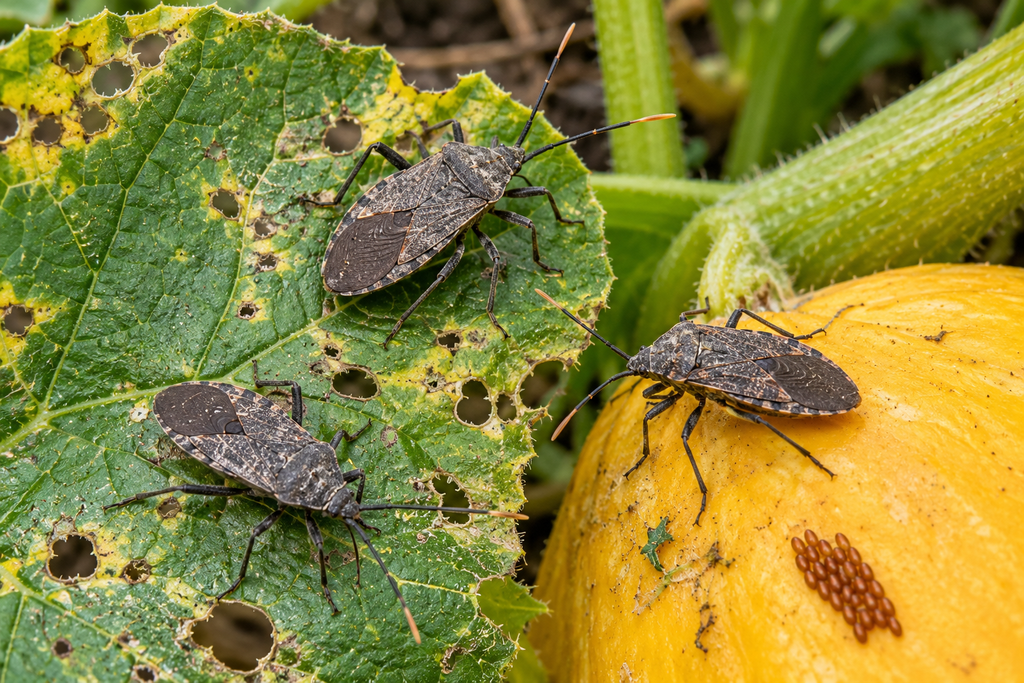
Squash bugs suck sap from pumpkins, squash, and zucchini, causing wilted, speckled leaves that turn brown. The shield-shaped gray-brown adults hide under debris, and clusters of bronze-colored eggs sit on leaf undersides, typically between the veins.
Check for eggs every few days. Scraping off or crushing egg clusters is the single most effective natural control. Eggs hatch into nymphs that are harder to manage, so earlier action is better.
Trap adults under boards placed near the plants. They gather there overnight, and you can collect them in the morning.
Use row covers early to keep adults away from young plants, but remove them when flowering begins so pollinators can reach the blossoms (or hand-pollinate if you keep covers on).
Clean up in fall. Adults overwinter in garden debris. Removing spent vines and rotating squash to a different bed reduces the number emerging next spring.
When it won’t work: Large nymphs and adults resist soaps and oils far more than young nymphs do. Treat early, or don’t count on sprays.
10. Cucumber Beetles: Protect the Seedlings and Watch for Disease
Striped or spotted cucumber beetles chew leaves and flowers, but the bigger risk is that they can spread bacterial wilt in cucumbers and melons. A plant that wilts suddenly while the soil is moist may be infected, and there is no cure once symptoms appear.
Row covers over seedlings are the strongest defense during the vulnerable early weeks. Remove them once flowers open so bees can pollinate.
Delay planting slightly in regions where early beetles emerge before plants are big enough to tolerate feeding. Check local extension guidance for timing.
Choose resistant varieties where available, especially if bacterial wilt is common in your area.
Remove and dispose of wilted plants promptly rather than composting them, and keep weeds down around the bed, since beetles shelter there.
11. Ants: Usually a Symptom, Not the Problem
Ants in the garden mostly matter when they protect aphids, scale, or mealybugs. They also nest in raised beds and containers, where they can disturb roots.
Treat the plant pests first. Remove the honeydew producers and the ants lose their reason to be there.
Block access. A band of sticky barrier product around a tree trunk keeps ants from climbing to the canopy. Apply it on a protective wrap, not directly to bark, and check that no bridges (branches, stakes) let ants bypass it.
Use borax-based baits with care. Boric acid and borax baits are commonly used against ants, but they can harm pets, children, and non-target insects. Place them in tamper-resistant stations the label recommends, away from where pets and wildlife can reach them.
Flood container nests. For ants in pots, soaking the container thoroughly or relocating the plant can encourage the colony to move. It’s a short-term fix.
Be realistic. Ant colonies can be large and extend well beyond your property. If they keep returning or nest near the house foundation, a licensed pest professional is a reasonable next step.
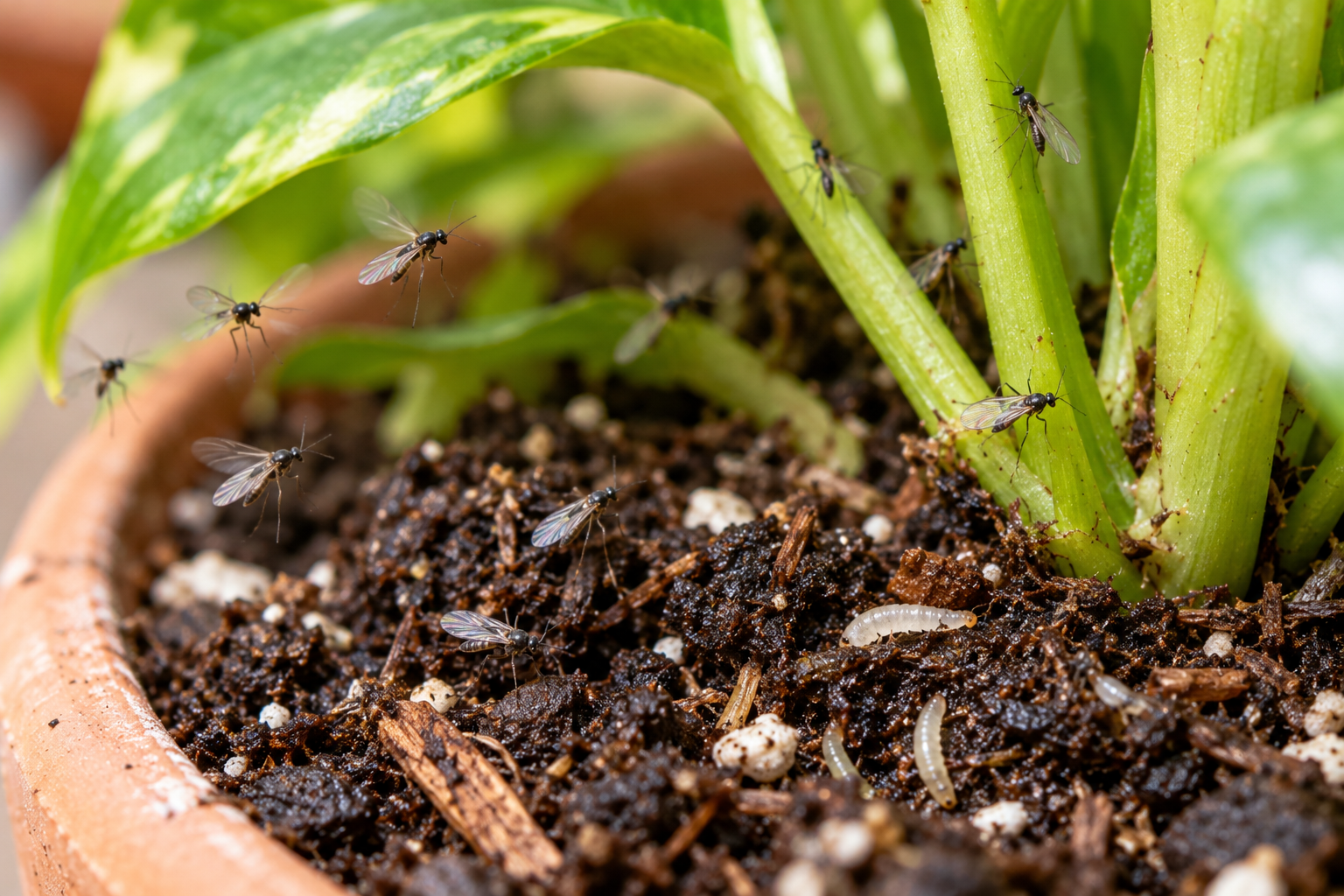
12. Fungus Gnats: A Watering Problem More Than a Bug Problem
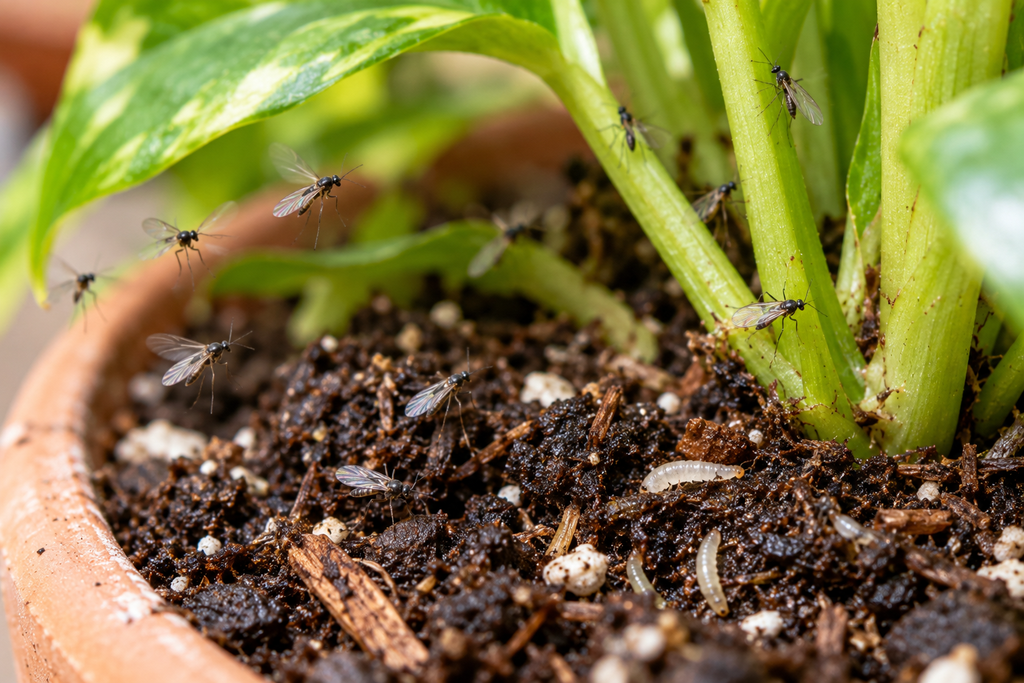
Fungus gnats are small, dark flies that hover around potted plants and rise when you water. Their larvae live in the top inch or two of damp potting mix, feeding on fungi and organic matter, and sometimes on tender roots.
Let the top layer dry. This is the most reliable fix. Larvae need constantly moist media, so letting the top inch or two dry out between waterings interrupts their life cycle. Be careful with moisture-loving plants, and adjust to what each species tolerates.
Bottom-water when appropriate, which keeps the surface drier while still hydrating the roots.
Use yellow sticky traps to catch adults and monitor numbers.
Treat the soil with Bti. Bacillus thuringiensis var. israelensis, sold in products such as mosquito dunks or gnat-specific granules, targets the larvae. Follow the product label for rates and apply as directed. This targets fly larvae specifically.
Avoid overwatering and old, soggy mix. Repotting into fresh, well-draining potting mix can help if the existing soil stays wet.
13. Thrips: Tiny, Fast, and Easy to Misdiagnose
Thrips are slender insects, typically under about 2 mm long, that rasp plant surfaces and feed on the sap. Damage appears as silvery streaks, black specks (their droppings), and distorted flowers or buds. They are easy to confuse with spider mite damage.
Confirm with a white sheet of paper. Shake a flower or leaf over paper; thrips appear as small slender specks that move.
Blue or yellow sticky traps help monitor adults. Blue is often used for thrips, though results vary.
Spray with insecticidal soap or spinosad-based products per the label, with attention to where thrips hide: inside buds, flower bases, and leaf folds. Spinosad can harm bees, so avoid spraying when pollinators are active and never on open blooms unless the label permits it.
Remove infested flowers and dispose of them in a sealed bag.
Control weeds around the bed, since they can host thrips that move onto crops. Reflective mulch can also reduce thrips pressure in some settings.
Be realistic about severity. Established thrips populations inside tight buds are hard to reach. Early detection and repeated treatment matter more than any single product.
14. Cutworms: Protect the Stem at Soil Level
Cutworms are caterpillars that hide in the soil by day and cut young seedlings off at the base at night. You come out to find a healthy seedling lying flat, with no sign of what did it.
Use collars. A cardboard tube, a paper cup with the bottom removed, or a similar collar pushed an inch or two into the soil and standing a couple of inches above it blocks the cutworm’s access to the stem. It’s simple and works well for transplants.
Dig around the stem. If a seedling is cut, gently dig around the base. Cutworms often curl up in a C-shape near the plant, and you can remove them by hand.
Till or turn soil before planting, which exposes larvae to birds and disrupts their cycle, and remove weeds early since they can attract egg-laying moths.
Consider beneficial nematodes where cutworms are a recurring issue. Their effectiveness depends on soil moisture, temperature, and the species of nematode, so check the label.
15. Stink Bugs: Reduce Damage, Not the Whole Population
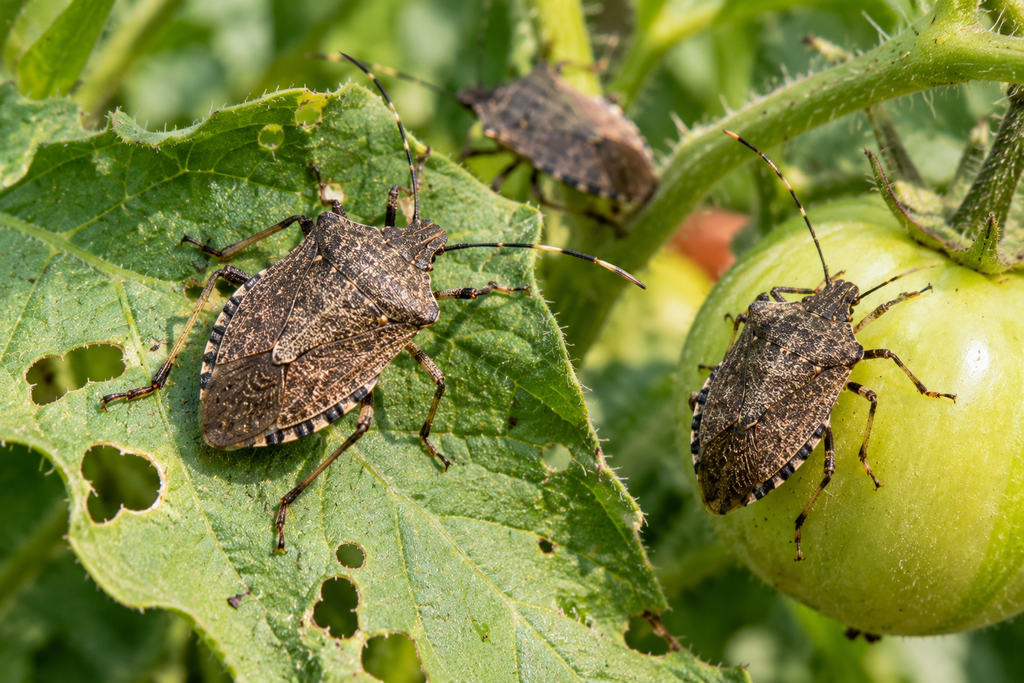
Stink bugs feed by piercing fruit and vegetables, leaving sunken, discolored, corky spots on tomatoes, peppers, beans, and tree fruit. They’re also a household nuisance in fall when they look for shelter.
Handpick into soapy water. It’s the simplest approach for small populations. Wear gloves if you want to avoid the odor.
Look for egg clusters on leaf undersides, usually small barrel-shaped eggs in tidy groups. Removing them early prevents nymphs.
Row covers protect crops during sensitive stages, though they must be removed for pollination.
Trap crops can draw stink bugs away from the main planting. Plants such as sunflowers or certain crops are sometimes used along borders, though results vary and need monitoring.
Clean up garden debris at season’s end, since adults overwinter in sheltered places.
Be realistic. Stink bugs are mobile, and they can fly in from surrounding areas. Even good control reduces rather than eliminates damage, and organic-approved sprays are often of limited effectiveness against adults.
Pests You Can Prevent: The Habits That Reduce Everything Above
A few practices lower pest pressure across the board:
- Rotate crops so soil-dwelling pests and diseases don’t build up in one bed.
- Clean up debris in fall, since many pests overwinter in plant litter.
- Water at the roots and keep foliage dry when you can.
- Plant diversity supports predators and parasitoids, so mix flowering plants into vegetable beds.
- Inspect regularly. A few minutes weekly with a close look at leaf undersides catches problems when they’re small.
- Keep records of what appeared and when. Many pests return on predictable schedules.
Common Questions
Is neem oil safe to use on everything?
Not necessarily. It can harm beneficial insects and bees if sprayed on open blooms, and it can burn leaves in hot, sunny conditions. Read the label for the plants and temperature range it covers.
Does diatomaceous earth kill garden pests?
It can kill soft-bodied insects that contact it when dry, but it loses effectiveness when wet and can also harm beneficial insects. Wear a dust mask when applying it, since fine dust irritates the lungs.
When should I call a professional?
If a pest threatens a tree, keeps returning despite repeated efforts, or nests near your home, your local extension office or a licensed professional can offer species-specific advice.
Key Takeaways
Identify the pest before you treat it, because the right method for a slug is wrong for an aphid. Start with removal, barriers, and sanitation, and move to soaps, oils, or biological products only when needed, following label directions each time. Time your efforts to the pest’s life cycle: crushing squash bug eggs this week saves you from fighting nymphs next week. And when a problem keeps returning, look for the underlying condition (overwatering, ants, heavy nitrogen, debris) rather than the next spray.

About Syprose Kiche
Syprose Kiche is the creator and writer behind My Besuited Home, a practical home and garden website covering DIY projects, gardening, lawn care, landscaping, home improvement, and outdoor living. She focuses on turning everyday homeowner questions into clear, practical guides backed by careful research and useful real-world considerations.