
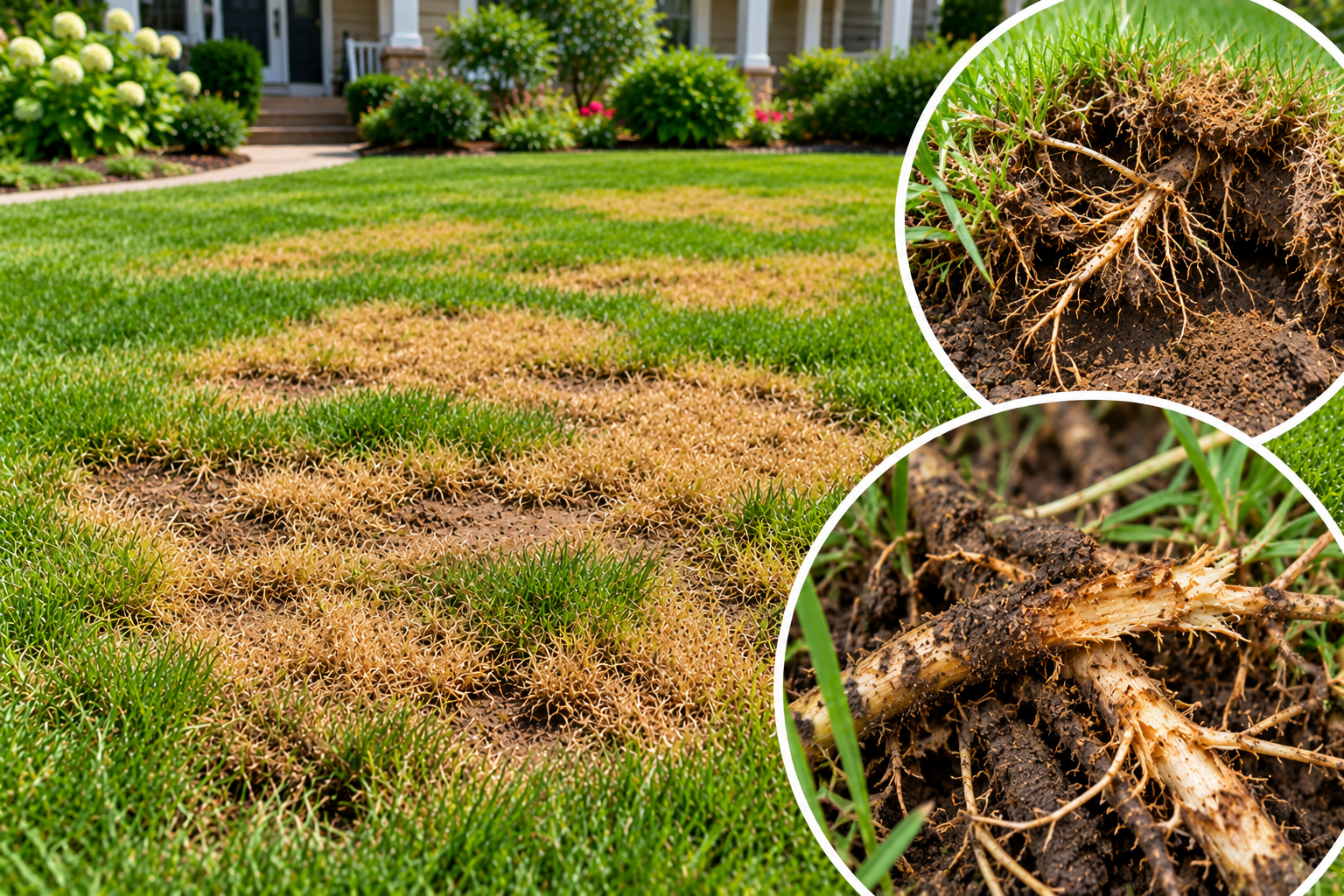
A lawn that turns straw-colored in July looks like it needs water. So you water it. Two weeks later the patch is bigger, or it hasn’t changed at all, or it has gone from tan to a darker, dead-looking gray. That is the point where drought stops being a good explanation.
Drought stress has a recognizable pattern. The whole lawn fades more or less together, the grass blades turn a dull blue-gray before they turn tan, and footprints stay pressed into the turf because the blades have lost the stiffness to spring back. Most importantly, it responds to a deep soaking. If a lawn gets a proper watering and does not green up within a week or two, something else is going on.
That “something else” is surprisingly often one of thirteen things. Several are insects feeding on roots or leaves. Some are diseases. Others are mechanical or soil problems that stop water from reaching roots no matter how much comes out of the sprinkler. The trouble is that all of them end up looking like the same brown patch, and the wrong fix (more water) can make several of them worse.
First, Rule Drought In or Out
Before working through the list, run three quick checks.
The tug test. Grab a handful of brown grass and pull gently. Grass that is dormant or drought-stressed stays anchored, because its roots are alive. If the turf lifts like a loose carpet, roots have been cut, eaten, or rotted. That points to grubs, root damage, or severe disease rather than thirst.
The screwdriver test. Push a long screwdriver into the soil a day after a good soaking. It should slide in with moderate pressure to a depth of several inches. If it stops at one or two inches, you are dealing with compacted soil or a hard layer underneath.
The pattern check. Drought usually follows sun exposure, slopes, and areas near pavement, because those dry out first. Insects and disease tend to make circles, irregular spreading patches, or damage along edges. Mechanical problems follow the mower’s path or the dog’s favorite spot.
Here is a quick reference before the details.
| What you see | Most likely culprits |
| Turf peels up easily like carpet | Grubs, root damage, severe thatch |
| Patches expand despite watering, often beside pavement in full sun | Chinch bugs |
| Circular or ring-shaped patches, worse after humid nights | Lawn fungus |
| Brown with green rings or green edges, small and scattered | Dog urine |
| Brown only where water pools after rain | Poor drainage |
| Brown, hard, water runs off | Compaction, soil problems |
| Straw-colored stubble after mowing | Scalping or mowing stress |
| Whole lawn tan but crowns firm, grass pulls with resistance | Heat dormancy |
1. Chinch Bugs: Tiny Insects That Mimic Sun-Scorched Grass
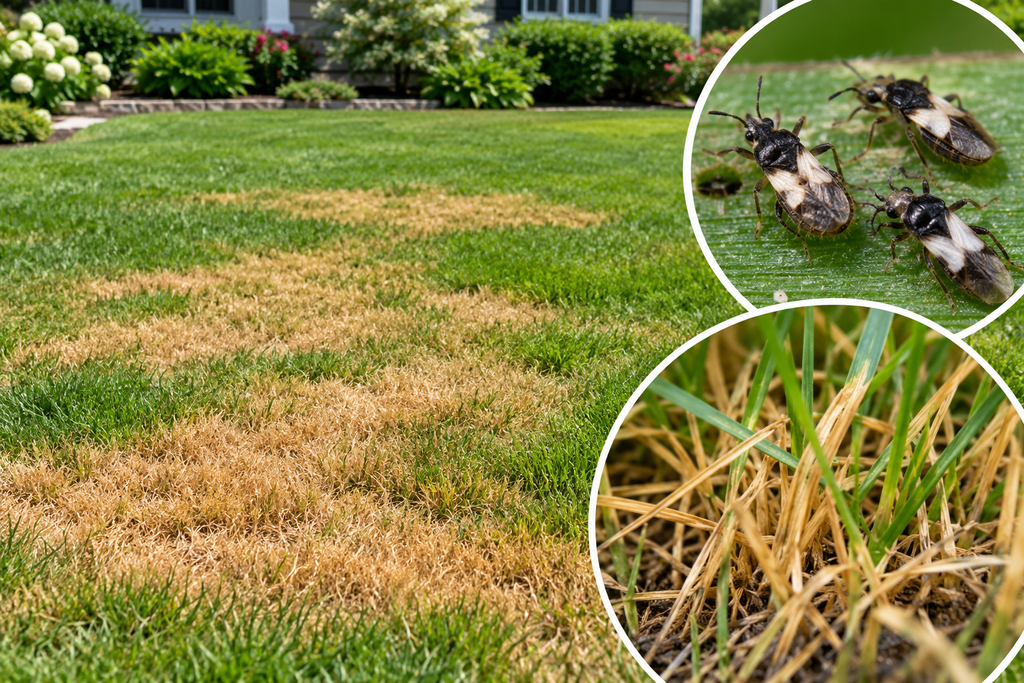
Chinch bugs are small sap-feeding insects, only about an eighth of an inch long as adults. They push their mouthparts into grass blades and stems and feed on plant juices, and the feeding also injects a substance that causes the grass to yellow, then brown, then die. Because they are drawn to hot, dry, sunny areas, the damage appears exactly where drought would be expected to appear first: along driveways, sidewalks, south-facing slopes, and curbs.
That overlap is why they get misdiagnosed so often. Watering does not revive the grass because the problem is not water. The patches grow outward as the insects move to fresh turf.
St. Augustinegrass is the classic target in warm regions, and the same family of pests affects other grass types in northern lawns, though the species and the exact timing differ by region. Cool-season lawns can be hit in the hottest weeks of summer.
How to confirm it. Look at the edge of a patch, where yellowing grass meets green grass, since that is where insects are active. Part the grass and look down at the soil surface and thatch for tiny black bugs with white markings on the wings. You can also try a flotation test: cut both ends off a large can, press it a couple of inches into the soil at the edge of the damaged area, fill it with water, and wait around ten minutes. Chinch bugs tend to float to the surface. Many extension services describe treatment thresholds in terms of insects per square foot, and those numbers vary by region and grass type, so check your state extension office before deciding the infestation is serious enough to treat.
What to do. Light infestations can sometimes be managed by correcting conditions that favor them, such as heavy thatch and drought stress. Insecticidal soap and some botanical products can reduce populations, though they usually need repeat applications and thorough coverage of the thatch layer. For heavier infestations, products labeled for chinch bugs are available, and the label controls everything: the lawn area, the timing, the watering-in instructions, and how long people and pets should stay off. Do not spray when the grass is flowering weeds that bees visit.
2. Grubs: When the Roots Are Gone but the Surface Looks Thirsty
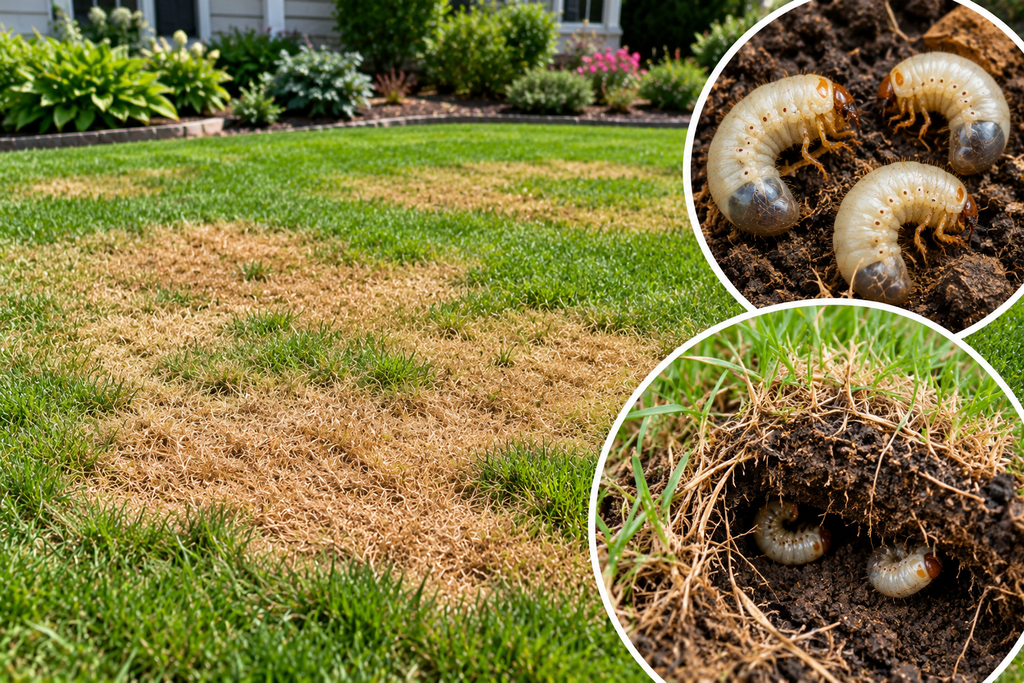
Grubs are the larvae of beetles such as Japanese beetles, European chafers, and June beetles. They live in the soil and feed on grass roots, which means the lawn loses its ability to take up water even though the soil may be perfectly moist. The top growth wilts and browns as if from drought, and the damage usually becomes visible in late summer into early fall, when grubs are growing and feeding heavily.
The giveaway is the tug test. Severely damaged turf comes up easily, with little or no root attachment, and you can often roll it back like a rug. Underneath you will find plump, white, C-shaped larvae with brown heads. Skunks, raccoons, crows, and moles digging up the lawn are another sign, because they are hunting the grubs.
How many is too many? A few grubs per square foot are normal and healthy lawns tolerate them. Commonly cited action thresholds are around five to ten grubs per square foot, but the number depends on grass species, how healthy the turf is, and the grub species. Cut a square foot of sod on three sides, peel it back, count the grubs, and compare the number to your local extension guidance.
Timing matters more than product choice. Preventive products applied in early to mid summer target newly hatched grubs. Curative products work on larger grubs in late summer or early fall, but they are less effective once grubs are big, and the grubs stop feeding as soil cools in late fall. Nematodes and milky spore are sometimes recommended as lower-impact options, though their effectiveness depends on the species of grub, soil temperature, and moisture, and results can be inconsistent. Read the label and match the product to the grub species in your lawn.
Watering a grub-damaged lawn does not fix it. After treatment, the damaged areas usually need to be re-seeded or patched, since roots will not regrow into dead sod.
3. Lawn Fungus: Brown Patches That Get Worse With Water
This is the problem where the drought instinct does the most harm. Fungal diseases love moisture, and a lawn that is watered lightly every evening can create exactly the conditions they need: grass blades that stay wet through the night.
Several diseases produce browning that gets mistaken for drought.
Brown patch shows up in hot, humid weather, especially when nighttime temperatures stay high. Patches are roughly circular and can range from a foot to several feet across. On tall-cut grass, you may see a darker “smoke ring” at the edge in the early morning when dew is present.
Dollar spot produces small, straw-colored spots about the size of a silver dollar, which can merge into larger irregular areas. It is commonly associated with lawns low in nitrogen, and tends to appear when days are warm and nights are cool and humid.
Summer patch and similar root-infecting diseases attack roots and crowns, producing ring or crescent-shaped patches during hot weather. They are harder to identify without a closer look and are sometimes confused directly with drought and grub damage.
How to tell fungus from drought. Disease lesions on individual blades are a clue: spots with distinct borders, or entire blades that look water-soaked or have a banded appearance. Early morning is the best time to look, because some fungi produce visible cottony growth when the grass is wet. Drought-stressed grass looks uniformly dull and curled rather than spotted.
What helps. Water deeply and infrequently, early in the morning, so blades dry quickly. Avoid evening watering. Mow at the recommended height for your grass type and keep blades sharp, since ragged cuts give fungi easy entry. Do not overfeed with nitrogen during hot weather, which can fuel some diseases (though dollar spot is the exception, tied to low nitrogen). Fungicides exist, but they are usually protective rather than curative, and many lawn diseases resolve on their own as weather cools if the grass crowns are alive. If the same patches return every year, getting the specific disease identified through a diagnostic lab can save money and time.
4. Compaction: The Lawn Is Getting Water. The Roots Are Not.
Soil compaction squeezes out the air spaces that roots need and water uses to move downward. In a compacted lawn, rain and irrigation run off or sit on the surface and evaporate, so grass roots stay shallow and dry even though the sprinkler runs on schedule.
Compaction is common in heavily used areas, along paths where people cut across the grass, in lawns built on construction-site soil, and in clay soil that has been walked on while wet. New housing developments often have it because topsoil gets stripped and heavy equipment packs the subsoil.
The screwdriver test is the quickest diagnostic. If it will not penetrate more than an inch or two even after a soaking, the soil is hard. Other clues include thin turf, bare patches in high-traffic zones, water pooling, and the presence of weeds like plantain and knotweed that tolerate compacted ground.
The fix is core aeration, which pulls plugs of soil out of the lawn. Rent a machine with hollow tines rather than spikes, because solid spikes can push soil together around the hole. Aerate when the grass is growing strongly so it can fill in: early fall or spring for cool-season grasses, and late spring to early summer for warm-season grasses. Aerating a drought-stressed or dormant lawn in midsummer heat can add stress.
Overseeding right after aeration works well because seed drops into the holes and makes good contact with soil. A thin layer of compost raked across the surface adds organic matter over time. Aeration will not hold up long if the real cause, like repeated driving or foot traffic over wet soil, continues. In that case, a stepping path or redirected traffic is the longer-term answer.
5. Soil Problems: When What’s Under the Turf Is the Real Issue
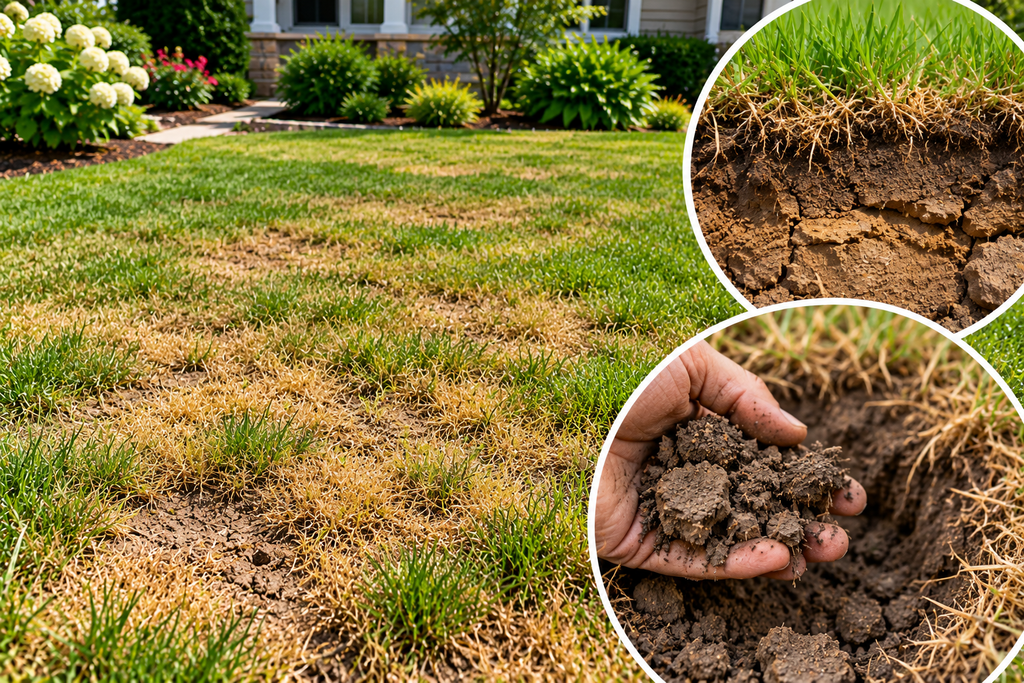
Sometimes the grass is fine and the soil is the problem. The lawn may have been seeded over a thin layer of topsoil on top of rubble, clay fill, or a sandy base. In those situations the grass roots have nowhere to go, and the lawn dries out quickly whenever the weather turns hot.
A few soil conditions commonly produce drought-like symptoms.
Shallow topsoil. Dig a small plug out of the lawn and look at the profile. Healthy turf soil usually has several inches of dark, root-filled topsoil. If you hit gravel, clay, or debris an inch or two down, the grass roots are limited to that thin layer, and it dries out faster than deeper soil.
Very sandy soil. Water drains through it so fast that roots barely get a chance to take it up. Sandy lawns can brown quickly in summer and may need more frequent but still moderate watering, plus organic matter worked in over time.
Heavy clay. Clay holds water but can seal on the surface, causing runoff. It also compacts easily, which circles back to the previous problem.
Hydrophobic (water-repellent) soil. Dry soil, especially sandy or high-organic soil, can become water-repellent. Water beads and runs off rather than soaking in. A sign is water that pools on the surface and then moves sideways, with dry soil only a short distance below. Slow, repeated, light watering cycles help water start penetrating, and wetting agents are sold for the purpose.
Soil pH and chemistry. Extremely acidic or alkaline soil limits nutrient uptake, which can leave grass weak and pale. A soil test through your local extension service or a reputable lab tells you pH, nutrient levels, and sometimes organic matter. It costs little compared with guessing, and the report usually includes lime or fertilizer recommendations specific to your lawn.
6. Thatch: The Spongy Layer That Sheds Water
Thatch is the layer of dead and living stems, roots, and debris that builds up between the green grass blades and the soil surface. A thin layer, around half an inch or less, is normal and even beneficial. When it grows thicker, it can act like a mat that sheds water, harbors insects and disease, and encourages roots to grow in the thatch rather than in the soil, where they are more exposed to drying out.
A thick thatch layer produces drought symptoms because water often runs off or gets held in the thatch and evaporates without reaching the soil. The lawn feels spongy underfoot, and grass crowns may be sitting on top of the layer rather than in the soil.
Cut a small wedge of turf and measure the brown fibrous layer between green grass and soil. If it is thicker than about half an inch, it is worth addressing.
Thatch tends to accumulate faster with certain grasses (Kentucky bluegrass, zoysia, and Bermuda grass are commonly cited), and with heavy nitrogen fertilizing and frequent shallow watering. Contrary to popular belief, clippings left on the lawn do not generally cause thatch, since they break down quickly.
Fixes. Core aeration helps break up and incorporate thatch over time. Power dethatching (vertical mowing) can remove it more aggressively, but it is hard on the lawn. Dethatch when the grass is actively growing and able to recover: early fall or spring for cool-season grasses, late spring for warm-season grasses. Avoid doing it in the heat of summer. Rake out the debris and consider overseeding afterward.
7. Dog Urine: Brown Spots With Green Rings
Dog urine contains concentrated nitrogen and salts. A little nitrogen feeds grass, which is why you often see a dark green ring around a dead spot: the center received a damaging dose, and the outer edge got a diluted, fertilizing one.
That ring is the best identifying feature. Other clues are scattered patches of consistent size, usually in spots the dog favors, such as along fences or near the door. Spots are often a few inches to several inches across.
Urine damage does not respond to watering unless you do it right after the dog goes, because the damage is already done by the time browning shows. Immediate diluting, meaning a thorough soaking of the spot soon after urination, can reduce the harm.
Repairs: rake out the dead grass, flush the soil with water to move salts below the root zone, and reseed or patch with sod. Some people train dogs to use a designated area with mulch or gravel. Diet changes and so-called lawn-saving supplements are sold, but evidence for them is mixed, and changing a dog’s diet or adding supplements should be discussed with a veterinarian first.
Dog urine is also often blamed when something else is going on, like grubs or fungus. If spots appear in places the dog never goes, look elsewhere.
8. Poor Drainage: Too Much Water Looks Like Too Little
This one confuses people because the grass wilts and browns in soggy soil. Roots need oxygen. When soil stays saturated, roots suffocate and decline, and the grass above ground can no longer take up water even though water is everywhere. The result looks like drought, even in a wet season.
Tell-tale signs include browning in low spots, areas where water stands for a day or more after rain, moss or algae on the soil surface, a sour smell, and shallow, weak roots. Digging a small hole and watching how quickly it drains (or whether it fills up and sits) tells you a lot. Overwatering, particularly on heavy soil, produces the same problem.
Causes include heavy clay, compaction, a high water table, downspouts discharging onto the lawn, grading that slopes toward low spots, and underground layers that block drainage.
Fixes depend on the cause. Redirecting downspouts and adjusting irrigation schedules are inexpensive and often enough. Aeration can improve infiltration in compacted soils. For persistent standing water, regrading, installing a French drain, or creating a rain garden may be warranted, and larger earthworks involve utility lines, property drainage rules, and neighbor impacts. A landscape contractor or drainage specialist is a reasonable call at that stage. Call your local utility locating service before any digging.
9. Root Damage: When Something Has Disrupted the Root System
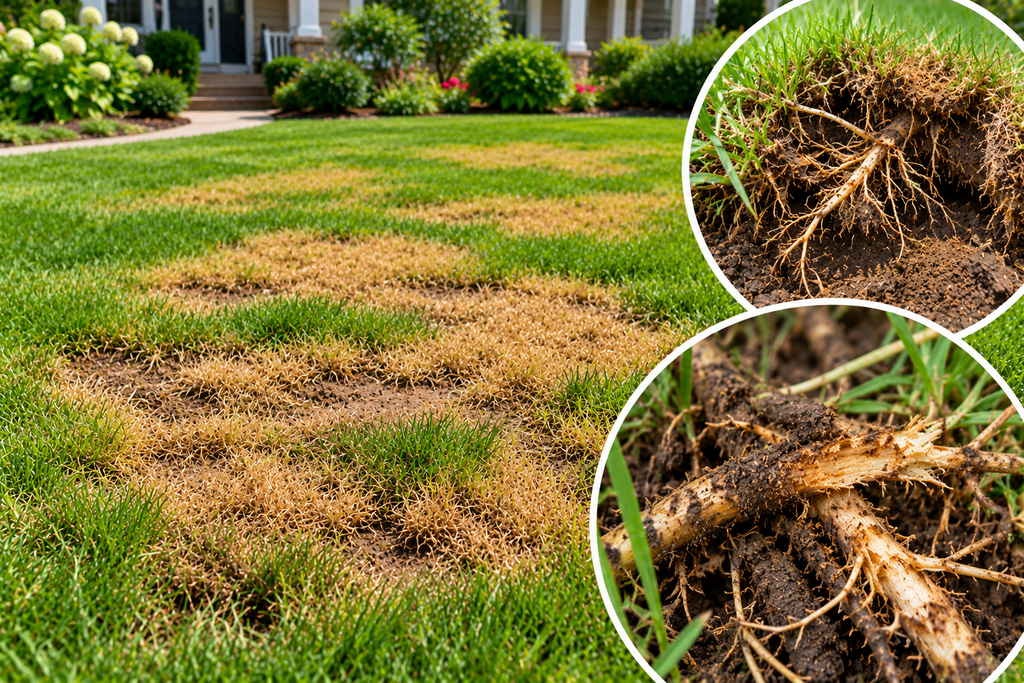
Beyond grubs, a handful of other things can damage roots and cause the lawn above to wilt.
Fertilizer or chemical burn. Too much fertilizer, a spill, or herbicide misapplied can burn roots and blades. Streaks following a spreader pass, or damage in a spilled spot, are the giveaway.
Construction and utility work. Trenching, grading changes, buried debris, and compaction from equipment can sever or smother roots. Damage may appear weeks or months after the work.
Tree roots. Large trees compete with grass for water and nutrients, and shade reduces grass vigor. Grass near mature trees often thins and dries out first.
Irrigation and plumbing leaks. A cracked sprinkler line or a leaking pipe can saturate one area while starving another. Unexplained soggy spots, or an unexpected rise in the water bill, are clues.
Roots rotting under disease. Some diseases mentioned above attack roots directly.
The tug test and a small dig-up usually show what you are dealing with. Healthy roots are white or cream-colored and firm. Brown, mushy, short, or missing roots tell you the problem is below ground. Treatment depends on cause. Stop the damage source, water appropriately, and reseed or resod areas that do not recover.
10. Nutrient Deficiency: Pale Grass That Needs Feeding, Not Soaking
Nitrogen-starved grass looks pale green to yellow, grows slowly, and thins out. Because it lacks vigor, it is less tolerant of heat and dry spells, so people often read the faded color as thirst.
A nitrogen deficiency tends to appear as an overall light green or yellow cast over the lawn, often more noticeable on older growth. Iron deficiency can show up as yellowing while veins stay green, especially on high-pH soils. Potassium plays a role in stress tolerance and low levels may leave grass more vulnerable to heat and disease.
Before reaching for a bag of fertilizer, test your soil. Guessing can lead to over-fertilizing, which burns grass, fuels disease, and washes nutrients into waterways. Local extension recommendations usually say how much nitrogen per thousand square feet to apply and when, and the right timing depends on grass type. Cool-season lawns typically do best with fall feeding, while warm-season lawns are fed in late spring and summer during active growth. Avoid heavy feeding of cool-season grass in the heat of summer, and never apply fertilizer to a drought-stressed, dry lawn without watering it in as the label directs.
Grass clippings left on the lawn return some nutrients and help, which is a good reason to mulch-mow when the turf is dry.
11. Scalping: When the Mower Cut Too Low
Scalping removes most of the green leaf and exposes brown stems and soil. The lawn suddenly looks tan and stubbly in patches, which gets mistaken for drought stress. It often happens on bumps, slopes, ridges, and uneven ground where the mower deck drops lower than expected, or after setting the mower on its lowest setting.
Scalping is especially damaging in summer. Taller grass shades soil, keeps it cooler, and supports deeper roots. A scalped lawn loses leaf area for photosynthesis, so the plant draws on stored energy, exposes soil to heat and weed seeds, and takes a while to recover.
Prevent it by raising the deck and following the one-third rule: never remove more than about a third of the blade height in one mowing. Typical recommended heights vary by grass: cool-season grasses such as tall fescue and Kentucky bluegrass often do best at roughly three to four inches, while Bermudagrass and zoysia are often kept much lower, and St. Augustine is kept taller. Check your local extension guidance for your species. Scalped patches usually recover with water, a light feeding according to soil test guidance, and a higher mowing height. Overseed bare patches if grass does not return.
12. Mowing Stress: Dull Blades, Wet Grass, and Repeated Patterns
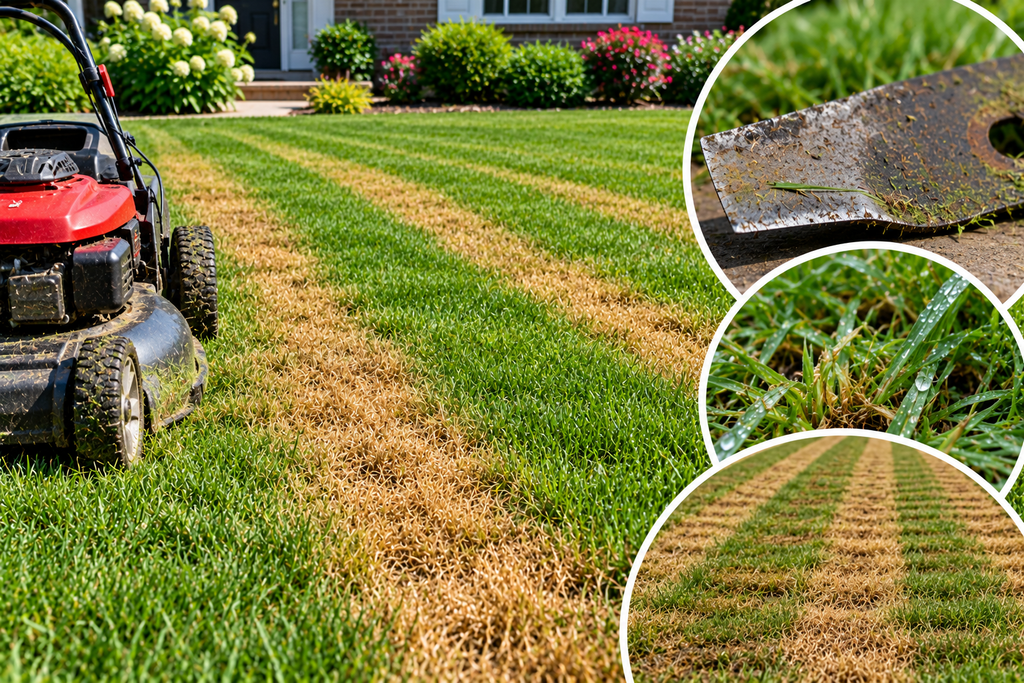
Even when the height is right, how you mow matters. Several habits produce a drought-like cast.
Dull blades. A dull blade tears grass rather than cutting it cleanly. The shredded tips dry out and turn gray-brown, and the whole lawn takes on a faded look a day or two after mowing. Look closely at the tips of the blades: frayed, ragged edges point to dull blades. Sharpen the blade at least once a season, and more often for heavy use.
Mowing in the heat of the day, or in drought. Cutting grass when it is already stressed adds one more strain. Mow in the cooler part of the day, and consider skipping or raising the height during extreme heat.
Mowing wet grass. Clumps, uneven cuts, and clogging all result, and wet clippings can spread disease.
Same pattern every time. Repeating the same path compacts the soil in wheel tracks and encourages grass to lean in one direction. Alternate your mowing direction.
The fix is cheap: sharper blades, higher deck, cooler mowing times, and a varied pattern.
13. Heat Dormancy: The One That Really Is Drought, Sort Of
Heat dormancy is a survival response, not damage. Cool-season grasses like Kentucky bluegrass, fine fescue, and perennial ryegrass can go dormant when summer heat and dry weather combine. Warm-season grasses go dormant in cold weather rather than heat, so it is also normal for them to turn brown in winter.
A dormant lawn turns tan or straw-colored, but the crowns, which sit at the base of the plant, stay alive. That is the key difference from a dead lawn. Crowns on dormant grass are firm and pale, and the grass resists pulling. Dead grass pulls out easily.
Many cool-season lawns can survive several weeks of dormancy without water. If dry weather will last longer than three or four weeks, many extension programs advise giving the lawn a small amount of water every couple of weeks to keep crowns hydrated, without trying to turn it green. The exact amount and frequency depend on region and grass species, so check local recommendations. Reduce traffic on dormant grass and avoid fertilizing or applying herbicide to a stressed lawn.
When the weather cools and rain returns, dormant grass typically recovers. If it does not green up after a few weeks of favorable conditions, then something else, from the previous twelve causes, is likely involved.
Questions Readers Often Ask
How long should I wait before deciding a brown lawn is dead rather than dormant? Give it a thorough soaking, then watch for new green growth at the base of the blades over the next two to three weeks. If crowns stay brown, mushy, or pull away easily, the grass is dead. If weather conditions are not yet favorable for growth, such as continued extreme heat, recovery may be delayed.
Can I treat several of these problems at once? Often they overlap. Compaction, thatch, and shallow roots frequently occur together, and a lawn weakened by one issue becomes more vulnerable to insects and disease. Diagnose first, then fix the underlying cause rather than applying products at random. Spraying insecticide on a fungus problem, or fungicide on a grub problem, will not help.
Is watering more ever the right answer? When soil is dry several inches down, and the grass responds within days, yes. Many lawn care sources suggest roughly an inch of water per week, from rain and irrigation combined, delivered in one or two deep sessions rather than daily sprinkles. Needs vary with soil type, temperature, and grass species.
Should I call a professional? It is worth it when you cannot identify the cause after the basic tests, the problem returns every year, you suspect a drainage or irrigation fault that needs excavation, or the damage covers a large area. A local extension office or a diagnostic lab can often help with identification at low cost.
Wrapping It Up
A brown lawn is a symptom, not a diagnosis. Before turning on the sprinkler again, do the tug test, push a screwdriver into the soil, and look at the edge of the damaged area at the base of the grass. Those three checks separate roughly half of these problems from true drought.
If the roots are gone, think grubs or root damage. If the soil is hard, think compaction. If patches are circular and worse in humid weather, consider fungus. If water is pooling, look at drainage. And if the grass is firm at the crown and the weather has been hot and dry, it may simply be waiting for cooler days.
Before using any insecticide, fungicide, or fertilizer, read the label, follow rates and timing, keep children and pets off treated areas as directed, and confirm local thresholds with your state extension service.

About Syprose Kiche
Syprose Kiche is the creator and writer behind My Besuited Home, a practical home and garden website covering DIY projects, gardening, lawn care, landscaping, home improvement, and outdoor living. She focuses on turning everyday homeowner questions into clear, practical guides backed by careful research and useful real-world considerations.