
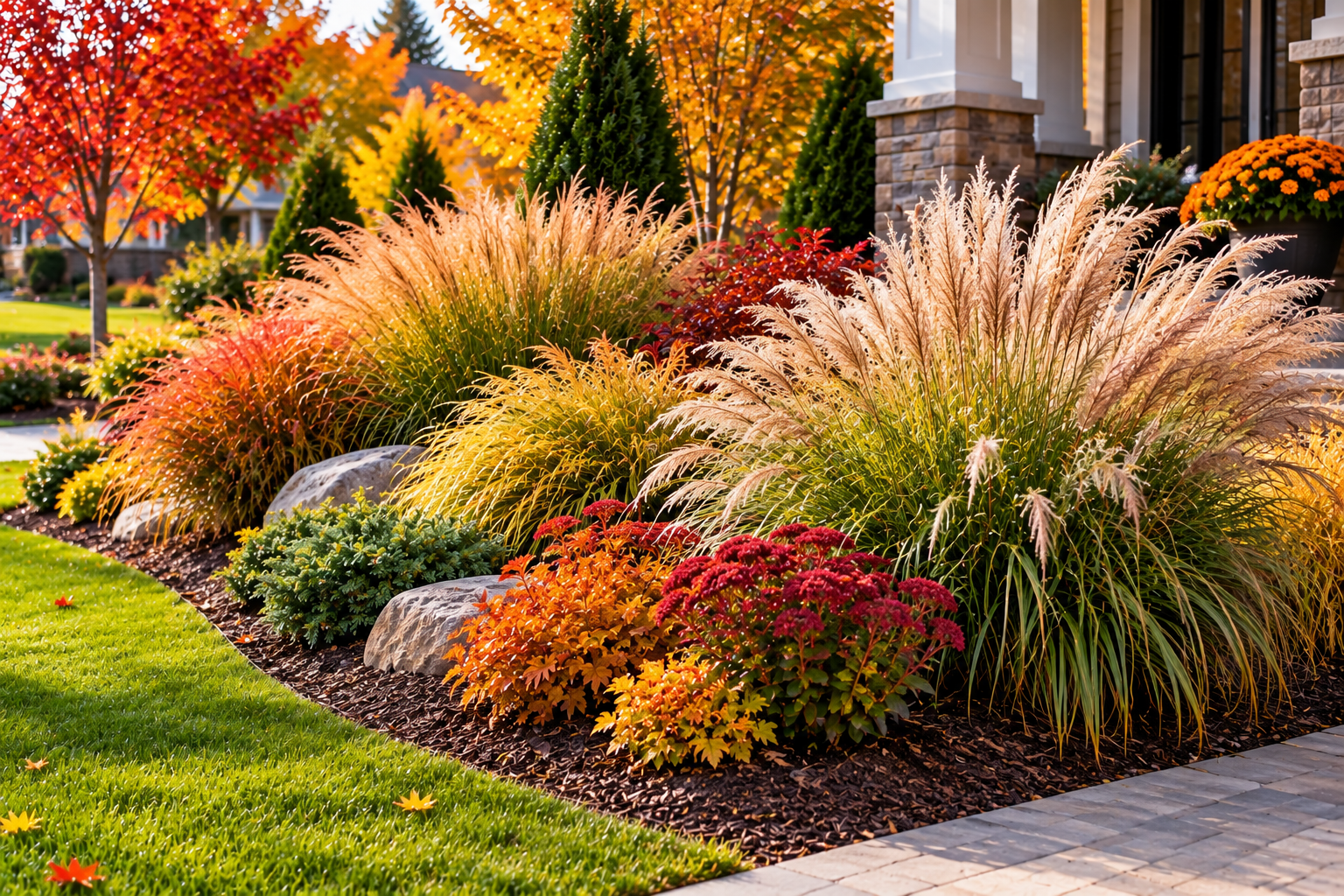
A lot of yards are designed in June. The nursery is full of blooms, the beds are at their fullest, and every plant gets chosen for the weeks it looks best. By mid-November the peonies are a heap of brown stems, the annuals are in the compost, and what remains is bare mulch and a few shrubs nobody picked on purpose.
That outcome comes from designing around flowers, the least dependable part of any planting. A bloom lasts days or weeks and can be flattened by one rainstorm. Structure lasts. Evergreen mass, bark, berries, seed heads, stone, and light are what you still see on a gray afternoon in late fall, and what shows through frost or snow. A garden that only performs for three weeks isn’t a design, it’s an event.
Check What Your Yard Looks Like in Late November
Fall is the best time to see what your garden is missing. Stand at the window you look out of most, whether that’s the kitchen sink, the home office, or the front door, and look at the yard the way it looks now, not how you remember it in July. Three questions are enough to start:
- What holds its shape at the tallest level? Evergreens, small trees, tall grasses, and structures count. Floppy perennials don’t.
- Is there any color at eye level? Berries, foliage, stems, and bark all count.
- Where does your eye land? If it lands on a fence, a bare patch, or a utility box, nothing is doing the job of a focal point.
Designers often think in layers: a tall layer (trees, large shrubs, structures), a middle layer (shrubs, grasses, large perennials), and a low layer (groundcovers, edging, mulch). A bed that’s strong in summer often has a middle layer and nothing else. The ideas below are grouped by the structural element they use, and several fill more than one layer.
Some cautions apply to nearly everything that follows.
- Hardiness zones. Many plants named here have narrow hardiness ranges. Check your USDA zone (or the equivalent in your country) against the plant tag, and check again with your local extension service or botanical garden, because tags are written for the whole country.
- Invasive plants. A few popular choices are classified as invasive in some regions, including certain Miscanthus cultivars, burning bush, and Rosa rugosa in coastal areas. Look up your state or regional invasive species list before buying.
- Nursery color is not a promise. Fall color depends on weather. Sunny days and cool (not freezing) nights tend to produce stronger color, while drought stress, early hard frosts, or a stretch of warm nights can mute it. A plant that glowed in a nursery pot may look duller in your yard in a different year.
Evergreen Backbone
1. Build a layered evergreen backbone instead of a row of identical shrubs
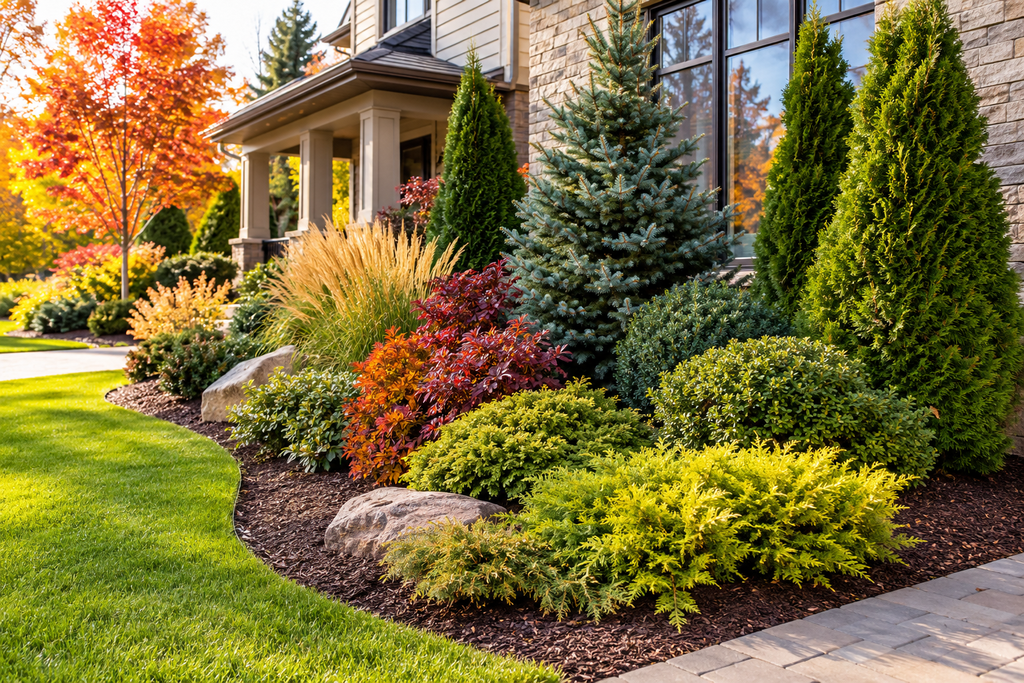
Evergreens are the only plants that look the same in January as in June, which makes them the skeleton of a four-season garden. But a line of identical green shrubs along the foundation reads as a hedge, not a design. The better approach is variety in both form and texture.
Mix upright or columnar shapes with rounded mounds and low spreaders. Combine fine needles with broad glossy leaves. Group them in clusters of three or five where you can see them from inside, rather than spacing them evenly along the house.
Check the mature size on the tag and take it seriously. A tag that says “dwarf” usually means slower-growing than the species, not small forever. Plenty of “dwarf” conifers reach six feet or more over time, and foundation plantings overgrown past the windows are one of the most common landscaping complaints.
2. Use conifers for blue, gold, and bronze, not only green
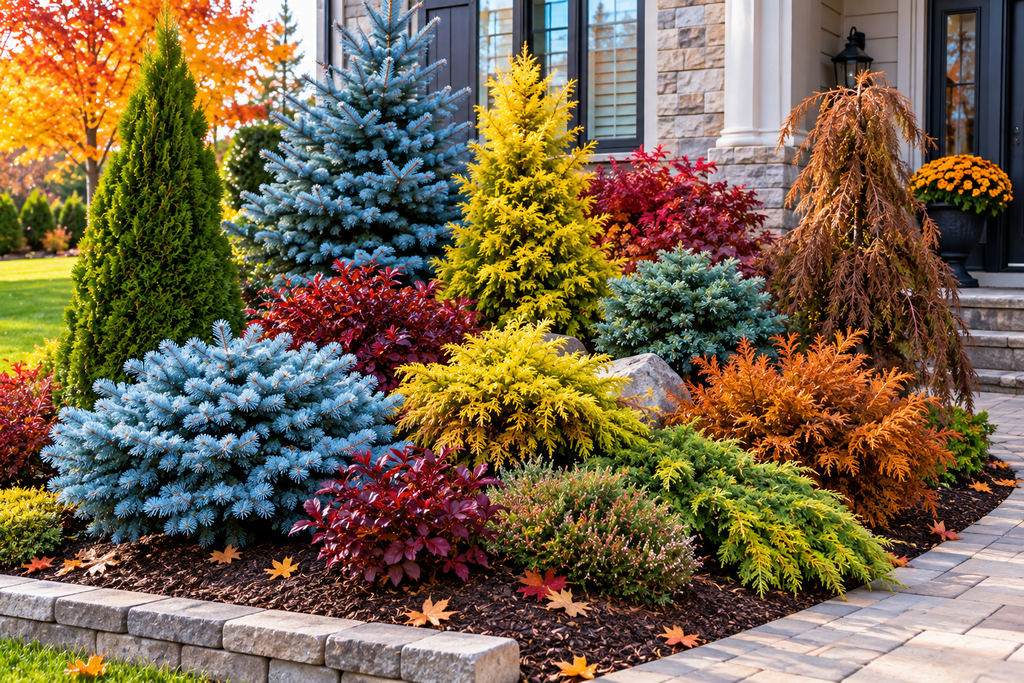
Conifers vary more in color than most people expect. Blue-gray spruces and junipers read cool against red brick or a brown fence. Gold-toned Hinoki cypress cultivars look like a bright spot even on an overcast day. Some creeping junipers (the ‘Andorra’ or ‘Plumosa’ types are commonly cited) shift toward plum or purple in cold weather. Verify the winter color of any specific cultivar with the nursery, as it varies by climate.
Match the plant to the site. Blue conifers generally want full sun and good drainage. Gold foliage can scorch in hot afternoon sun, so it’s better placed where it gets morning light. Don’t put a gold conifer next to a yellow-green shrub, since the two will clash. Place it against something darker, like a deep green evergreen or a dark fence.
3. Add broadleaf evergreens for shine and softness
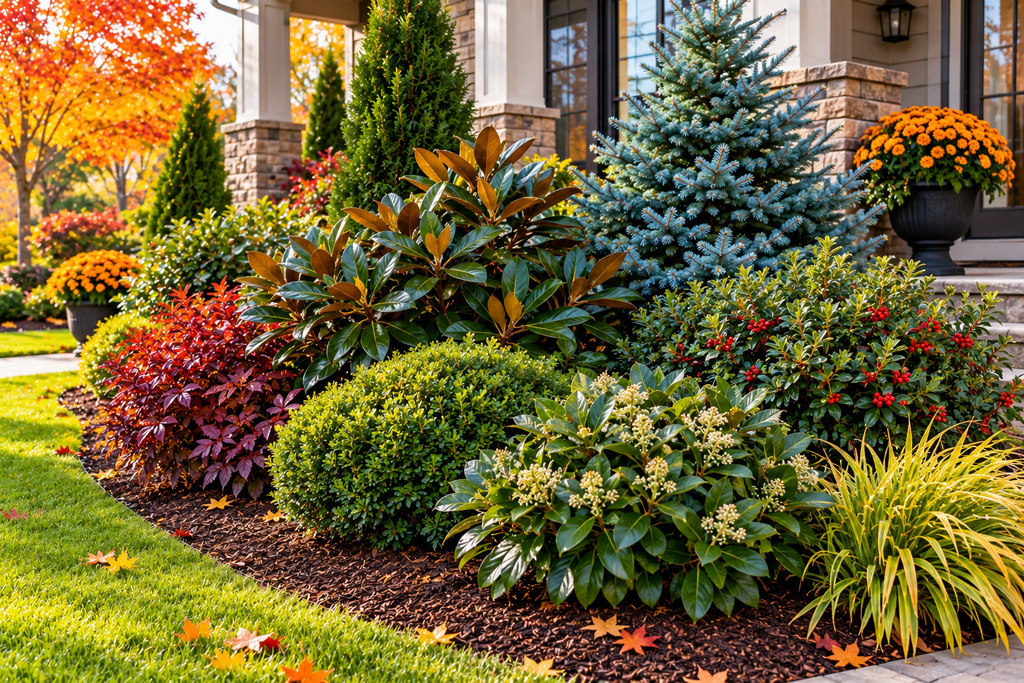
Needled evergreens can look stiff. Broadleaf evergreens such as inkberry holly, Japanese holly, mountain laurel, rhododendron, and Oregon grape (Mahonia) add glossy leaf surfaces that catch low winter light.
Boxwood is the classic choice, but boxwood blight and boxwood leafminer are serious problems in some areas. If you’re planting a new hedge, ask your local extension office what’s currently circulating and consider inkberry or Japanese holly as alternatives.
In colder zones, broadleaf evergreens are vulnerable to winter burn, which is browning from wind and winter sun while the ground is frozen and roots can’t replace lost water. Plant them out of the prevailing wind, water deeply before the ground freezes, and consider a burlap windscreen for young plants. Anti-desiccant sprays are sometimes recommended, but evidence for their effectiveness is mixed. Treat them as an extra, not a fix. Rhododendron leaves curling tightly in freezing weather is normal; the leaves unroll when temperatures rise.
Grasses and Seed Heads
4. Plant ornamental grasses in drifts
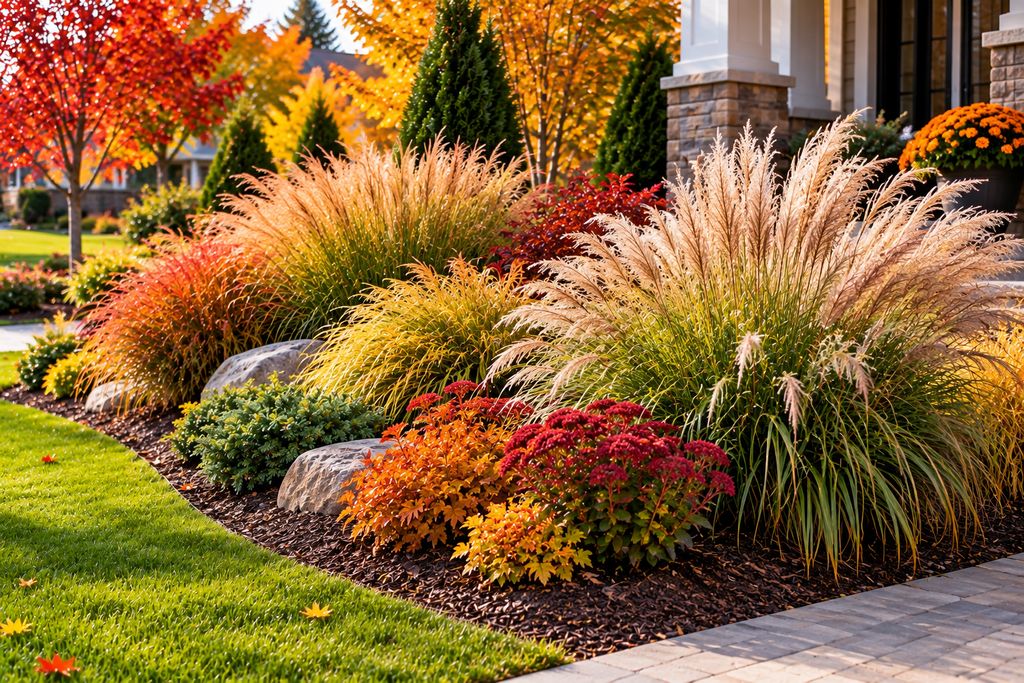
A single grass clump in a bed tends to look like an orphan. Groups of three, five, or more read as a drift, and drifts move in wind and catch low sun in a way single plants can’t.
Different grasses behave differently in fall:
- Switchgrass (Panicum) and little bluestem (Schizachyrium) offer reddish or copper tones, and many cultivars stay upright.
- Feather reed grass (Calamagrostis × acutiflora ‘Karl Foerster’) holds a narrow vertical shape and is known for standing through much of winter.
- Pink muhly gives a pink haze in fall, but it’s borderline hardy in colder zones.
- Miscanthus has beautiful plumes, but some cultivars self-seed aggressively and are restricted in parts of the US.
Upright cultivars tend to hold their shape better under snow than floppy ones, though heavy wet snow can flatten any grass. Leave the clumps standing through winter and cut them back to a few inches in late winter or early spring, before new growth starts. Cutting too early removes the winter silhouette, and cutting too late means shearing through new shoots.
5. Leave sturdy seed heads standing, and cut the ones that turn to mush
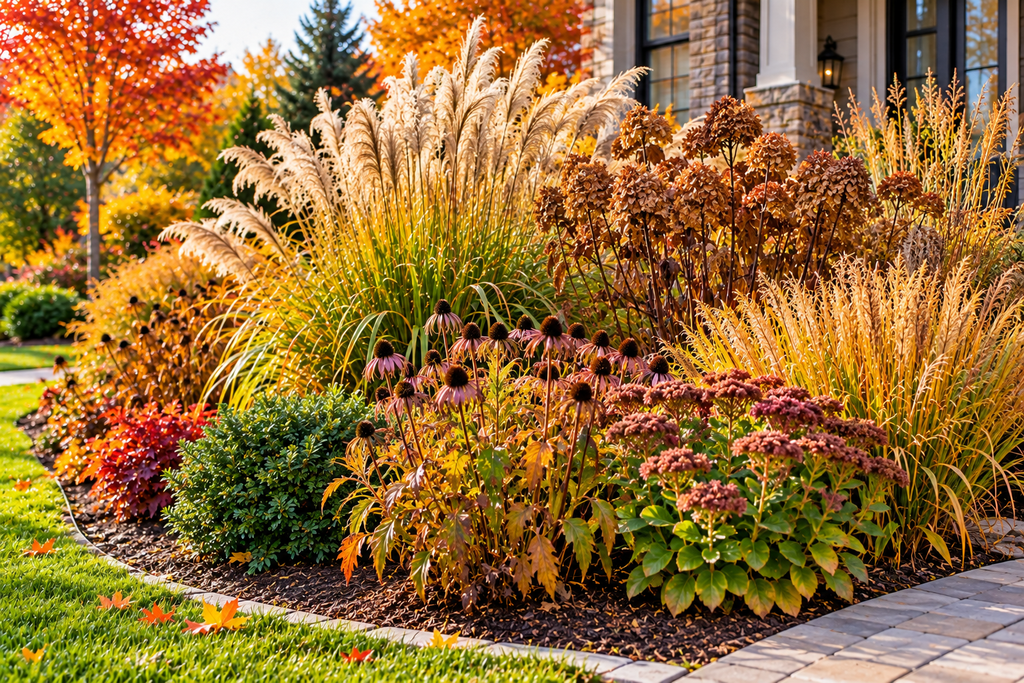
Coneflower, black-eyed Susan, sedum (now properly Hylotelephium), ironweed, and Joe-Pye weed all hold their seed heads into winter. They darken to brown or rust, catch frost beautifully, and feed birds. Goldfinches and other small seed-eaters are commonly cited as visiting coneflower heads.
A simple decision rule: leave stems that stand firm and keep their form, and cut plants whose foliage collapses into slimy brown mats (hostas, daylilies, many peonies). Also remove diseased material regardless of how it looks. Peony leaves with botrytis or powdery mildew, and rose leaves with black spot, shouldn’t overwinter in the bed, because the fungi can persist on debris. Put diseased material in the trash or municipal green waste, not a home compost pile that may not get hot enough.
6. Choose plants with sculptural forms for contrast
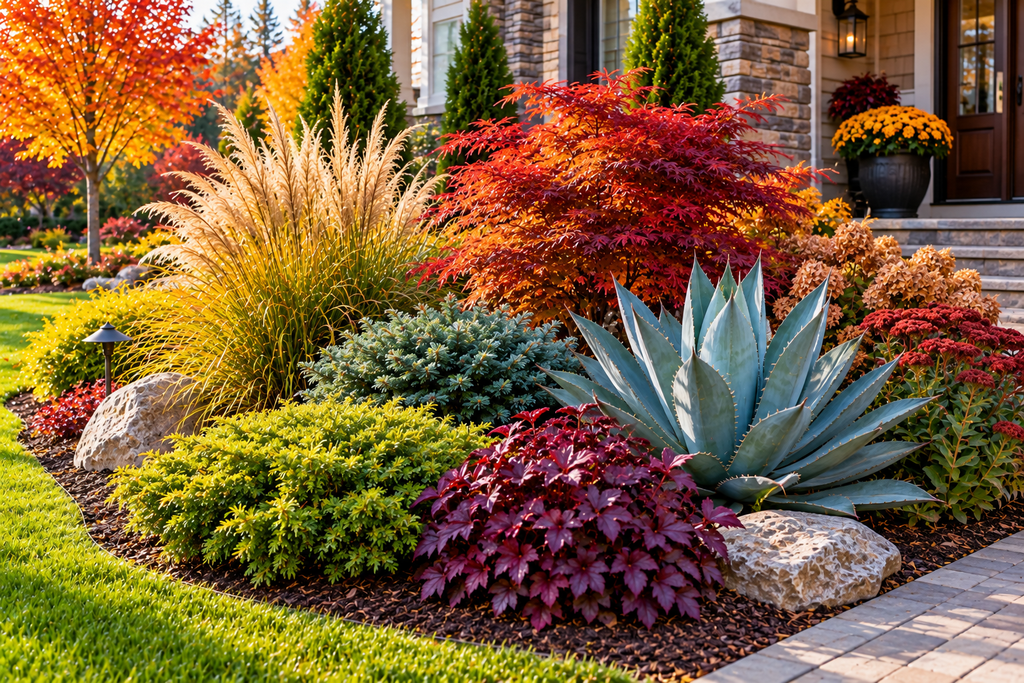
Not all seed heads look alike, and the best fall beds combine different shapes. Baptisia produces inflated dark pods that rattle in the wind. Allium leaves behind round, spiky globes. Sea holly (Eryngium) has silvery-blue spiny heads. Panicle hydrangeas such as ‘Limelight’ fade from white to pink, then tan, and the dried heads often persist into winter. Oakleaf hydrangea adds burgundy foliage and peeling bark.
Aim for contrast: something spiky next to something round next to something feathery. Three plants with the same outline, however attractive, blur together.
Panicle hydrangeas bloom on new wood, so they can be pruned in late winter without losing flowers. That also means you can leave the dried heads standing until then.
Berries and Fruit
7. Plant winterberry holly where it can be seen against a dark background
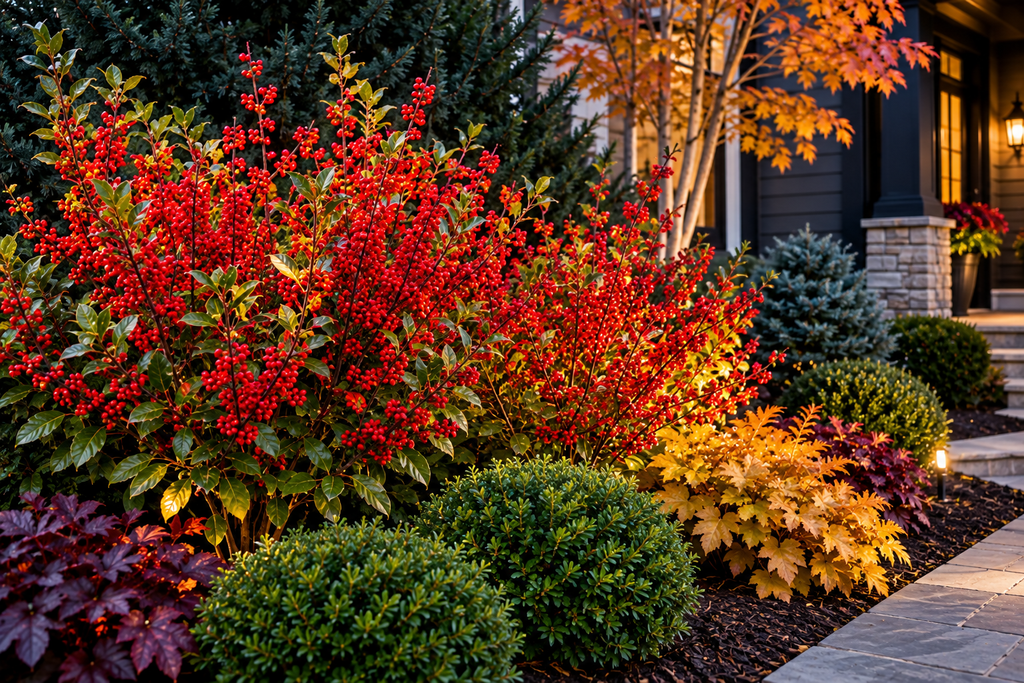
Winterberry (Ilex verticillata) is a deciduous holly. It drops its leaves in fall and leaves bare branches covered in bright red, orange, or occasionally yellow berries. Against a dark evergreen or fence, the effect is striking.
Winterberry is dioecious, meaning you need a male plant of a compatible cultivar nearby to get berries on the females, and their bloom times must overlap. Pairings are listed by nurseries (cultivars such as ‘Red Sprite’ and ‘Winter Red’ are often paired with male selections like ‘Jim Dandy’ or ‘Southern Gentleman’, but verify current pairings with the supplier). It tolerates wet soil and prefers acidic soil, so it suits spots where other shrubs struggle.
Birds eventually strip the berries. The timing depends on weather, local bird populations, and what else is available. Don’t count on berries lasting until spring.
8. Add purple, blue, and black berries to break up the red
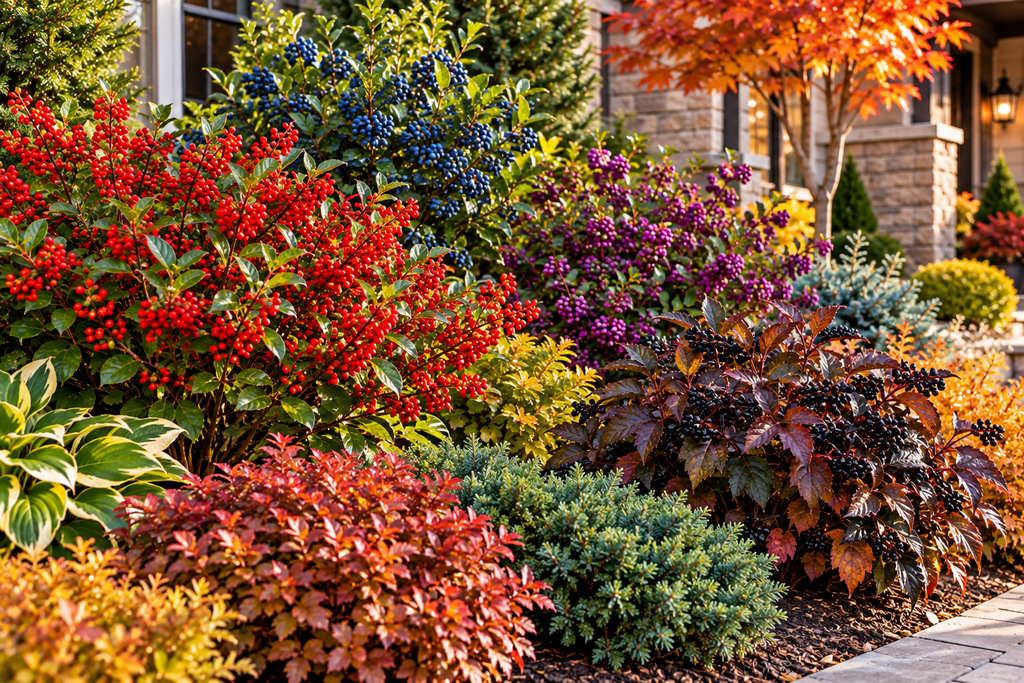
Beautyberry (Callicarpa) produces tight clusters of vivid magenta-purple berries along the stems, which stand out after the leaves drop. It blooms and fruits on new growth, so it’s usually cut back hard in late winter. In colder zones it may die to the ground each year and regrow.
Chokeberry (Aronia) provides red fall foliage along with dark berries. Many viburnums bear blue-black fruit, but many need a second compatible plant for good fruit set, so check the tag before assuming a single plant will fruit.
One safety note applies across this whole section. Many ornamental berries can cause stomach upset if eaten, and some plants are more toxic than that. Treat decorative berries as inedible, particularly around toddlers and dogs that chew. If you have children or pets, look up each plant with your poison control center or the ASPCA plant database before planting it where they play.
9. Use crabapples and rose hips for fruit that persists
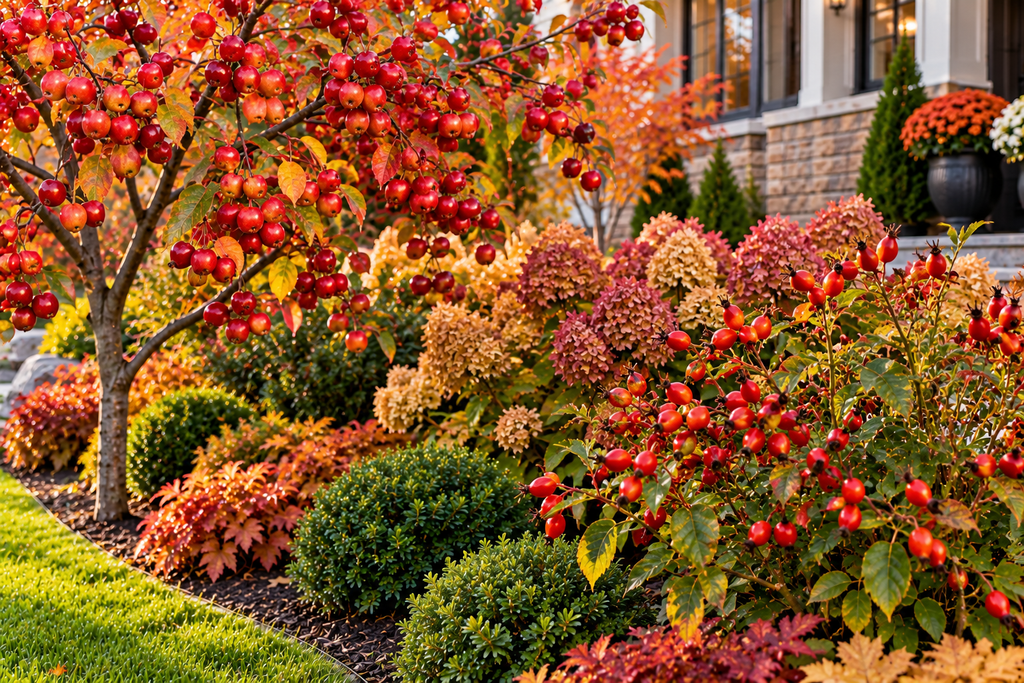
Small-fruited crabapples can hold bright fruit well into winter, and birds eat them as the season progresses. Choose disease-resistant selections, as apple scab can defoliate susceptible trees by late summer. Large-fruited crabapples drop heavy, messy fruit that can be a nuisance on a patio or walkway.
Rose hips are a low-effort fall detail on roses that produce them, such as rugosa types. To get hips, stop deadheading the final flush of blooms in late summer. Rugosa roses are invasive in some coastal and northern areas, so check local guidance.
Bark and Stems
10. Plant at least one tree for its bark
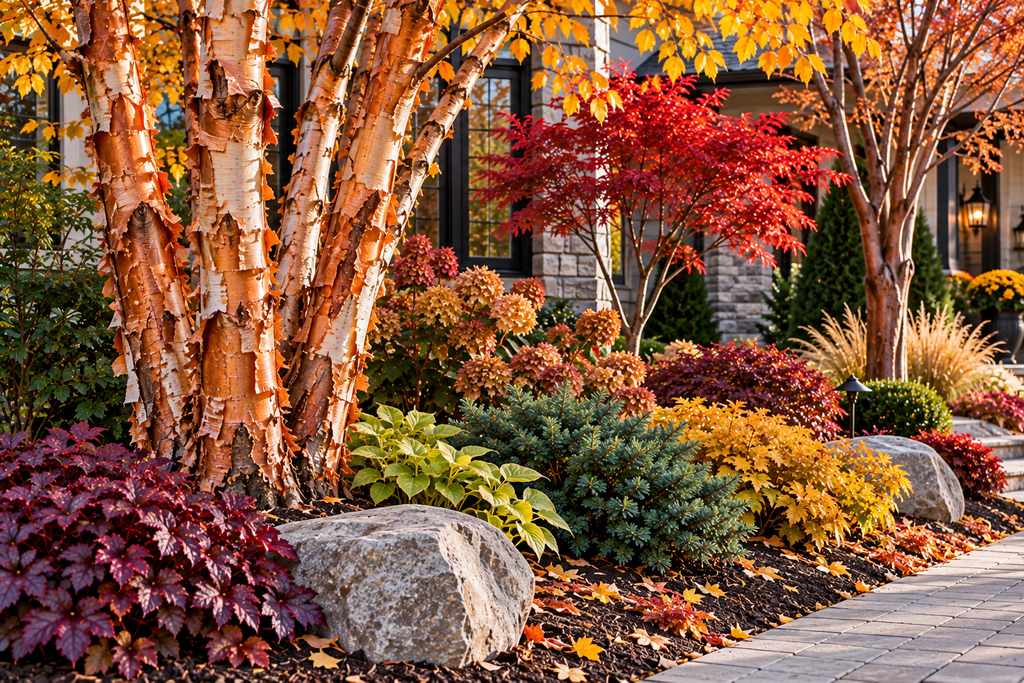
Bark is the most underused element of fall design because it only works once leaves are gone, and most gardens have nothing worth looking at. Options include:
- Paperbark maple (Acer griseum): cinnamon-colored, exfoliating bark, slow-growing, suited to roughly zones 4 to 8.
- River birch (Betula nigra), especially ‘Heritage’: peeling cream-to-salmon bark and better heat tolerance than white-barked birches, which are often vulnerable to bronze birch borer.
- Japanese stewartia and lacebark pine: mottled, patchwork bark in cooler climates.
- Crape myrtle: smooth, exfoliating bark in warmer zones.
Show bark off. Remove lower branches over time so the trunk is visible, or choose a multi-stemmed form. Plant it in front of a dark background such as evergreens or a fence, and consider uplighting (see idea 20).
11. Use colorful twigs for winter contrast
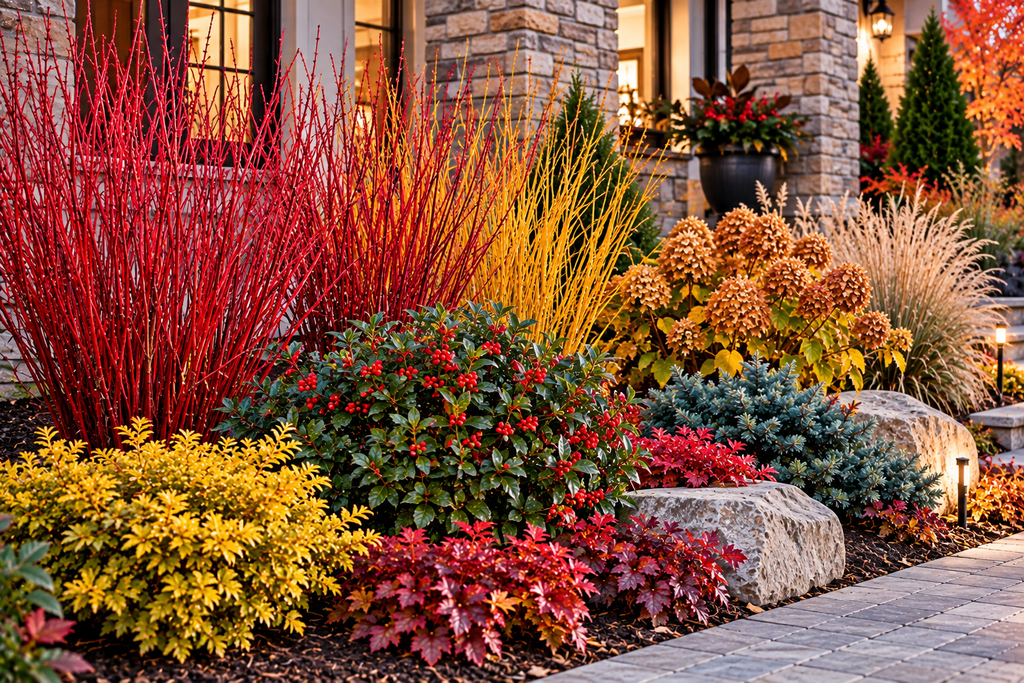
Red-twig and yellow-twig dogwoods offer bright stems when everything else has gone dull. The color is strongest on young stems, which is why the standard practice is to remove the oldest third of stems at the base each late winter. Left unpruned, old stems turn gray-brown and the shrub loses its effect.
Contorted hazel and corkscrew willow add twisted forms rather than color. They look best when planted where you can see them against snow or a plain wall.
Fall Foliage
12. Stack fall color in layers, and stagger when it peaks
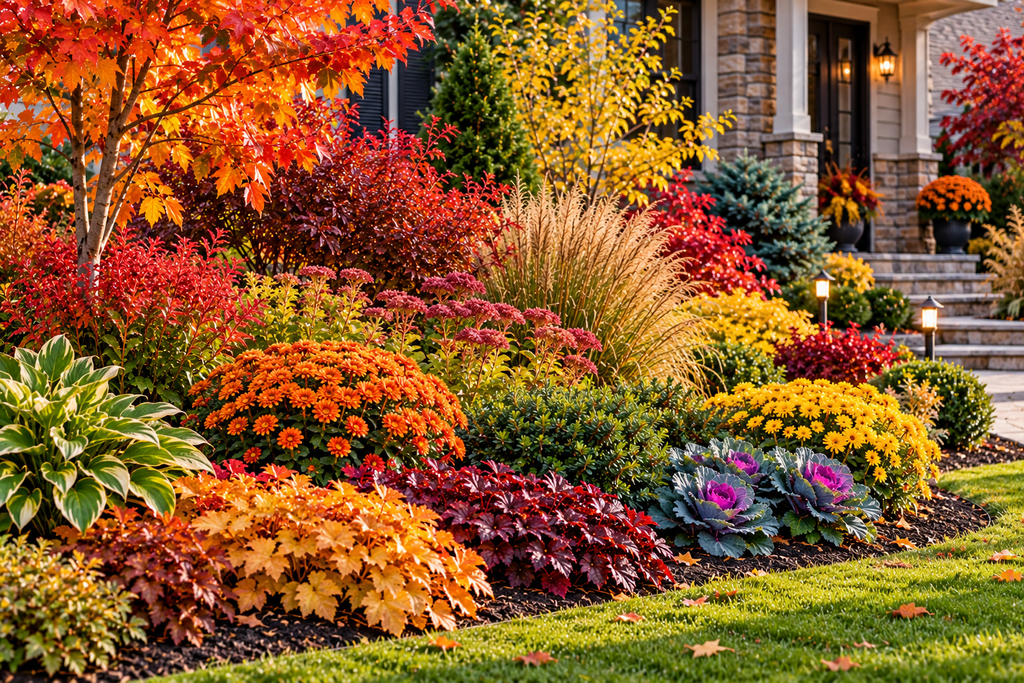
A single maple turning red is lovely for two weeks. Layering color extends the show:
- Small tree: Japanese maple, serviceberry (Amelanchier, which turns orange-red and also fruits in early summer), or sourwood.
- Shrubs: Fothergilla (orange, red, and yellow on one plant), Itea ‘Henry’s Garnet’ (burgundy), oakleaf hydrangea (burgundy), or Aronia (red).
- Perennials and groundcovers: see idea 13.
Plants peak at different times, so combining early, mid, and late colorers stretches the display into November in many climates.
Skip burning bush (Euonymus alatus). It’s popular for its scarlet color but is invasive in many US states, and alternatives like Aronia, fothergilla, and Itea offer similar color without the risk.
Some trees keep dead leaves through winter (marcescence). American beech and young oaks do this, and beech hedges can hold copper-colored leaves that rustle in wind and provide winter screening.
13. Choose perennials and groundcovers that color up or hold their leaves
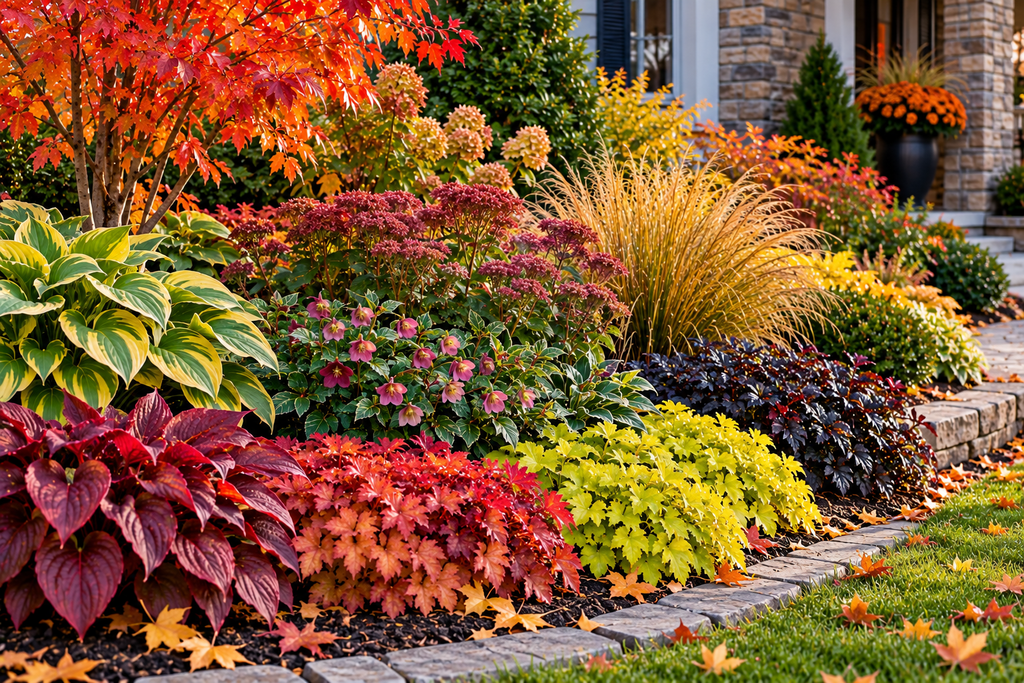
Not all low-layer interest is flowers. Blue star amsonia turns a clear golden yellow in fall. Bergenia’s leathery leaves redden in cold weather. Plumbago (Ceratostigma plumbaginoides) has deep red fall foliage after late blue flowers. Hellebores keep leathery foliage in many climates. Heuchera varies by cultivar and zone, staying colorful in mild areas and looking ragged in harsh winters.
For shade, where many of the options above struggle, consider Hakone grass (Hakonechloa), which turns golden in fall, along with oakleaf hydrangea, fothergilla in part shade, foamflower, and leucothoe. Most “fall color” lists assume full sun, so a shady yard needs a separate plan.
Stone and Hardscape
14. Anchor beds with boulders and stone, not just plants
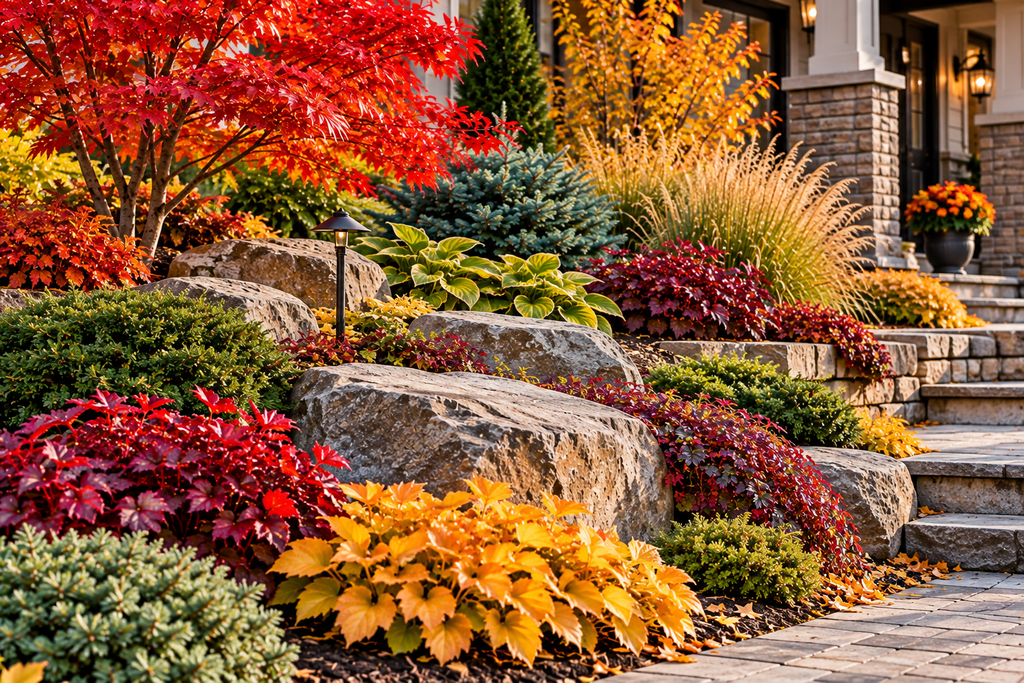
Stone is the one element that doesn’t change with the seasons, so it provides stability when plants are dormant. A group of boulders, a low dry-stack wall, or a stone outcrop gives the eye something to rest on.
For a natural look, bury about a third of a boulder, or more, so it looks like it has always been there, not delivered. Group stones in odd numbers, use rock that matches the local geology if possible, and vary sizes. Boulders are very heavy, so moving them is usually a job for equipment or a landscaper, not a weekend with a wheelbarrow.
Retaining walls above a modest height usually need engineering or permits, with the threshold varying by municipality (often around three to four feet, but verify locally). Frost heave can topple poorly built walls, so base preparation matters in cold climates.
15. Lay a path that creates a destination and a line
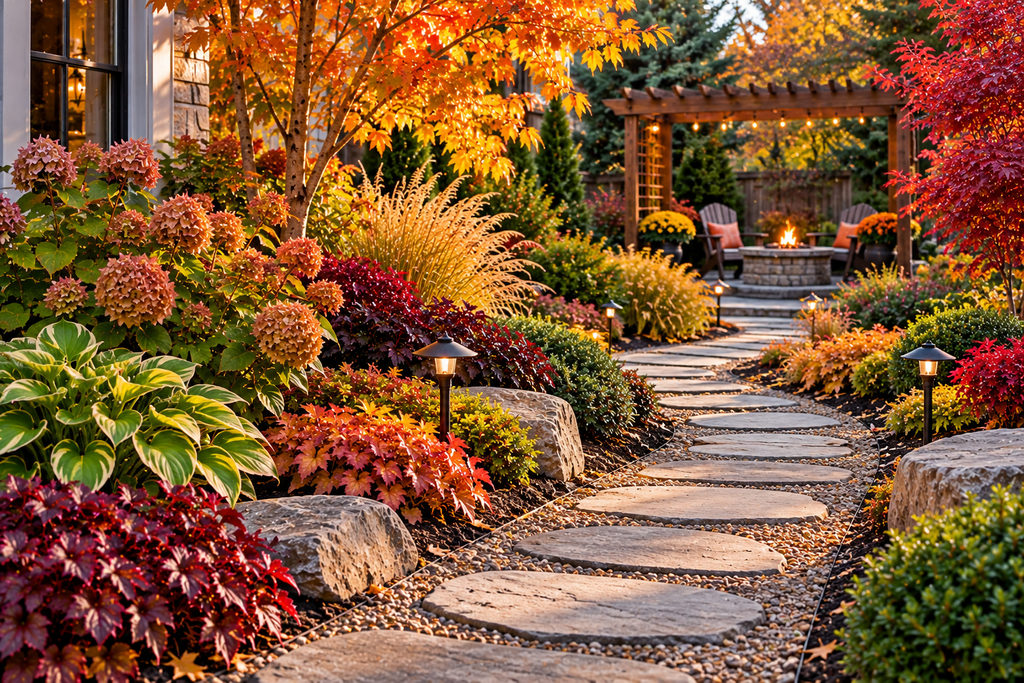
A path organizes space. A gently curving gravel or stone path leads the eye through the garden and gives a fall walk a purpose.
Material matters. Angular crushed stone compacts into a firm surface, while rounded pea gravel shifts underfoot. Stepping stones set in lawn or low groundcover look lighter and cost less than a full path. A compacted base of roughly four to six inches of crushed stone is a common recommendation for durable paths, though local soil and frost conditions affect this, so check local guidance. Allow about three feet for a garden path and more for a main walkway.
Gravel has downsides. Fallen leaves stick in it and are hard to rake out, and shoveling snow off gravel moves the stone with it. Define the edges with steel, stone, or brick so gravel stays in place.
16. Add one vertical structure that stays put
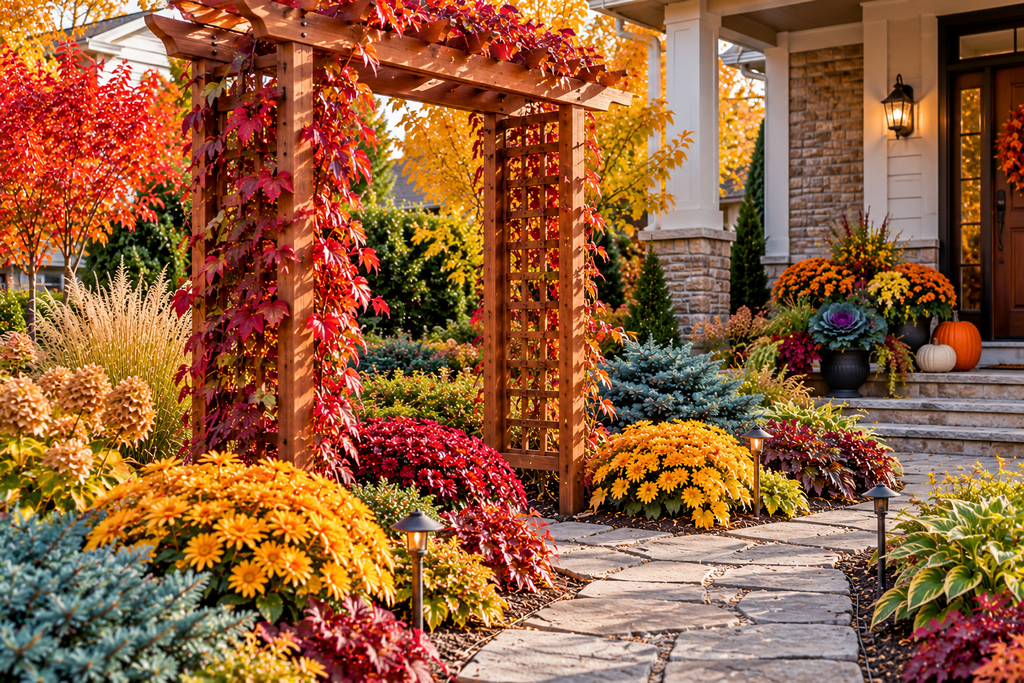
An obelisk, trellis, arbor, or pergola provides vertical interest when perennials have collapsed. Rusted steel ages well and looks right in autumn. Cedar and other rot-resistant woods hold up better than untreated softwood.
Climbing plants extend the effect. Clematis varieties with fluffy seed heads and climbing hydrangea with its peeling bark both look good after flowering. Virginia creeper gives brilliant red fall color but grows vigorously and can damage siding or mortar, so it’s best on a freestanding structure.
Anchor tall structures well. Wind catches an obelisk or trellis with a mature vine on it.
Mulch and Edges
17. Use dark mulch and a crisp bed edge to frame what’s left
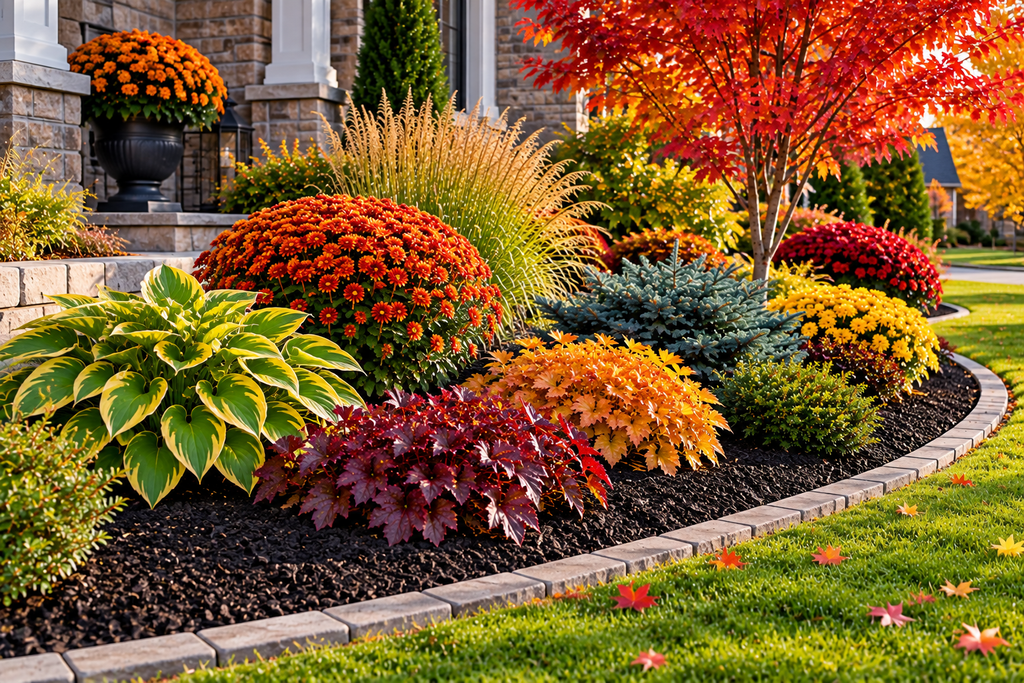
When plants thin out, the bed itself becomes the design. Dark shredded hardwood mulch makes bark, berries, and foliage stand out. A cleanly cut edge, with a defined line between lawn and bed, makes a sparse planting look intentional.
Apply mulch two to three inches deep and keep it a few inches away from trunks and stems. Piled against bark, it holds moisture and can encourage rot and pests. Shredded hardwood stays put on slopes, while bark nuggets can wash away. Gravel mulch suits dry-climate plantings but traps leaves and heats up in summer.
Timing is debated. In cold climates, extension guides often suggest waiting until the soil cools, or even begins to freeze, before applying winter mulch around borderline-hardy plants. The goal is to keep the ground consistently cold, so it doesn’t freeze and thaw repeatedly. Check your regional guidance.
18. Turn fallen leaves into mulch instead of bagging them
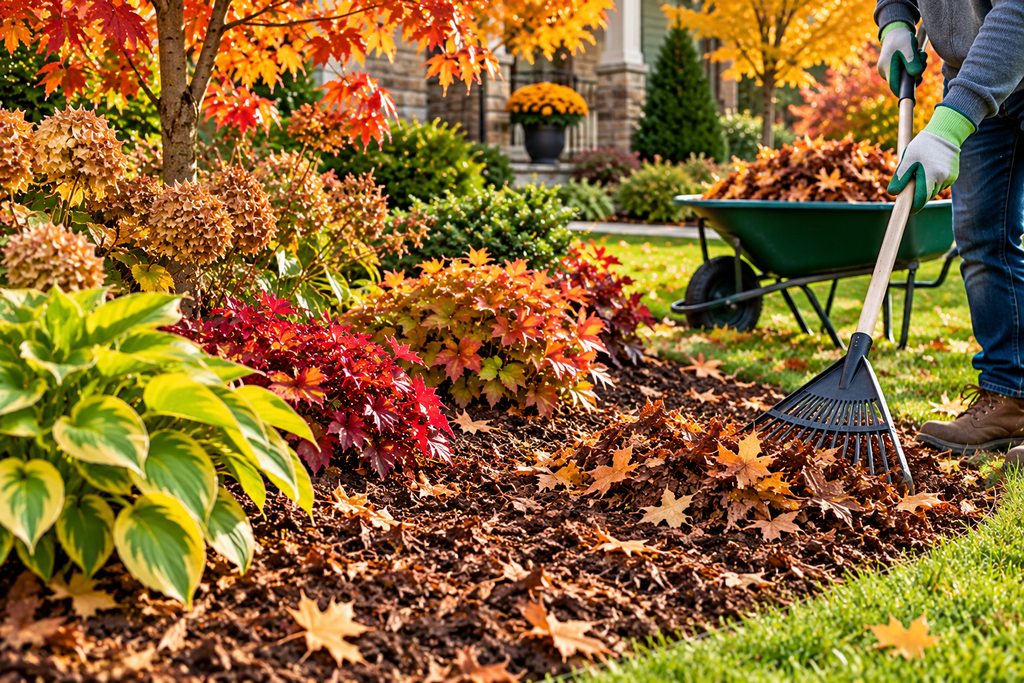
Shredded leaves make good mulch and feed the soil as they break down. Run a mower over a pile, or over leaves on the lawn, and spread the pieces two to three inches deep in beds. Whole leaves from maple or oak can mat together, block water, and smother small plants, so shredding matters. Leaf mold, made by piling leaves and letting them break down for a year or two, is a good soil conditioner.
Diseased leaves are the exception. Don’t use leaves from plants with fungal problems, such as apple scab or black spot, as mulch around the same species.
Containers
19. Build container plantings around a structural plant, not seasonal color
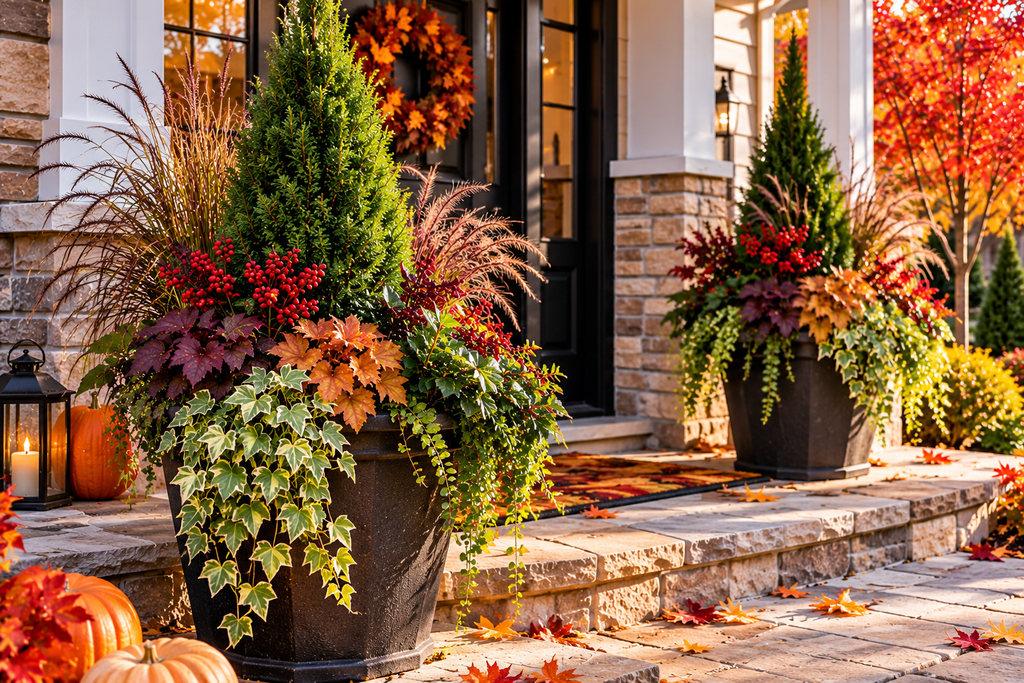
Containers by the door are the first thing visitors see, and the standard fall display of mums and pansies often looks tired within a few weeks. A structural plant such as a dwarf conifer, a grass, or a small evergreen gives the container a backbone, and you can swap seasonal color around it.
Plants in containers are more exposed to cold than plants in the ground, because roots have less insulation. A frequently cited rule of thumb is that container plants may need to be rated about two zones hardier than your zone to survive winter outdoors. Treat this as a guideline and confirm for specific plants.
Container choice matters too. Terracotta and some ceramics crack when water freezes inside them, so use frost-resistant materials (fiberglass, resin, metal, or ceramics rated for freezing temperatures) and make sure drainage holes aren’t blocked. Larger pots insulate better than small ones, which freeze solid. Evergreens in pots still need water on thawed days, since the foliage continues to lose moisture all winter.
For a quick winter look, push cut evergreen boughs, red dogwood stems, or birch branches into the soil. They last for weeks in cold weather and cost little.
Lighting
20. Light the garden for its winter silhouettes
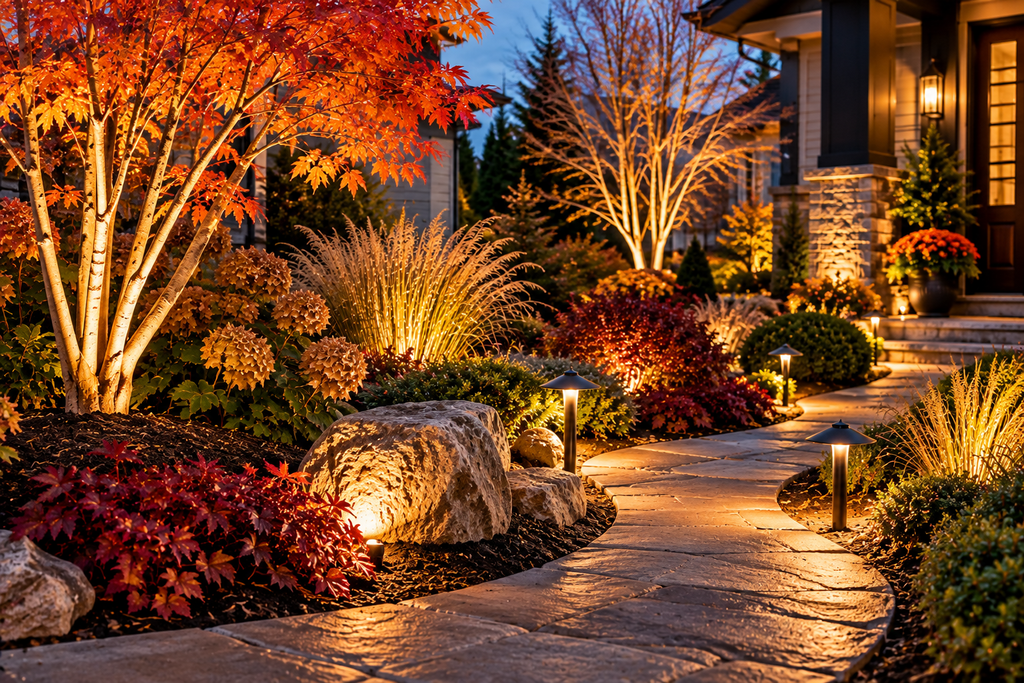
Fall brings earlier sunsets, so the garden spends much of the evening in the dark, when you’re most likely to see it from inside. Lighting turns bark, grasses, and stone into a feature.
Basic techniques:
- Uplight trunks and bark from a low fixture at the base of the tree.
- Backlight grasses so the plumes glow.
- Graze stone walls from close to the surface, so the light picks up texture.
- Use path lights sparingly. A few well-placed fixtures beat a continuous line of them.
Low-voltage LED systems (12 volts, run from a transformer with a timer or photocell) are the usual choice for homeowners. They’re safer to install than line-voltage systems, though you still need a weatherproof, GFCI-protected outlet for the transformer, and installing one may require an electrician. Any line-voltage (120 or 240 volt) work should be done by a licensed electrician and comply with local codes. Warm white light (around 2700K) generally looks more natural outdoors than cool white. Solar lights are easy to install but produce less light, and their output drops in the shorter, cloudier days of fall and winter.
Adjust fixtures as plants grow, because a light that was aimed at a young tree may end up buried in foliage. Avoid over-lighting, which flattens the effect and can bother neighbors and wildlife.
Where to Start If You Can Only Do a Few Things
The 20 ideas above don’t all need to happen at once, and many yards have limited sun, space, or budget. A rough order of priority for most gardens:
- Evergreen anchor (ideas 1 to 3). Without it, nothing else has a backdrop.
- Grasses and standing seed heads (ideas 4 to 6). These are among the cheapest, easiest ways to add winter interest, and many are things you stop doing (cutting back) rather than things you buy.
- One feature for bark, berries, or stems (ideas 7 to 11), chosen for the spot where you look most often.
- Lighting (idea 20), which can transform what you already have.
In a small yard, one well-chosen small tree with good bark and a drift of grasses will do more than a dozen mediocre shrubs. In a large yard, work in zones, starting with the view from the house.
Shade and deer change the plan. In shade, lean on idea 13’s shade options, oakleaf hydrangea, and evergreens that tolerate low light. In deer country, few plants are truly deer-proof, and hungry deer will eat nearly anything, so check local extension lists and protect young plants with fencing.
Questions Readers Ask
Will leaving seed heads standing create a weed problem?
Some plants will self-seed, and coneflower and black-eyed Susan are the usual offenders. If they spread more than you want, cut a few heads before the seeds disperse, or pull seedlings in spring. Plants with sterile or non-aggressive seed, such as most sedums and grasses, are less of a worry. Check invasive lists for anything that spreads vigorously.
Is fall too late to plant?
Fall is often a good time to plant trees, shrubs, and perennials, because the soil is still warm and roots can establish before the ground freezes. A commonly cited guideline is to plant at least about six weeks before the ground freezes, but the actual window depends on your climate, so check with a local extension office. Tender or marginally hardy plants generally do better planted in spring.
Do I need to water plants in fall?
Newly planted trees and shrubs still need regular watering until the ground freezes, and evergreens go into winter better when well watered. Established deciduous plants typically need less.
Take a Photo and Make a Short List
The most useful next step takes about ten minutes. On the next overcast day, photograph your yard from the window you use most. Look at the photo, not the garden, because photos strip away what your memory adds. Mark the empty spots, then pick one item from each layer (something tall, something at eye level, something low) and put it on a list for spring planting or for the nursery’s fall sale, when many plants are discounted and you can see real fall color on the tag.

About Syprose Kiche
Syprose Kiche is the creator and writer behind My Besuited Home, a practical home and garden website covering DIY projects, gardening, lawn care, landscaping, home improvement, and outdoor living. She focuses on turning everyday homeowner questions into clear, practical guides backed by careful research and useful real-world considerations.