
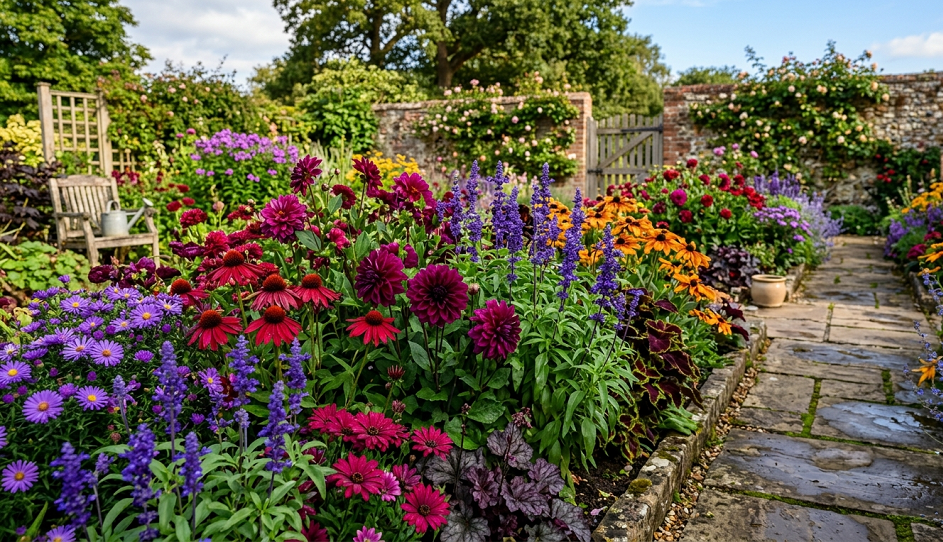
By late July, my garden used to look like it had given up. The spring tulips were long gone, the peonies were a memory, and everything left standing was either sun-bleached or just plain boring. I’d stand at the kitchen window with my coffee, staring out at a sea of faded greens and washed-out pinks, and wonder where I went wrong.
Then I stumbled into jewel tone gardening — and I haven’t looked back since.
A jewel tone garden is exactly what it sounds like: a planting scheme built around deep, rich, saturated colors. Think sapphire blue, amethyst purple, ruby red, emerald green, and topaz gold. These aren’t the soft pastels of a cottage garden or the hot neons of a tropical border. These are colors with weight to them — colors that photograph like a dream in that low golden late-summer light and look even better in person.
The best part? The plants that carry these colors are almost all late-season bloomers. We’re talking August through October. That dead zone when most gardens have nothing going on? That’s your moment to shine.
What Is a Jewel Tone Garden and Why Late Summer Is the Perfect Time for It
Most gardeners front-load their planting energy into spring. I used to do it too. You spend February drooling over seed catalogs, plant a gorgeous display of tulips and alliums, have three glorious weeks in May, and then spend the next four months waiting for something — anything — to happen.
The jewel tone approach flips that script. The plants that produce those deep, saturated colors — echinaceas, dahlias, agastaches, ironweeds, sedums, and asters — are overwhelmingly late-season performers. They spend the whole summer quietly growing, putting on root mass and height, and then they absolutely detonate with color right when you need it most.
Late summer light also works for these colors rather than against them. Harsh midday July sun washes out pastels and bleaches soft pinks into near-invisibility. But that same low-angle August afternoon light makes a deep purple aster or a burgundy dahlia look like it’s lit from within. You’re not fighting the season. You’re working with it.
There’s also a practical reason I love this palette: jewel tones tend to hold their color even in heat. I’ve watched my ‘Sombrero Adobe Orange’ echinacea stay saturated and vivid through two weeks of 90-degree temperatures when everything else in the border was drooping and pale. These plants are built for the end of summer. Their genetics are basically saying, “finally, it’s my turn.”
Choosing Your Jewel Tone Color Palette Before You Buy a Single Plant
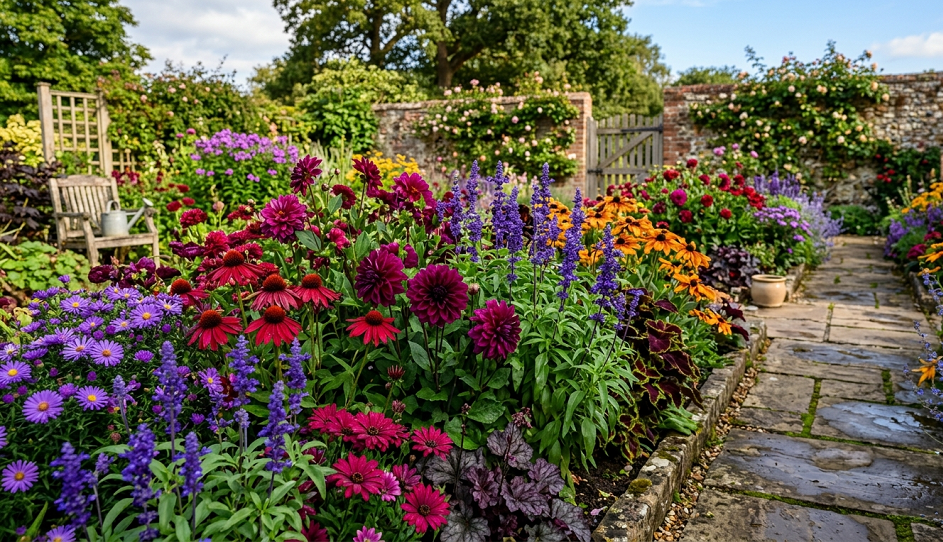
Here’s the mistake I made my first year: I went to the nursery with the vague notion of “jewel tones” and came home with a purple salvia, an orange marigold, a yellow rudbeckia, a red salvia, and a pink echinacea. I called it a jewel tone garden. It was not a jewel tone garden. It was chaos wearing a crown.
A real jewel tone palette needs anchor colors, supporting colors, and a foil. Think of it like dressing for a formal event rather than a costume party.
Pick two or three anchor jewel tones. For late summer, I’d push you toward deep purple-blue (amethyst/sapphire), rich magenta-red (ruby), and true gold (topaz). These are the dominant notes. Everything else plays off them.
Add one supporting color in a transitional shade. Teal, deep copper, or dark burgundy all work beautifully here. They’re not quite jewel tones on their own, but next to your anchors they pop in exactly the right way. My go-to is always ‘Chocolate’ eupatorium — a dark-leaved boneset that reads almost black-green from a distance and reflects copper tones up close.
Use emerald foliage as your glue. This is where most people underinvest, and it’s where I’d tell you to put real money. Dark, glossy, or fine-textured foliage — think ornamental grasses, dark-leaved cannas, or the purple-black of ‘Purple Ruffles’ basil if you want to double-dip with edibles — does the heavy lifting of making all those saturated flowers look intentional rather than accidental.
A bonus tip I picked up after embarrassing myself at a garden tour: write your palette down and take a photo of it before you shop. It’s easy to get seduced in the nursery. Seeing the words “no pink, no pastel yellow” on your phone screen while holding a very pretty ‘Bright Eyes’ phlox is the only thing standing between you and a regrettable impulse buy.
The Best Late Summer Plants for a Jewel Tone Garden
This is the heart of the whole project. Get the plant selection right and everything else is just placement.
1. Dahlias: The Undisputed Royalty of the Jewel Tone Border
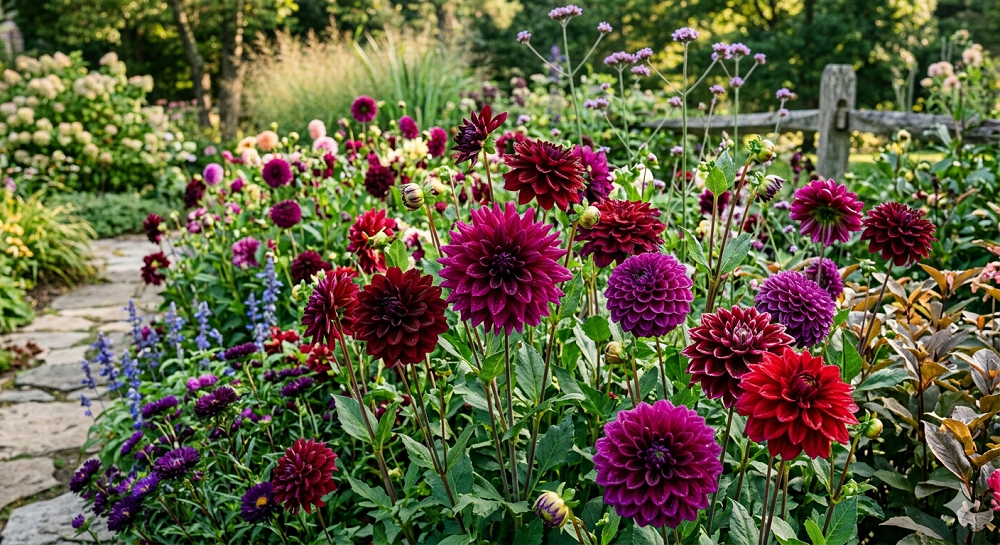
If you take nothing else from this article, plant dahlias. I mean it. Specifically, plant dinner plate dahlias in dark, saturated colors — ‘Café au Lait’ is lovely but it’s not a jewel tone (it’s basically a latte in plant form). You want ‘Thomas Edison’ (deep purple), ‘Rip City’ (near-black red), ‘American Dawn’ (true crimson), or ‘Hollyhill Black Beauty’ for a dramatic near-black accent.
Dahlias are summer to frost, and the more you cut them, the more they bloom. I’ve had single plants produce over 80 blooms in a season. They need staking, they need consistent water, and they absolutely need well-draining soil or their tubers will rot. But for sheer color output in a jewel tone palette? Nothing competes.
One critical mistake I made: planting tubers in cold soil. In my zone 7 garden, I planted in early April one year during a warm spell. Then we had three weeks of cold and wet, and half my tubers rotted before they could sprout. Now I wait until the soil is at least 60°F consistently — usually mid-May in my area. Patience is not my strong suit, but soggy dead tubers are a good teacher.
If you’re in zone 7 or warmer, you can try overwintering tubers in the ground with a thick mulch layer. I’ve had mixed results. For anything I love, I dig and store.
2. Ironweed (Vernonia noveboracensis): The Wildflower That Earns Its Keep
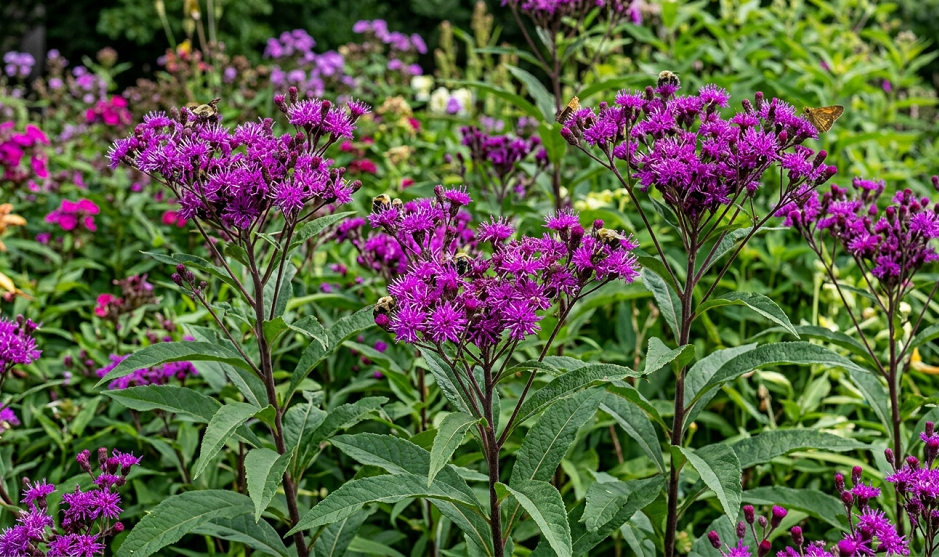
Most people have never heard of ironweed, and that is a genuine crime against late-summer gardening. This native North American wildflower blooms in a deep, electric purple that makes lavender look washed out. It’s tough as nails — I’ve seen it grow through a gravel driveway edge — and pollinators, especially monarch butterflies, go absolutely berserk for it.
The name comes from the fact that the stems are nearly impossible to cut without good pruners. They’re not kidding. I’ve tried with scissors. Don’t try with scissors.
Ironweed blooms late August through October and can get tall — up to six feet in rich soil. I grow the shorter cultivar ‘Walter’s Low’ in my front border where height is an issue, and the full-sized species in my back garden where it makes a spectacular backdrop for shorter dahlias and agastache. It’s drought-tolerant once established, doesn’t need deadheading, and spreads modestly by seed so you get a small bonus colony each year without it getting invasive.
Plant it in full sun for the best bloom count. It tolerates light shade but gets floppy and sulky about it.
3. Agastache (Hyssop): The Workhorse Everyone Underestimates
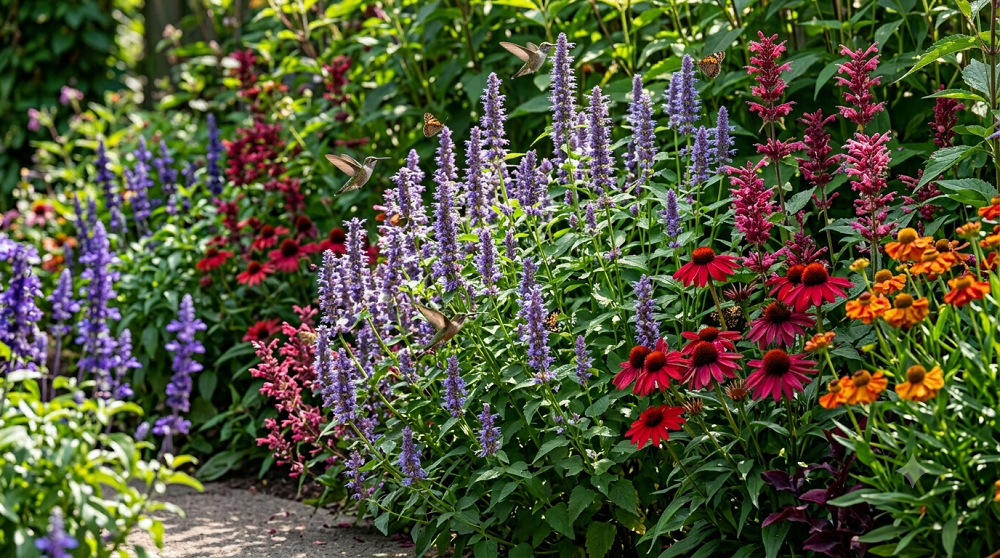
Agastache is one of those plants that looks unremarkable in a four-inch pot at the nursery and then completely takes over the middle ground of your border in the best possible way. The cultivars bred for deep color — ‘Black Adder’ (deep violet-blue), ‘Poquito Navajo Orange’ (rich copper-orange), and ‘Ava’ (bright purple-blue) — bloom from midsummer all the way through hard frost.
I have six square feet of ‘Black Adder’ in my back garden and it is, without exaggeration, the most productive plant I own by square footage. It blooms continuously from June to November, self-seeds politely, and the dried seed heads look beautiful in fall arrangements. The scent when you brush past it is incredible — warm, anise-forward, and slightly minty.
Agastache is drought-tolerant to a fault. That summer I forgot to set up the drip irrigation until late July? Everything wilted dramatically except the agastache, which looked at me with what I can only describe as contempt and kept blooming anyway.
One caveat: some cultivars are short-lived perennials or behave as annuals in colder zones. ‘Black Adder’ is reliably perennial to zone 5. Confirm your specific cultivar’s hardiness before committing a prime spot to it.
4. Echinacea (Coneflower): Pick the Right Ones for Jewel Tones
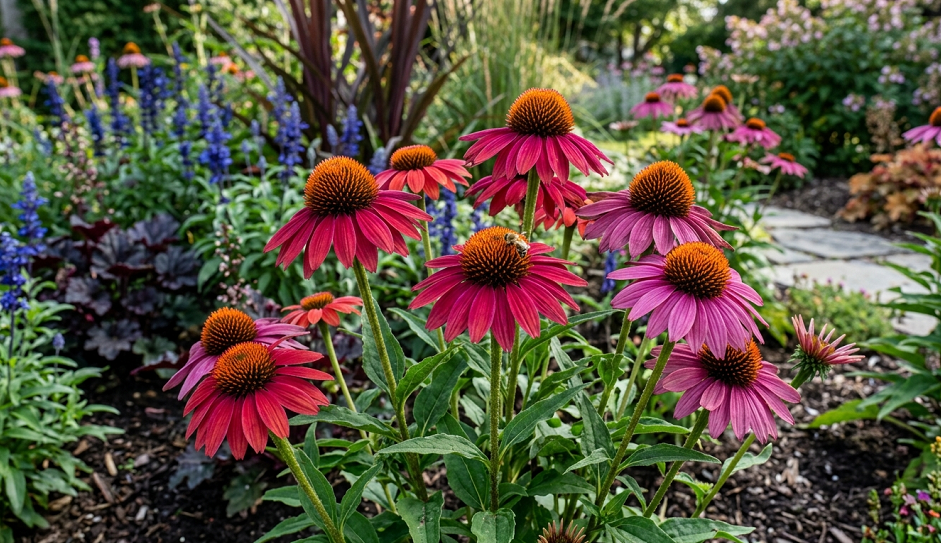
Here’s where I’ll be blunt: most echinacea cultivars are not jewel tones. The standard ‘Magnus’ is a nice medium pink. ‘White Swan’ is white. These are perfectly good plants but they will soften your jewel tone scheme into something more cottage-garden-ish.
For a true jewel tone palette, seek out ‘Magnus Superior’ (deeper pink-purple than the original), ‘Cheyenne Spirit’ (includes some deep ruby reds and oranges that work beautifully), or the newer dark cultivars like ‘Pow Wow Wild Berry’ and ‘Secret Lust’ — a gorgeous deep magenta with a dark center cone that photographs like a velvet painting.
Echinaceas are native prairie plants, which means they’re drought-tolerant, long-lived, and practically maintenance-free once established. They do need good drainage — wet feet in winter will kill them fast. My garden sits on clay, and the single best thing I ever did for my coneflowers was building up a slightly raised bed with added grit and compost before planting.
Leave the seed heads standing through winter. Goldfinches will thank you.
5. Sedum ‘Autumn Joy’ and Its More Interesting Cousins
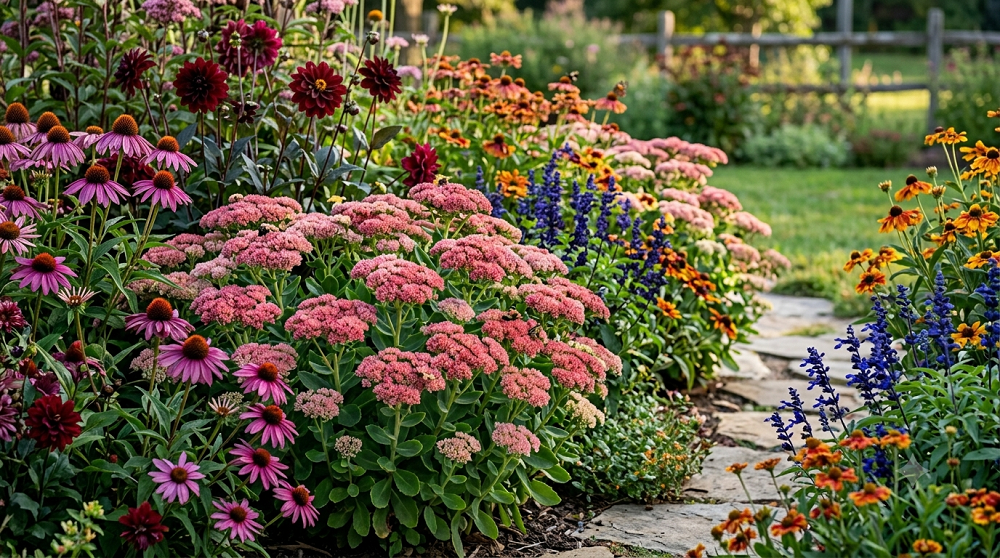
‘Autumn Joy’ sedum is a late summer classic and honestly? I think it’s a little boring on its own. Lovely structure, reliable bloom, easy care — but the dusty rose color is not a jewel tone. I grow it primarily because it holds a border together visually and the pollinators love it.
The more interesting options for a jewel tone scheme are the dark-leaved varieties. ‘Matrona’ has smoky purple-pink stems and leaves that contrast beautifully against its soft pink flowers. ‘Purple Emperor’ is even darker — nearly black-purple foliage that makes it read as a dark anchor plant even before it blooms. And the Sunsparkler series, especially ‘Dazzleberry,’ produces a deeper, truer pink that edges toward jewel tone territory.
Sedums require almost no work from you. Plant them, step back, and try not to over-water them. They actually perform better in lean, dry soil. I gave mine a generous mulch layer one year thinking I was being kind. I was not being kind. They sulked and barely bloomed.
How to Design the Layout: Layering Jewel Tone Plants for Maximum Impact
Designing the actual layout is where most of my early jewel tone attempts went sideways. I planted everything at roughly the same height, spread it out in rows, and ended up with something that looked like a parking lot median rather than a designed garden.
The fix is layering — and the jewel tone palette makes this especially dramatic because the color contrasts do a lot of the visual work for you.
Layer 1 — The Back: Tall Anchors (4–6 feet). Ironweed, tall dahlias, ornamental grasses like ‘Karl Foerster’ (its tan plumes are a perfect neutral foil), and tall asters like ‘Raydon’s Favorite’ go here. These are your backdrop.
Layer 2 — The Middle Ground (2–4 feet). Agastache, medium dahlias, ‘Autumn Joy’ and its cousins, taller echinaceas, and rudbeckia ‘Goldsturm’ (its true gold qualifies as topaz) occupy this zone. This is where most of your color mass lives.
Layer 3 — The Edge (under 2 feet). Dark-leaved low sedums, ‘Rozanne’ geranium (reliable blue-purple all summer), dwarf agastache, or even deep-colored annuals like ‘Profusion Cherry’ zinnia or ‘Superbells Calibrachoa’ in jewel tones. These tumble forward and soften the hard edge where garden meets lawn or path.
The single design move that made the biggest difference in my jewel tone garden: planting in overlapping drifts rather than distinct clumps. A drift of purple agastache that weaves between two clumps of gold rudbeckia reads as designed and intentional. Three separate circles of three different plants reads as random.
Real Talk: What Doesn’t Work in a Jewel Tone Garden
I promised you the mistakes, and I’m going to deliver.
Overusing burgundy foliage. I went through a phase — let’s call it the ‘Dark-Leaved Era’ — where I put nearly black or deep burgundy foliage plants everywhere. ‘Diabolo’ ninebark, ‘Black Lace’ elderberry, ‘Royal Purple’ smoke bush. All beautiful individually. All together in one border, they created what my partner diplomatically called “a garden that looks like it’s in mourning.” Use one or two dark foliage anchors. Let the jewel tone flowers do the color work.
Buying every color in a series. When I first got into dahlias, I ordered the “Rainbow Dinner Plate Collection” from a bulb catalog. The result was a beautiful explosion of every possible color — including a lot of pale peach, soft yellow, and light lavender that completely wrecked the jewel tone scheme I was building. Now I order specific named varieties, not collections.
Neglecting white or silver as a pause. Pure jewel tone gardens with no relief can start to feel visually exhausting, especially in a small space. A single clump of silver-leaved artemisia or white phlox used sparingly acts like a breath between notes. The key word is sparingly. One clump per 20 square feet is my personal rule.
Overwatering dahlias in hot weather. I’ve killed more dahlias by kindness than by neglect. Deep watering twice a week in hot weather is plenty. Every day? You’ll rot the crown and wonder why your plant looks like it’s melting.
A Quick Side Note on Soil Prep That Most People Skip
If your soil is compacted clay or sandy and dry, your jewel tone plants — especially dahlias and echinaceas — will underperform no matter how good your design is. Before planting, work in a 3-inch layer of compost. Add coarse grit to clay soils for drainage. This one-time investment pays dividends for years.
I spent three seasons wondering why my echinaceas were stunted and barely bloomed. Finally had my soil tested. pH was fine, but the drainage was terrible. Spent one weekend amending the bed and the following year those same plants looked like an entirely different species.
The Wrap-Up: Your Jewel Tone Garden Starts With One Good Decision
The whole point of a jewel tone late-summer garden is simple: color when everyone else has given up. While your neighbors are looking at seed-brown borders and tired summer annuals in October, you’re cutting handfuls of dahlias, photographing ironweed covered in monarchs, and watching the afternoon light turn your agastache into something out of a Dutch master painting.
You don’t have to do all of this at once. My honest parting advice: pick one 10-foot section of an existing border, clear it out, amend the soil well, and plant three or four of the plants from this list in a jewel tone palette. Do it well once. Watch what happens. The following spring, you’ll be planning how to expand it.
Jewel tone gardening changed the way I think about the whole growing season. Late summer stopped feeling like an ending and started feeling like the main event. For that, I’d call it one of the best mistakes I ever stumbled into.
Now I want to hear from you: do you already have any of these late-summer jewel tone plants growing, or is this a whole new direction for your garden? Drop your questions, your own plant picks, or your cautionary tales in the comments below — I read every single one and I’m happy to troubleshoot whatever you’ve got going on out there.

About Syprose Kiche
Syprose Kiche is the creator and writer behind My Besuited Home, a practical home and garden website covering DIY projects, gardening, lawn care, landscaping, home improvement, and outdoor living. She focuses on turning everyday homeowner questions into clear, practical guides backed by careful research and useful real-world considerations.