
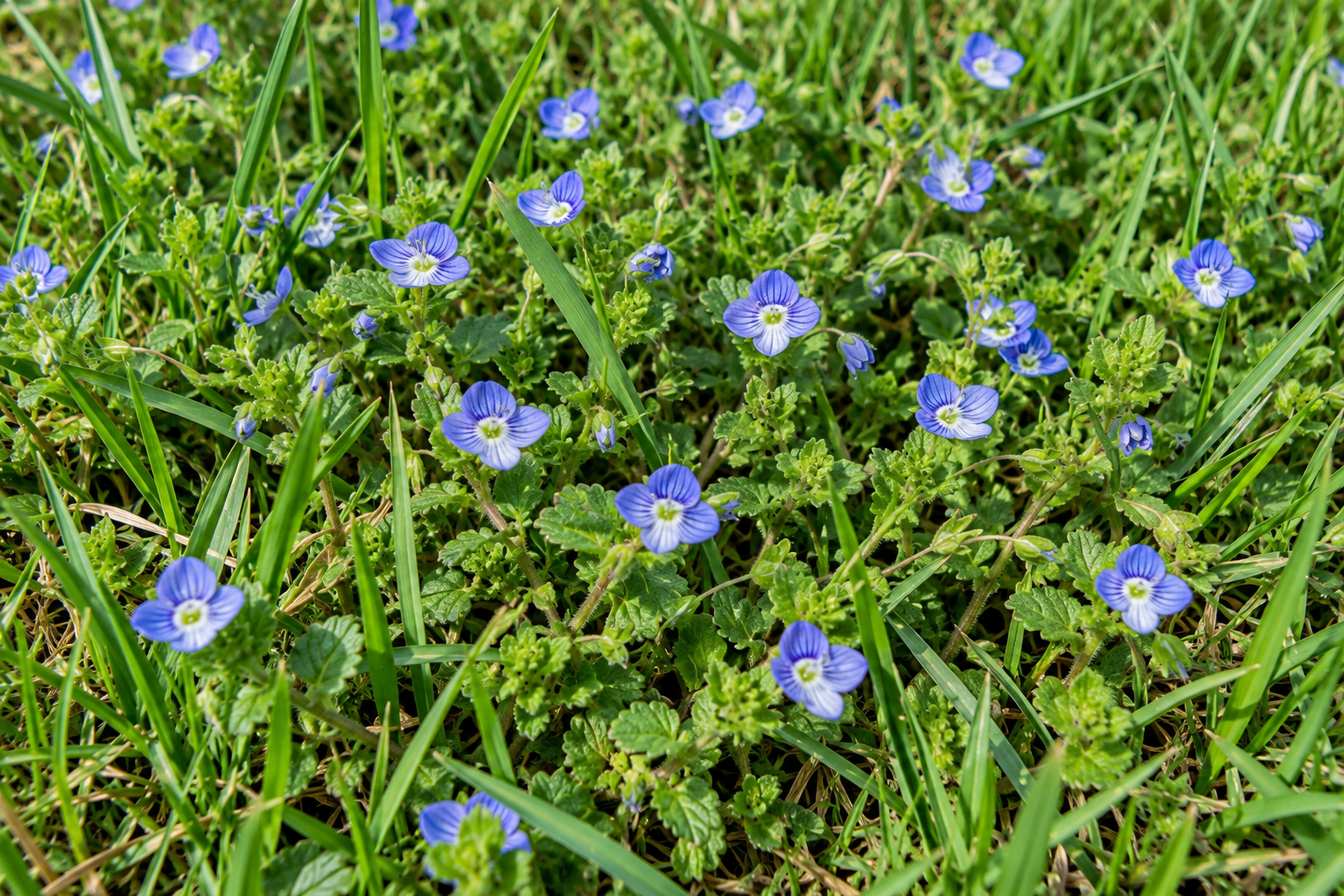
A patch of scalloped, purple-flowered plants shows up in the lawn in April. Someone sprays it with a product sold for creeping Charlie, and by June the patch has either vanished on its own or come back thicker. Both outcomes point to the same mistake: the plant was never creeping Charlie.
Several weeds borrow its rounded leaves, its low creeping habit, or its purple flowers, and each one responds to different treatment. Henbit and purple deadnettle are annuals that die back without help. Wild violet shrugs off the herbicide timing that works on ground ivy. Dollarweed points to a drainage problem more than a weed problem. Getting the identification right first decides whether you pull, spray, change your watering, or simply wait for summer.
Confirm the Real Thing First: Five Checks for Ground Ivy
Creeping Charlie (Glechoma hederacea), also called ground ivy, belongs to the mint family, and that family tie supplies most of the useful tests. Run through these before comparing it with anything else.
- Roll the stem between your fingers. Mint-family stems are square, with four distinct edges. Several look-alikes below are not mints, so this one check rules them out.
- Look at how the leaves attach. Ground ivy leaves grow in opposite pairs, and every leaf, including the pairs just under the flowers, hangs from its own short stalk (a petiole).
- Examine the leaf itself. It is rounded to kidney-shaped, with a notch where the stalk joins and scalloped edges. Leaves are roughly the size of a quarter or smaller.
- Crush a leaf and smell it. Damaged ground ivy gives off a sharp, minty odor that is easy to notice after mowing. Some sources describe it as unpleasant rather than pleasant, so expect pungent, not perfumed.
- Follow the stem. Stems run along the soil and form roots at the nodes where leaves attach, which is why a pulled strand often leaves rooted fragments behind.
The flowers are small, tubular, and light blue to bluish-purple, appearing in the leaf joints from about April through June in Nebraska (earlier or later in other regions). University of Minnesota Extension adds that the plant is a perennial that stays green year-round.
One caution about the name. “Creeping Charlie” gets used loosely. In some regions it also refers to creeping Jenny (covered below), and houseplant growers use it for a Pilea. If a product label or forum post leaves any doubt, the Latin name settles it.
Side-by-Side: Ground Ivy and Its Usual Look-Alikes
| Plant | Life cycle | Fastest way to separate it from ground ivy |
| Creeping Charlie (ground ivy) | Perennial, evergreen | Square stem, opposite stalked leaves, minty odor, stems that root as they creep |
| Henbit | Winter annual | Upper leaves have no stalk and wrap around the stem; blooms earlier |
| Purple deadnettle | Winter annual | Triangular to heart-shaped leaves; upper leaves tinted purple |
| Wild violet | Perennial | Leaves rise from a crown on their own stalks instead of along a creeping stem; five-petaled flowers |
| Speedwells | Mostly winter annuals (creeping speedwell is a perennial) | Not a mint, so no square stem; tiny blue flowers, often with a white throat |
| Dollarweed and dichondra | Perennials | Dollarweed’s stalk joins the middle of the leaf; dichondra’s smooth-edged leaf joins at the notch |
| Creeping Jenny | Perennial | Round, smooth-edged leaves; yellow flowers; not a mint |
| Common mallow | Annual or biennial | Leaves alternate rather than paired, with shallow lobes; deep taproot |
| Garlic mustard (first year) | Biennial | Crushed leaves smell like garlic |
Henbit and Purple Deadnettle: Spring Impostors That Vanish by Summer
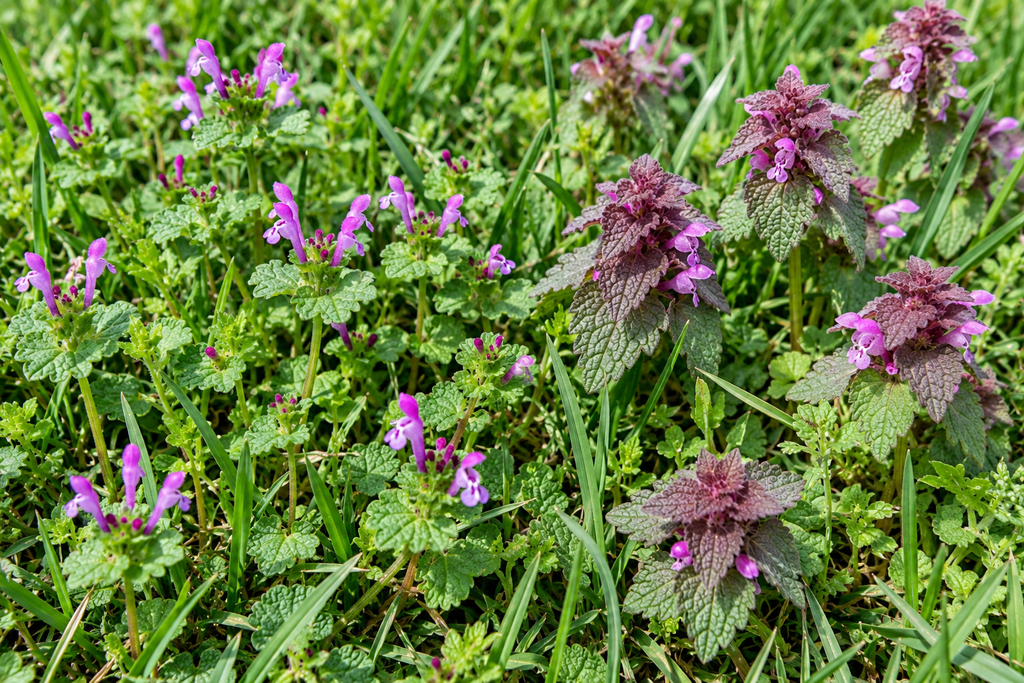
Both are winter annuals. Seeds germinate in fall, the plants overwinter as small seedlings, then flower from late winter into spring and fade as summer heat arrives. Mild winters give them a head start.
Both are also mints, so they share ground ivy’s square stems, opposite leaves, minty odor when damaged, and pink-purple flowers. Checks 1 and 4 will not separate them, and neither will leaf edges, since both have scalloped margins. Checks 2 and 5 will.
Henbit’s giveaway is leaf attachment. Leaves on the upper stem have no stalk and clasp the stem directly, while every ground ivy leaf has a stalk. Lower henbit leaves can have short stalks, so look at the upper part of a flowering stem rather than the base. Henbit also grows more upright than a ground ivy mat, with flowering stems reaching roughly 3 to 15 inches. Purple deadnettle has short stalks on its upper leaves, but its leaves are more triangular, and the ones clustered near the tip take on a reddish-purple tint.
Bloom timing offers a rough clue. Nebraska Extension lists henbit flowering from early March into May, ground ivy from April into June, and Iowa State notes henbit typically opens a few weeks ahead of ground ivy. Treat that as a hint, not a rule. Weather and region shift the dates, and the windows overlap.
Site history helps too. Michigan State Extension describes henbit as a weed of thin turf and new seedings that favors nutrient-rich soil, with pressure usually highest in the first year after renovation. A lawn seeded last fall that now has purple haze in thin spots is a better candidate for henbit than for ground ivy, which tends to settle into shade and moisture and stay.
Wild Violet: The Look-Alike That Resists the Usual Treatment
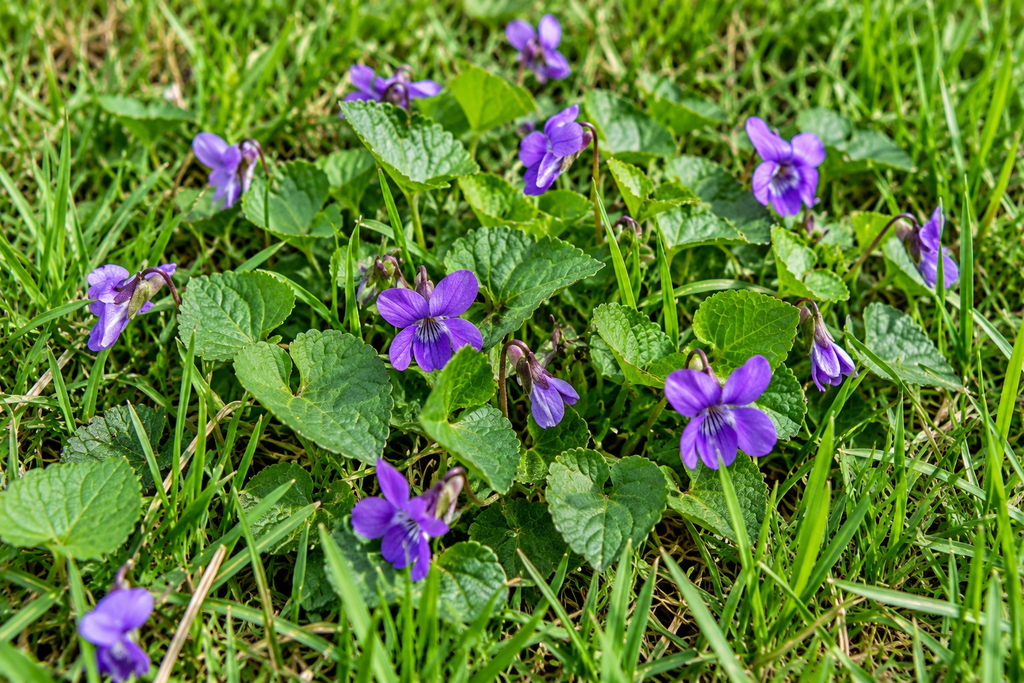
Wild violet and ground ivy both turn up in shady lawns and both carry purple flowers, which is why lawn-care professionals report mixing them up. The leaves are where they separate. Violet leaves are heart-shaped with rounded teeth, glossy and hairless, and often cupped toward the stalk. They rise in rosettes from a crown below the soil surface, each leaf on its own long stalk, rather than paired along a creeping stem. The flowers have five petals, two of them with white hairs at the base. Crushed ground ivy smells minty; that is the ground ivy side of the test.
The mix-up costs more here than with most look-alikes, because violet does not respond like ground ivy. Preemergent herbicides do not control it, according to Penn State, and Purdue’s turf specialists report that mowing, fertilizing, and irrigation changes do little to reduce it. Violet spreads by both seed and underground rhizomes, which is part of why it persists.
It is also a native plant in parts of the country. University of Minnesota Extension lists it as native there. In a shaded, low-maintenance corner where a uniform lawn is not the goal, some homeowners choose to leave it. That is a design decision, not a mistake.
Speedwell: Tiny Scalloped Leaves, Blue Flowers, and One Perennial Troublemaker
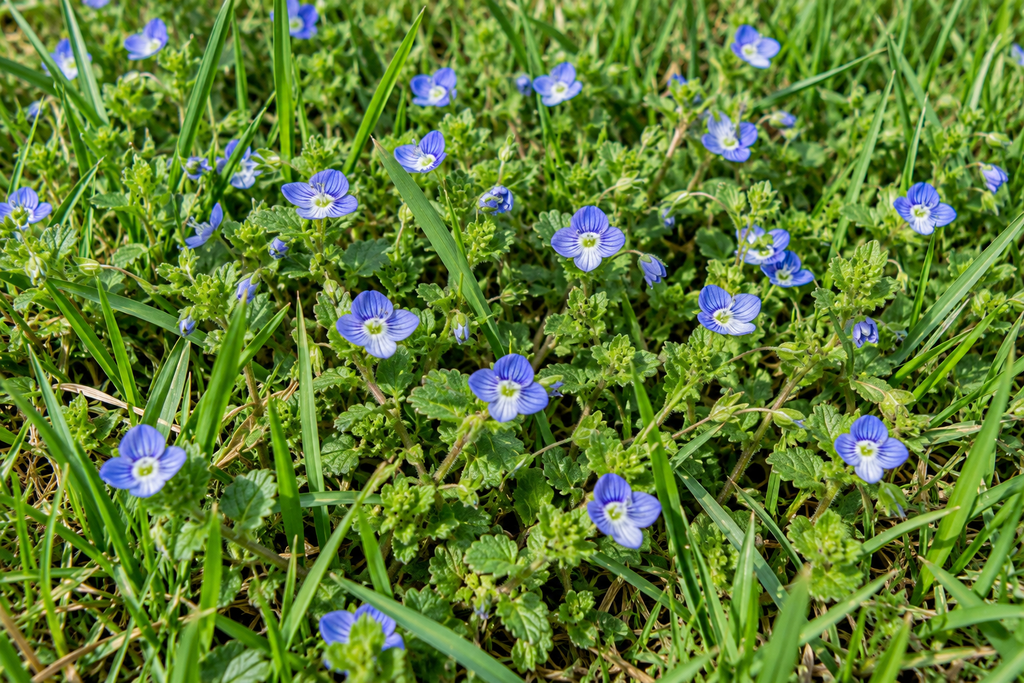
Speedwells (Veronica species) are not mints, so the square-stem test clears them immediately. Persian, ivyleaf, and corn speedwell are low, sprawling winter annuals with small opposite leaves, usually no more than about three-quarters of an inch wide, edged with rounded scallops that echo ground ivy’s. The flowers give them away: tiny and blue, often with a white throat, borne singly on slender stalks in the leaf joints. Nebraska Extension lists bloom from April through August.
Ivyleaf speedwell has lobed, ivy-shaped leaves with a larger center lobe, and its leaves are thicker and less toothed than those of Persian or corn speedwell. Persian speedwell tends to fade from turf during hot summer months, which is another point against ground ivy, since ground ivy persists.
The exception is creeping speedwell (Veronica filiformis). Washington State University’s HortSense describes it as a mat-forming plant that ranges from annual to perennial and is difficult to eradicate. If a blue-flowered mat survives the summer, check the stem shape before assuming it is ground ivy.
Seedlings add one more wrinkle. Michigan State notes that henbit seedlings can resemble creeping and corn speedwell, so a patch identified in early winter may need a second look in spring when flowers open.
Dollarweed and Dichondra: Round Leaves With the Stalk in the Wrong Place
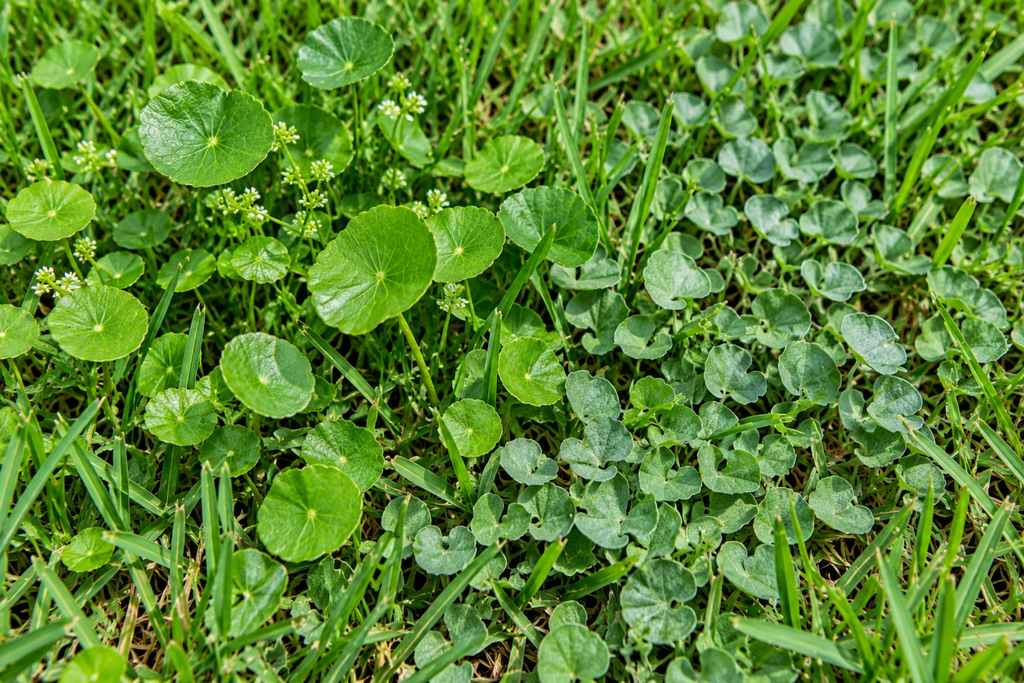
Dollarweed, also called pennywort (Hydrocotyle species), has glossy, round, scalloped leaves from about 1 to 2 inches across. The tell is the stalk. It attaches at the center of the leaf, giving it an umbrella or lily-pad look, according to Mississippi State University Extension. Ground ivy’s stalk attaches at an edge notch. Dollarweed is a rhizomatous perennial that grows in warm weather and is most often found in wet sites, so it is more common in warm, humid regions than in cold northern lawns.
Dichondra is the other plant people confuse with it. Its leaves are smooth-edged and shaped like a C or kidney, with the stalk at the notch, and it is sometimes grown on purpose as a grass alternative. Neither one has a square stem or a minty odor.
The practical value of recognizing dollarweed is what it says about the soil. Overwatering, poor drainage, low spots, and compaction all favor it, so the fix starts with water rather than a spray bottle.
Creeping Jenny: The Look-Alike Many People Planted on Purpose
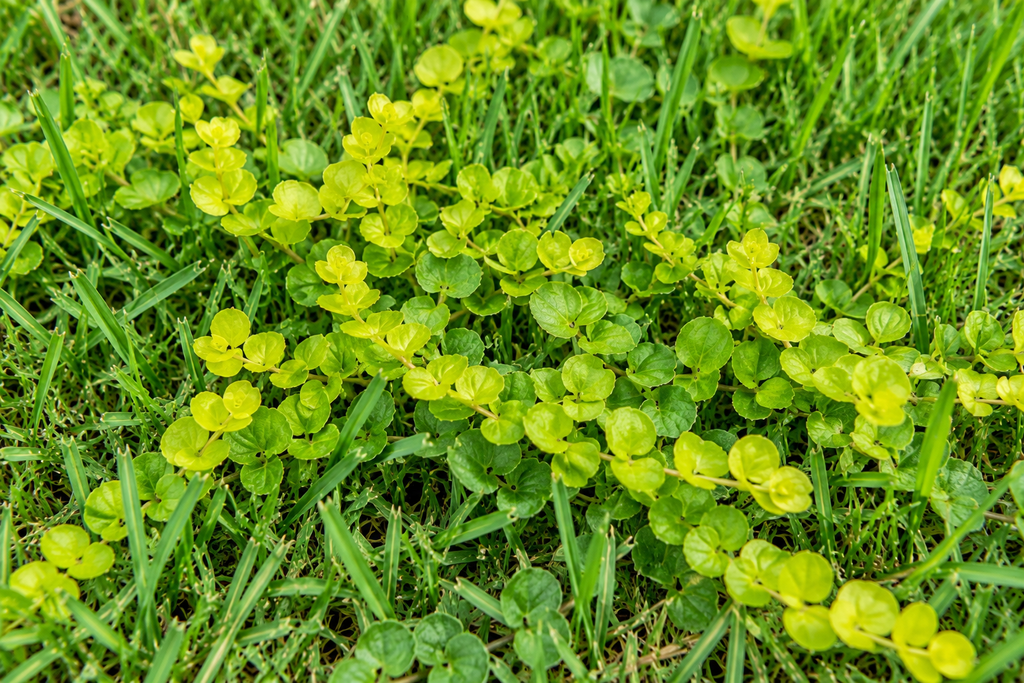
Creeping Jenny (Lysimachia nummularia), also sold as moneywort, is a garden-center groundcover. The Morton Arboretum describes opposite, nearly round leaves about three-quarters of an inch wide with smooth margins, and the species has green leaves while popular cultivars such as ‘Aurea’ have golden-yellow ones. Cup-shaped yellow flowers appear from late spring into summer.
Smooth edges are the quickest separator from ground ivy’s scallops, and the yellow flowers and non-mint family settle it. It is still a problem plant in some places: the Morton Arboretum and North Carolina State Extension both describe it as aggressive and invasive in some areas. Check local guidance before planting it, and edge or contain it where you do.
If it is in a bed you planted, it is an ornamental, and a herbicide chosen for ground ivy was not designed with it in mind. If it has crept into the lawn, expect to pull it out stem by stem, and ask your extension office which products list it.
Common Mallow and Garlic Mustard: Same Rounded Leaves, Different Leaf Arrangement
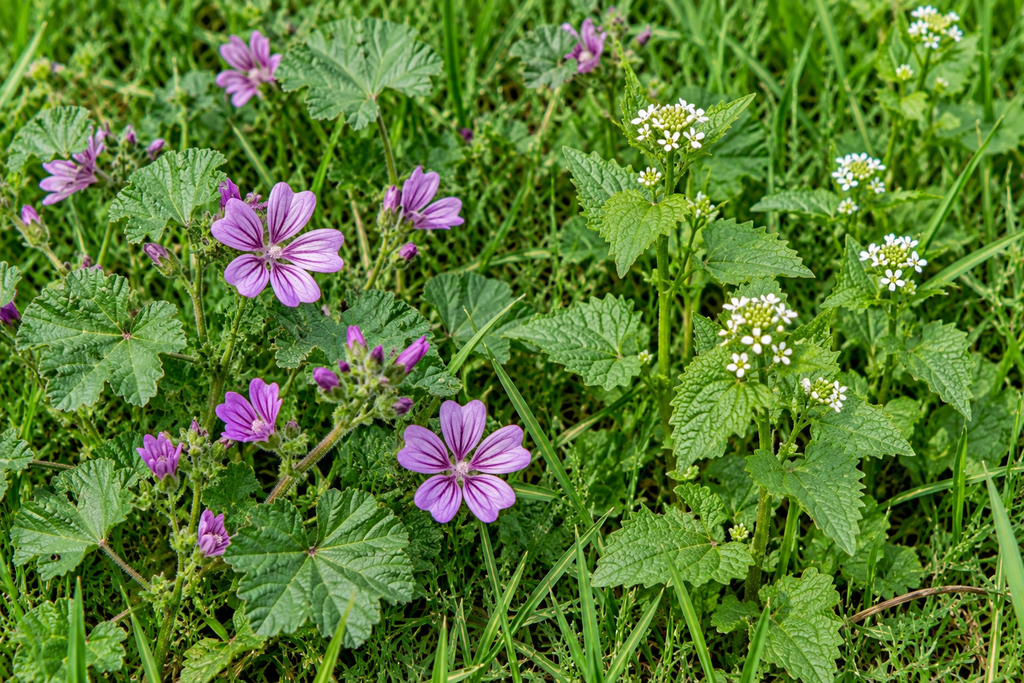
Both plants have rounded leaves that can pass for ground ivy at a glance, and both fail the arrangement test. Their leaves alternate along the stem instead of growing in opposite pairs.
Common mallow (Malva neglecta) has round to kidney-shaped leaves with five to seven shallow lobes, veins that radiate from the base, and long stalks. Stems trail along the ground, flowers are white to pale pink, and the fruits look like small flat buttons. Ohio State’s weed guide points out that ground ivy is easy to tell apart from it: ground ivy leaves are opposite, the stems are square, and the plant smells minty. Mallow also has a deep taproot, and University of Nevada, Reno Extension notes that mature plants are hard to pull for that reason. Remove it while it is young.
Garlic mustard (Alliaria petiolata) belongs here for shady beds and woodland edges. Its first-year rosette leaves are rounded and toothed, and crushing one gives off a garlic odor, not mint. It is a biennial that sends up a flowering stalk with small white flowers in its second year. It is regulated or listed as invasive in many areas, so confirm local guidance on removal and disposal, and pull it before it sets seed. (This paragraph draws on general botanical knowledge rather than a retrieved extension page; verify against your state’s invasive-species guidance before publishing.)
Match the Timing and Method to the Plant
Winter annuals: henbit, purple deadnettle, and most speedwells
Spring is late. By the time these plants are flowering, many have already shed or are about to shed seed, so spraying then mostly produces brown patches and a fresh crop of seedlings next fall. Nebraska Extension recommends targeting them in fall instead: mulch plus a preemergent herbicide in September in its region, hoeing seedlings soon after they sprout, or spot-treating young plants. Dates vary by climate, so follow your local extension calendar rather than the month. If you plan to overseed in fall, read the preemergent label first, since many of these products also block grass seed from germinating. Thickening thin turf helps over the long term, because these weeds favor sparse, nutrient-rich ground.
Ground ivy and creeping speedwell
Both are perennials that spread by creeping stems. Fall is the strongest window for herbicide, because the plant is moving nutrients down to its roots and carries the product with them, according to University of Minnesota and Nebraska Extension. Iowa State places the window in late September through early November for its climate and says two applications are needed. Triclopyr is the active ingredient extension sources mention most consistently. They do not agree on 2,4-D: Minnesota calls it not very effective on ground ivy, while Iowa State lists it among the most effective. Follow the product label and ask your local office instead of assuming. Tennessee Extension notes there are no preemergent herbicides for ground ivy, so crabgrass preventer will not help.
Hand removal works in beds and small patches only if it is thorough and repeated, because any fragment with a node can reroot. Minnesota’s Department of Natural Resources says all stems must be removed or the plant recolonizes. Where shade and moisture persist, ground ivy comes back after treatment; Minnesota Extension lists increasing sunlight to strengthen turf as a cultural control.
Borax shows up online as a home remedy. Iowa State Extension does not recommend it. A 1990s study there was promising, but it was never replicated, and questions remain, including how long boron stays in the soil.
Wild violet
Experts quoted in Landscape Management point to fall as the best time for herbicide, followed by a repeat application in spring. Use a postemergent whose label names wild violet, and plan on more than one pass.
Dollarweed
Correct the moisture problem first: reduce irrigation, improve drainage, and fill low spots. Then use a selective product labeled for dollarweed and for your turf type, applied while the weed is actively growing.
Creeping Jenny, mallow, and garlic mustard
These are mostly mechanical jobs. Pull mallow while young, dig or pull creeping Jenny stem by stem, and remove garlic mustard before seed set.
Before You Spray Anything
Broadleaf herbicides are not forgiving of mistakes, and a wrong identification wastes the product and can damage plants you wanted.
- Confirm the ID in hand. Use the five checks above on a flowering stem, not a single leaf.
- Read the label for both the weed and your turfgrass species. Products are labeled for specific weeds and specific grasses, and a product that suits one lawn can injure another.
- Protect what is nearby. Broadleaf herbicides can injure shrubs, perennials, vegetable gardens, and tree roots through drift or runoff. Skip windy days and keep away from beds.
- Follow the label’s directions on protective gear and re-entry. Keep children and pets off treated areas for the time it specifies.
- Spot-treat when you can. Nebraska Extension points out that broadcast applications waste money when only a few weeds are present.
- Do not substitute household mixes. Borax and similar remedies are not recommended by extension services.
Consider hiring a licensed applicator when the infestation covers much of the lawn, when weeds are tangled through ornamentals or tree roots, or when you cannot confidently identify the plant.
Common Questions About Telling These Plants Apart
Can I identify these from a photo, or do I need the plant in hand? Photos help, but the decisive clues are tactile: square versus round stem, whether the upper leaves have stalks, the smell, and whether the stems root as they creep. If you send a sample to an extension office or Master Gardener help line, include a stem with several leaf pairs and any flowers, plus a photo of the whole patch. Services and fees vary by county.
Can more than one of these grow in the same patch? Yes. Ground ivy and purple deadnettle can share habitat, and henbit often grows alongside purple deadnettle. In a shady, thin lawn a mixed patch is common. Time your fall control around the most persistent plant, which is usually the perennial.
Are any of these safe to eat? Foraging writers describe several of them as edible, but a lawn article cannot confirm a plant is safe, and this one does not cover edibility. Lawn and roadside plants can also carry herbicide residue or soil contaminants. If foraging interests you, use a regional field guide and an experienced local forager.
Final Thoughts
Most failed weed treatments trace back to the identification rather than the product. Before buying anything, check four things on a flowering stem: stem shape, whether every leaf has a stalk, the smell of a crushed leaf, and whether the stems root as they creep. Then note when the patch blooms and whether it is still there in July. Annuals fade, perennials do not.
A practical next step is to mark each suspect patch now and photograph it in spring and again in summer. By fall you will know which patches were annuals that took care of themselves and which are persistent perennials worth treating while the plants are drawing nutrients to their roots.

About Syprose Kiche
Syprose Kiche is the creator and writer behind My Besuited Home, a practical home and garden website covering DIY projects, gardening, lawn care, landscaping, home improvement, and outdoor living. She focuses on turning everyday homeowner questions into clear, practical guides backed by careful research and useful real-world considerations.