
Does your backyard look a little flat? You’ve got the lawn, maybe a few shrubs, but everything is stuck at waist height. It’s a common trap. I spent my first three years as a gardener focused entirely on the ground until I realized I was ignoring 90% of my available real estate: the vertical space.
If you want that “secret garden” vibe without waiting twenty years for a tree to grow, you need climbers. But let’s be honest—pick the wrong one and you’re either looking at a dead stick or a vine that’s currently trying to eat your neighbor’s cat. I’ve killed enough “easy” plants to know which ones actually pull their weight. Here are 15 flowering climbers that will transform your fences and pergolas without making you regret your life choices.
1. Clematis: The Queen of the Trellis
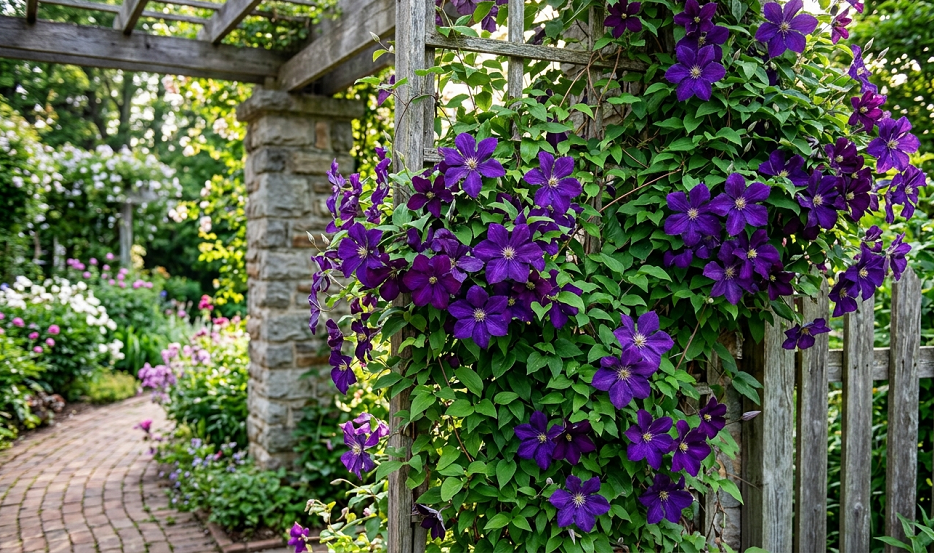
If you aren’t growing Clematis, you’re missing out on the easiest way to look like a pro. I used to think these were fussy because of the old “feet in the shade, head in the sun” rule, but it’s actually pretty simple. Just mulch the base heavily or put a flat rock over the roots. My favorite is ‘Nelly Moser’—the stripes are so perfect they look painted on.
Don’t buy the tiny, four-inch pots at the grocery store. They take forever to establish and usually give up the ghost before July. Go for a gallon-sized plant. It costs more upfront, but you’ll actually see flowers this decade. I’ve found that the biggest mistake people make is pruning them at the wrong time. Some bloom on old wood, some on new. If you hack it back in winter and it’s a spring bloomer, you just threw your flowers in the green bin.
I once spent an entire Saturday untangling a Clematis from a rose bush because I didn’t give it a dedicated wire to grab onto. They have these little “leaf tendrils” that act like tiny hands. If the support is thicker than a pencil, they can’t grab it. Use thin wire or bird netting against your fence to give them something to hold.
For the best results, feed them a high-potash fertilizer right when the buds start to swell. I’ve tried the “organic only” route with just compost, and while the plant stayed green, the blooms were pathetic. A little boost goes a long way here.
2. American Wisteria: No, Not the Invasive Kind
Listen to me carefully: stay away from Chinese or Japanese Wisteria unless you want to spend the rest of your life as a full-time pruner. I planted a Chinese Wisteria at my old house and by year five, it had crushed a sturdy cedar pergola and was trying to pry the siding off the garage. It’s a monster.
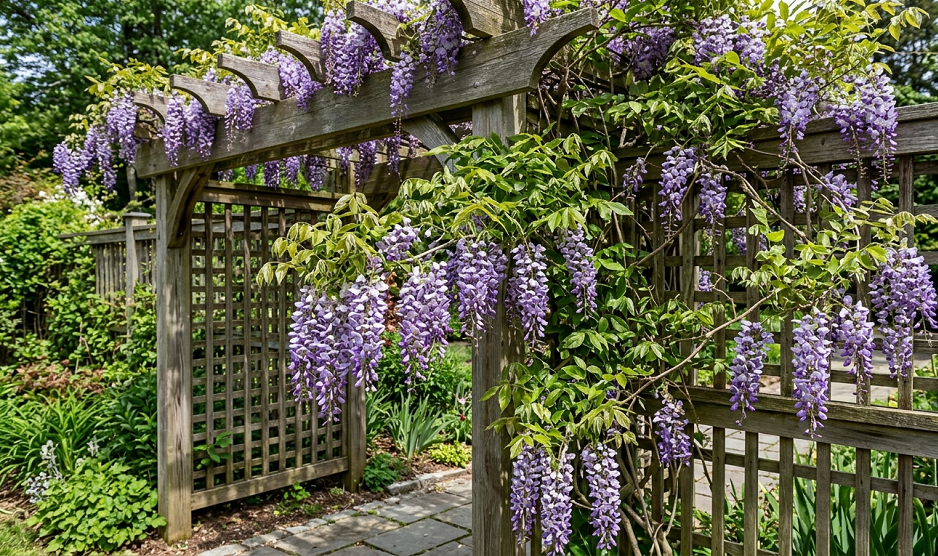
Instead, look for Wisteria frutescens, the American variety. It’s much more polite. It still gives you those gorgeous, dripping purple racemes that smell like heaven, but it won’t try to demolish your home. It blooms a bit later in the summer, which is actually great because it misses the late frosts that often kill the buds on the Asian varieties.
I love training these over a sturdy archway. The scent is heavy—in a good way. The first time my ‘Amethyst Falls’ bloomed, I sat under it for two hours with a beer and ignored my weeding chores entirely. It was worth it. Just make sure you have a support system made of heavy-duty timber or metal. Even the “polite” version is heavy when it’s wet.
One quick tip: if yours isn’t blooming, hit it with some superphosphate in the spring. Sometimes they get too much nitrogen from lawn runoff and they decide to just grow leaves instead of flowers. It’s like the plant forgets its job description.
3. Honeysuckle: The Fragrant Fence Cover
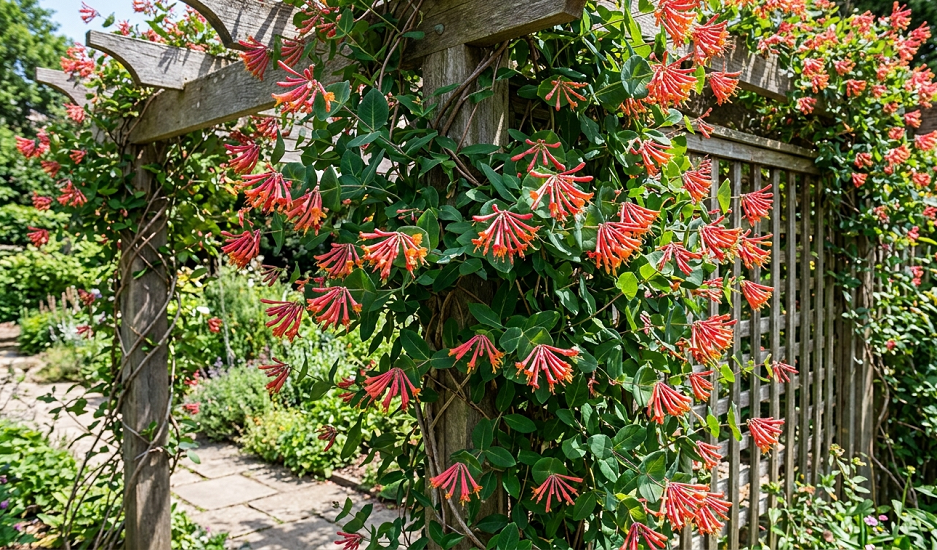
There is nothing quite like the smell of honeysuckle on a humid July evening. But please, for the love of all that is holy, do not plant the invasive Japanese variety with the white and yellow flowers. You’ll be fighting it in your woods for decades. I made that mistake in my first “wildlife garden” and I’m still pulling up runners ten years later.
Go for the ‘Gold Flame’ or ‘Major Wheeler’ (Trumpet Honeysuckle). These are native to North America, they aren’t invasive, and hummingbirds will fight each other for a spot on these vines. ‘Major Wheeler’ is a powerhouse—it’s a solid wall of red tubes all summer long.
I’ve found that honeysuckle is the best plant for covering a chain-link fence. It’s dense, it grows fast, and it doesn’t mind a bit of neglect. I have mine on a west-facing fence where the sun is brutal, and it just thrives. It doesn’t need fancy soil; it just needs a bit of water during the “dog days” of August.
One side note: keep an eye out for aphids. They love the tender new growth on honeysuckles. I don’t bother with pesticides; I just blast them off with a sharp stream of water from the hose. It’s cathartic and it works better than any chemical spray I’ve tried.
4. Climbing Roses: The Romantic Choice
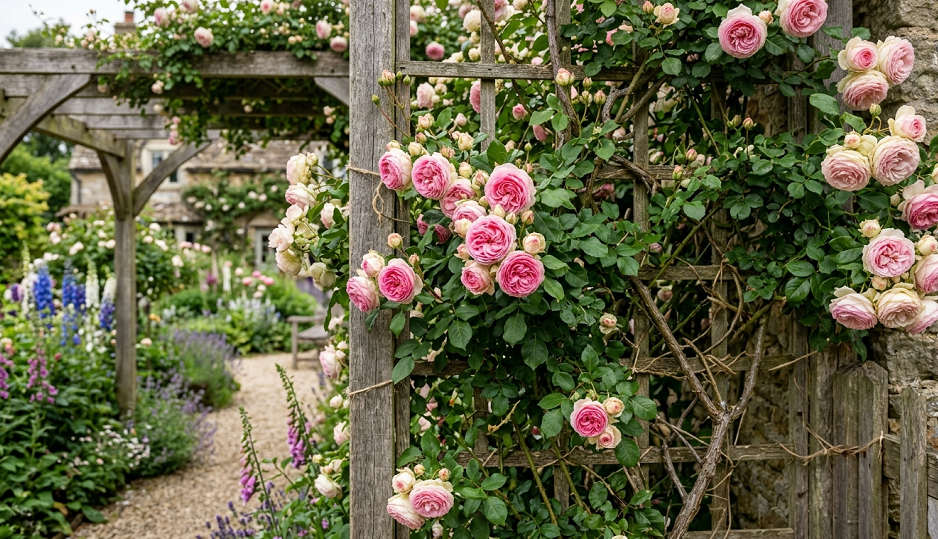
People are terrified of roses. They think they’re “divas.” And honestly, some of them are. But a good climbing rose like ‘New Dawn’ or ‘Eden’ is surprisingly tough. The trick is to realize that climbing roses don’t actually “climb.” They don’t have tendrils or suckers. You have to tie them to the support manually.
I use old pantyhose or soft garden twine to tie the canes. Don’t use wire; it’ll cut into the stems when the wind blows. My biggest “aha!” moment was learning to train the canes horizontally. If you let them grow straight up, you’ll get three flowers at the very top and a whole lot of ugly sticks at eye level. If you bend the canes sideways, every single node will send up a flowering shoot.
The summer my ‘Eden’ rose finally covered the back trellis, it was a literal wall of pink. I probably took 500 photos of it. It’s the kind of plant that makes your neighbors stop and stare. Just be prepared for the thorns. I have a permanent scar on my forearm from a rogue ‘Don Juan’ cane that caught me while I was mowing. Wear the long gloves.
Also, don’t skimp on the mulch. Roses hate “wet feet” but they also hate drying out completely. A three-inch layer of wood chips or compost keeps the roots cool and the black spot at bay. If you get black spot (yellowing leaves with black dots), just pull them off and throw them in the trash, not the compost.
5. Morning Glory: The Quick Fix
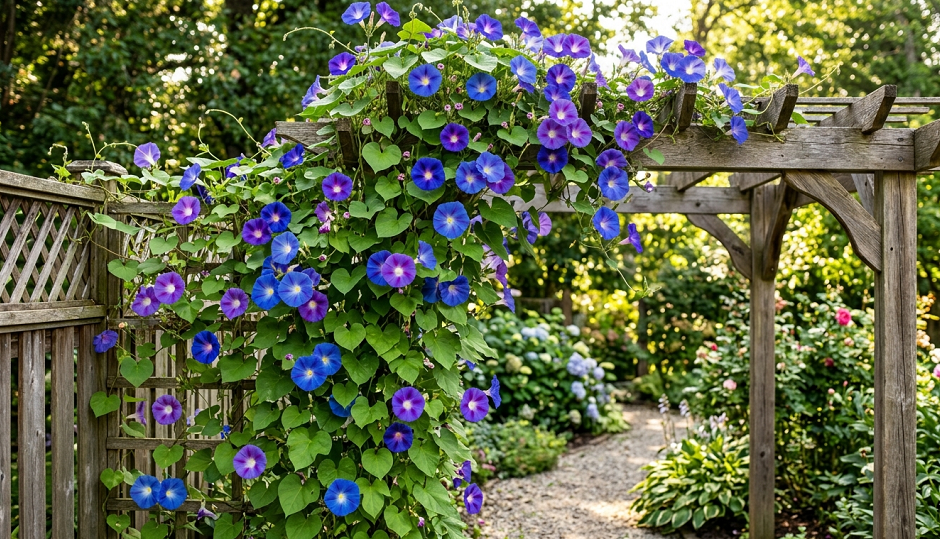
If you’re a renter or you just moved in and the yard looks like a wasteland, Morning Glories are your best friend. They are annuals, meaning they die when it frosts, but they grow twenty feet in a single season. I once planted some to hide a particularly hideous rusted shed, and by August, the shed was a beautiful purple mound.
They are cheap. A three-dollar packet of seeds will cover a whole balcony. Soak the seeds overnight in warm water before planting—they have a hard coat and need a little “wake-up call” to germinate. I’ve found that if I don’t soak them, they take three weeks to show up; if I do, they’re up in four days.
Be warned: they reseed like crazy. If you plant them once, you will have them forever. Some people call them weeds because of this, but honestly, I’d rather pull a few extra seedlings in May than have a bare fence. The ‘Heavenly Blue’ variety is the gold standard—it’s a blue so bright it almost looks fake.
Just don’t plant them near your vegetable garden. They will climb your tomatoes and strangulate them before you can say “caprese salad.” Keep them on their own dedicated trellis or a piece of twine stapled to a wall.
6. Black-Eyed Susan Vine: The Cheerful Neighbor
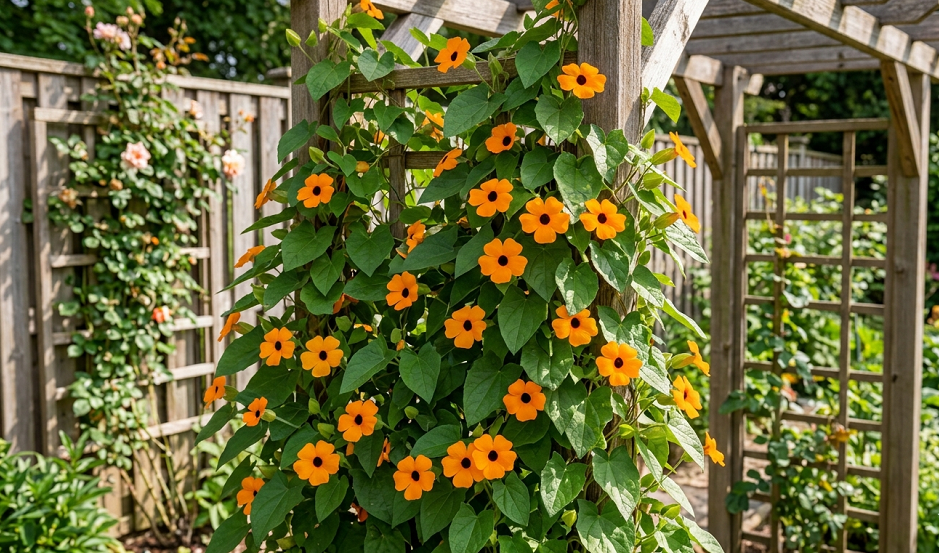
This isn’t the perennial flower you see in meadows; Thunbergia alata is a tender climber that looks like a little yellow or orange face with a dark “eye” in the center. I love these for window boxes or hanging baskets where they can spill over the edges or climb up the chains.
They are incredibly prolific. I’ve found that they do best in the morning sun and afternoon shade, especially if you live somewhere hot. If they get baked in the 4:00 PM sun, they tend to wilt and look sad until the next morning. I keep mine on the porch where they get the “polite” sun.
I’ve had great luck growing these in large pots with a simple bamboo tripod. It creates a “flowering pillar” effect that looks very high-end for about ten dollars’ worth of materials. They don’t need much fertilizer—too much “food” and they’ll give you a ton of leaves but very few of those iconic “eyes.”
One year, I tried to over-winter one indoors. Don’t bother. It got spider mites within a week and tried to infect my entire houseplant collection. Treat it as an annual, let it die with the first frost, and buy fresh seeds next year. It’s not worth the headache.
7. Passionflower: The Exotic Showstopper
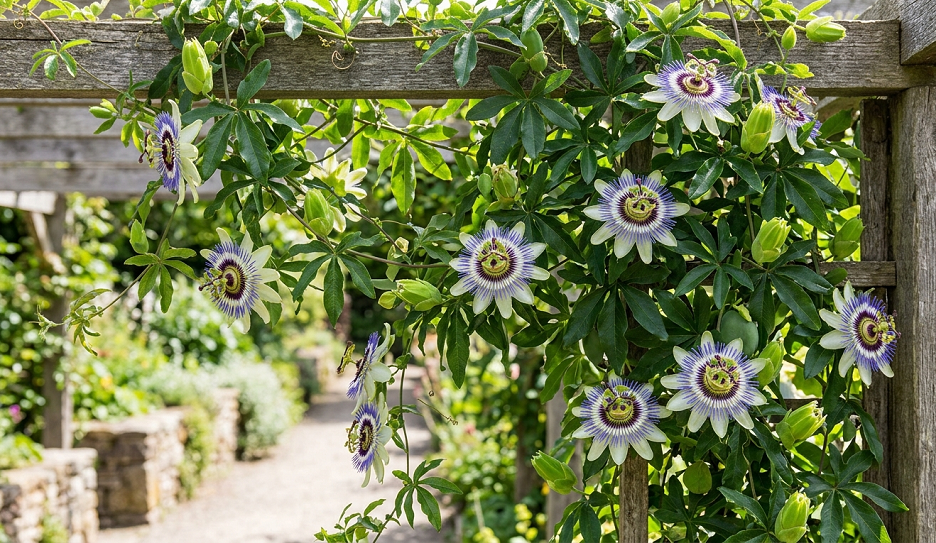
If you want people to ask, “What on earth is that?”, plant a Passionflower. The blooms look like something out of a sci-fi movie—complex, multi-layered, and deeply weird. Most people think they are strictly tropical, but Passiflora incarnata (Maypop) is actually hardy quite far north.
I grew one in my Zone 6 garden and was shocked when it came back after a brutal winter. It dies back to the ground every year, so don’t freak out when it looks like a pile of dead sticks in March. It’s a late sleeper; mine usually doesn’t show its face until late May, right when I’m about to give up on it.
The butterflies love it. Specifically, the Gulf Fritillary butterfly. Their caterpillars will eat the leaves, but don’t panic—the plant grows so fast it can easily handle a few hungry larvae. I consider it a fair trade for seeing those bright orange butterflies everywhere.
Just a heads up: it spreads via underground runners. I found a shoot popping up in the middle of my lawn about six feet away from the main plant. If you want to keep it contained, plant it in a bottomless bucket buried in the ground. It’s a “rambler” in every sense of the word.
8. Climbing Hydrangea: For the North Side
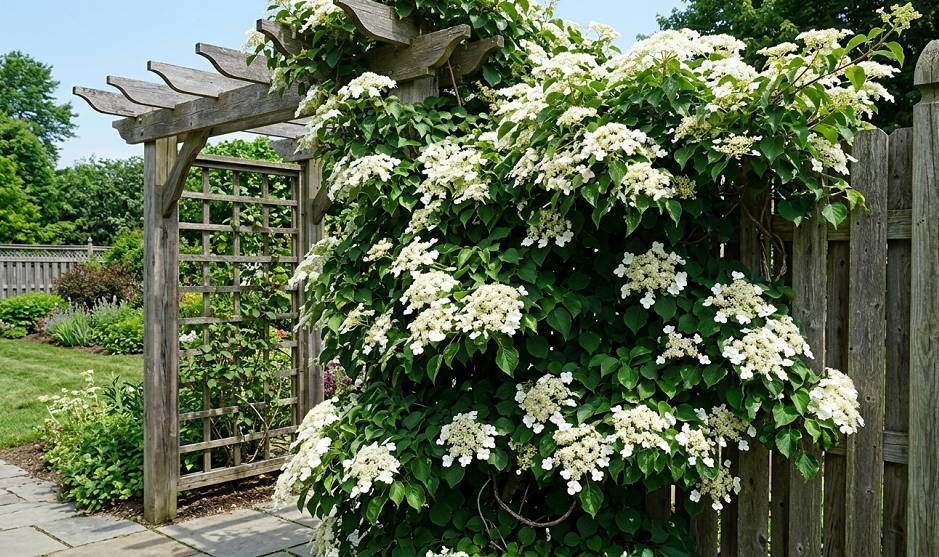
Most flowering vines crave the sun, but what do you do with that dark, depressing north-facing wall? You plant a Climbing Hydrangea. Unlike the others, this one uses “aerial rootlets” to glue itself to brick or stone. I have one on the side of my chimney, and it’s spectacular.
Fair warning: it is slow. The first three years, you’ll think it’s plastic. They say about this plant: “The first year it sleeps, the second year it creeps, and the third year it leaps.” By year four, mine was taking off like a rocket. The white lacecap flowers are elegant, and the peeling cinnamon-colored bark looks great even in the dead of winter.
I’ve found that you shouldn’t put this on a wooden fence unless you’re prepared to replace the fence eventually. The rootlets hold onto moisture and can rot the wood over time. It’s much happier on masonry or a very heavy-duty trellis set away from the house.
One side note for the impatient: if you want the look but don’t want to wait five years, look for Schizophragma hydrangeoides (False Hydrangea Vine). It looks almost identical but tends to bloom a bit sooner in its life cycle. I have both, and honestly, they’re both winners.
9. Sweet Autumn Clematis: The September Star
While everything else in the garden is starting to look tired and crispy in late August, Sweet Autumn Clematis is just getting started. It turns into a literal “snowdrift” of tiny, white, vanilla-scented flowers. I can smell mine from the driveway when I get home from work.
But let’s get real: this plant is a thug. It grows with an aggression that is frankly a little scary. I once left a ladder leaning against the fence for two weeks in September, and I had to prune the vine off the rungs just to get my ladder back. It will cover a twenty-foot fence in a single season.
In some areas, it’s considered invasive because it reseeds so easily. Check your local “naughty list” before planting. If you do plant it, be prepared to hack it back to about twelve inches from the ground every March. It blooms on new growth, so you can’t really hurt it with the pruners.
I’ve found that this is the best plant for hiding something truly ugly—like a chain-link dog run or a neighbor’s collection of “project” cars. It provides a massive amount of green privacy and then a spectacular finale of flowers before winter hits.
10. Jasmine: The Southern Belle
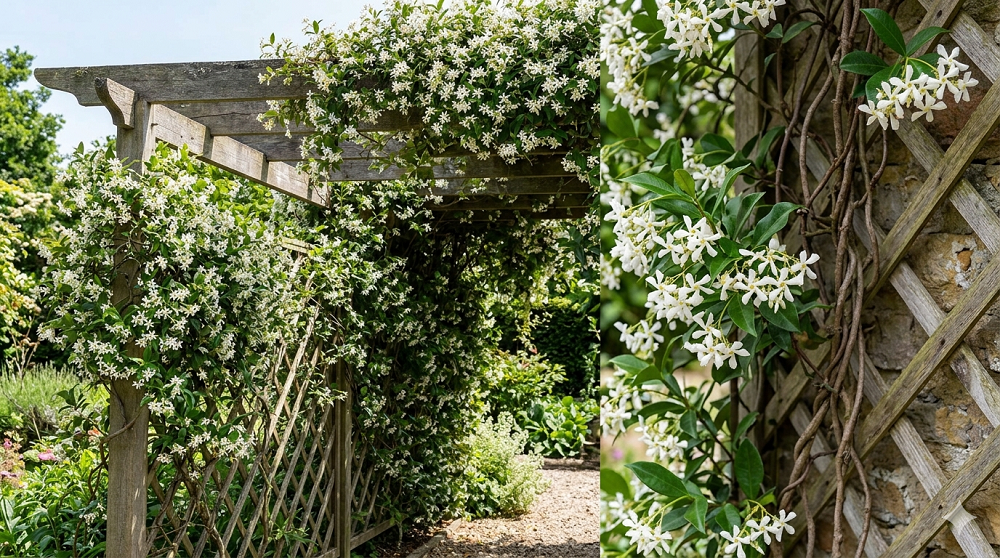
If you live in a warmer climate (or have a very sunny, sheltered patio), Star Jasmine (Trachelospermum jasminoides) is non-negotiable. The scent is the gold standard of gardening. I keep one in a large pot on my patio and move it into the garage for the three weeks of “real winter” we get here.
It’s an evergreen, so you get nice, glossy dark green leaves all year round. The flowers are small, white stars, but they pack a punch. One vine can perfume an entire backyard. I’ve found that it’s remarkably pest-resistant, too. I don’t think I’ve ever seen a bug on mine.
Don’t confuse this with “Carolina Jasmine,” which is yellow and blooms earlier. Both are great, but Star Jasmine has that classic “perfume” scent. It’s a bit of a slow starter, similar to the hydrangea, but once the roots are established, it fills in beautifully.
It’s also surprisingly drought-tolerant. I’ve forgotten to water my potted jasmine for a week in the middle of July (oops), and while it looked a bit wilted, it bounced back after a good soak. It’s a “tough cookie” despite its delicate looks.
11. Cup and Saucer Vine: The Annual Architectural Marvel
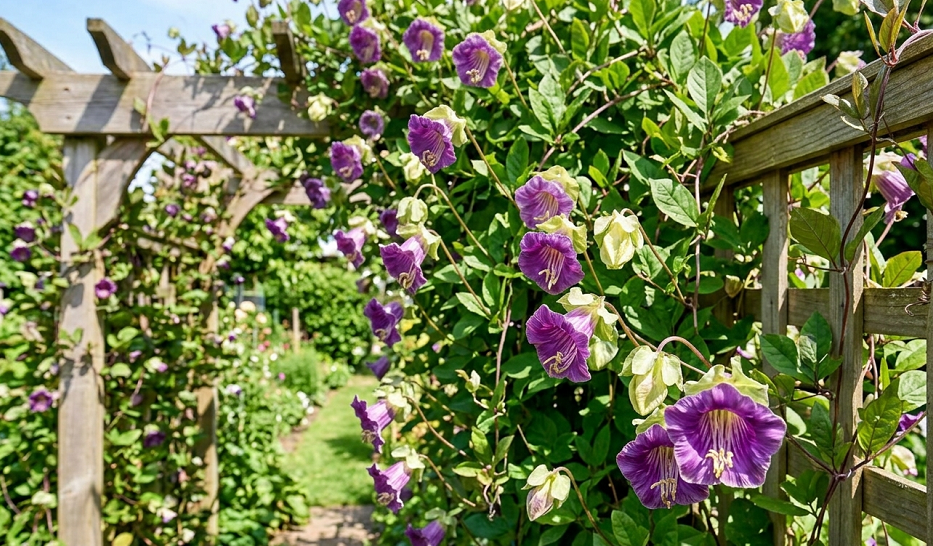
Cobaea scandens is one of those plants that makes you look like a botanical genius. The flowers actually look like a little purple cup sitting on a green saucer. It’s a fast-growing annual that can reach twenty feet if it’s happy.
I’ve found that the trick with these is to start them early indoors. If you wait to sow the seeds outside in May, you won’t get flowers until October, and then the frost will kill them two days later. Start them in peat pots in March, and don’t bury the seeds too deep—they need a bit of light to sprout.
They have these incredibly strong tendrils that will grab onto anything. I once had one “hitchhike” its way up a downspout and onto the roof. The flowers start out a pale green and then slowly turn a deep, royal purple over a few days. Watching the color change is half the fun.
A quick side note: don’t over-fertilize these with nitrogen. You’ll get a massive vine that could cover a school bus, but zero “cups.” Give them a phosphorus-heavy bloom booster once they hit about six feet tall.
12. Mandevilla: The Tropical Workhorse
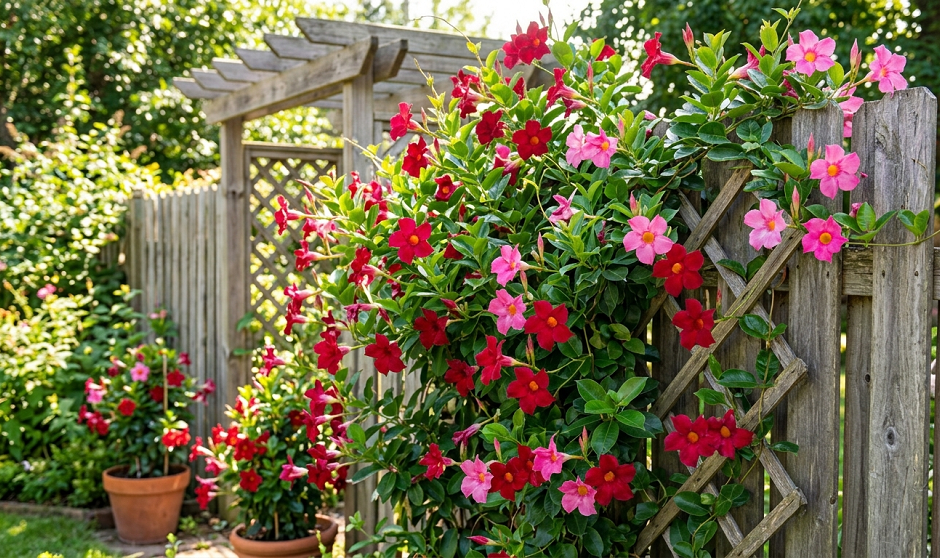
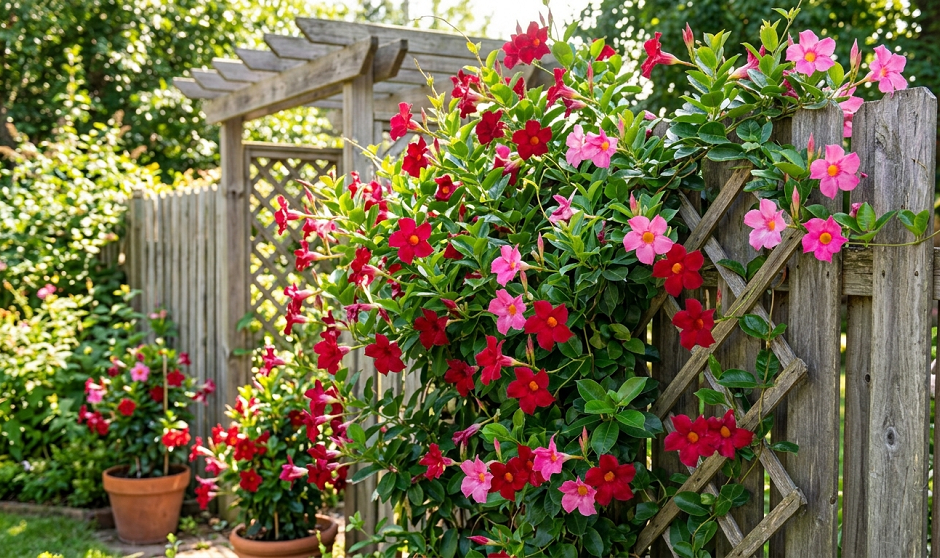
You see these at every garden center in the spring, usually with red or pink trumpet-shaped flowers. They are technically tropical perennials, but most of us grow them as annuals. They are the most reliable “bloom machines” I’ve ever encountered.
They don’t care about the heat. When every other plant in my yard is gasping for air in the August humidity, the Mandevilla is just cranking out more flowers. I use them in “thriller” pots—a big central trellis in a large container surrounded by some trailing petunias.
The “Sun Parasol” series is particularly good. I’ve found that the red ones tend to attract the most hummingbirds. They aren’t particularly fragrant, but the sheer volume of color makes up for it. They also have very clean, plastic-looking leaves that don’t seem to get diseases.
If you have a cat or a dog that likes to chew plants, be careful—the sap is milky and can be irritating. I keep mine on the “outside” of the deck railing just to be safe. It’s a low-maintenance, high-reward plant that never lets me down.
13. Trumpet Vine: Proceed with Caution
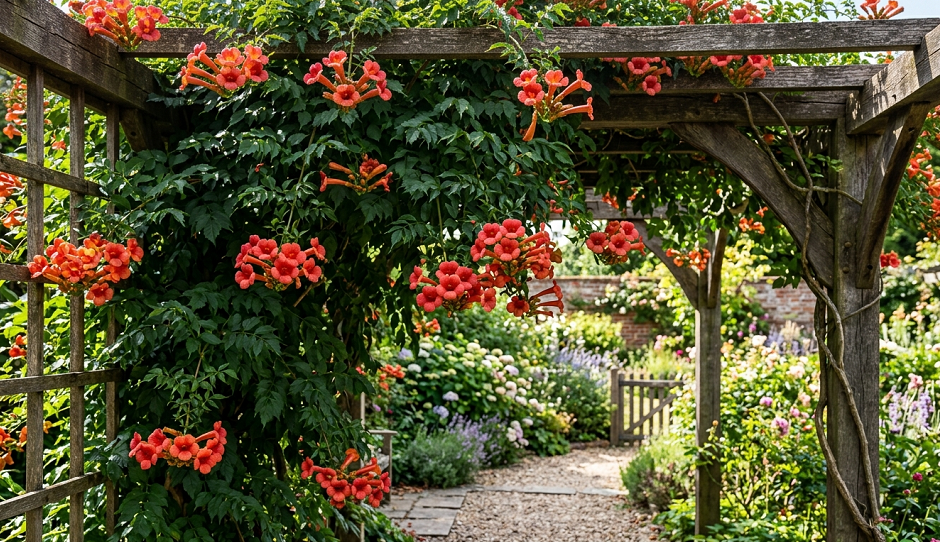
I’m putting this on the list because the flowers are incredible—big, orange, tropical-looking tubes that hummingbirds absolutely adore. But I’m giving you a stern warning: Campsis radicans is a beast. I’ve seen this vine pull the gutters right off a house.
Its roots are aggressive. It sends up “babies” everywhere. I spent three years trying to kill one that a previous owner had planted against the foundation. If you want this plant, you must put it on a standalone structure far away from your house—like a heavy-duty 4×4 post in the middle of a field.
I’ve found that the ‘Flava’ (yellow) or ‘Madame Galen’ (salmon) varieties are a little less “insane” than the native orange species, but they are still vigorous. You need to prune them hard every winter. Think of it like a pet tiger—beautiful, but you have to know what you’re dealing with.
If you have a massive, ugly telephone pole or a dead tree you want to hide, this is your plant. Nothing else can cover a dead oak tree as fast as a Trumpet Vine. Just don’t let it touch anything you actually value, like your garage or your sanity.
14. Bougainvillea: The Neon Nightmare (for your hands)
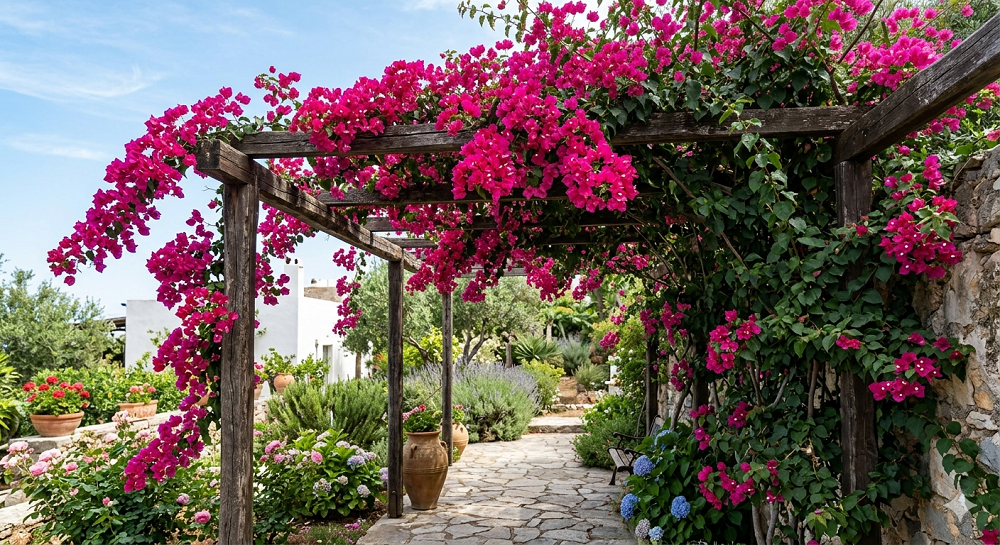
If you live in Zone 9 or higher, Bougainvillea is the king of climbers. The “flowers” are actually papery bracts that come in colors so bright they look like neon signs—magenta, orange, electric purple. They love the heat and they actually bloom better if you “abuse” them a little.
I’ve found that the biggest mistake people make with Bougainvillea is giving them too much love. If you water them too much and give them rich soil, they’ll just grow giant thorns and green leaves. If you let them dry out and bake in the sun, they’ll explode with color.
Speaking of thorns: they are no joke. They’re like shark teeth. I once got stuck in a Bougainvillea bush while trying to retrieve a lost frisbee, and I seriously considered just living there forever because it was too painful to move. Wear heavy leather gloves and a thick jacket when pruning.
The best part? They are incredibly drought-tolerant. Once established, you can basically ignore them. They are perfect for that hot, dry spot by the driveway where nothing else survives. Just make sure the soil drains well; they hate having “soggy bottom.”
15. Snail Vine: The Conversation Piece
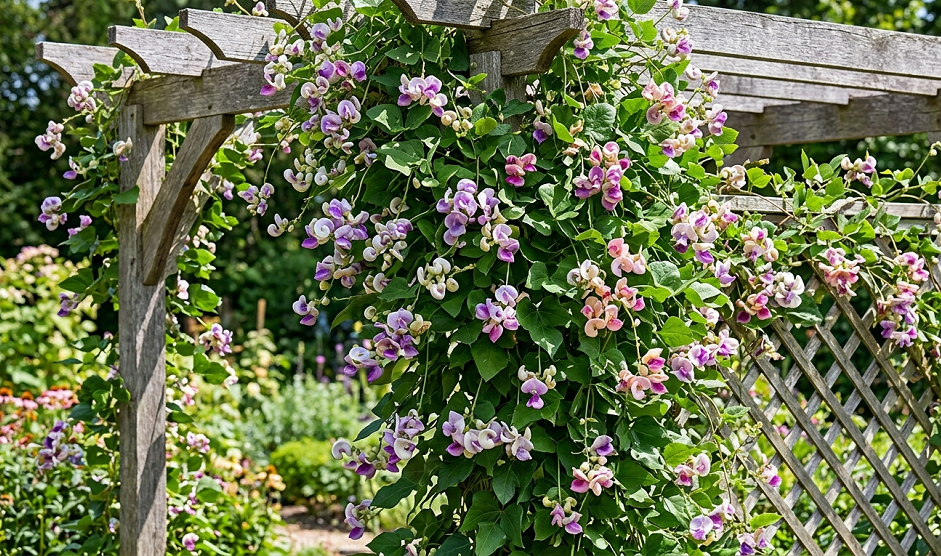
Finally, we have the Snail Vine (Vigna caracalla). This is a fast-growing tender perennial (grown as an annual in most places) that produces flowers that look exactly like little snail shells. They start out white and fade to a beautiful lavender and cream.
The smell is what gets you—it’s like a mix of hyacinth and jasmine. I grew one on a tripod near my back door, and every time someone walked by, they had to stop and poke the flowers. It’s a weird, wonderful plant that you won’t find in most “big box” stores. You’ll likely have to order seeds online.
I’ve found that they love heat. They sit there doing nothing all through June, and then as soon as it hits 90 degrees, they grow six inches a day. Give them plenty of water and a liquid fertilizer every two weeks to keep the blooms coming.
Side note: make sure you’re getting Vigna caracalla, the fragrant one. There is a non-fragrant version (Phaseolus giganteus) that looks similar but has zero scent. Don’t get cheated! The fragrant one is the only one worth the space.
The Real Talk: What Nobody Tells You
Before you go out and spend $300 at the nursery, let’s have a “fence-side” chat about what can go wrong. First off, most trellises sold at hardware stores are garbage. Those flimsy little fan-shaped wood things will snap the first time a heavy vine gets hit by a 20-mph wind. If you’re planting a perennial climber, build something sturdy with pressure-treated lumber or heavy-duty metal.
Second, climbing plants are messy. Roses drop petals, Wisteria drops seed pods, and Honeysuckle drops “spent” flowers that turn into a slippery mush on your patio. If you’re a “neat freak,” you’re going to hate vertical gardening. Personally, I think the “flower confetti” looks charming, but my wife disagrees when it gets tracked into the kitchen.
Lastly, don’t plant climbers against your siding. I don’t care what the Pinterest photo shows. Most vines trap moisture against the house, which leads to rot, mold, and ants. Always leave at least a 6-inch gap between your trellis and the wall of your home to allow for airflow. Your house (and your future repair bill) will thank you.
Parting Wisdom
If you only take one thing away from my years of trial and error, let it be this: Match the plant to the support, not the other way around. Don’t try to grow a Wisteria on a plastic lattice, and don’t waste a heavy-duty pergola on a Morning Glory. Think about how that plant is going to look (and weigh) in five years, not five weeks.
Gardening is just a series of experiments where the subjects occasionally die. Don’t be afraid to rip something out if it’s not working. I’ve “fired” plenty of plants that didn’t live up to the hype.
What’s the one plant you’ve tried to grow that turned into a total disaster? Let me know in the comments below—I need to know I’m not the only one who has accidentally grown a “weed” into a prize-winning specimen!

About Syprose Kiche
Syprose Kiche is the creator and writer behind My Besuited Home, a practical home and garden website covering DIY projects, gardening, lawn care, landscaping, home improvement, and outdoor living. She focuses on turning everyday homeowner questions into clear, practical guides backed by careful research and useful real-world considerations.