
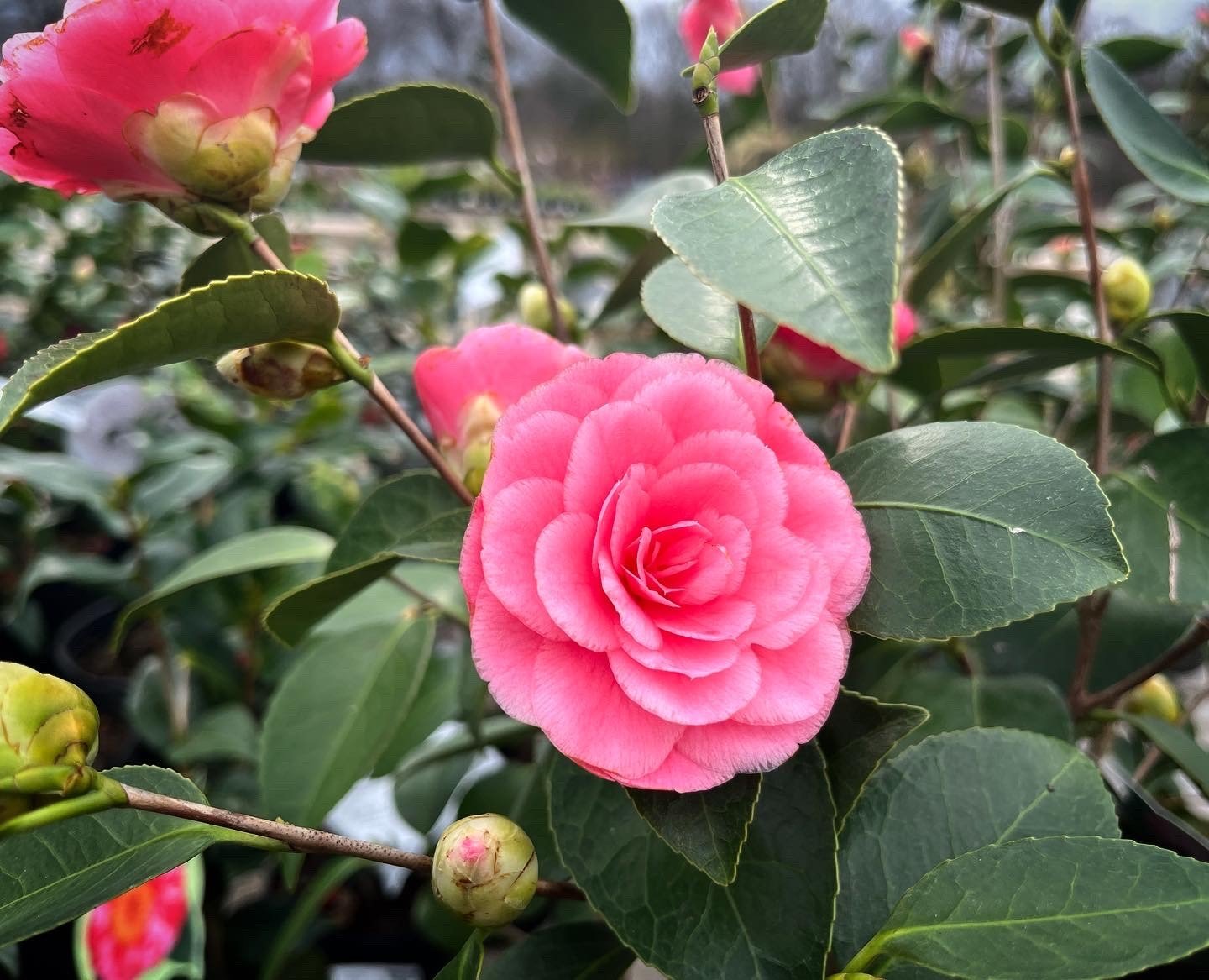
Every fall, my neighbor Denise knocks on my door holding a magazine photo of some impossibly perfect camellia bush and asks, “Can I grow this?” And every fall, I have to explain that yes, she absolutely can, but only if she picks the right variety for her yard instead of just grabbing whatever’s blooming at the garden center that weekend.
That’s the mistake most people make with camellias. They fall in love with a photo, buy the plant on impulse, stick it in full sun because “flowers need sun, right?”, and then spend the next two years wondering why the leaves are scorched and the blooms never showed up. Camellias are not roses. They don’t forgive bad placement.
The good news is that once you know which variety fits your climate, your light conditions, and honestly, your patience level, camellias are some of the most rewarding shrubs you can plant. They give you glossy evergreen foliage all year and then, right when everything else in the garden has given up for winter, they explode into flower. Nothing else does that.
I’ve grown a dozen different camellias over the years, killed a couple of them through pure stubbornness, and finally landed on a list of varieties that consistently perform. Here are 11 of the most beautiful camellia varieties worth a spot in your yard, plus what nobody tells you before you plant one.
1. Camellia japonica ‘Debutante’
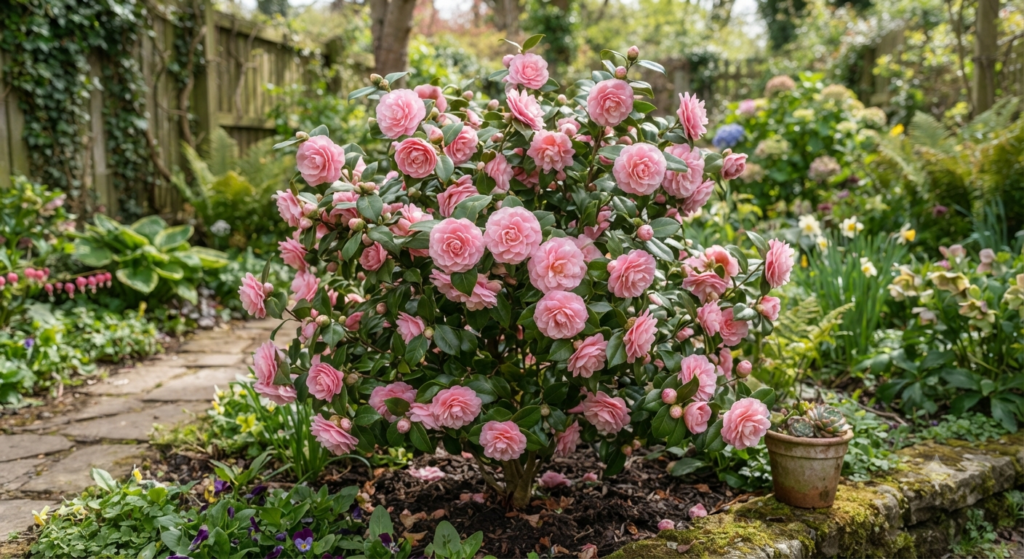
If you want the classic, old-fashioned camellia look, ‘Debutante’ is where you start. The blooms are a soft pink, packed with dozens of tightly layered petals in what’s called a peony form. From a few feet away, you’d swear it was an actual peony bush, not a camellia.
I planted my first ‘Debutante’ along a north-facing fence because I’d read that camellias hate afternoon sun, and that turned out to be excellent advice. The plant took about three years to really settle in and start producing that heavy, ruffled bloom count, so don’t panic if your first winter or two looks a little sparse.
This variety blooms early, usually late winter into early spring depending on your zone, which makes it one of the first real color shows in the garden after a gray winter. It’s also a slow grower, topping out around 6 to 8 feet, so it works well near a porch or entryway where you don’t want something that’s going to swallow the walkway in five years.
One search term I see a lot is “camellia that blooms like a peony,” and ‘Debutante’ is almost always the answer. If that’s the look you’re after, stop scrolling and just buy this one.
2. Camellia sasanqua ‘Yuletide’
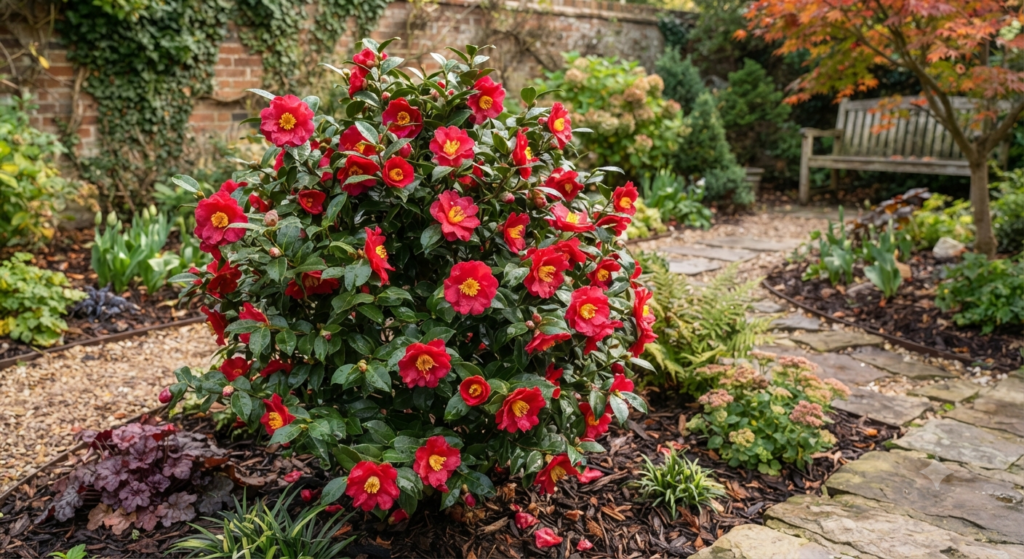
‘Yuletide’ is the camellia for people who want their yard to look festive without hanging a single string of lights. The flowers are a deep, saturated red with a burst of golden yellow stamens in the center, and they show up right around, you guessed it, the holidays.
Unlike a lot of camellias that sulk in full sun, sasanqua varieties like ‘Yuletide’ actually tolerate more light than their japonica cousins. Mine gets a solid four to five hours of direct sun and it’s never complained. That makes it a much easier plant for yards that don’t have a lot of shaded real estate.
‘Yuletide’ also grows more upright and compact than some sasanquas, which sprawl out sideways. That upright habit makes it a natural fit for foundation plantings or as a hedge along a property line. I’ve used mine as a privacy screen next to my driveway, and it’s filled in nicely without turning into an unmanageable thicket.
If you’re searching for “red camellia for Christmas” or “winter blooming shrub red flowers,” this is the plant every garden blog is pointing you toward, and for once, they’re right.
3. Camellia japonica ‘Nuccio’s Gem’
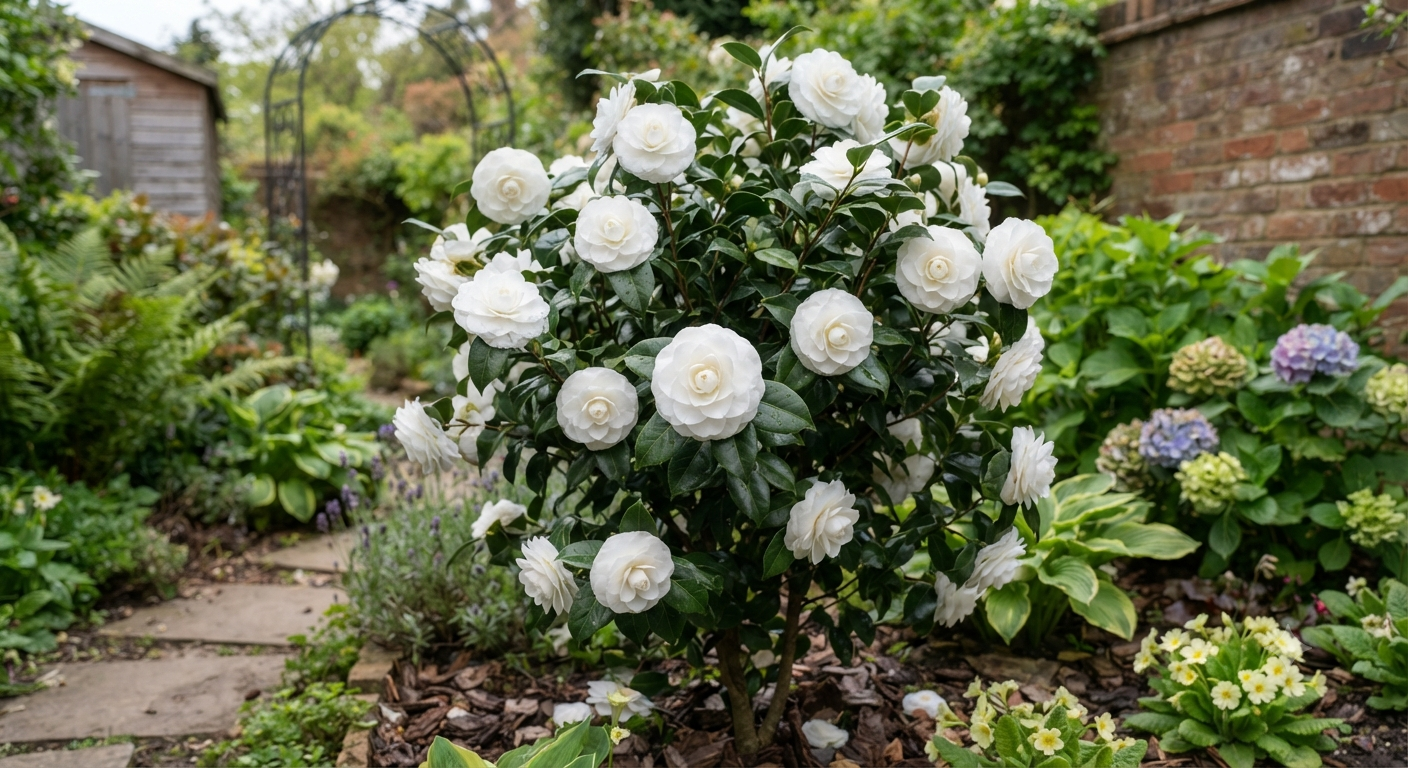
I’ll be honest, I planted ‘Nuccio’s Gem’ mostly because of the name, and it turned out to be one of the best impulse decisions I’ve made in my garden. The flowers are pure white, formal double form, meaning the petals are arranged in neat, symmetrical rows like something out of a wedding bouquet.
This variety is a favorite for cut flowers because the blooms hold their shape well once cut and don’t brown at the edges as fast as some other white camellias do. If you like bringing flowers indoors, this is the one to plant near your cutting garden.
‘Nuccio’s Gem’ needs consistent moisture, more than most camellias I’ve grown. During a dry August a few years back, I let mine go a week too long without water and the buds dropped before they even opened. That was a frustrating lesson, and now I keep this one on a drip line instead of relying on rainfall.
It’s a moderate grower, reaching 6 to 10 feet at maturity, and does best in that dappled, filtered light you’d get under a high canopy of pines or oaks.
4. Camellia japonica ‘Black Magic’
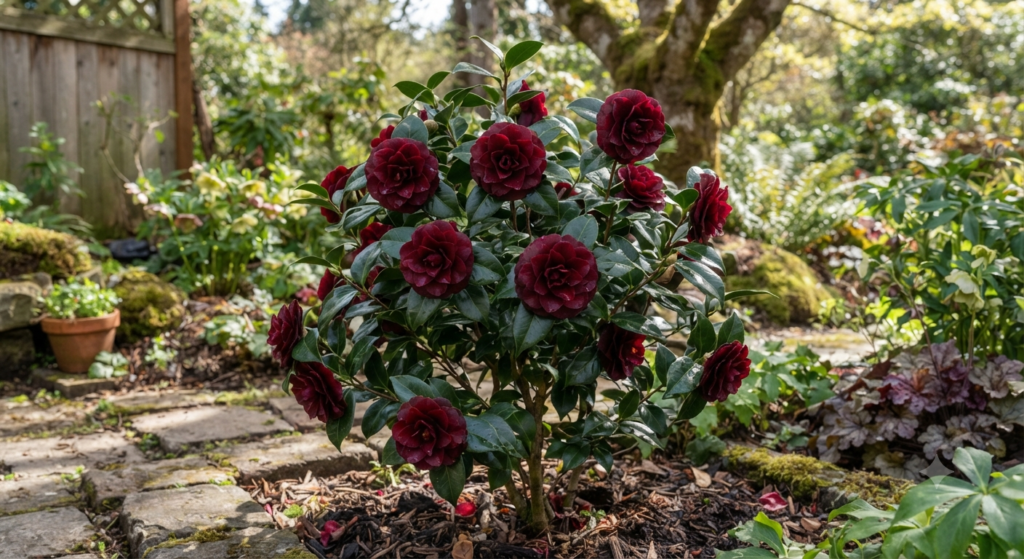
‘Black Magic’ is not for the faint of heart. The blooms are a deep, almost blackish red, dark enough that in low light they look nearly maroon-black. It’s dramatic in a way most camellias aren’t, and it looks incredible against a white or light gray fence.
I get a lot of questions about this one from people searching “dark red almost black flowering shrub,” and honestly, camellias don’t get much darker than this without crossing into novelty territory.
This variety tends to be a bit slower to establish than some of the others on this list. Mine sat looking sulky for its first two seasons before it finally put out a real flush of blooms. Patience matters here. Don’t yank it out and replace it just because year one looks unimpressive.
‘Black Magic’ also benefits from being planted where it gets some backlighting, either morning sun from the east or a spot where afternoon light filters through from behind. The dark petals can look almost muddy in flat, shadowed light, but they come alive when the sun catches them from an angle.
5. Camellia sasanqua ‘Setsugekka’
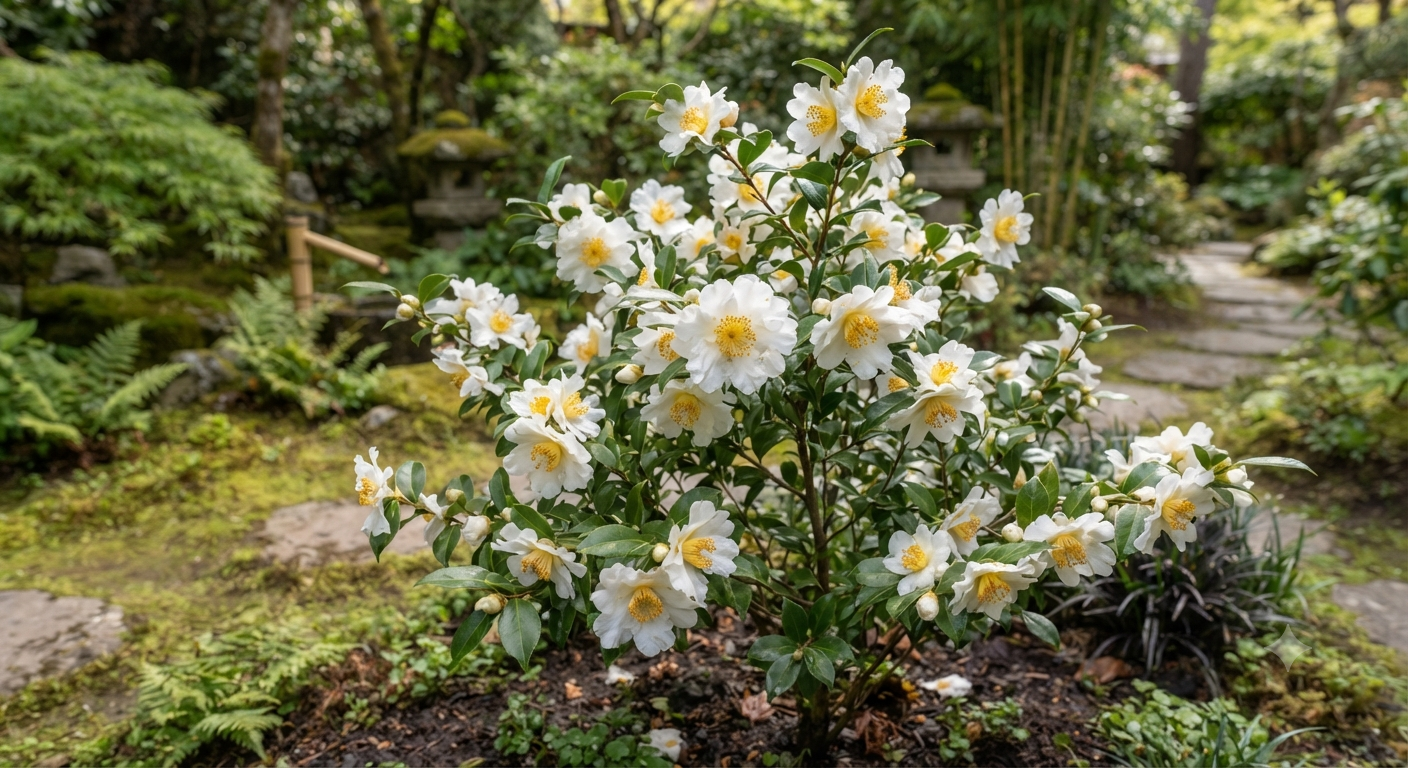
‘Setsugekka’ produces large, semi-double white flowers with slightly ruffled, wavy petal edges, and it’s one of the most fragrant camellias you’ll come across. Most camellias have little to no scent, so if fragrance matters to you, this is a big deal.
I’ve got mine planted about ten feet from a side patio, and on warm fall afternoons the smell drifts over while I’m having coffee out there. It’s subtle, not overpowering, more of a light, sweet note than a heavy perfume.
This variety also drops its spent petals cleanly instead of turning brown and clinging to the branch, which is a small thing but makes a noticeable difference in how tidy the plant looks through its bloom season. Some camellias hold onto dead flowers like they’re afraid to let go, and it makes the whole shrub look neglected even when it’s not.
‘Setsugekka’ handles more sun than most sasanquas and grows in a slightly spreading, almost weeping form, which makes it a nice choice for softening a corner of the yard or draping over a low wall.
6. Camellia japonica ‘Pink Perfection’
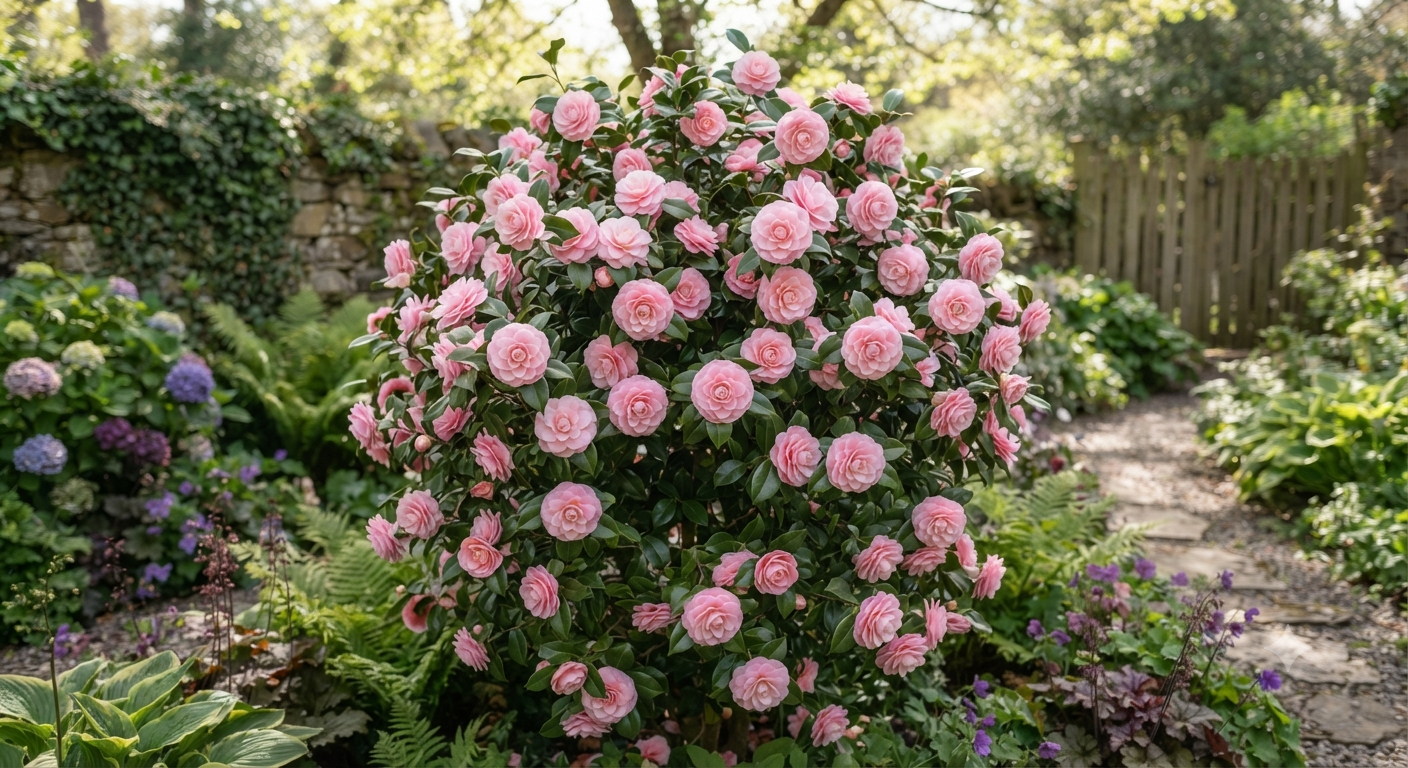
The name oversells it a little, but ‘Pink Perfection’ is still one of the most reliable, classic pink camellias you can grow. Small, formal double blooms in a soft, clear pink, packed with symmetrical petals, on a plant that’s been a garden staple for well over a century.
That longevity matters. Any variety that’s been in cultivation since the 1800s and is still sold in nurseries today has proven it can perform across a huge range of climates and conditions. This isn’t some trendy new hybrid, it’s a workhorse.
Quick side note: ‘Pink Perfection’ is also one of the more shade-tolerant camellias on this list, which makes it a solid pick if you’ve got a north or east-facing bed that doesn’t get much direct light. I’ve got one tucked under a magnolia where almost nothing else flowers, and it still puts on a decent show every spring.
Growth habit is upright and fairly compact, staying under 8 feet in most home landscapes, so it won’t overwhelm a smaller yard.
7. Camellia japonica ‘Kramer’s Supreme’
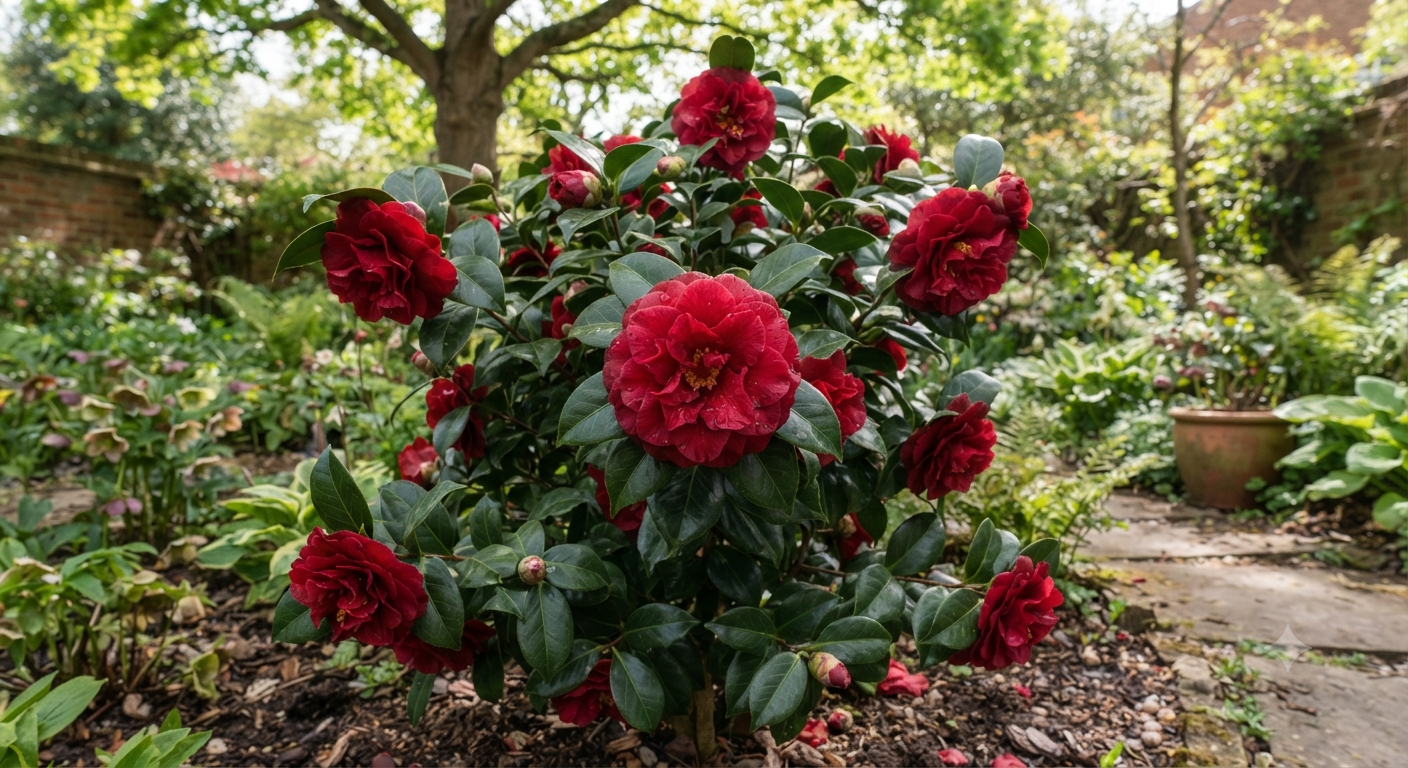
‘Kramer’s Supreme’ has huge, peony-form blooms in a rich, dark red, and unlike a lot of the deep red camellias out there, this one actually carries a light fragrance too. It’s not as strong as ‘Setsugekka,’ but it’s there if you get close.
This variety is a heavier feeder than most camellias I’ve worked with. I learned that after a few seasons of underwhelming blooms and finally switched to an acid-loving plant fertilizer specifically formulated for camellias and azaleas. The difference the following spring was night and day.
The flowers on ‘Kramer’s Supreme’ are large, sometimes 4 to 5 inches across, which means the branches can droop under the weight when the plant is loaded with blooms. I stake the lower branches on mine during peak bloom just so they don’t drag on the ground after a rainstorm.
This is a good option if you’re searching for “fragrant red camellia” because that combination is genuinely hard to find.
8. Camellia sasanqua ‘Shishi-Gashira’
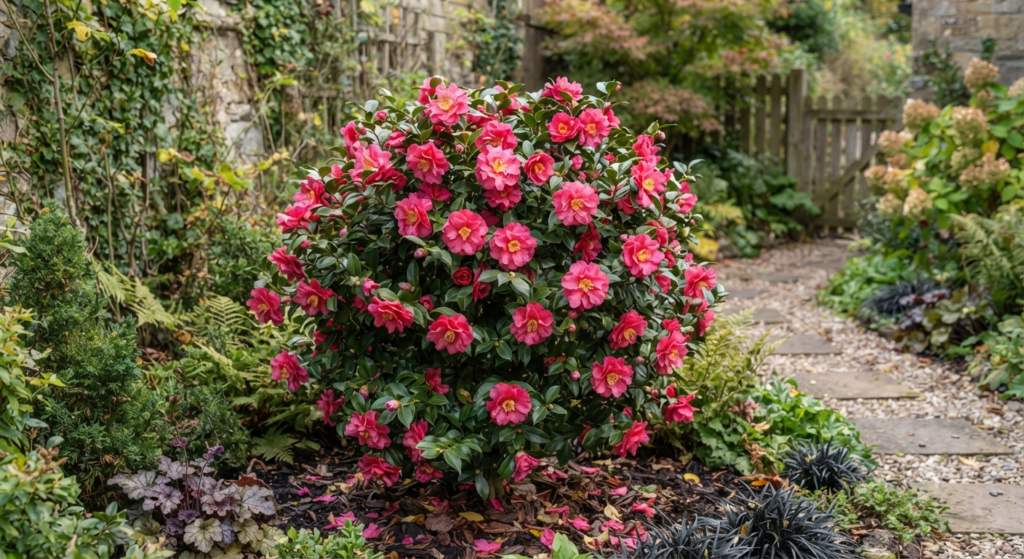
‘Shishi-Gashira’ is the camellia I recommend most often to people with small yards or anyone trying to fill a tight space near a patio or walkway. It stays compact, usually under 4 feet, and grows in a dense, mounding shape that barely needs pruning to stay neat.
The blooms are a rosy pink, semi-double, and smaller than most on this list, but the plant produces so many of them that it doesn’t matter. When it’s in full bloom, you genuinely can’t see much foliage at all.
This variety is also one of the easier ones to grow in a container, which is a huge selling point if you’re renting, working with a patio-only setup, or just want the flexibility to move it around depending on the season. I keep one in a large pot on my back deck and drag it under the eaves whenever a hard freeze is coming.
‘Shishi-Gashira’ tolerates more sun than most sasanquas, similar to ‘Yuletide,’ making it one of the more forgiving options if your light conditions aren’t ideal.
9. Camellia japonica ‘Elegans Splendor’
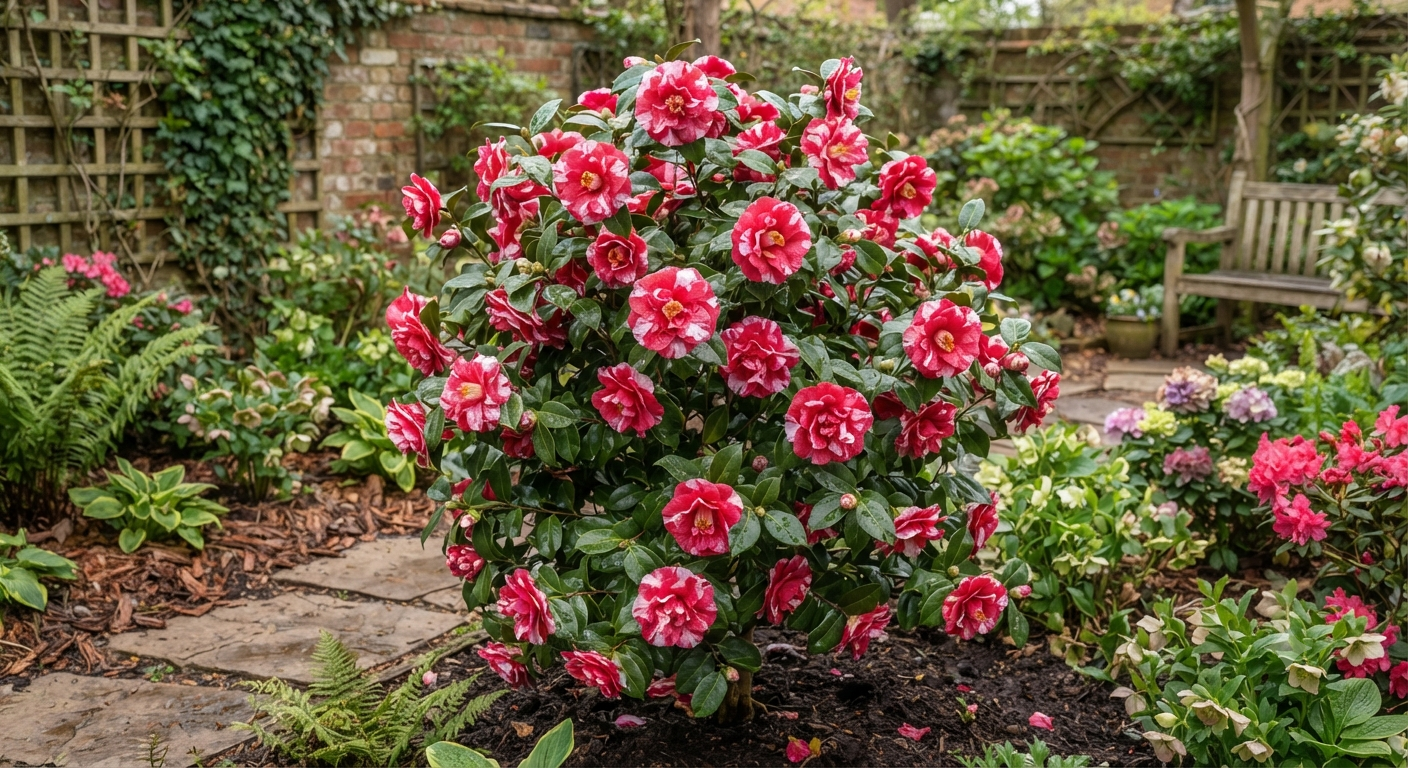
This one is a bit of an oddball, and I mean that as a compliment. ‘Elegans Splendor’ produces huge, anemone-form blooms, meaning a ring of large outer petals surrounds a dense, ruffled center that almost looks like a separate flower nested inside the first one. The coloring is usually a pink base with white marbling or streaking through the petals, and no two blooms look exactly alike.
That variability is part of the charm. My plant will throw a flower that’s mostly white one week and mostly pink the next, and I genuinely never know what I’m going to get until the bud opens.
This is a variety that rewards close-up viewing more than a distant garden view. Plant it somewhere you’ll actually walk past regularly, near a front door or along a path, because from across the yard, you’ll miss the detail that makes it special.
‘Elegans Splendor’ is a moderate grower and does best with that dappled shade most japonica types prefer, protected from harsh afternoon sun that can bleach out the delicate petal markings.
10. Camellia sasanqua ‘Cleopatra’
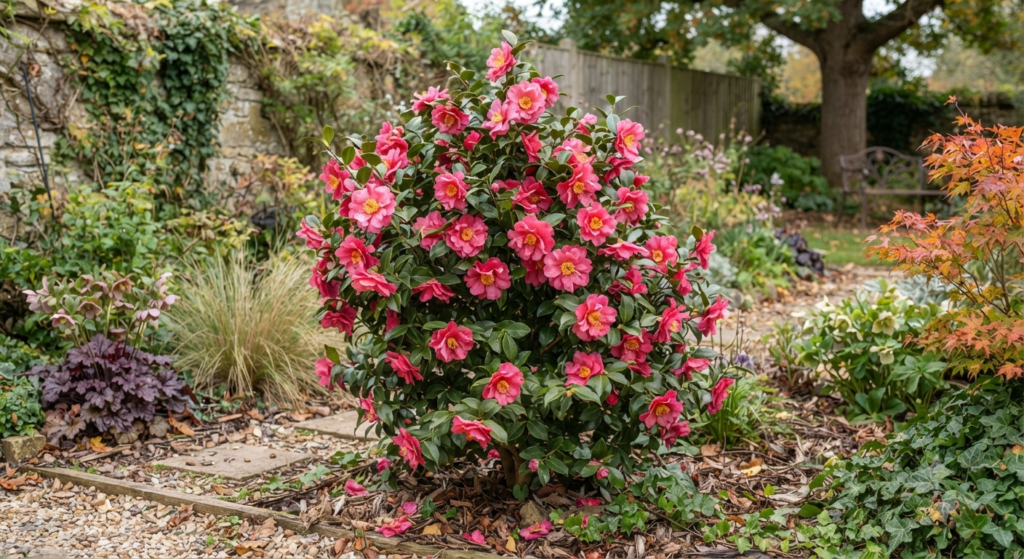
‘Cleopatra’ gives you smaller, single to semi-double blooms in a bright rose-pink, and while the individual flowers aren’t as showy as some of the bigger doubles on this list, the plant makes up for it in sheer bloom volume and a naturally graceful, slightly weeping growth habit.
I like using ‘Cleopatra’ as an informal hedge instead of the tightly clipped, boxy hedges most people default to. Let it grow into its natural shape and you get a soft, billowy screen instead of a green wall.
It handles heat better than a lot of camellias, which matters if you’re gardening somewhere with brutal summers. Mine has never shown the leaf scorch I’ve seen on more sun-sensitive varieties, even during a stretch of 95-degree days.
This is also one of the faster-blooming varieties from a young plant. I had flowers within the first full season after planting, which isn’t always the case with camellias that can take two or three years to really get going.
11. Camellia japonica ‘Grand Slam’
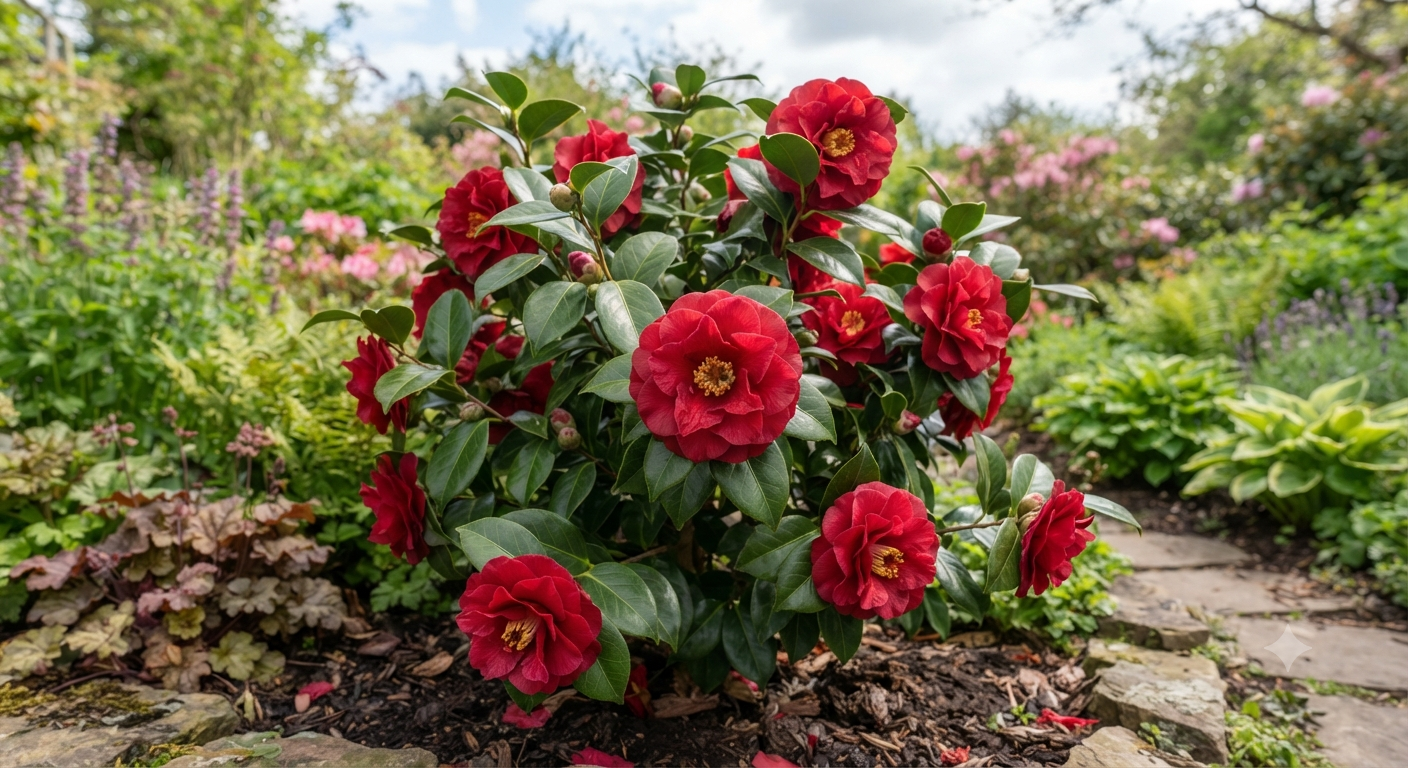
I’m ending on ‘Grand Slam’ because it’s genuinely one of the showiest camellias I’ve ever grown, and it deserves the closing spot. The blooms are a deep, velvety red, semi-double to peony form, and enormous, often 5 inches across or more.
This variety blooms slightly later in the season than a lot of the others on this list, which is actually useful if you’re trying to stretch your camellia display out over several months instead of having everything peak at once.
‘Grand Slam’ is also more sun-tolerant than most red japonica varieties, handling morning sun without the petal burn I’ve seen on similar cultivars. That said, I still wouldn’t put it in full, all-day sun. Filtered afternoon shade keeps the color richest.
If you only have room for one dramatic, showstopper camellia, this is the one I’d point you toward. It photographs beautifully and it’s the plant that gets neighbors asking what it is.
Real Talk: What Nobody Tells You About Growing Camellias
Camellias have a reputation for being fussy, and honestly, some of that reputation is deserved. Before you plant any of the varieties above, here’s what actually goes wrong.
- Bud drop is going to happen, and it’s not always your fault. Camellias are notorious for setting a huge number of buds and then dropping half of them before they open. Sudden temperature swings, inconsistent watering, or even a stretch of cloudy weather can trigger it. I’ve had entire branches of buds drop overnight with no obvious cause. It’s frustrating, but it’s normal, and it doesn’t mean the plant is dying.
- Full sun is the number one killer of japonica types. I said it earlier, but it’s worth repeating because it’s the mistake I see most often. People plant a japonica camellia in a sunny front bed because that’s where they have space, and within a season the leaves are yellowed, scorched, and dropping. Sasanqua varieties tolerate sun better, but even they appreciate some afternoon relief in hot climates.
- They’re slow to establish, and that tests everyone’s patience. Most camellias won’t hit their full bloom potential for two to three years after planting. If you’re the type who needs instant garden gratification, this shrub will frustrate you. I’ve had friends rip out perfectly healthy young camellias because they assumed the plant was a dud, when really it just needed another season.
- Alkaline soil will slowly kill them. Camellias need acidic soil, similar to azaleas and blueberries. If your soil naturally leans alkaline, or if you’ve got concrete foundations or walkways leaching lime nearby, you’ll need to amend the soil and probably keep amending it every year. Skip this step and you’ll see yellowing leaves with green veins, a classic sign of iron deficiency caused by high soil pH.
- Scale insects and sooty mold are common, and they’re gross. Camellias are prone to tea scale, tiny insects that cluster on the undersides of leaves and leave behind a sticky residue that turns into black sooty mold. It looks awful and it’s a pain to treat once it’s established. Check the undersides of leaves regularly so you catch it early instead of discovering a full infestation in August.
Final Thoughts
Camellias aren’t a plant-it-and-forget-it shrub, but they reward the effort in a way few other plants can match, especially when they’re throwing full, glossy blooms in the dead of winter while everything else in the yard looks half asleep. Pick the right variety for your light and climate, be patient through the first couple of seasons, and you’ll end up with a plant that outlives most fences.
Which of these varieties are you thinking about adding to your yard, or do you already have a camellia that’s been a total showstopper for you? Drop a comment below and let me know, I’m always looking for an excuse to add one more to my own collection.

About Syprose Kiche
Syprose Kiche is the creator and writer behind My Besuited Home, a practical home and garden website covering DIY projects, gardening, lawn care, landscaping, home improvement, and outdoor living. She focuses on turning everyday homeowner questions into clear, practical guides backed by careful research and useful real-world considerations.