
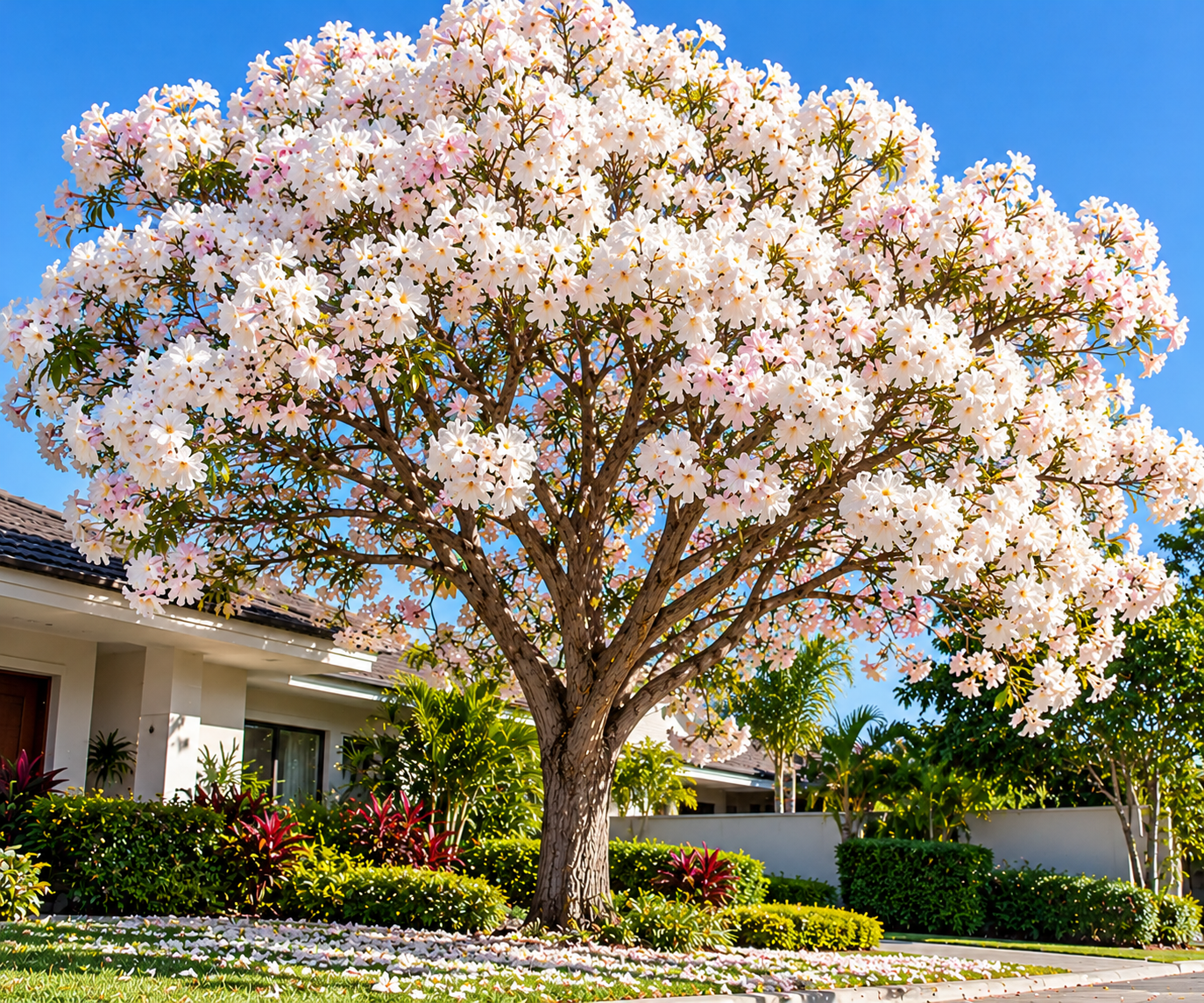
A Brazilian flowering tree can turn an ordinary front yard into a striking landscape, but the right choice depends on more than flower color. Some species produce enormous purple or pink blooms before their leaves return. Others cover their branches in yellow flowers, attract pollinators, or provide shade beneath a broad canopy. Their mature size, however, can make the difference between a tree that fits beautifully beside a house and one that eventually crowds the driveway or reaches overhead utility lines.
Climate is another important consideration. Many Brazilian trees thrive in warm, frost-free or nearly frost-free regions and struggle through the freezing winters experienced in USDA hardiness zone 5. A few can be grown in containers while young, although keeping a naturally large tree in a pot permanently requires more work than many gardeners expect.
The best approach is to choose a tree for its natural growth habit, flowering season, and cold tolerance—not simply its appearance in a nursery photograph. The following 11 Brazilian flowering trees offer a range of colors, sizes, and landscape uses, with practical guidance for choosing the right one for your property.
1. Yellow Ipê (Handroanthus albus)
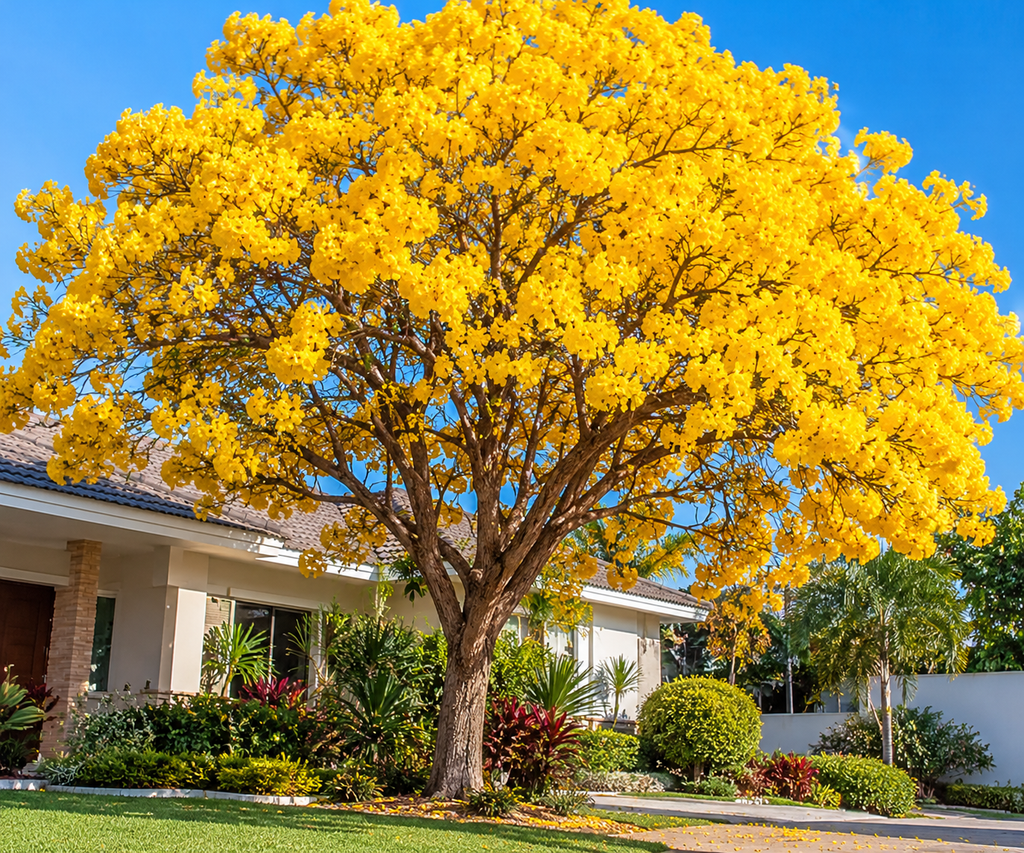
Flower color: Golden yellow · Best for: Sunny front yards and larger gardens
Yellow ipê is one of the most recognizable flowering trees associated with Brazil. When its branches fill with golden, trumpet-shaped flowers, the display can be so dense that the tree appears almost entirely yellow. The flowers are especially striking when the tree sheds much of its foliage before blooming, leaving the blossoms clearly visible against the sky.
The species, Handroanthus albus, is native to southeastern and southern Brazil and neighboring parts of South America. It is a deciduous tree, meaning it loses its leaves seasonally rather than remaining green throughout the year.
Where yelow ipê works best
A sunny front yard gives this tree the light it needs and enough open space for its crown to develop. It works particularly well as a standalone specimen in a lawn, where its seasonal flowering can become the main visual feature of the property.
Give it room from the beginning. A young nursery tree may look small beside a driveway, but its mature canopy will occupy considerably more space. Avoid planting it directly beneath overhead utility lines or in a narrow strip between a house and a boundary wall.
Yellow ipê is also a good choice for a warm-climate garden designed around seasonal color. Its flowering period provides a strong focal point before the surrounding landscape fills out with fresh foliage.
Growing considerations
- Sunlight: Choose a location with full sun.
- Soil: Use well-drained ground; avoid planting in a spot that remains waterlogged.
- Water: Water a newly planted tree deeply when the root zone begins to dry. Once established, adjust irrigation to rainfall and local conditions.
- Pruning: Remove dead or damaged branches and correct structural problems while the tree is young. Avoid cutting back the crown simply to force a large tree into a small space.
- Cold tolerance: Treat it as a warm-climate tree unless a locally reliable source confirms that your particular species and site can tolerate winter temperatures.
Yellow ipê is most rewarding when it can grow naturally into a tree rather than being repeatedly cut back to fit an unsuitable planting location.
2. Pink Trumpet Tree (Handroanthus impetiginosus)
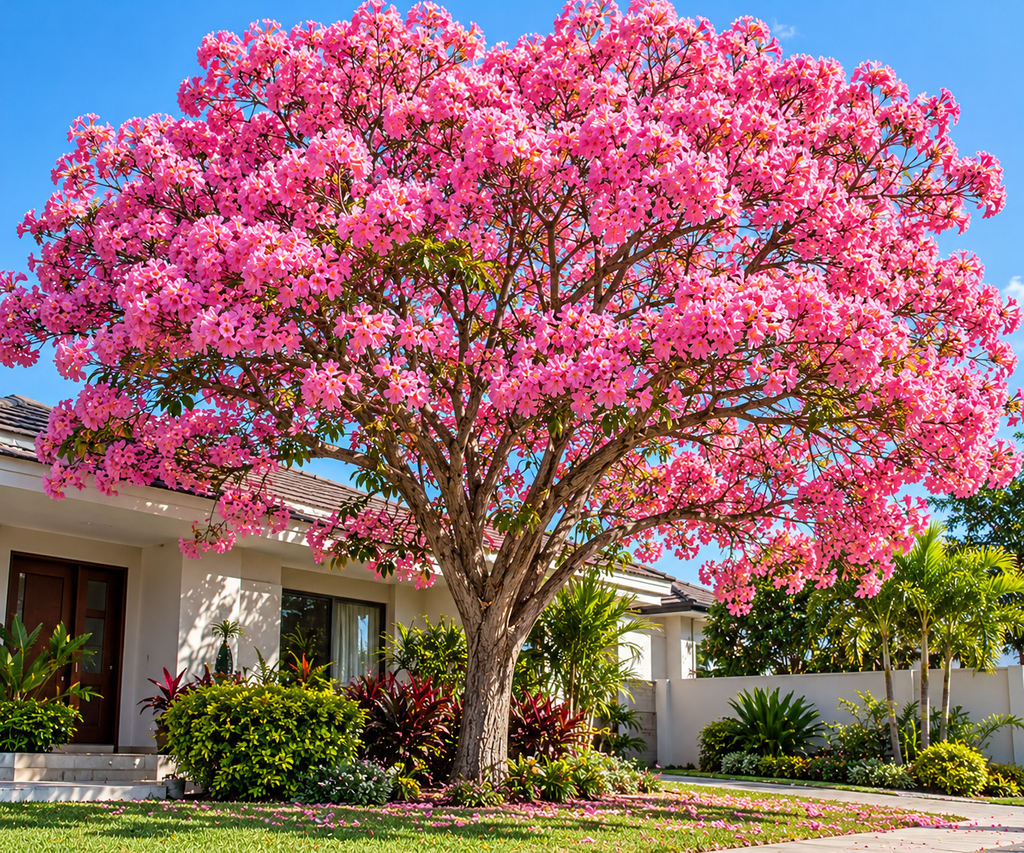
Flower color: Pink to lavender-pink · Best for: Statement trees and warm-climate landscapes
If pink is the color you want to bring into your front yard, the pink trumpet tree is a strong candidate. Its flowers form large clusters of tubular blooms, often appearing on nearly bare branches. The contrast between the pink canopy and a clear blue sky gives the tree a dramatic appearance without requiring elaborate landscaping around its base.
Known botanically as Handroanthus impetiginosus, this tree occurs naturally across a broad range of the Americas, including Brazil. It is deciduous and prefers a sunny position. The Denver Botanic Gardens lists its cold-hardiness limit at USDA zone 9b, which is a useful warning for gardeners in colder regions.
Use it as the main feature of a front yard
A pink trumpet tree can anchor a front lawn, frame a distant view, or provide a colorful focal point near an entrance. It is particularly effective against a simple background: pale walls, green lawn, neutral paving, or a low hedge.
For a balanced design, plant it far enough from the house that its mature crown has room to spread. Keep the area beneath the tree relatively simple. Low ground covers or a small ring of mulch can complement the flowers without competing with them.
The tree is less suitable for a tiny courtyard enclosed by tall walls. Restricted airflow, limited root space, and the need to prune a large crown can make that setting difficult.
What to expect through the seasons
The major flowering display is seasonal, not continuous. You may have a green canopy for much of the growing season, a period of leaf loss, and then a striking flush of pink flowers. The exact timing varies with climate and local growing conditions.
This seasonal cycle is worth considering before planting. If you want a tree that offers dense shade and flowers at the same time throughout the year, a deciduous trumpet tree may not match your expectations.
Give young trees regular attention during dry periods, particularly while roots are establishing. Avoid keeping the soil constantly saturated. If your area experiences cold snaps, protect a young tree where practical and recognize that a warm-climate species cannot reliably be made cold-hardy through routine winter care.
3. White Ipê (Tabebuia roseoalba)
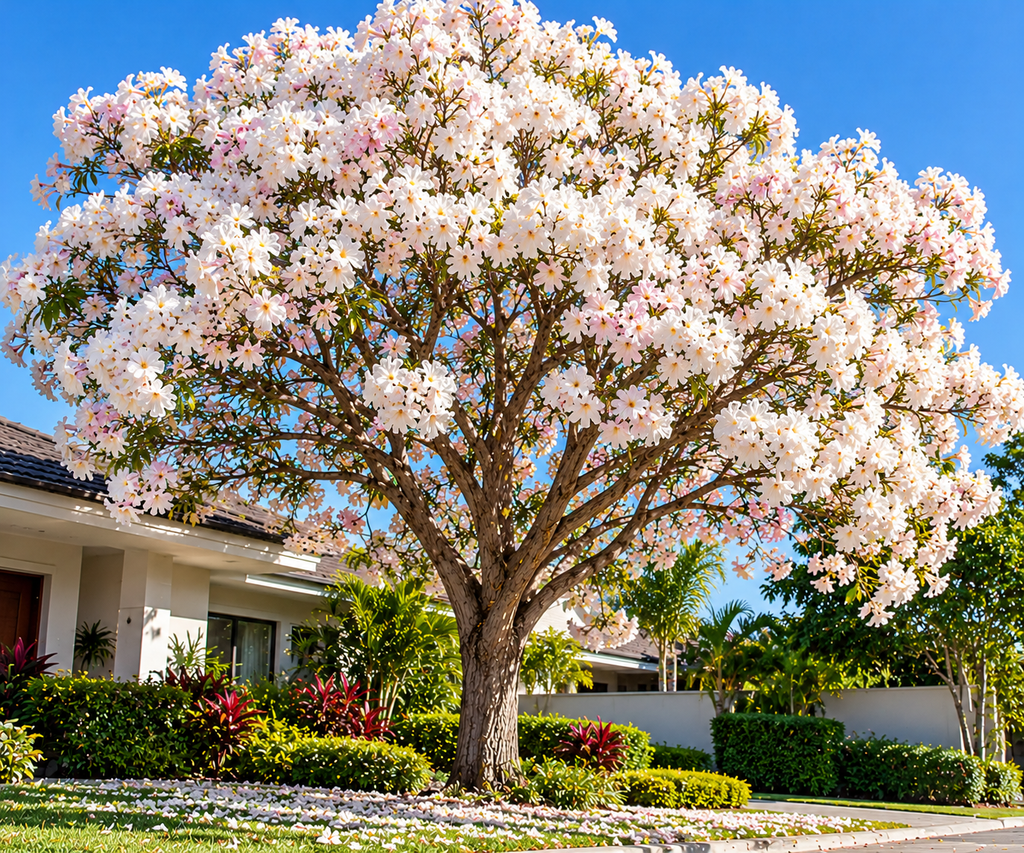
Flower color: White, sometimes with a pinkish cast · Best for: Smaller ornamental spaces
White ipê offers a lighter, more restrained alternative to the bright pink and yellow trumpet trees. Its clusters of white, trumpet-shaped flowers can cover much of the crown, especially when the tree loses its leaves before flowering. The effect is almost cloudlike, making it useful in landscapes where a softer color works better than a bold splash of pink or yellow.
The accepted botanical name is Tabebuia roseoalba. Kew’s Plants of the World Online records its native range from Peru through Brazil to Paraguay. Brazilian botanical sources describe it as a deciduous ornamental tree with showy flowers that can range from white to pale pink.
A useful option for a modest front yard
White ipê is often a better candidate for a smaller landscape than a very large shade tree, but it should not be mistaken for a miniature tree. Brazilian botanical references give heights that can reach approximately 7–16 meters, depending on the source and growing conditions.
That means it still needs space for its crown, trunk, and roots. A front yard with a modest lawn and an open planting bed may suit it well. A narrow strip between a building and a paved boundary may not.
Its pale blossoms work particularly well alongside darker green foliage. You could pair the tree with evergreen shrubs, low ornamental grasses, or a restrained planting of purple-flowering perennials. Avoid placing too many pale-flowering plants immediately around it, as the main flowering display can lose some of its visual impact.
The flowering window is short
One detail gardeners should understand is that white ipê’s spectacular flowering can be brief. A scientific article on the species describes a concentrated flowering display that may last only a few days on an individual tree, although flowering can occur in more than one pulse.
That short-lived display is part of its appeal, but it also means the tree is not the right choice if you expect months of uninterrupted flowers.
Plant it for the combination of seasonal drama, attractive branching, and the structure it provides when not in bloom. In a suitable warm climate, it can be a beautiful specimen tree without requiring a complicated companion planting scheme.
4. Brazilian Glory Tree (Pleroma granulosum)
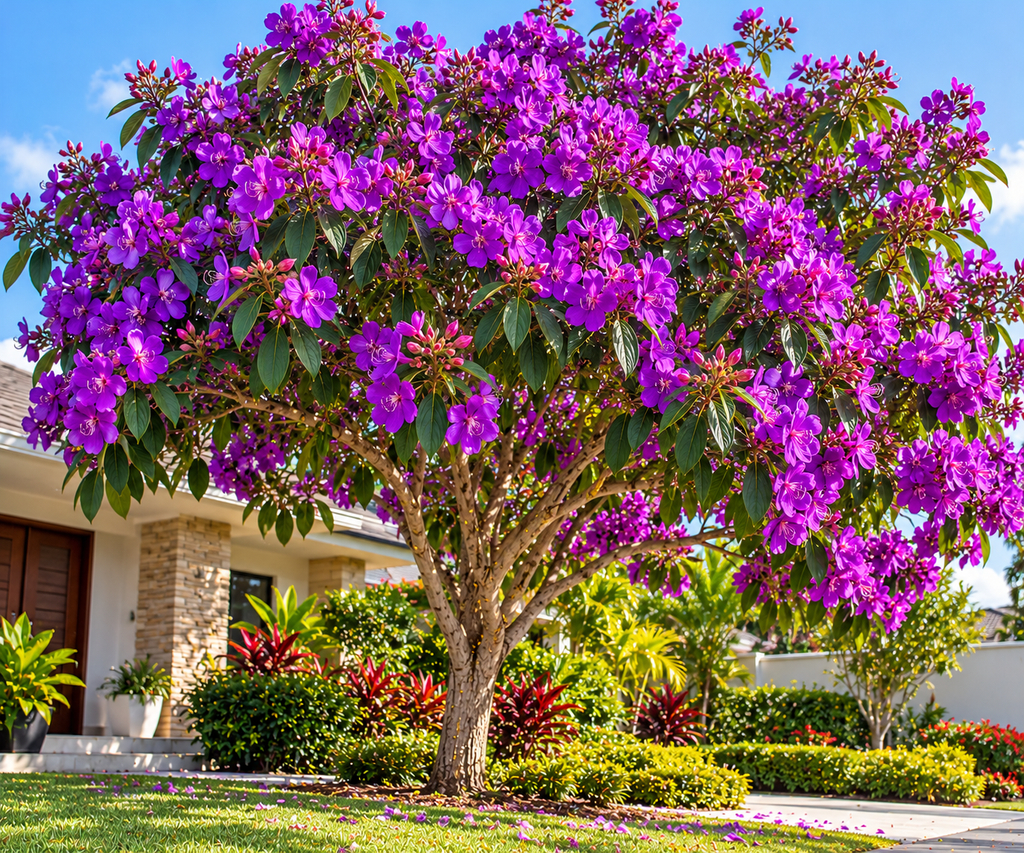
Flower color: Purple, violet, or pink · Best for: Colorful gardens and smaller lawns
The Brazilian glory tree, commonly known in Brazil as quaresmeira, is worth considering if you prefer purple or violet flowers to the trumpet-shaped blooms of ipês. Its flowers are showy and abundant, while its dark green leaves provide a handsome background outside the main flowering periods.
The species is widely known under the older scientific name Tibouchina granulosa and is also classified as Pleroma granulosum. It is native to Brazil and is commonly used in Brazilian landscaping. Botanical references describe a mature height of approximately 8–12 meters, making it a medium-sized tree rather than a compact shrub.
Why it stands out in residential landscaping
Unlike trumpet trees that can produce an especially dramatic burst of flowers over a short period, the Brazilian glory tree can flower in more than one season. Flowering patterns vary with climate, but the species is known for an extended ornamental display.
That makes it appealing for gardens where flowers are an important part of the design for more than a few weeks.
Its purple blossoms work well with white flowering shrubs, pink ornamental plants, and simple green ground covers. In a front yard, use it as a focal point in an open lawn or a larger planted bed. Its rounded crown can also help soften the appearance of straight fences and angular architecture.
Growing conditions to get right
The Brazilian glory tree needs a sunny location for good flowering. A Brazilian botanical garden reference specifically notes that the tree does not tolerate shade well and recommends full sun.
Choose a well-drained site, and water consistently while the root system is developing. Avoid planting it in a permanently wet depression or a narrow container where the roots cannot expand.
There is another consideration: the species can develop relatively fragile branches. Brazilian botanical references caution that branches may break in strong winds or storms.
For that reason, avoid placing it where falling branches could threaten a heavily used walkway, parked vehicles, or a roof. Periodic inspection and sensible structural pruning while the tree is young can help, but no pruning routine eliminates storm risk entirely.
If your priority is a flowering tree for a front yard in a warm climate, this species offers a particularly rich color palette. If you need a very small, low-maintenance tree for a confined courtyard, look for a naturally smaller species instead.
5. Sibipiruna (Cenostigma pluviosum)
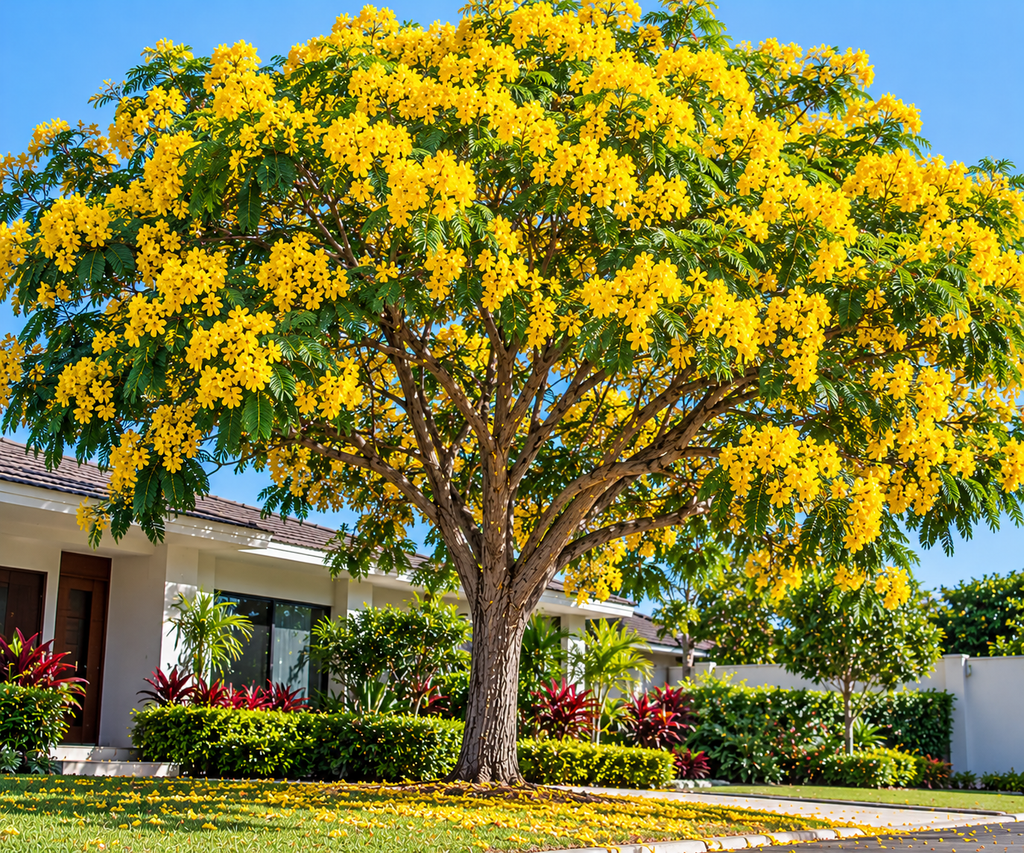
Flower color: Yellow · Best for: Larger front yards and open gardens
Sibipiruna is a Brazilian native tree with fine, fernlike foliage and clusters of yellow flowers. Its appearance is different from that of an ipê: instead of producing a crown dominated by large trumpet-shaped blooms, it combines delicate-looking leaves with sprays of smaller yellow flowers.
The accepted scientific name is Cenostigma pluviosum. Brazil’s State University of Northern Rio de Janeiro describes it as a South American tree native to Brazil that typically reaches approximately 8–16 meters in height. It is widely used in urban landscaping in Brazil.
A tree for shade as well as flowers
Sibipiruna makes sense when you want more than a brief flowering display. Its spreading crown can provide shade, while its foliage gives the yard a softer, less formal appearance.
In a spacious front yard, it can stand alone in a lawn or be used to frame an entrance. In a larger garden, it can provide a transition between open grass and lower planting beds.
Do not underestimate its eventual size. An 8–16-meter tree is not a good fit for a narrow strip of soil between a driveway and a house. Allow sufficient room for the canopy and roots, and check for overhead utility lines before planting.
The maintenance detail that is easy to overlook
Sibipiruna produces fallen leaves, flowers, and seedpods. These can accumulate on lawns, paving, and driveways. Brazilian university sources also identify susceptibility to a psyllid insect that can leave sticky deposits on nearby surfaces.
That does not mean the tree should be avoided. It means placement matters.
If you have a large paved driveway that must remain spotless, another species may be more convenient. If you have a lawn or planted area where seasonal debris is manageable, sibipiruna can be a handsome choice.
Plant it in full sun in soil that drains well. Water regularly during establishment, then adjust irrigation to the climate and soil. Avoid heavy pruning simply to reduce the tree to a size that does not fit the property.
6. Brazilian Redwood (Paubrasilia echinata)
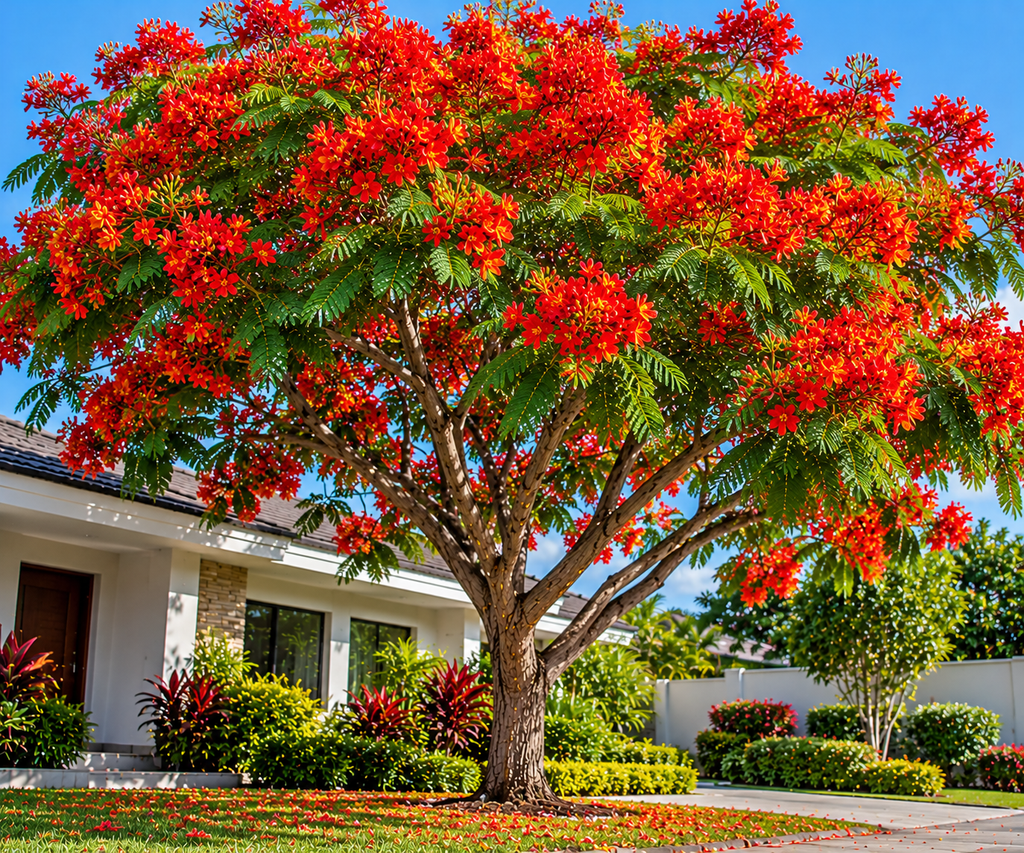
Flower color: Yellow with a distinctive red central petal · Best for: Botanical gardens and warm-climate specimen planting
Brazilian redwood, commonly called pau-brasil, is notable for its cultural significance as well as its flowers. The tree is closely associated with Brazil’s history, and its name is linked to the red dye historically obtained from its wood.
Its flowers are smaller and less overwhelming than those of a trumpet tree, but they have an unusual detail: four yellow petals surround a modified central petal that is red. The tree also has finely divided compound leaves that create an attractive canopy. The University of São Paulo’s botanical garden describes it as a native Atlantic Forest species that flowers in spring and is pollinated by insects, including bees and butterflies.
Where it belongs in a landscape
Pau-brasil is best treated as a specimen tree rather than a quick way to fill a large space. Depending on the source and growing conditions, it can grow beyond 12 meters, although its ultimate size varies.
A sunny, well-drained planting site is appropriate. The tree suits a tropical or subtropical garden, a botanical collection, or a property where native South American plants are part of the landscaping theme.
It can be especially attractive near an entrance or in an open lawn where its branching and foliage remain visible. Give it sufficient space and avoid crowding the base with large shrubs.
An important conservation consideration
Pau-brasil has suffered from extensive historical exploitation. Brazil’s national conservation assessment lists the species as critically endangered.
Anyone interested in growing it should seek legally propagated nursery stock from a reputable supplier and check applicable local restrictions. Do not collect plants or seeds from wild populations without proper authorization.
This is also not a suitable choice for a cold-winter garden. Its natural range and growing requirements favor warm conditions, and a container does not automatically make it tolerant of freezing temperatures.
Choose pau-brasil for its distinctive flowers, fine foliage, and botanical importance—not because it is the fastest-growing or easiest tree for every front yard.
7. Canafístula (Peltophorum dubium)
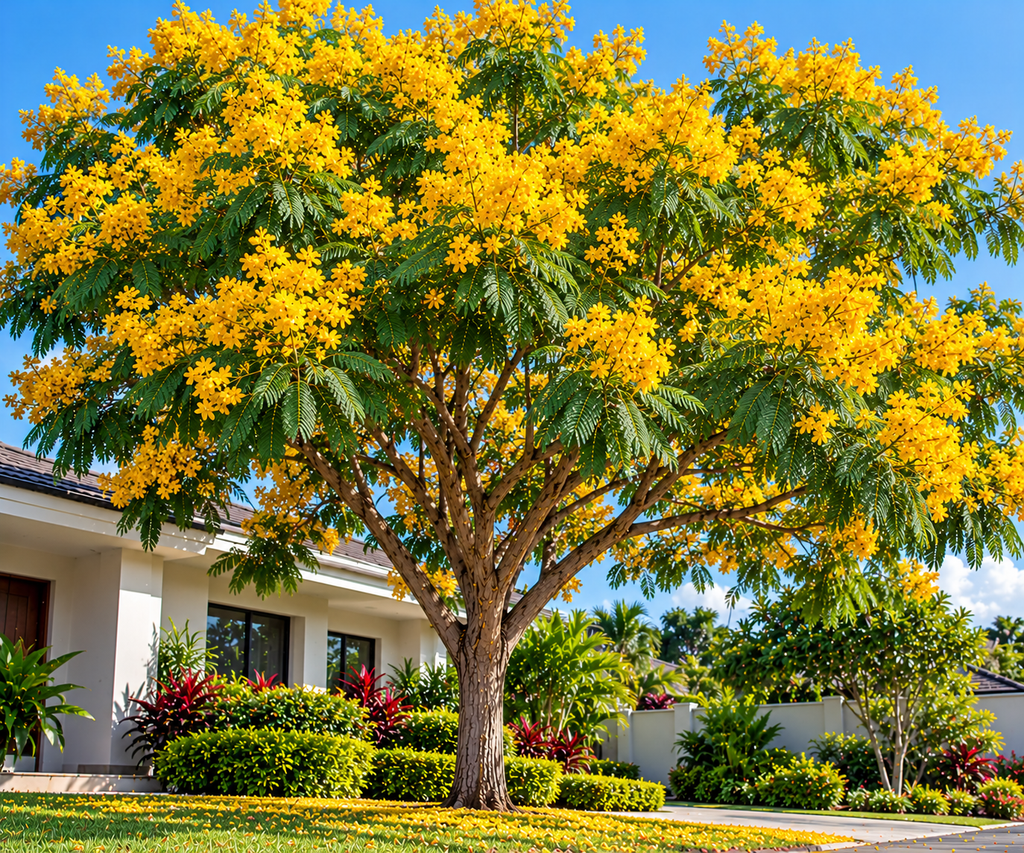
Flower color: Golden yellow · Best for: Large gardens and spacious lawns
Canafístula is a strong option for gardeners who want a substantial tree with a broad, flowering crown. Its yellow flowers grow in generous clusters, creating a bright display that contrasts with its divided foliage.
The species, Peltophorum dubium, occurs naturally in several Brazilian states. A botanical reference from the University of São Paulo describes it as a tree that can reach approximately 15 meters in height, with deciduous, finely divided leaves and yellow flowers arranged in large clusters.
Why it suits a larger property
The appeal of canafístula lies in its scale. It can make a large lawn feel more established, provide shade as the crown matures, and contribute seasonal color without relying on an extremely dense mass of blossoms.
Use it where the tree can develop a natural shape. A broad front lawn, a large garden near a boundary with adequate clearance, or an open section of a country property is generally more suitable than a narrow urban courtyard.
Because the mature tree can be tall and spreading, it should not be planted close to a building simply to provide immediate shade. A young tree may fit the space initially, but its future canopy and root system need to be considered from the start.
Seasonal changes and upkeep
Canafístula is deciduous, so it will not provide the same appearance in every season. Depending on the local climate, it may shed leaves and later produce its yellow flowering display.
Its seedpods and fallen leaves also contribute to seasonal cleanup. Avoid positioning it directly above a small ornamental pond or a narrow paved walkway if debris would be difficult to manage.
For establishment, select a sunny position with well-drained soil. Keep competing grass away from the immediate trunk area, use a layer of organic mulch without piling it against the bark, and water when the root zone begins to dry.
This is a better tree for a gardener who has space to accommodate a mature canopy than for someone looking for a compact ornamental that can be kept small indefinitely.
8. Brazilian Orchid Tree (Bauhinia forficata)
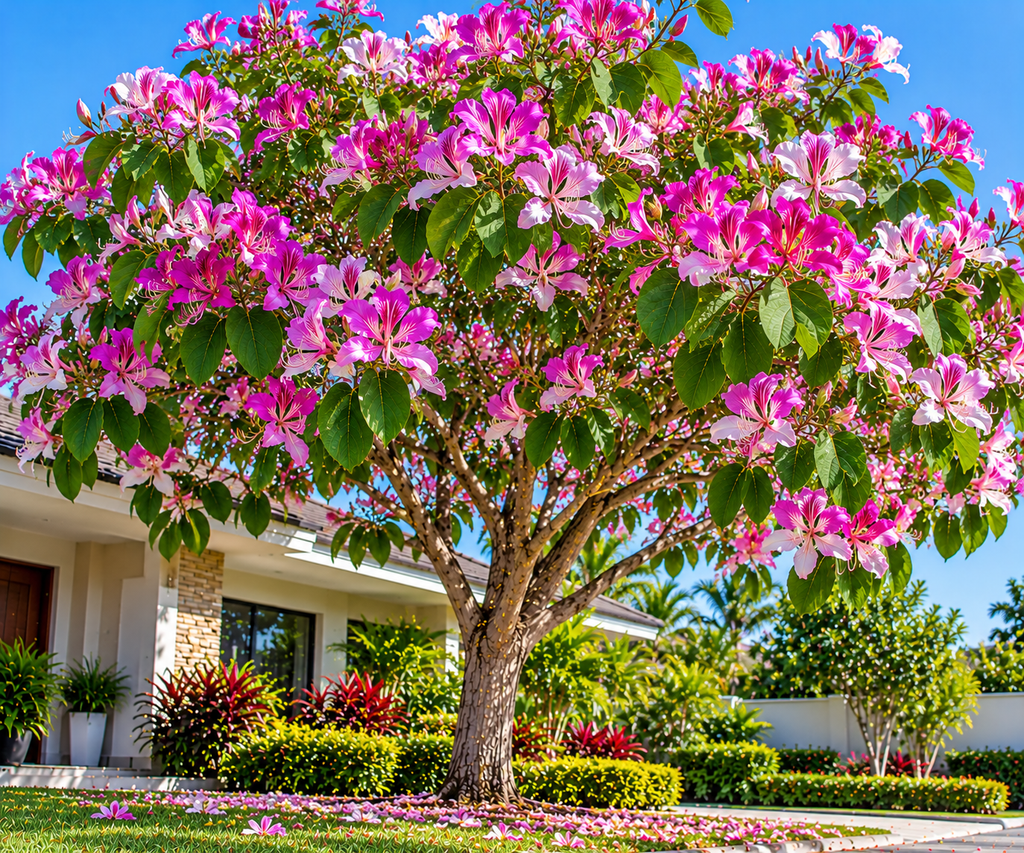
Flower color: White · Best for: Warm-climate ornamental gardens
The Brazilian orchid tree brings a different kind of flower to the garden. Its white blossoms have a delicate, orchidlike appearance, while its distinctive leaves are divided into two rounded lobes that resemble a butterfly or a hoofprint.
Despite its common name, Bauhinia forficata is a true tree, not an orchid. The University of Florida’s IFAS Extension describes it as an evergreen tree that can reach approximately 25–30 feet tall with a spread of 25–35 feet. It lists the species for USDA hardiness zones 10A through 11.
A good choice for a warm-climate garden
Its rounded crown and unusual leaves make it useful in a tropical or subtropical front yard. The white flowers provide contrast against green foliage, and the tree can serve as a focal point without the intense color of a pink trumpet tree.
It can also work in a larger patio garden if the planting area is open to the sky and offers sufficient root space. However, its mature spread means it is not a naturally compact tree for a very small courtyard.
The leaves are a particularly useful design feature. Even when the tree is not flowering, their shape gives the canopy an ornamental quality that ordinary oval-leaved trees do not have.
Care and placement
Give the tree plenty of sunlight and soil that drains well. Water regularly while it establishes, but do not leave its roots sitting in saturated soil.
Before planting near a walkway, check the nursery’s information about the particular tree’s growth habit and mature size. Some ornamental trees are sold at small sizes that make them appear suitable for almost any space; the Brazilian orchid tree is a reminder that a small specimen can still become a substantial tree.
Its published cold-hardiness range also matters. If your garden experiences regular freezes, choose a tree suited to that climate rather than relying on a sheltered wall to compensate for a major temperature mismatch.
For gardeners in warm regions, the combination of white flowers and distinctive foliage makes the Brazilian orchid tree a worthwhile alternative to the more familiar trumpet trees.
9. Floss-Silk Tree (Ceiba speciosa)
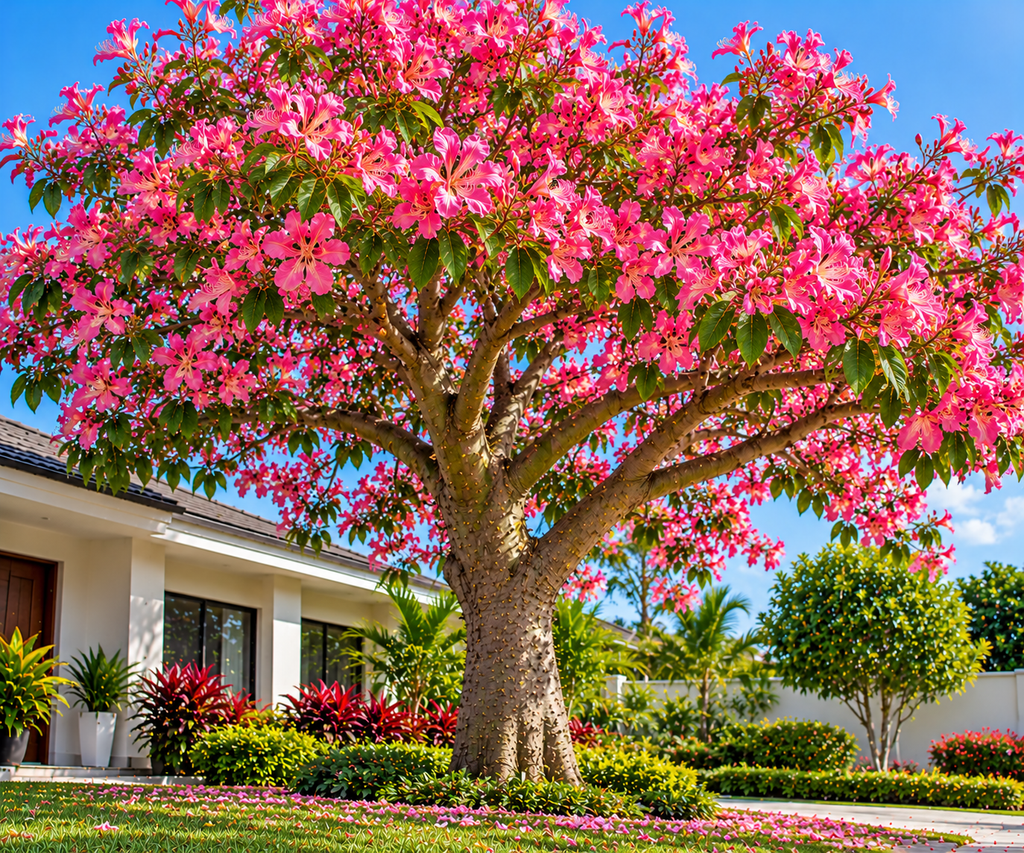
Flower color: Pink to rose, often with a pale center · Best for: Spacious lawns and parks
The floss-silk tree is one of the more unusual flowering trees associated with South America. It produces large pink flowers, but its trunk is equally distinctive: mature specimens often develop a swollen, bottle-shaped base covered in prominent conical prickles.
The species is native to Brazil and other parts of South America. Brazilian university botanical resources list it among the country’s native trees.
A drmatic tree that needs careful placement
A floss-silk tree is best planted where its shape can be appreciated from a distance. An open lawn is ideal because it gives the trunk, branching structure, and flowers room to stand out.
Its mature size and prickly trunk make it a poor choice beside a narrow path, a children’s play area, or a tight driveway. Do not place a bench or a frequently used seating area immediately against the trunk.
The tree is also better suited to larger gardens than tiny front yards. Its broad canopy can eventually dominate a small property, and its roots need adequate space.
What about maintenance?
Plant it in full sun and well-drained soil. Water consistently while the roots are establishing, then adapt irrigation to the local climate.
Avoid routine pruning that removes large sections of the crown just to make the tree fit a small space. The better solution is to choose an appropriately sized species before planting.
Its prickles are a practical concern during maintenance. Wear appropriate protective clothing when working around the trunk, and keep access paths clear of branches. If a mature tree develops a structural defect or has large limbs over a building, consult a qualified arborist rather than attempting major pruning from a ladder.
For a property with ample room, the floss-silk tree offers a memorable combination of pink flowers, a sculptural trunk, and a spreading canopy. For a cramped front yard, its unusual appearance is not enough to offset the placement problems.
10. Manacá-da-Serra (Pleroma mutabile)
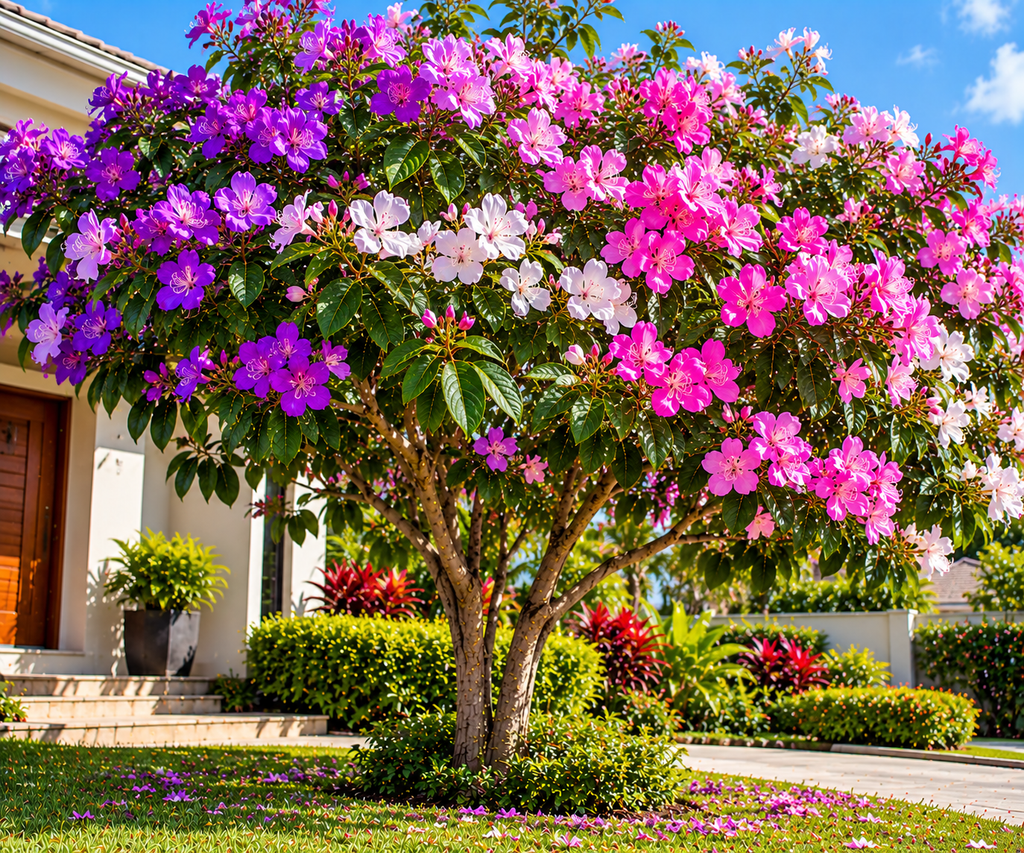
Flower color: White, pink, and purple as blooms mature · Best for: Colorful gardens with room for a small to medium tree
Manacá-da-serra is especially interesting because its flowers can change color as they age. Blossoms may open white, shift through pink, and become deeper purple tones before fading. A single tree can therefore carry several flower colors at once.
The plant is known botanically as Pleroma mutabile, formerly widely called Tibouchina mutabilis. It is a Brazilian native associated with the Atlantic Forest region.
Why it works as an ornamental focal point
A tree with flowers that change color can create a more layered effect than one that produces a single shade. Manacá-da-serra is particularly appealing in gardens built around contrasting colors, where its blossoms can sit alongside dark foliage, white flowers, or simple green ground cover.
It can suit a front garden where a very large shade tree would overwhelm the property, provided the particular variety and expected mature dimensions match the available space.
However, do not assume that every tree sold under the common name is a miniature variety. Nursery stock may include selections with different growth habits, and a standard tree can still become too large for a small courtyard.
Give it the right conditions
Choose a sunny position and soil that retains some moisture without becoming waterlogged. Newly planted trees need regular watering while their roots spread into the surrounding soil.
In hot, dry weather, watch for wilting and unusually dry soil around the root zone. These can indicate that irrigation needs adjustment. Do not respond by watering heavily every day without checking drainage; persistently wet soil can cause root problems.
As with the Brazilian glory tree, local climate is important. A species adapted to warm Brazilian environments should not be assumed to survive the prolonged freezing temperatures of colder North American gardens.
Manacá-da-serra is a good choice when you want something more visually complex than a single-color flowering tree. Its changing blossoms make it particularly effective as a standalone feature rather than one of many competing focal points.
11. Brazilian Jacaranda (Jacaranda cuspidifolia)
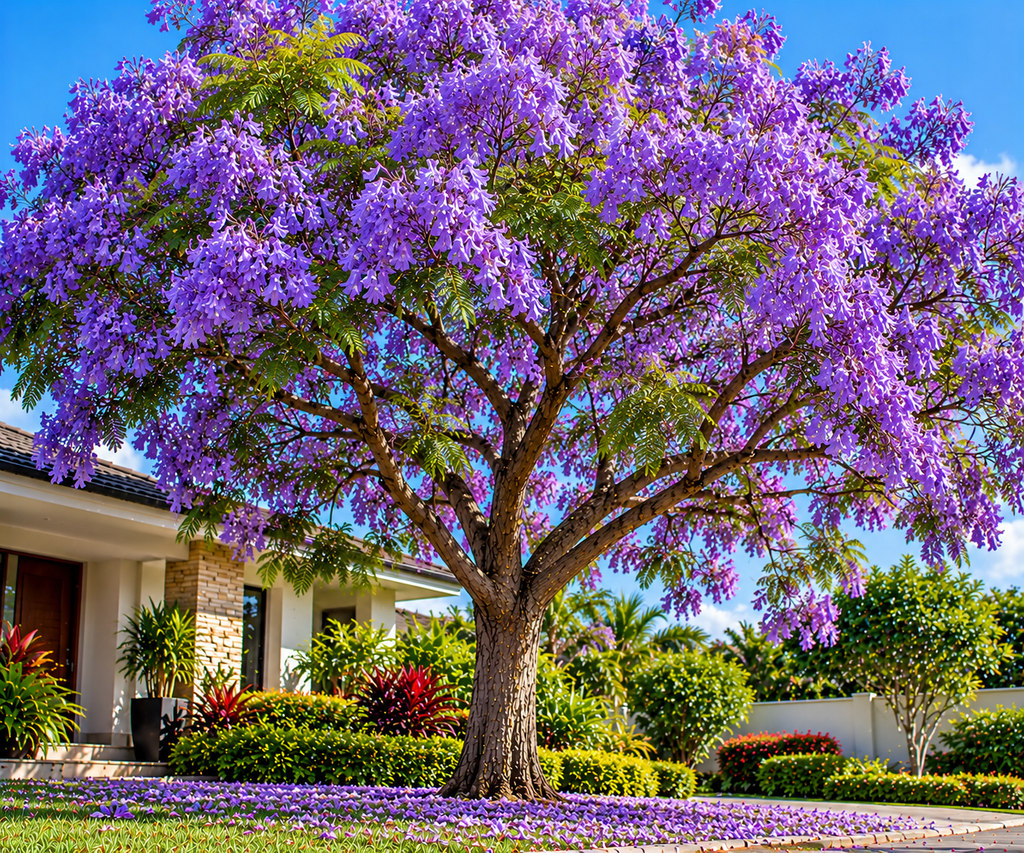
Flower color: Violet to blue-purple · Best for: Open sunny gardens and ornamental lawns
Jacarandas are often associated with spectacular purple-blue spring displays, but it is important to distinguish among species. The familiar Jacaranda mimosifolia is native to parts of South America outside Brazil’s native range, so it should not automatically be described as a Brazilian native. For a Brazilian-themed selection, Jacaranda cuspidifolia is a more relevant species to investigate with a reputable nursery.
Its trumpet-shaped purple flowers and finely divided foliage give it the classic jacaranda appearance. The blossoms are especially striking when they emerge against a relatively open canopy.
Where to plant it
A jacaranda works best where its flowering crown can be viewed from a distance. An open front lawn, a sunny garden border with plenty of room, or a large courtyard can provide the space needed for a good display.
Avoid planting it where the mature crown would block windows, interfere with utility lines, or overhang a narrow paved area that must remain clear. Flowering trees can drop large quantities of blossoms, and the resulting litter may be unwelcome on a small entrance path.
For a more balanced design, pair the tree with low, green planting rather than several other tall flowering trees. The fine-textured foliage and violet flowers are attractive enough to carry the design.
A caution about cold climates
Do not assume that all jacaranda species have the same hardiness. Confirm the exact scientific name on the nursery label and ask for locally relevant cold-tolerance information before purchasing.
If you live in a region with hard winter freezes, a Brazilian jacaranda is generally a poor choice for permanent outdoor planting unless a reliable local source confirms that the particular species is suitable for your conditions.
The tree is best viewed as a warm-climate ornamental rather than a universal solution for every garden. When grown in the right setting, it offers a distinctive purple flowering display that complements the yellow, white, and pink trees earlier in this list.
Which Brazilian flowering tree is best for your yard?
The most beautiful tree is not necessarily the best one for your property. A tree that looks spectacular in a botanical garden may become difficult to manage in a narrow front yard, while a slower-growing species may be a better fit for a residential landscape.
Use the following comparison to narrow down your options.
| Tree | Flower color | Approximate mature size or habit | Best use |
| Yellow ipê | Golden yellow | Medium to large | Sunny front lawn |
| Pink trumpet tree | Pink or lavender-pink | Medium to large | Colorful focal point |
| White ipê | White to pale pink | Medium | Smaller ornamental space |
| Brazilian glory tree | Purple or pink | 8–12 m | Colorful residential garden |
| Sibipiruna | Yellow | 8–16 m | Shade and seasonal flowers |
| Pau-brasil | Yellow with red center | Medium to large | Botanical specimen |
| Canafístula | Golden yellow | Up to about 15 m | Large garden |
| Brazilian orchid tree | White | About 25–30 ft tall | Warm-climate garden |
| Floss-silk tree | Pink or rose | Large, spreading tree | Spacious lawn |
| Manacá-da-serra | White, pink, purple | Small to medium, depending on selection | Color-changing floral display |
| Brazilian jacaranda | Violet to blue-purple | Confirm species-specific size | Open ornamental garden |
Sizes are approximate, based on the cited botanical references where available. Mature dimensions vary with species, climate, growing conditions, and cultivar. The Brazilian jacaranda entry requires confirmation of the selected species and its local growth characteristics.
For a smaller front yard, start by investigating white ipê and a compact, nursery-selected manacá-da-serra. For a larger lawn, yellow ipê, sibipiruna, or canafístula may be more appropriate. If you want a particularly unusual trunk and pink flowers, consider the floss-silk tree only where its size and prickles will not create problems.
Can you grow Brazilian flowering trees in USDA zone 5?
This is the most important question for gardeners in colder parts of the United States.
Most of the Brazilian tropical and subtropical flowering trees in this list are not dependable outdoor choices for USDA zone 5. Zone 5 locations can experience winter minimum temperatures around −20°F to −10°F (−29°C to −23°C), depending on the precise location and local conditions. Many warm-climate trees cannot tolerate that degree of cold.
For example, the Denver Botanic Gardens lists the pink trumpet tree, Handroanthus impetiginosus, as hardy to zone 9b, while the University of Florida’s IFAS Extension lists the Brazilian orchid tree, Bauhinia forficata, for zones 10A–11.
Those ranges are far removed from zone 5.
What are your options in zone 5?
You have three realistic choices.
- Grow a suitable tree outdoors instead. If winter hardiness is nonnegotiable, choose a flowering tree adapted to your region. Depending on the site, suitable alternatives may include redbud (Cercis canadensis), serviceberry (Amelanchier species), or certain hardy magnolias. Confirm the hardiness of the particular species or cultivar before buying.
- Grow a Brazilian tree in a container and overwinter it indoors. This can work for a manageable young specimen or a naturally smaller selection, but you will need suitable light, indoor temperatures, and enough room for the plant as it matures. A large tree can quickly become impractical to move.
- Use a seasonal container display. Keep a suitable warm-climate specimen outdoors during the frost-free season and move it to a protected location before cold weather arrives. This is more realistic for a compact plant than for a mature, full-sized tree.
Why a sheltered planting spot may not be enough
A south-facing wall can reduce wind exposure and provide some warmth, but it does not turn a zone 5 garden into a tropical climate. A severe freeze can still damage branches, roots, and flower buds.
Similarly, covering a large tree on a cold night is not a dependable substitute for appropriate hardiness. Before investing in an expensive specimen, verify the botanical name and ask the nursery how the plant performs through winter in conditions comparable to yours.
Can Brazilian flowering trees grow in pots?
Yes, some can be maintained in containers for a period of time, but the answer depends on the species and the purpose of growing it.
A young trumpet tree may fit in a large pot at the nursery. That does not mean it will remain a healthy, flowering container plant indefinitely. Trees develop woody stems and extensive root systems, and many eventually need more room than a patio pot can provide.
Choose the species before choosing the container
For container growing, look for a naturally compact selection or a species whose growth can be managed without severe repeated pruning. Ask the nursery about the mature size of the specific plant, not simply its current height.
A small ornamental specimen is generally a better starting point than a tree expected to reach 15 meters.
Pau-brasil, a large ipê, or a mature sibipiruna is not a sensible permanent container choice for most home gardeners. A compact manacá-da-serra selection may be more manageable, but its eventual size and cold tolerance still need to be confirmed.
Select a suitable pot
A container for a young tree should have drainage holes and enough volume for the root ball to expand. If the tree is root-bound or the roots circle tightly around the inside of the pot, it may need repotting.
Use a quality container-growing mix rather than dense garden soil, which can compact and drain poorly in a pot. Choose a stable container that will not tip easily as the canopy grows.
A larger pot is not automatically better if the growing medium remains wet for too long. The objective is to provide sufficient root space while allowing excess water to drain.
Watering and feeding container trees
Container trees dry out faster than trees planted in the ground, particularly in hot, sunny weather. Check the growing medium rather than following a rigid daily schedule.
Water thoroughly when the upper portion of the mix has begun to dry, allowing excess water to escape through the drainage holes. Avoid leaving the pot standing in a saucer of water.
Fertilize according to the requirements of the species and the instructions for the chosen fertilizer. Excess fertilizer can encourage soft growth, increase salt buildup in the potting mix, and create additional stress.
Pruning should preserve a balanced crown. Repeatedly cutting back the canopy to compensate for inadequate root space is a sign that the container is no longer suitable.
The winter problem with potted trees
A tree’s roots are more exposed to temperature fluctuations in a container than they are in the ground. Even a tree that tolerates mild winter conditions outdoors may need additional protection when grown in a pot.
For zone 5 gardeners, an indoor winter location must offer adequate light and suitable temperatures. A dark garage may protect a plant from freezing but may not provide appropriate conditions for an evergreen or actively growing tree.
For deciduous trees, winter dormancy and indoor storage requirements vary by species. Do not assume that every Brazilian tree can simply be moved into a heated living room.
If you want a flowering tree in a pot for a patio, confirm three things before purchasing: its natural mature size, whether it tolerates root restriction, and how it must be protected during winter.
How to plant a Brazilian flowering tree so it establishes well
Even a suitable tree can struggle if it is planted too deeply, watered incorrectly, or placed where its roots have nowhere to go. A few decisions made before planting can prevent years of avoidable maintenance.
1. Check the mature canopy and the space below it
Measure the available planting area before buying the tree. Consider the distance to the house, driveway, boundary wall, underground utilities, and overhead wires.
Do not choose a location based solely on the size of the nursery plant. A young ipê or sibipiruna may look perfectly proportioned beside a house, but its future canopy can extend well beyond the planting bed.
For a small front yard, choose a naturally smaller species instead of relying on annual pruning to control a large tree.
2. Match the tree to the soil
Check whether the soil drains freely after rain. If water remains pooled for a long time, investigate the drainage problem before planting a tree that requires well-drained conditions.
You can make a simple preliminary assessment by observing the planting area after rainfall and checking how quickly the soil dries. For a more difficult site, a local extension service or qualified landscape professional can help assess drainage and soil conditions.
Do not automatically add sand to clay soil or fill the planting hole with a completely different growing medium. An abrupt change in soil texture can affect how water moves around the root ball. Improve the site according to its actual drainage and soil characteristics.
3. Plant at the correct depth
Dig a hole that is wider than the root ball but no deeper than necessary. The uppermost structural roots should be close to the finished soil surface rather than buried beneath a thick layer of soil.
If the tree is growing in a nursery pot, remove it carefully and inspect the roots. Gently loosen circling roots where appropriate, and avoid damaging the root system unnecessarily.
Backfill with the excavated soil unless a site-specific recommendation calls for a different approach. Water after planting to settle the soil around the roots.
4. Mulch without covering the trunk
A layer of organic mulch can help moderate soil temperature and reduce moisture loss. Spread it over the root zone, leaving a clear gap around the trunk.
Piling mulch against the bark traps moisture and can contribute to bark damage and other problems. A shallow, broad layer is more useful than a tall mound around the base.
5. Water according to establishment, not the calendar
A newly planted tree needs closer monitoring than an established one. Check the soil around the root ball regularly, especially during hot or windy weather.
Water deeply enough to moisten the root zone, then allow excess water to drain. If the soil is still wet, do not keep adding water simply because another day has passed.
As roots spread beyond the original planting hole, the tree becomes less dependent on frequent irrigation. The time required varies with the species, soil, weather, and size of the original tree.
6. Prune for structure, not size control
Young trees benefit from correcting damaged, crossing, or poorly positioned branches when necessary. The aim is to develop a stable framework that can support the crown as it grows.
Avoid topping a tree or repeatedly removing large sections of its canopy to keep it within an unsuitable space. Severe cutting can leave large wounds and encourage weakly attached shoots.
If a mature tree has large branches over a roof, power lines, or a frequently used walkway, consult a qualified arborist. Work near electrical lines should be handled by the appropriate utility or qualified professionals.
Common mistakes when choosing Brazilian flowering trees
A flowering tree can look perfect in a photograph yet disappoint in a residential landscape. These are the most common problems to consider before purchasing one.
Choosing by flower color alone. A pink trumpet tree and a Brazilian glory tree may both offer pink or purple blooms, but their growth habits, seasonal patterns, and cold tolerance differ. Compare the scientific names and mature dimensions before deciding.
Assuming every Brazilian tree is tropical. Brazil contains many different climates and ecosystems. A tree from a seasonally dry region may have different needs from one associated with humid Atlantic Forest conditions. Origin provides useful clues, but the exact species still matters.
Treating zone 5 as a minor limitation. A tree rated for zone 9 or 10 is not a good zone 5 planting simply because the site has a sunny wall. Winter cold tolerance is a fundamental requirement, not a cosmetic preference.
Planting too close to paving. A small tree can become a large one. Roots, falling flowers, seedpods, and shade can all affect nearby paths and driveways. Allow room for the mature plant rather than planning around its nursery size.
Expecting continuous flowers. Some ipês produce their strongest displays over a short period, while other trees can flower more than once or over a longer season. Check the expected flowering pattern before choosing a species for a particular visual effect.
Overwatering a newly planted tree. Wilting does not always mean a plant needs more water. Roots damaged by poor drainage can also struggle to supply moisture to the leaves. Check soil moisture before increasing irrigation.
Keeping a naturally large tree in a pot indefinitely. Container growing limits root expansion and increases watering demands. It works best when the species and variety are suited to the available container space.
The simplest way to avoid these problems is to start with the planting site, climate, and mature size. Flower color should be the final decision, not the first.
Frequently asked questions
Which Brazilian flowering tree is best for a front yard?
For a spacious, sunny front yard in a warm climate, yellow ipê and pink trumpet tree are strong choices if you want a dramatic flowering display. White ipê is worth considering where a softer color and a somewhat more modest tree are preferable. For a garden where purple flowers are the priority, the Brazilian glory tree is an attractive alternative.
Always compare the mature dimensions with the available space before planting.
Are Brazilian flowering trees suitable for small gardens?
Some can work in smaller gardens, but many Brazilian flowering trees eventually become medium-sized or large trees. White ipê and carefully selected compact varieties of manacá-da-serra are worth investigating.
A small garden does not necessarily require a tree that stays tiny, but it does require a species whose mature canopy and root system fit the site. If the only available space is a narrow planting strip beside a building, a large ipê or sibipiruna is unlikely to be a practical choice.
Which Brazilian flowering trees have yellow flowers?
Yellow ipê (Handroanthus albus), sibipiruna (Cenostigma pluviosum), canafístula (Peltophorum dubium), and pau-brasil (Paubrasilia echinata) are all options. Their flowers differ in shape, density, and seasonal timing, so the best choice depends on whether you want a dramatic trumpet-shaped display, clusters of smaller flowers, or a distinctive botanical specimen.
Can Brazilian flowering trees survive zone 5 winters?
Most of the species discussed here are not dependable choices for permanent outdoor planting in USDA zone 5. Pink trumpet tree and Brazilian orchid tree, for example, have published hardiness ranges well above zone 5.
Container growing with appropriate winter protection may be possible for selected species, but it is not a practical solution for every tree. If reliable outdoor survival is essential, choose a species known to tolerate your local winter temperatures.
Can you grow a Brazilian flowering tree from seed?
Many trees can be propagated from seed, but germination requirements vary by species. Some seeds may need particular preparation or conditions, and seed-grown trees may take years to reach flowering size.
Buy seed from a reputable supplier that identifies the species correctly. If you want flowers sooner, a nursery-grown specimen may be more practical. For rare or threatened trees such as pau-brasil, use legally propagated material and follow local conservation rules.
Do Brazilian flowering trees attract pollinators?
Many produce flowers visited by insects. The University of São Paulo’s botanical garden identifies bees and butterflies among the pollinators of pau-brasil, while Brazilian botanical sources describe bees visiting white ipê flowers.
The wildlife value of a particular tree depends on its flowers, local climate, surrounding habitat, and the pollinators present in your area.
Key takeaways
The best Brazilian flowering tree is one that fits your climate and property as well as your preferred flower color.
- Choose yellow ipê or pink trumpet tree for a dramatic seasonal display in a warm-climate landscape.
- Consider white ipê for pale flowers and a more restrained ornamental effect.
- Look at the Brazilian glory tree or manacá-da-serra if purple and pink flowers are your priority.
- Choose sibipiruna or canafístula for larger landscapes where a substantial flowering canopy can develop.
- Treat pau-brasil as a special botanical choice, sourcing it responsibly because of its conservation status.
- For small gardens and containers, verify the exact variety’s mature size before purchasing.
- In USDA zone 5, prioritize cold hardiness or plan for a realistic container-growing and overwintering arrangement.
Before buying, confirm the scientific name, mature height and spread, flowering season, and locally appropriate hardiness information. Those four details will tell you far more about whether a tree belongs in your garden than its flower color alone.
Botanical references for further research
These sources provide additional information on species identification, native ranges, mature size, flowering, and growing conditions.
- Kew Science — Plants of the World Online: Tabebuia roseoalba and Handroanthus albus.
- University of São Paulo — Botanical trail and native tree descriptions, including quaresmeira and other Brazilian ornamental trees.
- University of Northern Rio de Janeiro — Sibipiruna tree profile.
- University of Florida IFAS Extension — Brazilian orchid tree growing information.
- Denver Botanic Gardens — Pink trumpet tree profile.
- CNCFlora — Pau-brasil conservation assessment.

About Syprose Kiche
Syprose Kiche is the creator and writer behind My Besuited Home, a practical home and garden website covering DIY projects, gardening, lawn care, landscaping, home improvement, and outdoor living. She focuses on turning everyday homeowner questions into clear, practical guides backed by careful research and useful real-world considerations.