
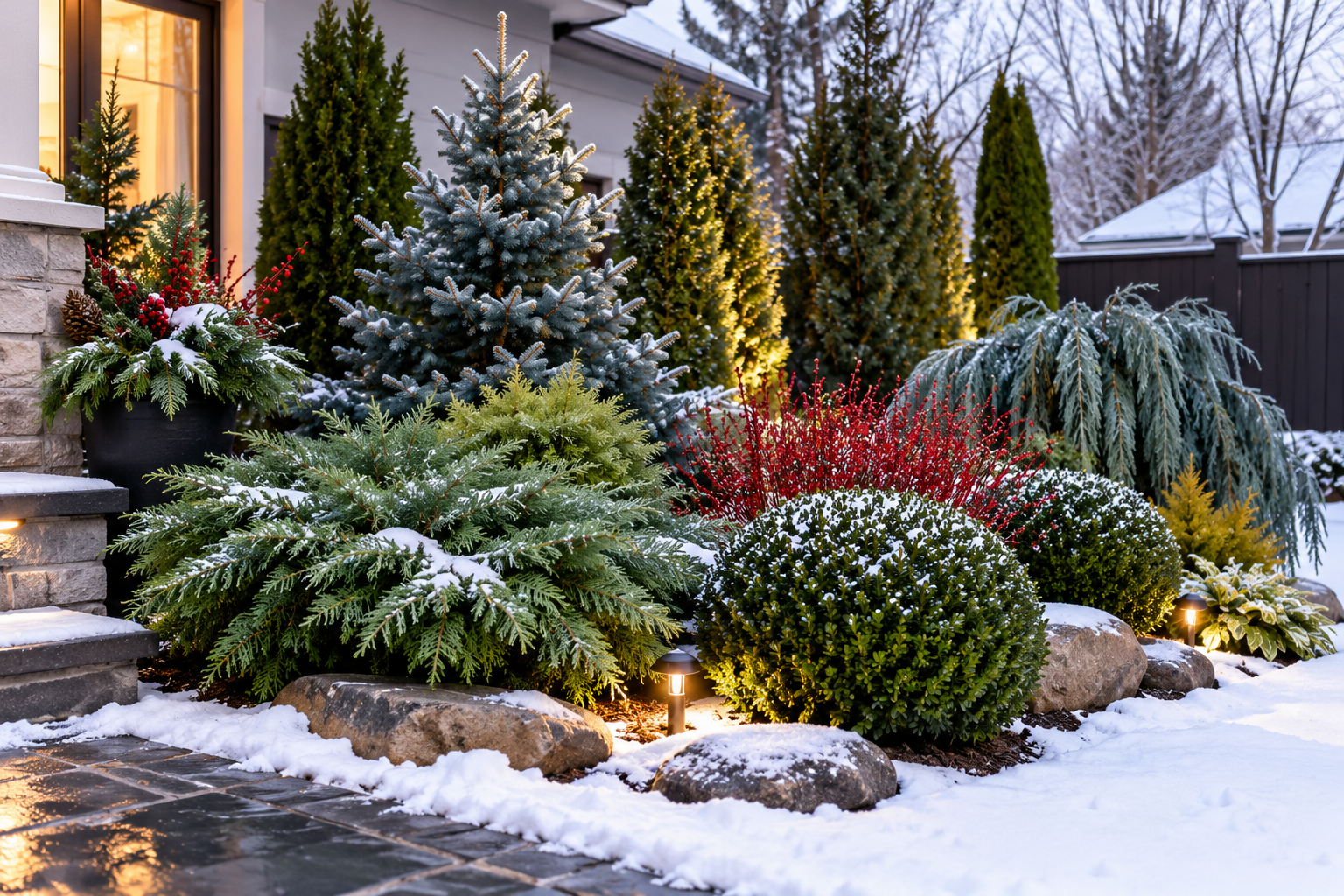
Look out the window in late January and you see what the yard is actually made of. The flowers, leaves, and green lawn are gone. What remains is the framework: shapes, bark, stems, evergreen mass, hard surfaces, and whatever light you’ve added. In many yards that framework turns out to be a fence, a strip of mulch, and one overgrown shrub.
A good winter landscape doesn’t depend on blooms. It depends on structure, contrast, and a handful of plants that look better once everything around them has dropped away. The fifteen ideas below cover evergreens, grasses, berries, bark, containers, structures, lighting, and planting for birds. They also cover the trade-offs plant tags tend to skip: winter burn, snow load, de-icing salt, deer, and berries that are toxic to pets and children.
Start With the View From Inside
Most people see their yard in winter through a window, not from a lawn chair. That changes where the effort should go. A showpiece at the back fence that you can’t see from the kitchen won’t help on a gray February morning.
Stand at the windows you use most, such as the kitchen sink, the living room, and the front door, and note what you see between roughly 15 and 40 feet out. Those sightlines are where winter plantings pay off. Photographing the yard from those spots in midwinter shows you where the gaps are, and a photo is more honest than memory.
Two design principles do most of the work.
Contrast beats quantity. Red berries against dark evergreen, red twigs against snow, and pale grass plumes against a dark fence all read clearly from a distance. Ten different plants in muted tones blur into a brown-gray wash.
Repeat things. A single specimen looks like an accident. Three or five of the same shrub or grass, spaced as a group, reads as a deliberate design, even in a small yard.
Check Hardiness Before Falling for a Plant
Every plant mentioned below has a hardiness range, and ranges differ by cultivar. The zones I give are approximate. Confirm the exact cultivar on the tag or with your local extension service before buying, particularly if you’re near the cold or warm edge of a plant’s range. Cold tolerance also depends on wind exposure, drainage, and how late in the season the plant was established.
Evergreens That Carry the Yard
1. Layer evergreens by texture, not just by green
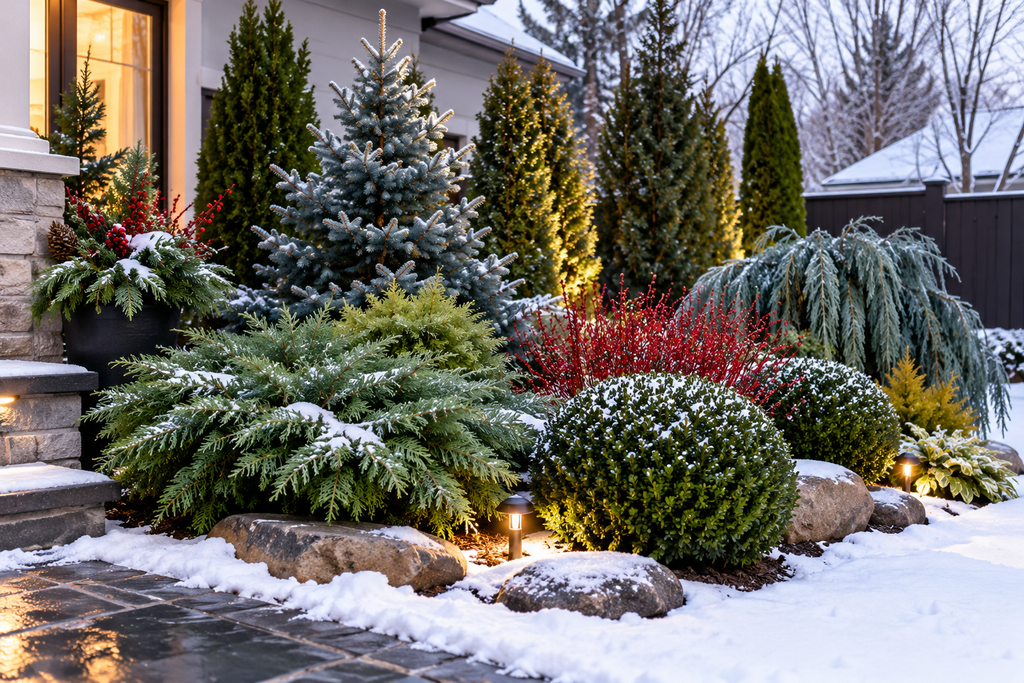
A row of identical dark green shrubs is better than nothing, but it’s flat. Winter makes texture more visible because there are fewer competing details. Mixing foliage types gives the evergreen backbone depth.
Fine, needled foliage (yew, hinoki cypress, dwarf pines) contrasts with broad, glossy leaves (hollies, boxwood, rhododendron, inkberry) and with the soft, drooping habit of some conifers. Plant a tight, rounded boxwood next to an upright conifer and a looser shrub like inkberry, and the group holds interest without a single flower.
Broadleaf evergreens such as rhododendron, boxwood, and holly are prone to winter burn, which shows up as brown, desiccated leaf edges or whole branches. It happens when wind and sun pull moisture from the leaves while frozen soil keeps the roots from replacing it. Three things reduce the risk:
- Plant them out of the harshest winter wind where you can, such as the lee side of a building or fence.
- Water deeply in fall until the ground freezes, particularly after a dry autumn.
- Keep a few inches of mulch over the root zone, pulled back slightly from the stems.
Evergreens planted late in the season need this most, because their roots haven’t spread yet. Burlap screens can help a young, exposed shrub, but they’re a stopgap. The better fix is putting the plant somewhere less windy.
Upright evergreens such as arborvitae and columnar junipers have a different problem. Heavy wet snow can bend or split multi-stemmed plants open. If you already have them, a loose wrap of soft tie or twine in late fall holds the stems together. When snow does accumulate, brush it off gently with an upward sweep. Don’t beat or shake branches that are encased in ice, since frozen wood snaps.
2. Use conifers for color: gold, blue, and bronze
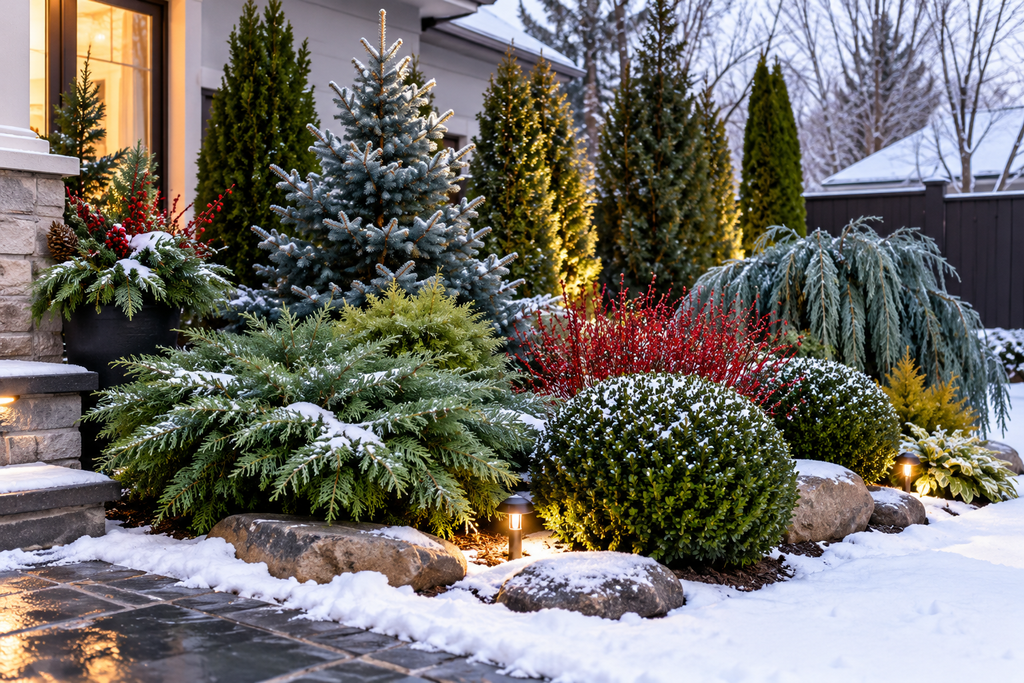
“Evergreen” doesn’t mean one green. Conifer cultivars come in blue-gray (Colorado blue spruce and its dwarf forms), chartreuse and gold (some false cypress and arborvitae cultivars), and plants that shift color with the cold. Some Japanese cedar (Cryptomeria) cultivars turn bronze or plum in winter, and some junipers pick up purple tones. That shift is normal seasonal color, not a sign of damage, though it helps to know which cultivar you have so you don’t mistake it for disease.
Gold foliage works best where winter light is weak, because it seems to glow on overcast days. Blue works against brick, stone, or snow. Avoid placing several strongly colored conifers next to each other. One gold, one blue, and a plain green anchor usually looks better than three attention-seekers.
Check mature size before buying. “Dwarf” on a conifer tag often means a slow-growing plant that still reaches several feet over the years. Space it for the final size, or you’ll be hacking at it in a decade, and most conifers don’t regrow from old wood the way many deciduous shrubs do.
3. Frame the windows you actually look out of
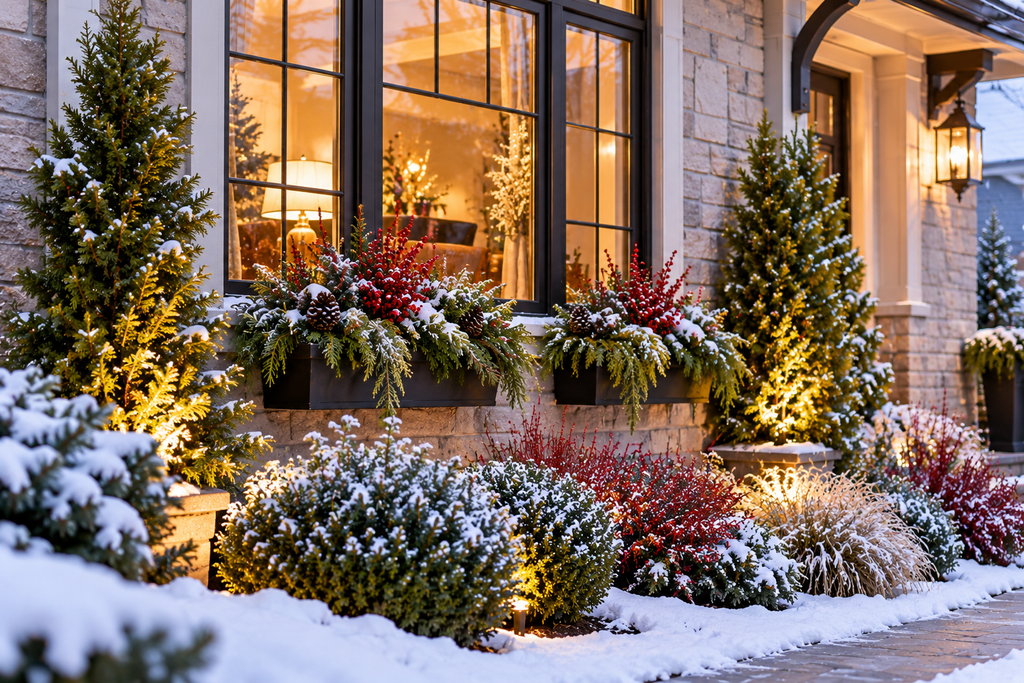
This one is a placement rule rather than a plant. Put your best evergreen structure in the sightlines you identified earlier. A pair of upright evergreens flanking a path, a rounded shrub grouping outside the main window, or a single sculptural conifer centered in a bed will all do more work than the same plants scattered along a back border.
Layering helps too. Taller evergreens go at the back, mid-height shrubs in front, and low or spreading plants at the edge. In winter that layering is what stops a yard from looking like a flat wall of green with a lawn in front.
Grasses and Stems Left Standing
4. Leave ornamental grasses upright through winter
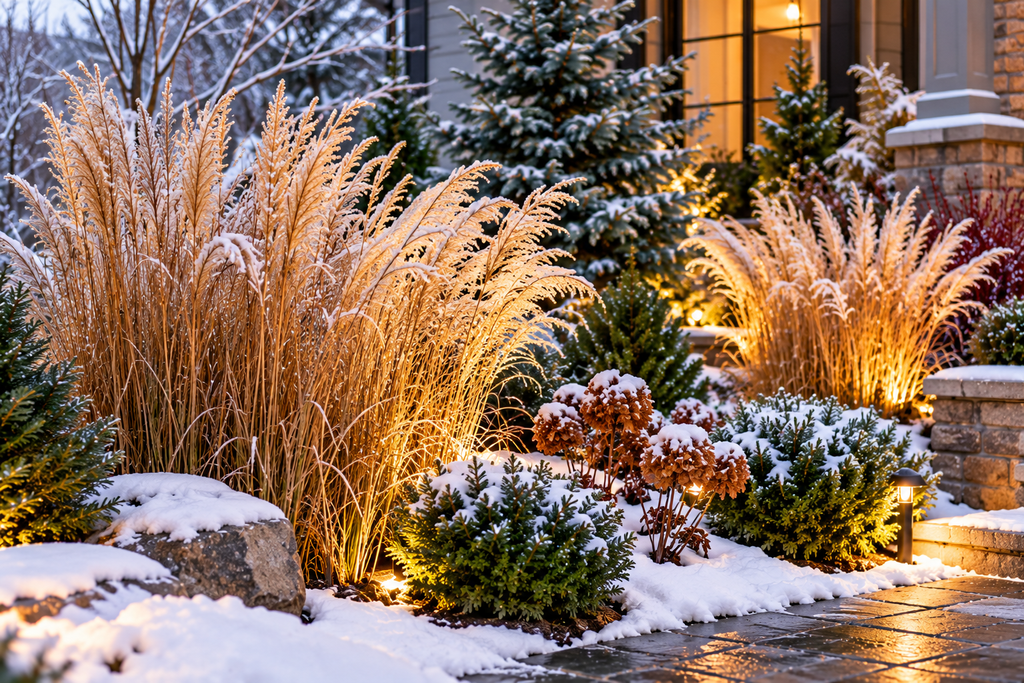
Cutting grasses to the ground in fall removes some of the best winter texture in the garden. Many ornamental grasses hold their form and soften to buff, tan, or copper tones, and they catch frost, snow, and low sun.
Some perform better than others under snow:
- Feather reed grass (Calamagrostis ‘Karl Foerster’, roughly zones 4–9) stays narrowly upright and tends to hold its shape.
- Little bluestem and switchgrass (Schizachyrium and Panicum, roughly zones 3–9 and 4–9 respectively) have good winter color, though switchgrass can flop in heavy snow.
- Miscanthus (roughly zones 5–9, with some cultivars hardier) gives big plumes, but taller types can collapse under wet snow or ice. If your area gets heavy, wet snowfall, choose upright cultivars.
- Fountain grass often shatters and looks ragged by midwinter in many climates.
Cut grasses back in late winter or very early spring, before new green growth appears, to a few inches above the ground. That timing keeps the winter display intact and lets you clear the old growth before it tangles with new shoots. Cutting too late chops the new blades.
One caution: in wildfire-prone regions, dry standing grass near the house is fuel. Local fire guidance on defensible space takes priority over the aesthetic argument, so keep standing grasses well away from the structure or cut them back.
5. Let seed heads and perennial skeletons stay
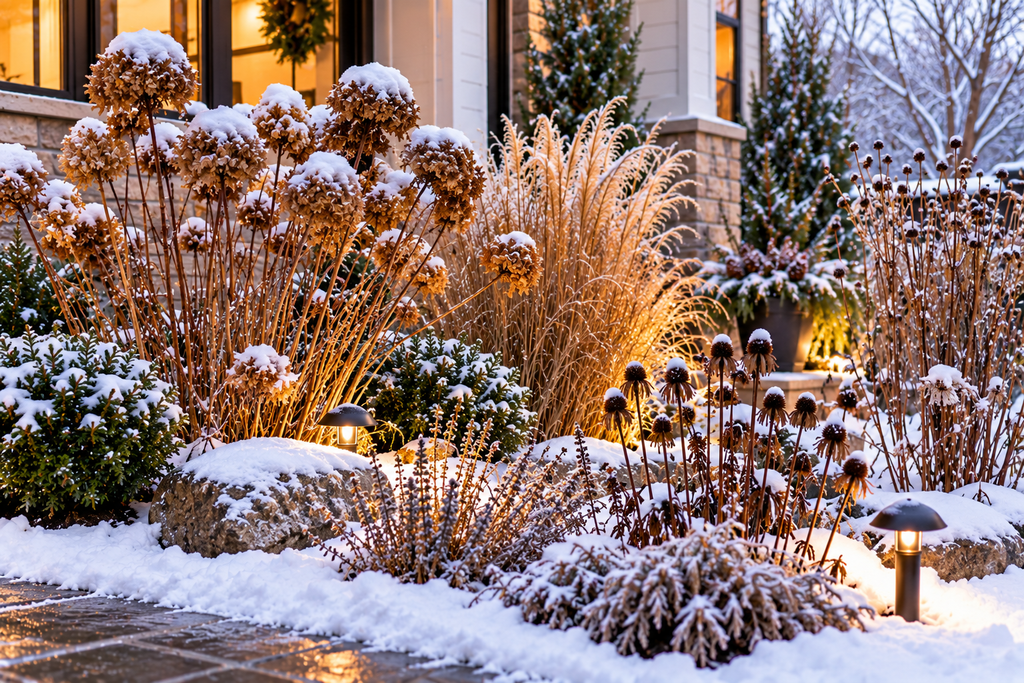
Many perennials look good in winter if you resist tidying them. Coneflower (Echinacea), black-eyed Susan (Rudbeckia), sedum, and many other perennials leave sturdy stems and seed heads that hold snow and frost. Sedum ‘Autumn Joy’ and similar types turn a rust-brown that reads as a deliberate color against pale grasses.
There’s a practical benefit beyond looks. Seed heads feed birds, and hollow stems can shelter overwintering insects. Hold off cutting until early spring, when the new growth begins.
Not every perennial improves with neglect. Hostas and daylilies collapse into slimy brown mats and are better cleaned up. The test is simple: if the plant stands up after frost and has a recognizable shape, leave it. If it falls over, cut it.
Color From Berries, Bark, and Twigs
6. Plant winterberry and hollies for berries that stay
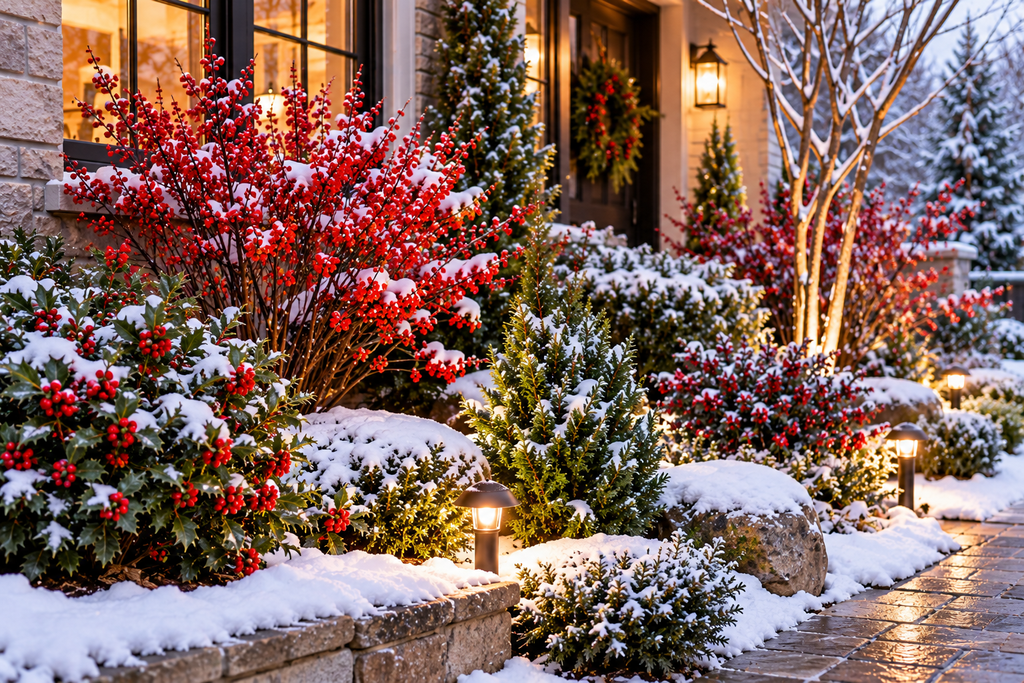
Winterberry holly (Ilex verticillata, roughly zones 3–9) is a deciduous holly, so it drops its leaves in fall and leaves bare branches packed with red, orange, or sometimes yellow berries. Against snow or evergreens, it’s among the most reliable winter color in the landscape.
The catch that catches many buyers out is that winterberry is dioecious. Only female plants produce berries, and they need a male plant nearby to pollinate the flowers. A female with no male in the area gives you a leafless shrub. The usual guidance is one male within roughly 50 feet for several females, and the male’s bloom time must overlap the female’s. Nurseries commonly sell matched pairs by cultivar name, so check the tag or ask. Also confirm that the male is hardy and compatible with your chosen female.
Evergreen hollies (American holly, blue holly hybrids, inkberry) follow a similar rule: berries need both sexes, though inkberry berries are black and less showy. Plant at least one berrying female in the group and make sure a male is within reach.
Holly berries are mildly toxic to people and pets if eaten in quantity. If small children or curious dogs use the yard, put the berrying shrubs where they can be admired from the window rather than within reach.
7. Look beyond holly: viburnum, chokeberry, crabapple, and rose hips
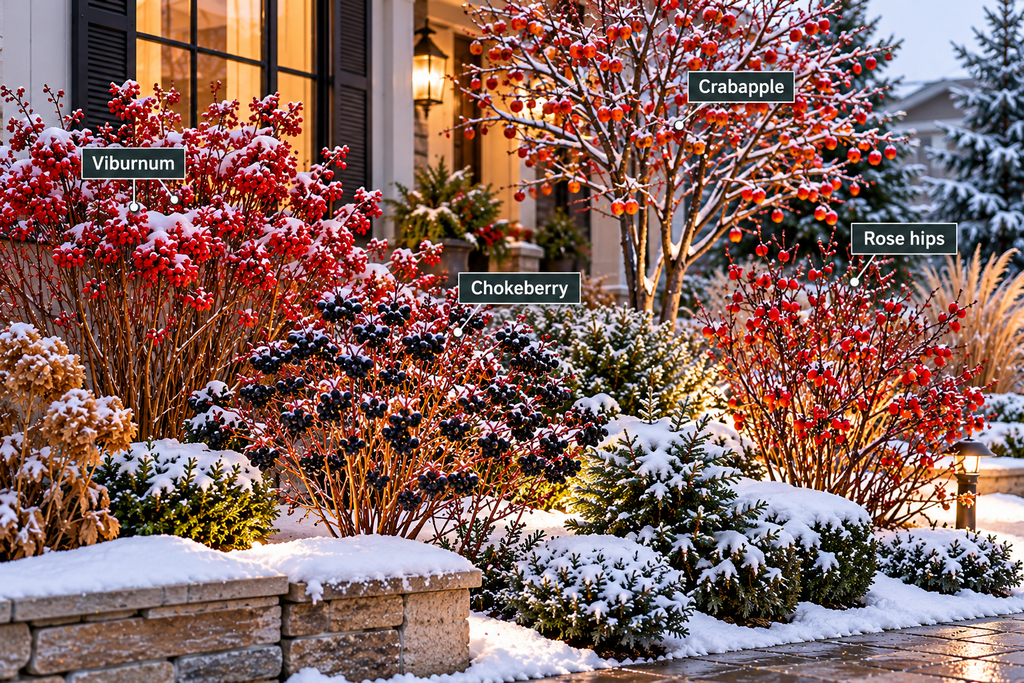
Several other shrubs and small trees hold fruit into winter:
- Viburnums, particularly American cranberrybush (Viburnum trilobum) and some hybrids, keep clusters of red or orange fruit that can persist well into the colder months.
- Black and red chokeberry (Aronia, roughly zones 3–9) carries dark or red fruit and has strong fall color that gives way to a tidy winter silhouette.
- Crabapples vary enormously. Some cultivars drop their fruit by fall, while small-fruited types hold them into winter. Look specifically for “persistent fruit” cultivars with disease resistance.
- Rugosa rose (Rosa rugosa, tough in cold regions) develops large red-orange hips after flowering.
Birds don’t eat all fruit at the same pace. Some berries disappear within weeks, while others, often crabapples and some viburnums, get eaten later in winter after repeated freezing and thawing softens them. If you want color that lasts, plant more than one type.
8. Choose trees with bark worth looking at
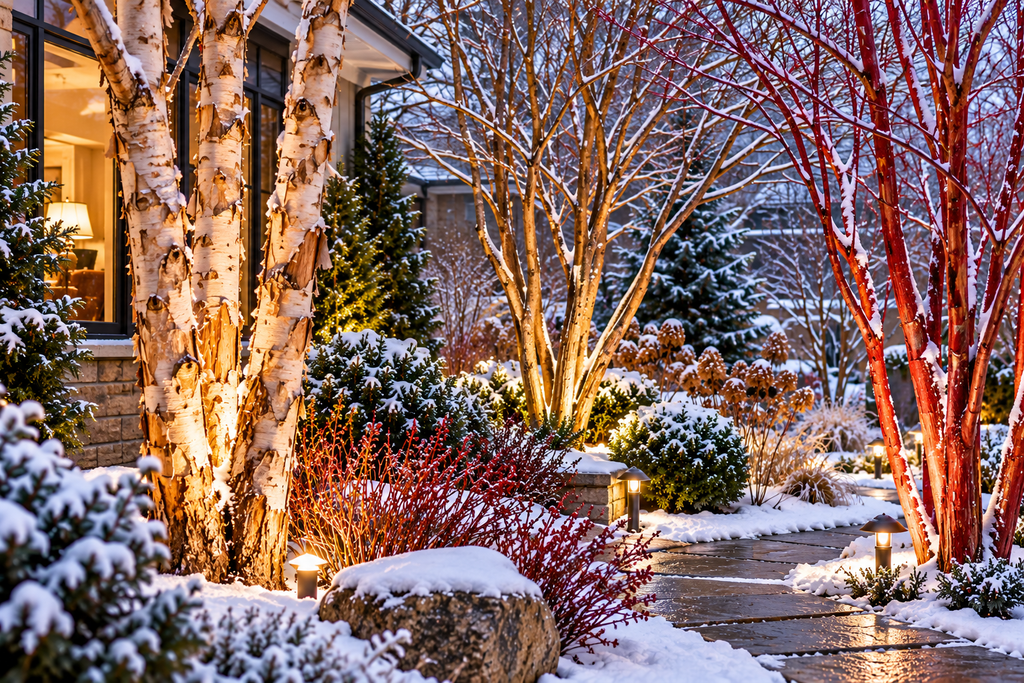
Bark is the most underrated winter feature, because it’s visible every day whatever the weather. Trees and large shrubs to look at include:
- Paperbark maple (roughly zones 4–8), with cinnamon-colored bark that peels in thin curls.
- River birch (roughly zones 4–9), whose cream-to-salmon bark exfoliates in shaggy sheets, especially on cultivars bred for that trait.
- Crape myrtle (generally zones 6/7–9), with smooth, mottled bark in warmer climates.
- Lacebark pine (roughly zones 4–8), which develops a patchwork of gray, green, and cream bark with age.
- Coral bark maple (a Japanese maple cultivar, roughly zones 5–8), whose young twigs turn coral-red in cold weather.
- Stewartia (roughly zones 5–8), with smooth, mottled bark and a graceful form.
Bark features often develop with age. A young sapling may look plain for years before the interesting bark appears, so ask the nursery about time to effect. For small yards, a single multi-stem river birch or paperbark maple in a visible spot does more than several modest shrubs.
Light matters too. A tree with exfoliating bark placed against a dark evergreen backdrop, or lit from below with a low-voltage light (see idea 14), shows the texture far better than the same tree against a pale fence.
9. Plant red- and yellow-twig dogwoods where snow will frame them
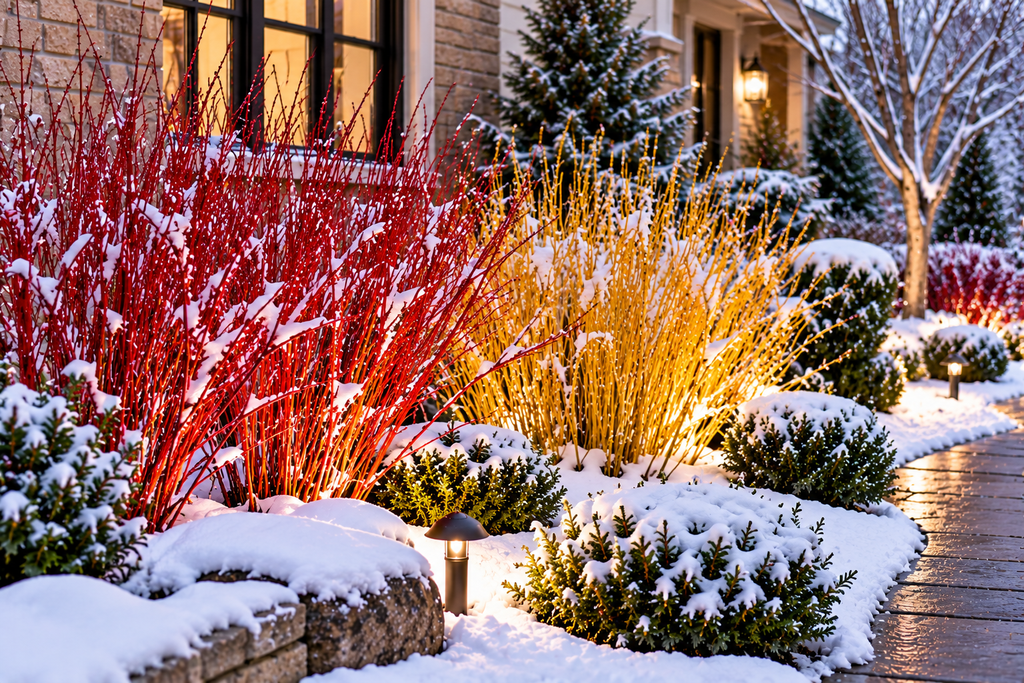
Shrub dogwoods such as Cornus sericea and Cornus alba are grown for their bright winter stems. Red-twig types give scarlet to crimson stems, and yellow-twig types give golden-yellow. They’re tough, widely hardy (roughly zones 2–8), and inexpensive compared with specimen trees.
The color is strongest on young stems, usually those up to about two or three years old. Older wood fades to dull gray-green. To keep the color vivid, remove roughly a third of the oldest stems at the base each year in late winter or early spring, which encourages colorful new growth. Skip this pruning for a few years and the shrub gradually loses its main reason for being planted.
Full sun gives the best color, though partial shade works. Plant them where snow or evergreens create a background, because red stems against bare brown ground disappear.
Shapes, Branches, and Winter Flowers
10. Add one or two plants with sculptural branches
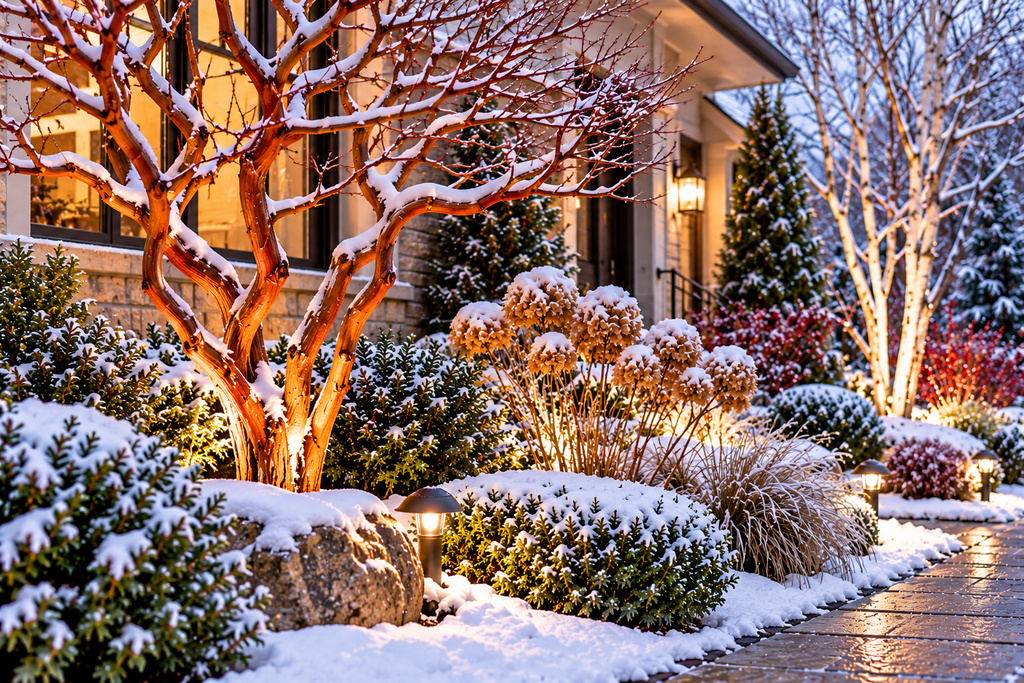
Some plants are really about branch structure. Contorted filbert, also called Harry Lauder’s walking stick (Corylus avellana ‘Contorta’, roughly zones 4–8), has twisted, curling stems that stand out once the leaves fall. Weeping forms of Japanese maple, weeping cherry, and weeping crabapple have arching shapes that look like they were drawn by hand. Multi-stem Japanese maples show off layered, horizontal branching.
Two practical notes:
- Contorted filbert is usually grafted onto a regular, straight-stemmed rootstock. Straight shoots that sprout below the graft are rootstock suckers and need to be cut off, or they take over the plant. Some regions also have eastern filbert blight, a fungal disease affecting hazelnuts, so ask a local nursery about it.
- Corkscrew willow has dramatic twisted stems but is short-lived, brittle, and has aggressive roots that can interfere with pipes and septic lines. It’s a poor choice near buildings or drainage.
Use these plants sparingly as focal points. One well-placed sculptural plant against a plain background gets noticed. Several together compete.
11. Add plants that actually bloom in winter
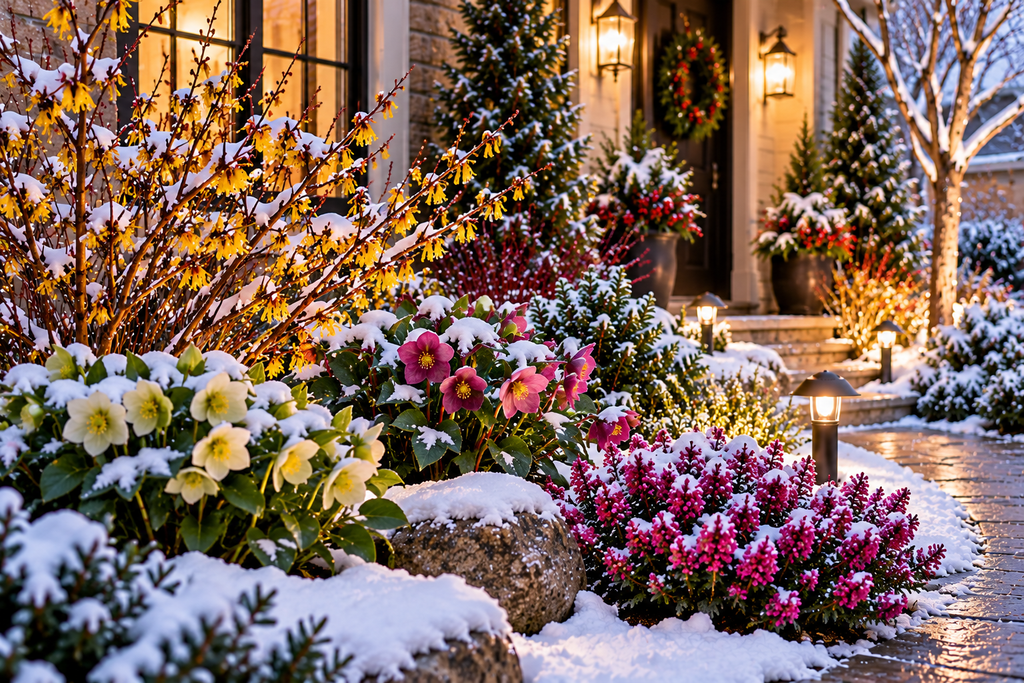
A few plants do flower in the cold months, and even a small number changes how the yard feels:
- Witch hazel (Hamamelis, roughly zones 5–9 for hybrids, and some native types hardier) produces spidery yellow, orange, or red flowers in late winter, often with a spicy scent.
- Hellebores (roughly zones 4–9) bloom in late winter to early spring in shade, and their foliage is evergreen in many regions. Cut off tattered old leaves in late winter to show the flowers.
- Snowdrops (Galanthus, roughly zones 3–8) are small bulbs that push through snow in late winter.
- Winter jasmine and wintersweet are options in milder climates for early color on arching stems.
Bloom timing depends heavily on local weather. In cold regions, “winter-blooming” often means late winter or early spring, so don’t expect January flowers everywhere. Plant these near paths or entrances where you’ll notice them, since the flowers are small and easy to miss from a distance.
Containers, Structures, and Light
12. Build winter containers that survive the freeze
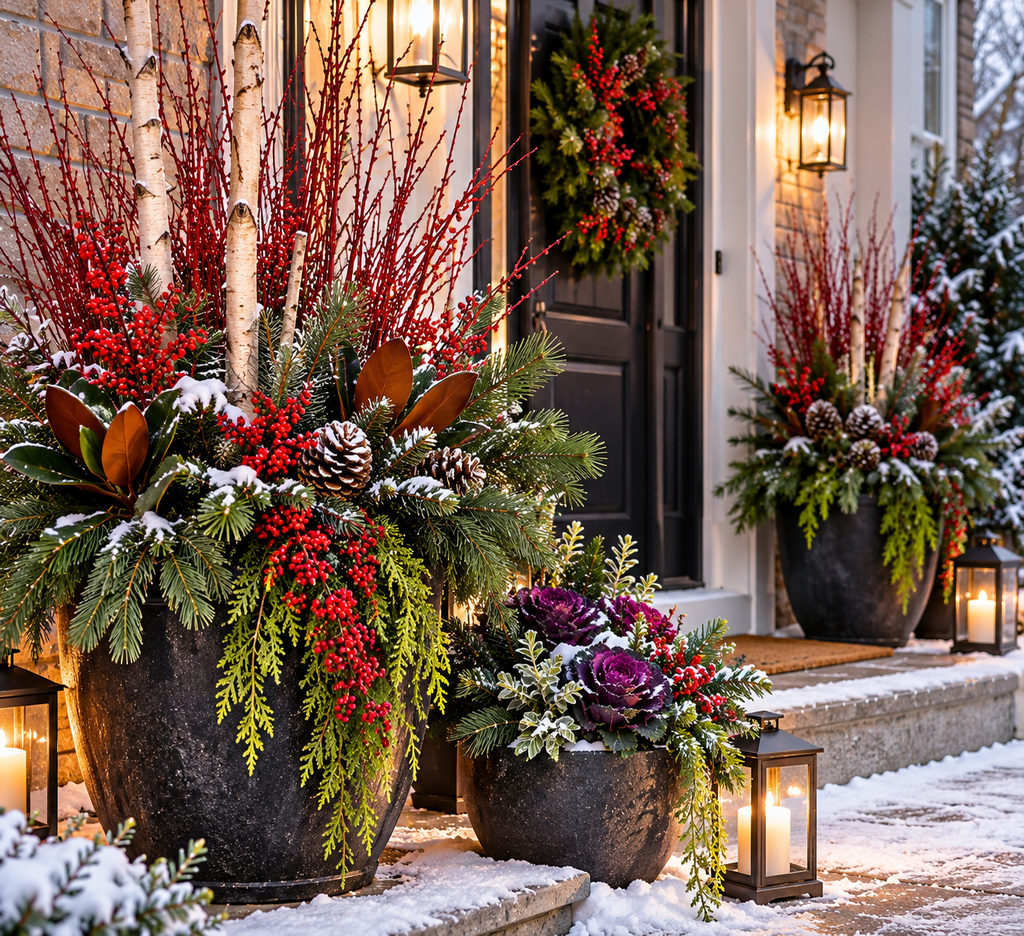
Containers add instant structure near doors and entries, and winter ones can be done well with very little. The usual approach is evergreen boughs (spruce, fir, cedar, pine) and branches such as red-twig dogwood, birch, or curly willow, pushed into the soil, sometimes with pinecones or dried seed heads added.
A few details determine whether it holds up:
- Fill the pot with moist potting soil before the hard freeze. The soil then freezes around the stems and holds them upright. Pushing boughs into dry soil that later freezes solid is much harder.
- Pots are colder than ground. Roots in a container are exposed on all sides to cold air, so a plant that is hardy in the ground may not survive in a pot. A common rule of thumb is to choose perennials hardy one or two zones colder than your own if you want them to live through winter in a container, or treat them as seasonal decoration.
- Match pot material to your climate. Terra-cotta and some ceramic pots can crack when wet soil freezes and expands. Fiberglass, resin, and frost-rated pots handle freezing better. Larger pots hold more soil, which cushions temperature swings.
- Cut greenery lasts weeks to a couple of months, depending on how cold it stays. Cold slows needle drop, and warm spells shorten it. Plan on refreshing it if you want it to look good into late winter.
If you want living plants, dwarf conifers, ornamental kale and cabbage, and hardy evergreen heuchera cultivars tolerate frost, though extended deep cold will eventually damage some of them. Pansies tolerate light frost but mostly stop growing in cold, so they’re better in milder regions.
13. Use structures that make sense in the snow
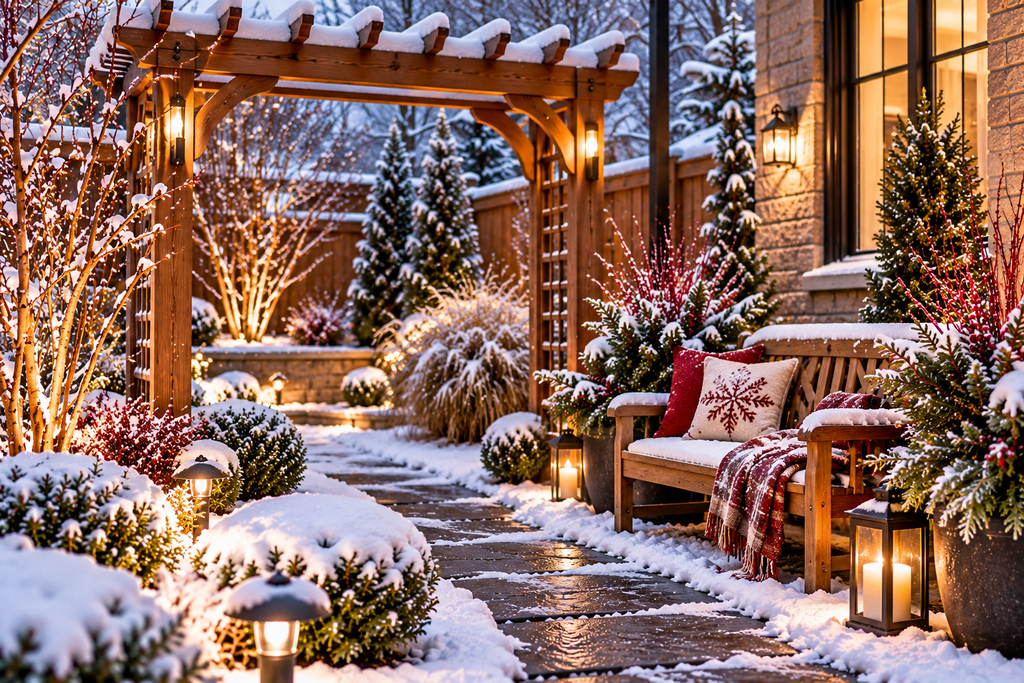
Garden structures give a bare yard bones, because they don’t depend on plants. An arbor, obelisk, trellis, pergola, or low wall provides vertical interest, a place for climbers to leave their skeletons on, and a focal point from the window.
Think about winter specifically:
- Snow and ice load. Lightweight trellises and decorative obelisks can bend under wet snow, particularly with a heavy vine on them. In snowy regions, choose sturdy construction and set posts below the frost line if the structure is permanent. Check local requirements for any structure that needs a permit.
- Material choice. Dark metal, weathered wood, and Corten steel (which forms a rust-colored surface) look good against snow. Painted white structures can vanish against a snowy backdrop.
- Hardscape counts. Stone walls, gravel paths, stepping stones, and defined bed edges all give a yard definition when the beds are empty. Crisp edges make a dormant bed look intentional rather than neglected.
- Snow storage. Don’t put delicate structures where shoveled or plowed snow will be piled. That’s how arbors get crushed.
A vine such as clematis or climbing hydrangea on a structure also earns its keep in winter. Some clematis leave fluffy seed heads, and climbing hydrangea has peeling, cinnamon-colored bark on mature stems.
14. Light the paths and one or two focal points
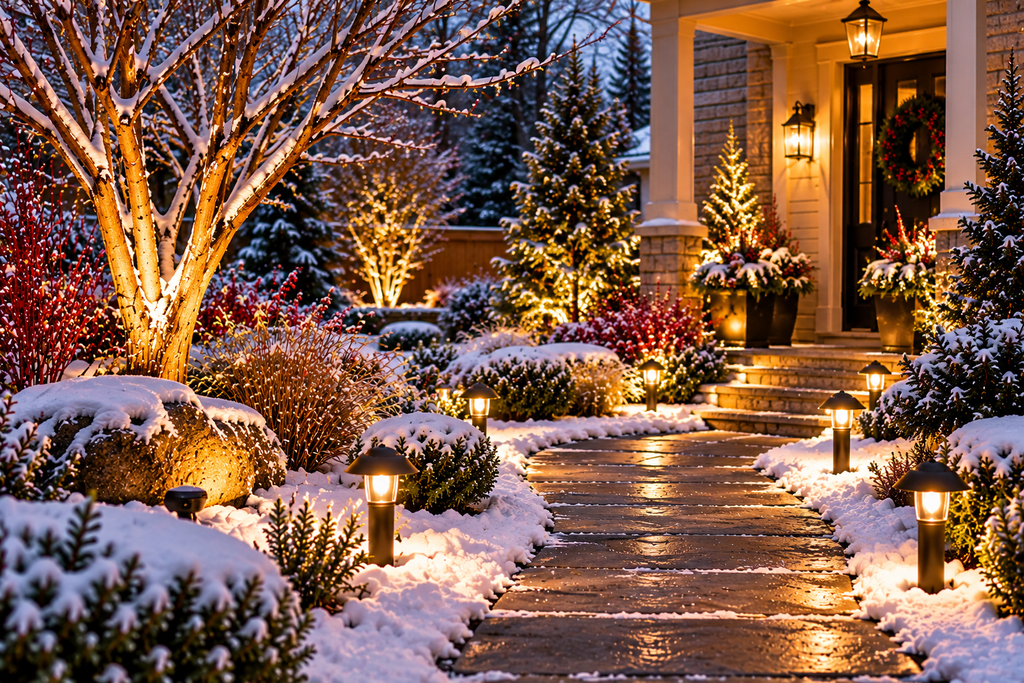
Winter nights arrive early, and for much of the season a yard is seen in the dark. Lighting makes the evergreens, bark, and structures visible after 4:30 p.m. and also makes icy paths safer.
Low-voltage landscape lighting (typically 12-volt) is the usual choice for homeowners. It runs through a transformer with a timer or photocell. It’s considered lower risk than line-voltage wiring, but the transformer still plugs into an outdoor-rated outlet, and that connection should be on a GFCI-protected circuit. Hardwired line-voltage lighting, buried cable, and new outdoor circuits are jobs for a licensed electrician, and many jurisdictions require permits and inspections.
A few design points:
- Choose warm white light, typically around 2700K. Cooler, bluish light looks harsh on snow and bark.
- Light the objects, not the sky. Low path lights should wash the ground and leave the fixture itself shielded to avoid glare. Uplights placed at the base of a tree can show off textured bark or a sculptural branch structure.
- Be restrained. Lighting a few key points looks better than a runway of fixtures.
- Be cautious with solar lights. Short days, low sun angles, and snow covering the panels reduce performance in many regions. They’re often dim or off entirely in the worst weather. They’re fine for decoration but unreliable for safety.
- Use timers. Leaving landscape lights on all night wastes energy and can disturb wildlife.
Lighting improves visibility on paths but doesn’t replace traction. Ice is invisible whatever the lighting.
Planting for Birds
15. Build in food, cover, and water for winter birds
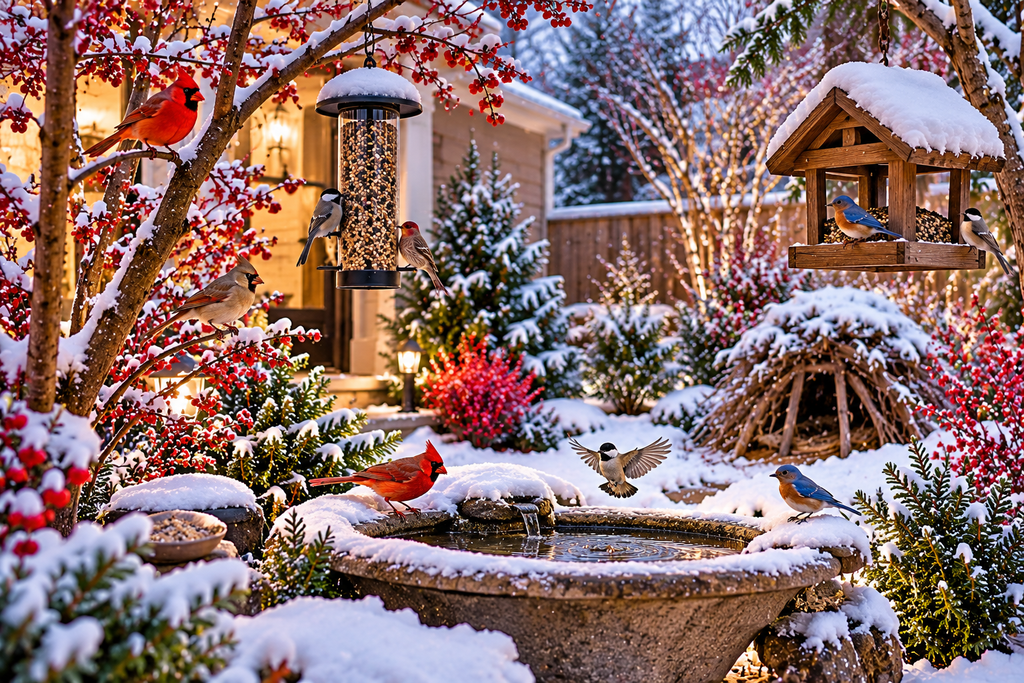
A yard with birds in it never looks empty. Planting for birds also overlaps with most of the earlier ideas, which makes it an efficient design goal.
Food. Berrying shrubs (winterberry, viburnum, chokeberry, crabapple, rose hips) and seed-bearing perennials and grasses provide natural food. Planting several kinds spreads the supply across the season, since birds strip some fruit early and leave others for later.
Cover. Dense evergreens such as spruce, juniper, and arborvitae give shelter from wind and predators and a place to roost at night. A brush pile in a back corner, built from pruned branches, serves the same purpose for small birds.
Water. Unfrozen water is harder to find in winter than food. A heated birdbath or a heater made for birdbaths helps. Use products designed for outdoor use and a GFCI outlet, and keep the water fresh.
Feeders. If you add feeders, placement matters because of window strikes. Commonly cited guidance from bird conservation groups is to put feeders either very close to a window (within about 3 feet) or far from it (more than about 30 feet). Feeders at intermediate distances let birds build up speed before hitting the glass. Keep feeders clean, since dirty feeders can spread disease, and place them away from spots where cats can ambush.
Native plants generally support more wildlife than non-native ones, so check which species are native to your region.
What Winter Does to Plants, and How to Plan for It
Salt. De-icing salt damages evergreen foliage and can harm soil and roots near paved areas. Shovel first, use sand for traction, and use salt sparingly. If walkways are lined with plants, choose salt-tolerant types or leave a setback from the pavement. Alternatives to sodium chloride exist, but they aren’t harmless to plants either, so read the label.
Deer. In areas with deer, winter food is scarce and plants they ignore in summer can get browsed. Yew, arborvitae, and rhododendron are often damaged, while boxwood, many conifers, and plants with strong aromas or prickly foliage tend to be less appealing. No plant is deer-proof, and browsing pressure varies by region and season. Local extension offices often publish deer-resistance lists for your area.
Wind. Open sites dry out evergreens faster. A windbreak planting on the windward side, with the plants set back from the ones they protect, helps.
Late planting. Fall planting is generally better than winter planting, because roots have time to establish before the ground freezes. Container-grown plants can be planted in winter in milder climates when the soil isn’t frozen, but they need watering during dry spells.
Questions Readers Often Ask
Which winter plants work in a shady yard?
Shade limits berry and bark options, but several plants thrive without much sun. Hellebores, hollies, inkberry, leucothoe, mahonia (in warmer zones), sarcococca, and evergreen ferns like Christmas fern all hold up in shade. Evergreen foliage carries the design while berries and flowers add interest in the brighter spots.
Why didn’t my winterberry produce berries?
The most common causes are a missing male pollinator, a male with a different bloom time, or a very young plant. Pruning off flower buds in late winter and heavy shade can also reduce fruiting. Check the sexes and bloom groups of your plants.
Can I add winter interest without buying many new plants?
Yes. Leaving grasses and seed heads uncut costs nothing, and moving a few containers to the front door takes an afternoon. Cut branches from existing dogwood, evergreens, or other shrubs for a container. Lighting a single tree or path is another low-effort step.
How much winter interest is enough?
There’s no fixed formula. A reasonable test is the January photo from your main windows. If the picture has a clear focal point, some evergreen mass, and at least one source of contrast, it’s working. If it’s brown and flat, add one evergreen group or one bark tree to that view first.
Key Takeaways
Start at the windows. The plants and structures you see most in winter deserve the budget. Build the evergreen framework first, with a mix of textures and one or two colors, then add contrast from berries, bark, or colored stems. Leave grasses and sturdy seed heads standing until late winter. Choose containers, structures, and lighting for how they behave in freezing weather, not just how they look in a catalog. Before buying any berry shrub, check whether it needs a male pollinator, and before buying any plant, confirm its hardiness for your zone.

About Syprose Kiche
Syprose Kiche is the creator and writer behind My Besuited Home, a practical home and garden website covering DIY projects, gardening, lawn care, landscaping, home improvement, and outdoor living. She focuses on turning everyday homeowner questions into clear, practical guides backed by careful research and useful real-world considerations.