
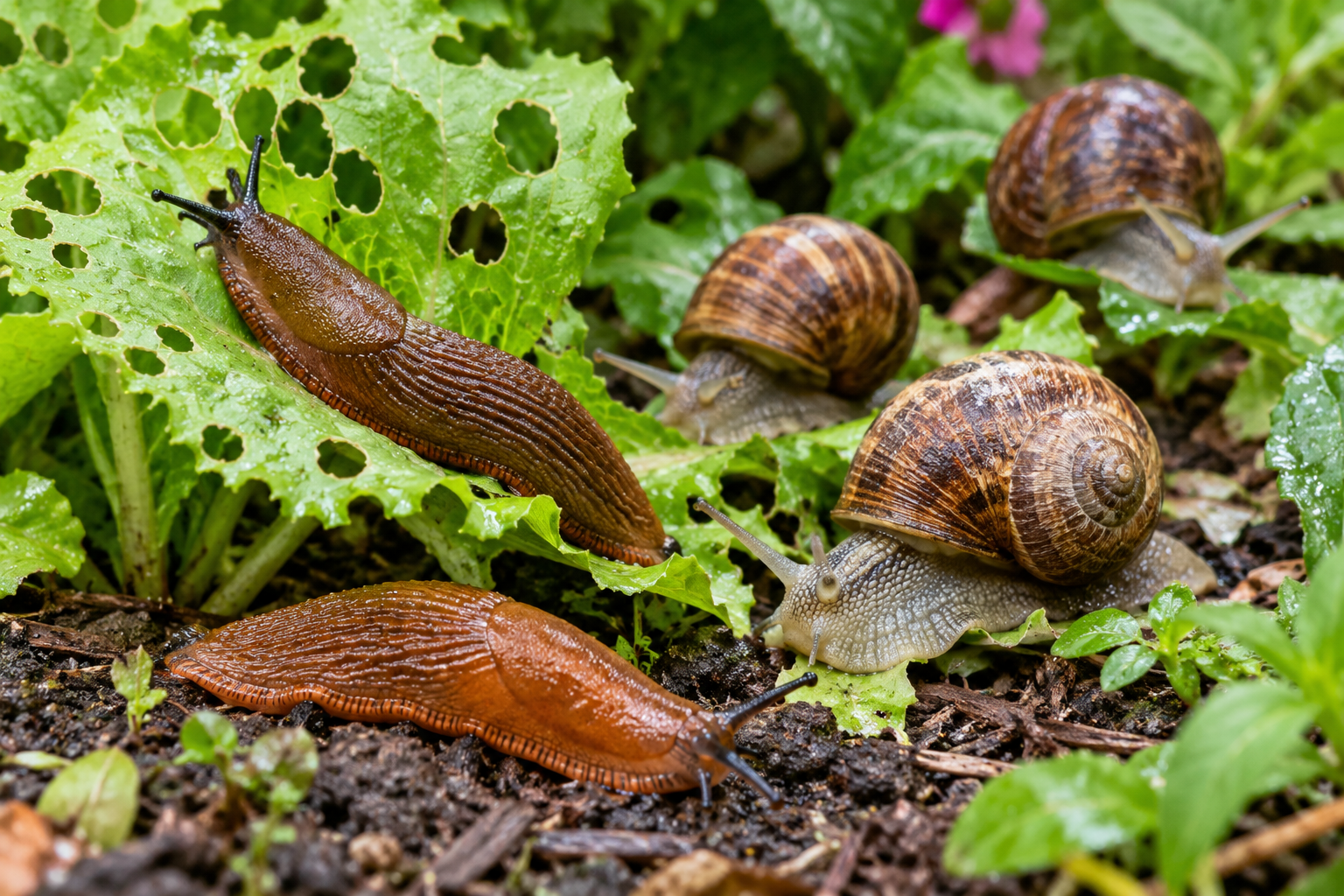
The slugs you can see in October are not the real problem. The real problem is small clusters of pearly, translucent eggs being laid right now in damp soil, under pots, along the edges of boards, and beneath whatever has been sitting on the ground since summer. A gardener who puts out a few traps in the fall and then packs the garden away is usually surprised in April, when the hostas, lettuce, and seedlings come up and the population has apparently rebuilt itself.
Fall is the one time of year when you can reduce slugs and snails at several stages of their life cycle at once: the adults gathering to lay eggs, the eggs themselves, and the shelters that let all of them survive the cold. This guide covers how to confirm what you’re dealing with, how to remove the hiding places that matter, which natural controls work, which popular ones don’t, and how to pace the work through the weeks before the ground freezes.
Why Fall Decides Next Spring’s Slug Problem
Slugs and snails are mollusks with no waterproof outer layer. They lose moisture quickly, so they feed at night or in damp, overcast weather and spend dry daylight hours tucked into cool, humid shelter. That’s why the cooler, wetter weather of fall suits them so well. Activity often picks up after the dry stretch of late summer, and many species lay eggs in autumn.
The details vary by species and climate, but the general pattern is consistent across most gardens:
- Adults mate and lay eggs in clusters, usually a few dozen at a time, in moist soil, under debris, or in crevices around stones and containers.
- Eggs are small and round, whitish to translucent, and look a bit like tiny pearls or tapioca. Depending on temperature they hatch in a few weeks or may wait through the winter. In mild climates, eggs laid in fall can hatch within weeks, so young slugs may be feeding in December.
- Juveniles and some adults overwinter in sheltered places. Garden snails commonly seal themselves into their shells with a dried layer of mucus and wait out cold spells under stones, in pot rims, in dense groundcover, or in cracks in walls and woodwork.
In colder regions a hard freeze kills many exposed adults, but eggs and sheltered individuals frequently survive. Those survivors are the starting population for spring, and a slug can lay eggs repeatedly over its life, so a few that escape the cold can rebuild numbers faster than most people expect.
Controlling them in fall matters for a practical reason as well. Most of the natural methods below work through habitat and timing rather than a one-time kill. They cost the least effort when the weather is still workable and the leaves haven’t turned into a mat of wet debris.
Confirming It’s Slugs and Snails
Before spending time on control, make sure the damage actually comes from mollusks. Several other pests chew holes in leaves.
Signs that point to slugs or snails:
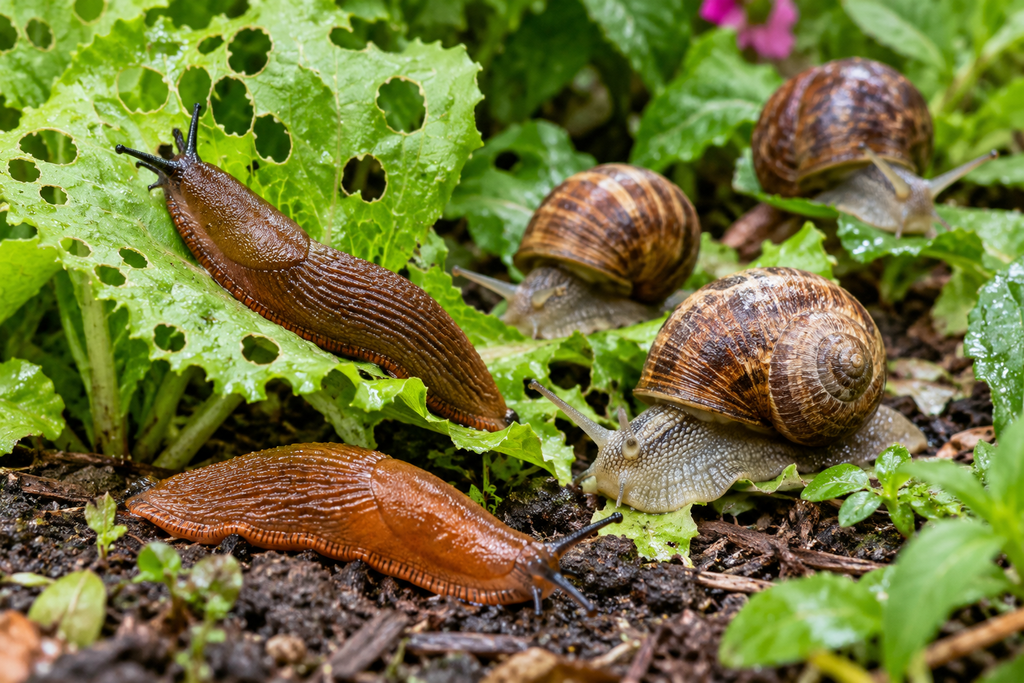
- Irregular, ragged holes with smooth edges, often in the middle of the leaf rather than around the margin
- Silvery, dried mucus trails on soil, leaves, paving, pots, and walls, most visible in the morning
- Seedlings or young plants eaten almost to ground level overnight
- Damage concentrated on lower, softer leaves and on plants close to the soil
- Holes in ripe strawberries or tomatoes sitting on the ground, and tunneling in tubers or root crops
Signs that point to something else:
- Dark pellet-like droppings (frass) on or beneath the plant suggest caterpillars
- Notched leaf margins often indicate weevils
- Chewing with no slime, plus seedlings cut cleanly at the base, can mean cutworms
- Larger-scale browsing with torn, ragged stems points to deer or rabbits
The most reliable test is to go outside with a flashlight one to two hours after dark, ideally after rain or a watering session. If slugs and snails are the culprit, you’ll find them on the plants, on the soil surface, and climbing pot sides. A quick look under a flat board or overturned pot left on the soil for a night or two works as well. If nothing is hiding there in the morning, or the damage continues without any mollusks in sight, look at the other suspects before investing in slug control.
Not all slugs are pests, either. Some species feed mainly on decaying matter, fungi, or other slugs. The ones that damage gardens are the ones you catch in the act on living plants.
Climate Changes the Plan
How aggressive to be depends on where you garden.
Cold-winter regions (where the ground freezes and stays frozen): Most adults will be lost to the cold if they can’t find shelter. Your main goals are to remove protected refuges and expose eggs, so that the winter does most of the killing for you.
Mild, wet winters (coastal areas, the Pacific Northwest, parts of the UK and Western Europe, much of the southern US): Slugs may stay active through winter whenever temperatures are above freezing. You’ll need ongoing control rather than one fall cleanup, and winter crops like kale, lettuce, and brassica seedlings are at risk.
Dry-winter climates: Activity depends heavily on irrigation. Drip lines, wet pots, and shaded, watered beds can sustain populations in places that are otherwise dry. Reducing unnecessary moisture is especially effective here.
If you aren’t sure how your area behaves, check with a local extension service or garden club. They can tell you when slug activity typically drops and whether eggs hatch in fall or spring where you live.
Removing Hiding Places: The Highest-Impact Fall Job
If you only do one thing, make it this. Slugs and snails need shelter more than they need any particular plant. Taking away the shelter forces them into the open, where they dry out, get eaten, or freeze. Habitat control also works for months, whereas traps only remove whatever happens to wander into them.
Clear leaf piles and debris from beds and borders
Fallen leaves are good for soil, but a thick, wet layer pressed against plant crowns is ideal slug housing. Rake or blow leaves out of beds, off the base of hostas and other low perennials, and away from the edges of vegetable plots. Compost them or shred them for use somewhere less vulnerable.
Spent annuals, rotting squash vines, and collapsed vegetable foliage all hold moisture against the soil. Remove them once the plants are finished. Diseased material shouldn’t go into a home compost pile that doesn’t get hot; check the guidance for your region.
Reduce and reposition mulch
Mulch helps in many ways, but a thick layer of damp shredded bark or compost is where slugs spend the day. You don’t need to strip beds bare. Instead:
- Keep mulch to about 2 to 3 inches deep, not the 4 to 6 inches some gardeners apply
- Pull it back a few inches from the base of vulnerable plants
- Consider coarser material (chunky bark, wood chips) near sensitive plants, since it dries faster and is harder for them to move across than fine, packed material
Deal with pots, boards, and other things lying on the ground
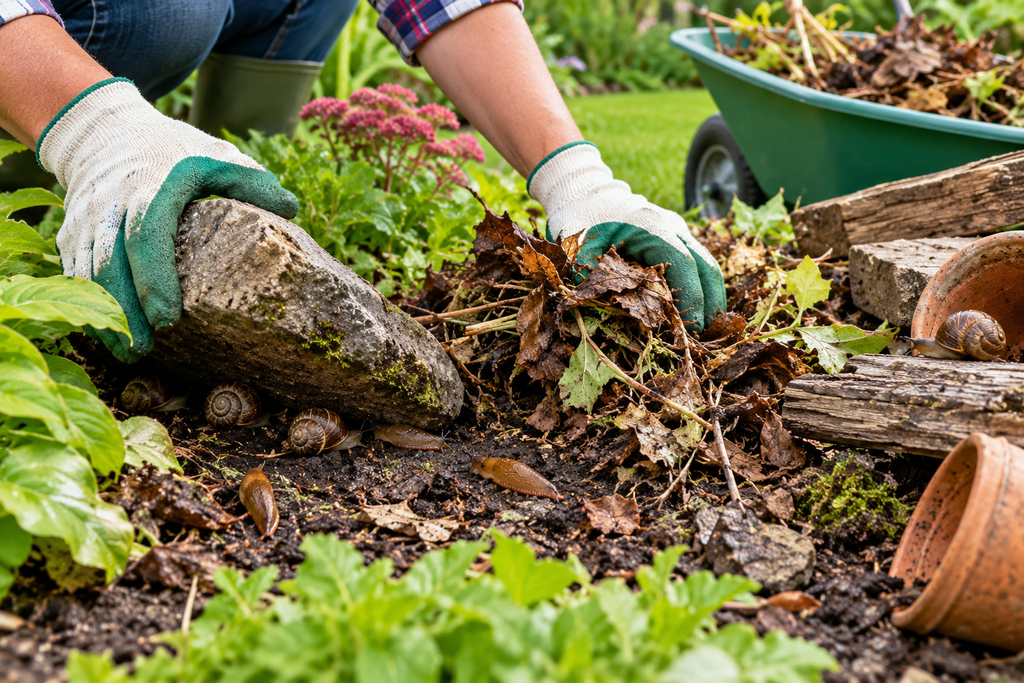
Pots set directly on soil, stacked saucers, spare lumber, bricks, paving offcuts, bags of potting mix, watering cans, and tarps all create dark, humid pockets. Lift each one and look underneath. Egg clusters and sleeping adults are often right there.
Move what you can onto a hard, dry surface or store it off the ground. Raise pots on pot feet or bricks so the underside can dry out. Stack stored pots upside down and away from beds.
Cut back overgrown edges and dense groundcover
Thick groundcover, such as ivy, vinca, and dense ground-hugging perennials, stays damp at ground level and is notoriously hard to search for slugs. If it borders a bed you care about, trim a clear band between the two, even just 12 inches. That gap forces them to cross dry, open ground to reach your plants.
Check walls, fences, and the base of structures
Garden snails especially use cracks, wall foot-joints, the undersides of window sills, and the gaps behind drainpipes as overwintering spots. A flashlight and a few minutes along a wall can turn up a surprising number of sealed shells.
Fix drainage and watering habits
Water in the morning rather than the evening so soil surfaces dry before dark. Where possible, use drip irrigation or soaker hoses at ground level instead of overhead sprinklers, which leave leaf surfaces and soil damp all night. Persistent wet patches near beds may point to a drainage problem worth fixing, since they’ll attract slugs regardless of the season.
Keep wood piles and compost bins away from vulnerable beds
A log pile, a firewood stack, and a compost heap are all excellent slug habitat. You don’t have to remove them; they also shelter useful predators. Just locate them well away from the plants you want to protect, and not butted up against a vegetable bed.
Hunting at Night: Hand-Picking and Trap Boards
Hand-picking sounds tedious, and it is, but in a small to mid-sized garden, a few nights in a row in fall can noticeably reduce the number of adults before egg-laying finishes. It’s also the one method with no cost, no chemicals, and no risk to pets.
How to do it well:
- Go out one to two hours after dark with a flashlight (a red filter or red cellophane over the flashlight sometimes disturbs them less, though that’s anecdotal rather than well studied).
- Check the undersides of leaves, the stems of plants, the rims and undersides of pots, and the soil beside favorite plants.
- Wear gloves. In some regions, slugs and snails can carry parasites, including rat lungworm in Hawaii and parts of the southern United States, and lungworm affecting dogs in parts of Europe. Wash hands afterward and wash any raw produce thoroughly.
- Drop them into a bucket of soapy water, which is the commonly recommended method. Don’t throw live ones over the fence into a neighbor’s yard, where they’ll just return or relocate the problem.
Trap boards make the search easier. Lay flat boards, wide planks, upturned flower pot saucers, or a damp piece of cardboard on bare soil near vulnerable plants. Slugs shelter under them during the day. Each morning, lift the board and collect everything underneath, then dispose of them as above. Check the underside for egg clusters at the same time and scrape them into the bucket.
Trap boards are most useful in late fall because they concentrate adults in predictable spots at the moment they’re looking for places to lay eggs. This is the one case where deliberately creating a hiding place is worth it, as long as you empty it every day or two. A trap board that’s never checked is just more habitat.
Exposing the Eggs
Mollusk eggs are soft-shelled and vulnerable to drying and freezing. In regions with cold winters, you can use that to your advantage.
Shallow cultivation in late fall, such as lightly turning the top few inches of bare vegetable beds or raking the soil surface, brings egg clusters into the open. Birds eat them. Dry air, frost, and sun damage the rest. Do this when there’s a forecast of dry or freezing weather, so exposed eggs don’t have time to recover.
Some limits are worth knowing:
- Don’t dig deeply or heavily till soil that you want to keep structured, especially in beds with established perennials or beneficial soil life
- Don’t cultivate around the root zones of established plants, where you could do more harm than good
- In mild, wet climates where soil doesn’t freeze, the effect is much smaller, though birds will still help
Checking egg clusters under pots, boards, and stones as you clear them is simpler and just as useful. Scrape them out and leave them in the sun on a hard surface, or add them to the bucket.
Drowning Traps: Do Beer Traps Work?
Beer traps are one of the most widely repeated slug remedies, and they do catch slugs. They are also easy to misuse.
How to set one up:
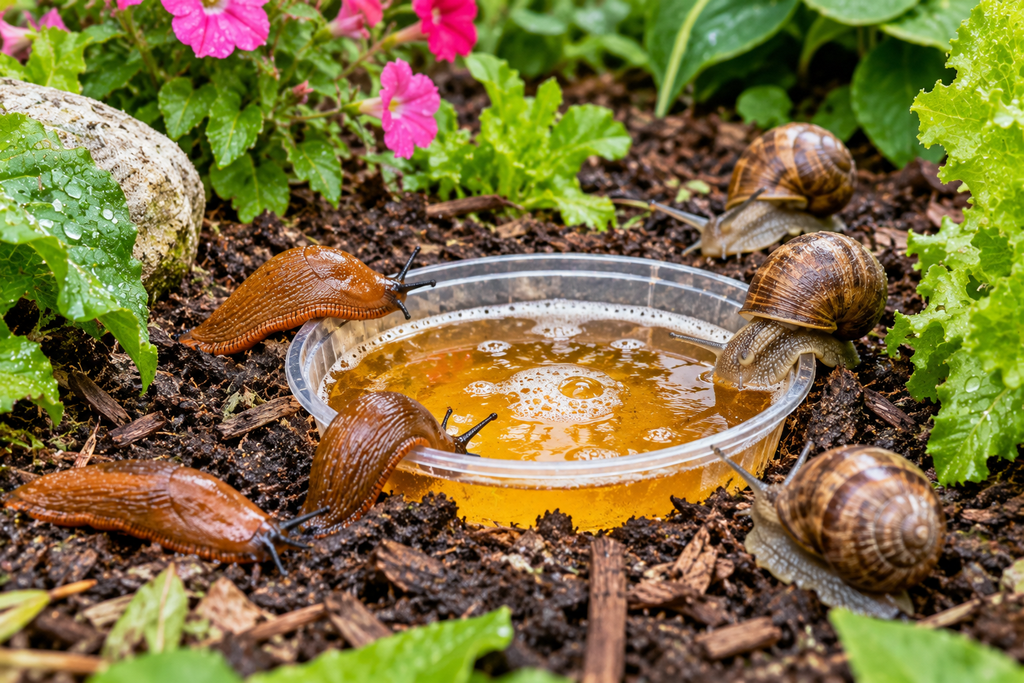
- Use a shallow container such as a yogurt cup, tuna can, or a purpose-made trap
- Sink it so the rim sits about an inch above the soil surface. A rim set flush with the ground can catch ground beetles, which are beneficial predators of slugs, so leaving a small lip helps them avoid falling in
- Fill it a third to half full with beer or a mixture of yeast, sugar, and water. The yeasty smell is the attractant, so the alcohol itself isn’t necessary
- Place several traps around the garden rather than one in a prized bed
- Empty and refill every day or two. Rain dilutes them and a full trap stops working
The limitations: Traps attract slugs from a distance, so one placed right next to your best plants can draw more of them in than would have come otherwise. Place them a few feet from the plants you want to protect, not beside them. Traps also kill only what falls in, and they catch relatively few snails. On their own, they rarely solve a large problem, but they work well as part of a combined approach, especially in a late-fall push to remove egg-laying adults.
Barriers: What Holds Up and What Doesn’t
A lot of garden advice recommends sprinkling things around plants. Most of it has weak support. Here’s how the common options compare.
| Barrier | How it’s meant to work | Realistic assessment |
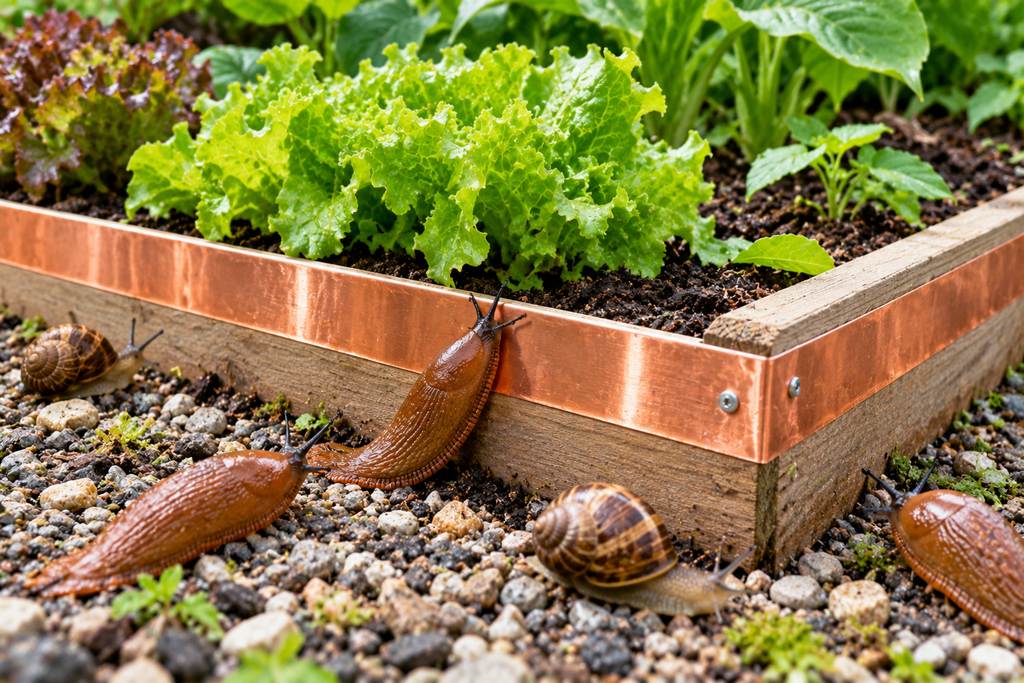
| Copper tape or bands | Contact with copper is believed to irritate slugs and snails, discouraging crossing | Can work on pots, raised beds, and tree trunks, but only if it’s wide enough, unbroken, free of soil or debris bridges, and not overhung by leaves. Evidence for effectiveness varies, and a few already-inside slugs defeat the whole barrier |
| Diatomaceous earth | Abrasive dust that damages the slug’s skin | Loses effectiveness when wet, which is most of fall. It must be reapplied after rain. It can also harm beneficial insects. Use only food-grade, never pool-grade, and avoid breathing the dust |
| Crushed eggshells | Sharp edges supposedly deter crossing | Controlled tests generally haven’t shown a reliable effect. They’re harmless, but not something to count on |
| Coffee grounds | Caffeine is reputed to repel or poison them | Research has found that caffeine solutions can affect slugs, but used grounds contain relatively little, and results in gardens are inconsistent. Heavy layers can also form a crust or affect soil |
| Gravel, grit, or bark chips | Rough or dry surface is uncomfortable to cross | Mixed results. Slugs are good at crossing most rough materials, but a dry, coarse, wide band may slow them. Fine gravel packed down offers almost no protection |
| Sawdust, ashes | Dry, abrasive | Both become useless when wet, and wood ash can change soil pH. Not recommended |
The pattern in this table is that barriers fail whenever they’re wet, narrow, or bridged. They work best in contained spaces (a single pot, a raised bed with a clean rim, a tree trunk) and worst around open garden beds, where slugs can arrive from any direction under a leaf or along a stem.
Copper tape around the rim of a container, with the area cleared of anything touching it, is the best-supported use of the group. For open beds, a combination of habitat control, trapping, and bait usually does more than any barrier.
One thing to skip entirely: salt. It does kill slugs, but it also damages soil and plants, builds up in the soil, and causes the animal a slow and distressing death. It’s not worth the garden damage.
Slug Baits: Iron Phosphate vs. Metaldehyde
When trapping and habitat control aren’t enough, baits are the most dependable option. The type matters.
Iron phosphate baits
Iron phosphate pellets are sold under several brand names and are approved for organic gardening in many regions (check for OMRI listing or your local equivalent if that matters to you). Slugs and snails that eat the pellets stop feeding and typically die within several days, usually hidden underground, so you may not see results right away.
How to use them well:
- Scatter thinly and evenly around the plants you want to protect, not in piles. A thin scatter is more effective and uses less product
- Apply in the evening when slugs are about to become active, ideally just before a mild, damp night
- Reapply as the label directs, especially after heavy rain, since moisture degrades the pellets
- Keep the pellets off plants and close to the soil, near paths and hiding places
- Store the container sealed and out of reach of children and pets
Cautions: Iron phosphate is generally considered lower risk to pets and wildlife than older baits, but “lower risk” isn’t the same as “safe to eat.” Large amounts eaten by a dog or other animal can still cause problems, and some formulations include added ingredients that can matter. Follow the label, and contact a veterinarian if a pet eats a significant amount. A few reports have raised concerns about effects on earthworms at heavy application rates, so thin scattering rather than heavy dosing is the sensible approach. If this matters for your situation, check the product label and your local extension guidance for current information.
Metaldehyde baits
Metaldehyde is highly toxic to dogs and cats, and it poses risks to wildlife. It has been restricted or banned for outdoor use in some countries. Even where it remains available, it isn’t a “natural” option and isn’t suited to a garden used by pets or children. If you have a bag of old slug pellets in a shed and aren’t sure what they contain, check the active ingredient before using them, and consider disposing of them through a local hazardous-waste program if they’re metaldehyde.
Natural Predators and Biological Control
A garden with a diverse population of predators will have fewer slug problems than a tidy one with none. You can encourage them without a lot of effort.
Ground beetles are among the most effective natural slug predators. They shelter under stones, logs, and dense low plantings, and they’re easy to kill accidentally with pesticides or by removing all cover. A small pile of stones or logs placed away from vulnerable beds gives them a home.
Toads, frogs, and garter snakes eat slugs. A shallow dish of water sunk into the ground or a small pond within the garden attracts amphibians. Leave a few undisturbed corners.
Birds eat slugs, snails, and especially eggs. Thrushes are known for cracking snail shells on stones. A bird bath and some shrub cover help, but don’t expect birds alone to manage a heavy infestation.
Ducks and chickens will eat slugs. Indian Runner ducks have a reputation for it, since they forage more gently than chickens and are less destructive to beds. But poultry bring their own problems (droppings, trampling, noise, and local rules on keeping them), so this is something to decide on its own merits and not purely for slug control.
Parasitic nematodes (Phasmarhabditis hermaphrodita) are microscopic worms that infect and kill slugs. They’re sold in some countries, notably the UK, for application with a watering can. They need moist soil and a minimum soil temperature that manufacturers specify, often around 5°C (41°F), so they’re better suited to early fall than to deep winter. Availability, registration, and how well they work on snails versus slugs vary by region, so check what’s actually sold where you are before planning around them.
Protecting What’s Still Growing
Fall isn’t only about reducing next year’s slugs. Many gardens still have vulnerable plants in the ground through autumn and winter: lettuce, kale, brassica seedlings, strawberries, newly planted perennials, and young transplants. These deserve more direct protection.
- Protect seedlings and transplants with collars. Cut plastic bottles into rings and push them a little into the soil around each plant. They work best when the soil inside is checked first, since a slug already inside defeats the point.
- Grow vulnerable plants in raised containers. A pot on a hard surface with copper tape around the rim and no overhanging foliage is far easier to defend than a bed.
- Space plants for airflow. Dense planting creates a damp microclimate that suits slugs. Where possible, leave gaps so surfaces dry between rains.
- Check hostas, in particular. Hostas are among the plants slugs target most, and the holes they leave remain all season. Clear leaf litter from the crowns after the foliage dies back, and look at the soil around them for eggs.
- Consider slug-resistant plants for problem spots. Slugs generally avoid plants with tough, hairy, strongly scented, or leathery foliage. Many gardeners find lavender, rosemary, sage, geraniums, ferns, and similar plants less damaged than soft-leaved hostas or lettuce, though no plant is truly immune, and a hungry slug will try almost anything. Regional extension lists are the best guide for what’s resistant where you live.
A Realistic Fall Schedule
Doing everything at once isn’t necessary. This sequence follows the order that gives the most benefit for the least time. Adjust the dates to your first frost.
Early fall (before the first frost):
Clear debris and pull back mulch. Lift and check pots, boards, and stones, and destroy any egg clusters. Fix irrigation timing. Set up beer traps and trap boards.
Mid-fall (through the main leaf drop):
Hand-pick on damp, mild evenings. Empty traps daily. Rake leaves off beds. Scatter iron phosphate bait thinly if numbers are high, repeating as the label states. Trim groundcover back from key beds.
Late fall (just before the ground freezes):
Lightly cultivate bare beds so eggs are exposed. Do a final check of walls, pot rims, and the base of structures for sheltering snails. Store pots upside down off the ground. Remove traps or keep checking them if the weather stays mild.
Winter (mild climates only):
Keep protecting winter crops and check regularly. Bait again if damage continues.
Early spring:
Repeat a quick check as soil warms and the first seedlings come up. This is when overlooked eggs hatch, and an early cleanup prevents a slow start from turning into a lost row of seedlings.
Mistakes That Undo the Work
A few common habits quietly keep the problem going:
- Controlling only what you can see. Slugs spend most of their time hidden, so a garden can look clear while the soil beneath mulch is full of them. The eggs are even less visible.
- Using every remedy at once, but only once. A single application of anything is rarely enough. Slug control is a repeated, overlapping effort, especially through wet weather.
- Leaving traps unattended. A full or dried-out trap, or a board never checked, becomes shelter instead of a control.
- Relying on barriers around an open bed. A broken or bridged barrier gives a false sense of protection.
- Putting bait where pets can reach it. Use bait stations or covered traps if animals share the garden.
- Leaving the perfect habitat right next to the best plants. If the lettuce bed sits against a damp, ivy-covered wall, no amount of bait will fully compensate.
When a Natural Approach Isn’t Enough
Most home gardens can reduce slug numbers significantly with habitat control, trapping, and iron phosphate bait. A few situations are more difficult:
- Very large plots, nurseries, or market gardens, where hand-picking is impractical
- Persistently wet sites with poor drainage
- Gardens next to woodland, streams, or large unmanaged areas that continually resupply slugs
In those cases, your local extension office or a professional horticulturist can suggest options that fit the site and local regulations. Be honest with yourself too about what counts as success. Eliminating every slug is unrealistic, and the goal is keeping numbers low enough that plants can outgrow the damage.
Questions Gardeners Often Ask
Can a hard freeze wipe out slugs and snails?
A hard freeze kills many exposed adults and can destroy eggs that are near the surface, but sheltered ones often survive. Slugs in mulch, under boards, or deep in soil crevices, and snails sealed in protected spots, may come through. A freeze helps, but it isn’t a substitute for clearing shelter.
Will slug bait harm my dog or cat?
It depends on the active ingredient. Metaldehyde is highly toxic to dogs and cats and should be avoided around pets. Iron phosphate is generally considered lower risk, but it’s still not food, and a large amount eaten can cause problems. Follow the label, store it securely, and call a veterinarian or poison helpline if a pet eats any.
Do coffee grounds and eggshells keep slugs away?
Not reliably. There is some research on caffeine and slugs, but spent grounds contain little, and garden results are inconsistent. Eggshells haven’t shown a dependable effect in controlled testing. They won’t hurt the garden, but they shouldn’t be your main defense.
Are all slugs harmful to the garden?
No. Some species feed on decaying material, fungi, or other slugs and cause little or no damage. If you find slugs on rotting leaves or compost and no damage appears on living plants, they may not need controlling. Native species in some regions, such as banana slugs on the Pacific coast of North America, are generally not garden pests.
How long do slug baits last in rain?
Iron phosphate pellets break down when wet, but many brands are formulated to resist weathering for a period of days. The label gives the product’s reapplication interval, and heavy or repeated rain will shorten it.
Key Takeaways
The most effective natural slug control in fall comes from shelter and timing, not from any single product. Remove the leaf litter, damp boards, pots, and thick mulch that give them cover. Hunt adults at night during the weeks they’re laying eggs. Scrape out any egg clusters you find, and expose the soil in late fall in cold climates. Add traps and, if the problem warrants, thinly scattered iron phosphate bait. Avoid metaldehyde around pets, skip the salt, and don’t expect eggshells or coffee grounds to hold the line.
If you only have an afternoon, spend it lifting everything that’s sitting on the ground in and around your beds. That one task finds most of the eggs and removes most of their winter hiding places.

About Syprose Kiche
Syprose Kiche is the creator and writer behind My Besuited Home, a practical home and garden website covering DIY projects, gardening, lawn care, landscaping, home improvement, and outdoor living. She focuses on turning everyday homeowner questions into clear, practical guides backed by careful research and useful real-world considerations.