
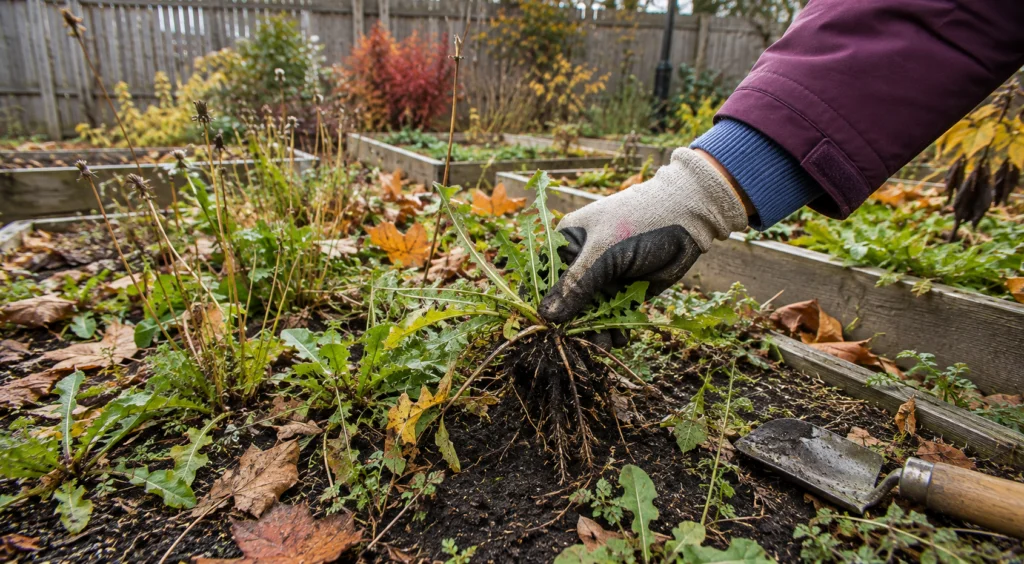
By late September, a lawn that looked reasonably clean all summer can start showing patches of low, spreading growth that clearly isn’t grass. Small round leaves hugging the soil. A rosette of leaves flattening out in a bare spot near the driveway. Something purple-flowered creeping along the edge of a flower bed. It’s a common pattern, and it catches a lot of homeowners off guard, because it seems backwards — shouldn’t weeds be a summer problem, when everything is growing fastest?
Fall isn’t a random time for weeds to show up. It’s one of the two most active germination windows of the year for a specific group of plants, and several things are happening in the lawn at once that make this the moment those weeds get their foothold.
Cool-Season Weeds Are Doing Exactly What They’re Built to Do
Most of what shows up in a lawn in September and October falls into a category called winter annuals. These are plants that germinate in fall, spend the cooler months as low rosettes or creeping mats, and then flower and set seed in spring before dying back as temperatures rise. Chickweed, henbit, purple deadnettle, and common speedwell all follow this pattern. Their seeds sit dormant through the heat of summer, waiting for soil temperatures to drop into a specific range — generally somewhere in the 50s to low 60s Fahrenheit — before they germinate.
That’s the piece a lot of people miss. Summer heat doesn’t suppress these weeds; it’s the condition they’re designed to wait out. The seeds were likely in the soil the entire summer, dropped by the previous year’s plants before they died. Once nights start cooling and the soil follows, germination begins, often before most homeowners have even switched their mowing schedule for the season.
Dandelions and plantain work differently. Both are perennials, meaning the plant that flowered last spring didn’t actually die — it’s been present in the lawn the whole time, just less visible when the surrounding grass was thick and actively growing. As turfgrass slows its growth in response to shorter days and cooler temperatures, these established weeds, which tolerate a wider range of conditions, don’t slow down nearly as much. They become more visually dominant not because they’re spreading faster, but because the grass around them is doing less to hide them.
The Lawn Itself Is Working Against Itself Right Now
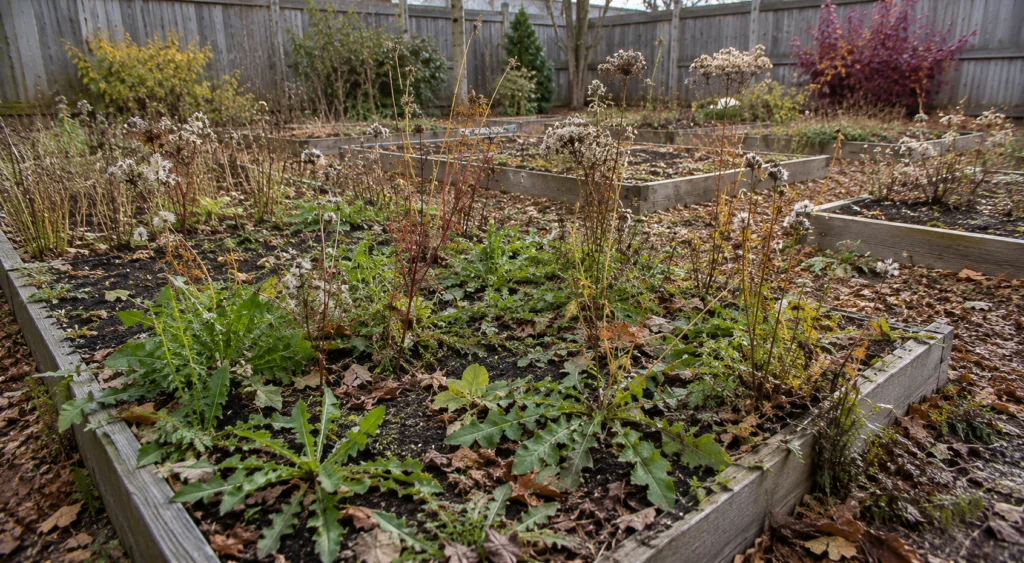
There’s a second factor that compounds the seasonal germination window: most lawns are thinner in early fall than they were in spring, and that thinning creates exactly the kind of opening winter annual weeds need.
Summer heat and, in many regions, several weeks of limited rainfall put cool-season turfgrasses like Kentucky bluegrass, fescue, and perennial ryegrass under real stress. Grass doesn’t necessarily die outright from this, but blade density drops, and the canopy that would normally shade the soil surface thins out. Weed seeds need light to germinate — for many species, direct sunlight hitting bare soil is the trigger that breaks dormancy. A lawn with a full, dense canopy shades out a large percentage of the seed bank simply by blocking that light. A lawn thinned by summer stress doesn’t offer that protection anymore, right at the point when the temperature trigger for germination is also being met.
This is why the two problems tend to show up together: visibly thinner turf and a new flush of weeds in the same weeks. It’s not a coincidence, and it’s not really two separate problems — it’s one condition (a stressed, open canopy) meeting one opportunity (a seed bank ready to germinate).
Mowing height plays into this too. Lawns mowed short through summer — shorter than about 2.5 to 3 inches for most cool-season grasses — lose canopy density faster under heat stress than lawns kept slightly taller, because there’s less leaf area to support the plant through dry spells. If mowing height dropped over the summer, even without anyone intending it as a change in practice, that alone can account for a meaningfully thinner lawn heading into the fall germination window.
Confirming What’s Actually Growing Before Doing Anything Else
Before deciding on a treatment, it’s worth taking a few minutes to actually identify what’s come up, because the right response depends heavily on whether you’re dealing with a winter annual, a perennial, or something that was simply overlooked earlier in the year.
A few identification points that matter for fall lawn weeds specifically:
Chickweed forms a low, dense mat with small, oval leaves in opposite pairs along thin stems, and tiny white star-shaped flowers with five deeply split petals that can look like ten. It roots at the nodes where stems touch soil, which is part of why it spreads into a mat so quickly once established.
Henbit and purple deadnettle are closely related and often confused for each other. Both have square stems (a mint-family trait) and grow upright rather than mat-forming, with purple-pink flowers. Henbit’s upper leaves clasp the stem directly; purple deadnettle’s leaves have short stalks and tend to have a purplish tinge, especially near the top of the plant.
Common speedwell has small round-to-oval leaves and produces small blue flowers with darker stripes on the petals. It can be low-growing and mat-forming, similar to chickweed, but the flower color and shape are distinct once you look closely.
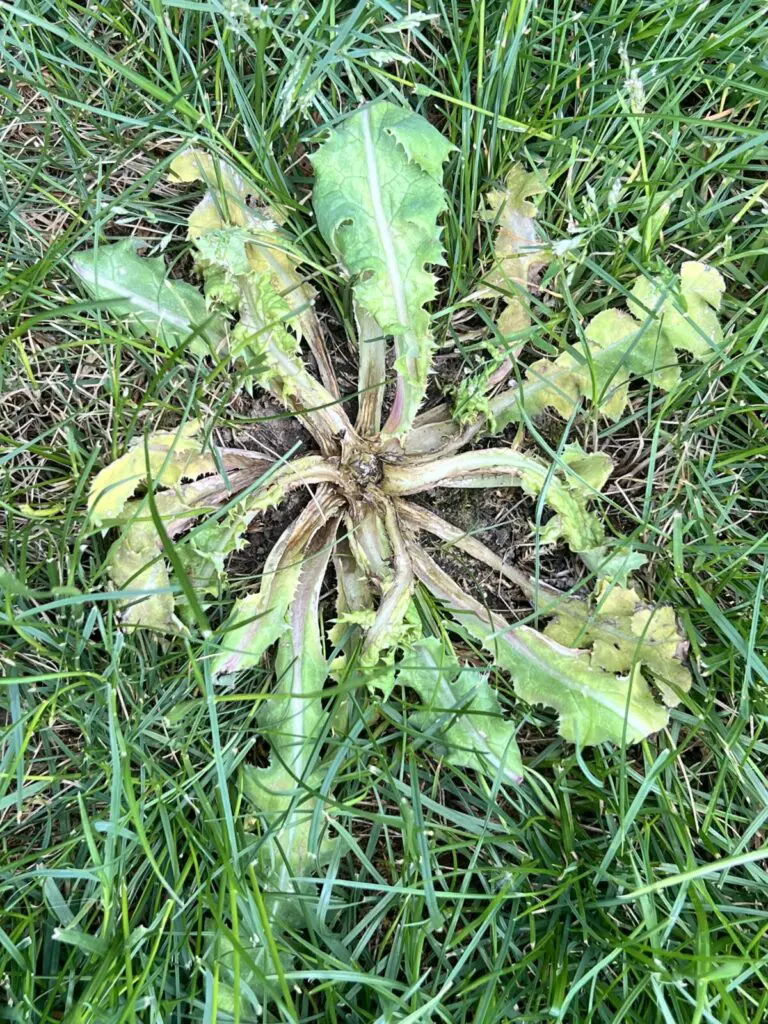
Dandelion is identifiable by its deeply toothed leaves in a basal rosette and, in fall, is usually not flowering — the yellow flower and puffball seed head are mainly a spring event. In fall, what you’re most likely seeing is the leaf rosette itself, flat against the ground.
Plantain — broadleaf plantain has wide, oval leaves with prominent parallel veins running the length of the leaf; buckhorn plantain has narrower, more lance-shaped leaves. Both grow as a basal rosette and tend to concentrate in compacted areas — along walkways, near gates, in high-traffic sections of the yard.
Clover is often lumped in with true weeds, but it’s worth a separate mention because a lot of homeowners aren’t sure whether it counts as a problem at all. It has the familiar three-leaflet (occasionally four) leaf pattern and small white or pink rounded flower clusters, and it spreads by both seed and creeping stems that root as they go. Fall clover growth is usually existing patches becoming more visible as grass thins, similar to dandelion, rather than a new fall germination event.
Annual bluegrass (Poa annua) deserves its own mention because it’s frequently mistaken for desirable turfgrass rather than identified as a weed at all, which is part of why it spreads unchecked in a lot of lawns. It’s a light, bright green — noticeably lighter than most desirable cool-season turfgrasses — with a boat-shaped leaf tip and a tendency to form clumps rather than blending evenly into the surrounding grass. It germinates on the same cool soil-temperature trigger as chickweed and henbit, often in the same weeks, and it’s one of the more persistent problems in lawn care because a large fall pre-emergent industry exists specifically around preventing it, yet it still shows up almost everywhere turfgrass is grown. Once established, annual bluegrass is genuinely difficult to control selectively, because it’s a grass being grown among other grasses, which rules out most broadleaf herbicides entirely; control generally depends on pre-emergent prevention timed to the same fall window discussed below, or, for small patches, physical removal.
If what’s showing up doesn’t match any of these, a photo submitted to a local extension office (most state land-grant universities offer this, often for free or a nominal fee) is a more reliable path than guessing, particularly before applying any herbicide. Misidentifying a weed can lead to using a product that doesn’t work on it, or in some cases, one that damages nearby plants unnecessarily.
What Actually Works, Depending on What You’re Dealing With
For Winter Annuals Already Visible (Chickweed, Henbit, Speedwell)
Once these are up and visible, a pre-emergent herbicide is no longer useful — pre-emergents work by preventing seeds from germinating, not by killing plants that have already sprouted. At this stage, the options are a post-emergent broadleaf herbicide labeled for the specific weed, or manual removal.
For small infestations — a patch or two rather than a lawn-wide problem — hand-pulling is often the more practical choice. These are shallow-rooted annuals, and pulling them, especially after rain or watering when the soil is soft, tends to remove the whole plant including the root system without much difficulty. The trade-off is time: pulling a lawn-wide chickweed infestation by hand is realistic for a few hundred square feet, not for half an acre.
For larger areas, a post-emergent broadleaf herbicide containing active ingredients like 2,4-D, dicamba, or triclopyr (often sold in three-way combination products) will control these species when applied according to label directions. Fall application has one practical advantage: broadleaf herbicides are generally more effective on actively growing, cool-weather annuals than they are during summer heat, when some products’ effectiveness drops and off-target drift risk to nearby plants increases with higher temperatures.
The important caveat, and one that trips up a lot of people doing fall lawn care at the same time as weed control: most broadleaf herbicides are not safe to apply within several weeks of overseeding, and many can’t be applied to newly germinated grass seedlings at all without killing them along with the weeds. If overseeding is part of the fall plan, the herbicide application needs to happen either well before seeding (check the specific product label — the waiting period varies, but four weeks before seeding is a common minimum) or well after the new grass has been mowed several times and is established, which for cool-season grass is typically six to eight weeks after germination. Applying broadleaf herbicide and grass seed close together in timing is one of the most common and most costly mistakes in fall lawn programs, because it can undo the investment in overseeding entirely.
For Perennials Already Established (Dandelion, Plantain)
These don’t respond well to simple pulling unless the entire taproot comes out. Dandelion and plantain both have deep taproots capable of regenerating a new plant from root fragments left in the soil, so a quick yank that snaps the top off the root usually results in regrowth within a few weeks.
A long-handled weeding tool designed to extract taproots — sometimes called a dandelion weeder or asparagus knife — gets under the crown and lifts the root with less soil disturbance than digging with a trowel, and it’s a reasonable option for scattered individual plants. For denser perennial weed populations, a systemic post-emergent herbicide (the same broadleaf products mentioned above) is more reliable, because it’s translocated down into the root system rather than just killing the visible leaves.
Fall is actually a favorable time to treat perennial broadleaf weeds with herbicide, arguably more effective than a spring application. As these plants prepare for dormancy, they’re moving sugars down into the root system to store energy for winter — and a systemic herbicide applied to the leaves during this period gets carried down into the roots along with those sugars, improving kill rates compared to a summer application when the plant’s energy flow is moving the other direction.
Fall Pre-Emergent: A Different Tool for a Different Timing Window
There’s a separate strategy worth understanding, distinct from treating what’s already up: applying a pre-emergent herbicide in late summer or very early fall, before winter annual weed seeds germinate, to prevent the flush from happening at all next year.
This is a different timing than the more commonly discussed spring pre-emergent application for crabgrass, which targets a summer annual and needs to go down before soil temperatures warm in spring. A fall pre-emergent for winter annuals like chickweed and henbit needs to go down before soil temperatures drop into their germination range — meaning it has to be applied before the weeds you’re currently seeing would have come up in the first place. If chickweed is already visible in the yard, a fall pre-emergent application this year is too late for this season’s flush; it becomes relevant as a preventive step for late summer of next year.
This distinction matters because pre-emergent herbicides are one of the most commonly mistimed lawn treatments. Applying one after weeds have already germinated does nothing for the weeds present and wastes the product. Applying one too far in advance of germination can mean the herbicide’s effective window has already passed by the time soil temperatures actually trigger germination, depending on the specific product’s residual activity length.
Pre-emergents also create the same overseeding conflict as broadleaf herbicides, but in a more absolute way — pre-emergent products work by preventing seed germination in general, which means they will prevent grass seed from germinating too. A lawn pre-treated with pre-emergent generally cannot be successfully overseeded for a period ranging from several weeks to several months, depending on the specific product. If overseeding and weed prevention are both goals for the same season, they typically need to be sequenced rather than combined, and reading the specific product label for its overseeding restriction is necessary rather than optional.
There’s also a non-synthetic option some homeowners prefer: corn gluten meal, applied as a pre-emergent, works by suppressing root development in newly germinating seeds rather than through a synthetic chemical mechanism. It’s a legitimate option for people avoiding synthetic herbicides, but it comes with two practical limitations worth knowing before relying on it. First, it’s meaningfully less effective than synthetic pre-emergents in most independent trials, so it’s better suited to a lawn with a light-to-moderate weed pressure than a heavily infested one. Second, because it works by suppressing any germinating seed, it carries the identical overseeding conflict as synthetic pre-emergents — it will suppress new grass seed just as readily as weed seed.
Timing also isn’t identical everywhere. In warmer transition-zone and southern climates, soil temperatures may not drop into the germination range for winter annuals until well into October or even November, which pushes both the ideal pre-emergent application window and the period when hand-pulling or post-emergent treatment makes sense correspondingly later. In colder northern climates, that same soil-temperature threshold can be reached by early September, meaning the entire fall weed season — germination, active growth, and the closing window for treatment before the ground freezes — happens on a noticeably compressed schedule. A specific calendar date is less useful here than tracking regional soil temperature; several university extension services and agricultural weather networks publish soil temperature maps updated through the season, and these are a more reliable guide to timing than a generic date range.
Why “Just Wait for Frost” Isn’t a Complete Answer
A common assumption is that a hard frost will kill fall weeds and solve the problem without intervention. This is only partly true, and relying on it can be misleading.
A hard freeze will kill many actively growing winter annual seedlings, particularly younger, less-established ones, which is part of why late-germinating chickweed and henbit sometimes seem to disappear in early winter in colder climates. But established winter annuals, especially plants that germinated early in fall and have had weeks to develop a deeper root system, often survive winter as a low rosette, becoming dormant rather than dying, and resuming growth as temperatures rise in late winter or early spring — which is when they flower and set the next generation of seed. In milder climates, many winter annuals don’t experience a hard enough freeze to be affected at all and simply continue growing through winter at a slower pace.
Perennial weeds like dandelion and plantain aren’t meaningfully affected by frost in terms of long-term control — the above-ground leaves may die back in colder climates, but the root system, which is where the plant persists, is unaffected by a single freeze event.
The practical implication is that “waiting it out” mainly works, and only partially, for late-germinating annual weeds in climates with a genuinely hard winter freeze. It’s not a reliable strategy for anything already well-established by the time frost arrives, and it does nothing for perennials.
A Few Mistakes Worth Naming Directly
Treating the weeds while ignoring the thin turf. Removing or killing the current weeds without addressing the canopy gap that let them germinate in the first place tends to produce a repeat problem, because the same bare, sunlit soil is still there, still holding a seed bank, still waiting for the next germination trigger. Overseeding those thin areas — timed correctly relative to any herbicide use, as covered above — closes the opening that weeds are exploiting.
Applying herbicide right before or right after seeding without checking labels. This has already been covered above, but it’s worth repeating because it’s the single most common timing error in fall lawn programs and the one with the most costly consequence — losing a season’s worth of overseeding investment.
Assuming a single herbicide application solves a perennial infestation. Dandelion and plantain, particularly larger, more established plants, sometimes need a second application several weeks after the first, because a portion of the root system can survive an initial treatment. This isn’t a sign the product failed; it’s a normal part of managing an established perennial with a deep taproot.
Mowing too short heading into fall. Cutting a cool-season lawn down to a very short height in early fall, sometimes done in the mistaken belief that it prepares the lawn for winter, removes leaf area the plant needs to recover from summer stress and opens more soil surface to light — working directly against weed prevention rather than for it. Most cool-season turfgrasses do better maintained in the 2.5 to 3.5 inch range through fall.
Watering shallow and often instead of deep and infrequent. Frequent light watering keeps the top inch or so of soil consistently moist, which is precisely the condition many weed seeds need to germinate, while doing comparatively little to encourage grass roots to grow deeper in search of moisture. Watering less often but more deeply — enough to moisten several inches of soil, then allowing the surface to dry out somewhat before the next watering — favors established turfgrass root systems over shallow-germinating weed seeds, and is generally the better practice for fall lawn recovery regardless of the weed question.
When the Problem Points to Something Beyond Weed Control
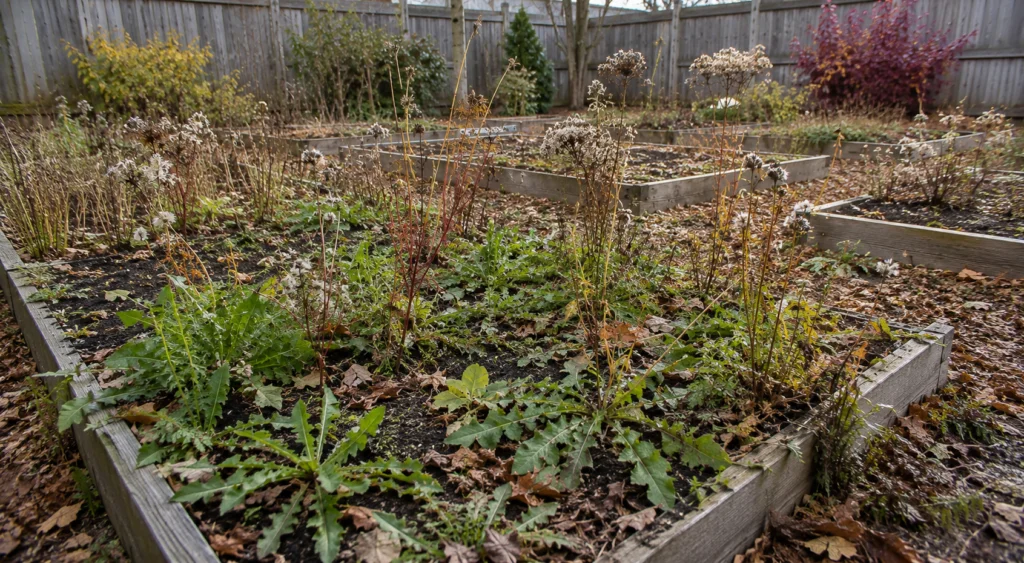
Occasionally, a fall weed flush is a symptom of an underlying lawn condition rather than a standalone problem. A few situations where it’s worth looking past the weeds themselves:
If the weeds are concentrated specifically in areas with heavy foot traffic, compacted soil is a likely contributing factor, since compaction restricts grass root growth while tolerant weeds like plantain and knotweed handle compacted soil more easily. Core aeration in fall, which physically relieves compaction, addresses this more directly than any herbicide will.
If the lawn shows a consistent pattern of thinning in the same areas every year regardless of weed treatment, drainage, shade, or soil pH may be limiting the turfgrass in ways that keep giving weeds an opening. A soil test, available through most extension offices for a modest fee, can identify a pH or nutrient issue that’s suppressing grass growth without being visually obvious.
If an infestation covers a large percentage of the total lawn area, involves a weed species that’s difficult to identify with confidence, or hasn’t responded to a properly timed and applied herbicide treatment, bringing in a licensed lawn care professional is a reasonable next step rather than repeatedly trying different products. This is particularly worth considering before using any herbicide near edible plants, wells, or waterways, where label restrictions and local regulations may apply and where a misapplication carries more consequence than in an ordinary lawn area.
A Few Questions Worth Answering Directly
Should weeds be pulled or treated before overseeding, or after? Generally before, with enough lead time for any herbicide used to clear the soil per its label instructions — commonly a few weeks, though this varies by product. Overseeding into an actively weedy, untreated area means the new grass is competing with established weeds for light, water, and space from day one, which puts it at a disadvantage.
Is it too late in fall to do anything about weeds? For hand-pulling annuals or spot-treating perennials with a post-emergent herbicide, most regions have a workable window until several weeks before the ground freezes, since these methods work on already-growing plants rather than depending on a germination-timing window. What does close out is the fall pre-emergent application window, since that needs to happen before germination, not after.
Will treating the weeds now stop them from coming back next fall? Only partially. Killing or removing the current plants addresses this year’s growth, but the seed bank in the soil, and any perennial roots not fully removed, remain. A fall pre-emergent applied at the correct time next late summer, combined with maintaining a dense, properly mowed lawn that shades out germinating seeds, is what actually reduces next year’s flush — treating this year’s weeds alone does not.
If there’s one takeaway to act on this week, it’s to identify what’s actually growing before reaching for a product, since the right response — hand-pulling, targeted post-emergent herbicide, or simply overseeding the bare patch it came up in — depends entirely on whether it’s a shallow-rooted annual or an established perennial with a root system built to survive a quick pull.

About Syprose Kiche
Syprose Kiche is the creator and writer behind My Besuited Home, a practical home and garden website covering DIY projects, gardening, lawn care, landscaping, home improvement, and outdoor living. She focuses on turning everyday homeowner questions into clear, practical guides backed by careful research and useful real-world considerations.