
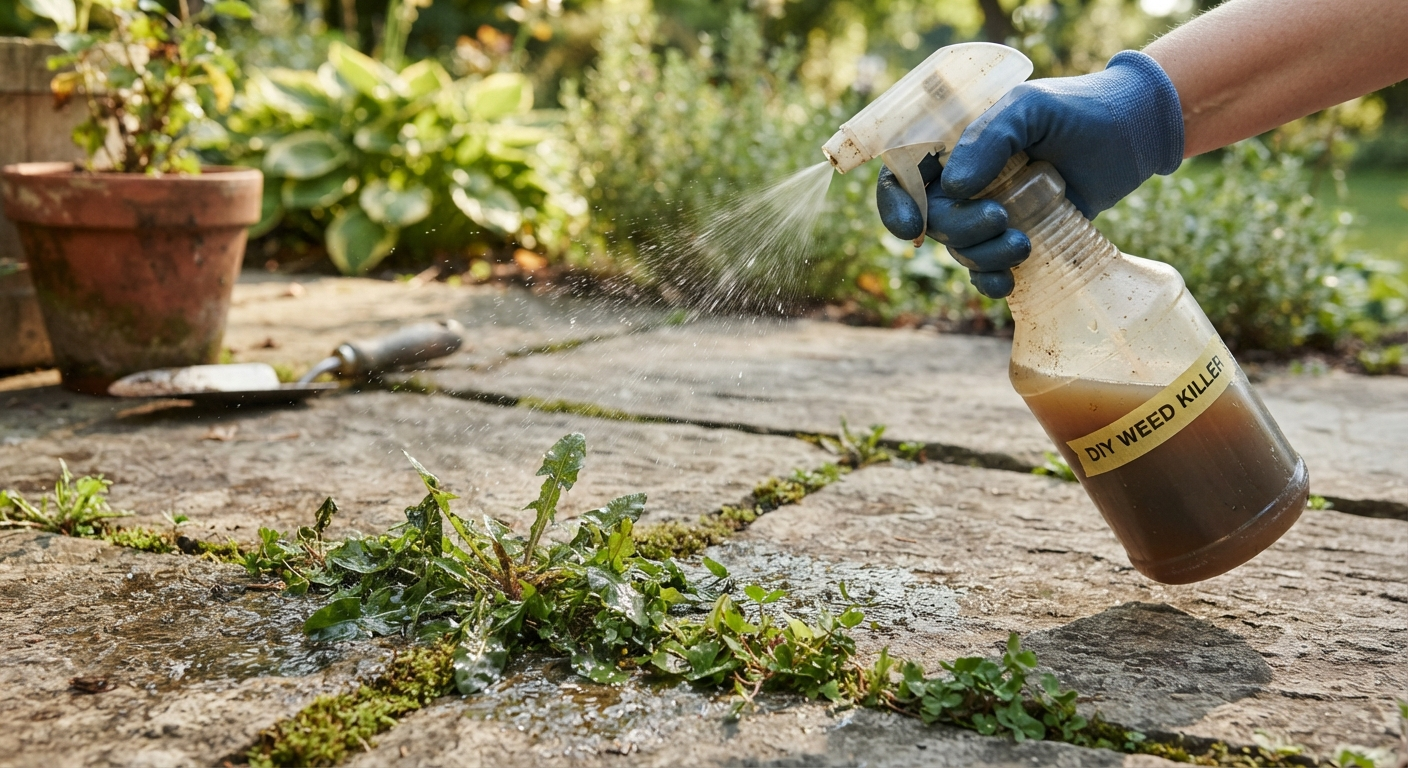
You mixed up a batch of vinegar weed killer, sprayed it on that crack in the driveway with the dandelion you’ve been fighting all summer, and came back three days later to find… nothing happened. Maybe the leaves wilted a little, looked sad for an afternoon, then bounced right back like they were mocking you.
I’ve been gardening for over a decade, and vinegar weed killer is one of those things that sounds foolproof on Pinterest and then absolutely humbles you in real life. Everyone shares the same “just spray vinegar on it” advice, but almost nobody tells you about the ten ways that advice can go sideways.
My neighbor once dumped an entire gallon of the cheap stuff from her pantry onto a patch of creeping Charlie and wondered why her tomatoes three feet away turned into crispy brown sticks the next week. That’s the kind of mistake I want to help you skip. Let’s get into what actually goes wrong.
Mistake #1: Using Regular 5% Grocery Store Vinegar
This is the big one, and it trips up almost every beginner. The vinegar sitting in your kitchen cabinet is about 5% acetic acid. That’s the same stuff you use for pickling cucumbers, and it’s simply too weak to kill established weeds.
I sprayed my first batch of “weed killer” straight from a bottle of Heinz white vinegar back when I was renting my first house with a yard. The weeds looked a little wilted for a day, then perked right back up like nothing happened. I felt like an idiot standing there with an empty spray bottle and a driveway full of unbothered crabgrass.
Horticultural vinegar, on the other hand, runs anywhere from 20% to 30% acetic acid. That’s strong enough to actually burn through plant cell walls and cause real damage. You can find it at garden centers, farm supply stores, or online, and it’s usually labeled specifically as “horticultural vinegar” or “weed killer vinegar” so you’re not guessing.
Quick side note: higher concentration doesn’t mean you should go overboard. This stuff is genuinely dangerous to skin and eyes at 20-30%, so treat it with the same respect you’d give any strong acid, gloves and eye protection included.
Mistake #2: Spraying Right Before Rain
I get it. You see a sunny window in the forecast, you rush outside, spray your weeds, and feel accomplished. Then two hours later the sky opens up and washes everything you just did straight into the soil.
Vinegar needs contact time to work. It’s a contact herbicide, meaning it has to sit on the leaf surface and actually burn through the waxy cuticle before it can do any damage to the plant underneath. Rain within a few hours of application basically resets the whole process.
I check the forecast obsessively now before I spray anything, and I aim for at least 24 hours of dry weather afterward. Morning dew counts against you too, so I wait until the leaves are completely dry before I start, usually mid-morning once the sun has burned off any overnight moisture.
If you’re someone who forgets to check the weather (no judgment, we’ve all done it), set a reminder on your phone the night before. It sounds excessive for something as simple as spraying weeds, but one wasted application means you’re back to square one, and vinegar isn’t exactly free.
Mistake #3: Skipping the Dish Soap
Plant leaves have a waxy outer layer that’s designed to repel water, which is exactly why plain vinegar tends to bead up and roll right off instead of sticking around long enough to do damage. Without something to break that surface tension, you’re basically watering your weeds instead of killing them.
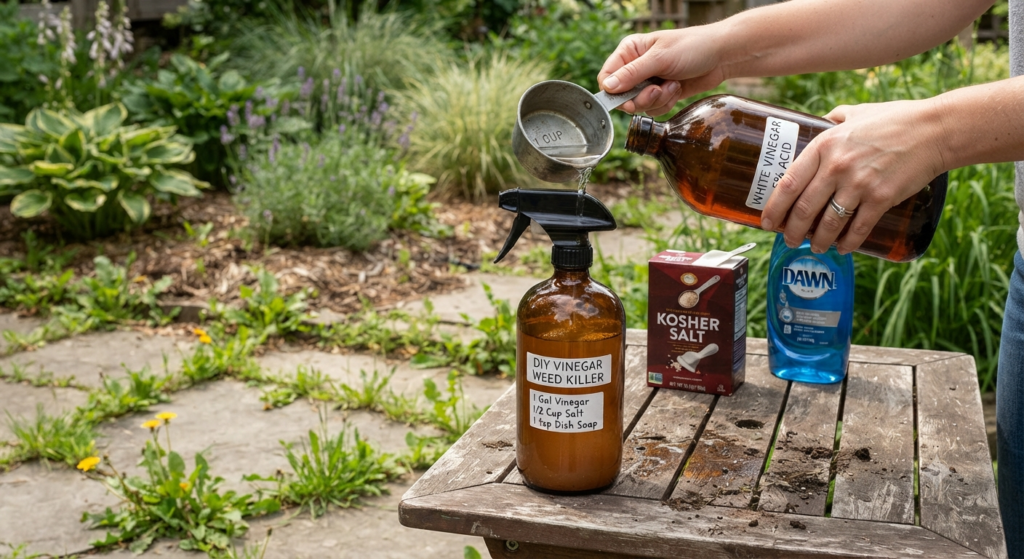
A few drops of plain dish soap, something like Dawn, acts as a surfactant that helps the vinegar spread out and cling to the leaf surface instead of sliding off. I use about one teaspoon of dish soap per quart of vinegar solution, and the difference in results is honestly night and day.
The first summer I tried vinegar weed killer, I skipped this step entirely because I didn’t understand why a gardening spray needed dish soap in it. My results were inconsistent at best. Some weeds died, others barely reacted, and I couldn’t figure out why until another gardener at my local nursery mentioned the surfactant trick.
Avoid scented or moisturizing dish soaps if you can help it. The extra additives in fancy soaps can sometimes interfere with how the solution performs, so stick with a basic, no-frills formula.
Mistake #4: Expecting One Spray to Kill Deep-Rooted Perennials
Vinegar is a foliar herbicide, which means it only damages the parts of the plant it touches directly. For young annual weeds with shallow roots, that’s often enough to kill the whole plant. For established perennials like dandelions, bindweed, or Canada thistle, you’re only burning the top growth while the root system underground shrugs it off completely.
I sprayed a patch of dandelions in my front yard three years running, convinced I was winning the battle each time the leaves turned brown and crispy. Every single time, new growth popped back up from the same root within two to three weeks. It wasn’t until I actually dug one up that I realized the root was still perfectly healthy, just waiting for another shot at sunlight.
For anything with a taproot or an extensive root system, vinegar is more of a management tool than a permanent solution. You’re weakening the plant over repeated applications, not eliminating it in one shot. Combining vinegar treatment with manual digging or a root-specific tool tends to get you much further than spray alone.
If you’re dealing with something like bindweed that spreads through underground rhizomes, honestly, vinegar alone is going to frustrate you. It might knock back visible growth, but the plant will keep sending up new shoots from parts of the root system you didn’t even know existed.
Mistake #5: Spraying on a Windy Day
This one cost me a row of prized hostas, and I still feel a little sick thinking about it. I was spraying dandelions near my garden bed on what I thought was a calm afternoon, and a gust of wind carried the mist right onto my hostas. Within two days, the edges of every leaf had gone brown and crispy.
Vinegar doesn’t care what kind of plant it lands on. It’s not selective like some commercial herbicides that target specific plant types. If the spray drifts onto your tomatoes, your roses, or your neighbor’s prize-winning hydrangeas, it’s going to cause damage there too.
I now spray only on still mornings, and I mean genuinely still, not just “a light breeze that probably won’t matter.” Even a gentle wind can carry fine mist several feet, and vinegar spray tends to drift more than you’d expect because the droplets are so light.
For weeds growing close to plants you actually want to keep, consider using a piece of cardboard or a plastic shield to block overspray while you work. It feels like overkill until the one time it saves your favorite rose bush from an untimely death.
Mistake #6: Treating Gravel Driveways and Patios Like a One-and-Done Fix
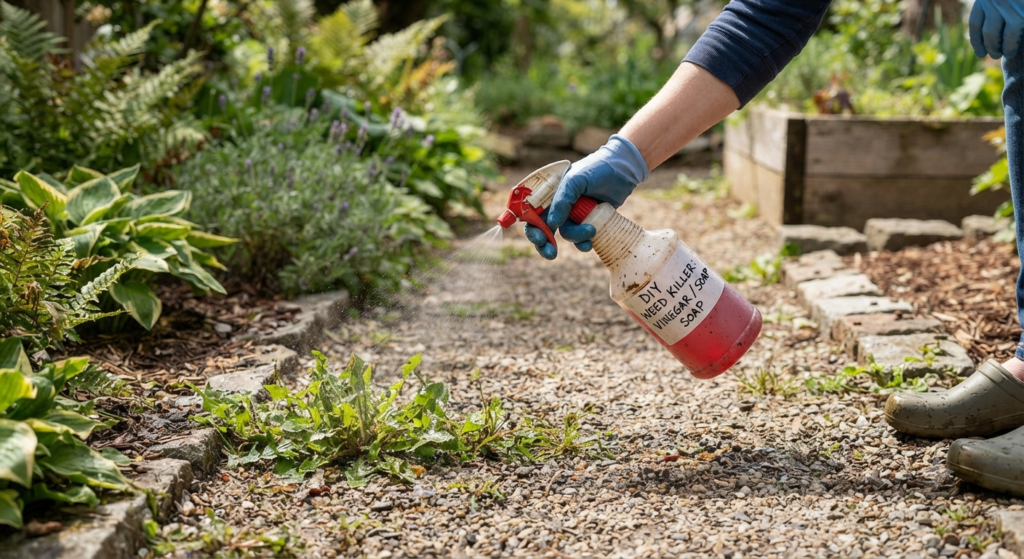
If you’ve got weeds pushing up through gravel or between patio pavers, vinegar can absolutely help, but it’s not the permanent solution a lot of people expect it to be. New weed seeds blow in constantly, and gravel areas are basically a welcome mat for opportunistic seedlings looking for a foothold.
I treat my gravel walkway every two to three weeks during peak growing season, not because vinegar doesn’t work, but because new weeds keep germinating in that same space. Anyone expecting a single spray to keep gravel weed-free all summer is going to be disappointed.
For a longer-lasting result, I’ve started combining vinegar sprays with a layer of landscape fabric underneath fresh gravel whenever I redo a section. That physical barrier cuts down dramatically on how often I need to spray, since fewer seeds ever make contact with the soil underneath.
Bonus side note: vinegar breaks down pretty quickly in the environment, which is genuinely one of its biggest selling points over synthetic herbicides. But that same quick breakdown means it doesn’t leave behind any residual weed prevention, unlike some chemical options that create a barrier in the soil for weeks.
Mistake #7: Spraying During the Hottest Part of the Day
You’d think blasting weeds with vinegar under full, blazing sun would speed things along, but extreme heat can actually cause the solution to evaporate off the leaf surface before it has enough time to work its way in. That leaves you with a weaker application than you intended.
On the flip side, vinegar does actually work best on hot, sunny days generally speaking, just not during the absolute peak heat of midday. I’ve had my best results spraying between 10 a.m. and 2 p.m. on a day forecasted to hit at least 75 degrees, when the sun is strong enough to help the acid do its job but not so brutal that the solution flash-dries before it can penetrate.
I made the mistake early on of spraying at 6 a.m. because that’s when I had free time before work. The morning dew diluted my solution, and the cooler temperatures meant the vinegar just didn’t perform the way it does on a proper warm afternoon.
Cloudy, cool days are the worst possible timing. Vinegar is essentially inactive without sunlight and heat to help it break down the leaf’s protective cuticle, so if your forecast looks gray and mild, it’s genuinely worth waiting for better conditions instead of wasting a batch.
Mistake #8: Not Reapplying Often Enough
A lot of people spray once, see brown wilted leaves within a day, and assume the job is finished. Brown leaves mean the top growth is damaged, not that the entire plant, roots included, is dead. This is especially true for anything beyond young annual weeds.
I check back on treated areas every five to seven days now. If I see any green regrowth peeking through, even a tiny bit, I hit it again immediately before it has a chance to rebuild strength through photosynthesis. Letting regrowth sit untreated for too long basically undoes your progress and lets the plant recover.
For particularly stubborn weeds, I’ve found that three to four applications spaced about a week apart does far more than one heavy-handed spray ever could. It’s tedious, I won’t pretend otherwise, but it’s genuinely more effective than dumping a gallon of vinegar on something once and walking away frustrated when it grows back.
Keep a little notebook or a note on your phone tracking which areas you’ve sprayed and when. It sounds excessive for weed control, but when you’re managing multiple garden beds, a gravel path, and cracks in the sidewalk all at once, it’s shockingly easy to lose track of what’s been treated recently.
Mistake #9: Ignoring the Soil pH Impact of Repeated Use
Here’s something almost nobody mentions: vinegar is acidic, and repeated heavy applications to the same patch of soil over months or years can actually shift the pH of that soil over time. For most weed patches in gravel or pavement cracks, this barely matters. For soil beds near your vegetable garden, it absolutely can.
I once treated a border area right next to my raised beds so aggressively over one growing season that the soil there tested noticeably more acidic the following spring. Nothing I planted in that exact strip grew well until I amended it with lime to bring the pH back into a reasonable range.
If you’re spraying vinegar anywhere near garden soil you actually intend to plant in later, it’s worth testing your soil pH occasionally, especially after a season of frequent treatments. A basic soil test kit from any garden center will tell you where you stand, and it takes ten minutes.
This isn’t a reason to avoid vinegar entirely. It’s just a reason to be a little more thoughtful about where and how often you’re spraying it, especially in areas that border productive planting space rather than purely decorative gravel or pavement.
Mistake #10: Forgetting About Personal Protective Gear
Horticultural-strength vinegar at 20-30% acetic acid is not the same gentle stuff sitting in your salad dressing. It can cause real chemical burns on skin and serious damage if it splashes into your eyes. I’ve talked to more than one gardener who treated it casually because “it’s just vinegar” and ended up with a nasty skin reaction to show for it.
I always wear rubber gloves, safety glasses, and closed-toe shoes when I’m mixing or spraying anything above 10% concentration. It might feel like overkill for something you can buy at a farm supply store without so much as a warning label conversation, but the concentration makes all the difference compared to what’s in your pantry.
Keep it away from pets and kids until the solution has fully dried on the treated surface, generally a few hours depending on sun and heat. I keep my dog inside on spray days until everything’s dried and set, just to be safe, since curious noses and paws have a way of finding freshly treated patches.
Store your horticultural vinegar in its original labeled container, away from anything you’d mistake for cooking vinegar in a dim pantry. That sounds obvious until you’re digging through a cluttered garage shelf and grab the wrong bottle by mistake.
Real Talk: When Vinegar Weed Killer Just Isn’t Worth the Effort
I want to be straight with you here. Vinegar weed killer works great for young annual weeds in cracks, gravel, and pavement edges. It’s cheap, it’s relatively low-risk to the environment compared to synthetic options, and it breaks down fast in soil.
But for large infestations of established perennial weeds with deep root systems, spread across a big area, vinegar becomes a serious time sink for pretty mediocre results. I’ve watched people spend an entire summer weekend after weekend spraying a quarter-acre of bindweed, only to end up exactly where they started once fall rolled around.
If you’re dealing with a genuinely large-scale weed problem, especially one involving rhizome-spreading perennials, it might honestly make more sense to smother the area with cardboard and mulch for a season, or bring in a targeted solution suited to that specific weed. Vinegar is a tool, not a miracle cure, and pretending otherwise just leads to burnout and frustration.
I’ve also found that vinegar is genuinely not worth using on large lawn areas where you’re trying to kill weeds without harming the grass. Since it’s non-selective, you’ll end up with just as many dead patches of grass as dead weeds, and reseeding that whole mess afterward is way more work than it needed to be.
Final Thoughts
Vinegar weed killer isn’t magic, and it isn’t useless either. It’s a solid, low-cost tool for the right job: young weeds, cracks in pavement, gravel paths, and small-scale spot treatments where you’re willing to reapply a few times. Get the concentration right, pick a dry and sunny day, add your dish soap, and be patient with reapplication, and you’ll actually see results instead of wasted afternoons.
What’s your biggest vinegar weed killer horror story? Drop it in the comments below. I’d love to hear whether you’ve made any of these same mistakes, or if you’ve found a trick that’s worked even better for your yard.

About Syprose Kiche
Syprose Kiche is the creator and writer behind My Besuited Home, a practical home and garden website covering DIY projects, gardening, lawn care, landscaping, home improvement, and outdoor living. She focuses on turning everyday homeowner questions into clear, practical guides backed by careful research and useful real-world considerations.