
My old patio was a disaster — cracked concrete stained with ten years of barbecue drips, a stubborn rust ring from a terra cotta pot I’d left out all winter, and one corner that had heaved up so badly I tripped over it every single time I walked out the back door. I kept patching it, power-washing it, and swearing at it. Then a neighbor two streets over redid her entire outdoor space with large-format porcelain tiles, and I stood out there with my mouth open like an absolute fool.
That was three years ago. My patio is now the thing people ask about at every summer cookout. And if you’re here, chances are you’re staring at your own sad slab of concrete, wood decking that’s seen better decades, or a gravel patch that just redistributes itself under your furniture. You want something that looks sharp, stays clean, and doesn’t require you to reseal it every spring. Porcelain is your answer.
I’ve made plenty of mistakes along the way — ordered the wrong size tiles, picked a finish that showed every single footprint, tried to DIY the cutting without the right blade. I’m going to save you every single one of those headaches. Here are seven modern porcelain patio ideas, ranked by the impact they’ll make on your outdoor space.
1. Large-Format Porcelain Pavers: The Fastest Way to a High-End Look
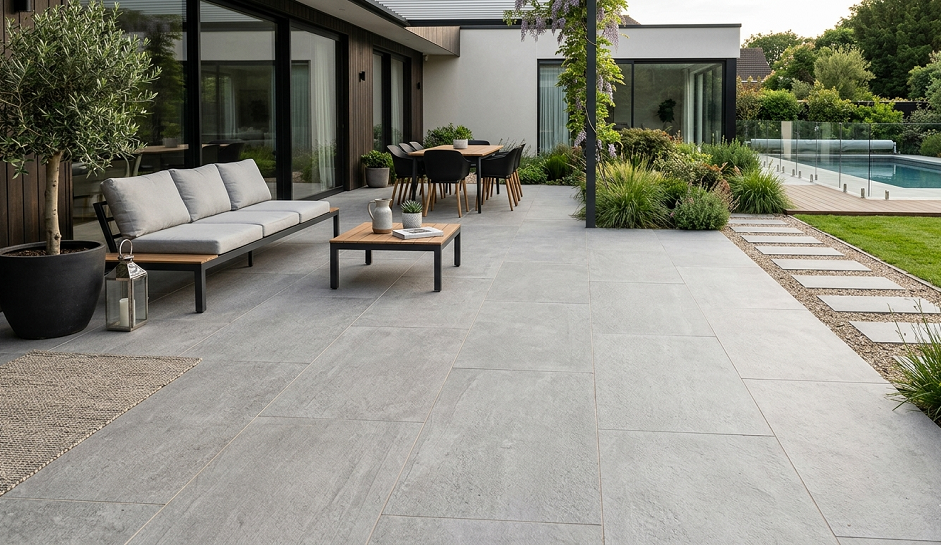
If someone asks me what single upgrade delivers the most dramatic transformation per square foot of material, I say large-format porcelain pavers without even hesitating. We’re talking 24×24 inch, 24×48 inch, or even 36×36 inch slabs laid with tight 1/8-inch grout joints. The result is a surface that reads as one continuous, seamless plane — the kind of patio you see in architectural magazines that you assume cost a small fortune.
The format matters because fewer grout lines mean less visual noise. On my old patio, the 12×12 tiles I started with looked dated the moment I finished laying them. The grid pattern pulled the eye in six directions and made the space feel small and cluttered. When I switched to 24×48 laid in a running bond, the whole yard looked three times bigger. That is not an exaggeration.
On the practical side, large-format pavers are genuinely easier to keep clean. Dirt and debris settle in grout lines, so fewer lines means fewer places for grime to hide. The tradeoff is that installation is more demanding — bigger pavers need a flatter, more carefully prepared substrate. Any low spot in your base and a big paver will rock. Spend the money on proper base prep. I cannot stress this enough. The tile is not where you cut corners.
For color, I lean toward light-to-mid tones: warm beige, soft greige, or a cool light grey. They don’t show heat shimmer, they keep the space feeling open, and they pair with almost any furniture color. Pure white looks stunning in photographs and absolutely awful after one rainy season in a real garden.
2. Porcelain Tile That Looks Like Concrete: All the Style, None of the Sealing
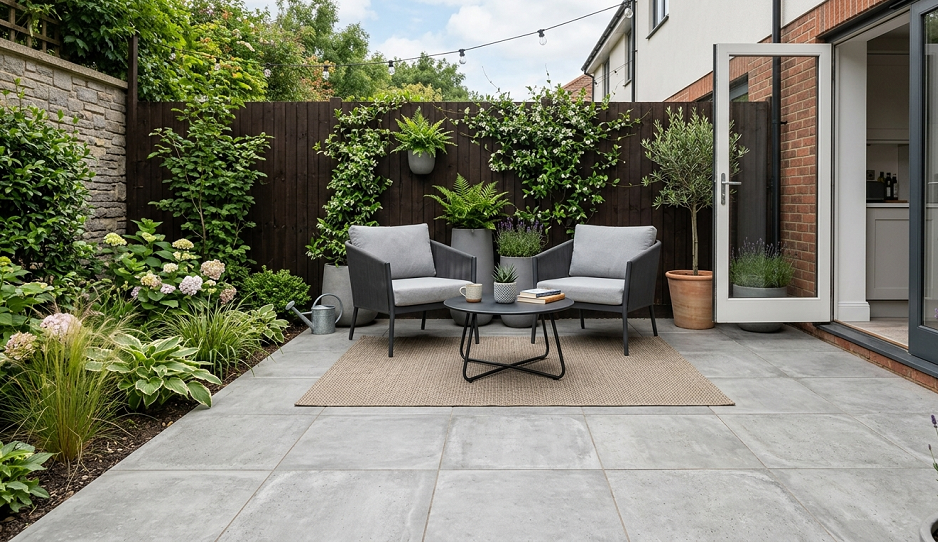
Poured concrete patios have had a serious moment in modern landscape design, and I get the appeal. That raw, industrial look works beautifully against clean lines, steel planters, and minimalist furniture. But real concrete is porous, it cracks, it stains from oil and tannins, and it needs acid washing or sealing to stay presentable. Concrete-look porcelain gives you every bit of that aesthetic without any of those problems.
The technology has gotten genuinely impressive. A few years back, faux-concrete tile had a repetitive pattern that gave it away immediately — you’d see the same vein or aggregate texture repeating every third tile like a bad wallpaper. The best manufacturers now use high-definition digital printing with four or more unique faces per tile, so the variation looks completely organic. Stand ten feet back and I challenge you to tell the difference.
My favorite application is a large-format concrete-look tile in a soft medium grey — something with a little warmth in it rather than a cold blue-grey. Pair that with a matte finish (I’ll talk more about finishes later — the wrong one is a nightmare), timber-look decking on a pergola overhead, and stainless or powder-coated black furniture. That combination is the definition of contemporary outdoor living right now, and it won’t feel dated in five years the way some trendier choices might.
One thing I should mention: the concrete-look tiles with a light aggregate or fleck in them do a better job of hiding the inevitable footprints and dust than the flat, solid-tone versions. The plain grey slabs photograph beautifully and look like a fingerprint magnet in actual use. Go for the version with some texture variation in the face of the tile.
3. Porcelain Wood-Effect Tiles for a Deck-Style Patio That Actually Lasts
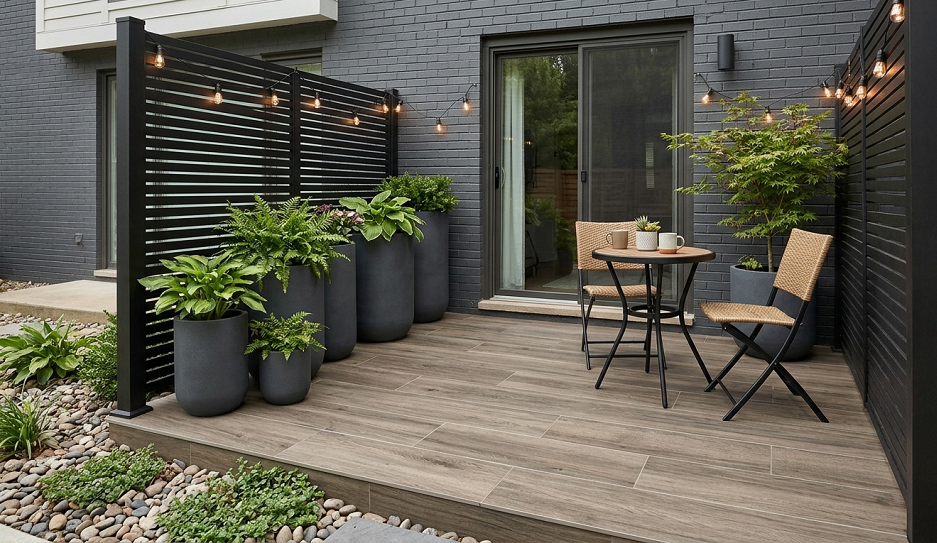
Real timber decking is beautiful until it isn’t. I’ve owned a hardwood deck and spent more hours on my hands and knees oiling, sanding, and replacing boards than I care to admit. The summer I found a 3-foot section of my deck had gone completely spongy under the surface — looking solid but collapsing underfoot — I started seriously researching alternatives. Porcelain wood-effect tile was the answer I kept landing on.
Modern wood-look porcelain has come an extraordinarily long way. The best options replicate the grain, knots, and color variation of real timber so convincingly that I’ve had guests crouch down and actually touch my patio tiles because they weren’t sure what they were looking at. Long, narrow plank formats — typically 6×36 or 8×48 inches — run in the same direction and create exactly the visual language of a timber deck without any of the rot, splinter, or maintenance concerns.
For installation, wood-look tiles need to be laid with their long edges running parallel and a consistent running bond offset — either a 1/3 or 1/4 offset rather than the more common 50% brick bond. The reason is technical: wood-look tiles have a directional grain, and a 50% offset can create a pattern that the eye reads as a H-joint, which looks distinctly un-wood-like. Your installer should know this. If they don’t, find a different installer.
My strong preference is a mid-tone warm brown — something that reads like aged oak or teak rather than a light blonde pine. The light blonde versions wash out in direct sun and show every scuff. The very dark espresso tones look incredible in photos and reveal every speck of dust, every fallen leaf fragment, every paw print in real life. Middle tones are the practical sweet spot. And always — always — choose a matte or textured finish for wood-look tiles used outdoors. Anything glossy on a plank tile looks like cheap vinyl flooring from the 1980s.
4. Porcelain Pavers with Gravel Infill: A Contemporary Japanese-Influenced Design
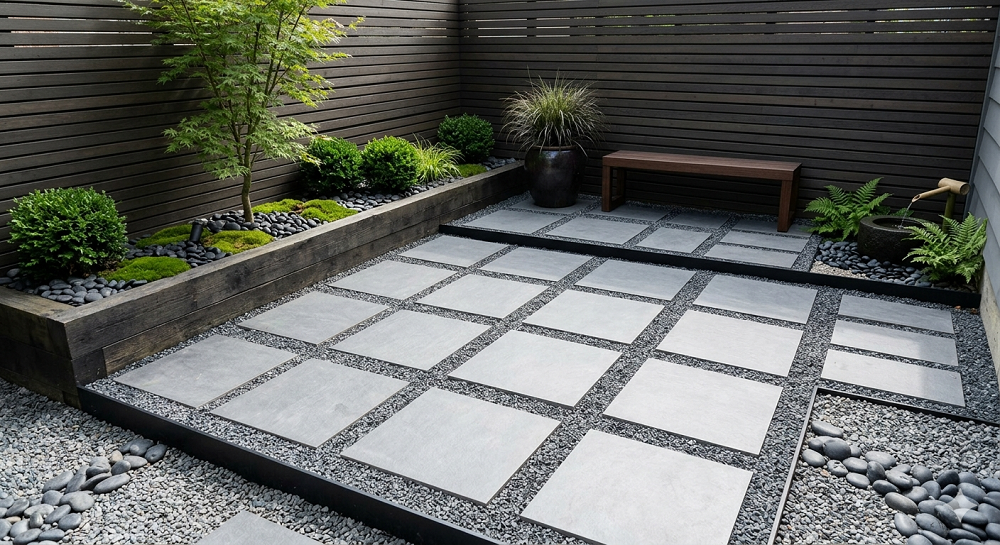
This is the idea that gets the most questions when people see my back garden. Instead of covering every inch of the patio in solid tile, I alternated large square porcelain pavers — 24×24 inches, light grey — with 2-inch wide gravel channels between each paver. The effect is architectural, calming, and deeply contemporary. It looks like it belongs in a Japanese zen garden crossed with a minimalist European courtyard.
The practical benefits are real, not just aesthetic. The gravel channels act as drainage breaks, so rainwater percolates through rather than sheeting across the surface and pooling at the foundation or running off in one direction. In areas with clay-heavy soil or tight drainage, this can make an enormous difference in how well your outdoor space holds up through wet seasons. My corner that used to flood now stays dry.
For the tile, you want a rectified large-format paver in a neutral tone — light grey, warm white, or soft beige all work. For the gravel, choose a washed pea gravel or decomposed granite in a tone that contrasts enough with the tile to read clearly from above. White marble chip with grey tile is a classic. Natural tan gravel with a warmer beige tile is softer and more organic. Avoid black gravel with dark tile — it kills the visual contrast that makes this design work.
The one installation note I’ll emphasize: set your pavers in a mortar bed, not directly on compacted gravel, and secure edging restraints before you fill in the gravel channels. The most common mistake is laying this pattern without proper edge restraint and watching the gravel migrate under the tiles over the first winter. Get the edging right and this design stays sharp for decades.
5. Raised Porcelain Deck on Adjustable Pedestal System: Sleek, Level, and Completely DIY-Friendly
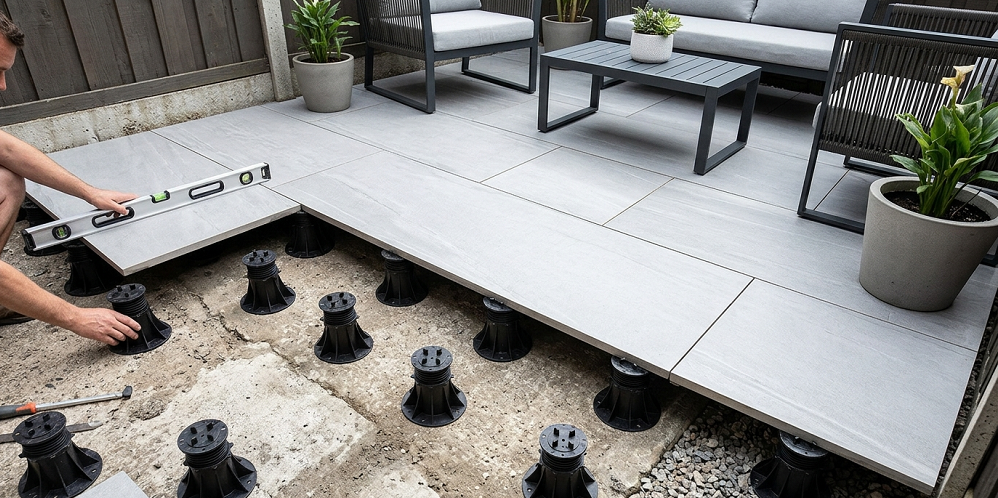
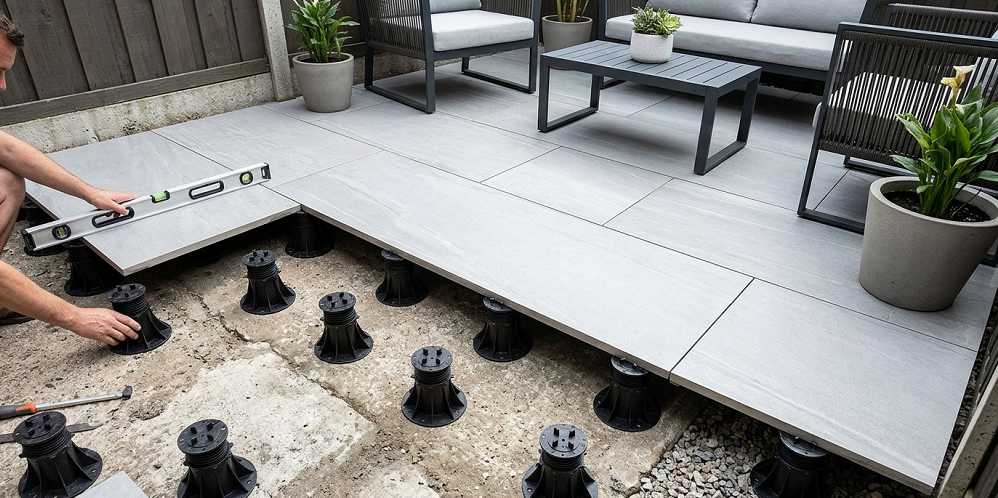
If your existing surface is uneven, badly cracked, or you’re working over a rooftop terrace or balcony, a raised pedestal paver system might be the most intelligent solution I know of. You install adjustable plastic pedestals directly on your existing surface — no demolition, no concrete cutting, no skip hire — and set large-format porcelain pavers on top. The pedestals have screw-adjustable heights, so you can create a perfectly level deck over a surface that pitches in six different directions.
I used this system over an old concrete slab that had heaved so badly at one end there was a 2-inch height difference across 12 feet. Leveling it with self-leveling compound would have cost almost as much as the tile itself. The pedestal system took two days, a rubber mallet, and a spirit level. The end result is flawless. Utterly flat, perfectly drained — water runs off between the tiles and down through the gaps, so there’s no standing water — and if I ever need to access anything underneath, I just lift the tiles out.
The key requirement is that your tiles need to be large enough to span multiple pedestals with adequate support — 24×24 inch minimum, and 24×48 is even better. Smaller tiles will flex and crack. Your porcelain also needs to be a proper paver grade with adequate thickness — at least 3/4 inch (20mm) — not the 3/8-inch indoor floor tile that some suppliers will try to sell you for outdoor use. Thick paver-grade porcelain is non-negotiable for pedestal systems.
The look this creates is genuinely floating-deck contemporary. Paired with a glass balustrade, cable railing, or no railing at all on a ground-level installation, it reads as sophisticated and intentional in a way that few other patio surfaces can match. It is my single favorite technique for rooftop terraces and awkward surfaces.
6. Indoor-Outdoor Porcelain Flow: Extending Your Interior Flooring to the Patio
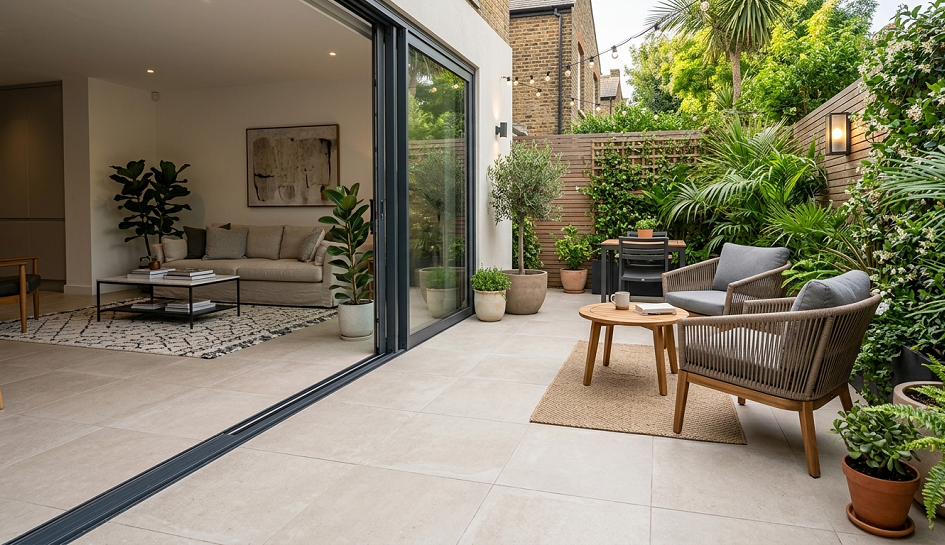
This idea requires some planning at the build or renovation stage, but the visual payoff is bigger than almost anything else on this list. The concept is simple: choose a large-format porcelain tile that looks identical or near-identical both inside and outside, align the grout joints across the threshold, and let the flooring flow through sliding glass or bi-fold doors without interruption. The interior and exterior become one continuous living space.
I did a version of this when I replaced my kitchen flooring three years ago. The tile I chose inside — a 24×24 light stone-look porcelain — had a matching outdoor paver version with identical dimensions and very similar face. I carried the tile from the kitchen through the sliding door and about 15 feet into the patio. When the doors are open, the inside and outside read as a single room. My kitchen, which is not large, suddenly feels enormous. It is one of the highest-impact changes I’ve ever made to a home.
There are technical requirements to get this right. The outdoor version of the tile needs to be frost-resistant and slip-rated for wet conditions — most good manufacturers offer both an indoor and an outdoor version of their popular tile lines for exactly this purpose. The threshold detail matters too: you need a drain channel or a slight slope break to keep rain from running directly into the house, but this is a solvable problem and any competent installer will know how to handle it.
The color palette that works best for this treatment is neutral and slightly warm — think travertine, light limestone, or a muted sand tone. Cool greys can read beautifully indoors under artificial light and feel harsh and clinical outdoors in strong afternoon sun. Warm neutrals perform in both conditions.
7. Patterned Porcelain Feature Zone: A Bold Contemporary Focal Point
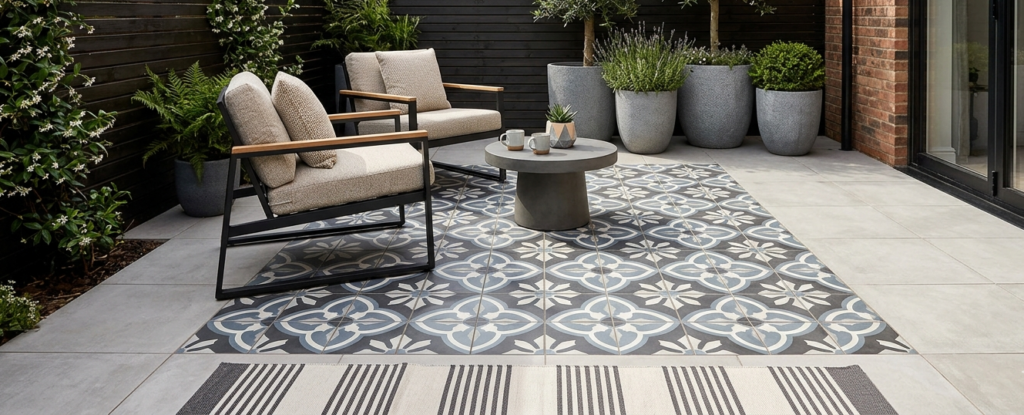
Every rule I follow in patio design says to keep the field tile simple and neutral. And then there’s this one exception I keep making, because it works so well: a patterned tile feature zone. Pick one area — the dining space under a pergola, a circular area around a fire feature, or a strip running the length of an outdoor kitchen — and use a graphic or geometric porcelain tile in that zone. Keep everything around it plain. The result is a patio that has one clear visual focal point without tipping into chaos.
The best patterns for contemporary outdoor use are large-scale geometrics: hexagons, chevrons, or oversized Moroccan-influenced repeats in black and white or two neutrals. I’ve used a black and white large hexagon tile under an outdoor dining table and had more people comment on it than on anything else in the garden, including the hand-built raised beds I spent an entire weekend constructing. The tile took four hours to lay. Humbling, honestly.
Scale the pattern to the space. A small feature zone — say a 6×6 foot circle — needs a smaller pattern repeat so the design registers clearly. A large open terrace can handle a much bolder, larger-scale geometric. The mistake I see constantly is tiny intricate mosaic tiles in a large open space where the pattern completely disappears at normal viewing distance, becoming visual noise rather than a design statement.
Quick side note: If you’re considering a patterned tile, order 15-20% extra. Pattern tiles require more cuts at the edges, and matching the pattern across replacement tiles years later is nearly impossible if the line gets discontinued. I learned this the expensive way.
Real Talk: What Can Go Wrong With Porcelain Patios (And What’s Not Worth the Effort)
Let me be direct with you here, because everything I’ve said above sounds very optimistic and I want you going in with eyes open.
The wrong finish will ruin everything.
A polished or semi-polished finish outdoors is a mistake. Full stop. I’ve seen beautifully designed contemporary patios rendered completely unusable because the homeowner chose a shiny finish tile that becomes dangerously slippery when wet and shows every water mark, footprint, and leaf stain in between. Always choose matte, brushed, textured, or an outdoor anti-slip rated finish for any tile that’s going outside. If a tile doesn’t have a slip rating (look for R10 or R11 for outdoor use), don’t use it.
Cheap base preparation is where projects die.
The single most common cause of cracked or rocking tiles is inadequate substrate preparation. If you’re laying on an existing concrete slab, it needs to be structurally sound and level. If you’re building fresh, the compacted gravel base needs proper depth — typically 4-6 inches for a pedestrian patio — and the mortar bed needs to be laid correctly. I watched a neighbor cut corners on the base prep on a genuinely beautiful tile job, and by the third winter, three large pavers had cracked and two others had rocked loose. Do the base right or don’t do the job.
DIY cutting of porcelain without the right tools is a waste of time and tiles.
Porcelain is extremely hard and dense. You cannot score-and-snap it the way you can with ceramic tile. You need a wet saw with a quality diamond blade designed for porcelain — not a general tile blade, not a masonry blade, a porcelain-rated blade. I tried to cut the first twenty tiles of my patio project with an underpowered wet saw and a cheap blade I had in the garage. I chipped edges, cracked tiles, and burned through a blade in about ninety minutes. Rent a quality wet saw or budget for an installer.
Thin porcelain slabs (less than 12mm) outdoors: I’d skip them for now.
Ultra-thin porcelain is a fascinating product and I understand why it’s appearing everywhere. But for outdoor patio use in a climate with frost, ground movement, or foot traffic, I’ve found it’s still too fragile to be reliable. The margins for error in base prep are almost nonexistent at that thickness. Standard 20mm paver-grade porcelain is mature technology with a long track record. The ultra-thin stuff is great indoors and on walls. Give it another five years to prove itself underfoot outside.
Parting Wisdom: Get the Tile Right and Everything Else Falls Into Place
After three patio projects, more tile samples than I have shelf space for, and one genuinely catastrophic mistake involving a polished finish and a garden party held in light rain, here’s what I actually believe: the tile choice is the thing that determines whether your patio looks like a thoughtful, designed outdoor room or an afterthought. Get the format, finish, and installation right, and the furniture, plants, and lighting become easy decisions.
Start with the largest format you can manage with your budget and substrate. Pick a matte or textured finish without a second thought. Choose a neutral field color and, if you want to have fun, add one bold feature zone. Don’t cheap out on base prep or the cutting equipment. And buy ten percent more tile than you think you need, because you will need it.
Modern porcelain patio design is genuinely accessible now in a way it wasn’t five or ten years ago. The product availability, the price points, and the installation knowledge are all there. The only thing standing between you and a patio you actually want to spend time on is making a few smart choices upfront.
Now I want to hear from you — are you considering a full rip-and-replace, or working with an existing surface? Have you already gone down the porcelain path and discovered a finish or format I haven’t mentioned here? Drop your questions and thoughts in the comments below. I read every one, and if I don’t know the answer, I’ll tell you that too.
Tags: porcelain patio ideas, modern patio design, porcelain pavers outdoor, contemporary patio makeover, large format patio tiles, outdoor tile design, porcelain patio cost, porcelain vs concrete patio

About Syprose Kiche
Syprose Kiche is the creator and writer behind My Besuited Home, a practical home and garden website covering DIY projects, gardening, lawn care, landscaping, home improvement, and outdoor living. She focuses on turning everyday homeowner questions into clear, practical guides backed by careful research and useful real-world considerations.