
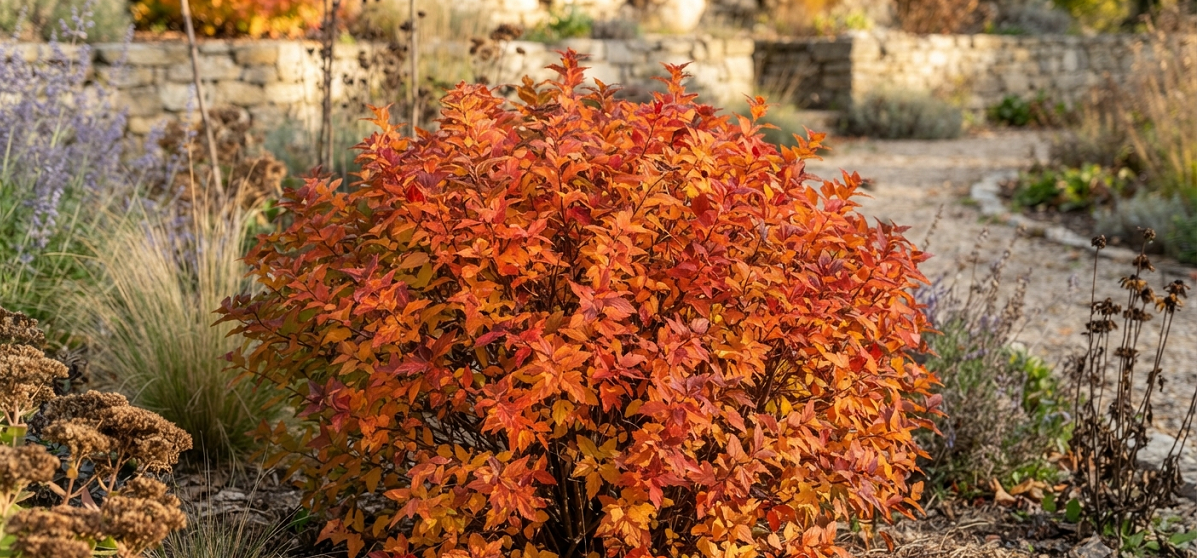
Your hydrangeas are crispy. Your lawn is the color of toast. And your water bill looks like a phone number.
I get it. Every August, my inbox fills up with the same question: “What can I plant that won’t beg for water all summer and still gives me a good show before winter?” Most people think drought-tolerant means boring — gray leaves, maybe a flower if you’re lucky, and definitely no autumn color.
That’s a myth I’ve been trying to kill for years.
I’ve spent more summers than I’d like to admit hauling a hose across my backyard, babying plants that never should have been on my property zone in the first place. The shrubs on this list are the ones that stuck around after I stopped coddling them. They took the neglect, shrugged it off, and paid me back with orange, red, and burgundy leaves right when everything else in the yard started looking tired.
This list covers shrubs that work across most temperate climates, roughly USDA zones 4 through 8, with notes on where each one really shines. I’ll flag the zone range for every plant so you’re not guessing.
What Makes a Shrub Truly Drought-Tolerant?
Before we get into the list, let’s clear something up. “Drought-tolerant” doesn’t mean “never water it.” It means the plant can handle dry spells once it’s established, usually after its first full growing season.
Here’s what I look for when I’m picking shrubs for a low-water fall garden:
- Deep or wide root systems that can find moisture on their own
- Leaves with a waxy coating, fuzzy texture, or silvery color (these all reduce water loss)
- A history of surviving in rocky, sandy, or clay-heavy soil without constant babysitting
- Native or near-native status to a dry region, since local plants already know how to handle your weather
If a shrub checks two or three of these boxes, it’s a solid bet. Now let’s get into the actual plants.
1. Smoke Bush (Cotinus coggygria)
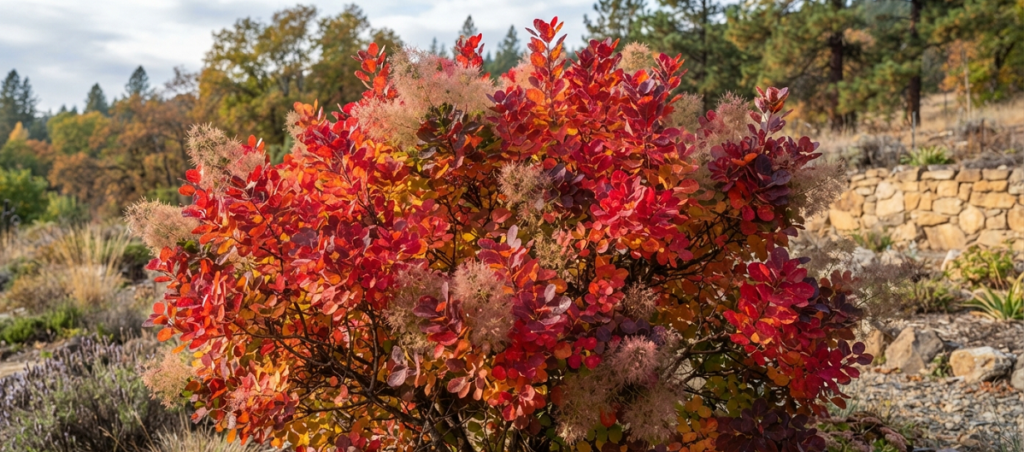
Smoke bush is the drama queen of the drought-tolerant world, and I mean that as a compliment. The wispy, smoke-like seed clusters give it a name that gets people curious, but the real payoff comes in October when the leaves turn a mix of orange, red, and deep purple.
I planted a ‘Royal Purple’ variety along my back fence about eight years ago, mostly because a neighbor was tearing hers out and offered it to me for free. Best free plant I’ve ever taken.
Smoke bush handles poor, rocky soil without complaint. It actually performs worse in rich, over-fertilized soil, which throws people off. Give it full sun, average soil, and skip the fertilizer, and it will reward you with a fall color show that stops foot traffic.
It grows well in zones 4 through 9 and can reach 10 to 15 feet if you let it, though regular pruning keeps it a manageable size. Water it during the first year to get the roots established, then mostly leave it alone.
2. Tiger Eyes Sumac (Rhus typhina ‘Bailtiger’)
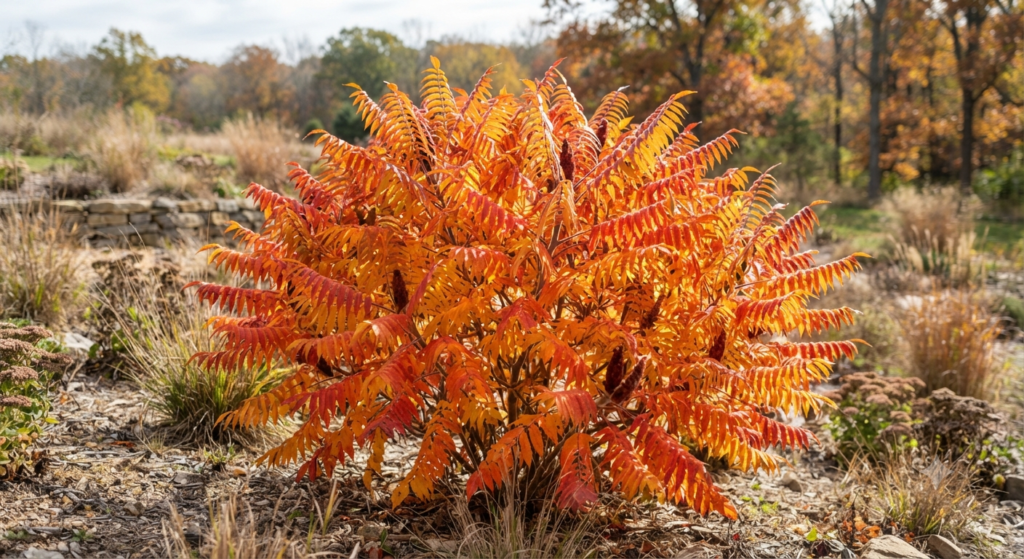
Sumac has a reputation problem. People hear the name and think of the wild, scraggly stuff growing along highway medians. Tiger Eyes is the cultivated cousin, and it’s a completely different animal.
The lacy, chartreuse foliage turns brilliant orange and scarlet in fall, and the color show is honestly one of the best on this entire list. I’ve had customers ask me what kind of maple it is, and I have to explain, no, it’s a shrub, and yes, it barely needs water.
This one spreads through underground suckers, so it’s not for a tight, formal bed. I use it in spots where I want a naturalized look or where I’m trying to fill in a slope that erosion keeps chewing away at. The root system that makes it spread is the same one that makes it drought-resistant.
Zones 4 through 8. Full sun to partial shade. It tops out around 6 feet, which is shorter than the wild sumac you’re picturing.
3. Red Chokeberry (Aronia arbutifolia)
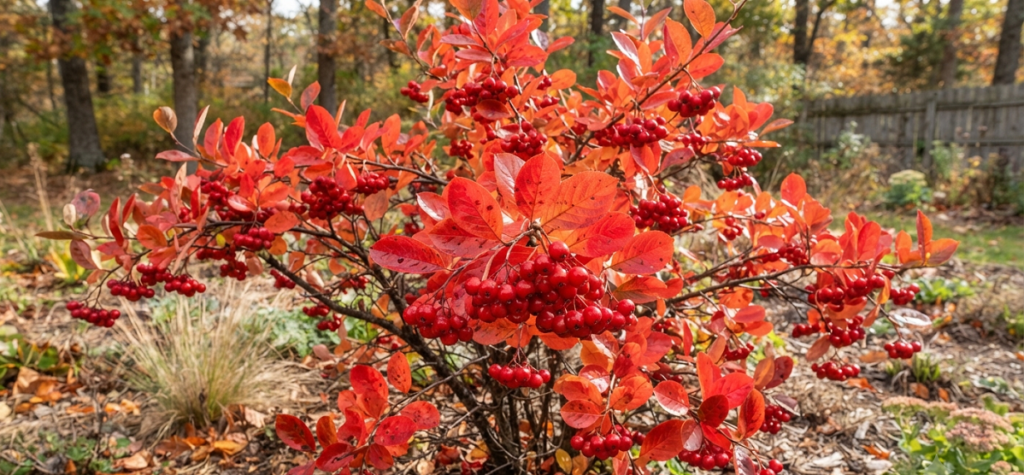
Chokeberry gets overlooked because the name sounds unappetizing, but this native shrub deserves way more attention than it gets. White spring flowers turn into bright red berries that birds go crazy for, and the foliage turns a deep wine-red in autumn.
I put a row of these along a drainage swale on a client’s property where nothing else wanted to grow. Chokeberry handles both wet spring soil and dry summer conditions, which is a rare combination. It’s basically the shrub equivalent of someone who’s fine whether the party is loud or quiet.
The berries are technically edible but intensely tart, hence the name. Leave them for the birds unless you’re planning to make jam, which some people do.
Zones 4 through 9. Full sun for the best fall color, though it tolerates partial shade. Expect 6 to 10 feet at maturity.
4. Dwarf Fothergilla (Fothergilla gardenii)
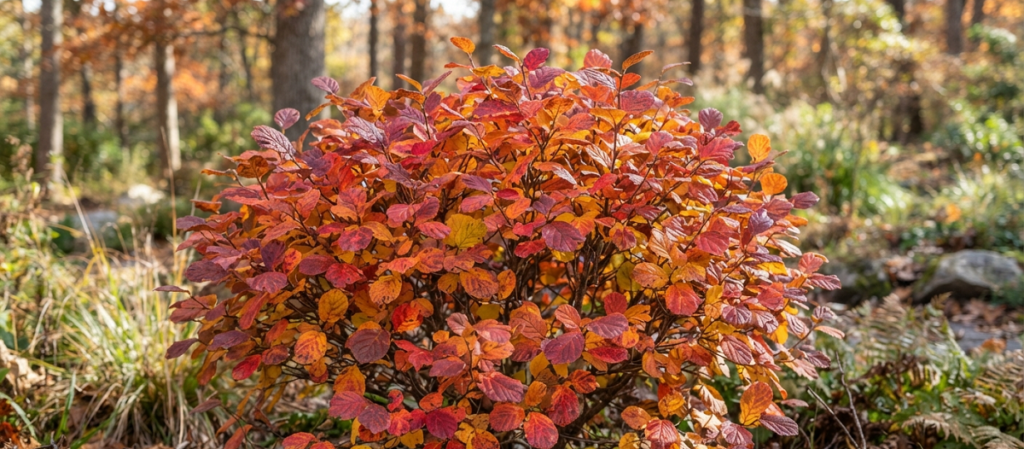
If you want fall color without the shrub taking over your entire flower bed, dwarf fothergilla is your answer. This compact native shrub tops out around 3 feet and puts on a fall display that rivals shrubs three times its size — yellows, oranges, and reds often appearing on the same branch at once.
In spring, it produces bottlebrush-shaped white flowers with a light honey scent. I planted three of these along a shady walkway a few years back, and they’ve needed almost zero maintenance since. No pest problems, no disease issues, nothing.
Fothergilla likes slightly acidic soil, so if you’ve got heavy clay or alkaline soil, work in some compost before planting. Once established, it handles dry spells just fine.
Zones 5 through 8. Partial shade to full sun. Great for foundation plantings or small spaces where bigger shrubs would be overkill.
5. Blue Mist Shrub (Caryopteris x clandonensis)
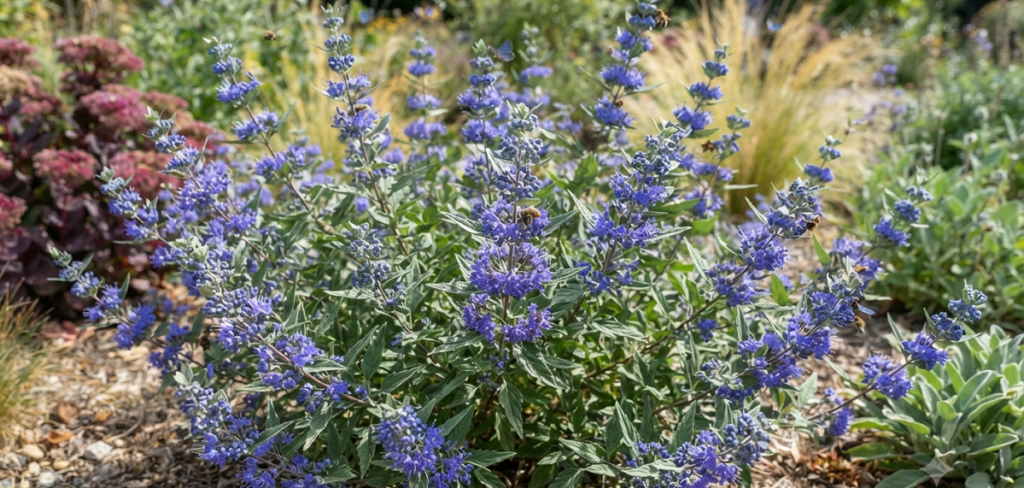
Most of this list focuses on foliage color, but blue mist shrub earns its spot with late-season blue flowers that show up right when everything else is winding down. The silvery-green leaves also pick up a soft gold tint in fall, which pairs beautifully with the blue blooms still hanging on.
I use this one constantly in xeriscape designs because it’s one of the few shrubs that offers real drought tolerance and a genuinely showy flower at the same time. Bees and butterflies swarm it in September, which makes it a great pick if you’re trying to support pollinators heading into fall.
Cut it back hard in late winter or early spring since it blooms on new wood. I know that feels aggressive the first time you do it, but the plant bounces back fast and blooms even better for the haircut.
Zones 5 through 9. Full sun. Stays compact at 2 to 3 feet, which makes it perfect for smaller yards or mixed borders.
6. Ninebark (Physocarpus opulifolius)
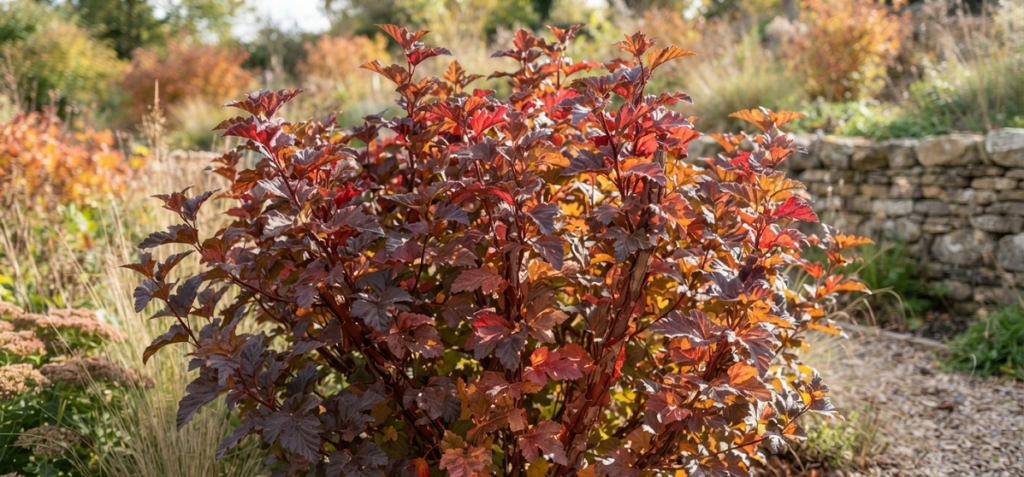
Ninebark is one of those shrubs that quietly does everything right. The peeling, multi-layered bark gives it winter interest, the summer foliage comes in deep purple or gold depending on the variety, and the fall color adds bronze and red tones on top of whatever the leaf color already was.
My favorite variety is ‘Diabolo,’ with near-black purple leaves all season that deepen into a moody bronze-red in October. I planted one as a specimen shrub near my front porch, and it’s become the plant people ask about most when they visit.
Ninebark tolerates poor soil, drought, and even some standing water, which makes it one of the most forgiving shrubs you can plant. It’s native to much of North America, so local wildlife already knows what to do with it.
Zones 2 through 8. Full sun to partial shade. Ranges from 3 to 8 feet depending on the cultivar, so check the tag before you buy.
7. Sand Cherry (Prunus besseyi)
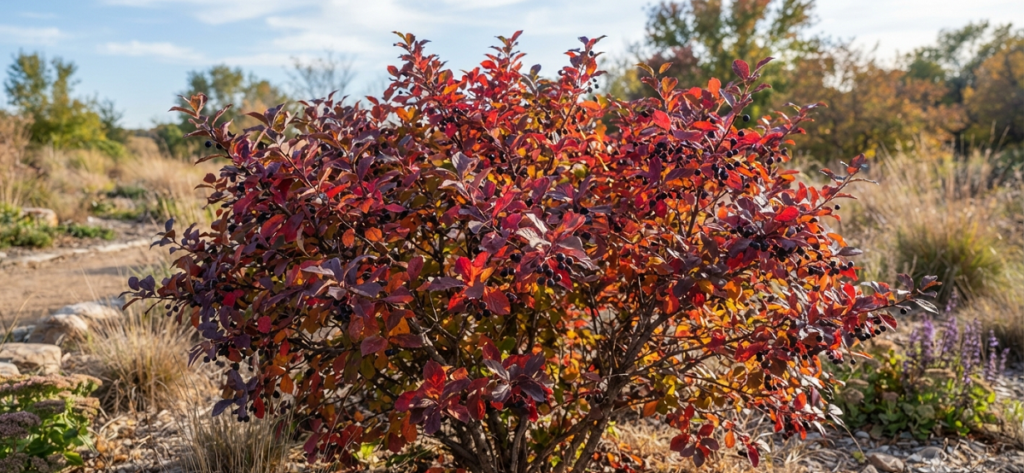
Sand cherry is built for exactly the kind of tough, sandy, dry conditions its name suggests. This is a shrub, not the ornamental tree version of flowering cherry, and it’s genuinely one of the toughest plants on this list.
Purple-leaved varieties like ‘Purple Leaf Sandcherry’ start the season with deep burgundy foliage and shift into a fiery red-purple in fall. Small white or pink spring flowers turn into edible (if sour) fruit that wildlife will clean up before you notice they’re there.
I planted a row of these on a slope that got full afternoon sun and almost no irrigation. They didn’t just survive — they thrived, filling in faster than the drip-irrigated shrubs on the shadier side of the same yard.
Zones 3 through 8. Full sun. Grows 6 to 10 feet, though regular pruning keeps it tidier if you want a hedge shape.
8. Rabbitbrush (Chrysothamnus nauseosus)
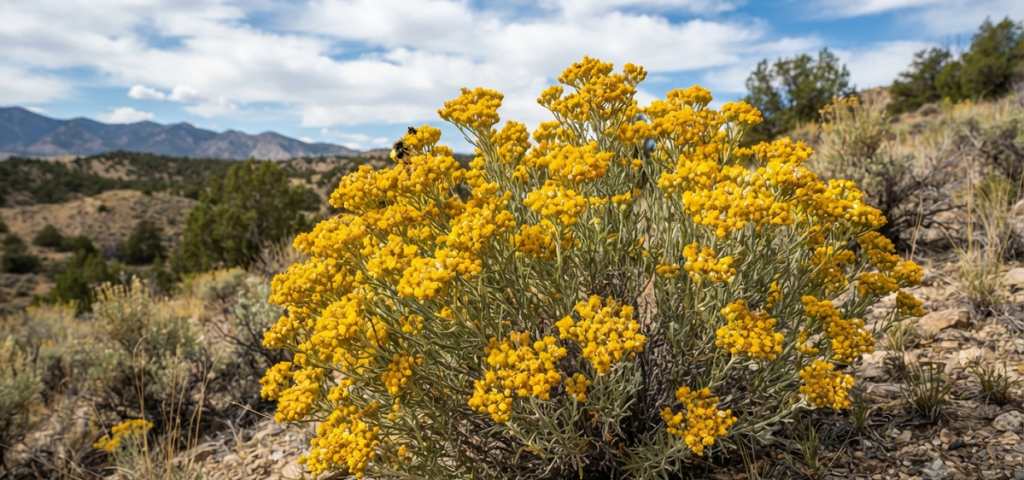
Rabbitbrush isn’t going to win any beauty contests in a formal garden, and I’ll be honest about that upfront. But if you’re gardening in a genuinely dry, western climate, this native shrub is nearly indestructible, and the silvery-gray foliage turns a warm gold in fall right alongside its bright yellow late-season blooms.
I recommend this one specifically for xeriscape projects, roadside plantings, or anywhere you need something to hold a slope without a drip line running to it. It’s native to much of the western United States, so it’s already adapted to alkaline soil, low rainfall, and temperature swings that would kill less rugged shrubs.
The name comes from a slightly unpleasant smell when the leaves are crushed, so don’t plant it right next to your porch swing. Give it space in a naturalized area instead.
Zones 4 through 9. Full sun only. Grows 2 to 7 feet depending on variety and conditions.
9. Spirea (Spiraea japonica varieties)
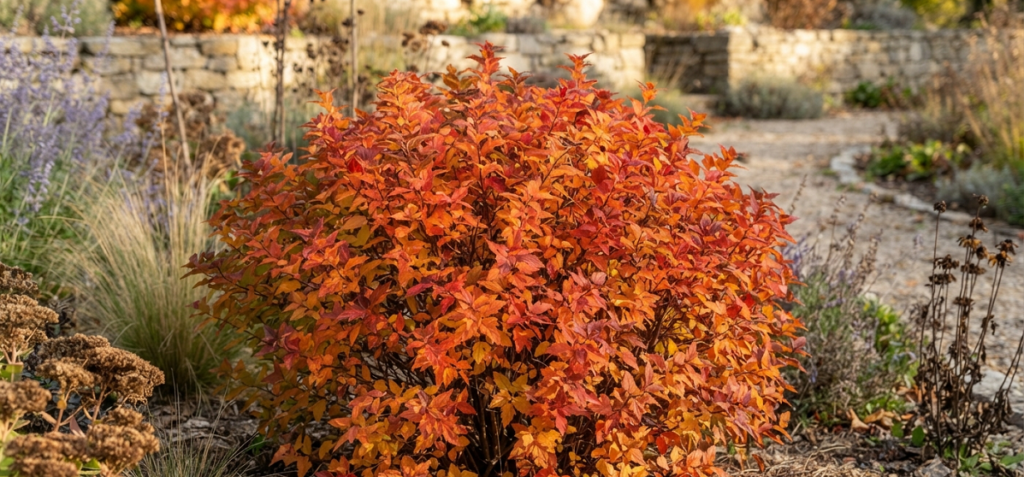
Spirea is the shrub I recommend to beginners because it is nearly impossible to mess up. Varieties like ‘Goldflame’ and ‘Magic Carpet’ bring orange and copper tones in fall on top of foliage that’s already colorful all season long.
I’ve planted spirea in soil so compacted you’d have trouble getting a shovel into it, and the plants didn’t seem to notice. It handles heat, drought, poor soil, and the occasional missed watering better than almost anything else on this list.
Spring flowers in pink, white, or red add another layer of interest, and deadheading after the first flush often triggers a second bloom in late summer. It’s a lot of payoff for very little effort.
Zones 3 through 8. Full sun to light shade. Most varieties stay compact at 2 to 4 feet, making it an easy fit for foundation beds.
10. Shrubby Cinquefoil (Potentilla fruticosa)
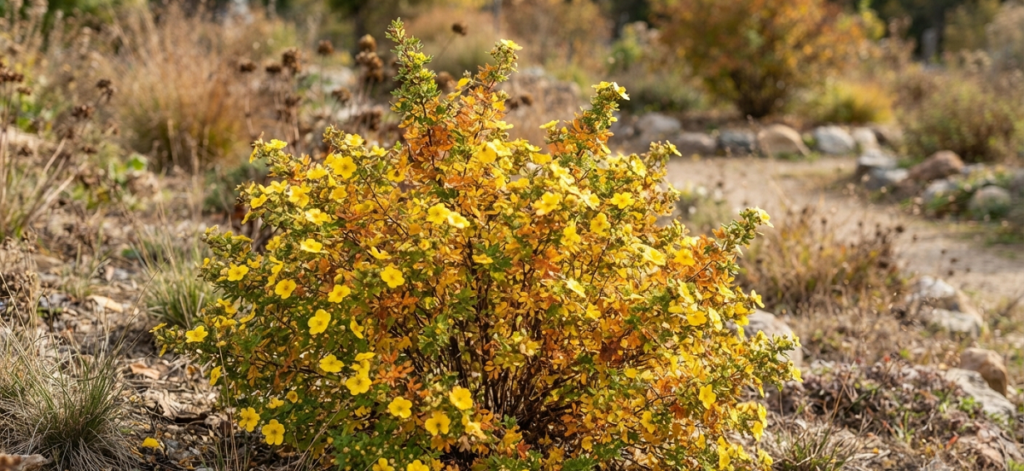
Cinquefoil doesn’t get talked about much, which is a shame because it blooms from early summer straight through fall, and the small, fine-textured leaves turn a soft yellow-gold as the season winds down. It’s a low-maintenance native shrub that handles rocky, poor soil without complaint.
I used a row of these along a parking strip on a commercial job years ago, in a spot that got reflected heat off asphalt all summer with almost no supplemental water. They kept blooming right up until frost.
The yellow, white, or pink flowers (depending on variety) attract pollinators for months, and the plant’s compact, mounding shape works well for low hedges or mixed borders without needing constant shearing.
Zones 2 through 7. Full sun to partial shade. Stays small, usually 1 to 4 feet, which makes it a good choice for tight spaces.
11. Russian Sage (Perovskia atriplicifolia)
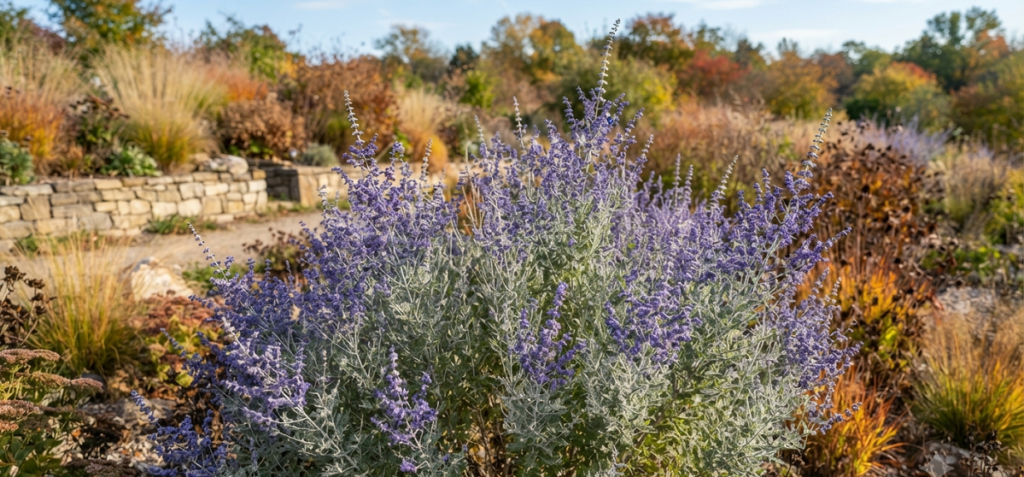
Russian sage sits right on the line between shrub and perennial, but I include it here because the woody base and structure hold up through fall and into winter like a true shrub. The silvery foliage and lavender-blue flower spikes create a hazy, soft look that’s genuinely one of my favorite textures in a fall garden.
This is one of the most drought-tolerant plants I’ve ever grown, period. I’ve forgotten to water new transplants for weeks during a dry spell and had them bounce back without missing a beat. That’s not something I’d recommend on purpose, but it tells you something about how tough this plant is.
The foliage doesn’t turn a dramatic red or orange, but the silvery-blue tone combined with the late-season blooms gives your fall garden a completely different color palette than the typical orange-and-red lineup. It’s a nice contrast plant if you’re using several shrubs from this list together.
Zones 4 through 9. Full sun. Grows 3 to 4 feet and pairs beautifully with ornamental grasses.
Bonus: Japanese Barberry (Berberis thunbergii) — Proceed With Caution
I’m including barberry as a bonus rather than a full entry because it comes with a real asterisk. The burgundy and gold varieties put on excellent fall color and handle drought about as well as anything on this list. But barberry is classified as invasive in several states, since birds spread the berries into wild areas where it crowds out native plants.
Before you plant it, check your state’s invasive species list. Some states have banned sales outright. If it’s not restricted where you live, look for sterile cultivars that don’t produce viable seed, which cuts down on the spread risk significantly.
I mention this one because people ask about it constantly, and I’d rather give you the full picture than pretend it doesn’t exist.
Real Talk: What Can Go Wrong With Drought-Tolerant Shrubs
Drought-tolerant doesn’t mean maintenance-free, and I want to be straight with you about where people mess this up.
The first year still needs water. Every shrub on this list needs regular watering for its first growing season while the roots establish. Plant one in July and walk away, and you’ll likely lose it, drought-tolerant reputation or not.
“Drought-tolerant” doesn’t mean “drainage-tolerant.” A lot of these shrubs, especially rabbitbrush and Russian sage, hate sitting in soggy, poorly drained soil far more than they mind dry conditions. If your yard holds water after a storm, you’ll need to address drainage before you plant, or pick a different section of the yard.
Overwatering kills more of these plants than underwatering. I’ve found that well-meaning gardeners are the biggest threat to a drought-tolerant shrub. The instinct to keep watering out of habit, even after the plant is established, leads to root rot far more often than dry soil ever does.
Fall color isn’t guaranteed every single year. Weather plays a role. A warm, wet autumn can mute the color show on some of these shrubs compared to a year with crisp nights and dry days. Don’t panic if one October looks less impressive than the last.
Barberry and burning bush both carry invasive concerns in parts of the country. I mentioned barberry above, but burning bush (Euonymus alatus) has similar issues in the eastern United States and didn’t make my main list for that reason. Always check local guidance before planting either one.
Final Thoughts
You don’t have to choose between a water-wise yard and a colorful one come fall. I’ve killed my fair share of plants chasing the wrong look for my climate, and every shrub on this list is one I’d plant again without hesitation.
Start with one or two from this list based on your zone and sun exposure, get them through their first summer with consistent water, and then step back and let them do their thing.
What’s your zone, and which of these are you thinking about adding to your yard this fall? Drop a comment below — I read every one, and I’m always curious what’s working (or not working) in other people’s gardens.

About Syprose Kiche
Syprose Kiche is the creator and writer behind My Besuited Home, a practical home and garden website covering DIY projects, gardening, lawn care, landscaping, home improvement, and outdoor living. She focuses on turning everyday homeowner questions into clear, practical guides backed by careful research and useful real-world considerations.