
My backyard used to be a tinderbox. I didn’t know it at the time. I had ornamental grasses right up against the fence, a cedar mulch pathway running wall-to-wall, and a juniper hedge that a firefighter friend later described as “basically a can of gasoline with leaves.” When a grass fire jumped the road two properties over one August, I got religion fast.
If you’re in a dry summer climate — Southern California, Arizona, Nevada, Colorado’s Front Range, parts of Texas, or anywhere the summer grass turns the color of straw by June — this article is for you. Firescaping, sometimes called fire-wise landscaping or defensible space gardening, is the practice of designing your yard to slow, deflect, or stop a wildfire from reaching your home. It’s not about making your yard look like a gravel parking lot. Done right, it’s actually beautiful. But it takes intention, the right plant choices, and a clear understanding of how fire actually moves.
Let me walk you through the seven ideas I’ve implemented (and in some cases, re-implemented after learning hard lessons) that have made the biggest difference.
1. Create Defined Defensible Space Zones Around Your Home
Before you plant a single thing, you need to understand the concept of defensible space zones. This is the foundation of all firescaping and the thing most homeowners skip because it sounds bureaucratic. It isn’t — it’s the whole game.
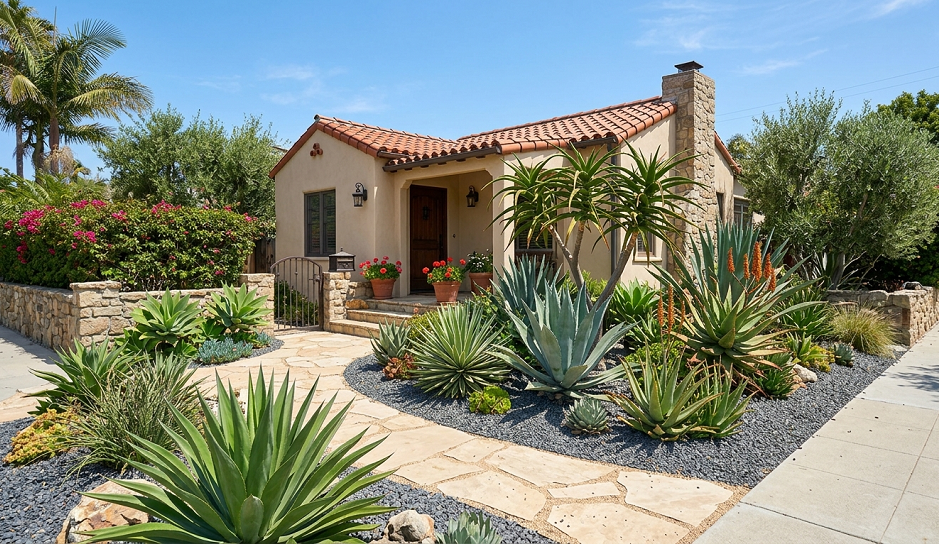
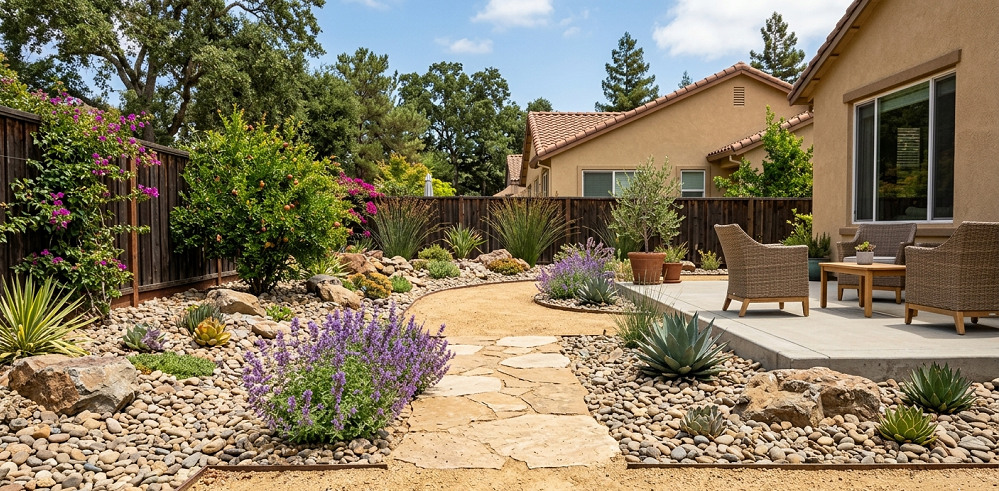
Zone 1 is the area immediately surrounding your house, typically 0 to 30 feet out. This zone needs to be lean, green, and irrigated. Think low-growing plants, spaced widely, with no continuous “fuel ladder” that lets fire climb from the ground up into your eaves. Everything here should be well-watered and as moisture-retentive as possible. I keep this zone almost exclusively with succulents, low-water ground covers, and hardscape.
Zone 2 stretches from 30 to 100 feet (or to your property line, whichever comes first). Here you’re reducing overall fuel load — thinning shrubs, removing dead vegetation, keeping grass mowed short. You’re not creating a moonscape; you’re creating gaps. Fire needs continuous fuel to travel. Gaps break that chain.
Zone 3, if your property extends that far, is about the wildland edge — managing native brush, removing invasive dry grasses, and keeping any trees limbed up at least 6 to 10 feet from the ground so fire can’t climb into the canopy. Most suburban lots don’t have a Zone 3, but if you’re on acreage or at the wildland-urban interface, this is where most fires get their start.
When I finally mapped my yard this way, I realized I had trees touching my roofline (Zone 1 violation), a mulched pathway creating a continuous fuel source (Zone 1 mistake), and a solid wall of shrubs with no gaps anywhere (Zone 2 disaster waiting to happen). Fixing the zones first made every other firescaping decision easier.
2. Replace Flammable Mulch With Fire-Resistant Ground Cover Options
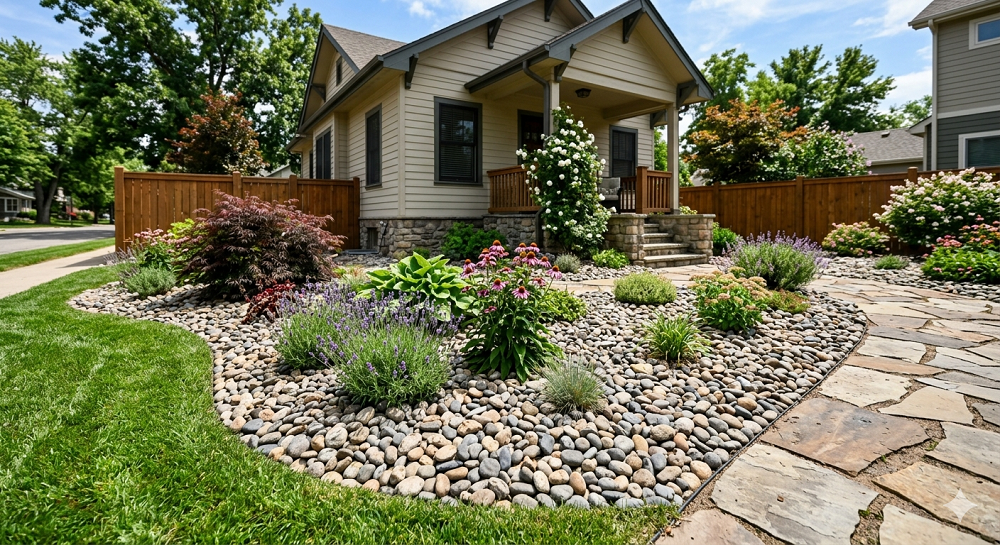
This one is going to upset some Pinterest boards, but cedar and wood chip mulch is a wildfire liability in dry climates. I know it looks great. I know it suppresses weeds beautifully. I know you just bought six cubic yards of it. But wood mulch is essentially pre-processed fuel, and in Zone 1 especially, it can carry embers right to your foundation.
The best fire-resistant mulch alternatives I’ve personally used are decomposed granite (DG), river rock, and pea gravel. Decomposed granite is my personal favorite — it’s affordable, looks natural, drains well, and won’t carry an ember. It also keeps the soil cooler in summer and suppresses weeds reasonably well once you’ve got a solid 3-inch layer down.
For living ground cover, creeping thyme (Thymus serpyllum) is a gem. It’s drought-tolerant, fire-resistant, stays low, smells wonderful when you walk across it, and blooms in summer. Ice plant (Carpobrotus or Delosperma species) is another workhorse — high moisture content in the leaves makes it one of the most fire-resistant ground covers you can plant, and it’s nearly indestructible once established. I planted a slope full of Delosperma cooperi five years ago and it has asked nothing of me since except occasional appreciation.
The one ground cover I’d steer you away from? Liriope and mondo grass. Both are frequently marketed as low-maintenance and drought-tolerant, but they dry out badly in summer and become highly flammable. I spent two summers ripping mine out.
3. Choose the Best Fire-Resistant Plants and Shrubs for Dry Climates
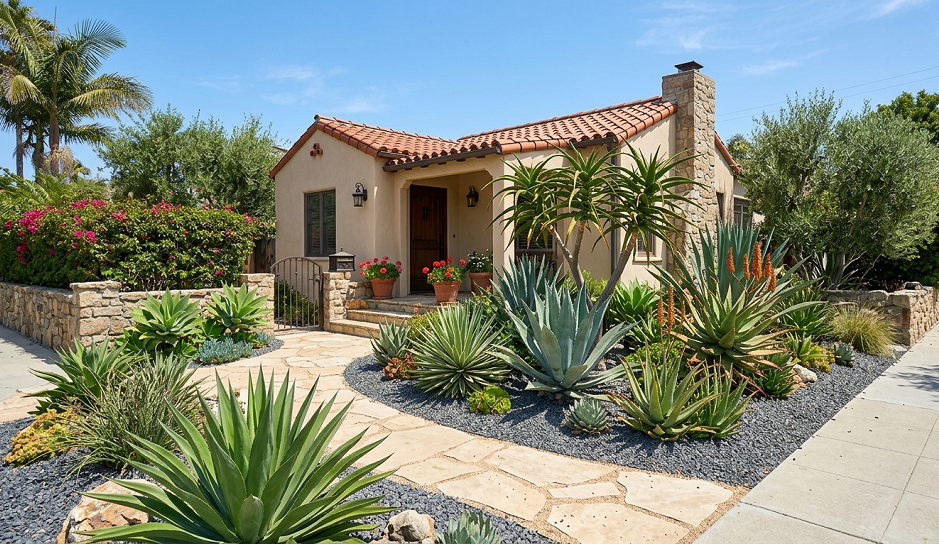
Plant selection is where firescaping gets genuinely fun. The myth that fire-resistant landscaping means ugly landscaping is exactly that — a myth. Some of the most striking plants in dry-climate gardens are also among the most fire-resistant.
The key characteristics to look for: high moisture content in leaves and stems, low resin and oil content (rosemary and lavender smell amazing but are flammable — more on that in the “Real Talk” section), non-papery or non-shredding bark, and a tendency to stay green through summer drought rather than going dormant and dry. Succulents tick almost all of these boxes, which is why I’ve made them the backbone of my Zone 1.
Here are the plants I personally grow and recommend for fire-resistant landscaping in dry summer climates:
- Agave — Almost completely fire-resistant due to massive water storage. Agave americana, agave attenuata (no spines, great for families), and agave parryi are all workhorses. I have eight of them and they’re the most carefree plants in my yard.
- Aloe — Similar logic to agave, but blooms are spectacular and hummingbirds lose their minds over them. Aloe vera, aloe ferox, and aloe arborescens are the ones I’ve had best luck with.
- Ceanothus (California Lilac) — Yes, it can be flammable when completely dry and dead, but established ceanothus is relatively fire-safe, extremely drought-tolerant, and the spring bloom is nothing short of electric blue perfection.
- Manzanita — Native to California and the Southwest, this shrub has a thick, smooth bark that resists fire better than most shrubs its size. It also gives wildlife habitat and looks gorgeous year-round.
- Encelia farinosa (Brittlebush) — One of the best low-water, fire-resistant shrubs for the desert Southwest. Covered in yellow daisy flowers in spring. Bulletproof once established.
Space these plants properly. “Properly” in firescaping means with actual gaps between them — not the shoulder-to-shoulder planting that looks lush but creates a fuel ladder. A good rule of thumb: shrubs in Zone 1 should be spaced so that their mature canopies don’t touch.
4. Design a Fire-Safe Hardscape That Creates Natural Fire Breaks
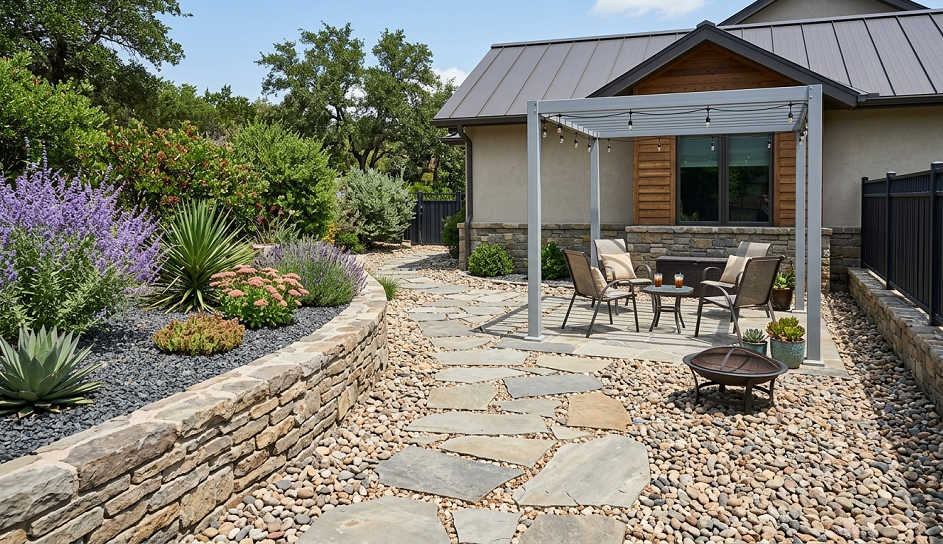
Hardscape is your secret weapon in firescaping landscaping. Patios, paths, gravel beds, dry creek beds, retaining walls, and concrete borders all do double duty: they look intentional and designed while simultaneously creating firebreaks that interrupt the path a ground fire travels.
A concrete or flagstone patio immediately adjacent to the house is one of the most effective fire-safety features you can add. Fire can’t burn stone. Gravel pathways — especially those 3 to 4 feet wide — act as fuel breaks. I redesigned my main garden path from cedar mulch to decomposed granite about three years ago, and the difference in fire risk was immediately apparent to my firefighter friend when he walked through.
Dry creek beds are both functional and beautiful. Fill them with rounded river rock, plant the edges with low, moisture-retentive plants, and you’ve created a natural-looking feature that channels water during rain and serves as a firebreak year-round. I built one along my back fence line specifically to create separation between my ornamental garden and the wooden fence, and it’s probably the design element I’m most proud of in the whole yard.
One thing I’ve seen homeowners get wrong: they’ll do all the right plant choices and then run a wood deck right to the back door, surrounded by combustible mulch, with a lattice skirt under the deck where debris accumulates. That deck is going to go. If you have or want a deck, use composite decking rather than wood, skip the lattice skirt, and keep the area under and around it completely clear of vegetation and debris.
5. Use Strategic Tree Placement and Limbing to Reduce Fire Ladder Risk
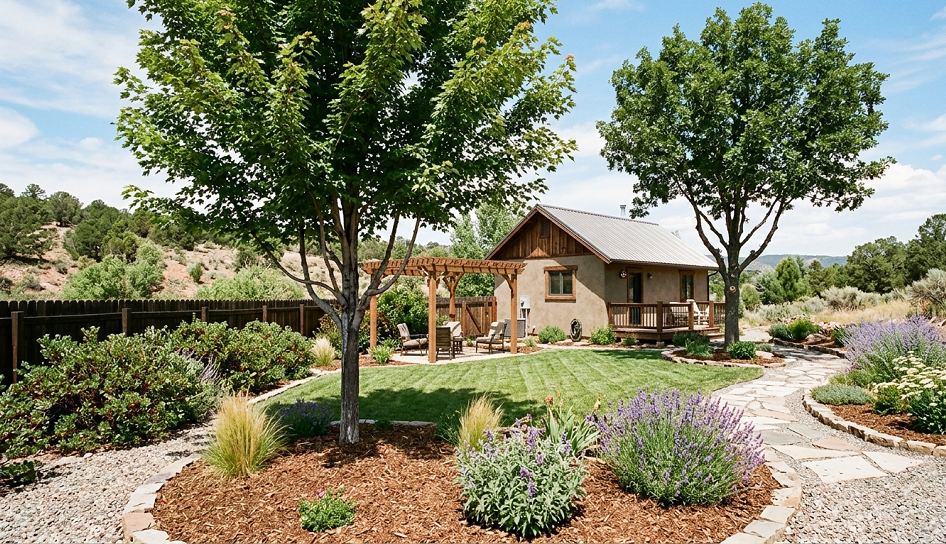
Trees are one of the trickiest elements in firescaping landscaping because they’re big investments, slow to grow, and feel permanent in a way shrubs don’t. But a poorly placed or poorly maintained tree can be the single biggest fire risk on your property.
The concept to understand is the “fire ladder.” Ground fire burns low. It wants to stay low. But if there are shrubs growing under a tree whose branches start 3 feet off the ground, fire climbs up those shrubs, into the lower branches, and suddenly you have a 40-foot torch. Remove that ladder — by limbing trees up to at least 6 to 10 feet from the ground — and fire loses its escalator.
For tree selection in dry climates, I’ll be direct: avoid conifers in Zone 1 whenever possible. I know pines and junipers look native and beautiful. I know they provide shade and privacy. But resin-filled conifers are fire’s best friends. If you love them, push them to Zone 2 and beyond, limb them high, and keep the understory absolutely clear. Never let grass or shrubs grow in the drip zone of a pine.
Better tree choices for Zone 1 in dry climates include desert willow (Chilopsis linearis), mesquite (Prosopis species), palo verde (Parkinsonia species), and in California, coast live oak (Quercus agrifolia). These are all drought-adapted, relatively low in volatile oils, and beautiful. My desert willow blooms its heart out all summer with almost zero water and zero input from me.
Spacing matters as much as species. Trees in Zone 1 should be spaced at least 10 feet apart (canopy to canopy at maturity) and never positioned where they overhang the roof. That sounds obvious until you’ve seen how fast a Modesto ash can grow over a roofline in five years.
6. Install Low-Volume Irrigation to Keep Fire-Resistant Plants Hydrated in Summer
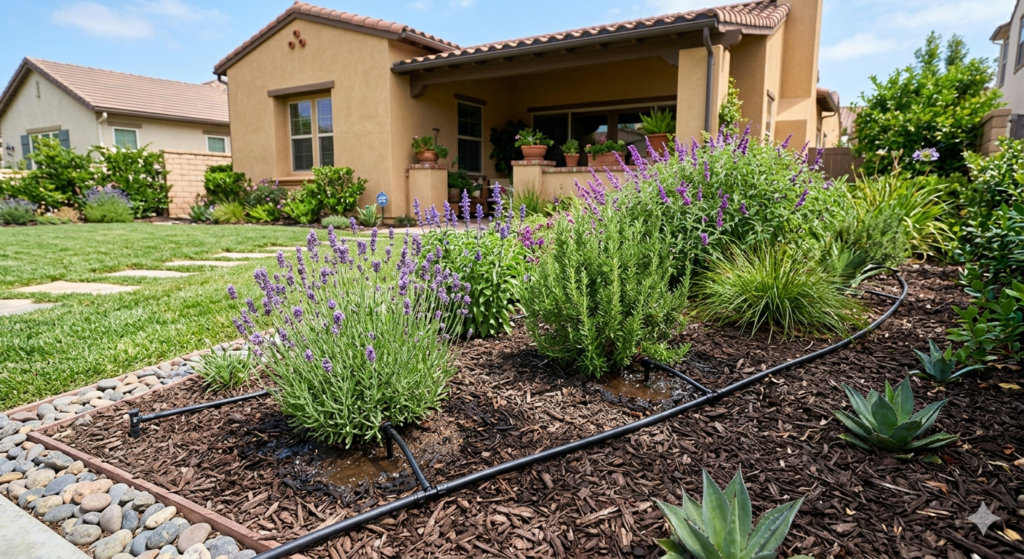
Here’s something the generic firescaping advice glosses over: even fire-resistant plants need to stay hydrated to resist fire. A stressed, drought-deprived agave is less fire-resistant than a well-watered one. A green, irrigated lawn (yes, really) is actually one of the most fire-safe surfaces you can have immediately around a house. Fire doesn’t love wet things.
This doesn’t mean running your sprinklers constantly and ignoring water restrictions. It means using drip irrigation efficiently to keep your fire-resistant plantings in good health through the summer. Drip is ideal because it delivers water directly to the root zone with almost no evaporation or runoff.
I set up a simple drip system in my Zone 1 plantings using 1/4-inch emitter tubing and a basic timer — the whole setup cost me about $80 in parts and an afternoon of work. The plants stay visibly healthier through our August heat events, and I use dramatically less water than when I was hand-watering.
For areas where you do have lawn — and I’m not saying lawn is evil; a green grass buffer directly around the house has fire value — switch to a warm-season drought-tolerant variety like buffalo grass (Bouteloua dactyloides) or blue grama grass (Bouteloua gracilis). Both are native to the western U.S., survive on far less water than fescue or Kentucky bluegrass, and stay green enough through dry periods to maintain their fire resistance.
7. Manage Dry Seasonal Vegetation and Dead Material With a Regular Maintenance Routine
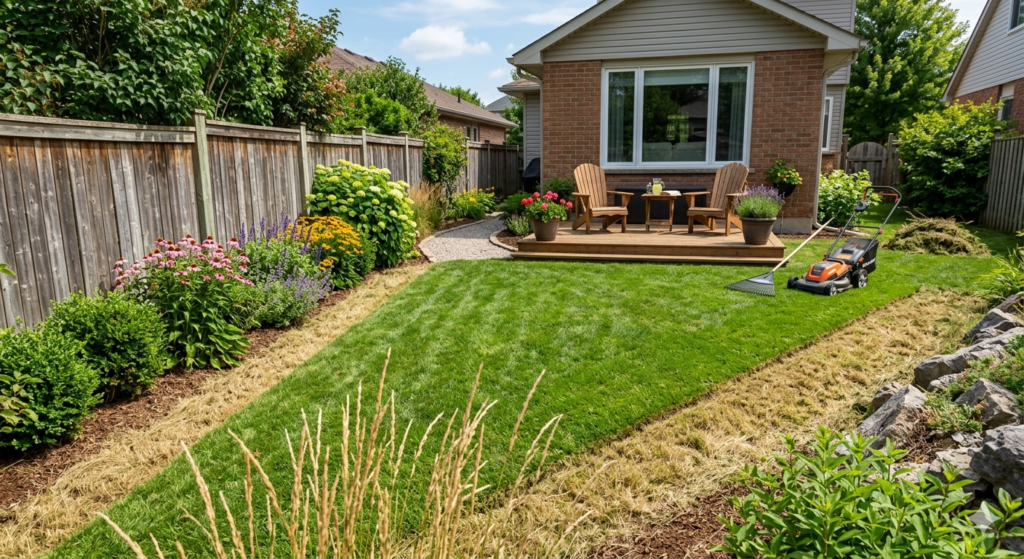
Every fall, I spend a weekend doing what I think of as my fire audit. I walk every inch of my property with a critical eye, asking: what is dry? what is dead? what is touching the house? This annual ritual has caught potential problems — a dead shrub I hadn’t noticed, accumulated debris under a deck board, a branch that had grown back toward the roofline — more times than I can count.
Year-round maintenance is actually the most underrated part of firescaping. You can do everything else right — perfect plant selection, perfect spacing, great hardscape — and then let your property go unmanaged for two years and undo most of it. Dry grass goes to seed and creates fuel. Dead wood accumulates. Volunteer plants appear in your gravel (happens to everyone).
The critical seasonal tasks for dry-climate fire maintenance:
- Late spring/early summer — Mow or cut back all dry annual grasses before they go fully dormant. This is your most important window. Green grass is fine. Knee-high dry grass against a fence is not.
- Midsummer — Check for dead branches in trees and shrubs. Remove accumulated debris from gutters (dry leaves in gutters catch embers). Check that your Zone 1 plantings haven’t grown together and closed their gaps.
- Fall — Full fire audit (described above). Remove any fallen leaves or debris from against the house foundation. This is when roof debris matters most — pine needles on a roof are an ember-catching hazard.
- Late fall/winter — Prune, cut back, and generally reset. This is also the best time to make changes to your plan for the coming year.
I’ve found that a simple photo log — just snapping a few reference shots of each area of the yard each season — helps me see creep that I’d otherwise miss. When you look at your yard every day, you stop seeing it clearly. The photos don’t lie.
BONUS: The Ember-Resistant Home Edge — Where Landscaping Meets Structure
This one lives at the intersection of firescaping and home hardening, and it’s too important to leave out. Most homes in wildfires are destroyed not by direct flame contact but by embers — burning material that travels on wind and lands on or near the house. Your landscaping in the immediate 0 to 5 feet around the foundation needs to account for this.
Clear this zone almost completely. No wood mulch, no dense plantings, no storage of anything combustible. Use gravel or concrete. Any plants should be isolated, succulent, and low. This 5-foot zone is sometimes called the “ember-resistant zone,” and it’s where a little landscaping restraint pays massive dividends.
Real Talk: What’s Not Worth the Effort (and What the Internet Gets Wrong)
Let me be straight about a few things that come up constantly in firescaping content.
Lavender and rosemary are not fire-safe plants. I know. They’re everywhere in fire-wise plant lists and they’re beautiful. But both are high in volatile oils. In a normal climate with regular summer moisture, they’re fine. In a hot, dry August when they haven’t had rain in four months, they’re flammable. I still grow rosemary because I love it, but it’s in Zone 2, away from the house, and I know what it is.
Fiber cement and stucco siding aren’t a free pass. I’ve heard homeowners say “we have stucco, we’re fine” — and then lose a porch, a fence, a tree overhanging the roof. The landscaping still matters even if your house cladding is fire-resistant.
You cannot firescape your way out of a major wildfire crown run. If a fire is moving fast in 50-mph winds through a dense forest or chaparral, no amount of landscaping will save your house if it’s directly in the path. Defensible space is most effective for slower-moving ground fires and gives firefighters a place to work. Understand its limits.
Synthetic turf is not fire-safe. I’ve seen it marketed as a “fire-safe lawn alternative” and I roll my eyes every time. Most synthetic turf products melt, and the melting plastic can spread fire. If you want a low-maintenance lawn alternative for Zone 1, use decomposed granite or plant a drought-tolerant living ground cover.
The Wrap-Up: One Thing You Can Do This Weekend
Firescaping is one of those projects where the whole can feel overwhelming and the parts are very manageable. You don’t have to redo your entire yard this year.
Here’s my parting advice: start with Zone 1 and the 5-foot ember zone. Walk the perimeter of your house this weekend. Look at what’s growing within 30 feet. Note anything that’s dead, anything that’s touching the structure, any wood mulch, any shrubs that have grown into each other without gaps. Make a simple list. Then tackle one item per month.
The summer I did my first real fire audit, I removed two junipers, replaced my cedar mulch with decomposed granite along the fence line, and limbed up my one pine tree. Three tasks. One season. My property became meaningfully safer without looking any worse — honestly, it looked better.
Firescaping isn’t about fear. It’s about being a thoughtful steward of your little piece of dry-climate earth. Do it right, and you’ll have a yard that’s beautiful, low-maintenance, and able to give fire a harder time than it expected.
What about you? Have you started firescaping your property, or are you still in the “I know I should but haven’t” stage like I was for years? What’s the biggest challenge you’re facing — plant selection, a specific zone problem, an HOA that won’t budge? Drop your question or situation in the comments below. I read every one, and I’ll give you a straight answer based on what’s actually worked in my yard.

About Syprose Kiche
Syprose Kiche is the creator and writer behind My Besuited Home, a practical home and garden website covering DIY projects, gardening, lawn care, landscaping, home improvement, and outdoor living. She focuses on turning everyday homeowner questions into clear, practical guides backed by careful research and useful real-world considerations.