
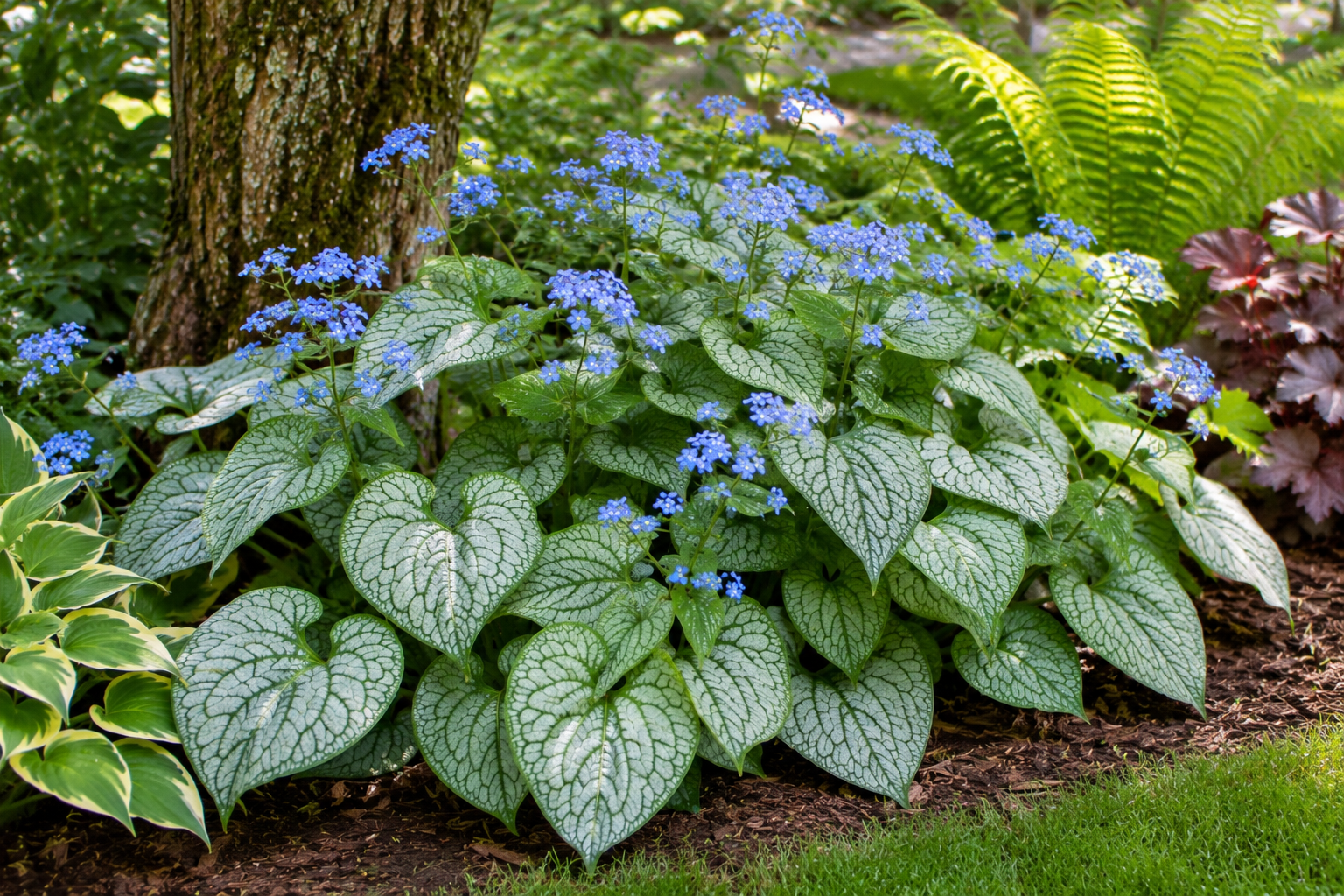
Grass rarely holds on for long beneath a mature maple or oak. It thins out, mosses over, and leaves a bare, root-ridged patch that most people eventually decide to turn into a planting bed. That decision is sound, but the bed that follows often fails for reasons unrelated to how much shade the spot gets. The tree is taking most of the water. Its roots fill the top foot of soil. And every shovel of digging risks cutting something the tree needs.
The plants below were chosen with those conditions in mind. Some tolerate dry, root-filled soil better than others, some need steady moisture, and a few have quirks worth knowing before you buy. Before the list, though, it helps to sort out what kind of shade you actually have and how to plant among roots without harming the tree, because those two things decide whether a border thrives or limps along.
Why the Ground Under a Tree Is Harder Than Ordinary Shade
A bed on the north side of a house and a bed beneath a large tree can receive the same amount of light and still behave like two different gardens. The difference is below ground.
A mature tree pulls up an enormous amount of water through the growing season, and most of its feeder roots sit surprisingly close to the surface, commonly in the top 12 inches of soil. Those roots spread well beyond the drip line, the circle on the ground under the outer edge of the branches. Anything you plant is competing with them for water and nutrients. This is why a hosta that sails through summer in a shaded side yard can brown at the edges beneath a silver maple, even though the light is similar.
Rain also reaches the ground unevenly. A dense canopy intercepts a light shower, and the trunk and large branches funnel part of what does fall away from the soil closest to the base. The area near the trunk can stay dry even after a decent rain.
Then there is the tree itself. Some species are harder to garden beneath than others:
- Shallow, dense rooters such as maples (especially silver and Norway maples) and beeches leave very little open soil. Planting here means small plants set into pockets, and patience.
- Black walnut produces a compound called juglone that stunts or kills some plants growing near it. Many shade plants are fine and some are sensitive, so check a juglone-tolerance list from a state extension service before planting if the tree is a walnut.
- Conifers such as spruce and pine drop acidic needles and cast shade all year, which cuts light and adds another layer of dryness. The plants that cope are fewer, and the list below flags the tougher ones.
None of this rules out a good border. It means choosing plants for the root zone, and treating the first year of watering as part of the planting rather than an afterthought.
Work Out Your Kind of Shade Before You Buy Anything
Plant tags say “shade,” but that word covers at least three different situations.
Dappled shade is what a high, open canopy such as honey locust or birch produces: moving patches of sun across the day. It is the most forgiving condition and suits nearly everything in this article.
Deciduous shade changes with the seasons. Beneath a maple or oak, the ground gets real sun in late winter and early spring before the leaves open, then deep shade from late spring through fall. That early window is why hellebores, bleeding hearts, and other spring bloomers do so well here. They flower while the light is still available.
Deep or dense shade comes from evergreens or wide, low-branched trees, where the ground may see little direct sun at any time of year. Flowers are fewer here and foliage does most of the work. Ferns, epimedium, and hostas carry this kind of bed.
Separately from light, decide whether the soil is dry or moist. A simple check: a day or two after a soaking rain, push a trowel into the bed a few inches from the trunk and again near the drip line. If the soil is still dust-dry a couple of inches down, treat the area as dry shade, which is common under large trees. If it stays damp or sits in a low spot, moisture-loving plants like astilbe and hakonechloa become realistic options.
The answer is often both at once, with a dry zone near the trunk and a moister zone out toward the edge of the border. That is useful, because it lets you put the thirstier plants where they will be happy.
Planting Between Roots Without Hurting the Tree
This part gets less attention than plant selection, and it matters more to the tree’s long-term health.
Skip the tiller. Tilling or deep digging across the root zone tears up feeder roots. Plant in individual pockets instead, using a hand trowel or a small spade.
Do not cut large roots. If a root bigger than roughly an inch or two across is in the way, move the planting hole rather than cutting it. Extension and arborist guidance generally treats major root cutting as a risk to the tree’s stability and health, and a tree that has stood for decades is worth more than one perennial.
Do not pile soil over the roots. It is tempting to build up a mounded bed of rich soil to make planting easier. Adding more than a couple of inches of soil over the root zone can smother roots by limiting their oxygen supply. Keep any added material shallow, and mix compost into each planting pocket instead of layering it across the whole area.
Mulch, but keep it off the trunk. A layer of shredded bark or leaf mulch about 2 to 3 inches deep holds moisture and moderates temperature. Pull it back a few inches from the trunk so bark is not sitting in constant damp, which invites rot and gives rodents shelter.
Buy small. A quart or one-gallon plant fits a pocket between roots far more easily than a large divided clump, and smaller plants generally establish more readily in competitive soil. The border will look sparse for a season. That is normal.
Water deliberately for the first year. New plants have a small root system and are competing with a mature tree. Deep, slow watering once or twice a week during dry spells in the first growing season, then easing off, is the usual pattern. Established plants in dry shade often still need a drink during prolonged droughts.
The 15 Plants
Hardiness zones below reflect commonly published ranges; cultivars vary, so check the tag on the specific plant you buy.
1. Hosta (Zones 3–9)
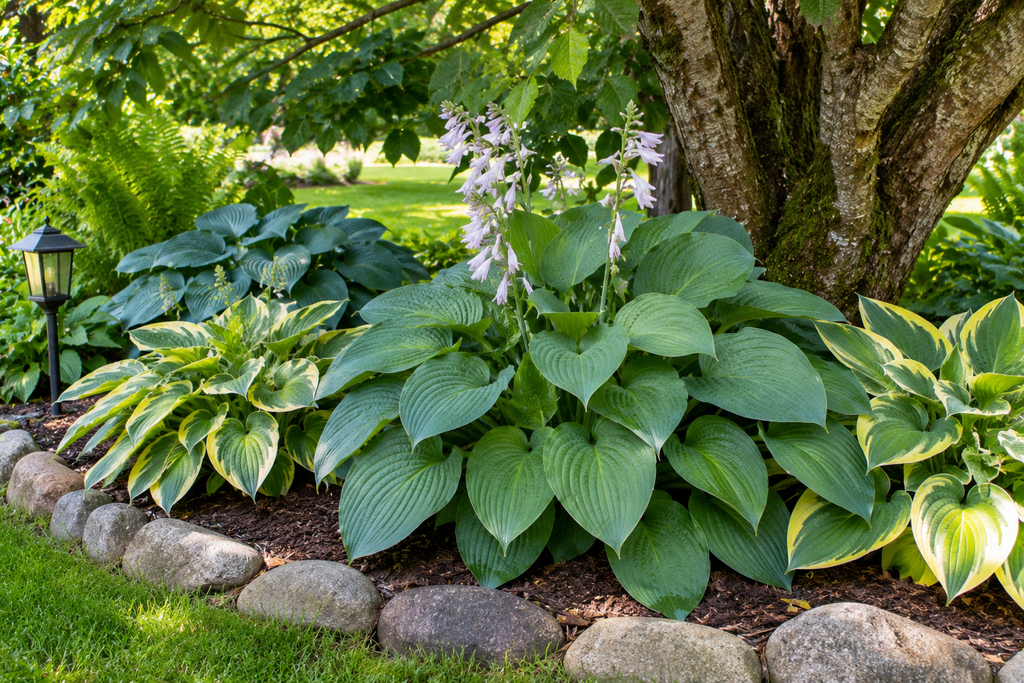
Hosta is the obvious choice for a reason: it covers ground, tolerates deep shade, and comes in sizes from under 6 inches to well over 3 feet. The trade-off is that it is also a favorite of slugs, snails, and deer. Thick-leaved cultivars, including many of the large blue types, tend to hold up to slug damage better than thin-leaved ones, so choose those where slugs are common.
Leaf color affects placement. Blue hostas generally keep their color best in more shade, while gold and variegated forms handle a bit more light. Hostas appreciate moisture, so give them the moister end of the border. Scorched, browning leaf edges beneath a thirsty tree usually point to water stress rather than disease. Hostas are listed as toxic to dogs and cats if eaten.
2. Hellebore (Zones 4–9)
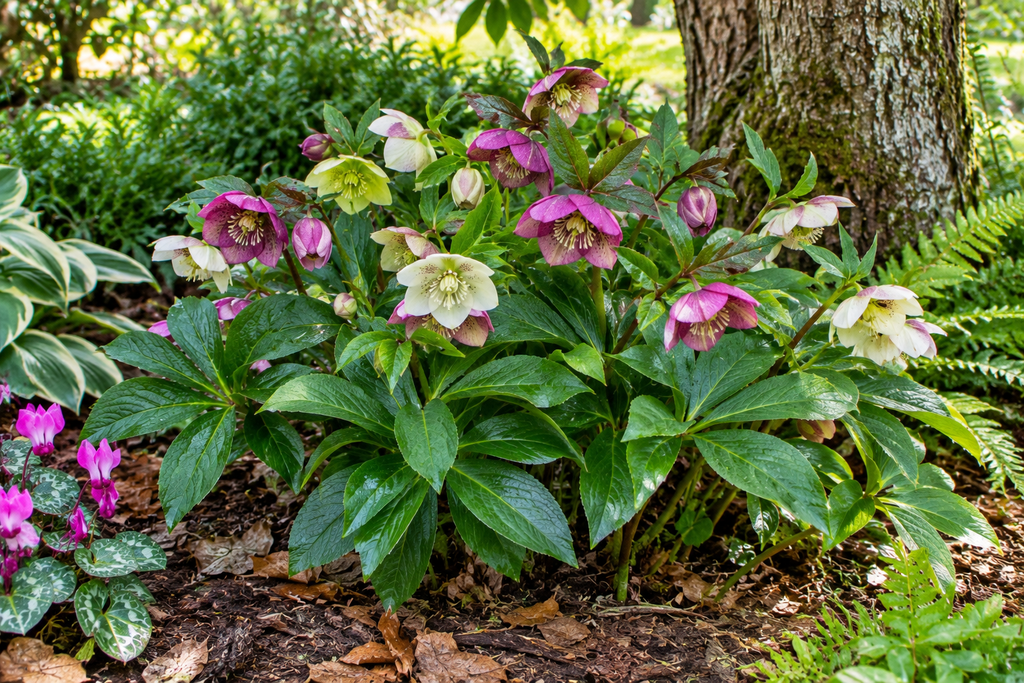
Hellebores bloom in late winter to early spring, often when little else is moving, with nodding flowers in white, pink, plum, near-black, and green. The foliage is leathery and stays on the plant through much of the year. They are also among the better performers in dry shade once established, and deer and rabbits generally leave them alone.
One maintenance habit makes a visible difference: cut off the previous year’s battered leaves in late winter, before the flower stalks rise, so the blooms are not hidden. Plan on patience too. Hellebores often sulk for a year after planting and then take off. All parts are toxic if eaten, so consider that if pets or small children use the area.
3. Brunnera (Zones 3–8)
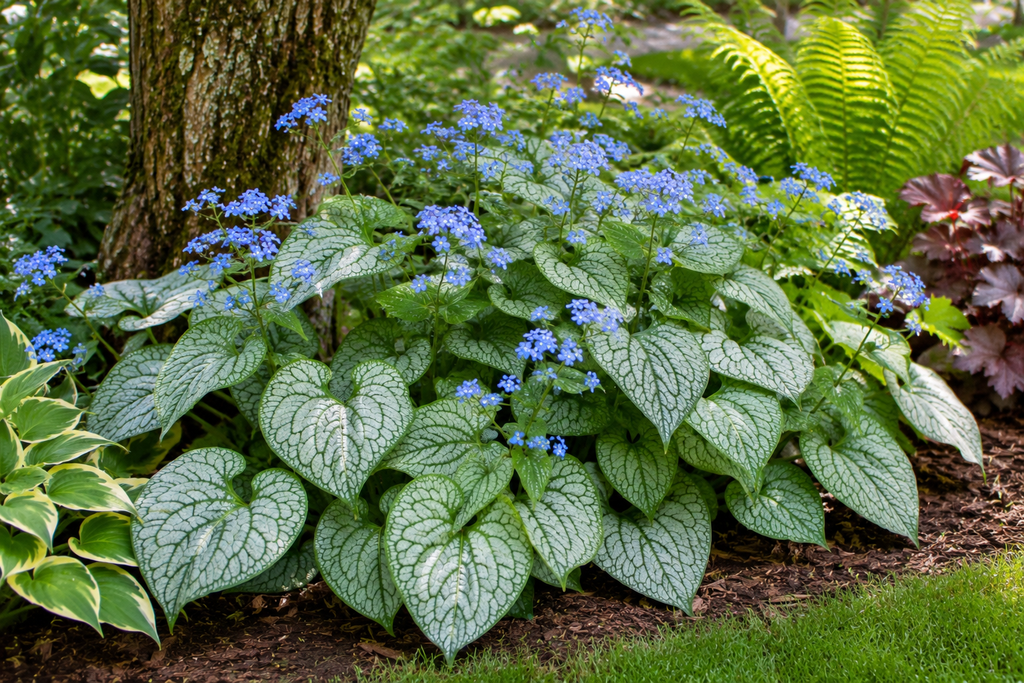
Brunnera produces sprays of small sky-blue flowers in spring that resemble forget-me-nots, above heart-shaped leaves. The cultivar ‘Jack Frost’ is popular because its silvery leaves with green veining brighten a dim corner long after the flowers finish.
It wants evenly moist soil. In dry conditions the leaf edges crisp and brown, which is why it belongs toward the outer edge of the border, away from the driest soil near the trunk. Deer typically ignore it.
4. Epimedium (Zones 4–9, depending on species)
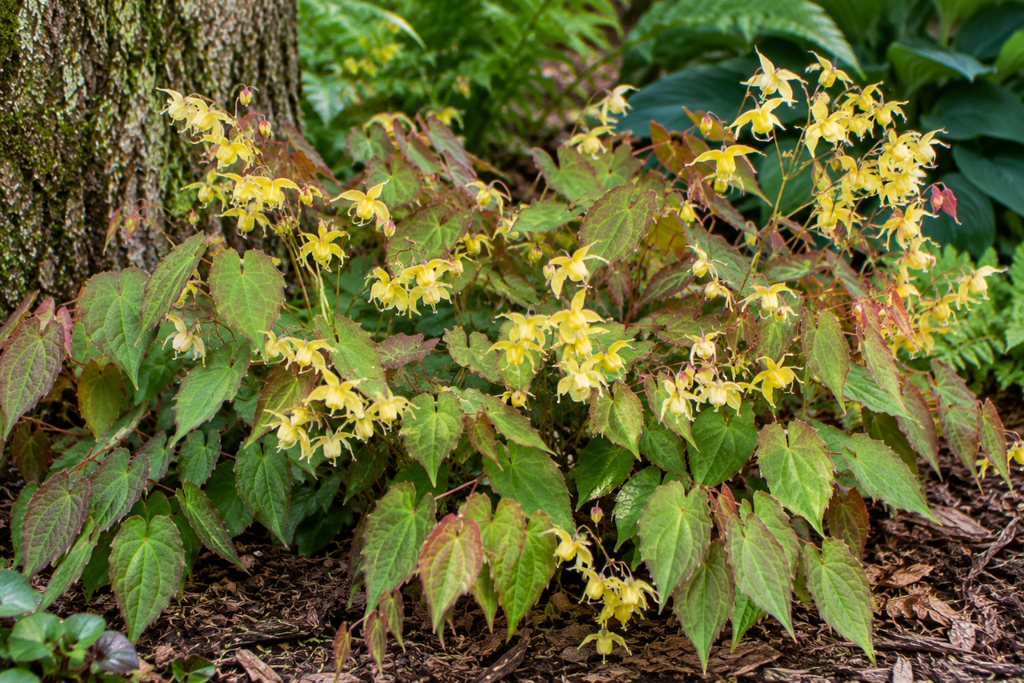
Epimedium, also called barrenwort, is one of the few perennials that handles dry shade under mature trees without much complaint once its roots are established. The heart-shaped leaves emerge tinted bronze or red, and the small, orchid-like spring flowers hang on wiry stems.
It is slow to fill in and not cheap, which tempts people to skip it. Buy a few and be patient. Species and hybrids differ in habit: some spread by rhizomes to form a dense carpet, while others stay in clumps, so read the label if spread matters. For deciduous types, shear off last year’s foliage in late winter before the flowers appear, or the blooms get lost in the old leaves.
5. Lungwort (Pulmonaria) (Zones 3–8)
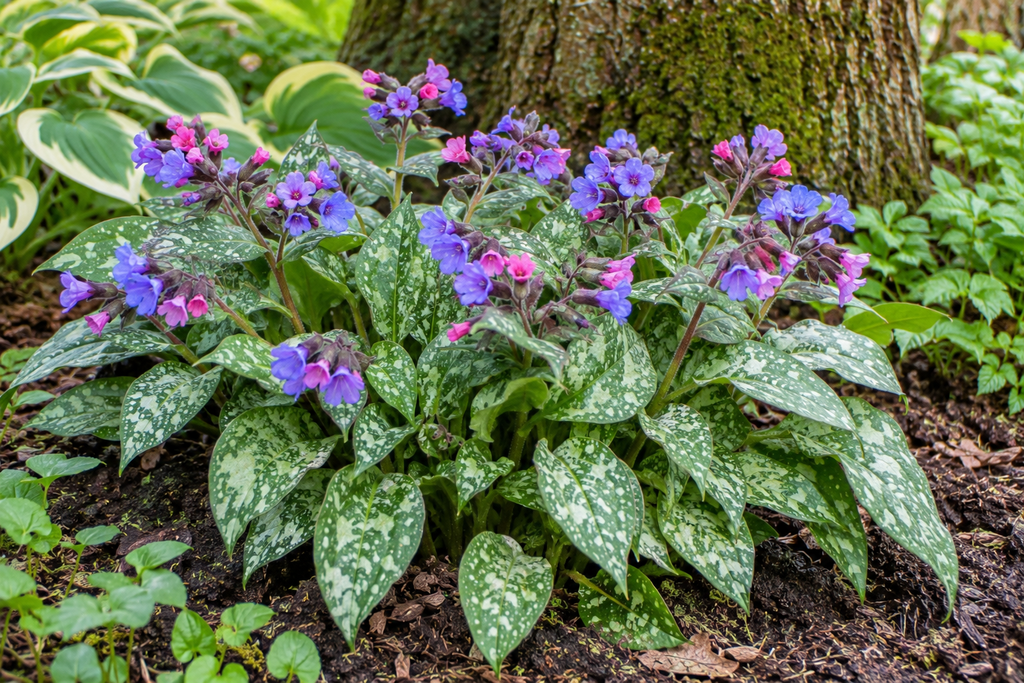
Lungwort offers early spring flowers that open pink and mature to blue, sometimes on the same stem, above silver-spotted leaves. It blooms around the same time as hellebores and brunnera, and its foliage stays presentable into summer.
Powdery mildew can turn the leaves white and ugly in dry, stuffy conditions. If that happens after flowering, cut the foliage to the ground. Fresh leaves usually return, though the plant may need a good watering to do it. Planting it with decent air circulation and enough moisture reduces the problem.
6. Coral Bells (Heuchera) (Zones 4–9)
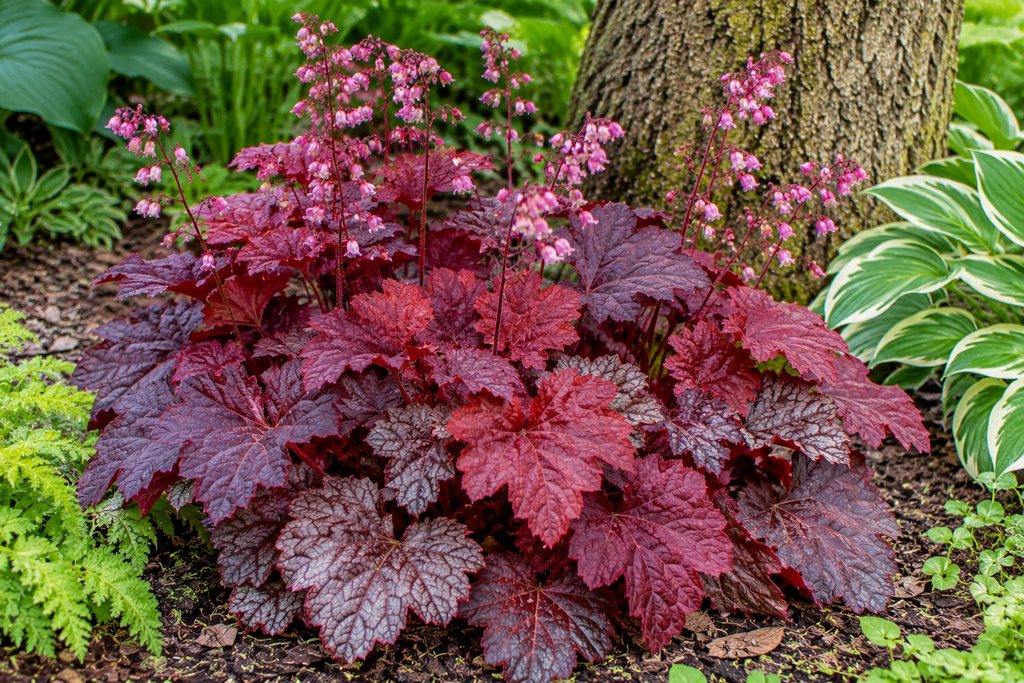
Heuchera is grown mainly for foliage in colors ranging from lime and amber to burgundy and near-black. It slots neatly into the front or middle of a border and holds its color across seasons in mild climates.
More light usually gives richer color, so in deep shade the leaves may fade toward green. Dark-leaved types tolerate brighter conditions than pale ones, which scorch. Heucheras dislike soggy soil, and in climates with freeze-thaw cycles the crowns can heave upward out of the ground; pressing them back in and adding mulch in late fall helps. They also benefit from being divided and replanted a bit deeper every few years as the stems grow woody.
7. Japanese Forest Grass (Hakonechloa macra) (Zones 5–9)
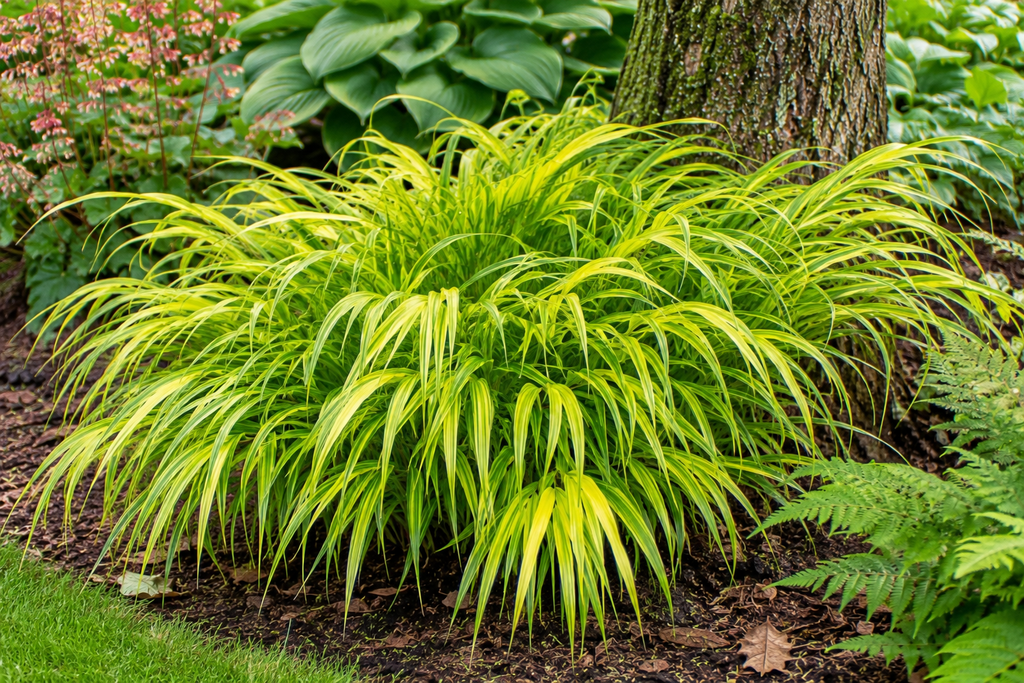
Japanese forest grass forms cascading mounds of arching, bamboo-like blades. The popular ‘Aureola’ has golden-yellow foliage with green streaks that lights up a shaded border, and many forms turn orange to bronze in fall.
It grows slowly, so a single plant can look underwhelming for a couple of seasons. It also prefers consistent moisture and soil rich in organic matter, which makes it a poor match for the driest root-filled ground. Plant it in the moister part of the border where its mounding shape can spill over an edge or a stone.
8. Ferns: Christmas, Autumn, and Japanese Painted (Zones 3–9)
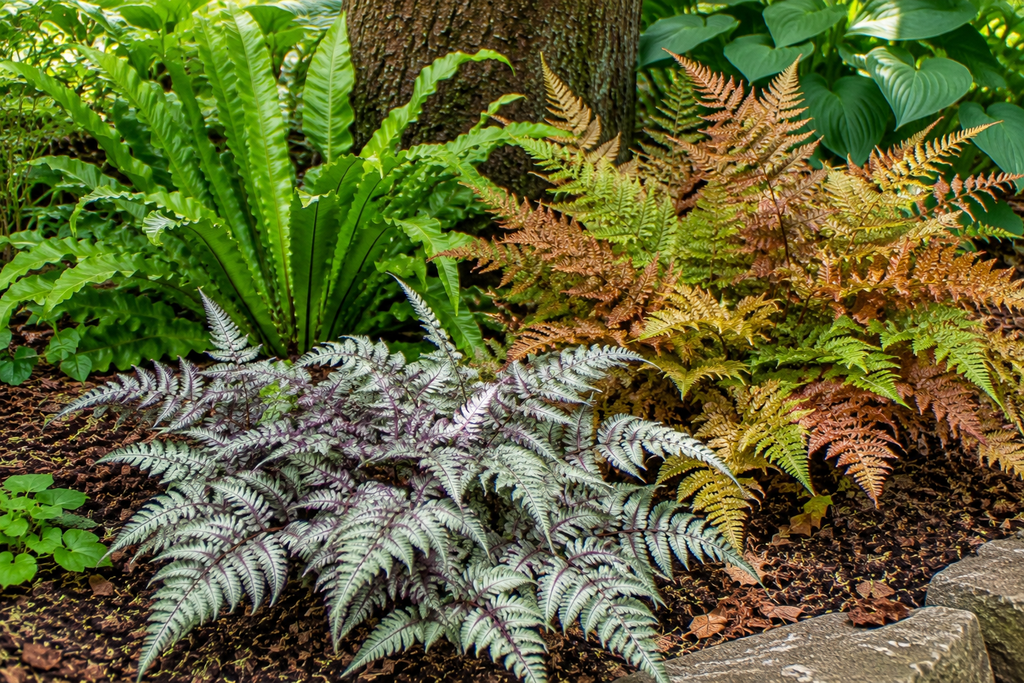
Ferns suit root-crowded ground well because their fibrous roots are shallow and they fill gaps that flowering plants avoid. Three are especially useful.
Christmas fern (Polystichum acrostichoides, zones 3–9) is a native evergreen whose fronds stay green through winter and handle drier shade better than many ferns. Autumn fern (Dryopteris erythrosora, zones 5–9) produces coppery-red new fronds that age to glossy green. Japanese painted fern (Athyrium niponicum ‘Pictum’, zones 3–8) has silver and burgundy fronds that brighten dark spots but needs more moisture than the other two.
Plant ferns with the crown at soil level, not buried. Evergreen types look their best if the previous year’s tattered fronds are trimmed in early spring as the new fiddleheads begin to uncurl.
9. Bleeding Heart (Zones 3–9)
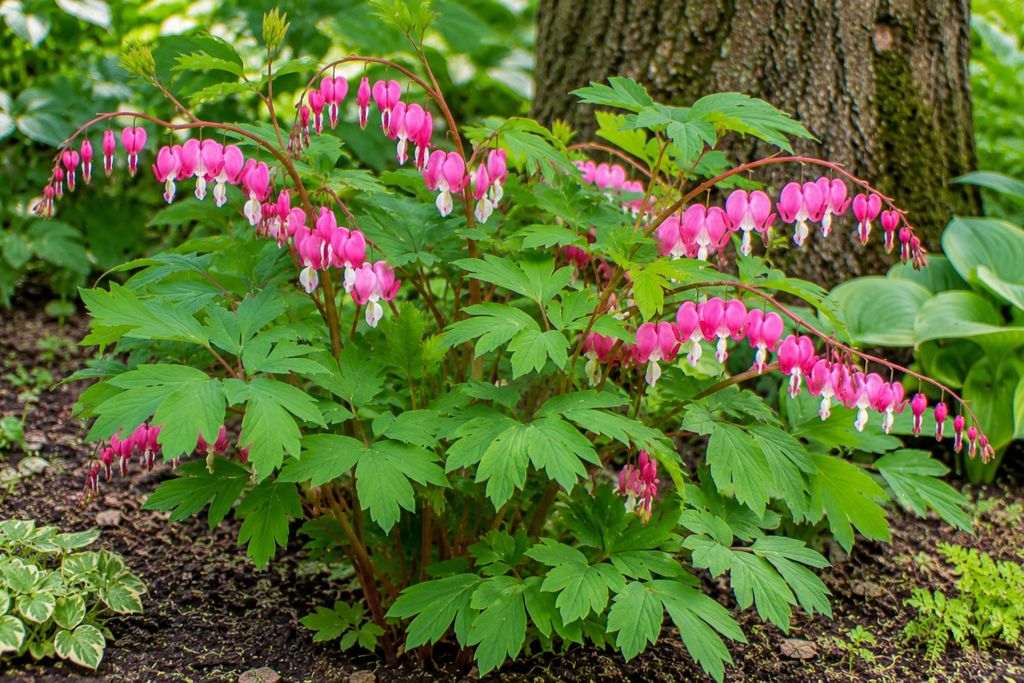
Old-fashioned bleeding heart (Lamprocapnos spectabilis) carries rows of pink-and-white hearts on arching stems in spring, making it a showpiece in a woodland-style border. The catch is that it often fades by midsummer, with the foliage yellowing and disappearing, particularly in warm weather.
That is normal dormancy, not a problem, but it leaves a gap. Tuck it behind or between hostas and ferns, whose expanding leaves cover the empty space. Fringed bleeding heart (Dicentra eximia) is smaller, blooms for a longer stretch, and tends to keep its foliage longer. Parts of both are toxic if eaten.
10. Foamflower (Tiarella) (Zones 3–9)
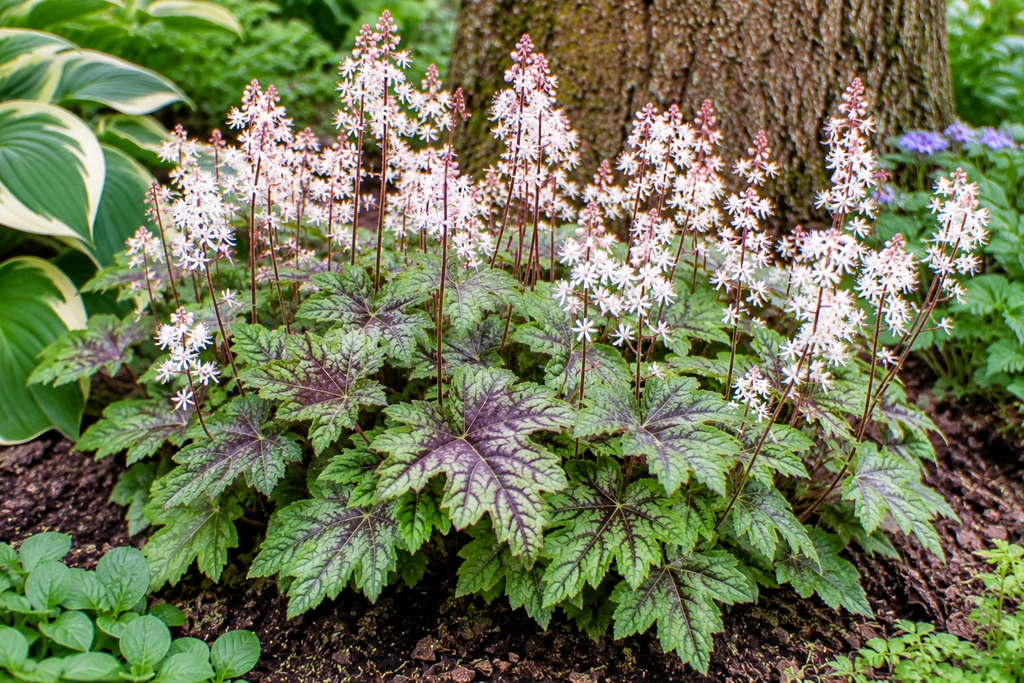
Foamflower sends up frothy spikes of white to pale pink flowers in spring above maple-shaped leaves, many of which have dark markings. The species Tiarella cordifolia spreads by runners to form a low ground cover, while many hybrid selections form tidy clumps instead, so check which kind you are buying.
It does best in humus-rich, evenly moist but well-drained soil and partial to full shade. It is a good match for the edge of a border, where the foliage softens a hard line against a path or lawn.
11. Bigroot Geranium (Geranium macrorrhizum) (Zones 3–8)
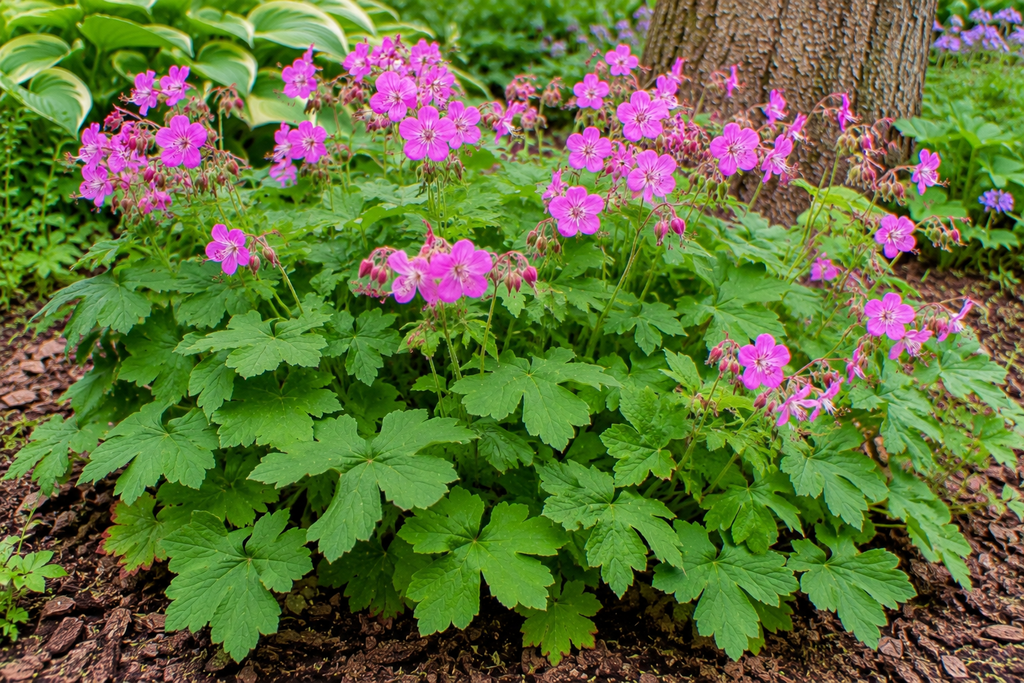
This is a hardy perennial geranium, not the annual pelargonium sold in window boxes. Bigroot geranium is one of the toughest plants for dry shade beneath trees. Its soft, scented leaves form a dense, weed-suppressing mat that is semi-evergreen and often turns red and orange in fall, and the magenta, pink, or white flowers appear in late spring.
It spreads steadily by thick rhizomes, so give it room or plan to divide it. Deer generally avoid the aromatic foliage. It is a sensible choice around the base of larger trees where little else will grow.
12. Sweet Woodruff (Galium odoratum) (Zones 4–8)
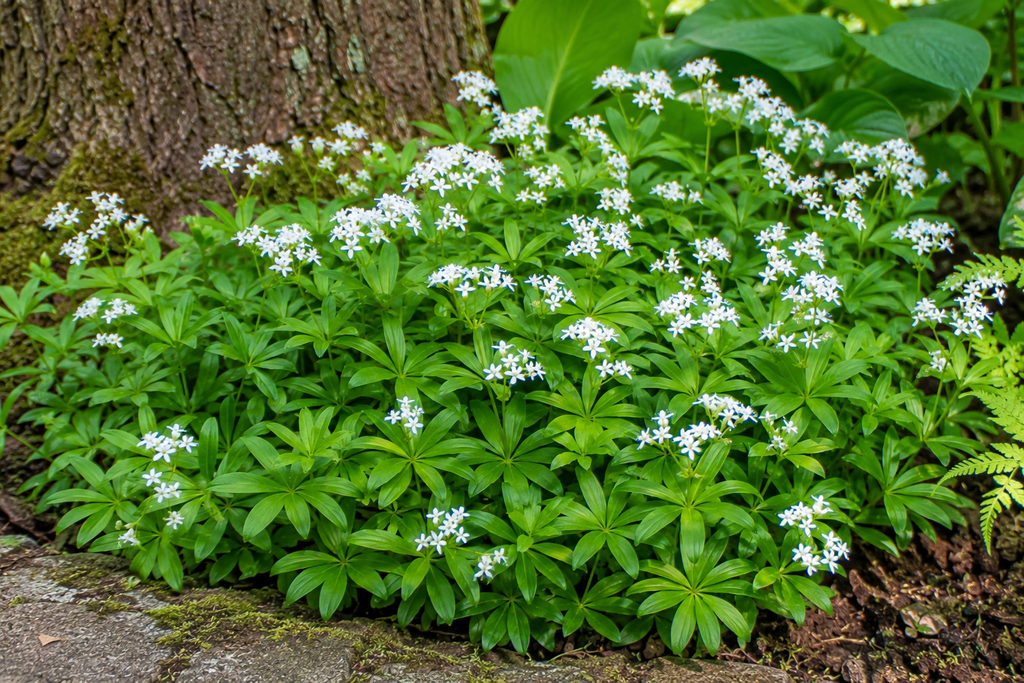
Sweet woodruff is a low carpet of whorled leaves topped with tiny white star-shaped flowers in spring. It is a pretty, light-reflecting ground cover under trees and, when dried, the foliage has a faintly sweet, hay-like scent.
It spreads readily, especially in moist soil, and can crowd smaller neighbors, so it is best used where you want a carpet rather than mixed in a border of delicate plants. It also prefers cooler summers; in hot, humid regions it can struggle. Consider it for cool-climate gardens or the shadiest, coolest part of the bed.
13. Solomon’s Seal (Polygonatum) (Zones 3–9)
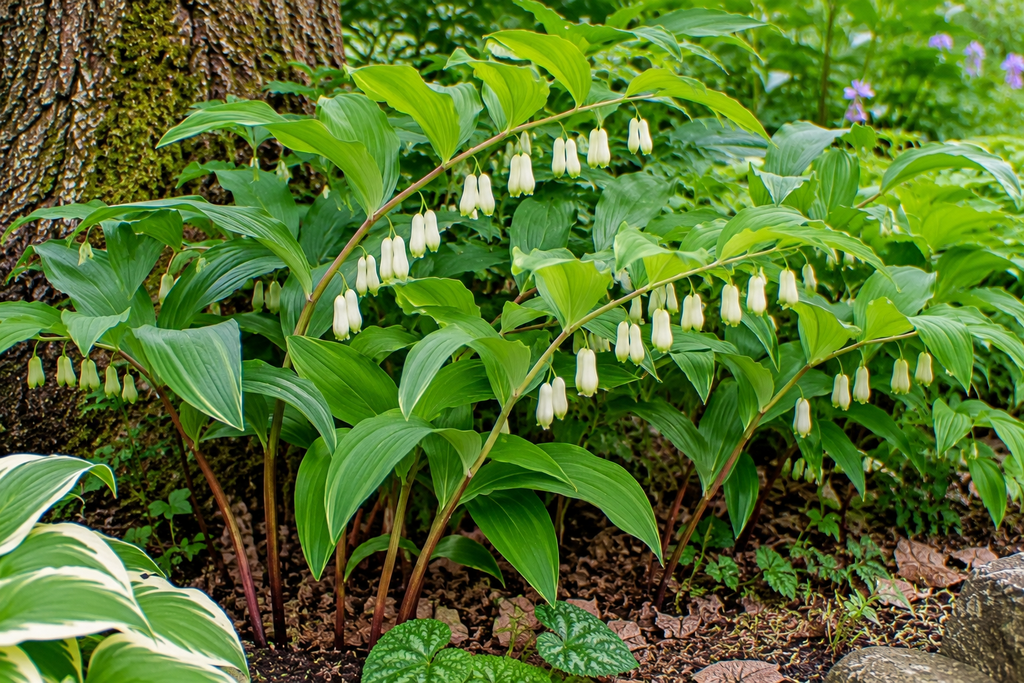
Solomon’s seal sends up elegant arching stems with pairs of leaves and rows of dangling, bell-shaped white flowers in spring. The variegated form (Polygonatum odoratum var. pluriflorum ‘Variegatum’) has cream-edged leaves that light up shade and often turn yellow in fall.
It grows from rhizomes and slowly forms a graceful colony, making it a good vertical element at the back of a border. Deer tend to leave it alone. Its main pest is the Solomon’s seal sawfly, whose larvae can strip the foliage in early summer; if the leaves start to look lacy, inspect them promptly. The berries and other parts can cause stomach upset if eaten.
14. Astilbe (Zones 4–8)
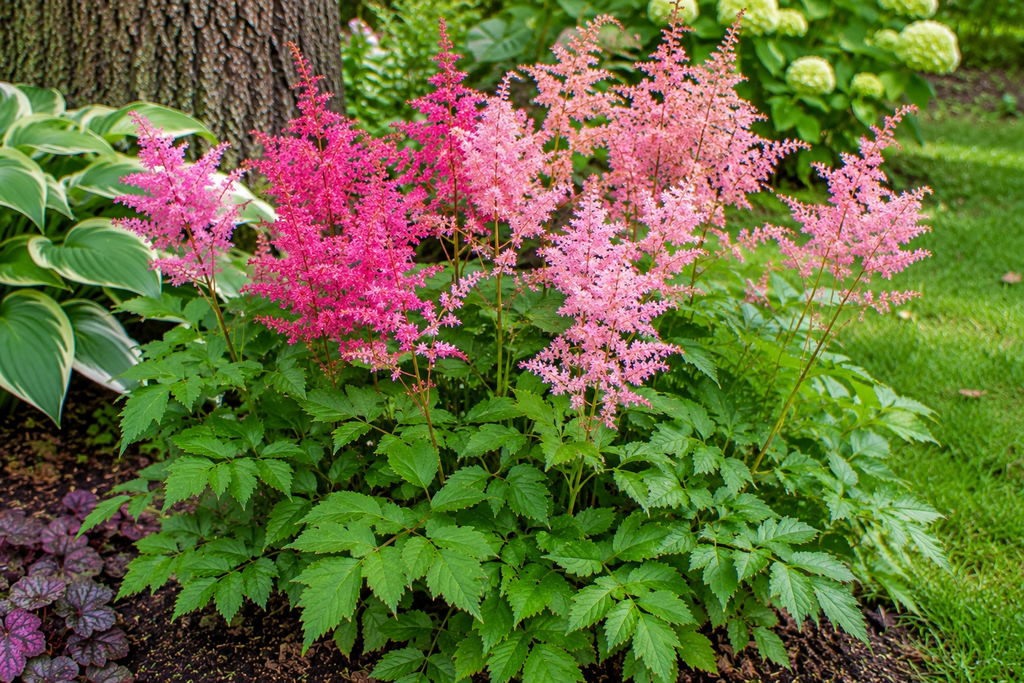
Astilbe offers feathery plumes of white, pink, red, or lavender in early to midsummer, which is a stretch when many shade plants have finished blooming. The ferny foliage is attractive in its own right.
The condition to take seriously is moisture. Astilbe wilts and crisps in dry soil, so it is not a plant for the driest area beneath a large tree unless you are prepared to water. Used in the lower, moister part of the border, or near a downspout or irrigation line, it does very well. Choose cultivars by height, as they range from under a foot to around four feet.
15. Liriope (Lilyturf) (Zones 5–10)
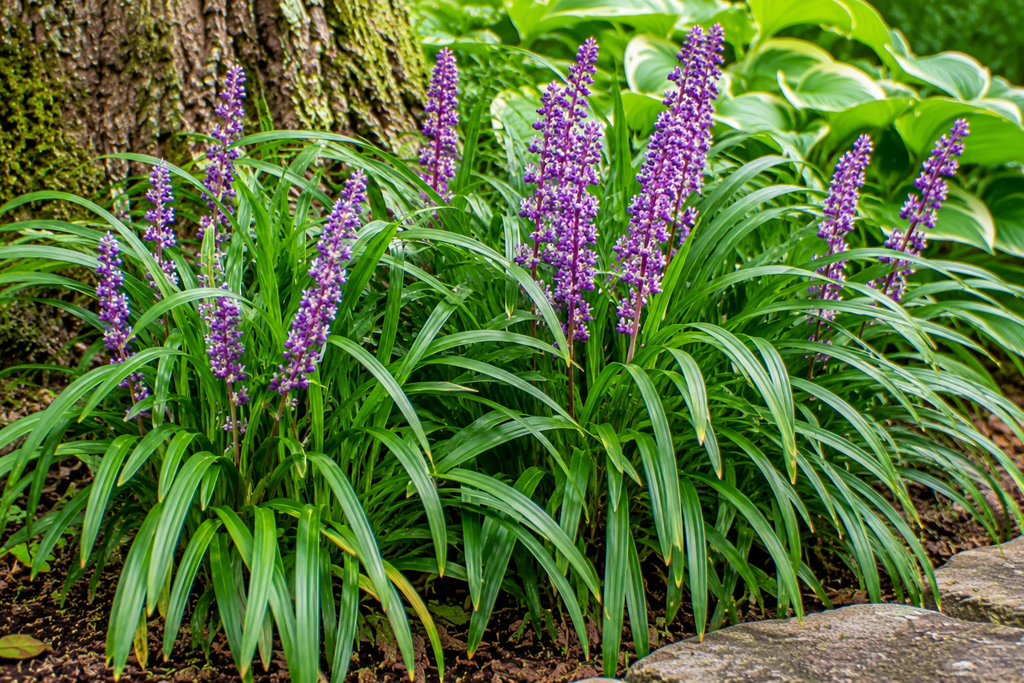
Liriope is a tough, grassy evergreen with arching strap leaves and spikes of lavender or white flowers in late summer, followed by dark berries. It tolerates dry shade and tree-root competition well, and its tidy habit suits the front edge of a border or a path.
There is an important distinction between clumping Liriope muscari, which stays put, and spreading Liriope spicata, which can run aggressively and is considered invasive in some parts of the Southeast. Check with your local extension office if you garden in that region. Shear the foliage close to the ground in late winter, before new growth starts, to remove winter-damaged leaves.
Quick Comparison by Condition
| Condition | Plants that tend to cope |
| Dry shade near trunks | Epimedium, bigroot geranium, hellebore, Christmas fern, liriope |
| Moist shade toward the border edge | Astilbe, brunnera, Japanese forest grass, Japanese painted fern, hosta |
| Deep shade, little direct light | Hosta, ferns, epimedium, Solomon’s seal |
| Deer-heavy areas | Hellebore, brunnera, epimedium, bigroot geranium, Solomon’s seal (hosta is often browsed) |
| Early-season color | Hellebore, lungwort, brunnera, bleeding heart |
No plant is completely deer-proof, and hungry deer will sample almost anything, so treat the deer column as a tendency rather than a guarantee.
Arranging the Border So It Looks Planned
A bed of single plants dotted at random looks busy and unfinished. A few habits fix that.
Plant in drifts of three, five, or seven of the same plant, and repeat key plants along the border. Repetition gives the eye something to follow, which matters more in shade where flowers are fewer and color is subtle.
Work with contrast in leaf shape and texture rather than relying on flowers. Pair the broad leaves of hosta with the fine texture of ferns, the strappy form of liriope or forest grass, and the rounded leaves of heuchera or brunnera. A silver-leaved plant next to a dark one reads clearly even in low light.
Place taller plants such as Solomon’s seal and astilbe at the back or toward the trunk side, mid-height plants like hosta, ferns, and hellebore in the middle, and low plants such as foamflower, sweet woodruff, and bigroot geranium at the front. Curve the border’s edge instead of ruling it straight; curved beds also make it easier to avoid major roots as you plan.
To keep something blooming through the year, mix by season. Hellebore carries late winter, lungwort, brunnera, epimedium, bleeding heart, and foamflower take spring, bigroot geranium and Solomon’s seal follow into early summer, astilbe handles midsummer, and liriope covers late summer. Between the flowers, foliage plants such as hosta, heuchera, ferns, and forest grass hold the border together.
What Goes Wrong in the First Two Years
Most failures in a tree-root bed trace back to a handful of causes.
Underwatering after planting. The tree’s roots are established; the new plant’s are not. A bed that looks shaded and cool can be bone dry a few inches down. Check with a finger or trowel rather than judging by the surface.
Planting too deep. Crowns of hosta, heuchera, and ferns should sit at soil level. Buried crowns rot, and dug-in plants are slower to recover.
Using one plant for every condition. A moisture-loving plant in dry soil and a dry-shade plant in a soggy low spot both underperform. Match the plant to the spot within the bed, as described above.
Ignoring slugs until it is too late. Hosta and some other soft-leaved plants attract them. Reducing heavy mulch right against the plants, watering in the morning so the soil surface is drier at night, and choosing thicker-leaved varieties help. Follow the label exactly on any slug bait, and look for products labeled safe for use around pets and wildlife if those are a concern.
Expecting a full border in year one. Perennials planted small typically take two to three growing seasons to fill in. A bed that looks thin in the first spring is on schedule, not failing.
Fertilizing heavily. Shade plants in a root-filled bed generally do not need heavy feeding, and strong fertilizer near a tree can push soft growth without benefiting either. A topdressing of compost in spring is usually enough.
If the tree itself looks stressed, with thinning crowns, dead branches, or heaving ground near large roots, or if you are unsure about working near a very large or valuable tree, consult a certified arborist before digging.
Questions Readers Ask
Can I plant right up to the trunk?
It is best not to. Leave a clear space of several inches around the base of the trunk, keep mulch pulled back from the bark, and begin planting a little farther out. The flare at the base of the trunk needs air, and constant moisture against bark invites decay. The ground very near the trunk is also the driest, with the densest root competition.
What if a plant fails even though the shade is right?
Check moisture first. In root-filled beds, dryness is the likeliest culprit even when the surface looks fine. If the soil is damp but the plant is struggling, look at planting depth and drainage. Swapping in a tougher dry-shade plant such as epimedium or bigroot geranium often works better than adding more water or more soil.
How do I plant around a lot of surface roots?
Skip any spot with a large root. Plant in the gaps, use small plants, and dig by hand. If there is almost no soil exposed, a thin layer of mulch and a few plants in the pockets is more realistic than a full border. Raised beds filled with deep soil over the roots tend to hurt the tree, so avoid building one.
Key Takeaways
A good border under a tree starts with the conditions rather than the plant list: how much light arrives, whether the soil is dry or moist, and how crowded the roots are. Choose epimedium, bigroot geranium, hellebore, Christmas fern, or liriope for the driest spots, and save astilbe, brunnera, and Japanese forest grass for the moister edge.
Plant small, dig by hand, leave large roots alone, and keep added soil and mulch shallow and away from the trunk. Water new plants carefully through the first year, and expect the bed to fill in over two to three seasons. Check hardiness zones, juglone sensitivity if the tree is a black walnut, and any local invasive-plant concerns for liriope before you buy.

About Syprose Kiche
Syprose Kiche is the creator and writer behind My Besuited Home, a practical home and garden website covering DIY projects, gardening, lawn care, landscaping, home improvement, and outdoor living. She focuses on turning everyday homeowner questions into clear, practical guides backed by careful research and useful real-world considerations.