
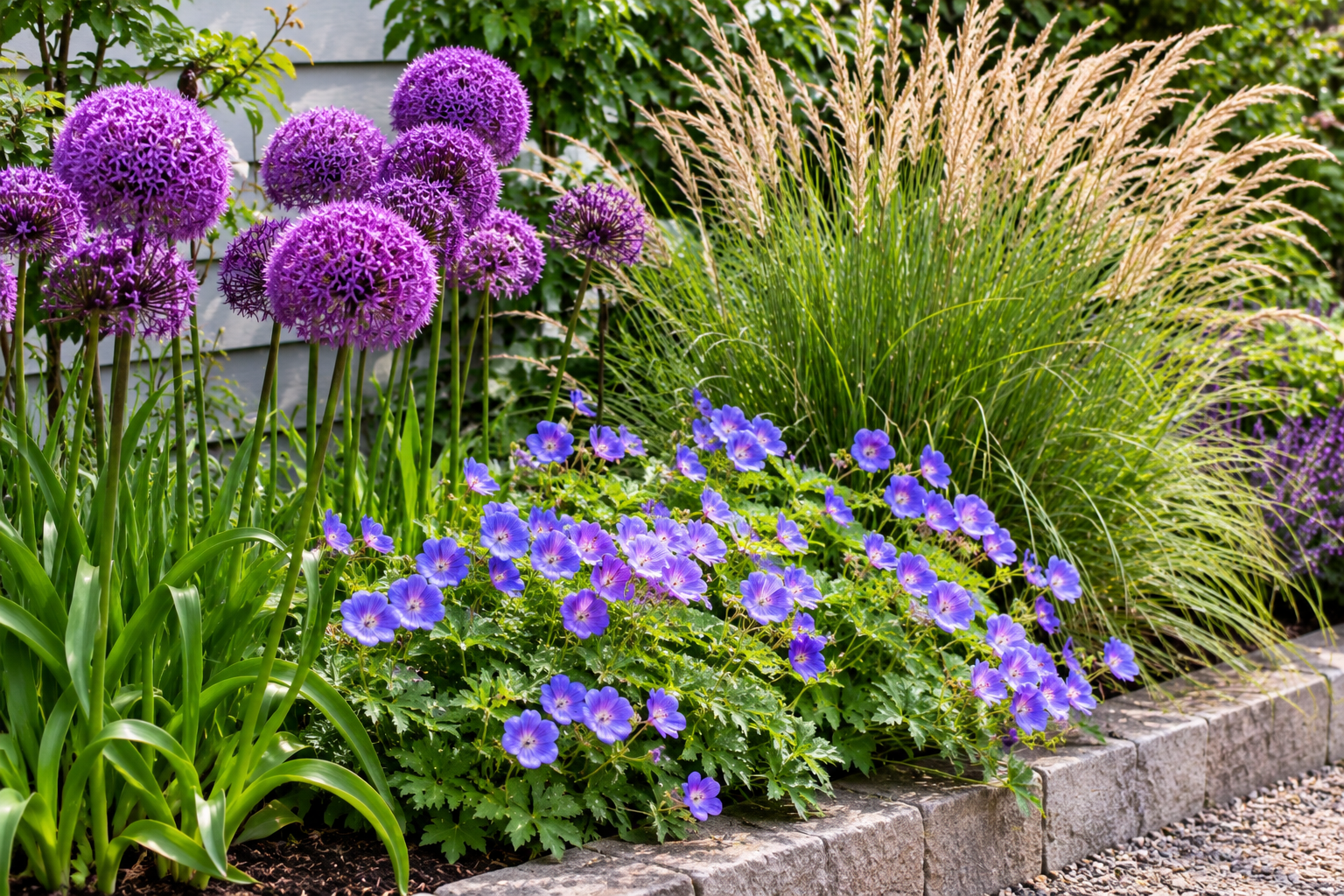
A border full of peonies looks spectacular for about two weeks. Then the petals drop, the plants turn into green mounds, and the bed sits quiet until something else wakes up. Most people who plant a flower border run into this by the second year. Each plant has a bloom window, usually two to six weeks, and a bed built from favorites that all bloom in June will have a great June and a dull rest of the year.
The fix is not more plants. It is choosing plants whose windows hand off to each other, so that when one finishes, something nearby is just getting started. The fifteen combinations below are built that way. Each one lists a bloom sequence, why the plants work together, and the problem most likely to trip you up.
How to Build a Border That Hands Off From Season to Season
Before the combinations, a few rules explain why they work. Once the logic is clear, you can swap in plants that suit your own climate and soil.
Plan around three bloom layers, not twelve months
Trying to schedule a bloom for every week of the year usually produces a scattered bed with no impact at any time. A more workable plan uses three layers: something for spring, something for summer, and something for late summer through fall. Add a fourth layer of structure (seed heads, evergreen foliage, ornamental grass) for winter, and the bed has a reason to be looked at from March through February.
Each layer needs enough plants to read as a block. A single plant of each kind looks like a sampler. Groups of three to five of the same perennial, planted in a loose triangle or drift, read as a deliberate color patch from across the yard.
Let foliage cover the gaps
Spring bulbs and early perennials leave holes when they finish. Bulb foliage in particular has to stay in place until it yellows, which takes about six weeks after flowering, because the leaves are feeding the bulb for next year. The standard solution is to plant bulbs behind or among perennials whose leaves expand in late spring and screen the fading bulb foliage. Several combinations below use exactly that trick.
Bloom dates shift with your zone
Every bloom period in this article is approximate and written for a typical cold-to-moderate climate, roughly USDA zones 5 through 7. In zone 4, expect bloom a week or two later. In zone 8 or 9, spring plants bloom earlier, often by a month, and some of the cold-dependent ones (tulips, peonies, lilacs) struggle without enough winter chill. Hardiness ranges listed below are the commonly published ranges for the species; cultivars vary, so the plant tag or the grower’s description is the final word.
Check height and spread before you check color
A combination that looks balanced in a photo can fall apart if the tall plant goes in front. As a general rule, set the tallest plants at the back (or the center of an island bed), medium plants in the middle, and low edgers at the front. Then leave room. A perennial sold in a one-gallon pot often grows two to three feet wide in a few seasons, and crowding is the main reason borders get scruffy by year three.
Sunny Border Combinations
Full sun, meaning about six or more hours of direct light, supports the widest range of perennials and the longest bloom sequences.
1. Daffodils, Daylilies, and ‘Autumn Joy’ Sedum
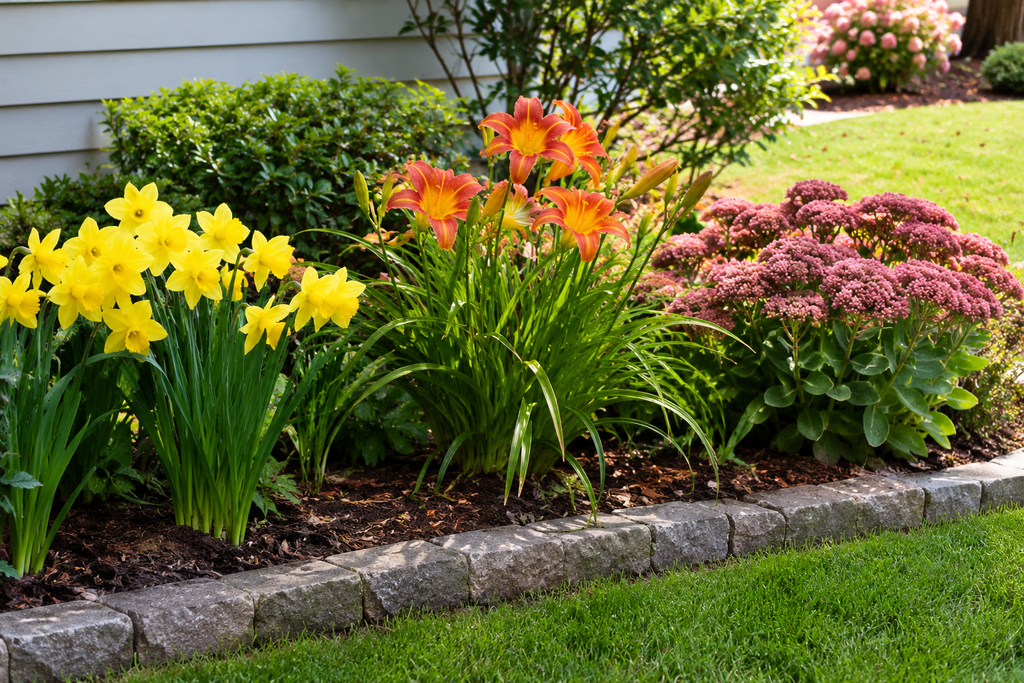
Bloom sequence: daffodils in April, daylilies from late June into August, sedum from late summer into October.
This is the easiest handoff in the article, and it works because of what each plant does when it is not blooming. Daylily foliage comes up in spring as the daffodils flower, then fans out over the fading daffodil leaves. Sedum stays a tidy, blue-green mound through the middle of summer, then swells into broad flower heads that start pale green, turn pink, then deepen to rusty red in fall.
Daffodils are hardy in roughly zones 3 to 8, daylilies in 3 to 9, and ‘Autumn Joy’ sedum in 3 to 9. Plant daffodil bulbs in fall at about three times their height, usually around 6 inches deep. Daffodils are also rarely eaten by deer or rodents, which makes them a good bulb for beds that get nibbled.
Watch out for: shade. Sedum flops open in the center when it gets less than about six hours of sun, and a floppy plant is a poor fall finale. If the bed is a little shady, shorter sedum varieties hold their shape better.
2. Tulips, Catmint, and Russian Sage
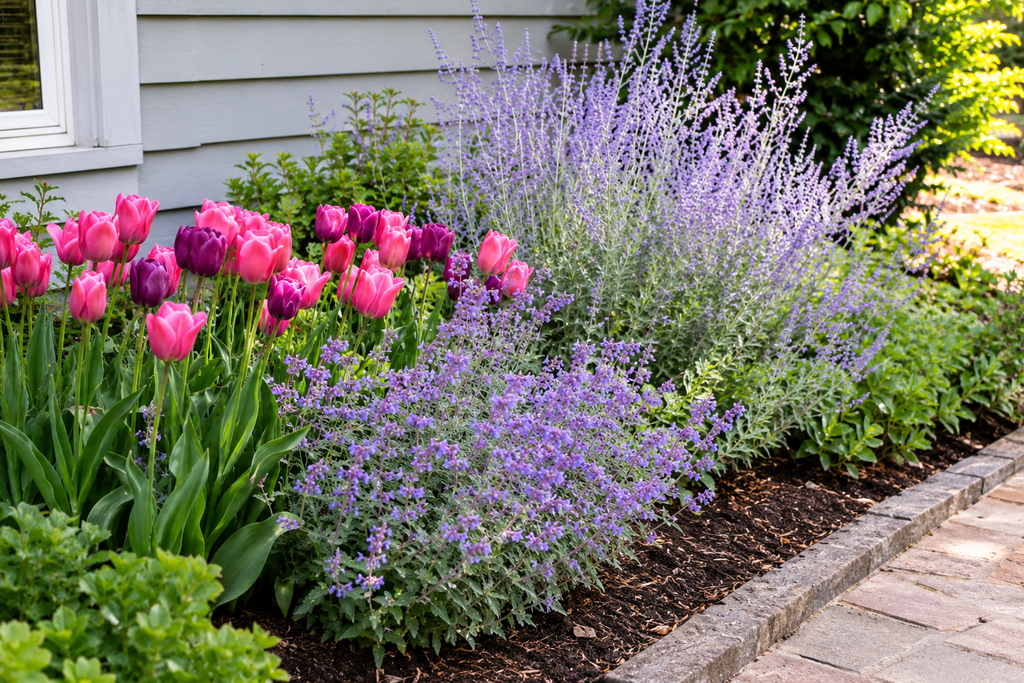
Bloom sequence: tulips in April and May, catmint from May into June with a second flush later, Russian sage from July into September.
Catmint (Nepeta) forms a loose, billowing mound that hides tulip leaves as they go yellow. After the first flush of purple-blue flowers fades, shearing the plant back by about a third to a half prompts new growth and a second round of bloom. Russian sage takes over in midsummer with silvery stems and hazy lavender flowers on plants that can reach three to four feet.
The weak point is the tulips. In many climates, tulips bloom well the first spring and then decline, and they are a favorite food of deer and voles. Treat them as a short-lived layer to be refreshed every few years, or choose species tulips and the Darwin hybrids, which tend to come back more reliably. Catmint is hardy in zones 3 to 8 depending on variety, and Russian sage in zones 4 to 9.
Watch out for: drainage. Russian sage rots in soil that stays wet through winter, and catmint is happiest in the same lean, well-drained conditions. A bed that holds water is not the place for this pairing.
3. Alliums, ‘Rozanne’ Geranium, and Feather Reed Grass
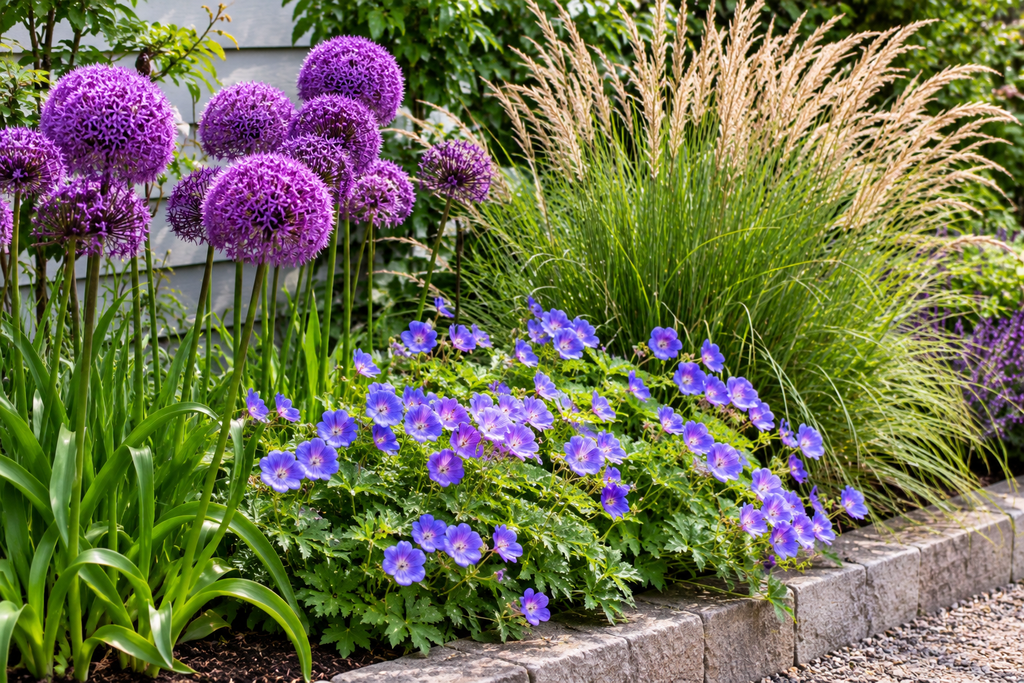
Bloom sequence: alliums in May and June, ‘Rozanne’ hardy geranium from June until frost, feather reed grass plumes from June through winter.
Ornamental alliums such as ‘Purple Sensation’ produce round, violet-purple globes on stems of two to three feet. The foliage starts yellowing about as the flowers open, which is why the combination needs company. ‘Rozanne’ geranium, a sterile hybrid that puts out violet-blue flowers for months without needing to set seed, spreads into the gaps and covers the mess. The upright grass ‘Karl Foerster’ adds vertical lines, flowers in early summer, and keeps its tan plumes standing through winter before being cut down in late winter.
Alliums are hardy in about zones 4 to 8, ‘Rozanne’ in roughly 5 to 8, and feather reed grass in 4 to 9. Allium bulbs go in during fall, about four to six inches deep depending on the size of the bulb, and the package label is worth following.
Watch out for: the early weeks of spring. Feather reed grass is a cool-season grass that grows early, so the clump looks full by May, but the geranium may still be small. That is normal and fills in by midsummer.
4. Peonies, ‘May Night’ Salvia, and Purple Coneflower
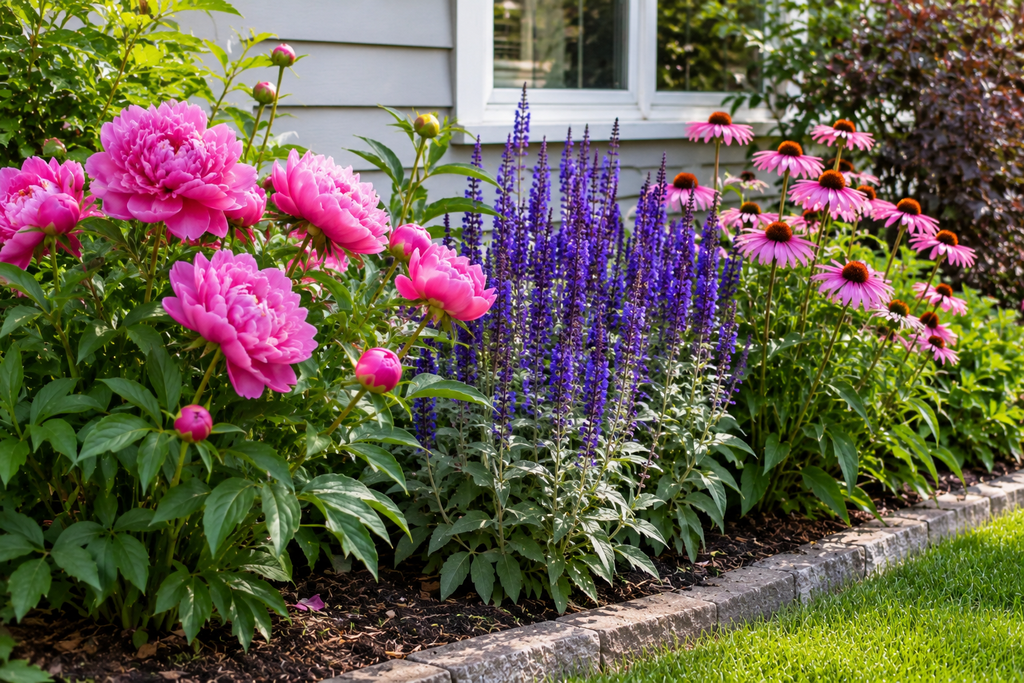
Bloom sequence: peonies in late spring, salvia from May into June (with a rebloom), coneflowers from July into September.
A peony plant is in full bloom for only about a week or two, but the foliage stays handsome through fall, which makes it a good anchor for a bed rather than a one-act show. ‘May Night’ salvia blooms at the same time in deep violet spikes, and cutting it back after the first flush prompts a second, lighter flush later in summer. Purple coneflower then carries the bed through the hottest months, and the seed heads left standing in fall feed goldfinches.
Peonies are hardy in about zones 3 to 8. The single most common reason a peony fails to bloom is planting too deep. The reddish buds (called eyes) on the root should sit only about one to two inches below the soil surface, and deeper planting often produces healthy leaves with no flowers. Peonies also dislike being moved, so decide on the spot before planting.
Watch out for: tall peony varieties that flop in rain. A simple wire ring set over the plant in early spring holds the stems up as they grow through it.
5. Baptisia, Coneflower, and Little Bluestem
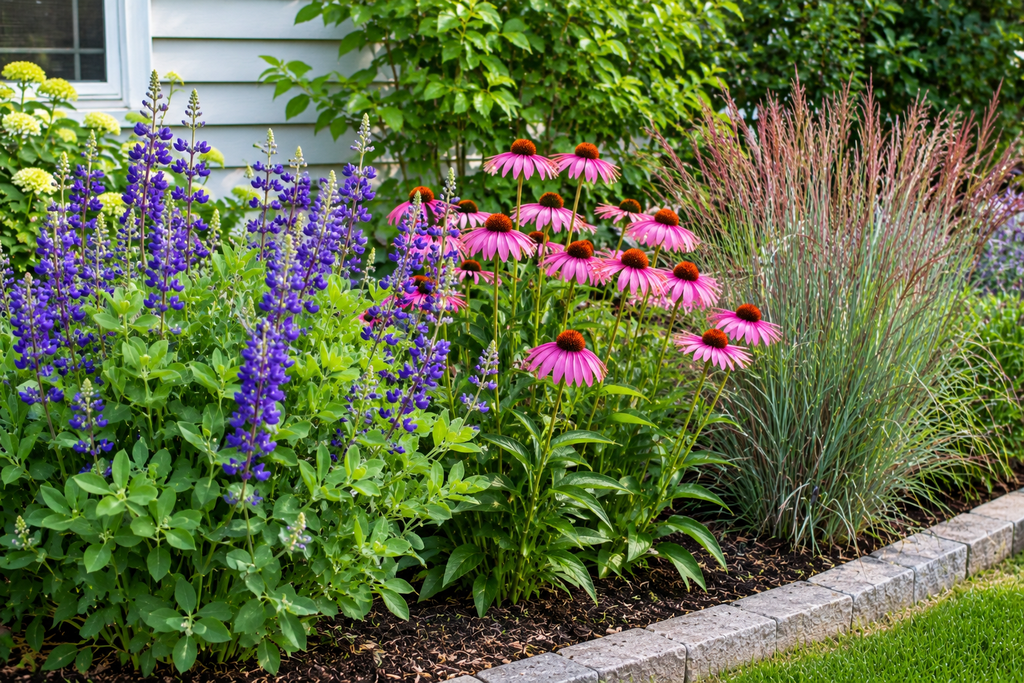
Bloom sequence: baptisia in May and June, coneflower in summer, little bluestem coloring in fall and standing through winter.
This is a prairie-style border with a long season of interest. False indigo (Baptisia australis) produces blue lupine-like flower spikes in late spring, then forms a rounded, shrubby mound of blue-green foliage and dark, rattling seed pods that look good into winter. Little bluestem, a native grass, stays blue-green in summer and turns copper and orange in fall. The coneflowers bridge the two.
The tradeoff is patience. Baptisia develops a deep taproot and is slow to establish, often taking two or three years to flower heavily, and it does not like being transplanted afterward. Give it permanent space (three feet wide is reasonable) from the start. Baptisia is hardy in about zones 3 to 9, little bluestem in 3 to 9.
Watch out for: tidiness. This combination looks natural rather than formal, which suits some yards and clashes with others. Mowed edging along the front helps it read as intentional.
6. Shrub Rose, Siberian Iris, and Catmint
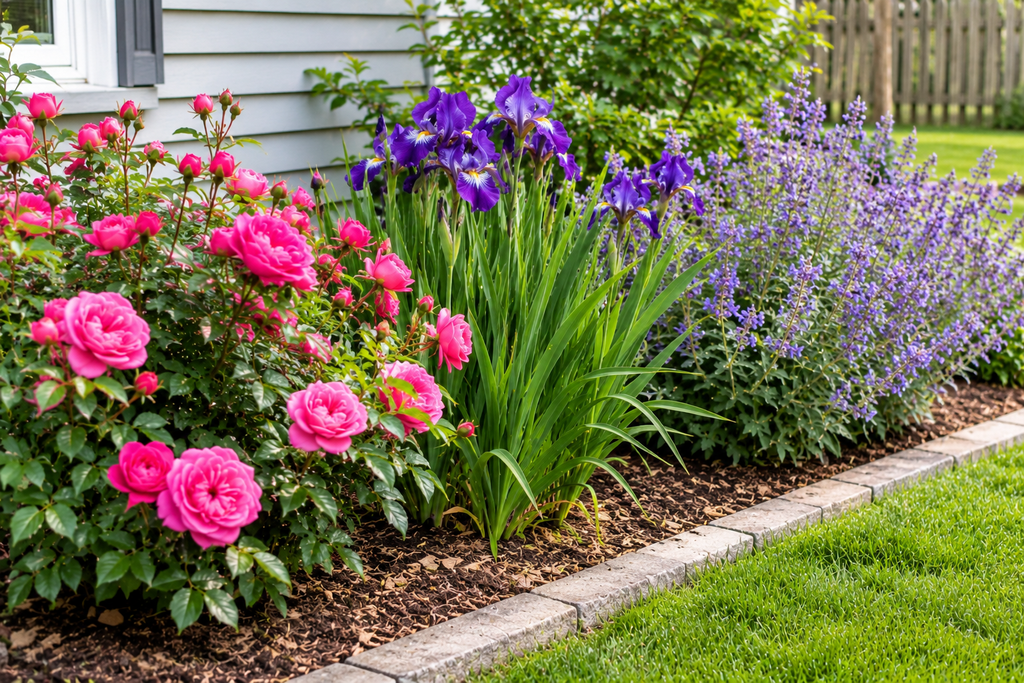
Bloom sequence: iris in late May and June, catmint in May and June with a rebloom, a repeat-blooming shrub rose from June until frost.
Siberian iris produces slim, upright foliage that stays presentable all season, long after the flowers are gone, unlike bearded iris whose leaves often look ragged by late summer. Behind it, a repeat-blooming shrub rose supplies color from early summer onward, and catmint softens the front edge.
Roses vary enormously in disease resistance, so choose a variety bred for it. The Knock Out series is widely sold for that reason and is generally listed for zones 5 to 9, but verify the exact variety’s range and mature size, since some roses reach four feet across or more.
Watch out for: water. Siberian iris tolerates moist soil, roses want regular water during establishment, and catmint prefers it drier. In practice, plant the catmint on the edge where the soil drains slightly faster, and put the iris and rose where they get the most irrigation.
7. Yarrow, Russian Sage, and Hardy Sedum for Dry Beds
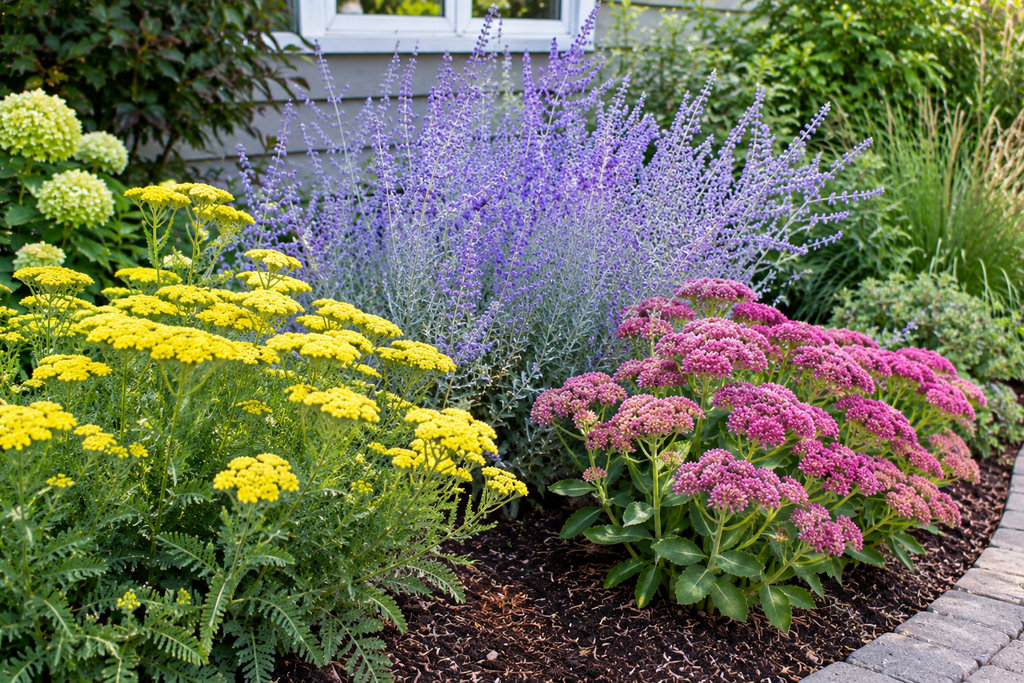
Bloom sequence: yarrow from June into September, Russian sage from July into September, sedum from late summer into fall.
This is a low-water combination for hot, dry, sunny strips: along a driveway, beside a south-facing wall, or on a slope where irrigation is impractical. Yarrow forms flat flower heads in yellow, pink, or white on ferny gray-green foliage, and deadheading spent heads often extends the bloom. Russian sage adds height and a long blue haze.
All three are drought-tolerant once established, usually after the first full growing season, but they will need regular watering in that first year. They are also generally disliked by deer. Yarrow and sedum are hardy in about zones 3 to 9, Russian sage in 4 to 9.
Watch out for: rich soil and fertilizer. These plants grow lanky and flop when overfed, and compost applied heavily every spring defeats the purpose. Lean soil keeps them compact.
Part Shade and Shade Combinations
Shade borders bloom less loudly, so they lean on foliage texture and on well-timed flower bursts. “Shade” here means dappled light or roughly three to five hours of sun; deep shade under dense evergreens is a harder problem that few flowering perennials solve.
8. Snowdrops, Hellebores, and Hostas
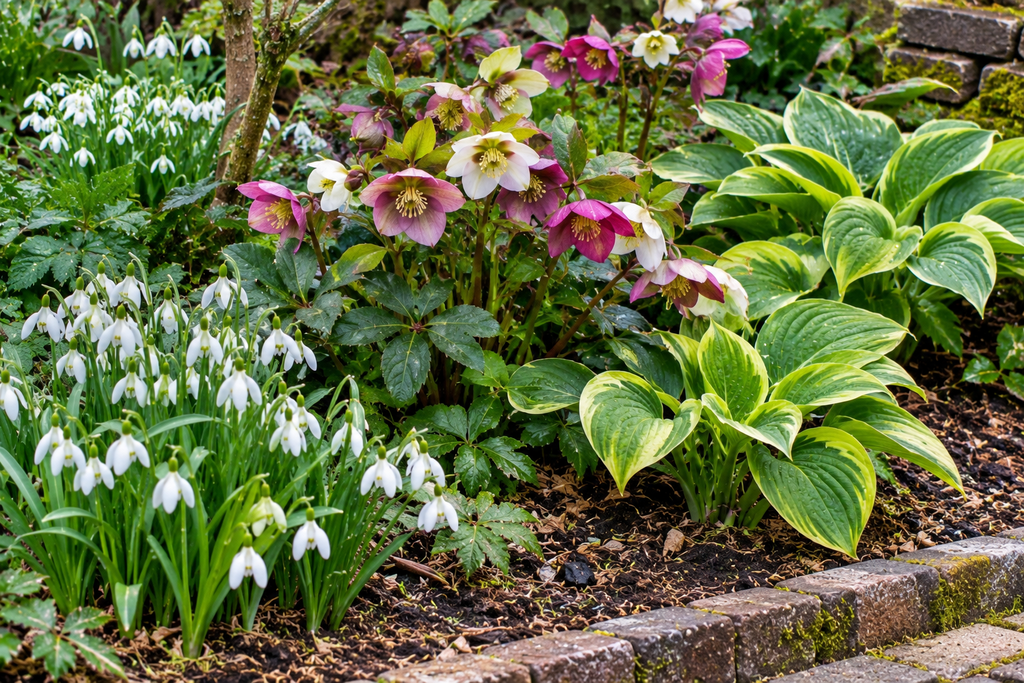
Bloom sequence: snowdrops from February into March, hellebores from late winter into April, hostas providing foliage from May on, with flower spikes in summer.
This pairing earns its place at the front door or along a path, because it blooms when almost nothing else does. Snowdrops (zones 3 to 7 or so) push through cold soil and even snow, and hellebores (zones 4 or 5 to 9) hold their nodding flowers for weeks. Hostas then come up late in spring and cover the area where the early plants are fading, so the bed never looks empty.
Hellebore leaves are evergreen in milder winters and benefit from having last year’s tattered leaves trimmed off in late winter, before the flower stalks emerge, so that the blooms show. A word on safety: hellebores, snowdrops, and hostas are all considered toxic to pets if eaten, and hellebore sap can irritate bare skin, so wear gloves when cutting them back.
Watch out for: slugs, which find new hosta leaves quickly in damp springs. If the bed is slug-prone, thicker-leaved varieties tend to suffer less damage than thin-leaved ones.
9. Bleeding Heart, Astilbe, and Japanese Anemone
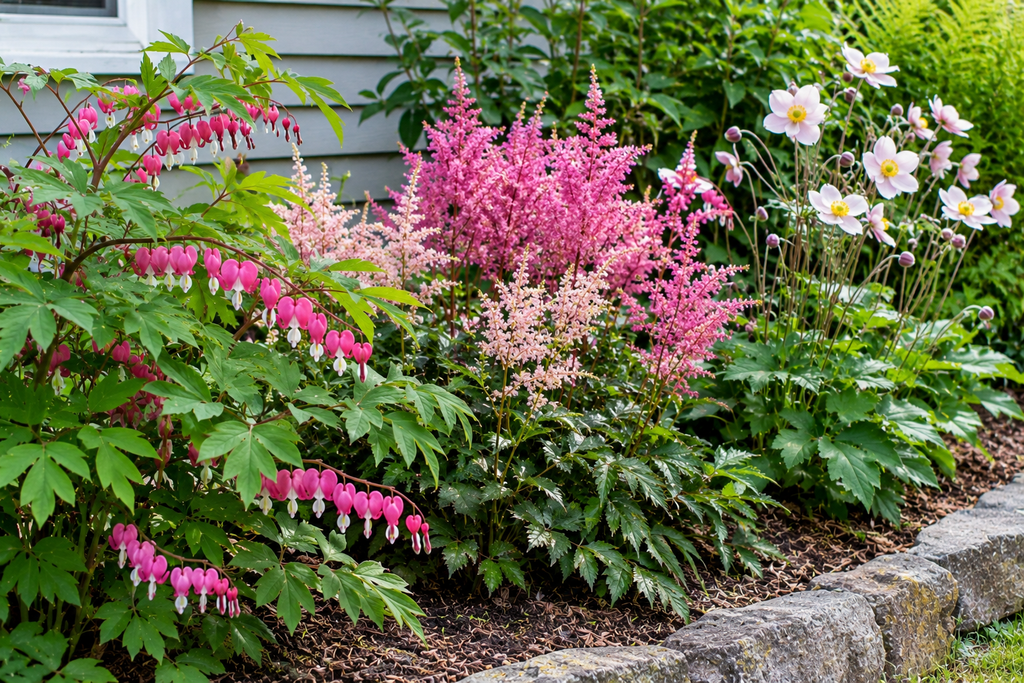
Bloom sequence: bleeding heart in April and May, astilbe in June and July, Japanese anemone from August into October.
A classic woodland sequence. Old-fashioned bleeding heart has arching stems of pink-and-white hearts in spring, then often fades and goes dormant by midsummer, especially in heat. Astilbe’s feathery plumes come up in the gap it leaves, and Japanese anemone closes the season with tall, airy stems of pink or white flowers when most shade plants are finished.
Astilbe needs consistently moist soil, and a few dry weeks in summer can brown its leaf edges, so this is not a bed for a dry spot under a mature tree. Japanese anemone spreads by underground runners and can crowd neighbors over time. Bleeding heart is hardy in about zones 3 to 9, astilbe in 3 to 8, and Japanese anemone in about 4 or 5 to 8.
Watch out for: the summer gap. Because bleeding heart disappears, put a hosta or fern beside it so the bare patch is not a surprise.
10. Brunnera, Coral Bells, and Japanese Forest Grass
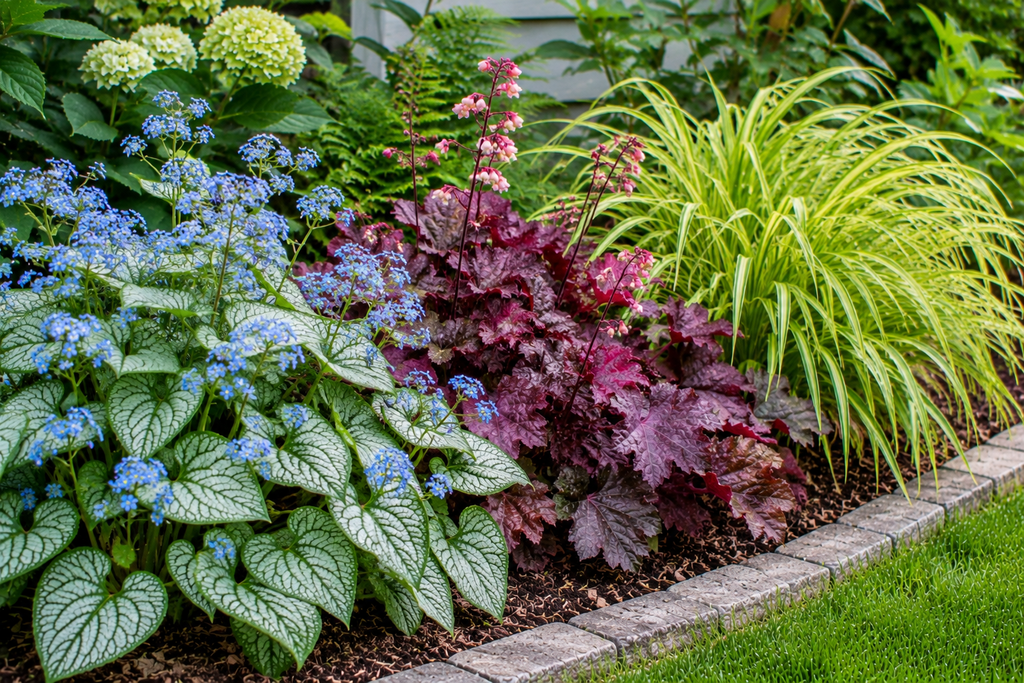
Bloom sequence: brunnera in April and May, coral bells (Heuchera) flower sprays in June and July, forest grass for foliage all season.
When the goal is color that lasts all season rather than an explosion of flowers, this is the combination to choose. Brunnera has small sky-blue flowers like forget-me-nots, and varieties such as ‘Jack Frost’ are grown as much for their silver, green-veined leaves as for blooms. Coral bells come in burgundy, lime, amber, and near-black leaf colors. Japanese forest grass (Hakonechloa) adds a cascading, bamboo-like texture, and golden varieties brighten dark corners.
Forest grass is slow to bulk up, and this is a bed that rewards patience. Brunnera is hardy in zones 3 to 8, coral bells in 4 to 9, and forest grass in 4 to 9.
Watch out for: heat and wet winters. Heuchera crowns can heave out of the ground in freeze-thaw cycles or rot in soggy soil, so mulch lightly and push any lifted plants back in during spring.
Shrub-Backed and Mixed Borders
Shrubs give a border bones. They hold the bed together when perennials are dormant, and they bloom at times perennials do not.
11. Lilac, ‘Limelight’ Hydrangea, and Montauk Daisy
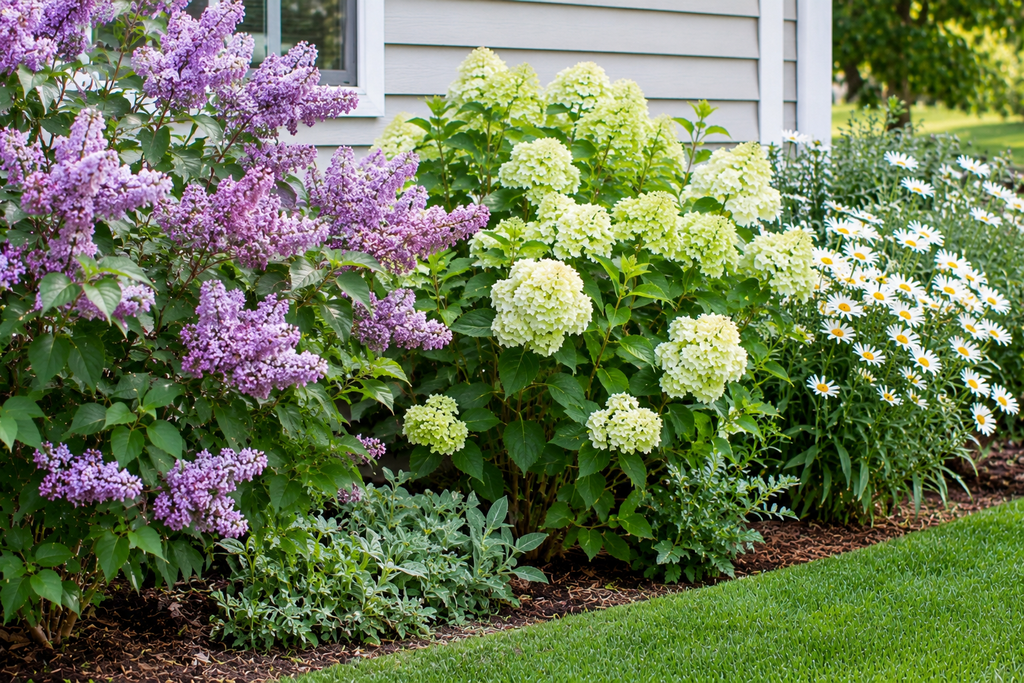
Bloom sequence: lilac in late April and May, panicle hydrangea from July into October, Montauk daisy in September and October.
Three stages, three heights. Common lilac (zones 3 to 7) is the spring backbone and can reach eight to fifteen feet, so it needs space. ‘Limelight’ hydrangea blooms on new wood, so it can be pruned in late winter without sacrificing flowers, and its blooms open lime green, fade to cream, then blush pink as autumn cools. Montauk daisy (zones 5 to 9) sits in front and opens white daisies when most of the garden is winding down.
Pruning matters here. Lilacs set next year’s buds soon after flowering, so any pruning should happen right after bloom, not in fall or spring. Montauk daisies grow tall and leggy unless pinched back once in early summer, traditionally by the Fourth of July, which keeps the plants compact.
Watch out for: lilac powdery mildew. It is common in humid summers and mostly cosmetic. Good air circulation helps more than spraying.
12. A Three-Level Bulb Layer Under Perennials
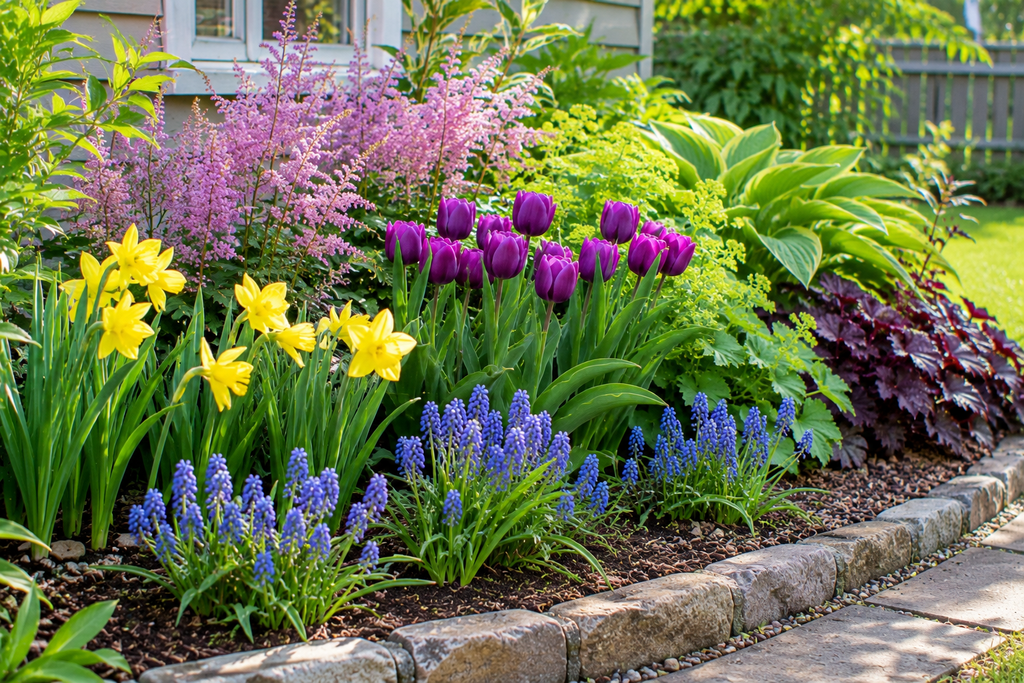
Bloom sequence: crocus in February and March, daffodils in April, tulips in late April and May, alliums in May and June, then perennials above them.
This is less a plant pairing than a technique. Bulbs of different sizes can share the same square foot of soil because they are planted at different depths: smaller bulbs such as crocus go in about three to four inches down, daffodils about six, and larger tulips and alliums deeper still. When planted in fall in overlapping layers, they flower in succession over three months or more. Perennials planted on top, such as hardy geraniums and daylilies, grow up and hide the fading bulb foliage.
The quality of this approach depends on drainage and restraint. Bulbs rot in soil that stays wet, and a layered planting can get overcrowded after a few years. Mark the area in spring so you avoid digging into it later.
Watch out for: squirrels, which dig up crocus and tulips. Laying chicken wire or hardware cloth over the planted area until the ground freezes, then removing it in spring, is the standard remedy. Alliums, daffodils, and snowdrops are usually left alone.
13. Bee Balm, Coneflower, and New England Aster for Pollinators
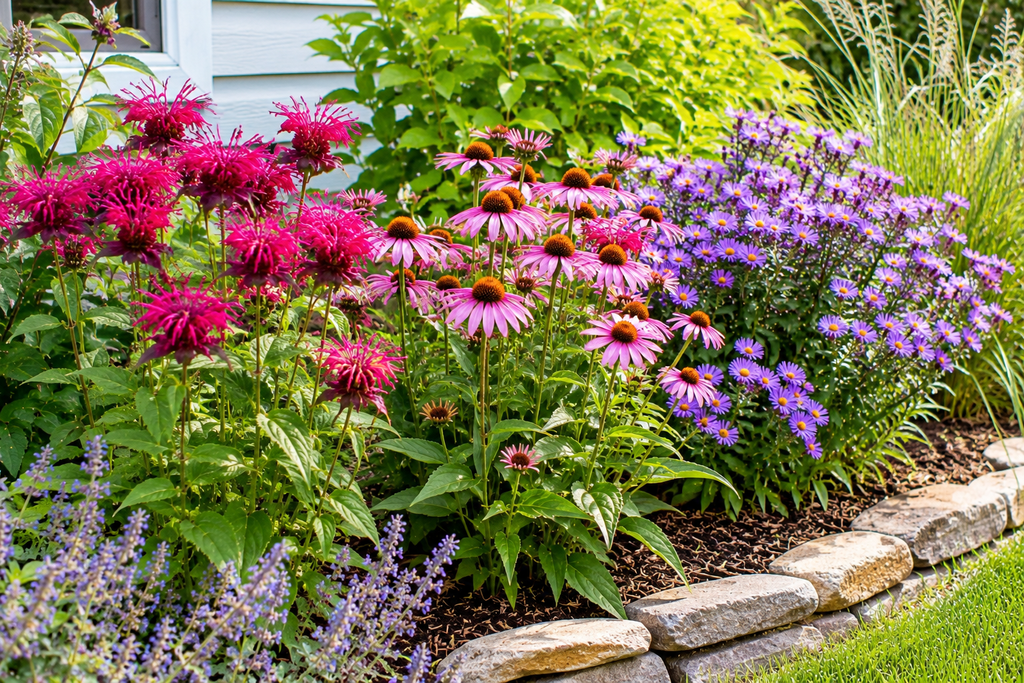
Bloom sequence: bee balm in July and August, coneflower from July into September, aster in September and October.
This combination feeds pollinators from midsummer into fall, which is when many native bees and migrating monarchs need nectar the most. Bee balm (Monarda) draws hummingbirds, coneflower draws bees and butterflies, and asters bring in late-season foragers when little else is open.
Bee balm is prone to powdery mildew, which is mostly a cosmetic problem but can leave plants looking ragged in August. Look for varieties sold as mildew-resistant and give them good airflow. New England aster can reach three to six feet, though shorter selections such as ‘Purple Dome’ stay around two feet and do not need staking. Bee balm is hardy in about zones 4 to 9, aster in 4 to 8.
Watch out for: spreading. Bee balm runs, so lift and divide clumps every two or three years to keep them where they belong.
14. Creeping Phlox, Dianthus, and Lamb’s Ear for the Front Edge
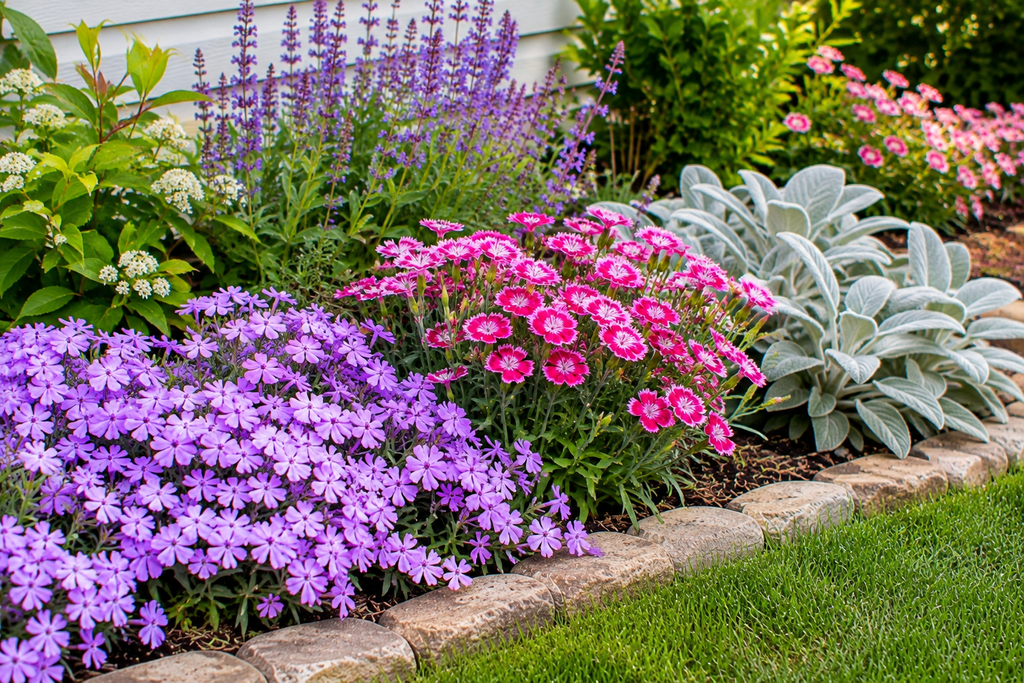
Bloom sequence: creeping phlox in April and May, dianthus in May and June, lamb’s ear foliage all season with flower spikes in early summer.
Borders often fail at the front, where plants have to be short, tidy, and attractive even when not in bloom. Creeping phlox makes a carpet of flowers in spring and stays green in many climates through winter. Dianthus ‘Firewitch’ keeps blue-green, grassy foliage and blooms magenta in early summer. Lamb’s ear adds soft, silver leaves that make a neutral background for both.
Lamb’s ear leaves can melt into brown mush in humid, wet summers, so this pairing works best in dry or moderate climates, with room for air to move between plants. All three are hardy in roughly zones 3 to 9, with lamb’s ear a bit less cold-tolerant (about 4 to 8).
Watch out for: pairing this with a bed that gets regular lawn sprinkler overspray. Constant leaf wetness encourages rot in both dianthus and lamb’s ear.
15. Violas, Zinnias, and Garden Mums for New Beds
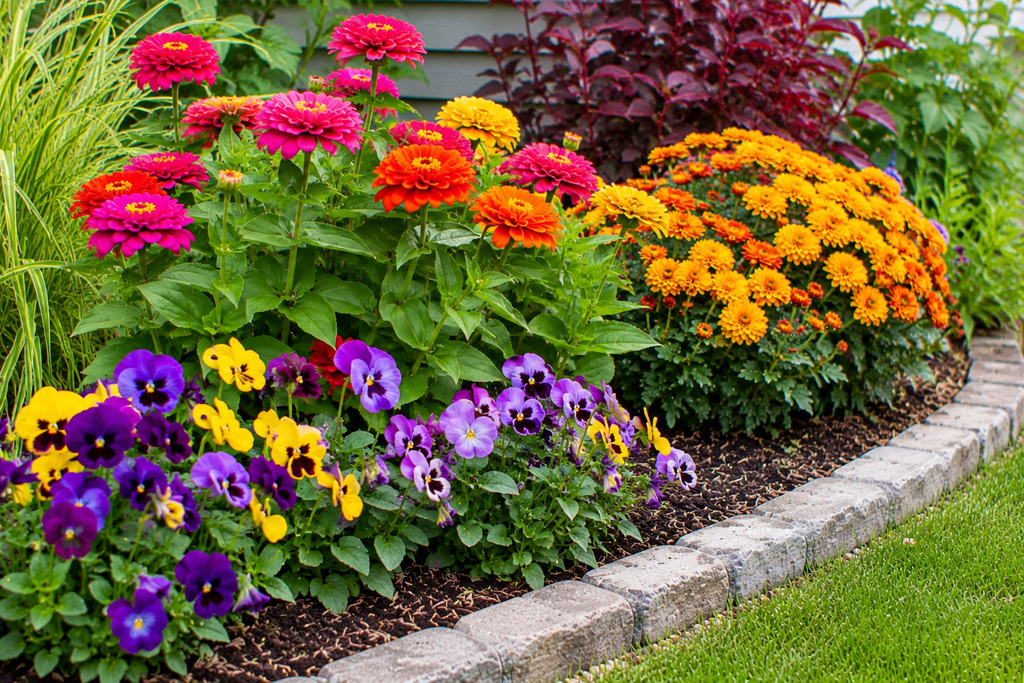
Bloom sequence: violas in early spring and again in fall, zinnias from early summer to frost, mums in September and October.
A new perennial border looks sparse for the first year or two. Annuals can fill the gaps while the permanent plants grow. Violas and pansies like cool weather and stall in summer heat. Zinnias, sown from seed after the last frost, bloom roughly two months later (check the packet) and keep flowering until the first hard frost if deadheaded or cut regularly. Mums take over in fall.
Be careful with mums. Many sold in fall are grown for a single display and do not reliably overwinter, while hardy garden mums planted in spring (rather than in October) have a much better chance of surviving. Zinnias also mildew in humid weather, so spacing and morning watering help.
Watch out for: treating this as permanent. It is a strategy for a new bed or a gap-filler, with annual replanting, rather than a perennial design.
Why Some Combinations Fail Even When the Bloom Times Match
Bloom timing is the easy part. The usual problems are about conditions and care.
Mismatched water needs. Pairing a moisture-loving plant (astilbe, Siberian iris) with a drought-lover (Russian sage, yarrow) in one bed means one of them will always be unhappy. Grouping plants by water need, even within a mixed bed, is more important than matching colors.
Ignoring mature size. A bed planted with perennials spaced for how they look in the pot will be crowded within three years. Check the spacing on the tag and plan for it, using temporary annuals to fill the space until the perennials mature.
Skipping deadheading and cutbacks. Several plants in this article rebloom only if cut back after the first flush: catmint, ‘May Night’ salvia, and in some cases yarrow. Spent flowers left in place often tell the plant its work is done.
Cutting bulb foliage too soon. Braiding, tying, or mowing off daffodil and tulip leaves while still green reduces next year’s bloom. Wait until the leaves are yellow and pull away easily.
Planting everything at once for the same effect. If every plant in the bed peaks the same month, the bed will look splendid and then empty. When shopping, read the bloom period on each tag and make sure at least one plant per layer covers each season.
A Rough Calendar for Keeping the Border Going
A few tasks, done at the right time, keep the sequence going.
- Late winter: cut back ornamental grasses and any perennials left standing for winter interest, before new growth starts. Trim tattered hellebore leaves. Prune summer-blooming shrubs that flower on new wood, such as panicle hydrangea.
- Spring: divide crowded summer and fall bloomers like asters and bee balm as growth begins. Add a light layer of mulch, about two inches, without piling it against stems. Put supports over peonies and tall plants before they grow.
- Early summer: shear catmint and salvia after the first bloom. Pinch Montauk daisies and tall asters to keep them compact. Prune lilacs right after flowering.
- Late summer: deadhead rebloomers, plant any gaps with fall-blooming perennials from nurseries, and watch for mildew.
- Fall: plant spring bulbs in the weeks before the ground freezes. Leave seed heads on coneflowers, grasses, and sedum for winter structure and for birds.
Questions Readers Often Ask
How many plants do I need for a border that blooms in every season?
There is no fixed number, but a useful starting point is three to five plants of each variety in groups, and at least two or three varieties for each of the three bloom seasons. For a typical border ten to fifteen feet long and three to four feet deep, that adds up to roughly 25 to 40 plants, depending on mature size. Smaller, denser plantings look fuller, though they need dividing sooner.
Can I plant these combinations in fall rather than spring?
In most climates, yes. Fall planting of perennials (about six weeks before the first hard freeze) gives roots time to establish while the soil is warm and the plants are not losing water to hot leaves. Bulbs are planted in fall by design. Sedum, grasses, and late-blooming perennials like asters also do well, but some gardeners wait until spring for borderline-hardy plants so they have a full season to establish before winter.
How do I find out which bloom times apply in my area?
Start with your USDA hardiness zone and then check the local cooperative extension service, which often publishes regional bloom calendars and recommended plant lists. Local botanical gardens and native plant societies are other good sources. Keep a simple dated log of when plants open in your own yard for a year or two, because microclimates (a south-facing wall, a low frost pocket) can change bloom dates by a week or more.
Do I have to deadhead everything?
No. Deadhead the plants that rebloom (catmint, salvia, zinnias, yarrow) and leave the rest. Coneflowers, sedum, grasses, and asters are often better left standing for winter structure and for the birds that eat the seeds.
Key Takeaways
A border that blooms through the year is a handoff, not a pile of favorites. Aim for three bloom layers, group plants by water and light needs, let later perennials hide fading bulb foliage, and cut back rebloomers on time. If you only have room for one change this season, start with the gap in your calendar: look at which months your bed is bare and add a single plant group, in threes or fives, that flowers then. Verify hardiness zones and mature size for the specific varieties you buy, since the ranges given here are general guides rather than guarantees.

About Syprose Kiche
Syprose Kiche is the creator and writer behind My Besuited Home, a practical home and garden website covering DIY projects, gardening, lawn care, landscaping, home improvement, and outdoor living. She focuses on turning everyday homeowner questions into clear, practical guides backed by careful research and useful real-world considerations.