
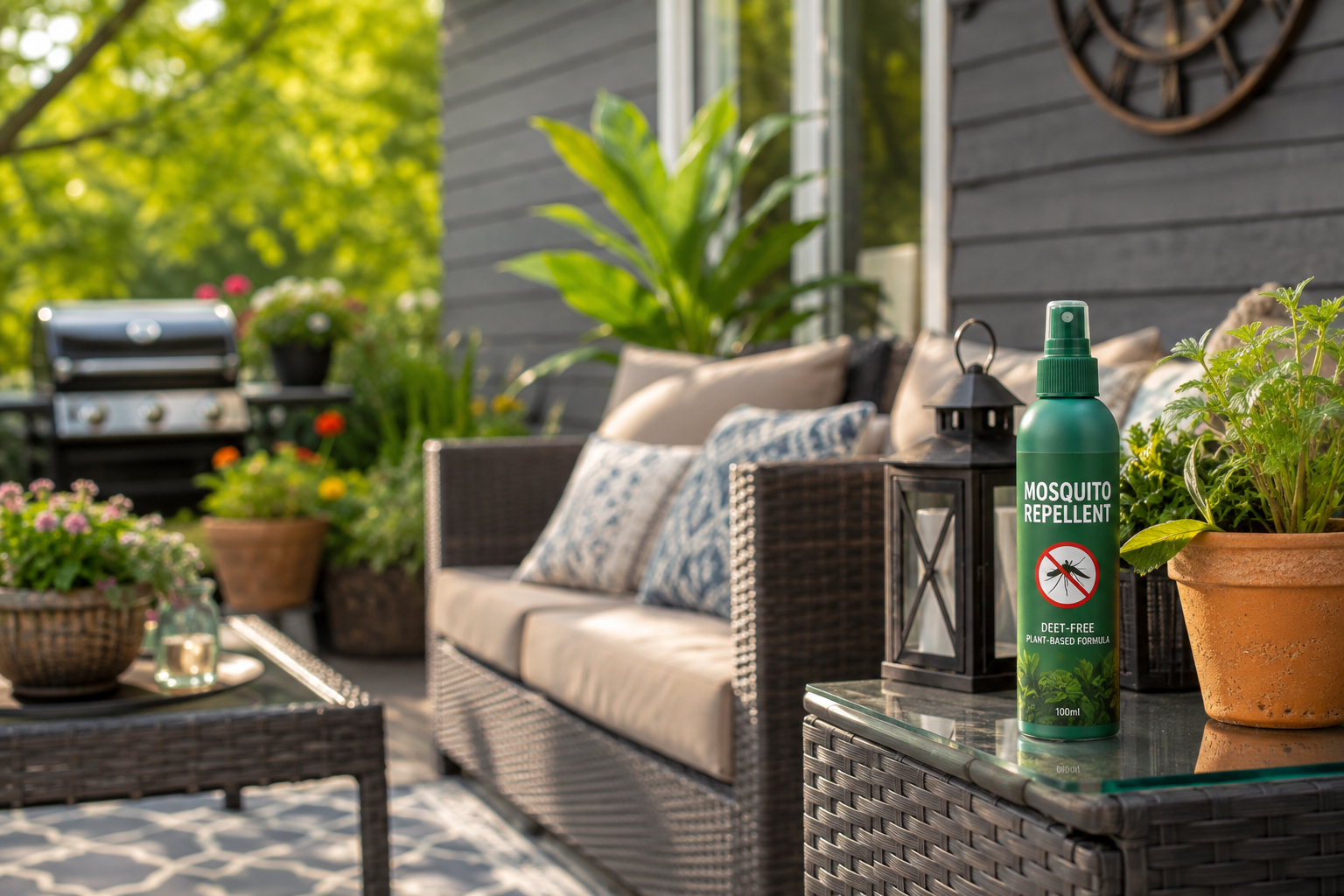
A patio that looked fine in July can turn into a mosquito problem by September without a single new puddle appearing. The reason usually isn’t obvious rainfall. It’s the small, easy-to-miss pockets of water that build up as summer storms taper off and morning dew lingers longer on cooler nights: a saucer under a planter, a fold in a patio umbrella cover, a low spot between pavers that never quite dries out. By the time anyone notices mosquitoes swarming around the seating area at dusk, there’s usually already a breeding cycle running somewhere within a few feet of the table.
Late summer and early fall are a strange in-between period for mosquito activity. Water sources that dried up during the hottest weeks start refilling as afternoon storms return in some regions, while cooler nights push mosquitoes to seek out warmer, more sheltered spots — which often means patios, decks, and the furniture on them. Clearing breeding sites during this window matters more than most homeowners realize, because a female mosquito needs remarkably little water and remarkably little time to produce the next generation.
Why Patios Become Breeding Grounds This Time of Year
Mosquitoes don’t need a pond. A female can lay eggs in as little as a bottle cap’s worth of standing water, and depending on the species and temperature, eggs can develop into biting adults in about a week to ten days. Warm late-summer temperatures actually speed this cycle up, while the cooler nights of early fall slow adult activity just enough that mosquitoes cluster in the warmest, most sheltered microclimates they can find — which is frequently a patio tucked against a house wall, under an overhang, or surrounded by furniture that traps humidity.
Patios also collect water in ways lawns and garden beds don’t. Hard, non-absorbent surfaces mean rain doesn’t soak in — it pools in whatever depression it finds and stays there until it evaporates or someone dumps it out. Combine that with all the objects people leave on a patio (planters, furniture, grills, toys, decorative items) and you get dozens of small water traps that a homeowner walking past every day simply stops noticing.
Late summer and early fall add another layer: leaf litter. As trees begin dropping leaves, gutters, downspouts, and drainage channels around a patio start clogging faster than they did in July. A clogged drain doesn’t just mean water sitting in a pipe — it means water backing up onto a patio surface where it wasn’t collecting before, in a spot nobody thinks to check because it was never a problem earlier in the summer.
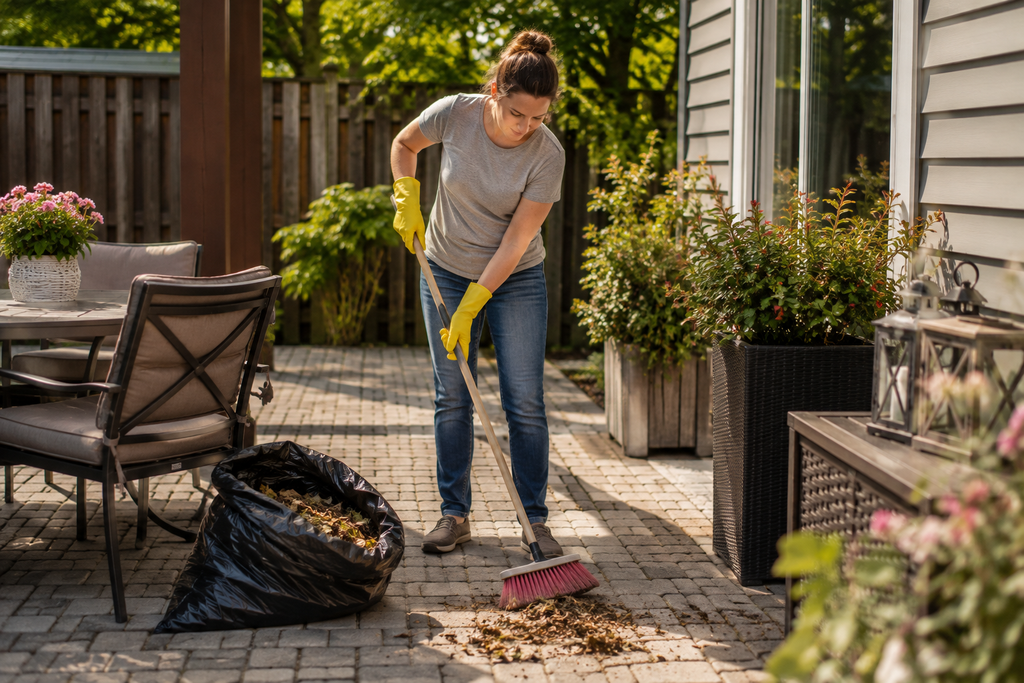
A Walkthrough of the Patio, Not Just a Checklist
Rather than treating this as a list to skim, it helps to physically walk the patio and its immediate surroundings the way water actually moves through it. Start at the highest point — a roofline or wall the patio sits against — and work outward and downward, since that’s the direction water travels after it rains.
- Gutters and downspouts. If a downspout empties directly onto or near the patio, check where that water actually ends up. A downspout extension that’s come loose or shifted can redirect water into a low spot along the patio’s edge that stays wet for days. Clogged gutters themselves are a common and frequently overlooked breeding site — leaves and debris hold water at the top of the house, well above eye level, which is exactly why they get missed.
- Furniture and cushions. Fold up any patio umbrella and check the folds in the fabric. Tip over chairs with hollow arms or legs — plastic outdoor furniture often has recessed seat areas or armrests that trap rainwater invisibly. If cushions have waterproof covers, check underneath them; water can collect between the cover and the cushion itself without ever being visible from above.
- Planters and pot saucers. This is one of the single most common residential breeding sites, and it’s often the one people are most reluctant to deal with because they don’t want to stop watering their plants. The saucer under a potted plant holds exactly the kind of small, stagnant water mosquitoes prefer, and it refills every time the plant is watered. Drilling a drainage hole in the saucer, or switching to saucers with a built-in reservoir that stays covered, solves this without giving up the plants.
- Toys, buckets, and decorative containers. Anything designed to hold water, even briefly — a decorative urn, a dry birdbath that fills with rain, a child’s water table — needs to be checked every few days, not just after obvious storms.
- Low spots and drainage dips in the paving itself. This is the category most people don’t think to check because it looks like a structural or cosmetic issue rather than a pest one. If certain pavers or sections of concrete have settled unevenly over time, they create shallow depressions that hold water long after the rest of the surface has dried. Running a hand across the patio surface a day or two after rain — feeling for damp spots that the rest of the patio has already shed — is a more reliable way to find these than looking for a puddle, since by the time it’s dry enough to walk on comfortably, the water may have just soaked below the surface into gravel or sand bedding, which can still support larvae if it stays saturated.
- Rain barrels and downspout diverters. If there’s a rain barrel anywhere near the patio, it needs a secure, fine mesh screen over every opening, including the overflow spout. An unscreened rain barrel is essentially a mosquito nursery with a lid on it.
- Grills, smokers, and covered equipment. Grill covers pool water in their folds just like umbrella covers do, and the depression where a grill lid meets its base can hold a surprising amount of rainwater if the grill isn’t perfectly level.
What to Do Once You’ve Found Standing Water
The response depends on whether the water source can be eliminated outright or whether it needs to stay in place.
For anything that doesn’t need to hold water — old buckets, forgotten toys, tarps bunched up on the ground, a saucer under a planter that isn’t currently in use — the simplest and most permanent fix is to empty it, dry it out, and either store it upside down or get rid of it. There’s no maintenance schedule to keep up with if the water source no longer exists.
For water sources that serve a real purpose and can’t simply be removed — birdbaths, rain barrels, ornamental ponds, pet water bowls left outside, planter saucers still in active use — the water needs to be changed on a cycle short enough to break the mosquito life cycle before it completes. Because eggs can become biting adults in roughly a week under warm conditions, changing water every three to four days is a reasonable target during the warmest stretches of late summer, stretching to about once a week as temperatures cool into fall and development slows down.
For structural low spots in patio paving that hold water after every rain, emptying isn’t really an option — the water is sitting in a depression that will refill the next time it rains regardless of what’s done with it today. These require either a physical fix (discussed below) or ongoing larvicide treatment until the underlying drainage problem is addressed.
Using a Larvicide for Spots That Can’t Be Drained
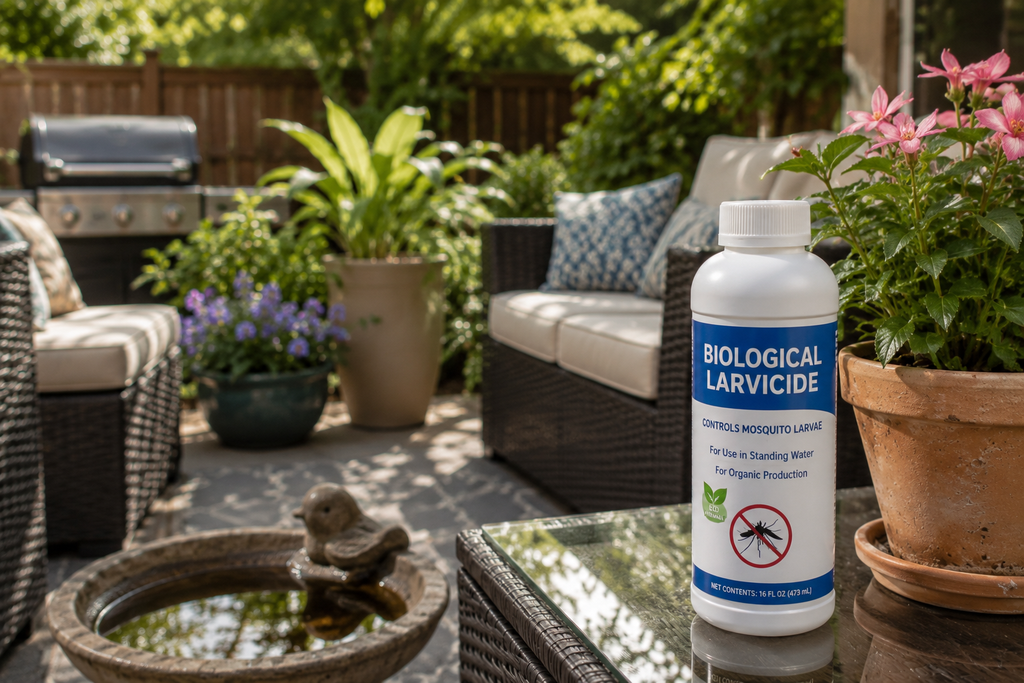
For water features and low spots that need to hold water, a biological larvicide containing Bacillus thuringiensis israelensis, usually sold under names like Mosquito Dunks or Mosquito Bits, is the option most extension services and pest management programs point to for residential use. It works by releasing a bacterial protein that’s toxic to mosquito larvae specifically, without the broad toxicity of a general insecticide, which is why it’s commonly recommended for birdbaths, rain barrels, and ornamental ponds where fish, birds, and pets are also present.
A few practical points make a real difference in how well it works:
It needs to actually be in the water where larvae are developing, not just nearby. Dunks work well in larger volumes like rain barrels or ponds because they release the active ingredient gradually over roughly a month; bits work faster and are often better suited to smaller volumes like planter saucers or small containers, since they can be broken into pieces sized to the amount of water involved.
Always follow the product label for the specific water volume being treated. Larvicide products are formulated with a particular water volume in mind, and using less than directed for a given amount of water reduces effectiveness without necessarily being any safer.
It’s a control measure, not a cure for the underlying problem. If a water source keeps refilling because of a drainage issue, larvicide reduces the mosquitoes emerging from that water but doesn’t fix why the water is there in the first place. Relying on it indefinitely as a substitute for correcting a drainage problem tends to become an ongoing chore rather than a one-time fix.
It should not be treated as a substitute for eliminating water that doesn’t need to be there. Larvicide has a real, useful role for water features that must remain, but using it as a shortcut to avoid emptying a forgotten bucket or tarp fold is treating a five-minute task as a recurring maintenance obligation.
When the Patio Itself Is the Problem
Sometimes the breeding site isn’t something sitting on the patio — it’s the patio surface. Settled pavers, cracked concrete, and poor grading around the edge of a patio all create the kind of shallow, slow-draining depressions mosquitoes favor, and no amount of emptying containers will fix that.
A few signs point to a structural drainage issue rather than a container problem:
Water is still visibly damp or puddled more than 24–48 hours after a rain, in the same spot every time, on a hard surface that should otherwise dry quickly.
The patio slopes toward the house rather than away from it, which pushes water toward the foundation and often creates a persistent damp zone along that edge.
Sand or gravel joints between pavers stay saturated even when the paver surface itself looks dry, which can happen when the base material beneath the patio doesn’t drain properly.
For minor cases, re-leveling a small number of settled pavers or adding polymeric sand to open joints can resolve a shallow depression without a full patio rebuild. For a patio that slopes the wrong way across a large area, or where water is pooling against a house foundation, the more durable fix is regrading — adjusting the slope of the ground beneath and around the patio so water moves away from the structure rather than collecting on it. This is a bigger project, and if it involves altering drainage near a foundation, a landscaping or drainage contractor is generally the better call than a DIY attempt, both because getting the slope wrong can create new water problems and because foundation-adjacent grading sometimes intersects with local building requirements.
Downspout extensions are a cheaper, faster fix worth trying first if the water is coming from a specific point rather than general poor grading — extending a downspout an extra few feet so it discharges past the patio edge, onto a splash block, or into a drainage channel, can eliminate a chronic wet spot without touching the patio itself.
Common Mistakes That Let Mosquitoes Keep Breeding
- Treating one obvious source and assuming the problem is solved. A rain barrel or birdbath is an easy, visible target, but mosquitoes only need one overlooked container to keep the population going. A thorough walkthrough matters more than treating the first thing found.
- Dumping water on the patio itself instead of somewhere it can drain away. Emptying a saucer or bucket directly onto the patio surface just relocates the water to whatever low spot is nearby, sometimes recreating the exact problem being solved. Water should go into a drain, a garden bed that will absorb it, or a spot well away from any other container.
- Forgetting that fall leaf drop changes the picture. A gutter or drain that handled water fine all summer can back up within a week or two once leaves start falling in volume, particularly after the first heavy rain of the season. Late summer and early fall call for more frequent gutter and drain checks than mid-summer did, not less, even though it may feel like the mosquito season should be winding down.
- Assuming cooler weather means the problem is over. Many mosquito species remain active well into fall, particularly during a mild autumn, and some species that transmit disease are actually more active in the cooler parts of the season than in peak summer heat. Cooling temperatures reduce mosquito activity gradually, not suddenly, so it’s a mistake to stop checking for standing water as soon as the weather turns.
- Relying on citronella candles or bug zappers as a substitute for removing standing water. These products may reduce the number of mosquitoes landing on people at a given moment, but they do nothing to stop new mosquitoes from developing nearby. They’re a reasonable addition to an evening outdoors, not a replacement for source control.
Fogging, Sprays, and Where Professional Help Fits In
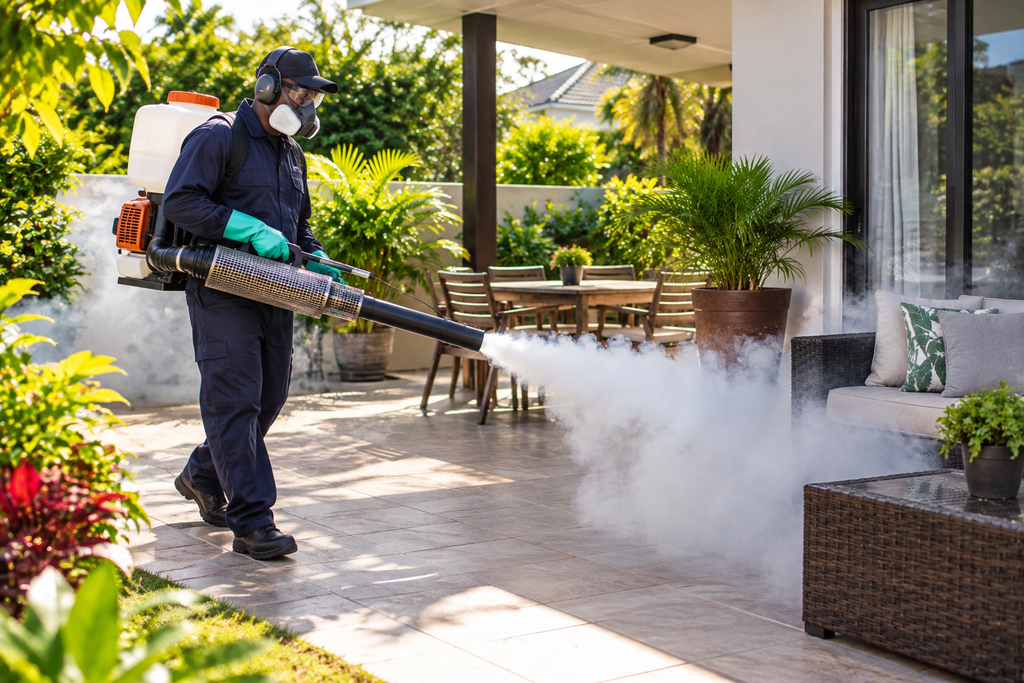
Perimeter sprays and fogging treatments — whether applied by a homeowner with a backpack sprayer or by a pest control company — target adult mosquitoes on contact and through residual effect on vegetation, but they don’t address breeding sites. They can meaningfully reduce mosquito numbers for an event or a stretch of bad activity, but if standing water nearby isn’t dealt with, new adults keep emerging behind the treatment.
Professional pest control is worth considering in a few specific situations: when a property has a chronic mosquito problem that persists despite a genuine effort to eliminate standing water, when there’s a large or hard-to-reach water source such as a drainage ditch, retention pond, or wooded area bordering the yard that can’t reasonably be managed by hand, or when a household includes someone at higher risk from mosquito-borne illness and a more comprehensive, scheduled treatment plan feels warranted. A professional can also identify breeding sites on a property that aren’t obvious from a casual walkthrough, particularly in drainage systems, crawl spaces, or areas with standing water that isn’t visible from ground level.
A Realistic Weekly Routine for the Rest of the Season
Given how quickly a new source can develop as fall approaches, a short recurring check tends to work better than an occasional deep clean. After any rain, or at least once a week regardless of rainfall, it’s worth walking the patio and checking pot saucers, furniture folds, and any decorative containers; checking that gutters and downspouts are still flowing freely and redirecting water away from the patio; and glancing at any low spots in the paving to see whether they’re still damp longer than the surrounding surface. This takes a few minutes and catches new problems before they’ve had time to complete a breeding cycle.
Frequently Asked Questions
Does a single day of standing water matter, or does it need to sit for a while? A single day generally isn’t enough for mosquitoes to complete their development, but eggs can be laid in water that’s only been standing briefly, and once eggs are present they’ll continue developing as long as the water stays. The safer approach is to prevent water from sitting for more than a couple of days rather than trying to judge exactly how long is too long.
Can rainwater collected for garden use be a mosquito risk? Yes, unless the collection barrel or container is properly screened. A fine mesh screen over every opening, including overflow spouts, prevents adult mosquitoes from laying eggs in the collected water without affecting its usefulness for watering plants.
Is it necessary to treat a birdbath even if it’s changed regularly? If the water is genuinely changed every few days, additional treatment usually isn’t necessary. The risk comes from birdbaths that are refilled on top of old water rather than emptied and refreshed, since that allows any eggs already laid to keep developing.
Will mosquito activity stop once temperatures drop consistently below a certain point? Adult mosquito activity does decline as temperatures fall, but the exact threshold varies by species and region, and a stretch of unseasonably warm fall weather can bring activity back even after a cool snap. It’s more reliable to keep checking for standing water through early fall than to assume a single cold night ends the season.
The Actual Takeaway
The patio doesn’t need a single dramatic fix — it needs a short list of specific spots checked on a short cycle, because that’s how quickly a new breeding site can appear as the season shifts. Water that can be eliminated should be eliminated outright rather than managed; water that has to stay, in a birdbath or rain barrel, needs either a frequent change schedule or a properly dosed larvicide; and any spot on the patio itself that stays damp longer than it should is worth investigating as a drainage problem rather than something a fogger or citronella candle will solve.

About Syprose Kiche
Syprose Kiche is the creator and writer behind My Besuited Home, a practical home and garden website covering DIY projects, gardening, lawn care, landscaping, home improvement, and outdoor living. She focuses on turning everyday homeowner questions into clear, practical guides backed by careful research and useful real-world considerations.