
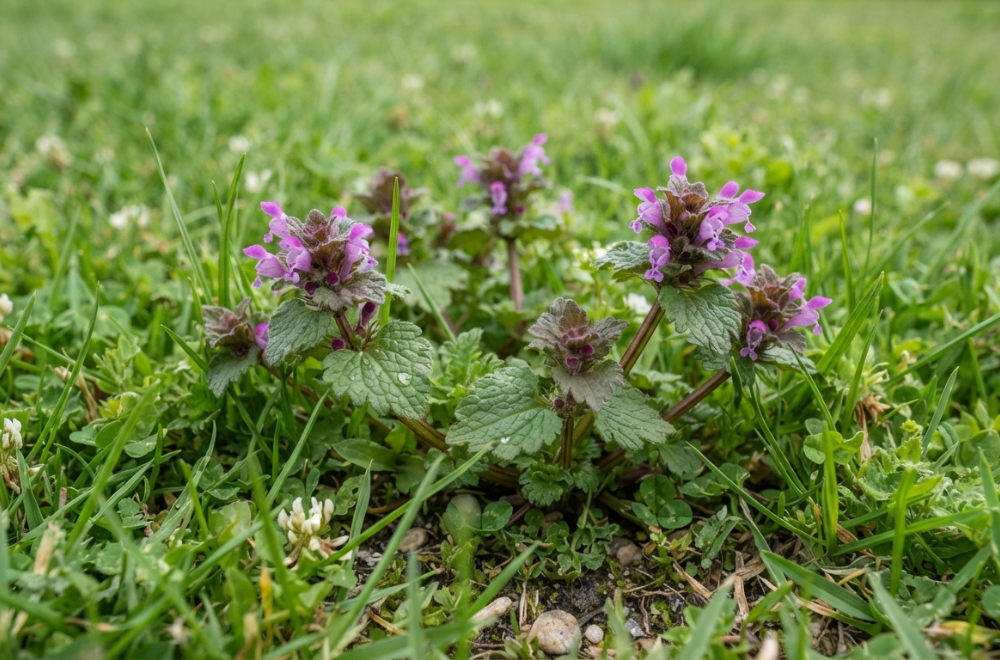
By late February or March, a lawn that looked bare and brown all winter can suddenly turn purple almost overnight. Small tubular flowers cover patches of turf, especially along the edges of the yard, near flower beds, or in thin, sunny spots where the grass never quite filled in. This is usually henbit, and by the time it’s noticeable, it’s already been growing for months.
That timing is the first thing worth understanding about henbit. It’s not a summer weed that shows up when the lawn is stressed and thin from heat. It’s a cool-season annual that germinates in fall, sits quietly through winter, and then flowers and sets seed before most people have even started mowing. Anyone trying to control it in April or May with the same approach they’d use on a summer weed is usually a season too late.
What Henbit Actually Looks Like
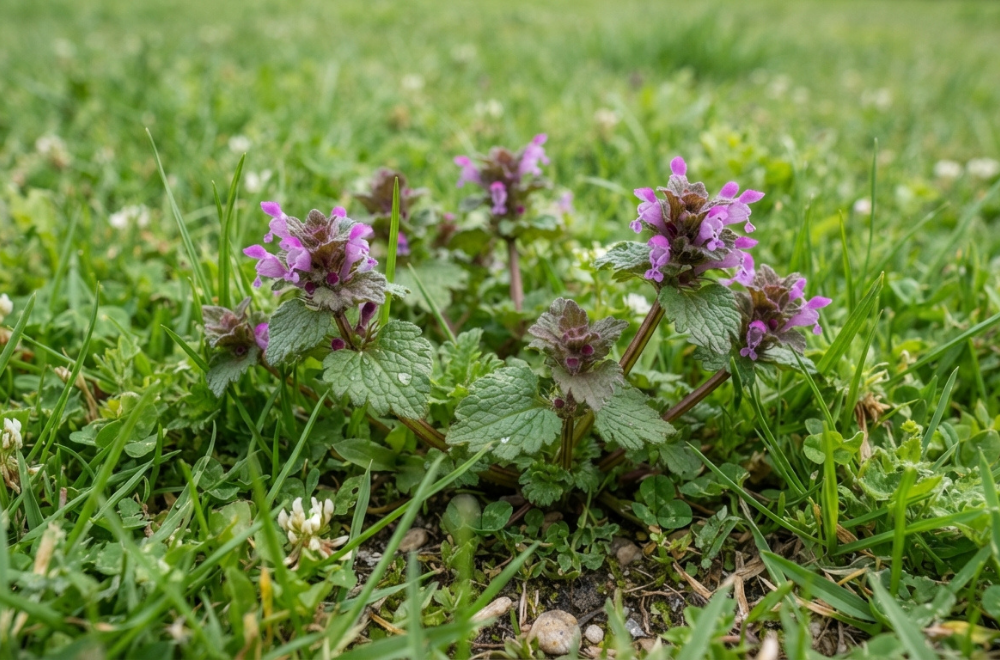
Henbit (Lamium amplexicaule) belongs to the mint family, and it shows several of the traits that family is known for. The stems are square in cross-section, not round — roll one between your fingers and you can feel the edges. The leaves are rounded to slightly triangular, with scalloped or toothed edges, and they grow in opposite pairs up the stem. The upper leaves are distinctive because they clasp directly around the stem with no leaf stalk at all, which is where the species name amplexicaule (“stem-clasping”) comes from.
The flowers are small, tubular, and pinkish-purple, arranged in whorls near the top of the plant. They open in early spring, sometimes as early as late winter in milder climates, and they’re often the first obvious sign that henbit has been established for a while. Plants typically grow four to twelve inches tall, with stems that can sprawl and root where they touch the soil, which is part of why a small patch can spread into a noticeable mat over a few weeks.
Henbit vs. Purple Deadnettle vs. Ground Ivy
These three are the ones most often mixed up, and the distinction matters because control timing and methods overlap but aren’t identical.
Purple deadnettle (Lamium purpureum) is henbit’s close cousin and the one it’s confused with most. The easiest tell is the upper leaves: deadnettle’s upper leaves have short stalks and often take on a purplish tinge, especially toward the top of the plant, while henbit’s upper leaves clasp the stem directly with no stalk and stay more uniformly green. Both flower around the same time and respond to the same control strategies, so for practical purposes the distinction matters more for identification than for treatment.
Ground ivy (Glechoma hederacea), also called creeping charlie, is a different problem entirely. It’s a perennial rather than a winter annual, it spreads aggressively by creeping stems that root at nodes, and it comes back year after year from the same root system rather than from seed alone. Ground ivy has kidney-shaped, scalloped leaves and a stronger minty smell when crushed. Confusing ground ivy for henbit is a common mistake because a single fall herbicide application that handles henbit will do very little against an established ground ivy patch, which needs a different, often more sustained approach.
Why Henbit Shows Up Where It Does
Henbit seed needs open soil and light to germinate well. That’s why it concentrates in thin turf, bare patches, disturbed soil along sidewalks and driveways, and newly seeded areas that haven’t filled in yet. A dense, healthy stand of turfgrass shades the soil surface enough to suppress a lot of henbit germination on its own — this is one of the more overlooked facts about the weed. Lawns with compacted soil, poor drainage, or low mowing heights that keep the canopy thin tend to have the worst henbit problems, because the conditions that stress turfgrass are the same ones that give henbit an opening.
Soil temperature is the trigger. Henbit seed germinates as soil cools in fall, generally once temperatures drop into the 50s°F, and germination can continue through a mild winter. This means the plants a homeowner sees flowering in March actually took root the previous September or October. Anyone who sprays in spring and finds the henbit dead within a week or two, only to see a fresh flush the following fall, isn’t dealing with regrowth — they’re dealing with an entirely new generation from seed that was already in the soil.
Confirming It Before You Treat
Before choosing a control method, it’s worth spending thirty seconds confirming the plant. Pull a single stem and check for the square cross-section and the clasping upper leaves. If the stem is round, or the plant is creeping and rooting extensively along runners, it’s more likely a different weed — chickweed, for instance, has round stems and small white star-shaped flowers, and responds to a different set of pre-emergent timings. Misidentifying the weed is one of the more common reasons a treatment “doesn’t work” when the real issue is that it was never the right treatment for what was actually growing.
Getting Rid of Henbit Once It’s Already Growing
Once henbit is up and flowering in the lawn, the options narrow somewhat, and the right choice depends on how much is there and how tolerant the rest of the lawn is of intervention.
Hand-Pulling and Mechanical Removal
For a light infestation — a few scattered patches rather than a lawn-wide problem — hand-pulling is often the most practical option, and it avoids herbicide altogether. Henbit has a shallow root system, so young plants usually come up easily, especially after rain or irrigation has softened the soil. The key is timing: pulling before flowers open prevents seed set, which matters because a single flowering henbit plant can produce a substantial number of seeds that will simply restart the problem the following fall. Once seed pods have formed, pulling still removes the plant but won’t undo the seed that’s already dropped into the soil.
For larger areas, a garden hoe or a hand cultivator worked shallowly across the surface can clear a bed or bare patch faster than pulling plant by plant, though this isn’t practical across an entire lawn without damaging the turf.
Post-Emergent Herbicides
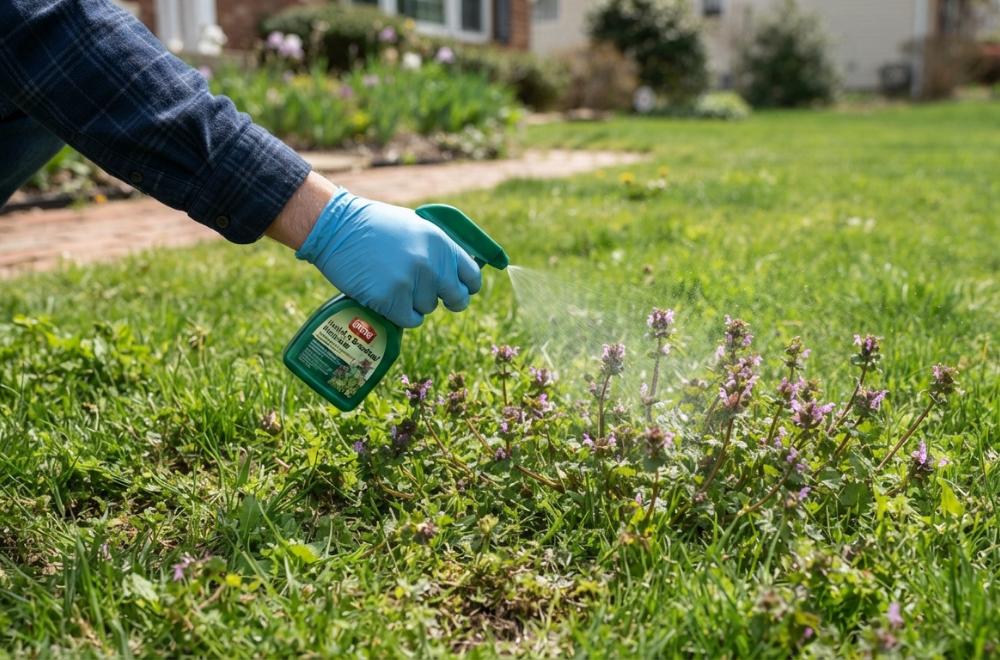
For an established stand across turf areas, a post-emergent broadleaf herbicide is usually the more realistic option. Henbit responds reasonably well to common three-way combination herbicides containing 2,4-D, mecoprop (MCPP), and dicamba, particularly when applied to young, actively growing plants. Products like these are widely available at garden centers and are labeled for use on cool-season and warm-season turf, though the specific formulation and rate should always match what’s listed for the grass species in the lawn — applying a broadleaf herbicide at the wrong rate, or on a grass type not listed on the label, risks damaging the turf along with the weed.
There’s a practical window here worth knowing: herbicides are considerably more effective on henbit while it’s young and before it flowers. Mature, flowering plants have already invested energy into seed production and are noticeably more resistant to knockdown, which is part of why late-season spraying often produces disappointing results — the visible plants may brown and die, but not before scattering seed, which defeats much of the purpose.
Herbicide should be applied on a calm day with no rain expected for at least 24 hours, following label instructions on temperature range (many broadleaf herbicides shouldn’t be applied above 85°F or so, and cooler early spring days often fall within the ideal range). Keep children and pets off treated areas until the product has dried, and store any concentrate away from where either might access it. Anyone treating a lawn near a vegetable garden, pond, or well should read the label’s setback distances carefully, since drift and runoff restrictions vary by product.
Where Post-Emergent Treatment Falls Short
Post-emergent control deals with the plants that are already there — it does nothing to prevent the next generation from germinating in the fall. This is the single most common reason people feel like they’re fighting henbit every single year: they’re only ever treating the symptom that shows up in spring, never the seed that goes into the ground in fall.
The Control Method Most People Skip: Fall Pre-Emergent Application
Because henbit germinates from seed in fall, a pre-emergent herbicide applied to the lawn in late summer or early fall — typically when soil temperatures are still in the 70s°F and beginning to trend downward — can prevent the bulk of the seed from germinating at all. Products containing prodiamine, dithiopyr, or pendimethalin are commonly used for this purpose and are the same category of product many people already apply in spring for crabgrass, just used on the opposite end of the calendar for a cool-season target.
Timing here is unforgiving in a way that spring weed control isn’t. Pre-emergent herbicides work by forming a barrier at the soil surface that stops germinating seedlings; they don’t do anything to a plant that’s already emerged. Apply too early and the barrier can break down before henbit germination even peaks; apply too late, after germination has already started, and the product won’t touch the plants that are already up. For most of the transition zone and northern U.S., this generally falls somewhere in the September window, though local university extension guidance is the more reliable source for a specific date range, since it varies by region and by the particular product’s residual length.
One caution worth flagging: a lawn that’s being overseeded in fall with new turfgrass seed generally can’t be treated with the same pre-emergent, since the barrier that stops henbit seed from germinating will just as effectively stop grass seed. If overseeding is part of the fall plan, the pre-emergent application and the overseeding need to be scheduled around each other rather than done at the same time — usually the pre-emergent goes down well before or well after seeding, per the product label.
Corn Gluten Meal as an Organic Alternative
Corn gluten meal is sometimes marketed as a natural pre-emergent for lawns, and it does have some inhibitory effect on germinating seeds, including weed seeds like henbit’s. In practice, its effectiveness tends to be less consistent and generally weaker than synthetic pre-emergent herbicides, and it needs to be applied at a fairly high rate to have a noticeable effect, which can also add a meaningful amount of nitrogen to the soil as a side effect. It’s a reasonable option for anyone specifically trying to avoid synthetic herbicides, with the understanding that results will likely be more modest than a product like prodiamine or dithiopyr.
Fixing the Lawn Conditions That Let Henbit In
Herbicide handles the current problem. Thickening the lawn addresses the reason henbit had room to grow in the first place, and this is the part that tends to get the least attention even though it often matters the most over a two or three year timeline.
Overseeding thin areas in early fall, before or after any pre-emergent application (never both at once, as noted above), gives turfgrass a head start on filling in bare soil before henbit seed germinates. A guide to overseeding thin lawns can walk through timing and seed selection in more depth than fits here, but the general principle is that dense grass out-competes henbit for light and space.
Mowing height plays a real role. Lawns mowed too short expose more bare soil and more light to the surface, which favors germination of low-growing weeds like henbit. Raising the mowing height to the upper end of what’s recommended for the specific grass type — often three inches or more for many cool-season lawns — helps the canopy close over bare patches.
Aerating compacted soil in fall, ideally before overseeding, improves water and air movement to the root zone and gives grass a better chance to establish densely rather than leaving open ground for weed seed to settle into.
A soil test is worth doing if henbit (or other weeds generally) keeps concentrating in the same areas year after year. Compaction, poor drainage, and low fertility all show up as thin turf, and thin turf is where henbit thrives. Addressing the underlying soil issue is a slower fix than a bag of pre-emergent, but it’s the one that actually changes the trend over multiple seasons instead of just resetting the clock each year.
Common Mistakes Worth Avoiding
A few patterns come up often enough to call out directly. Spraying a post-emergent herbicide on henbit that’s already flowering and expecting it to prevent next year’s growth — it may kill this year’s plants, but the seed may already be set. Skipping the fall pre-emergent window because the lawn “doesn’t have a henbit problem” in September, when the problem is actually invisible at that point and won’t show up until the following spring. Applying pre-emergent and overseeding at the same time, which can suppress the new grass seed along with the henbit. And treating ground ivy with a henbit strategy, assuming it’s the same weed, when the two need different long-term approaches.
When to Bring in a Professional
Most henbit situations are manageable with over-the-counter products and reasonable timing. Professional lawn care becomes more useful when the infestation covers a large percentage of a substantial lawn, when there’s uncertainty about herbicide safety near edible plants, wells, or waterways, when the lawn has multiple weed problems layered together (henbit plus ground ivy plus something else), or when previous treatments haven’t worked and it’s unclear whether the issue is the product, the timing, or the underlying soil condition. A professional can also help identify whether what looks like henbit is actually one of its look-alikes, which changes the recommended approach.
Frequently Asked Questions
Is henbit harmful to pets or people? Henbit isn’t considered toxic to dogs, cats, or people in the way that some common lawn and garden plants are, and it doesn’t carry the skin irritation risks that something like poison ivy does. It’s more of a nuisance weed than a hazard, though as with any plant, it’s reasonable to avoid encouraging pets to graze on any lawn weed regularly.
Will mowing get rid of henbit? Mowing removes the flowers, which can reduce seed production if it’s done before flowering finishes, but it won’t kill the plant or its roots. Because henbit tends to grow low to the ground, especially in short turf, it often escapes the mower blade entirely and continues flowering below cutting height. Mowing is a minor supporting tactic at best, not a control method on its own.
Does henbit mean something is wrong with my soil? Not necessarily wrong, but it usually does mean the turf in that spot is thinner or more open than it is elsewhere in the yard, whether from compaction, shade, low fertility, or wear. Henbit is more an indicator of opportunity for weeds in general than a sign of a specific soil deficiency.
Can I compost pulled henbit? If the plants haven’t gone to seed yet, they can typically go into a compost pile without much concern. Once seed pods have formed, though, many home compost setups don’t reach temperatures high enough to reliably kill weed seed, and the seed can survive and end up spread wherever the finished compost is later used. Bagging flowering or seeded henbit for disposal is the safer choice in that case.
Next Steps
If henbit is showing up right now, hand-pull what’s manageable before it flowers, and treat larger areas with a post-emergent broadleaf herbicide while the plants are still young. Then mark a reminder for early fall — that’s the window that actually determines whether this shows up again next spring, and it’s the step most lawns never get.

About Syprose Kiche
Syprose Kiche is the creator and writer behind My Besuited Home, a practical home and garden website covering DIY projects, gardening, lawn care, landscaping, home improvement, and outdoor living. She focuses on turning everyday homeowner questions into clear, practical guides backed by careful research and useful real-world considerations.