
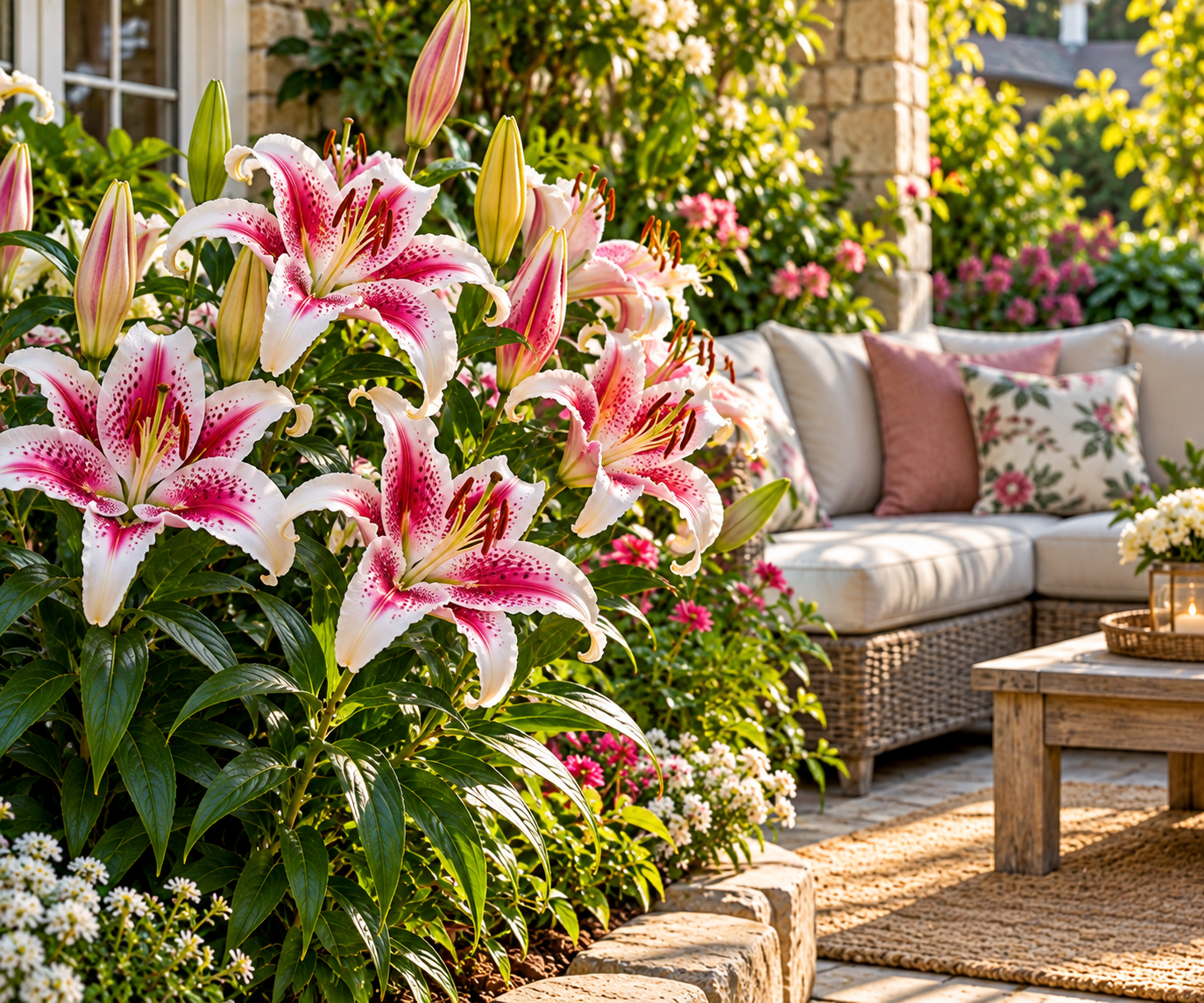
A gardenia planted in the back corner of the yard can bloom heavily for weeks and never register with anyone, while a single lavender plant beside the front step perfumes every trip to the mailbox. Scent depends less on how many fragrant plants a garden holds than on where they sit. Fragrance molecules drift a short distance, get diluted by wind, and are released fastest when petals are warm. A plant has to be close to where people walk, sit, and open windows, and it has to be placed where air actually carries its scent in their direction.
That is why this list is organized by location instead of by plant type. Each group below matches plants to a spot: the front door, the pathway, the seating area, and the windows. Hardiness zones are given as approximate ranges for the species; cultivars can differ, so check the plant tag or your local extension service before buying.
How Scent Behaves in a Garden (And Why It Shapes Where You Plant)
A few patterns explain most of the success and failure with fragrant plants.
Warmth releases scent. Fragrant compounds evaporate faster as petals warm, so a plant against a sunny wall often smells stronger on a warm afternoon than the same plant in a cool, shaded bed. A cold, rainy day can mute even a very fragrant plant.
Air movement cuts both ways. A light breeze carries scent along a path. A strong wind scatters it before anyone can smell it. Sheltered spots, such as a courtyard corner, the side of a porch, or the lee of a fence, hold fragrance longer.
Some plants smell at specific times. Several of the most powerful garden fragrances come from flowers pollinated by moths, which open or intensify at dusk. Flowering tobacco, moonflower, and some lilies belong in a spot you use in the evening. Plants that release scent when touched, like thyme and lavender foliage, belong beside a path you actually walk.
Breeding has sometimes traded scent for appearance. Many popular sweet peas and some modern roses and heliotropes were selected for flower size, color, or disease resistance, and some have far less fragrance than older types. The plant tag, a catalog description, or a nursery’s note on “strongly scented” varieties matters more than the species name.
Strong does not mean pleasant for everyone. A scent that is lovely at arm’s length can be heavy in a closed bedroom. Plants with intense fragrance, such as lilies and daphne, work best where there is air movement or where the person can choose to step away.
Fragrant Flowers for the Front Door
A front entrance is a good place for fragrance because people pass through it several times a day, the space is often sheltered by the house, and the walls hold warmth. The best choices here are compact, reliable, and attractive when not in bloom, since they will be seen year-round.
1. Gardenia (Gardenia jasminoides)
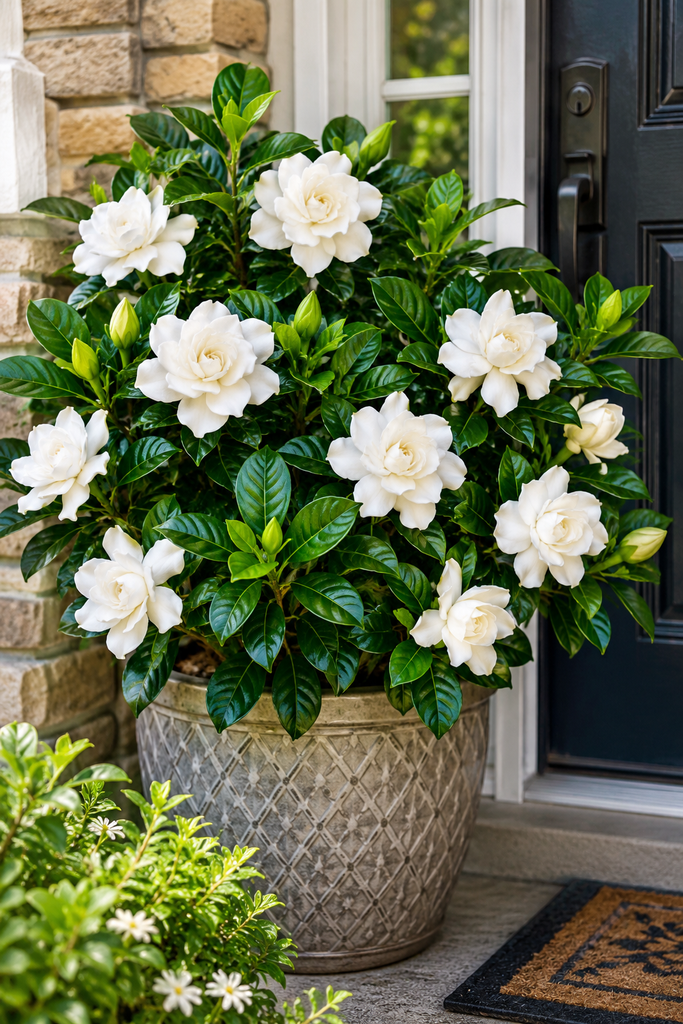
Gardenia is the standard answer for a perfumed entrance: glossy evergreen leaves and creamy, heavily scented flowers in late spring through early summer. It has a reputation for being difficult, and the reputation is mostly about conditions. It generally grows outdoors in zones 8 to 11, with some cultivars rated slightly colder, and it wants acidic, well-drained, consistently moist soil and bright light with some protection from hot afternoon sun.
The usual failure is yellowing leaves, which often points to soil that is not acidic enough or to poor drainage. Buds that drop before opening are commonly linked to sudden changes in temperature, inconsistent watering, or dry air. In colder zones, gardenia can live in a large pot near the door and move to a bright, cool indoor spot before frost.
2. Jasmine (Jasminum and Trachelospermum)
“Jasmine” covers several different plants, and they are not equal. Common jasmine (Jasminum officinale) is a twining vine rated roughly for zones 7 to 10 with clusters of white, sweetly scented flowers in summer. Star jasmine, also called Confederate jasmine (Trachelospermum jasminoides), is evergreen and rated roughly zones 8 to 10, and it is not a true jasmine, though its scent is very similar. Arabian jasmine (Jasminum sambac) is the one used in jasmine tea and is only hardy in the warmest zones, so it is usually grown in containers elsewhere.
Training any of them over a door frame, arch, or trellis puts the flowers at nose height. Allow for support from the start, since twining vines grow quickly and become hard to untangle once they are established. Jasmine in a pot by the door is a workable option in zones too cold for it to survive winter outdoors.
3. Fragrant Roses
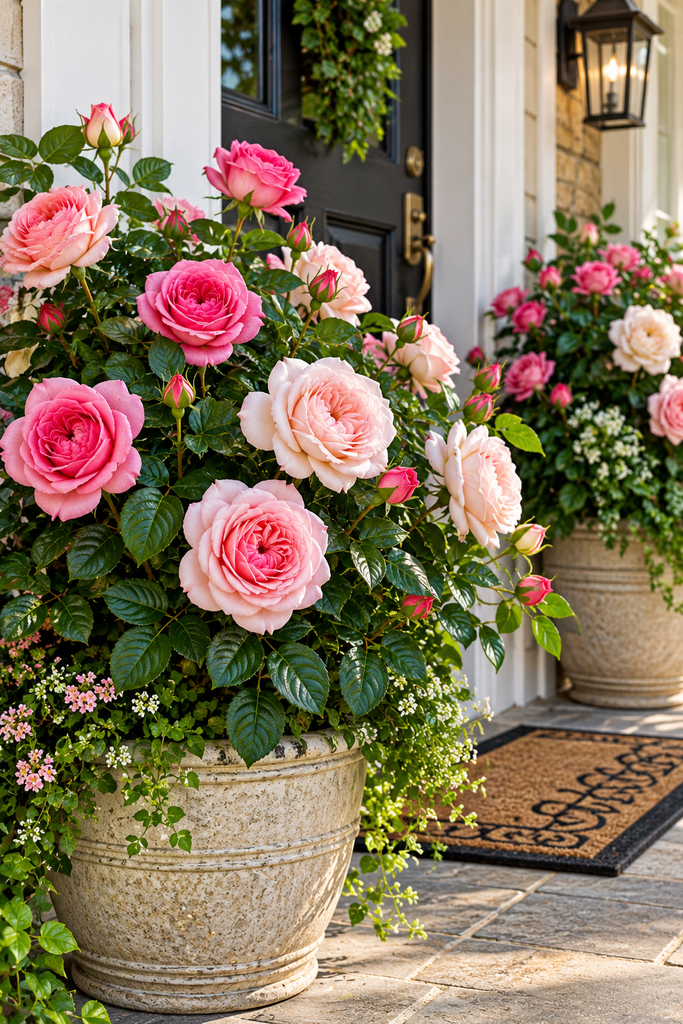
A rose is not automatically fragrant. Many florist-type and landscape roses have little or no scent, and a gorgeous flower on a plant tag guarantees nothing. For a front door, look for varieties described as strongly scented. Damask and many old garden roses, hybrid teas bred for scent, and English-style roses are the types most often described this way. Fragrance can also vary with climate and time of day, and roses often smell strongest on warm mornings.
A climbing rose on a trellis beside the door puts flowers at face level, while a shrub rose in a pot or border works when the wall space is limited. Good air circulation matters, because crowded roses against a wall invite fungal problems like black spot and powdery mildew. Leave a gap between the plant and the siding, and water at the base rather than over the foliage.
4. Daphne (Daphne odora and Daphne x burkwoodii)
Daphne has a small, nearly spicy-sweet flower fragrance that is strong for its size. Winter daphne (D. odora) blooms late winter into early spring in zones roughly 7 to 9, and it is also known for being fussy. It dislikes wet soil, resents being moved, and can die suddenly for reasons that are hard to diagnose. Daphne x burkwoodii, such as the cultivar ‘Carol Mackie’, is generally considered easier and hardier, to roughly zone 4 or 5, with a late spring bloom.
Plant it where the soil drains very well, and treat the spot as permanent. All parts of daphne are poisonous if eaten, and the sap can irritate skin, so it needs thought if small children or dogs use the entrance.
5. Tea Olive (Osmanthus fragrans)
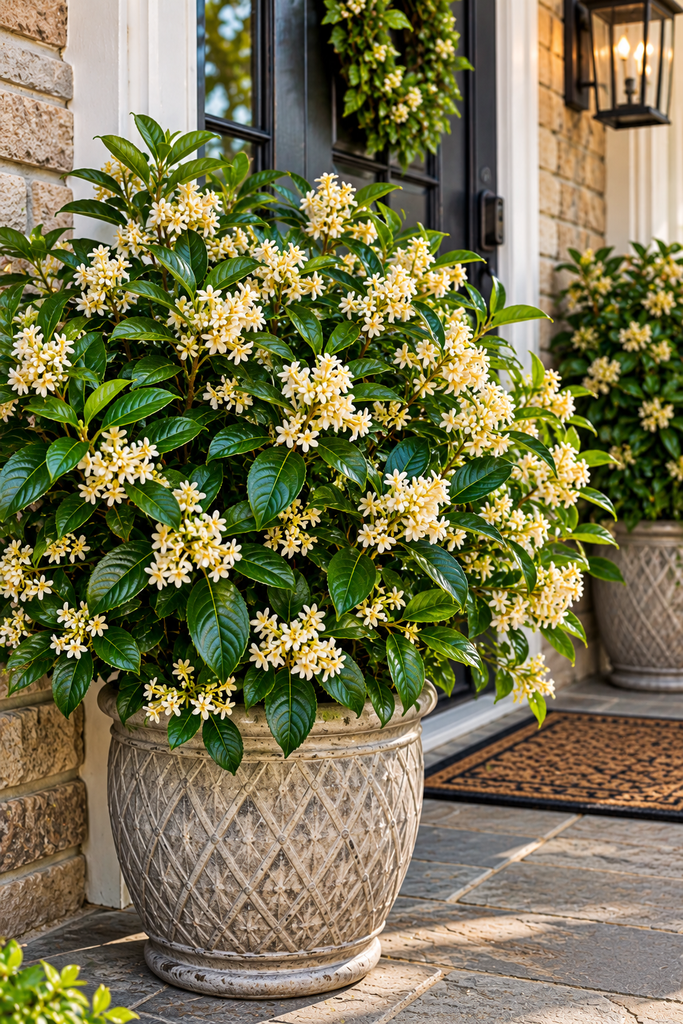
Tea olive is an evergreen shrub with tiny, easy-to-miss flowers that carry a fragrance often compared to apricots or ripe peaches. It blooms mainly in fall and again at other times in mild climates, which makes it a good answer to the problem that most fragrant plants peak in spring. It is generally rated for zones 8 to 11, and in cooler zones a holly tea olive (Osmanthus heterophyllus) is sometimes grown instead, though it is less fragrant.
As a plant, it is tall and upright with the potential to reach a large size, so it suits the corner of an entrance rather than the foundation strip under a window. Give it full sun to part shade and decent drainage.
Fragrant Plants Along Pathways
Path plantings are about brushing and crushing. A plant that releases scent when touched makes a path more enjoyable even if it never flowers. The edge of a path is also usually sunny, well-drained, and a little dry, which suits many Mediterranean herbs.
6. Lavender (Lavandula)
Lavender needs full sun and very good drainage, and those two things matter more than anything else. English lavender (Lavandula angustifolia) is the hardiest, rated roughly zones 5 to 8, and it is the type usually used for its sweet scent. Lavandins (L. x intermedia) are larger and often more fragrant but generally less cold-hardy. Spanish lavender is showier and tolerates heat, but its scent is more camphorous.
The common cause of death is wet roots: heavy clay, mulch piled against the crown, or overwatering. In clay soil, plant it on a slight mound or in a raised bed, and consider gravel mulch rather than wood mulch. Trim lightly after flowering, avoid cutting into old bare wood, and place it where a brushed stem releases scent at hip height.
7. Thyme (Thymus)
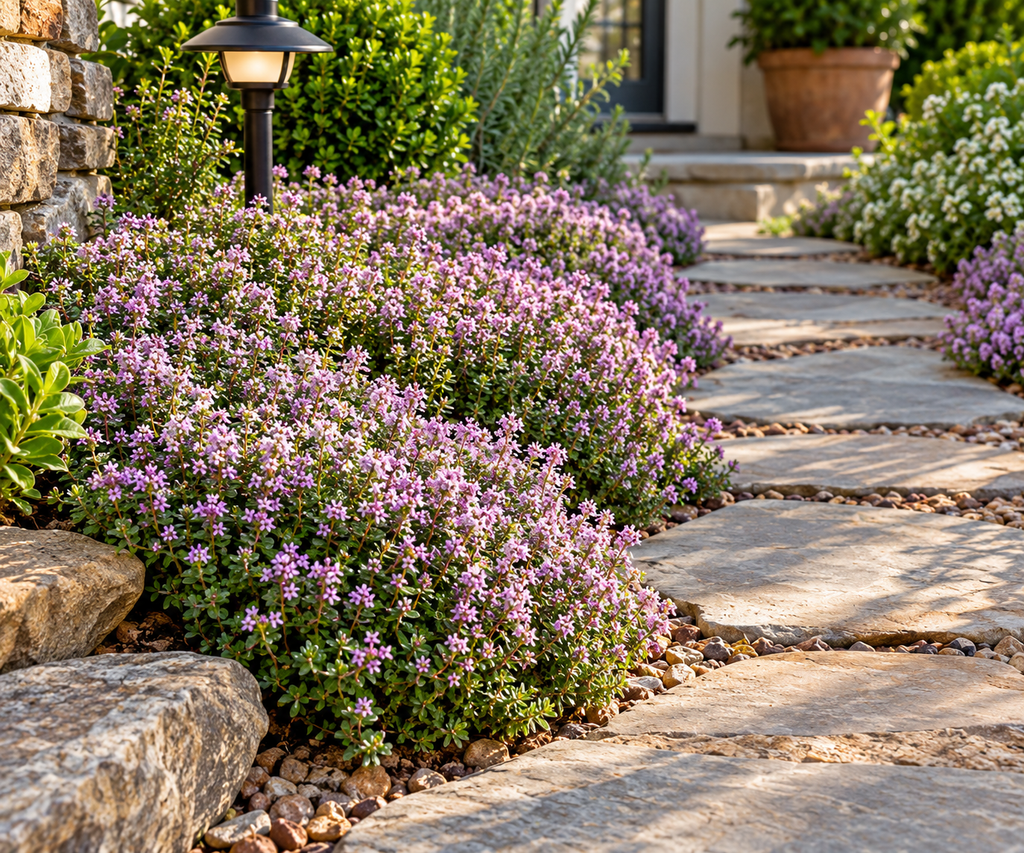
Creeping thyme (Thymus serpyllum and related types) is rated roughly zones 4 to 9 and is one of the few fragrant plants that tolerates light foot traffic. Planted between stepping stones, it releases a herbal scent when stepped on, and in early summer the tiny flowers add color and attract bees. Common thyme (T. vulgaris) grows more upright and works better at the edge of a path than underfoot.
It wants full sun and sharp drainage, and it will struggle in wet, shady conditions. It also does not tolerate heavy, constant foot traffic. Think of it as a plant for the places people occasionally step, not the main walking line.
8. Sweet Alyssum (Lobularia maritima)
Sweet alyssum is a low annual with clusters of tiny white, pink, or purple flowers that smell of honey. It is cheap, grows quickly from seed or small plants, and fills gaps along a path edge or between pavers. It prefers cool weather, so it often blooms heavily in spring and fall and may fade or look scraggly in the heat of midsummer. A light shearing in summer often brings back fresh growth when temperatures drop.
It self-seeds in many gardens, which can be a bonus along a path or a nuisance in a tidy bed. The scent is gentle, so it is best placed where people pass close to it, not planted at a distance.
9. Dianthus (Pinks and Carnations)
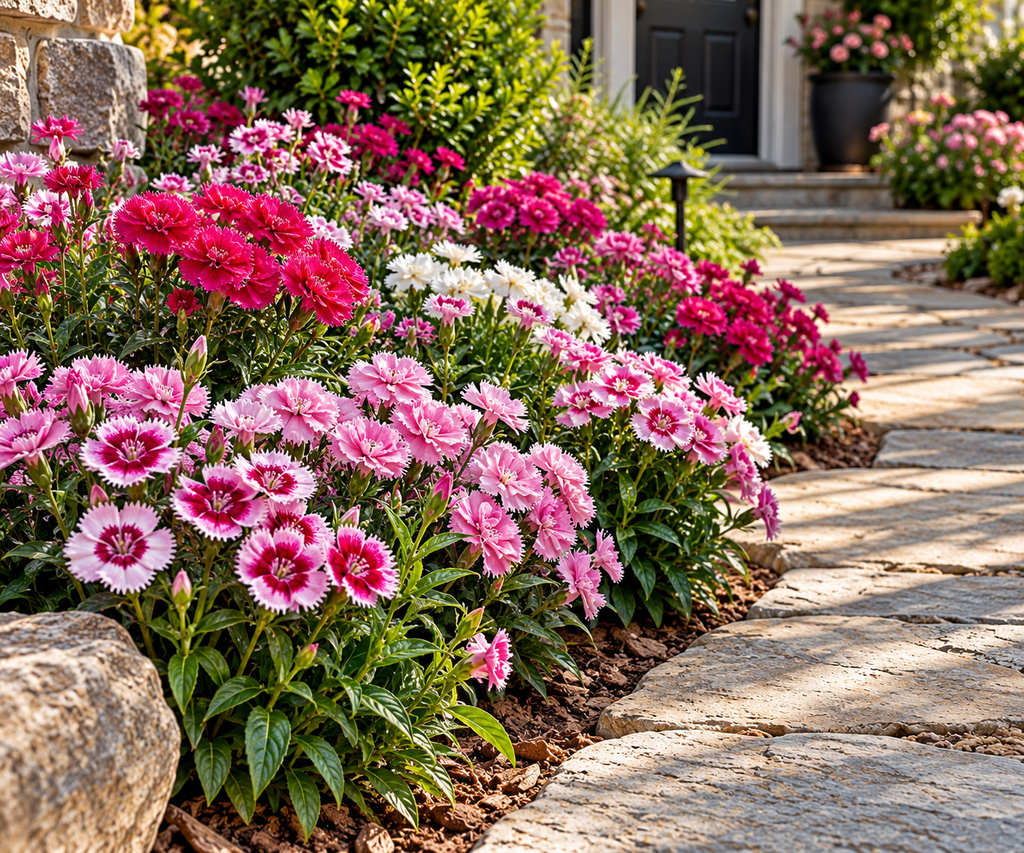
Cottage pinks (Dianthus plumarius) and many other dianthus carry a clove-like fragrance, with a spicy-sweet scent that suits a path border. They form tidy mounds of blue-gray foliage that looks good even when out of bloom, and hardiness depends on the species, often covering roughly zones 3 to 9. Dianthus needs sun and sharp drainage, and it can rot in heavy, wet soil.
Fragrance varies a lot among cultivars. Some modern dianthus sold for color have little scent, so choose varieties described as fragrant.
10. Heliotrope (Heliotropium arborescens)
Heliotrope has dark purple flower clusters that are often described as smelling like vanilla or cherry pie. It is a tender perennial in the warmest zones and is grown as an annual almost everywhere else. It likes sun and consistent moisture, and it sulks in cold soil, so wait until nights are mild before planting.
As with sweet peas, some newer cultivars have been bred for compact form and flower color at the expense of fragrance. If scent is the goal, look for plants labeled as fragrant, and smell them at the nursery when possible.
Fragrant Flowers Near Seating Areas
Seating areas are used differently from entrances. People sit still, often in the evening, and stay long enough to notice a subtle fragrance. That favors dusk-scented plants and larger shrubs that can screen the space while perfuming it.
11. Honeysuckle (Lonicera)
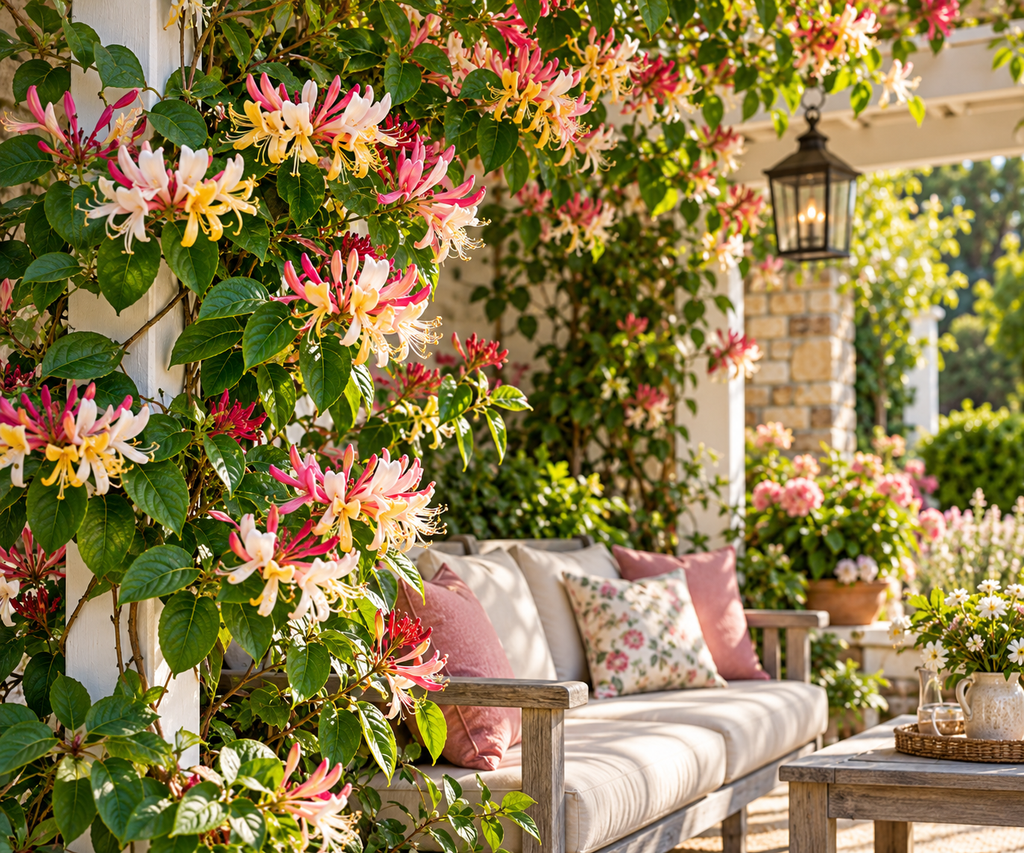
Honeysuckle has one of the most recognizable garden fragrances, strongest in the evening. Not all honeysuckles are good choices, and this is where a lot of gardeners go wrong. Common European honeysuckle or woodbine (Lonicera periclymenum) is strongly fragrant and rated roughly zones 5 to 9. Native trumpet honeysuckle (L. sempervirens) is a useful plant for hummingbirds, though its scent is mild. Japanese honeysuckle (L. japonica) is highly fragrant but is considered invasive in much of the eastern and southern United States, so it is a poor choice where it can escape.
Check your local extension service or invasive plant list before buying. Train honeysuckle on a sturdy trellis or pergola beside the seating area, and expect to prune it after flowering to keep it from becoming a tangle.
12. Mock Orange (Philadelphus)
Mock orange is a deciduous shrub with white flowers in late spring to early summer whose scent resembles orange blossom. Many varieties are rated roughly zones 4 to 8, and they tolerate a range of soils as long as drainage is decent. The scent can be strong, so it does best beside a seating area, not directly under a bedroom window.
It blooms on the previous year’s wood, so prune right after flowering. Waiting until later in the year removes next season’s flower buds. Outside bloom time it is a plain green shrub, which makes it better as part of a mixed border than as a stand-alone feature.
13. Lilac (Syringa)
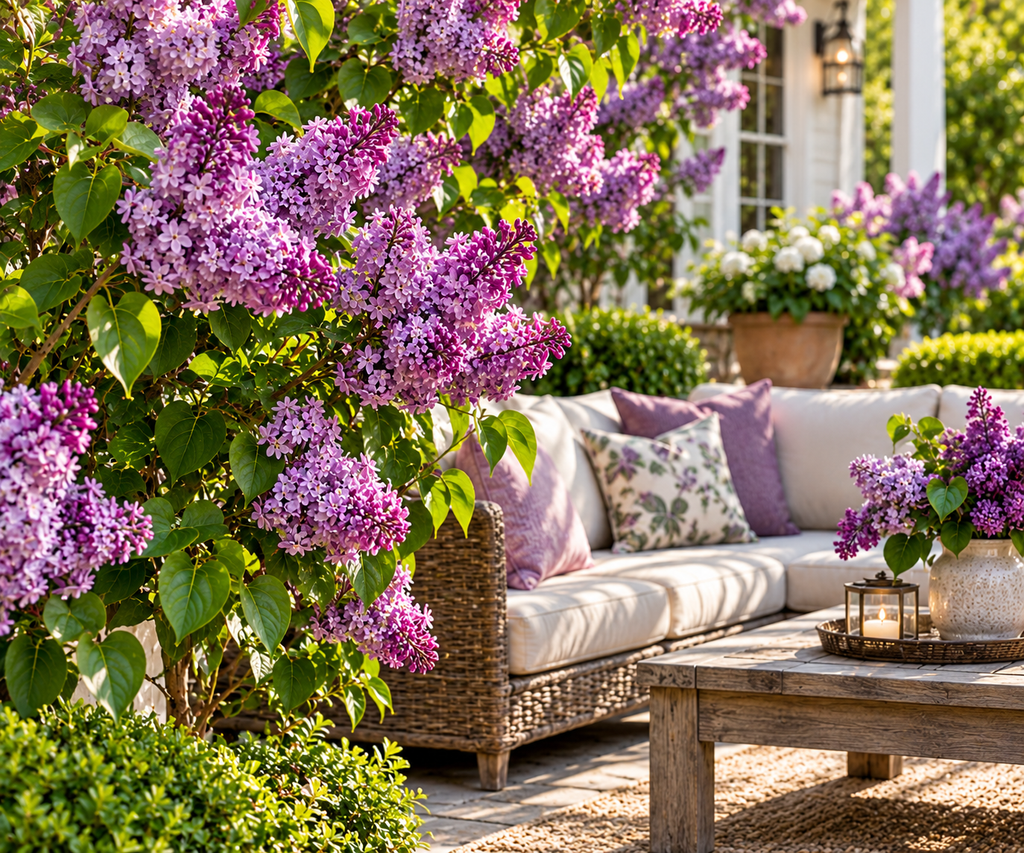
Common lilac (Syringa vulgaris) is rated roughly zones 3 to 7 and needs a cold winter to bloom well, so it is generally a poor choice in the warmest climates. The scent is unmistakable, but the flowering window is short, usually two to three weeks in mid to late spring. It needs full sun and decent drainage, and it blooms on old wood, so prune immediately after flowering.
Powdery mildew is a frequent cosmetic problem in humid summers. It rarely kills the plant, but good air circulation and sunny placement reduce it. Smaller types such as ‘Miss Kim’ stay compact enough for a patio, and reblooming types are sold that flower a second time later in the season, though usually less heavily.
14. Flowering Tobacco (Nicotiana)
Tall white or green nicotiana, including Nicotiana alata and N. sylvestris, open or intensify their fragrance at dusk. Many compact modern varieties sold in bright colors have little scent, so choose the taller, white-flowered types for fragrance. It is grown as an annual in most zones and does well in sun to part shade with regular water.
All parts of the plant contain nicotine and are toxic if eaten, which matters in a yard where children or pets spend time.
15. Oriental Lilies (Lilium)
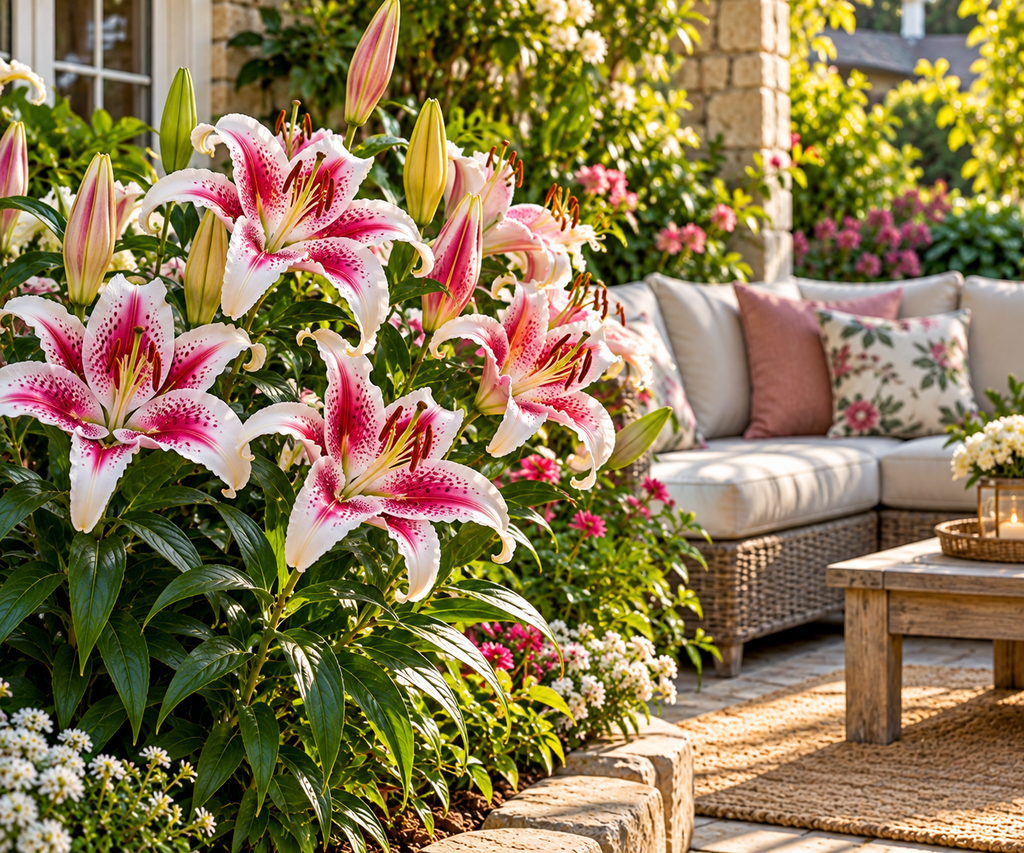
Oriental lilies, including ‘Stargazer’, are among the most powerfully scented garden flowers. They bloom in mid to late summer and are generally rated roughly zones 5 to 9. They need full sun to light shade and well-drained soil, because the bulbs rot in standing water.
Two cautions matter. The fragrance is strong enough to be overwhelming in a small, enclosed space, so give them room. And true lilies are highly toxic to cats, with even small amounts of pollen, petal, or vase water reported as dangerous. If cats spend time in the yard, skip them or choose another plant.
16. Moonflower (Ipomoea alba)
Moonflower is a fast vine whose large white blooms open in the evening and release a sweet scent. It grows as an annual in most zones and needs warm weather and a long growing season. Seeds have a hard coat, and nicking them or soaking them overnight before planting usually improves germination.
Because it blooms at dusk, it suits an evening patio better than a daytime one. The seeds are toxic, so keep that in mind around children and pets.
Fragrant Plants Around Windows
Window plantings have a particular advantage: a breeze through an open window carries scent directly into the room. They also have a particular risk, since a plant that is lovely outdoors may be too heavy indoors. Plant fragrance near bedroom windows with some caution, and favor lighter, sweeter scents.
Jasmine and Gardenia at Windows
Both plants from the front door section work well here. Jasmine trained on a trellis beside a window, or a gardenia in a bed or large container under it, scents the room when the window is open. Place them so that the plant sits a little to the side of the opening, not directly beneath, to keep the scent gentle rather than concentrated.
17. Sweet Peas (Lathyrus odoratus)
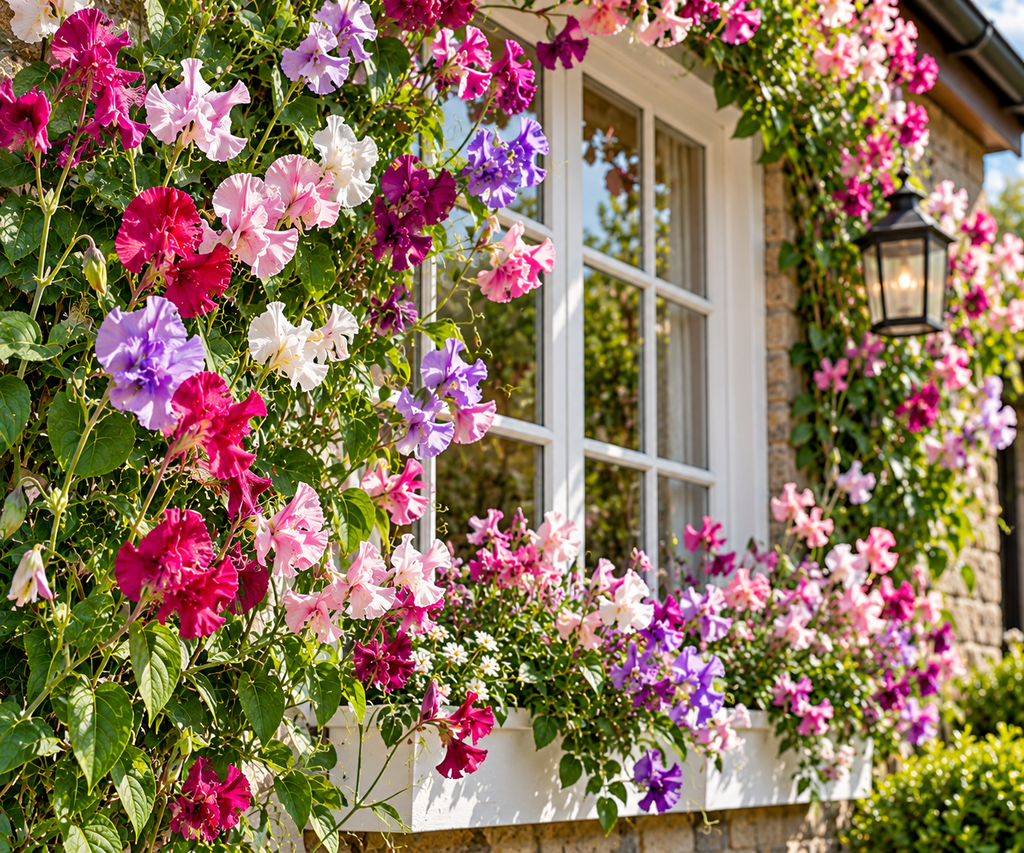
Sweet peas are cool-season annual vines with ruffled flowers whose scent is sweet and slightly citrusy. They are the classic choice for a trellis beneath a window. In mild-winter areas they are often sown in fall, and in colder climates they are sown in early spring as soon as the soil can be worked. They dislike heat, and flowering slows when summer temperatures rise.
Heirloom varieties such as ‘Cupani’ and many grandiflora types are known for strong scent, while some modern types selected for large flowers are weakly scented. Regular picking encourages more blooms, and the seeds and pods are toxic if eaten.
18. Hyacinth (Hyacinthus orientalis)
A drift of hyacinths under a window in early spring can perfume a room as soon as the window opens for the first time in months. Bulbs are planted in fall, and they are generally rated roughly zones 4 to 8. In warm climates, bulbs are often pre-chilled in a refrigerator before planting, away from fruit that gives off ethylene gas.
Hyacinth bulbs and sap can irritate skin, so gloves are sensible when planting. The flowers fade within a few weeks, and the bulbs often decline in vigor in following years, so some gardeners replant fresh bulbs for the best display.
19. Stock (Matthiola incana)
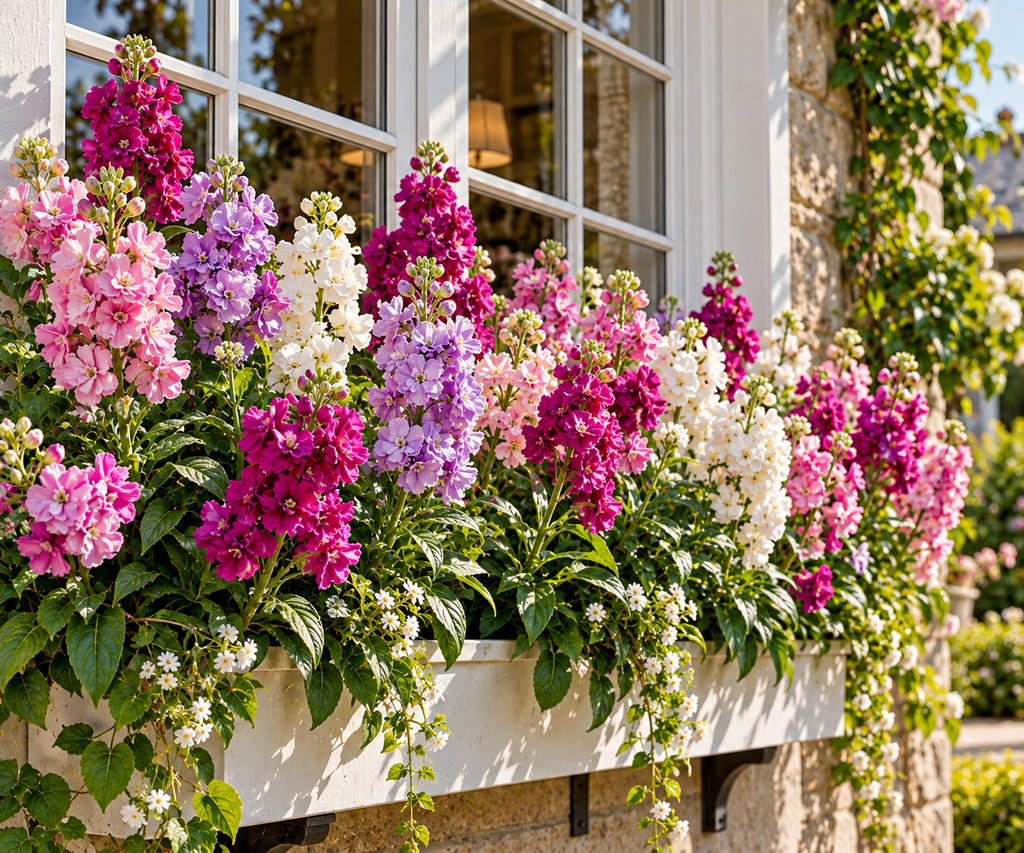
Stock has dense spikes of flowers with a spicy, clove-like fragrance. It is a cool-season annual that does best in spring and fall and struggles in heat. It suits a bed under a window that gets sun but cool nights. Plants vary a lot in flower form and scent, so it helps to choose a named strain described as fragrant.
20. Korean Spice Viburnum (Viburnum carlesii)
This deciduous shrub has pink buds that open into white flower clusters with a strong, spicy-sweet scent in mid-spring. It is rated roughly zones 4 to 7 and grows into a rounded shrub about as wide as it is tall, so it needs room. It suits a spot beside a window with good sun and decent drainage, and it typically asks for little attention beyond occasional pruning after flowering.
21. Lily of the Valley (Convallaria majalis)
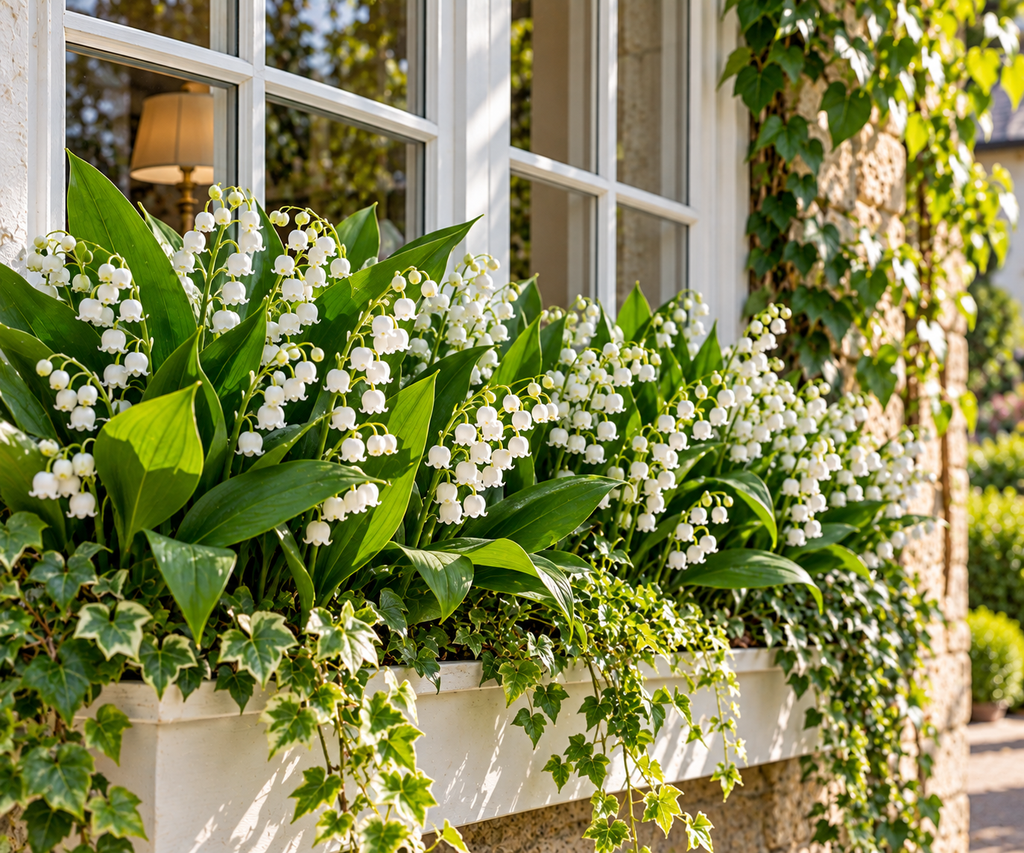
Lily of the valley has small, nodding white bells and a clean, sweet scent. It grows in part to full shade and is rated roughly zones 2 to 7, making it one of the few fragrant options for the shady side of a house. It spreads by underground stems and can become aggressive, so it works best where it can be contained by pavement, a wall, or a bed edge.
All parts are poisonous if eaten, so it is not a good choice where small children or pets are likely to chew on plants.
Planning a Garden That Smells Good Across the Seasons
A yard where everything blooms in May smells great for a few weeks and then very little. A better plan staggers fragrance through the year. Daphne, hyacinth, and Korean spice viburnum cover late winter to mid-spring. Lilac, mock orange, sweet peas, and roses carry spring into early summer. Lavender, honeysuckle, jasmine, nicotiana, and lilies cover summer. Tea olive and some repeat-blooming roses carry into fall. Thyme and lavender foliage contribute scent in every season they are green.
If space is limited, put the most fragrance where it is used most. A single large pot near the door, one vine on a patio trellis, and one plant near the most-used window will do more than a dozen scattered around the yard.
Mistakes That Leave a Fragrant Garden Smelling Like Nothing
- Buying by color without checking for scent. Many modern cultivars of roses, sweet peas, heliotrope, nicotiana, and dianthus are less fragrant than older types.
- Planting too far from where people are. A fragrant shrub at the back fence rarely reaches anyone on the patio.
- Ignoring wind. In an exposed spot, scent is gone before it arrives. A hedge, fence, or wall to break the wind helps.
- Choosing plants that do not suit the climate. Lilacs in a mild-winter climate and gardenias in a cold one are common disappointments.
- Overlooking toxicity. Several plants on this list are poisonous to people, pets, or both. Check the species before planting near play areas, and check with a veterinarian or poison-control resource if an animal eats something.
- Overcrowding scent. Too many strong fragrances in one small spot compete with each other. Two or three strong plants in an area usually works better than six.
Questions Readers Often Ask About Fragrant Plants
Can fragrant plants be grown in containers? Many can. Gardenia, jasmine, lavender, roses, sweet alyssum, heliotrope, and thyme all do well in pots with good drainage holes. Containers are especially useful where soil is poor or the climate is too cold for a plant to survive winter outdoors, since the pot can be moved.
Do fragrant flowers cause allergies? Scent and pollen are different things. Many fragrant flowers are insect-pollinated and release little airborne pollen, but strong fragrance can still bother people with sensitivities or asthma. If someone in the household reacts to scent, it is reasonable to test a plant outdoors first before planting it near a window.
Why does my fragrant plant smell stronger some days than others? Temperature, humidity, time of day, and wind all affect how much scent reaches a person. Warm, still conditions tend to bring out more fragrance, and some plants release most of it in the evening.
Key Takeaways
Placement decides whether a fragrant garden is noticed. Put the strongest, most reliable plants by the front door and the windows people actually open, use touch-activated plants like lavender and thyme along paths, and save the dusk-scented plants for the places where people sit in the evening. Check hardiness for your zone, choose varieties described as fragrant, and read the toxicity notes before planting near children or pets. If the list feels long, start with one plant for each of the four spots and add from there.

About Syprose Kiche
Syprose Kiche is the creator and writer behind My Besuited Home, a practical home and garden website covering DIY projects, gardening, lawn care, landscaping, home improvement, and outdoor living. She focuses on turning everyday homeowner questions into clear, practical guides backed by careful research and useful real-world considerations.