
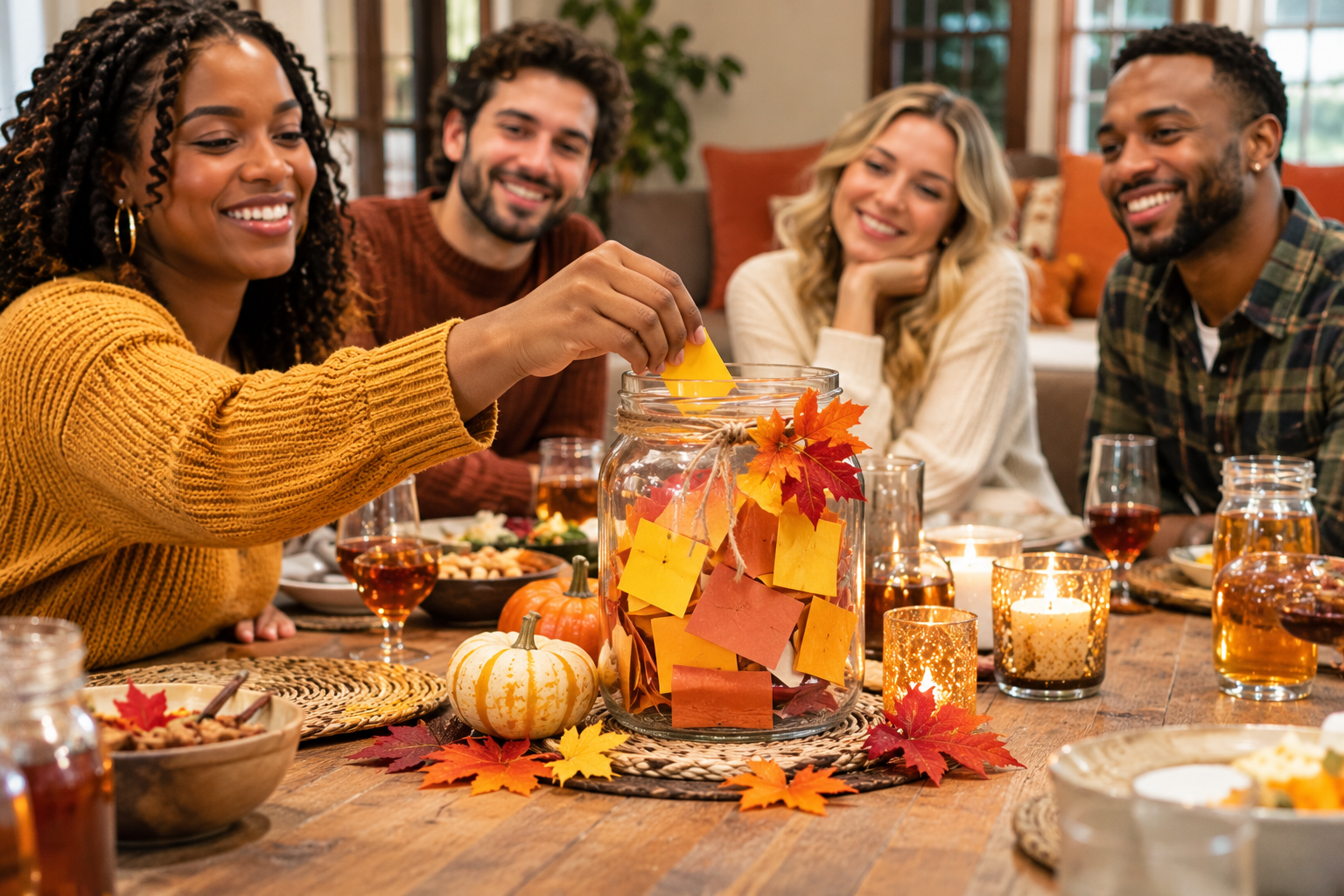
Most Friendsgivings go wrong in one of two ways. Either the host cooks everything alone and finally sits down at 8 p.m. too tired to talk, or eight guests each arrive with a pan of mashed potatoes and nobody remembered a vegetable. Neither is a personality flaw. Both are planning gaps, and both are easy to close before anyone buys a turkey.
The ideas below are grouped by the decisions a host actually makes: what format to run, how to dress the space, what to do once people have eaten, and how to adjust for a teen crowd or a Black Friendsgiving gathering. Thanksgiving falls on Thursday, November 26 this year, so the weekends on either side are where most Friendsgivings land. Pick what fits your head count and your kitchen, and ignore the rest.
Three Numbers to Settle Before You Pick Anything
Seats. Plan on roughly 24 inches of table width per person. A standard six-foot folding table seats six comfortably, three per side, and an eight-footer seats eight. Past that, you need a second table or a plan for people to eat from a buffet and sit at a coffee table or counter. Guessing wrong here is what produces the elbow-to-elbow dinner where nobody can reach the gravy.
Oven hours. A home kitchen has one oven, and everyone’s dish wants 350°F at the same time. A 12- to 14-pound unstuffed turkey takes roughly three to four hours at 325°F, and it should rest for 30 to 45 minutes under foil before carving. That rest is your window: pull the bird, turn the oven up, and use it for rolls, casseroles, and anything that needs reheating. Dishes that run on a slow cooker, the stovetop, or no heat at all (salads, cranberry sauce, pies) are what keep the schedule from collapsing.
Power. Three slow cookers, a warming tray, and a coffee urn on one power strip can trip a breaker, and the trip usually happens mid-meal. Spread appliances across different outlets, ideally different circuits, and avoid daisy-chaining extension cords. If you can’t tell which outlets share a circuit, test during setup rather than during dinner.
Format Ideas: Decide How the Day Works First
The format determines the budget, the workload, and who ends up at the stove. Settling it first makes every later choice easier.
1. A Potluck With a Real Sign-Up Sheet
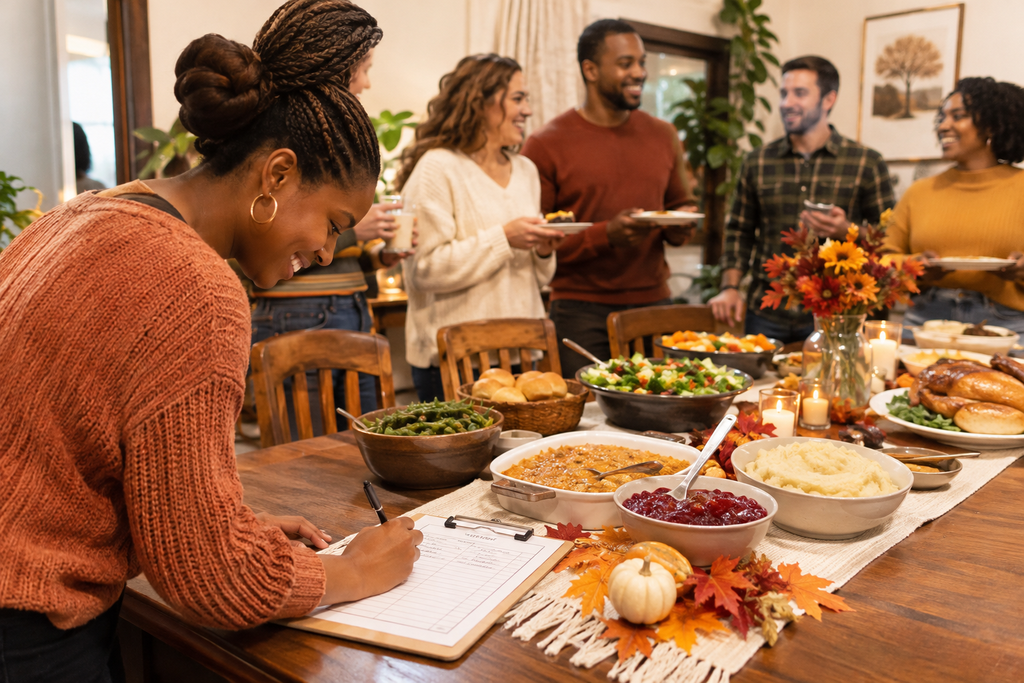
The usual potluck failure is the vague request: “bring a side.” Ask each person to claim a specific dish instead, in a shared spreadsheet or group chat, and add three extra columns: needs the oven, needs an outlet, and arrives hot or cold. That small addition is what lets you build the oven schedule before the day instead of improvising it.
For ten guests, a workable spread is two oven sides, two stovetop sides, one salad, one appetizer, two desserts, and someone assigned to drinks and ice. Add a column for dietary needs so the person bringing stuffing knows to make it vegetarian if one guest needs it. Ask people to arrive in oven-safe dishes and to bring their own serving spoons. Hosts rarely own twelve serving utensils.
2. The Host Cooks the Turkey, Guests Bring the Sides
This hybrid works because the turkey is the one item guests can’t easily bring: it needs the longest oven time and the most attention. You handle the bird and the gravy; everyone else covers sides and desserts.
The main trap is thawing. The USDA’s guidance for a refrigerator thaw is about 24 hours for every 4 to 5 pounds, which puts a 14-pound bird at roughly three days. Frozen turkeys that are still icy at the center on the morning of the party are one of the most common ways a Friendsgiving ends up with dinner at 9 p.m. The turkey is done when a thermometer reads 165°F in the thickest part of the breast, the innermost part of the thigh, and the wing. Color and juices are unreliable.
If oven space is tight, spatchcocking (removing the backbone and flattening the bird) shortens roasting time noticeably and frees the oven sooner. A butcher or the meat counter will often do it if you ask in advance.
3. A Cook-Along Where Everyone Arrives at 2 p.m.
In this version, the cooking is the event. Guests arrive in the afternoon and each person owns one dish and one workstation: rolls at the counter, a pie in the corner, potatoes on the stove. It suits groups who like to cook and don’t mind a loud kitchen.
It has a real limit. Most kitchens fit two or three people at once before it becomes a hazard, with hot pans, knives, and a full oven in the same few feet. Give everyone else jobs elsewhere: setting the table, building a snack board, running the drink station. Keep children and pets out of the cooking zone, and keep one person in charge of anything that comes out of the oven.
4. A Backyard or Patio Friendsgiving
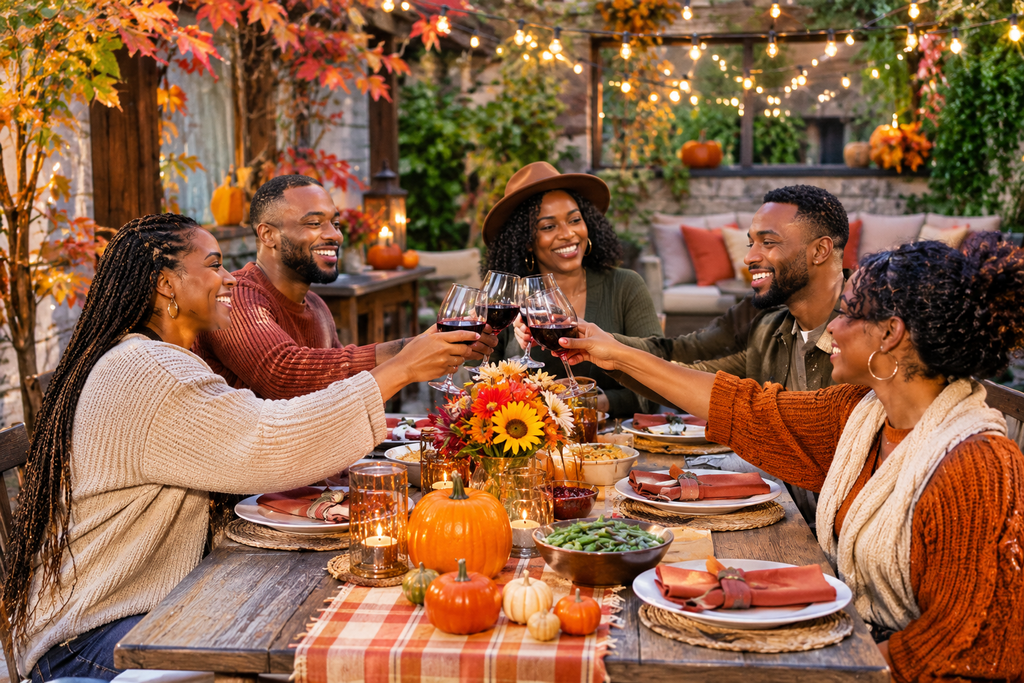
Late November is workable outdoors in many climates if you plan for the cold, and an outdoor setup keeps the mess away from your floors. Start with timing: sunset comes early this time of year, often before 5 p.m. across much of the country, so schedule the meal around the light rather than the other way around.
Heating needs care. Propane patio heaters are for open-air use only, on level ground, with clear space above and beside them as the manufacturer specifies. Keep them away from tents, awnings, low branches, and tablecloths. A fire pit adds warmth and atmosphere, but check local burn restrictions first, keep a hose or extinguisher within reach, and keep a clear zone around it.
Food also cools faster outdoors. Hot dishes should stay above 140°F, so use chafing dishes, covered pans, or a slow cooker rather than leaving casseroles in the open air. A basket of blankets near the seating costs almost nothing and does a lot of work.
5. Friendsgiving Brunch
This format is worth considering for guests who have family dinners later in the week. It starts around 11 a.m., costs less, and skips the turkey entirely. Think biscuits with sausage gravy, sweet potato hash, a quiche or breakfast casserole that can be assembled the night before, and a pumpkin pancake or waffle bar.
A waffle bar only works with enough irons. One iron means a line; keep finished waffles on a rack in a 200°F oven so people eat together. Add a cider and coffee station, and brunch becomes a fair stand-in for a full dinner with half the dishes.
6. A Small Table for Four to Six
Cooking a whole turkey for four people leaves a week of leftovers and a crowded fridge. A bone-in turkey breast, Cornish hens, or a roast chicken delivers the same feel with a fraction of the cooking time and fewer dishes. Cut the side list too: mashed potatoes, one vegetable, stuffing, and one dessert is a complete meal for a small group.
In a small apartment, the table is the constraint. Serve from the stove or counter instead of putting every dish on the table, and use the extra table surface for plates and glasses. A low coffee table with floor cushions makes a perfectly good casual setup if no one at the party has mobility issues.
Friendsgiving Decorations That Make the Table Look Planned
Decorating is where Friendsgivings tend to get overbuilt. Three things do most of the work: a table covering, warm lighting, and one natural centerpiece. Everything else is optional.
7. A Low Centerpiece From the Yard and the Produce Aisle
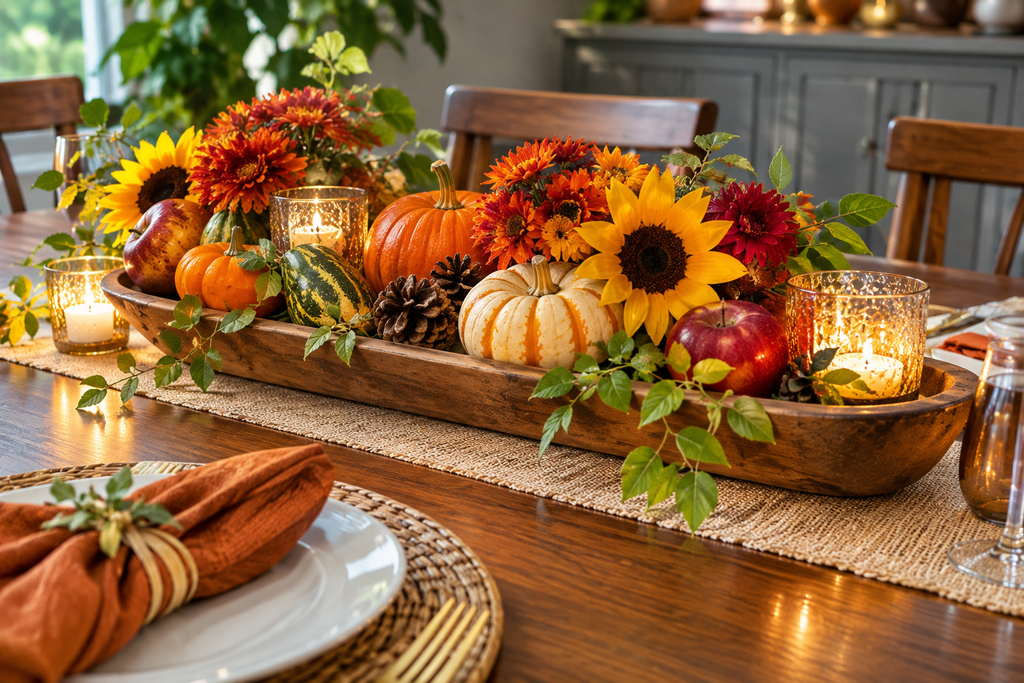
Trim branches with fall color, bundle a few small pumpkins and gourds, and add pears, apples, or pomegranates. Cluster them down the center of the table in a loose line rather than in one tall arrangement. The height rule is simple: if guests can’t see the person across from them when seated, it’s too tall.
Be careful with plants. Holly berries and several other common fall branches are toxic if eaten, which matters if toddlers or pets will be around. Skip berries you can’t identify, shake branches outdoors to dislodge insects, and keep decorative fruit away from the serving area so no one mistakes it for something edible after a week at room temperature.
8. A Kraft Paper Runner Guests Can Write On
Roll butcher or kraft paper down the table, tape the ends under, and leave pens in cups. Write a few prompts along the edge: a thing you’re grateful for, your worst cooking disaster, a recipe you’d like to learn. Guests write and doodle between courses, and the runner doubles as a game.
Protect the table underneath. Ink can bleed through thin paper, so lay a plastic or fabric cloth below. And keep trivets or folded towels at every hot dish. A casserole straight from a 350°F oven can leave a ring on a wood finish in a few minutes.
9. Layered, Low Lighting
Overhead lights flatten a dinner table. Turn the main fixture down, add lamps around the room, and put candles at table level. Warm-white bulbs, usually labeled around 2700K, give the amber glow people associate with a cozy dinner.
For candles, choose stable holders and keep flames at least a foot from anything that can burn, a guideline fire-safety organizations commonly give. Dried leaves and paper runners count. Skip scented candles near the table, since they compete with the food. Flameless LED candles are a sensible choice when children, pets, or a crowded table are in the mix. Blow out real candles before anyone leaves the room.
10. An Entryway and Porch That Set the Tone
Guests form their impression before they reach the food. A couple of pumpkins, a pot of mums, and a bundle of cornstalks by the door signal a party, and a porch light on by 4 p.m. makes arrival easier in the early dusk. Clear wet leaves off steps and walkways: they’re slippery, especially in the evening.
Use the space inside the door, too. A rolling garment rack, a bench, or a spare bed handles coats for a dozen guests. A boot tray handles muddy shoes in rainy weather. These are boring details, but they decide whether the first ten minutes feel calm or chaotic.
11. A Long Table Built From What You Already Own
If you don’t own a table that seats eight, there are practical ways around it. Line up two or three folding tables end to end, tape the seams flat, and cover them with a floor-length cloth that hides the legs and the mismatch. If the surfaces differ in height, shim the lower leg with a folded towel or a block under the foot. Check that each folding table’s leg locks are fully engaged before loading it with food.
A sheet of 3/4-inch plywood across two sawhorses also works for a rustic look, but sand the edges, make sure the sawhorses are steady, and don’t rely on it for heavy loads without testing. Either way, rehearse the setup a few days early so you aren’t improvising while guests arrive.
Friendsgiving Games That Work After a Big Meal
People eat a lot at Friendsgiving and then sit still, which is exactly when a game helps. A good lineup has one low-effort option for the table, one for the group, and one active option for anyone who wants to move. No one should be forced to play.
12. A Gratitude Jar With a Guessing Twist
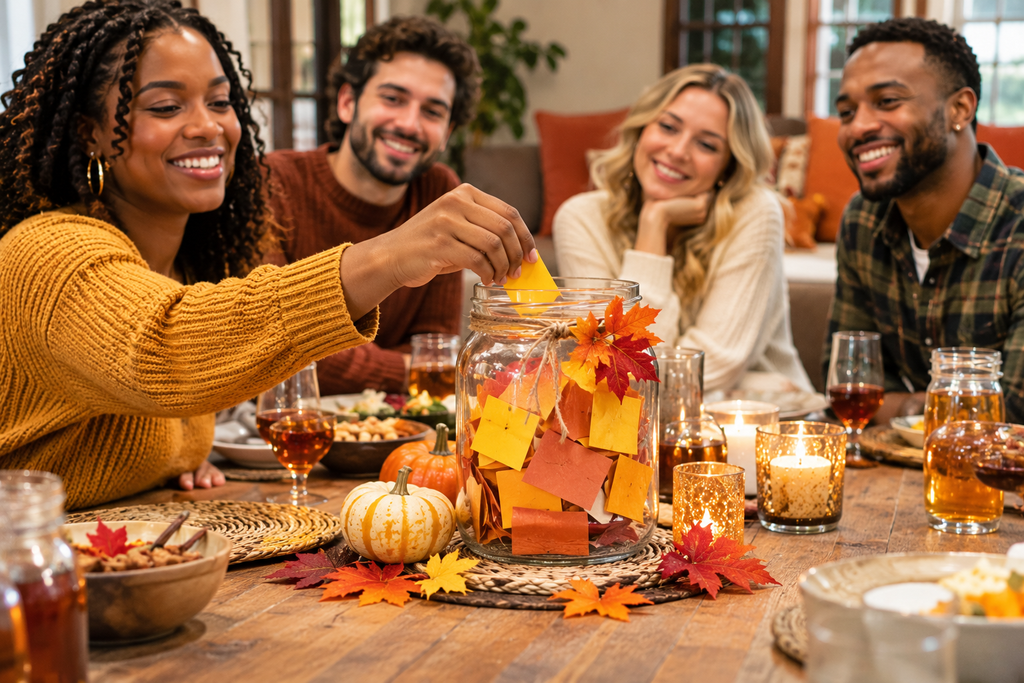
The standard go-around, where each person says what they’re thankful for, tends to produce a lot of mumbling. A jar fixes that. Put a slip and a pen at every seat, ask for one specific answer to a prompt (something small that went right this year, someone who helped them, a food they’d defend in an argument), and collect the slips. Read them aloud after dessert and let the table guess who wrote each.
It takes about fifteen minutes, costs nothing, and gets quieter guests involved without putting them on the spot.
13. Two-Round Friendsgiving Trivia
Split trivia into two rounds. The first is about the holiday: Abraham Lincoln proclaimed a national day of Thanksgiving in 1863, and Congress fixed the holiday on the fourth Thursday of November in 1941, which gives you a few safe questions. The second round is about the guests. Everyone submits two anonymous facts about themselves (a hidden talent, an odd job, a bad haircut), and the table guesses whose fact it is.
Play in teams by seating area, keep score on a sheet of paper, and give the winners something silly, like first choice of pie. Verify any specific holiday facts before the party, since trivia disputes can derail the evening faster than a burnt roll.
14. A Blind Pie or Side Dish Competition
Number the dishes, remove the names, and give each guest a scorecard with a few categories: flavor, texture, and presentation. Serve small portions, about an inch of pie, so people can taste several. Tally the scores while everyone eats, and award a prize, a spray-painted gravy boat makes a decent trophy.
A few rules prevent hurt feelings. Allow store-bought entries in a separate category, label allergens on each card, and skip this one entirely if the group includes someone who would feel judged. It runs best when the cooks are comfortable laughing at their own results.
15. A Gift Swap With a Spending Cap
A white elephant exchange works well at Friendsgiving, particularly with a firm limit of $15 to $20 and a theme like kitchen gadgets, cozy things, or regifted items. Draw numbers, let players steal a gift two or three times, and decide beforehand whether the final player can take anything.
Plan on roughly an hour for a dozen players. With larger groups, the stealing gets repetitive, so reduce the steal limit to keep it moving.
16. A Turkey Bowl and Cornhole Before Dinner
A touch or flag football game in the yard is a classic Friendsgiving addition, and it’s easier to organize before the meal than after it. No one wants to sprint on a full stomach. Keep the roster flexible, make sure the ground is clear of leaves and holes, and make flag or touch the rule so no one gets hurt.
Cornhole is a lower-effort alternative. Regulation boards are 24 by 48 inches and set 27 feet apart, measured front edge to front edge, though shortening the gap suits kids and small yards. For rainy days, move to indoor games like charades, a Jackbox-style party game, or a round of Heads Up.
Friendsgiving Party Ideas for Teens
A teen Friendsgiving differs from an adult one mostly in who’s in charge. Adults need to be in the building, in the background, and responsible for the stove, the oven, and the rules. Before the day, settle four things and put them in the invitation: the guest list, the start and end times, a clear no-alcohol policy, and a parent contact number. Ask about food allergies up front. A teen with an unrecognized allergy is a worse surprise than a late dessert.
17. A Potluck With Build-Your-Own Stations
Teens usually don’t have the budget or experience to cook a full side, so assign simple items: a bag of rolls, boxed mac and cheese, canned cranberry sauce, a tray of cookies. Add one or two build-your-own stations to make it feel like an event. A mashed potato bar (toppings like cheese, bacon bits, and chives) or a mac and cheese bar with breadcrumbs and hot sauce works for a crowd with different tastes.
Set up a mocktail and cider station with sparkling juice, cranberry, ginger ale, and citrus slices in a beverage dispenser. It gives the drinks a grown-up feel without alcohol. A phone playlist, a simple photo corner with string lights, and a long table are all it takes for the setup. Adults should handle carving and hot dishes.
18. A Team Cook-Off Using Mystery Ingredients
This one is closer to a TV competition than a dinner. Split teens into teams of three or four, hand each team the same basket (canned pumpkin, apples, crackers, a block of cheese, a bag of marshmallows), and give them 30 minutes to build a dessert or appetizer. A parent or older sibling judges on taste, creativity, and cleanliness.
Set ground rules. Give each team a cutting board and one designated knife handler, keep everything on counters rather than near the stove, and have an adult supervise any heat source. It costs under $30 in groceries for most groups and gives teens something to do beyond their phones. The results usually double as the dessert table.
Black Friendsgiving: Food, Music, and Games
Black Friendsgiving is a long-running tradition for many Black people, often held with friends and chosen family around Thanksgiving, and its menus and customs vary by region and household: Southern, Caribbean, West African, and Midwestern traditions can look quite different. Treat the ideas below as starting points, not a rulebook.
19. A Family-Style Menu Where the Recipe Owner Brings the Dish
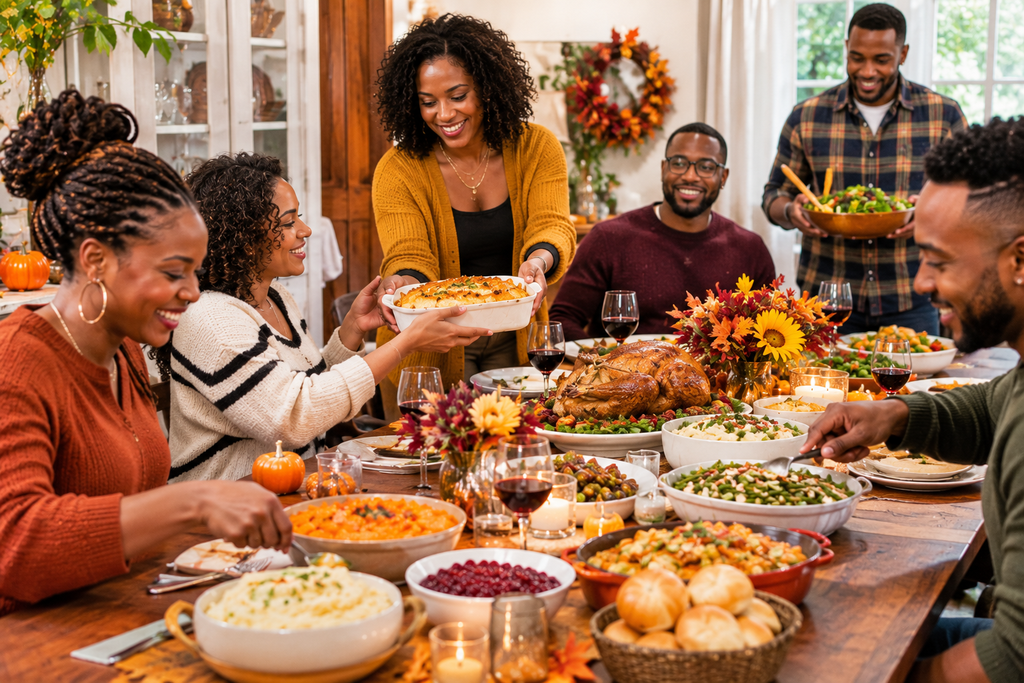
Many Black Friendsgiving tables include baked macaroni and cheese, collard or mixed greens, cornbread dressing, candied yams or sweet potato pie, and peach cobbler or banana pudding, alongside a turkey, ham, or both. These dishes are often tied to someone’s own recipe, so ask the person who owns it to bring it rather than assigning it to whoever is free.
Some practical notes. Greens typically simmer for an hour or more and reheat well, so they’re ideal to make a day ahead. Baked mac and cheese holds heat in a covered foil pan, but dairy-based dishes shouldn’t sit out for more than two hours, so serve in smaller waves. Greens are often seasoned with smoked pork, so make a smoked-turkey version or label what’s inside for guests who don’t eat pork. Add at least one vegetarian side so those guests have more than salad.
If a fried turkey is part of the plan, it’s a safety-heavy job. Fry outdoors, a safe distance from the house, deck, and garage, on level ground, with the bird completely thawed and thoroughly dried, since water causes hot oil to spatter. Measure the oil before heating: place the turkey in the empty pot, cover it with water, remove the bird, and mark the water level. That is how much oil to use. Never leave the fryer unattended, and keep a fire extinguisher rated for grease fires close by. Skip water entirely.
If frying feels like too much, a smoked turkey from a local shop or a roasted bird with a spice rub keeps the flavor with less risk.
20. Card Tables, a Playlist, and Warm Colors
A games-after-dinner segment is a staple at many gatherings, and spades, Bid Whist, and dominoes are common choices. Set up card tables before dinner so the transition is easy. Both spades and Bid Whist are played in partnerships of four, so with twelve guests, run a bracket and keep score on a pad. Dominoes suits a smaller group that likes to talk during play.
Build the playlist in phases: softer soul, jazz, gospel, and classic R&B during dinner, then louder and more danceable as the evening goes on. Songs like Frankie Beverly and Maze’s “Before I Let Go” are widely treated as sing-along standards, and group dances like the Cupid Shuffle or the Electric Slide get people up between games.
For decor, earth tones like burnt orange, deep green, gold, and burgundy work well. If you add textiles such as mud cloth or kente-inspired patterns, buy from Black-owned or African artisan makers rather than mass-market imitations, and consider ordering desserts or bread from a local Black-owned bakery.
Leftovers, Allergies, and Other Details Hosts Forget
Food safety. Perishable food shouldn’t sit at room temperature for more than two hours, or one hour if the room is above 90°F. Hot food should stay above 140°F and cold food below 40°F. Refrigerate leftovers in shallow containers, eat them within three to four days, and reheat to 165°F. Have foil pans and zip bags ready, or ask guests to bring containers, so leftovers leave with people instead of overwhelming your refrigerator.
Allergies and labels. Ask about allergies in the invitation and have guests label their dishes with key ingredients: nuts, dairy, gluten, pork. A folded index card by each dish takes seconds.
Drinks. If alcohol is served, provide good non-alcoholic options and encourage designated drivers or ride shares. A couch or air mattress for overnight guests is a sensible backup.
The bathroom and the trash. Before guests arrive, stock extra toilet paper, a clean hand towel, and a lined wastebasket. Put a large trash can and a recycling bin near the kitchen. A dozen guests generate more waste than most households handle in a week.
Questions Hosts Actually Ask
How much food should I plan per person? A common rule of thumb is 1 to 1.5 pounds of whole turkey per guest, which accounts for bones, and about half a cup of each side per person, with extra for mashed potatoes and stuffing. A nine-inch pie cuts into about eight slices, so ten guests who want to try two desserts need at least three pies.
Is it fair to ask guests to chip in for the turkey? Yes, and many groups prefer it. If the host buys the bird and the main cooking supplies, splitting the cost through a payment app keeps the cost from falling on one person. Mention it in the invitation rather than afterward.
What if someone’s dish doesn’t match the plan? Absorb it. If two people bring mashed potatoes, serve one at a time or label them. The sign-up sheet reduces surprises, but a few extras never hurt a Friendsgiving.
What time should it start if guests have another dinner later? Start by 2 or 3 p.m. so people can eat, play a game or two, and leave on time. A brunch start also leaves plenty of room for later plans.
Final Thoughts
The best Friendsgivings have a clear format, a realistic oven schedule, and a handful of small touches rather than a hundred. Pick a date, choose one format from the first section, and send the invitation with a sign-up sheet that tracks oven and outlet needs. Then pick one decoration idea, one game, and one thing you’d like guests to remember. The rest of the list is a menu to draw from, not a checklist.

About Syprose Kiche
Syprose Kiche is the creator and writer behind My Besuited Home, a practical home and garden website covering DIY projects, gardening, lawn care, landscaping, home improvement, and outdoor living. She focuses on turning everyday homeowner questions into clear, practical guides backed by careful research and useful real-world considerations.