
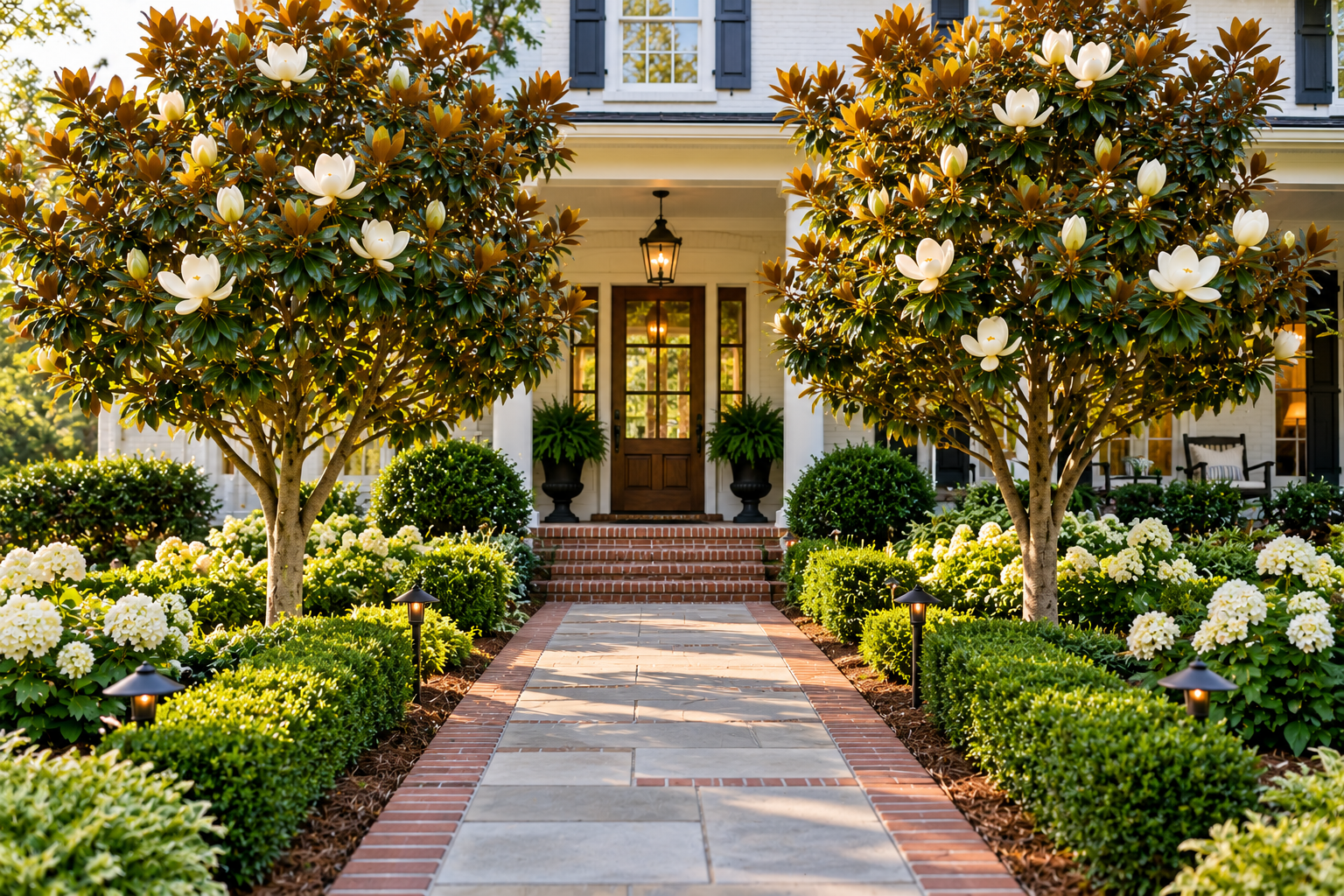
A magnolia in a three-gallon nursery pot is easy to misjudge. It stands about three feet tall, carries a handful of glossy leaves, and looks perfectly at home eight feet from the front steps. Fifteen or twenty years later, if it is a full-size Southern magnolia, it can top the roofline of a two-story house, with a canopy wide enough to shade the entire front bed, roots lifting the edge of the driveway, and a carpet of stiff leaves that no rake ever quite finishes.
That is the real planning problem with magnolias. They are among the most rewarding trees for a Southern-style yard, with evergreen foliage, large fragrant flowers, and a presence that makes a plain lot look established. The ideas that work well are the ones that begin with the tree’s eventual size, its shallow roots, and its leaf drop, then build the design around them. The eleven ideas below do that, from driveways and privacy screens to hydrangea and rose pairings, along with the spacing rules and cautions that tend to get skipped.
Choosing a Magnolia That Fits the Space You Actually Have
Most of what people call a magnolia in a Southern yard is Southern magnolia (Magnolia grandiflora), the evergreen tree with leathery leaves and dinner-plate-size white flowers. It is not the only option, and for many properties it is not the best one. The genus also includes smaller evergreen and semi-evergreen selections, plus deciduous types that flower before their leaves appear. Mature size is what separates them most.
| Type | Typical mature size* | Foliage | Best suited to |
| Full-size Southern magnolia (species and large selections) | 50 to 80 ft tall, 30 to 40 ft wide | Evergreen | Large lots, rural properties, wide front lawns |
| Compact Southern selections such as ‘Little Gem’ and ‘Teddy Bear’ | 15 to 25 ft tall, 8 to 15 ft wide | Evergreen | Suburban lots, screening, patios, walkways, large containers |
| Sweetbay magnolia (M. virginiana) | 10 to 35 ft tall, 10 to 20 ft wide | Semi-evergreen to evergreen in mild climates | Damp spots, smaller yards, areas near seating |
| Saucer magnolia (M. × soulangeana) | 20 to 25 ft tall and wide | Deciduous | Early spring color in cooler zones |
| Star magnolia (M. stellata) | 10 to 20 ft tall, 10 to 15 ft wide | Deciduous | Small spaces, early bloom |
*Sizes are typical ranges and vary by cultivar, soil, and climate. Check the plant tag or the grower’s listing for the exact selection before buying.
Hardiness follows a similar split. Southern magnolia is generally grown in USDA zones 7 through 10, and a few selections, including ‘Bracken’s Brown Beauty’ and ‘Edith Bogue’, are often recommended for the colder edge of that range around zone 6. Confirm that with a local nursery or cooperative extension office, because survival at the margins depends heavily on wind exposure and site shelter. Sweetbay tolerates colder winters and, unusually for a magnolia, wet soil. Saucer and star magnolias are hardy farther north but carry a different risk: their buds open in late winter or early spring, and one hard frost can turn the flowers brown overnight.
The Root and Soil Rules Behind Every Idea Below
Magnolia roots are fleshy, shallow, and spread well past the edge of the canopy. Three practical rules follow from that, and they come up again and again in the ideas below.
The first is that the tree dislikes disturbance. Piling extra soil over the root zone, driving vehicles across it, or trenching through it for a path, drain, or utility line can send the tree into slow decline that may take several years to show. The second is planting depth. Set the top of the root ball level with, or slightly above, the surrounding soil, and keep a 2- to 4-inch layer of mulch a few inches back from the trunk. The third is soil and water. Magnolias generally prefer slightly acidic to neutral, well-drained soil that is rich in organic matter, and they need regular watering for roughly the first two years while roots establish. In alkaline soil the leaves can turn yellow between the veins (iron chlorosis), and in soil that stays waterlogged the roots can rot.
Before digging anywhere in the yard, call 811 so buried utilities are marked. In the U.S. the service is free, and a shovel through a gas or electric line is not a mistake worth testing.
1. Plant One Tree Off-Center in the Front Yard
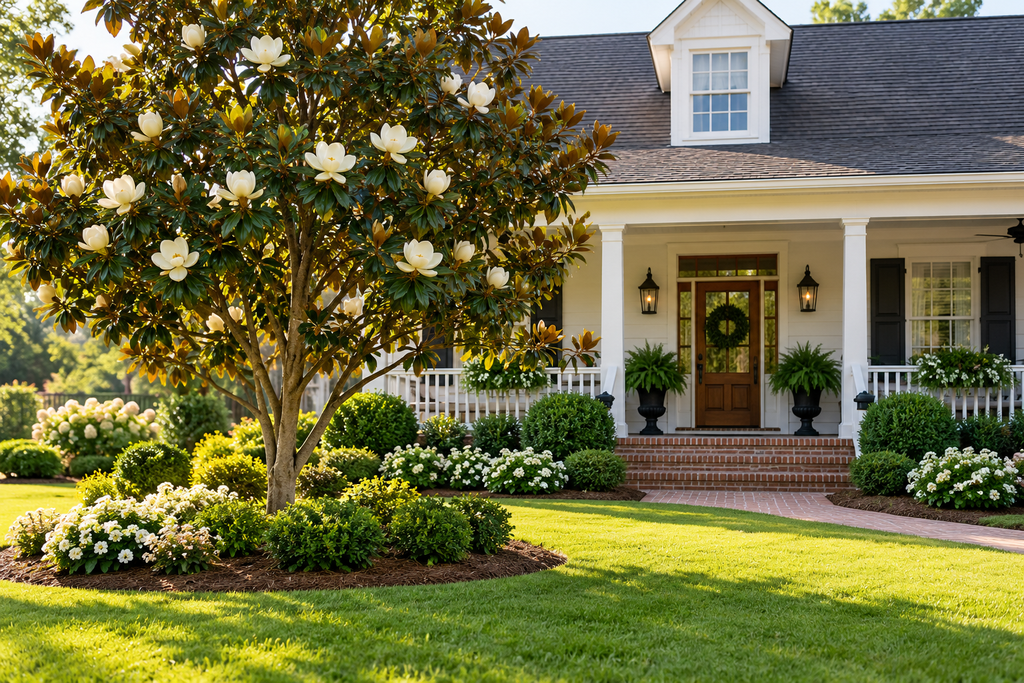
A single magnolia can anchor an entire front yard, and the strongest placements usually avoid dead center. A tree set to one side of the front door, balanced by lower shrubs and a bed on the opposite side, looks established rather than staged. A matching pair flanking the door is a more formal choice and suits symmetrical brick or colonial-style houses.
Distance from the house matters more than almost any other decision here. A common guideline is to set a tree back at least half its mature canopy width from the wall, plus extra for roof overhang. For a full-size Southern magnolia that means 20 feet or more. For a compact selection like ‘Little Gem’, roughly 10 feet is a more realistic starting point. Keep the trunk well away from septic fields, sewer lines, and overhead wires, and on a corner lot check local sight-line rules, since a tree that branches low can block a driver’s view of the intersection.
Orientation counts too. An evergreen on the south side of a house shades the windows in winter, when that sunlight is useful for warmth. If the south wall matters for heating, set the tree farther back or consider a deciduous selection there.
Underplant the base with something low, such as a mulched bed with mondo grass or liriope, so the trunk does not look like a post stuck into the lawn.
2. Line a Driveway Only If There Is Room to Do It Right
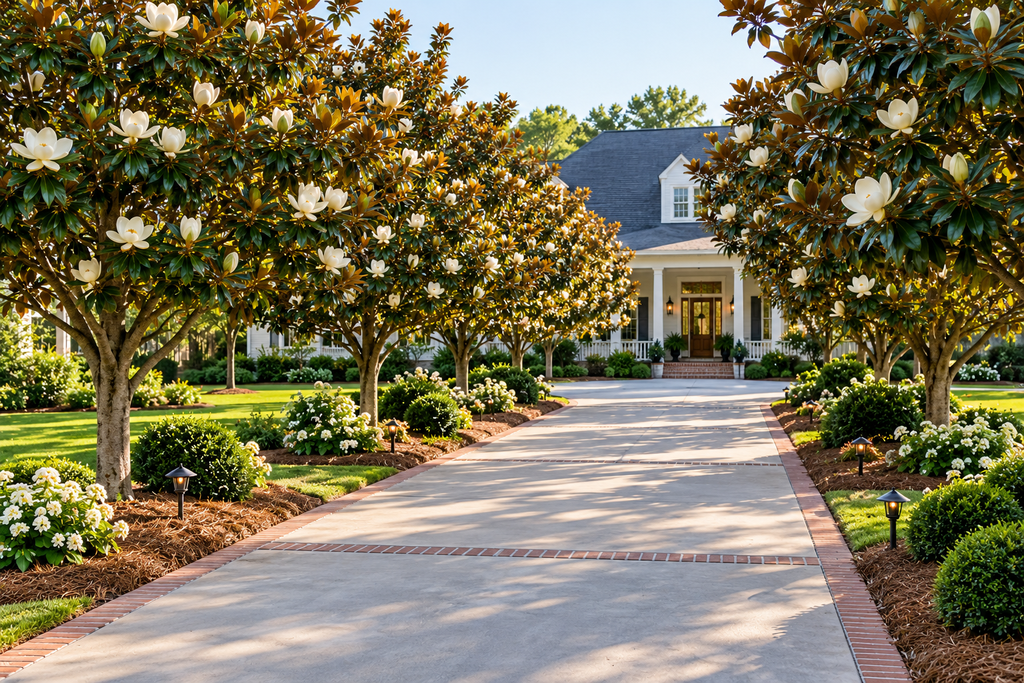
A row of magnolias along a driveway is the image behind many Southern estates, and it is also where some of the costliest mistakes happen. Shallow roots can lift and crack concrete and asphalt. No setback guarantees safety, but these ranges make reasonable starting points: 15 to 20 feet from the pavement edge for full-size Southern magnolias, and about 6 to 10 feet for compact selections. On a standard residential lot, only the compact types usually fit.
Spacing depends on the tree. Compact selections can go roughly 12 to 15 feet apart if the goal is a continuous green wall, while full-size trees need 30 feet or more between trunks. Planting in a wide lawn strip, or on the far side of a shallow swale or bed, gives roots somewhere to spread besides under the pavement.
Two details people often overlook are overhead clearance and what happens to cars parked beneath the canopy. Delivery trucks and some emergency vehicles need around 13 to 14 feet of clear height, and local fire-access rules can require more, so lower limbs along a driveway will need to be pruned up as the tree grows. That trades away the ground-sweeping look magnolias are known for. And if the tree develops magnolia scale, a sap-feeding insect, the sticky honeydew it produces can drip onto cars and grow a black sooty mold (see the maintenance section below).
If the driveway is gravel or permeable pavers, roots are less likely to cause damage, though leaf litter will need regular clearing so it does not turn into a slippery mat.
3. Flank a Walkway With Compact Trees
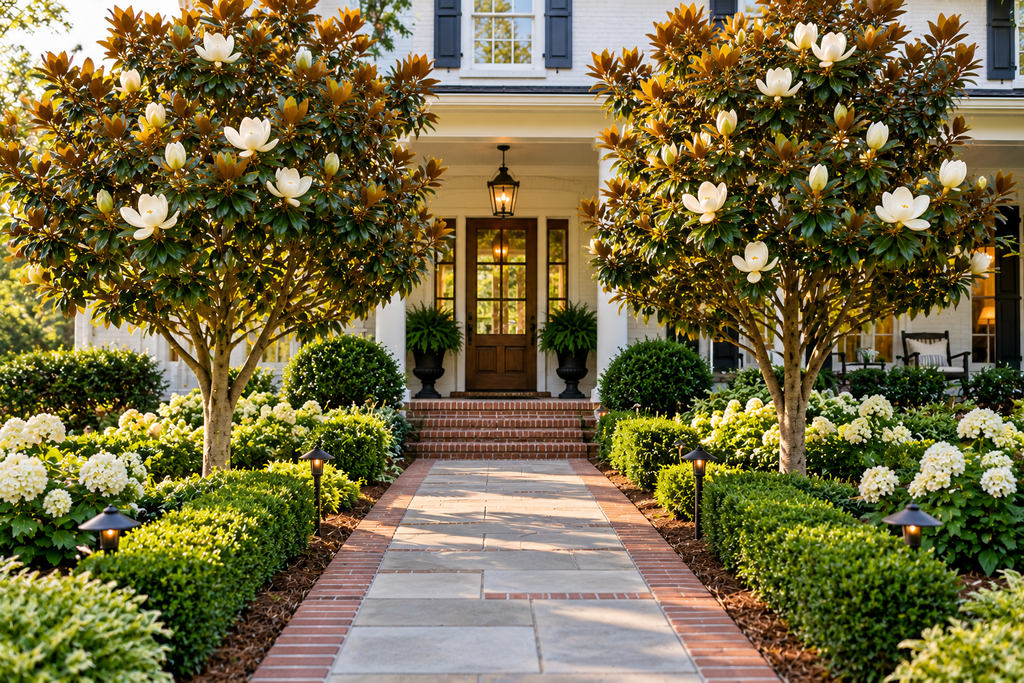
Planting a pair of magnolias on either side of a front walk puts fragrance at the exact moment people arrive at the door. Compact selections with a fairly narrow, upright habit work best. ‘Little Gem’ is commonly used for this, and ‘Alta’ is often listed as narrower still, though verify its size with the grower, since listings differ. Set the trees about 6 to 8 feet from the edge of the path so that branches have room before they reach walkers.
Wet magnolia leaves and fallen petals are slippery, and the cones that drop in fall are hard underfoot. For a path that older relatives, kids, or delivery drivers use, that matters. Plan to sweep it regularly, and use a textured surface such as brushed concrete, stone with some grip, or gravel rather than polished tile.
If the walkway already exists and the tree does not, planting is easy. If the tree is already established and the path is new, avoid digging down. A path built on a thin layer of compacted gravel over the existing grade, or with stepping stones set into the surface, disturbs far fewer roots than excavating a trench for a poured base.
A low border of boxwood-alternative shrubs or mondo grass along the path edge keeps the planting from looking top-heavy, with all the interest overhead and none at ground level.
4. Build a Privacy Screen That Starts at Eye Level
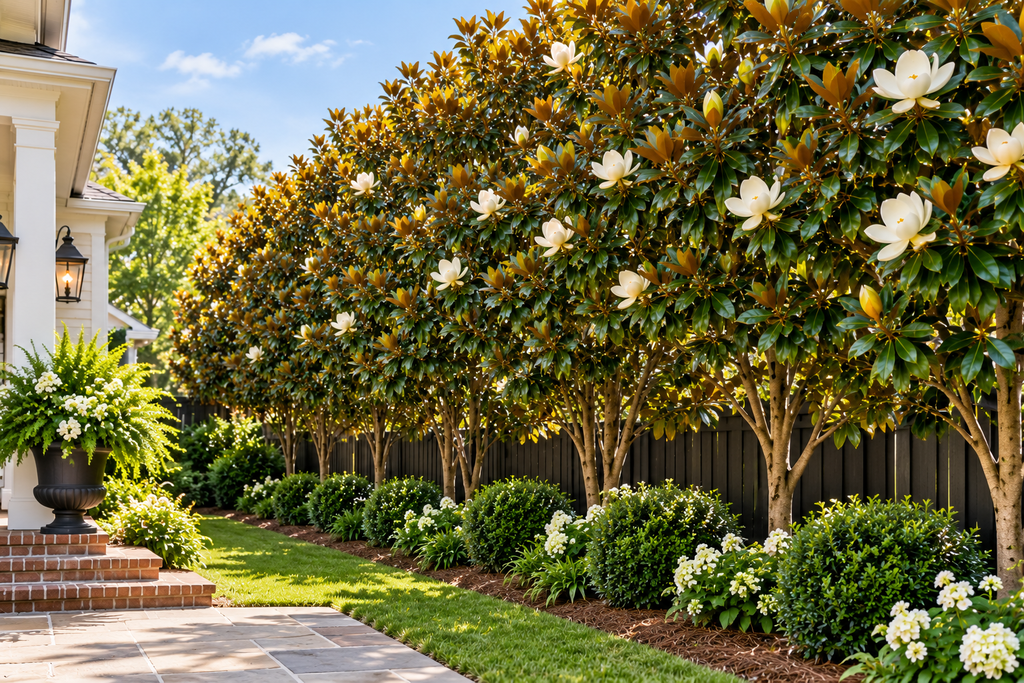
Magnolias suit screening because evergreen branches often reach nearly to the ground, which covers the zone where a fence-line view is actually blocked. Many privacy hedges thin out at the bottom as they age. A well-placed magnolia does not.
Spacing depends on how quickly the screen needs to close. For compact selections, 8 to 10 feet apart is a common range, while sweetbay can go slightly closer. Staggering the trees in a zigzag, rather than a straight line, fills gaps more quickly and looks less like a fence made of plants. Keep trunks at least 5 or 6 feet off a solid fence or property line to leave room for growth and for access when the time comes to prune.
Patience is part of the price. Southern magnolias are moderate growers, often in the range of 1 to 2 feet per year depending on selection and conditions, so a young screen can take five to eight years to fill in. A faster, shorter-lived shrub such as wax myrtle (Morella cerifera) planted between the trees can supply cover in the meantime and be removed once the magnolias take over.
Full-size Southern magnolias are a poor choice for most residential screens. They spread 30 feet or more, and the shade and roots eventually take over the yard they were meant to protect. Before planting along a boundary, check the local rules on setbacks, hedge height, and any HOA restrictions, as these vary widely.
5. Put a Magnolia Beside the Patio, but Choose the Species Carefully
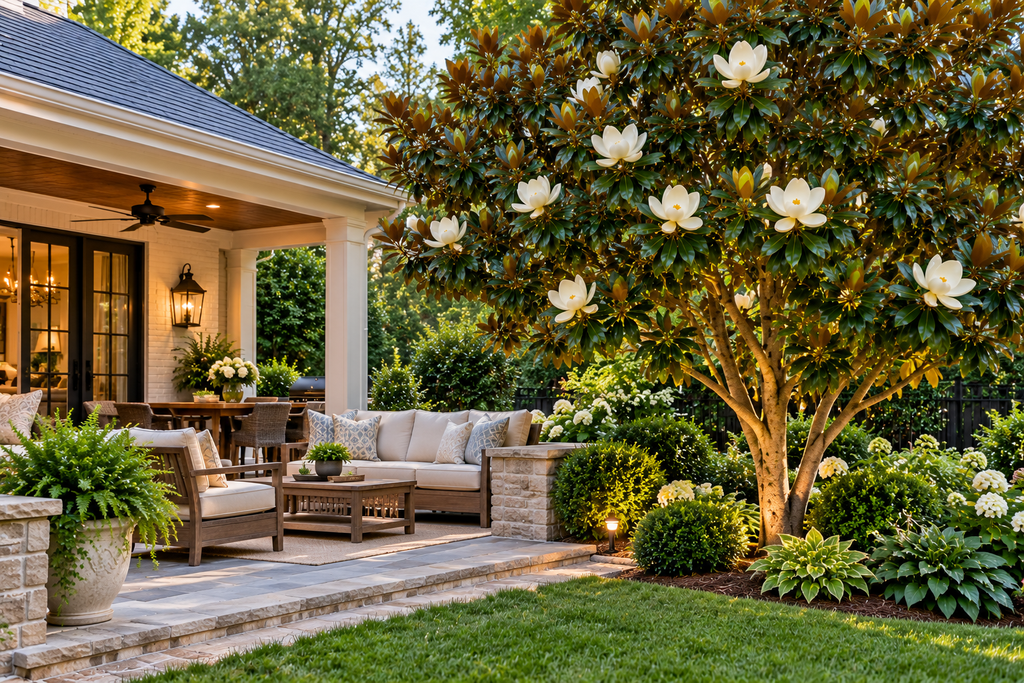
A magnolia near a patio gives shade, evening fragrance, and a visual wall on one side. It also drops things. Leaves land on furniture, petals brown quickly on tabletops, and the large seed cones that fall in autumn can drop with a thump. Sitting directly beneath the canopy is not always as pleasant as sitting near it.
A compact Southern selection planted 10 to 12 feet from the patio edge usually delivers the benefits without most of the mess, because the canopy shades the space without covering it. Sweetbay is another good fit for seating areas. It has smaller, lemon-scented flowers and smaller leaves, which makes cleanup lighter.
Heaving pavers are the other issue. Roots can shift hard surfaces over time, so sand-set pavers over a compacted base tend to cope with minor movement better than a rigid poured slab. If the patio is already poured, keep the tree on the far side of the lawn or bed rather than close to the slab.
Fragrance deserves a moment too. Southern magnolia flowers carry a strong, sweet-lemony scent. Many people love it, but it can be heavy in a confined space or beneath an open bedroom window. Experiencing the plant in bloom at a nursery or arboretum before committing is worth the trip.
6. Give a Specimen Tree a Mulch Bed Instead of Fighting for Grass
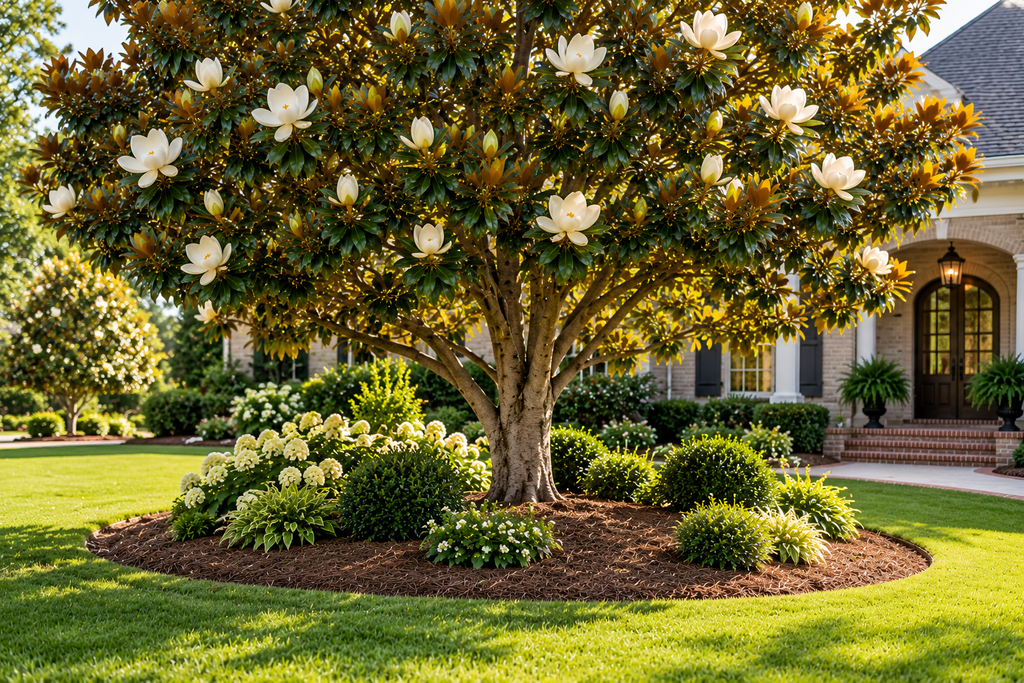
Grass under a mature Southern magnolia is a losing battle. The canopy is dense and evergreen, so shade lasts through the whole year, the roots take most of the surface moisture, and a thick layer of leaves smothers whatever turf does grow. Most lawn grasses thin out beneath it within a few seasons, and no amount of seed or fertilizer will change that.
The better approach is to stop asking the lawn to grow there. Create a mulched bed under the canopy, extending to the drip line (the outer edge of the branches) where practical. A 2- to 4-inch layer of shredded bark, pine straw, or shredded magnolia leaves works well, kept a few inches back from the trunk so moisture does not collect against the bark. Edge the bed with steel, stone, or a clean spade cut so the mower stays out, since repeated mower strikes injure surface roots and the trunk base.
If you want something growing in the bed, choose plants that tolerate dry shade and root competition: mondo grass, liriope, Asiatic jasmine, and autumn fern are common Southern choices. Plant small, and by hand, without cutting any roots thicker than about a pencil.
Some homeowners prefer the look of branches sweeping the ground with leaf litter underneath, with no bed and no mowing. That is a legitimate design, and it makes cleanup simpler. It does mean skipping any plans for a lawn beneath the tree.
7. Pair Magnolias With Hydrangeas for a Summer Handoff
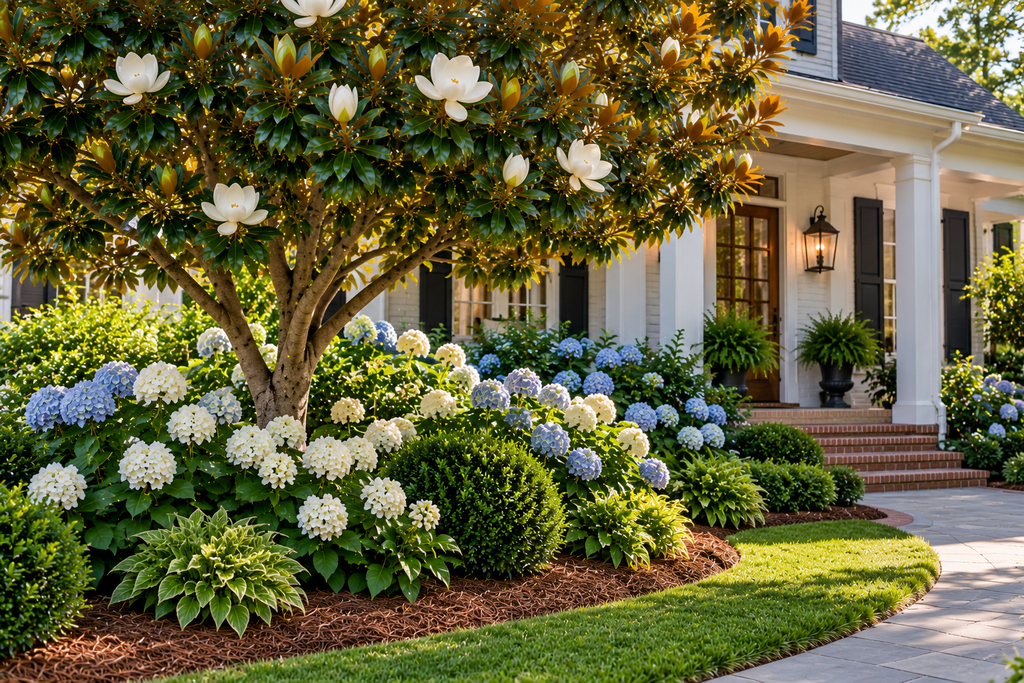
Magnolia flowers peak from late spring into early summer, and hydrangeas pick up as the first flush fades. The pairing works on color, since white magnolia flowers sit well beside blue, pink, or white hydrangea blooms. It also works on conditions, because both do best in moisture-retentive, slightly acidic soil.
The catch is competition. An established magnolia pulls a great deal of water from the top foot of soil, and hydrangeas are thirsty plants. Species choice makes a big difference here.
- Oakleaf hydrangea (H. quercifolia) handles dry shade and root competition better than most. It has cone-shaped white flowers and leaves that turn burgundy in fall.
- Bigleaf hydrangea (H. macrophylla) gives the classic mophead look but wilts quickly in dry soil. It does best with morning sun and afternoon shade, and in a magnolia bed it needs steady watering.
- Smooth hydrangea (H. arborescens, including ‘Annabelle’) tolerates part shade and blooms reliably on new growth.
- Panicle hydrangea (H. paniculata) wants at least six hours of sun, so plant it at the sunny edge of the canopy, not underneath.
Set hydrangeas near the drip line instead of tight against the trunk, dig holes by hand, and avoid cutting large roots. A common guideline for watering is about an inch per week from rain or hose, more in a heat wave, and the plants will need it consistently through the first year.
On color, acidic soil with available aluminum tends to push bigleaf hydrangeas toward blue, and magnolias like slightly acidic soil, so blue is a natural direction. In mixed or amended soil the result is unpredictable. White varieties avoid the question entirely.
8. Plant Roses in the Sunny Gaps, Not Under the Canopy
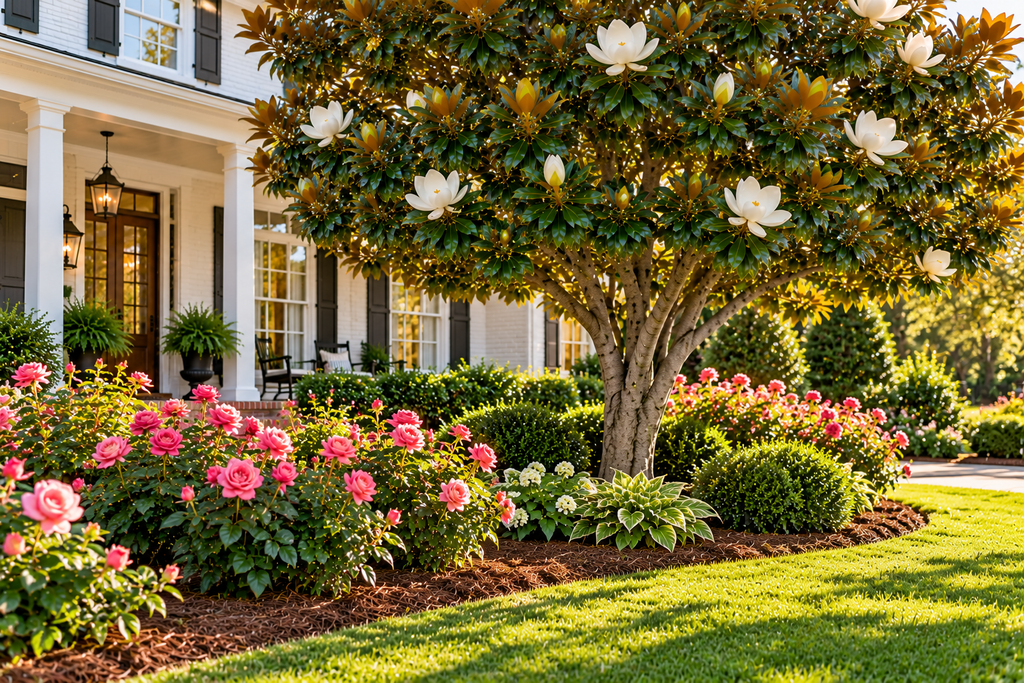
Roses and magnolias photograph well together and grow poorly when planted too close. Roses generally need six or more hours of direct sun and good air movement to stay healthy. A magnolia’s dense evergreen canopy and thirsty roots offer neither.
The workable version of this idea uses the magnolia as a backdrop. Place roses in full sun beyond the canopy edge, on a bed that faces open sky, or on a fence, trellis, or arbor nearby. A climbing rose on a pergola near the tree gets the Southern look without the competition. As a rough rule, keep roses well outside the drip line of a mature full-size tree, and a few feet outside that of a compact one.
Humid Southern summers bring black spot and powdery mildew, and that makes variety selection more important than anything else you do. Older China roses such as ‘Old Blush’ and ‘Mutabilis’ are often grown across the South, and Texas A&M’s Earth-Kind program tests and designates roses for low-input performance, so its list is worth checking before you buy. Give each plant space for airflow and avoid wetting the leaves when watering.
On color, soft pink, cream, and pale yellow roses echo magnolia flowers without competing. Deep red gives sharper contrast and reads more formal.
9. Layer Camellias, Azaleas, and Evergreen Shrubs Underneath
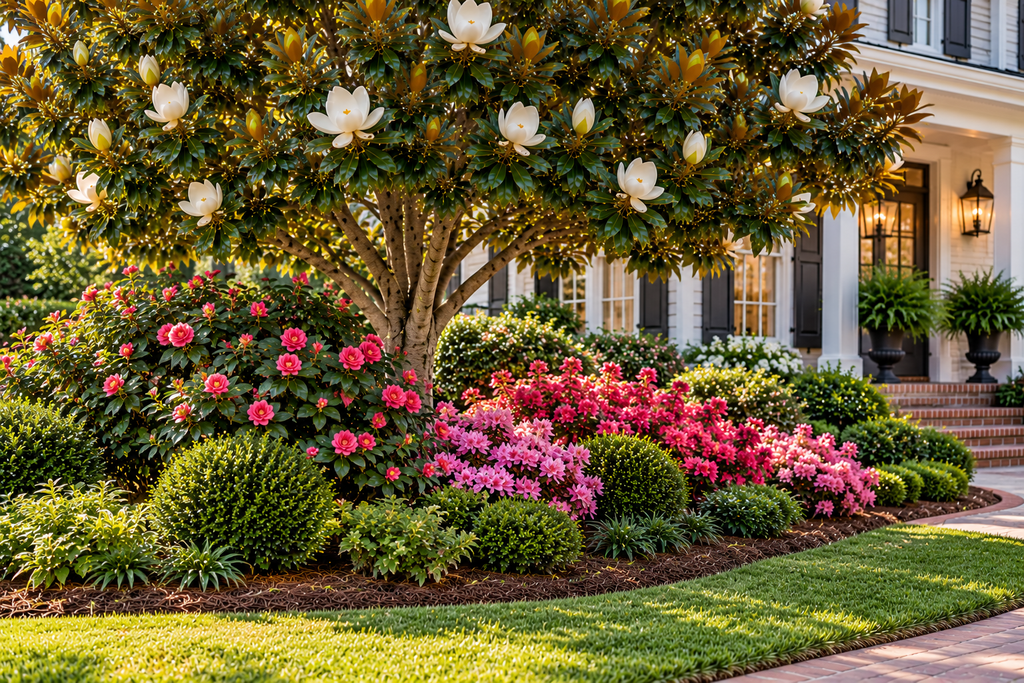
This is the planting that makes a magnolia yard look distinctly Southern: a shaded understory of acid-loving shrubs that bloom when the tree does not.
Camellias do a lot of work here. Sasanqua camellias flower in fall and early winter, and japonica camellias from late winter into early spring, so they cover the gap between magnolia blooms. Azaleas fill in spring, and reblooming types extend that into summer or fall. Tea olive (Osmanthus fragrans) adds strong fragrance in cool seasons in the warmer part of the magnolia’s range. All of them tolerate the dappled shade at the edge of the canopy, and all of them do better with mulch and consistent moisture.
For evergreen structure, boxwood is the classic choice, but boxwood blight has become a problem in parts of the country, and it is worth checking with a local extension office before buying. Japanese holly, inkberry, and dwarf yaupon holly make comparable low hedges and avoid the problem. Dark green on dark green can look flat beneath a glossy-leaved tree, so mixing in a variegated or lighter-leaved plant adds depth.
Stagger the layers: taller shrubs near the canopy edge, shorter ones in front, and ferns or groundcovers closest to the path. And plant on the outer edge of the root zone rather than beside the trunk, where every hole cuts into roots.
10. Grow a Compact Magnolia in a Large Container
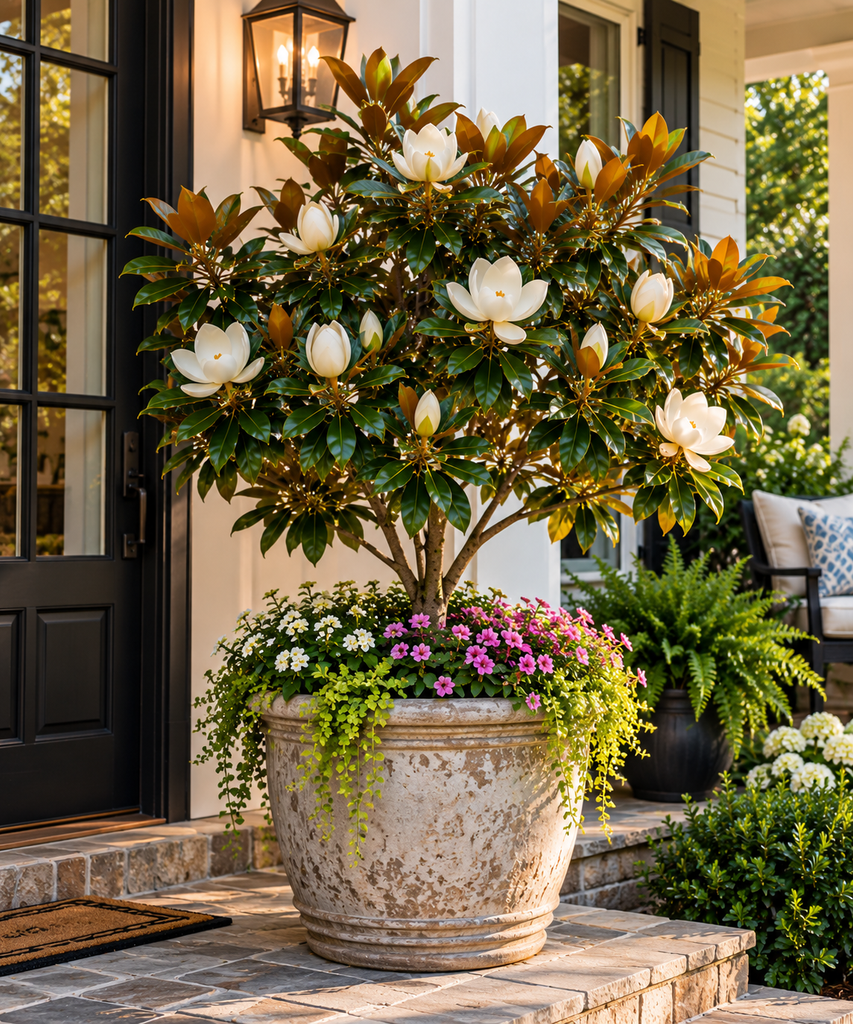
A magnolia in a pot is not a permanent solution, but it works for patios, courtyards, and entryways where a ground planting is not possible. Compact Southern selections such as ‘Little Gem’ and ‘Teddy Bear’ are the usual picks.
The container needs to be big, at least 24 inches across and deeper than that if possible, with real drainage holes. Use a quality potting mix rather than garden soil, which compacts in a pot. Lightweight resin or fiberglass containers are easier to move, but a tall evergreen catches wind like a sail, so the base should be weighted or sheltered. Check the soil often in summer, since containers dry out faster than ground beds, and in hot weather large pots may need watering daily.
Winter is the main risk. Roots in a container are exposed to cold from every side, and a common rule of thumb is that they are effectively one or two hardiness zones colder than the same plant in the ground. In marginal climates, move the pot to a sheltered spot or wrap it in the cold months. Expect slower, smaller growth than a ground-planted tree, and plan to refresh the soil or root-prune every few years. If the tree starts to look crowded or stops growing, that is the signal.
11. Uplight the Tree for Evening Drama
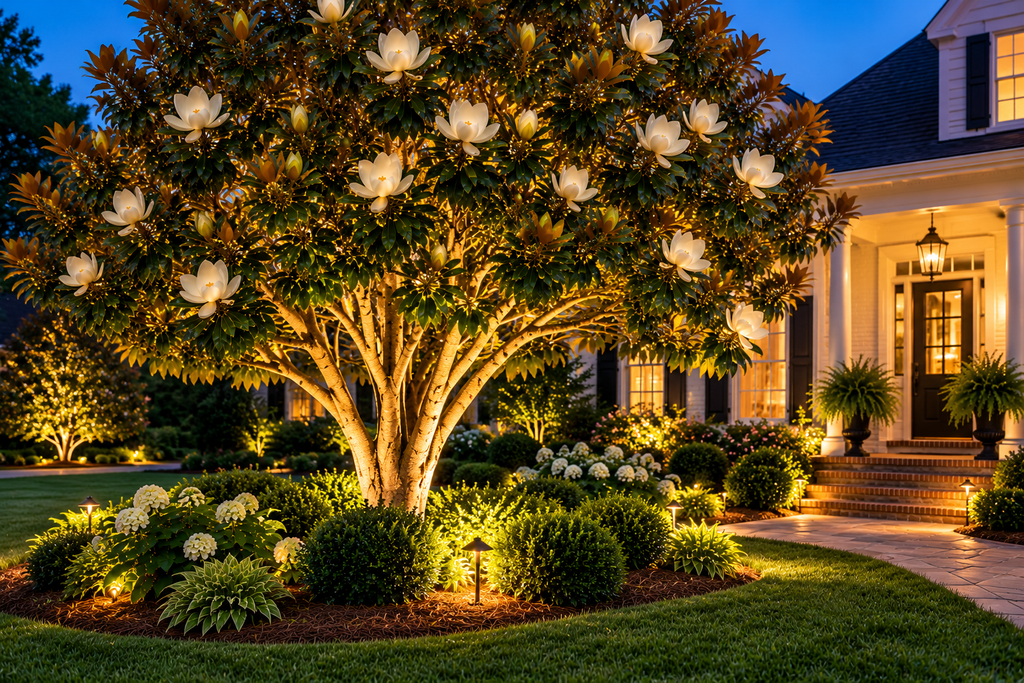
Magnolia leaves are glossy and the flowers are pale, and both respond well to light after dark. A pair of low-voltage LED uplights at the base can turn a tree into the main feature of an evening yard.
Place fixtures a couple of feet from the trunk, aim them up into the canopy, and use a wide beam on a large tree. Warm white bulbs (around 2700K) tend to flatter green foliage and white flowers more than cool white does. Moonlighting, where fixtures are mounted higher in the branches and aimed downward, gives a softer, dappled effect on the ground below.
Safety and root care both matter. Use fixtures rated for outdoor wet locations, power the transformer from a GFCI-protected outlet, and hire a licensed electrician for any line-voltage wiring. For the low-voltage cable, lay it under mulch or bury it shallowly in a narrow slot instead of trenching through the root zone. Keep fixtures out of the leaf litter so debris does not cover the lens, and check their aim once a year, since growth and settling will shift them.
What Magnolias Ask of You Every Year
None of these ideas works without accepting a few recurring chores.
Leaf drop. Southern magnolias shed older leaves mostly in spring and early summer as new growth emerges, with a lighter scattering the rest of the year. The leaves are stiff and decompose slowly. Whole leaves can mat over groundcovers and trap moisture. Shredding them with a mower makes them easier to handle, and shredded leaves make a decent mulch in beds. A sweetbay or compact selection reduces the volume.
Magnolia scale. This large, soft-bodied scale insect feeds on twigs and can leave leaves sticky with honeydew and coated in black sooty mold. Signs include shiny residue on leaves or cars and waxy, rounded lumps on stems. Light infestations are often tolerated; heavier ones may be treated with horticultural oil or other products at specific times of year. Timing matters, so contact your local extension office, and follow the label on any product you use.
Pruning. Southern magnolias need little. Remove dead or crossing branches, and do any shaping soon after flowering. Heavy topping tends to leave ugly stubs and weak regrowth. For a tall, mature tree, a certified arborist is the safer choice than a ladder.
Questions Readers Ask About Magnolia Landscaping
Why are the leaves on my magnolia turning yellow? It depends on what else is happening. A few yellow older leaves in spring or early summer are usually normal seasonal shedding. Yellow leaves with green veins, especially on new growth, often point to iron chlorosis in alkaline soil, and a soil test will confirm the pH. Widespread yellowing alongside wilting and thin canopies can mean root problems from poor drainage, soil compaction, or recent construction nearby. If the yellowing spreads, an arborist or extension agent can diagnose it on site.
How long before a young magnolia blooms? It varies. Trees grown from seed can take a decade or more, while named cultivars propagated from cuttings or grafts, such as ‘Little Gem’, often bloom within a few years of planting. A newly planted tree may skip a season while it recovers from transplant stress. Treat any number as an estimate, and ask the nursery about the specific selection.
Will a magnolia grow in clay soil? It can, if the soil drains. Clay itself is not the problem; standing water is. A simple test is to dig the planting hole, fill it with water, and see how long it takes to empty. If water is still sitting there after a day, drainage is poor. In that case, plant the root ball slightly high, widen the planting area instead of just amending the hole, or choose sweetbay, which tolerates wetter ground.
Key Takeaways
The best magnolia landscaping starts with the mature size of the tree you pick. Match the selection to the space, give compact types 6 to 12 feet from paving and structures, and give full-size trees far more. Treat the root zone as off-limits for digging, fill, and traffic. Replace struggling lawn under the canopy with a mulch bed, and plant partners like camellias, azaleas, and oakleaf hydrangeas at the canopy edge. Keep roses in full sun nearby, not underneath.
Before buying, check the cultivar’s listed size and hardiness with a local nursery, call 811 before digging, and confirm local setback and HOA rules. A good plan on paper saves a decade of correction later.

About Syprose Kiche
Syprose Kiche is the creator and writer behind My Besuited Home, a practical home and garden website covering DIY projects, gardening, lawn care, landscaping, home improvement, and outdoor living. She focuses on turning everyday homeowner questions into clear, practical guides backed by careful research and useful real-world considerations.