
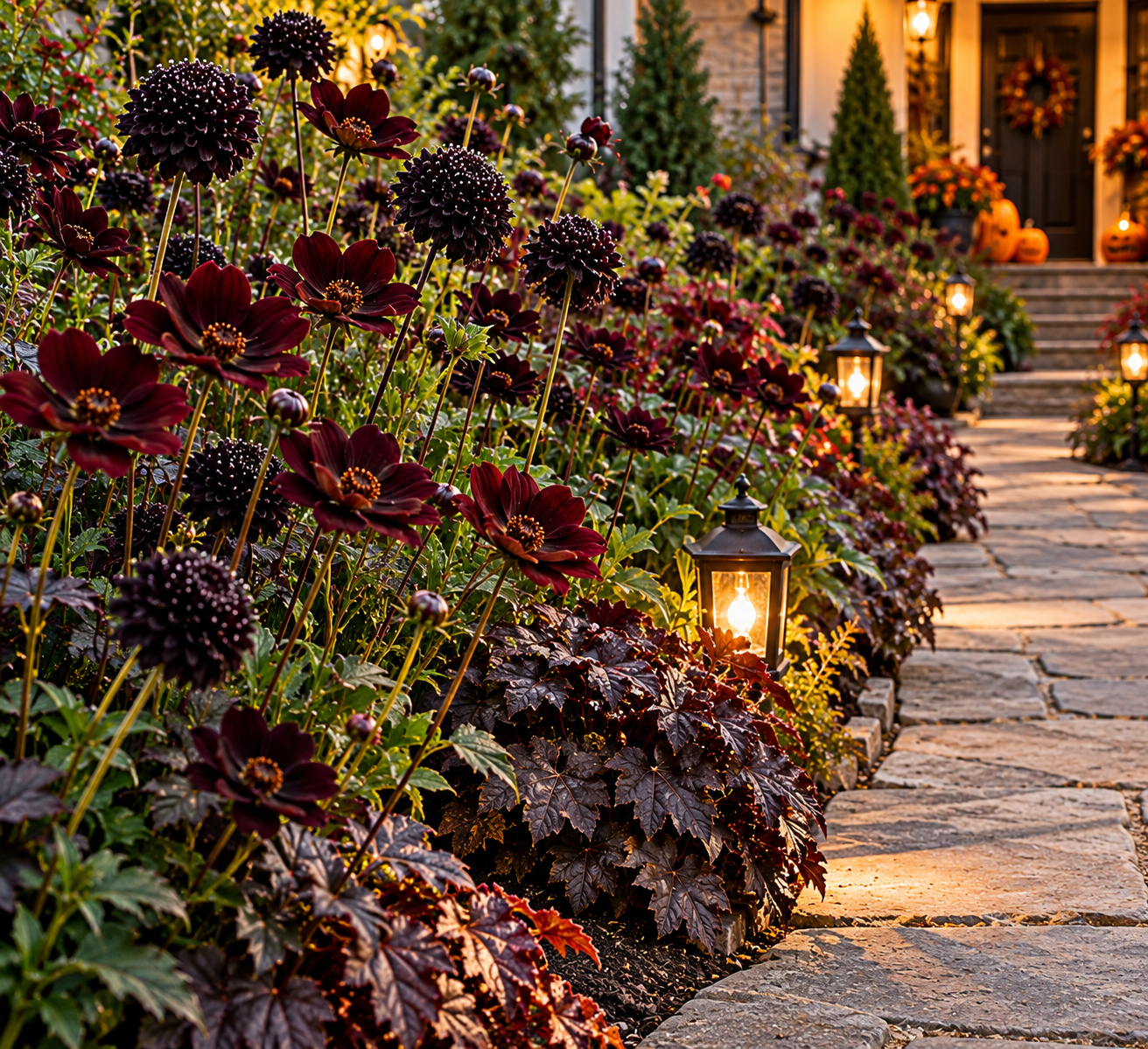
By the last week of October, a lot of front yards are in an awkward state. Summer annuals have either been flattened by frost or are hanging on with a few ragged flowers, the lawn is collecting leaves, and the only thing that looks deliberate is a plastic skeleton leaning against the porch rail. Good Halloween garden decor works with that mood instead of covering it up. Deep burgundy flowers, near-black foliage, lumpy heirloom pumpkins, seed heads, bare branches, and low light already look a little haunted. The trick is arranging them so the effect reads as intentional.
This guide covers 17 ideas that use living plants and pumpkins as the main material, with a few DIY props where they earn their place. Each idea notes timing, what tends to go wrong, and how to adapt it, because fall weather, rot, and hungry squirrels cause more trouble than any design choice.
Check Your Frost Date Before You Buy Anything
The single biggest planning mistake with fall decorating is buying plants that die before the party. Halloween falls at a different point in the growing season depending on where you live. In much of the northern U.S., the first frost has often arrived by early October, while parts of the South and the coasts may not see one until November or later. Your local cooperative extension office or the National Weather Service can tell you the average first frost date for your area, and that date should shape what goes in the ground and what goes in pots.
Sorting plants into three groups makes the shopping easier:
- Frost-tender: coleus, ornamental sweet potato vine, dahlias, purple fountain grass, and basil. Frost around 32°F damages them, so they suit warm climates or a short display window.
- Cool-season and frost-tolerant: ornamental kale and cabbage, pansies and violas, garden mums, dusty miller, heuchera, and most ornamental grasses. These are the reliable choices for late-October displays.
- Permanent: shrubs and perennials that stay in the landscape and look good again next year.
If frost is forecast but the nights before Halloween are still ahead, containers can be dragged into a garage or covered overnight with an old sheet. That protects against a light frost. A hard freeze, generally 28°F or lower, will damage most tender plants even under a sheet.
Pumpkins also run on a clock. The numbers below are rough ranges, since heat, rain, and wildlife change everything.
| Item | Typical outdoor life | What shortens it |
| Uncarved pumpkin | Several weeks to a couple of months | Heat, bruises, standing water, freezing |
| Carved pumpkin | Roughly 3 to 7 days | Warm days, rain, squirrels, candle heat |
| Potted garden mum | Weeks of bloom with regular watering | Drying out in small pots, hard freeze |
| Ornamental kale or cabbage | Often through light frosts and into winter | Deer, rabbits, extreme cold |
Moody Flowers and Foliage That Do Most of the Work
Plants are the cheapest way to get a dark, theatrical look, and unlike plastic props they get better as the light drops. These first five ideas are built around color rather than objects.
1. A Black-and-Burgundy Foliage Container
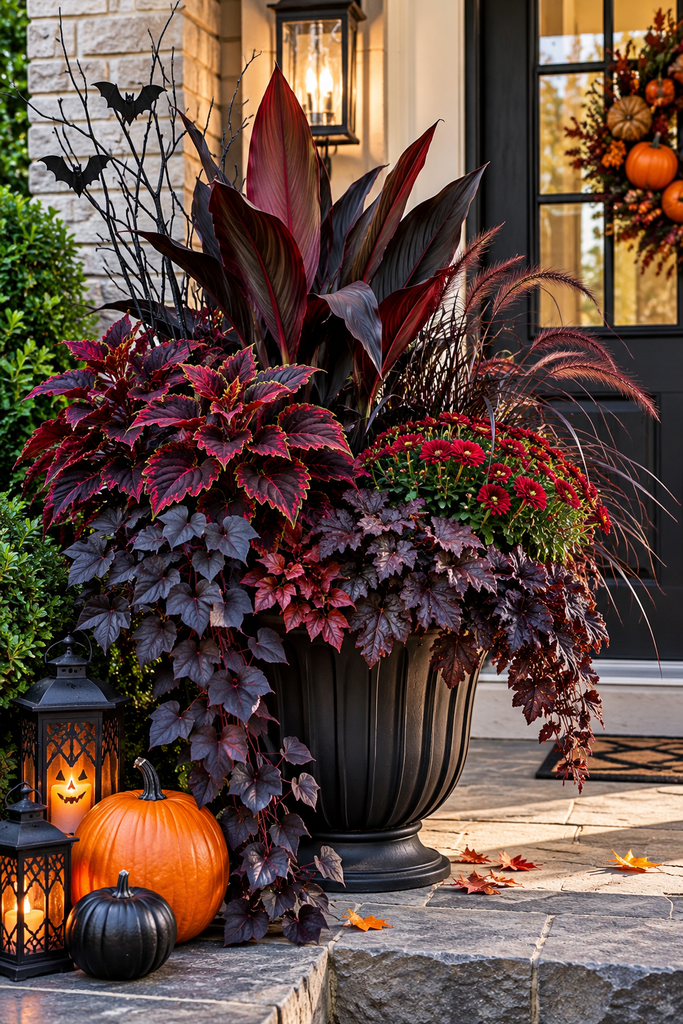
Dark foliage reads as moody even without a single flower, and it holds its color longer than blooms do. A large pot, around 16 to 20 inches across, gives enough room to build a layered arrangement. Use a tall plant in the center, such as purple fountain grass or a dark ornamental pepper. Fill around it with a purple-leaved heuchera like ‘Obsidian’ or ‘Palace Purple’, then let black mondo grass (Ophiopogon planiscapus ‘Nigrescens’) or a dark sweet potato vine such as ‘Blackie’ spill over the rim.
The common mistake is making everything dark. Near-black plants in a near-black pot disappear at dusk, which is exactly when trick-or-treaters are looking. Add one contrast: a chartreuse sweet potato vine, a small orange pumpkin tucked into the soil line, or even a pale stone at the base. Fountain grass and sweet potato vine will not survive frost, but the heuchera and mondo grass are perennials in many zones (heuchera is commonly listed for zones 4 to 9, mondo grass for roughly 6 to 10, though tags vary). After Halloween, those two can go into the ground rather than the compost pile.
2. Dark Chrysanthemums Grouped in Charcoal Pots
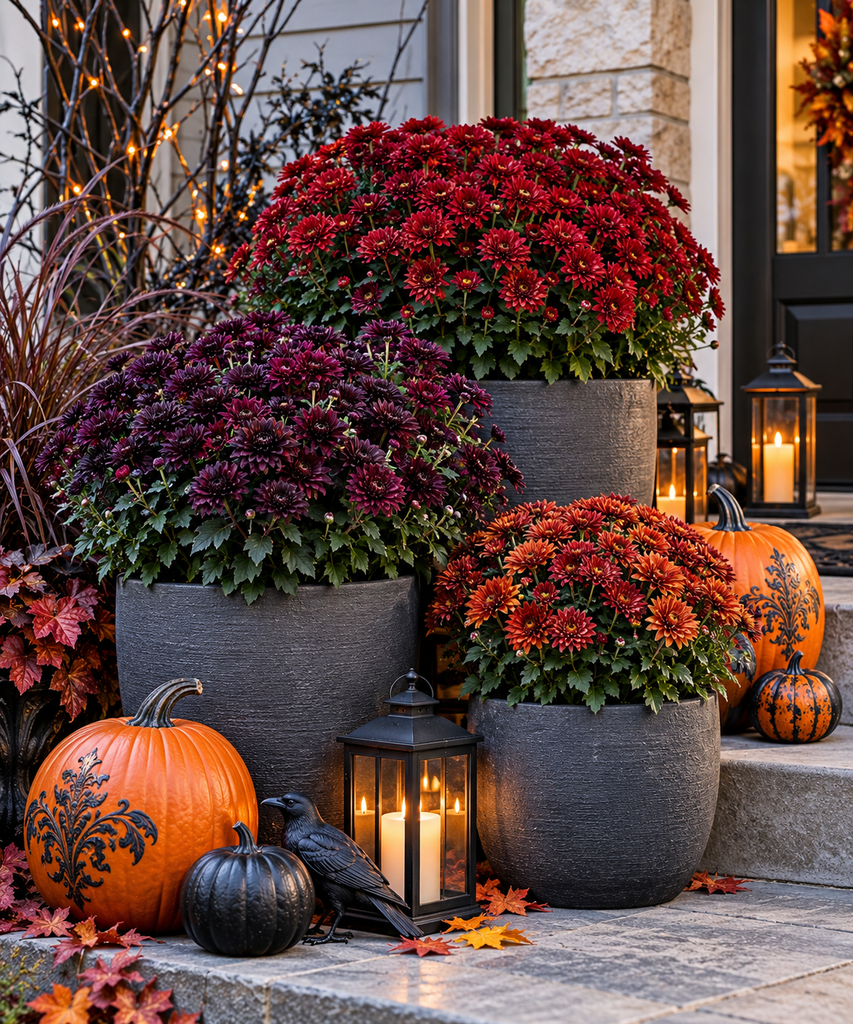
Garden mums are sold in bloom all over the country in fall, and the deep reds, burgundies, and bronzes look dramatically different from the usual yellow and orange when they are set against dark containers. Group them in odd numbers, three or five, at different heights on porch steps. Set them in matte black or charcoal pots, or slip the plastic nursery pot inside a decorative one so it can be lifted out later and drained properly.
Small pots dry out quickly when a mum is in full bloom, so check soil daily and water when the top inch feels dry. Pinch off spent flowers to keep the plant looking tidy. One distinction matters here: florist mums sold as indoor gift plants are bred for cut-flower and indoor use and rarely survive outdoors, while garden mums can overwinter in some climates if they are planted early enough to establish roots. A mum bought in mid-October and planted in a cold zone is a gamble, so it is smarter to treat it as seasonal décor. Chrysanthemums are also listed by the ASPCA as toxic to dogs and cats, which matters if a pet chews plants on the porch.
3. Dahlias in Wine, Chocolate, and Near-Black Tones
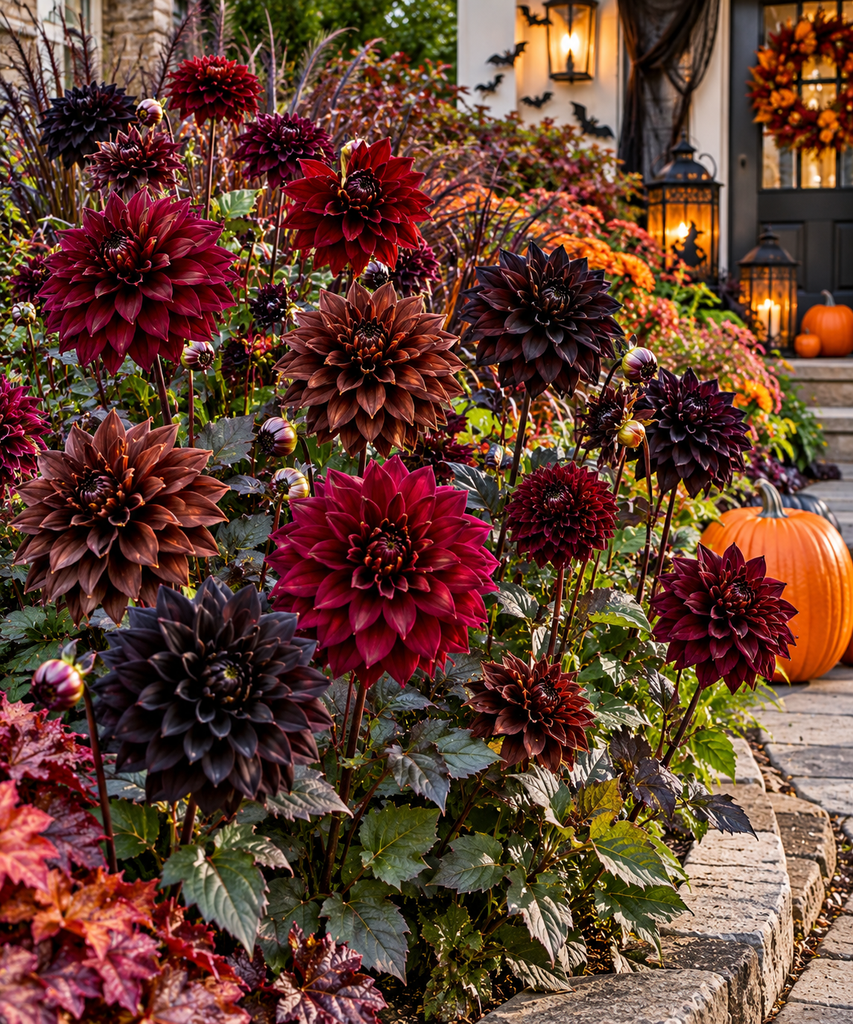
Dahlias bloom until frost, and in many regions frost lands close to Halloween, so they can carry a front-yard bed right up to the date. The darkest flowers are really deep reds and maroons. Cultivars commonly sold as dark dahlias include ‘Karma Choc’ and ‘Arabian Night’, and ‘Bishop of Llandaff’ has nearly black foliage with bright red flowers. Plant them in a raised bed or large pot near the front steps so the blooms are at eye level.
Their behavior after Halloween depends on climate. Dahlia tubers are generally considered hardy in roughly zone 8 and warmer, where they can stay in the ground under mulch. In colder zones, gardeners usually dig the tubers after frost blackens the foliage and store them somewhere cool and dry until spring. If you are buying potted dahlias at a late-season discount, expect the show to last until the first hard frost and plan for that, not for months of color.
4. Chocolate Cosmos and ‘Black Knight’ Scabiosa Along the Path
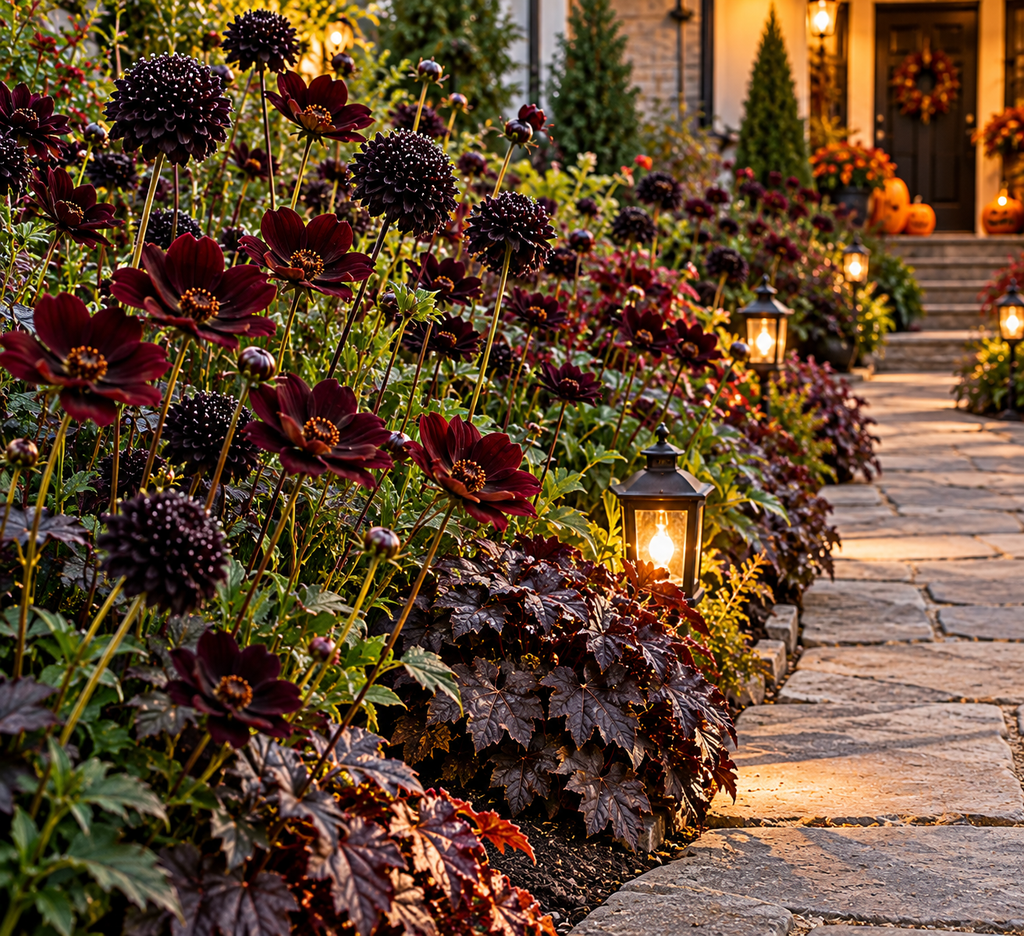
No flower is truly black, but a few come close. Chocolate cosmos (Cosmos atrosanguineus) has velvety maroon blooms that many people describe as smelling faintly of chocolate or vanilla. It grows from tubers, behaves as a perennial in roughly zones 7 to 10, and is treated as an annual or lifted in colder areas. Pincushion flower ‘Black Knight’ (Scabiosa atropurpurea) produces very dark maroon heads on long stems, and pollinators visit it until late in the season.
Both need to be planted well before October, so this is partly a plan for next year. If they are already in your garden, give them a spot along the front walkway where visitors pass close enough to see the detail, because dark flowers look like gaps in the planting from far away. Pair them with silver foliage such as dusty miller so the blooms stand out rather than blur into the soil.
5. Ornamental Kale and Cabbage Tucked Around the Pumpkins
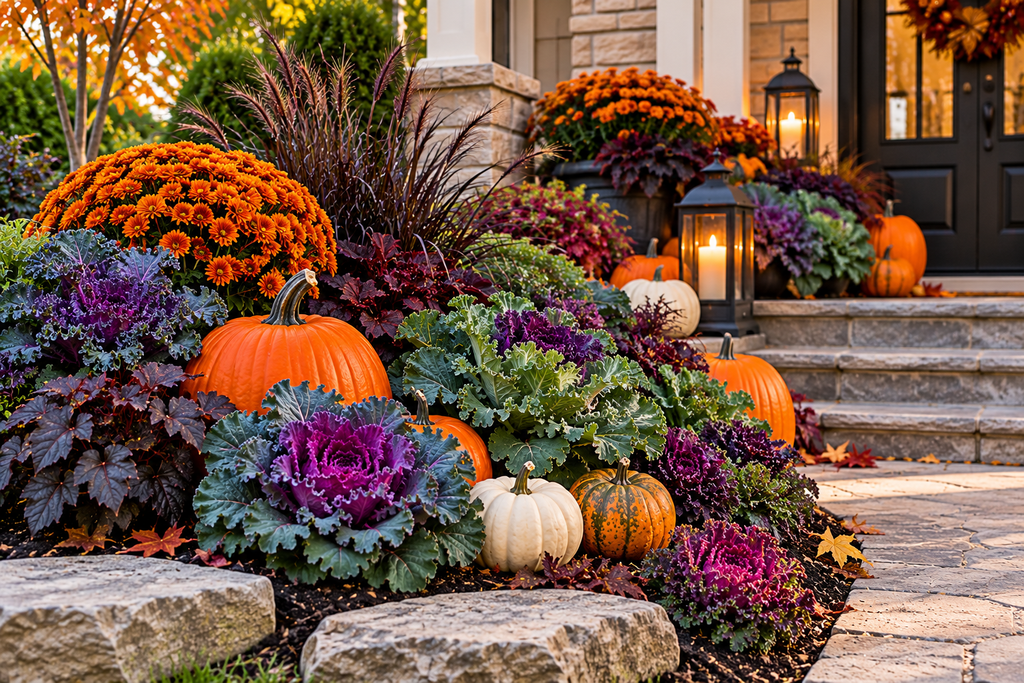
Ornamental kale and cabbage are built for exactly this season. They tolerate frost, and cold nights tend to intensify their purple, magenta, and cream coloring. For a Halloween palette, look for the deep burgundy, ruffled types like ‘Redbor’ or tightly ruffled varieties like ‘Nagoya’, and plant them roughly 12 to 18 inches apart in a bed or in a wide, shallow container.
The design move is to nestle pumpkins into the planting so the kale leaves frame them. Skip the idea of eating these plants: ornamental varieties are often grown and treated for display rather than food, so keep them out of the kitchen. Deer and rabbits may nibble them in rural or suburban yards, so if wildlife pressure is high, set them in pots near the door instead of at the edge of the lawn.
Pumpkin Displays That Don’t Look Like a Grocery Store Pile
Pumpkins are the obvious centerpiece, but a heap of orange pumpkins on a step reads as a seasonal sale display. Variety, height, and a bit of restraint do more than quantity.
6. Pumpkin Steps With Mixed Heights and Textures
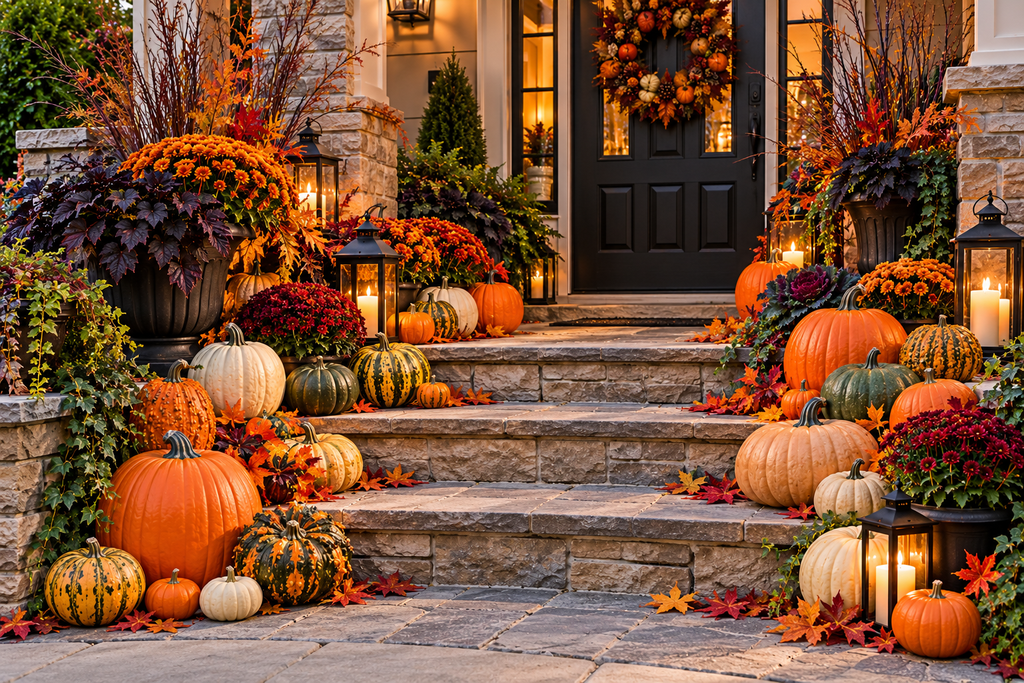
Pumpkins now come in far more colors and surfaces than the standard orange carving type. A mix might include a blue-gray ‘Jarrahdale’, a deep brick-red ‘Cinderella’ (also sold as ‘Rouge Vif d’Etampes’), a tan ‘Long Island Cheese’, a pale ‘Lumina’, and a warty ‘Galeux d’Eysines’ (the peanut pumpkin). Replace at least half the bright orange with these cooler and earthier tones and the display immediately feels more moody.
Group them in threes at different sizes, with the largest at the back or on a lower step. Two practical points protect the porch. Moisture and rot from pumpkins can stain and soften wood, so set them on bricks, slate, or a plastic tray rather than directly on a painted deck. And never pick up a pumpkin by its stem, since the stem is often what separates first and opens the way for rot. Choose pumpkins with firm, intact stems and no soft spots or cuts. A large pumpkin can weigh 20 pounds or more, so keep heavy ones off railings and wobbly stacks.
7. Hollowed-Out Pumpkin Planters
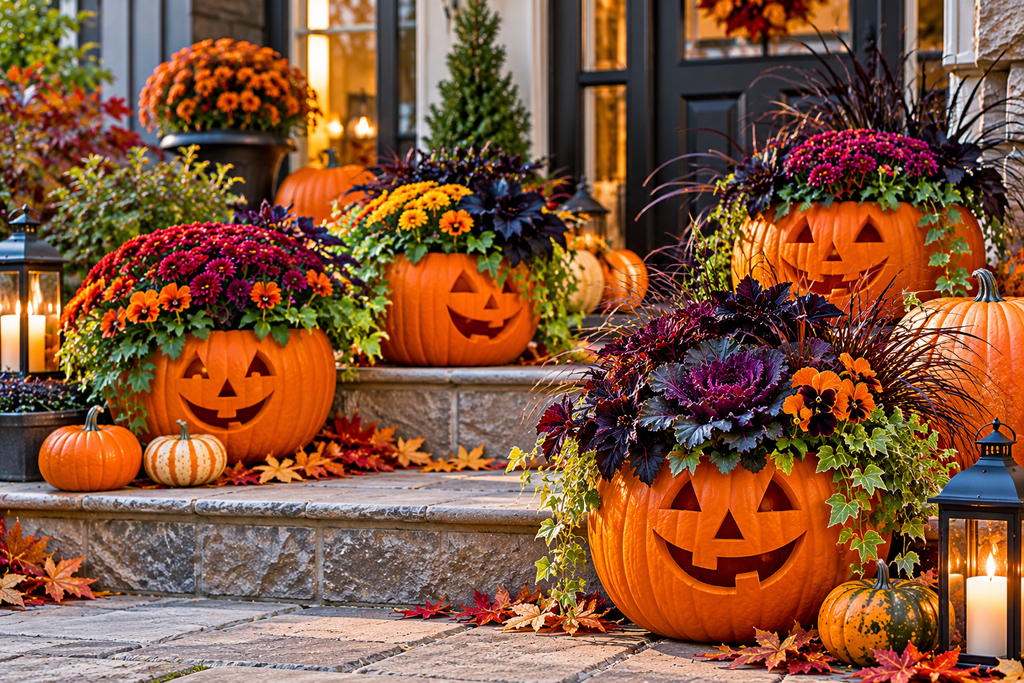
A pumpkin can serve as a short-lived planter, and the main thing to get right is keeping the plant separate from the pumpkin flesh. Cut a wide opening in the top, scoop out the seeds and strings, and set a plant in its plastic nursery pot inside the cavity rather than filling the pumpkin with soil. That way you can lift the plant out to drain excess water, and you can remove it before the pumpkin collapses.
Good plants for this are small mums, pansies and violas, ornamental kale, dusty miller, and a young heuchera. Thick-walled pumpkins such as ‘Jarrahdale’ or ‘Cinderella’ tend to hold up longer than thin-skinned carving types. Even so, expect roughly one to two weeks of good looks, so assemble these a few days before Halloween and set them on a tray or plate to catch moisture. Water the plant sparingly, since extra water speeds decay.
8. A Moonlit Scheme in White Pumpkins and Silver Foliage
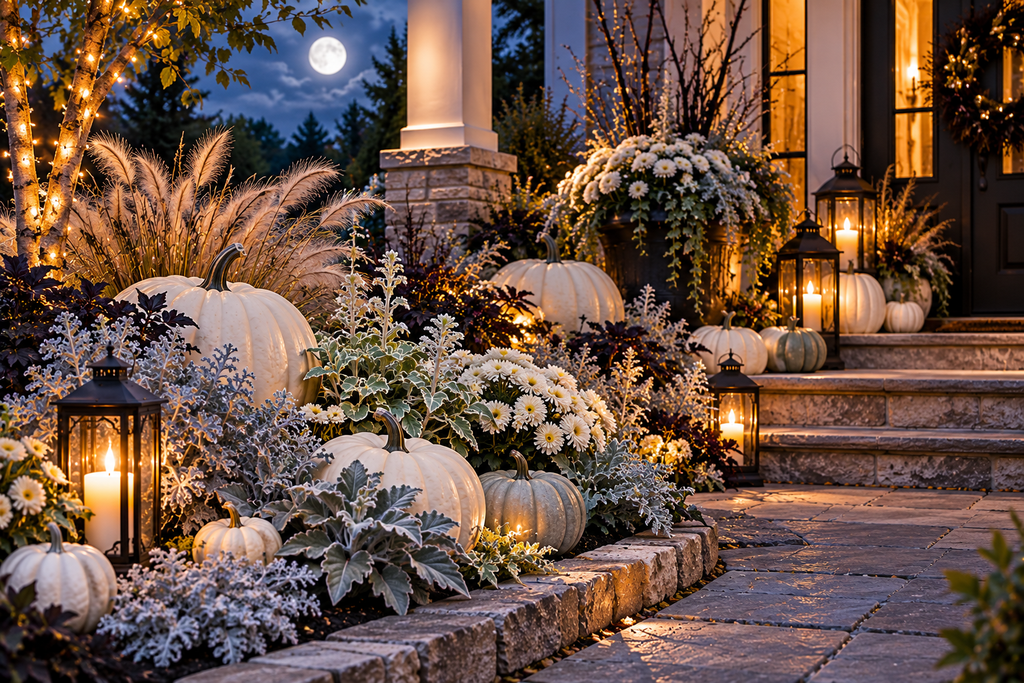
This is the pale alternative to dark and orange. White pumpkins such as ‘Lumina’ and ‘Casper’, plus miniature ‘Baby Boo’ types, catch what little light is left at dusk and stay visible long after orange pumpkins have faded into shadow. Pair them with silver and gray plants: dusty miller (which tolerates light frost), lamb’s ear, and white mums.
The effect gets more dramatic with a few black elements for contrast, such as a black urn, black mondo grass at the base, or a handful of pumpkins painted matte black with acrylic or chalk-style paint. Painted pumpkins are decorative only, so they should not be composted or fed to wildlife afterward. A moonlit scheme is also one of the easier ones to light, since a single warm uplight on a white pumpkin cluster can illuminate half the front steps.
9. Cornstalks, Straw Bales, and Gourds (With a Fire Warning)
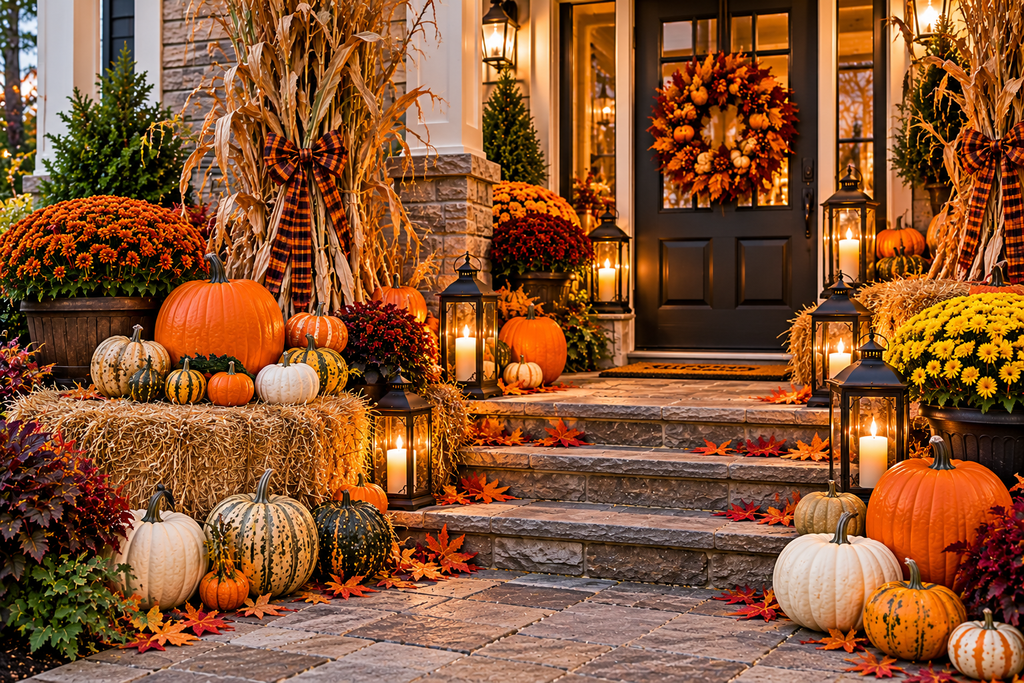
Bundled corn shocks tied to a porch post or lamppost add vertical height to a yard that otherwise has none, and a straw bale makes a natural riser for pumpkins at the base of a tree. Scatter small gourds and Indian corn around the edges to soften the arrangement.
A small distinction is useful when buying: straw (dry stalks left after grain harvest) is generally lighter and less likely to sprout than hay, which can carry seed. Either one can drop bits onto the lawn, so a tarp under the bale keeps cleanup simple. The more serious issue is fire. Dry stalks and straw ignite easily, so keep them well away from candles, porch heaters, fire pits, grills, and hot incandescent bulbs, and use LED lights only. Bales left in rain also grow moldy, so set them on a pallet or tarp and put them in a spot that drains.
Plants and Props for a Spookier Yard
These ideas push further into the haunted-yard look, and most of them are straightforward DIY projects.
10. Muhly and Fountain Grasses for a Smoky Haze
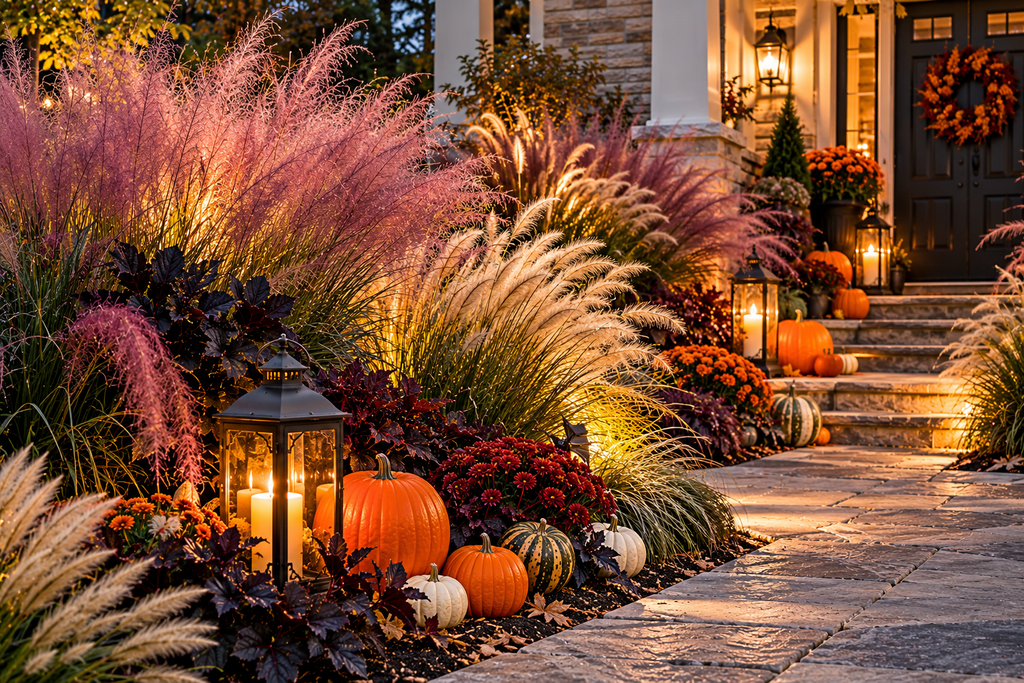
Pink muhly grass (Muhlenbergia capillaris) produces cloud-like pink-purple plumes in fall, and from a distance a mass planting looks like a low drift of smoke. It is generally hardy in roughly zones 6 to 10. In colder areas, purple fountain grass (‘Rubrum’) gives a similar burgundy plume, though it is treated as an annual in most places.
Place grasses in front of a dark wall or fence and behind pumpkins so the plumes are backlit by low evening sun or a warm light at ground level. Plumes glow most when the light hits them from the side or behind. Leave the grass standing through the season, since the dried plumes keep looking good into winter.
11. A DIY Graveyard Bed With Foam Tombstones and Ferns
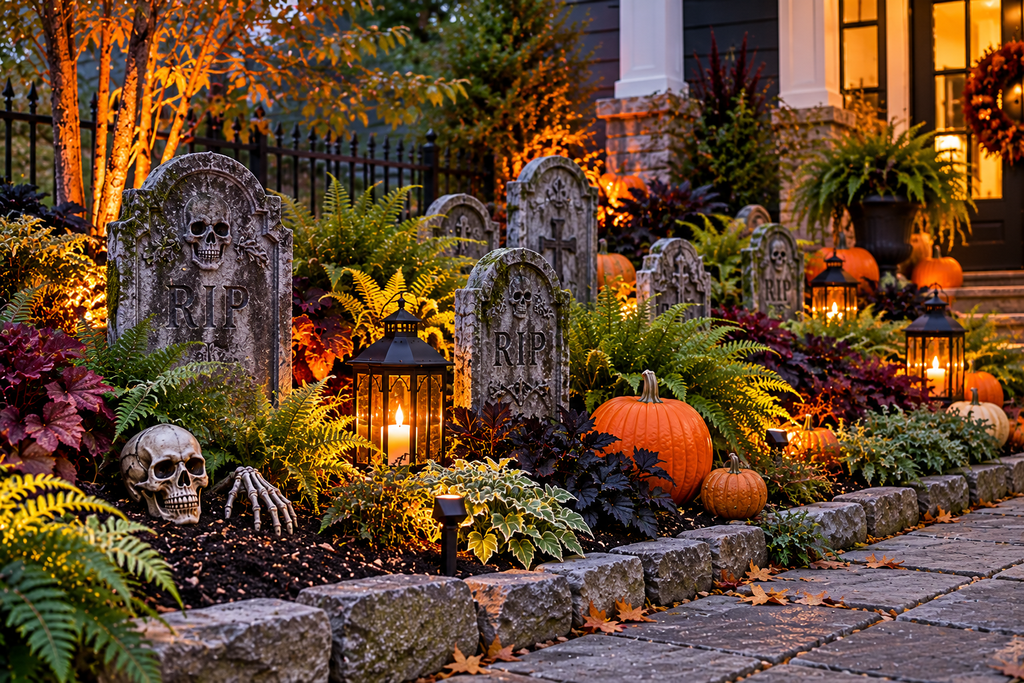
Tombstones are one of the easiest Halloween garden decorations DIY projects, and they cost little if you use rigid foam insulation board.
- Buy 2-inch-thick extruded polystyrene board, and cut arched or rounded tops with a serrated knife.
- Carve lettering and cracks with a pen or a screwdriver tip.
- Paint with water-based acrylic or latex paint. Many solvent-based spray paints dissolve foam unless the can says it is foam-safe.
- Build up a gray base, then dry-brush darker gray and green into the crevices for an aged look.
- Stake each stone with a wooden stake or rebar pushed through the foam into the ground, because a flat 2-inch slab catches wind like a sail.
Plant ferns (such as the evergreen Christmas fern), black mondo grass, and Ajuga ‘Black Scallop’ around the base, and add a layer of moss or dried leaves. If stakes will go deeper than a few inches near irrigation lines or utilities, locate the lines first and call 811 before driving anything deep. Store the stones in a dry place afterward, since foam crumbles into small pieces that wildlife can swallow.
12. A Witch’s Cauldron Planter
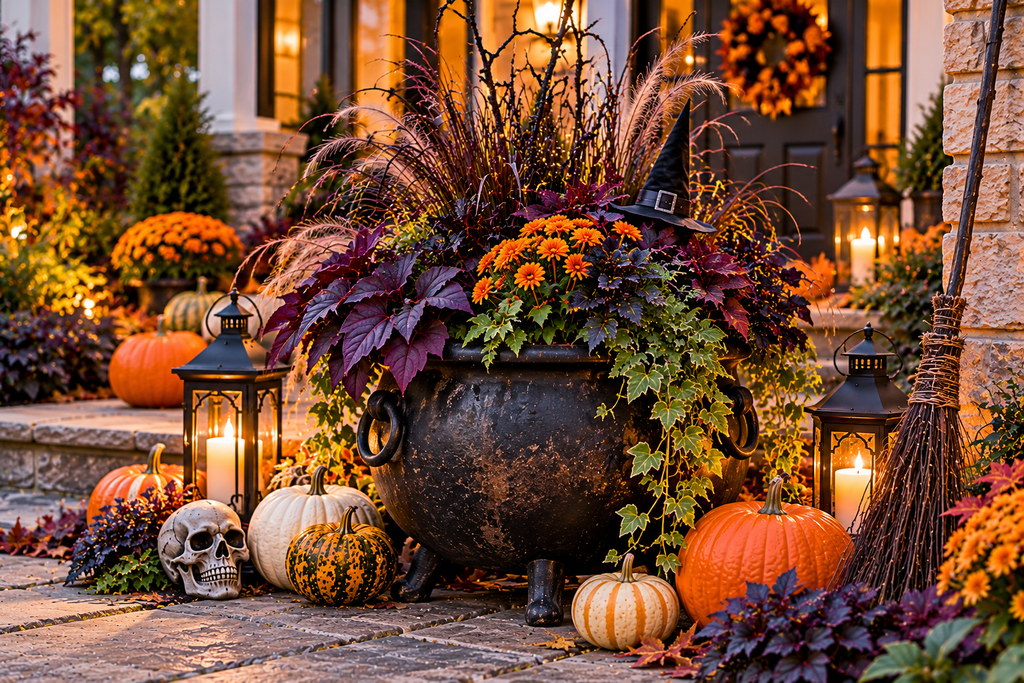
A black cauldron makes a good focal point near the door, and a plastic or cast-iron one works. If the cauldron has no drainage holes, drill several half-inch holes in the bottom so that water does not sit around the roots. Fill with potting mix, set a mound of ornamental kale in the center, and let ivy or sweet potato vine trail over the edge.
For the “brew” effect without plants, line the cauldron with moss and place a green LED puck light underneath. Skip dry ice for home displays. It can cause frostbite on contact, and it should never go in sealed containers or enclosed spaces because the carbon dioxide gas it releases builds pressure and displaces air.
13. A Witch’s Apothecary Herb Bed
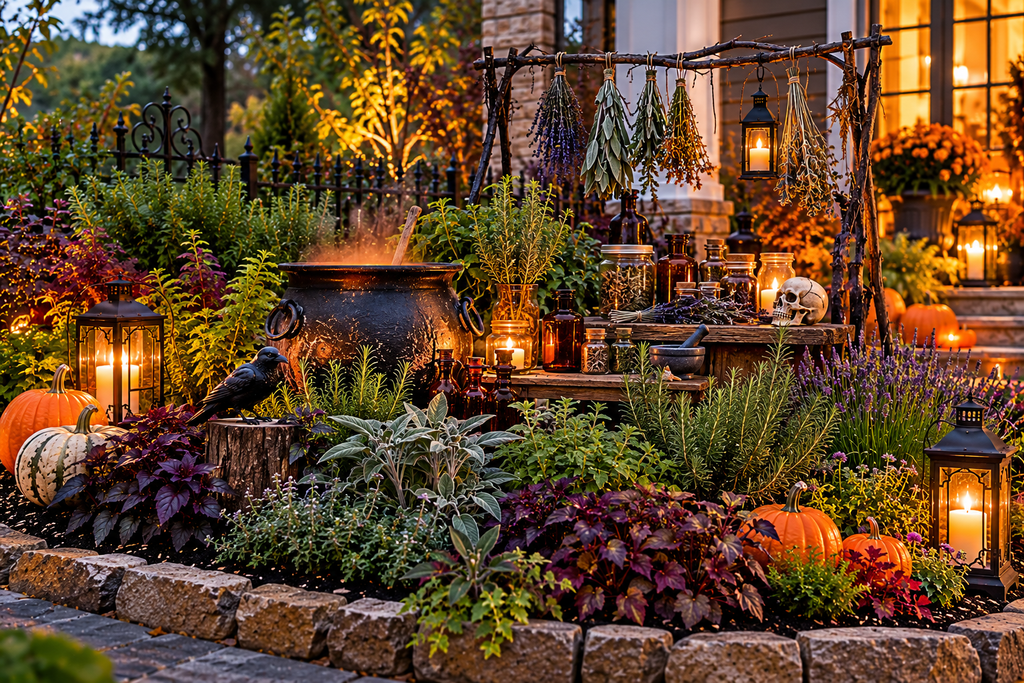
People love the idea of a “poison garden,” and the safe version uses harmless herbs with theatrical labels. Purple sage, rosemary, thyme, lavender, and ‘Purple Ruffles’ basil (a tender annual that will not take frost) all have the right dusky look. Hand-letter wooden plant markers with dramatic names, such as “Bat Wing” for sage, and add a few glass jars or an old wooden crate.
The plants that real poison gardens use, including monkshood (Aconitum), foxglove (Digitalis), angel’s trumpet (Brugmansia), oleander, and castor bean, are toxic to people and pets, and monkshood can irritate skin on contact. Keep these away from front yards visited by children and dogs. Anything labeled with a spooky name should still be marked clearly as ornamental if it is not meant to be eaten.
14. A Bare-Branch Tree With Bats and Crows
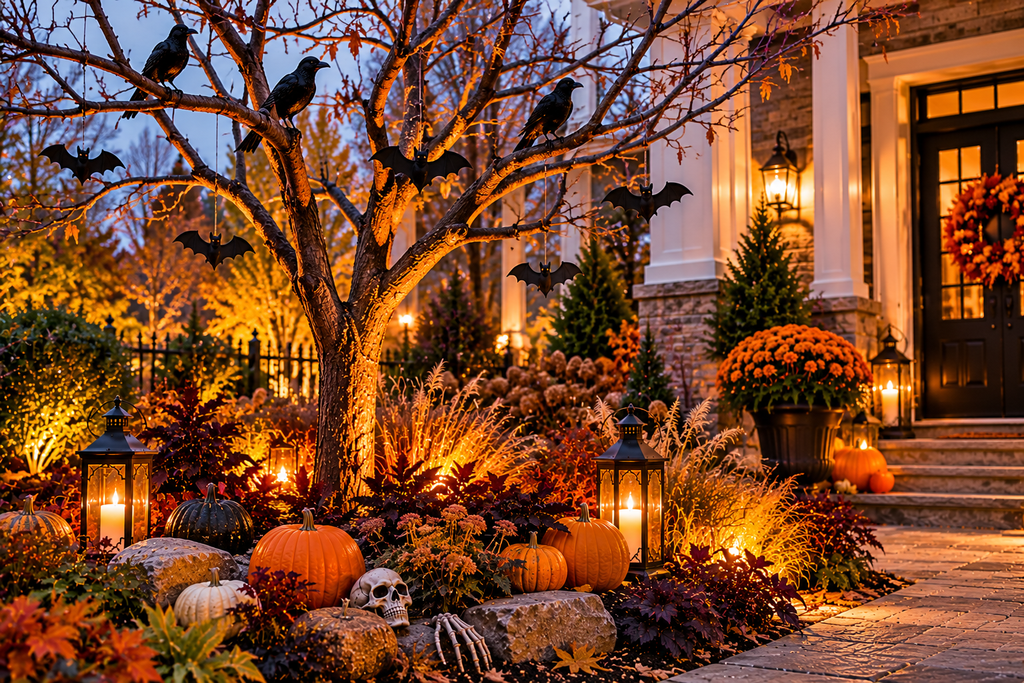
A bunch of branches in a heavy urn looks like a sculptural leafless tree. Fill a large pot or bucket with gravel and a few rocks, set the branches in and wedge them tightly. Hang bats cut from black felt or craft foam, which hold up in damp weather better than paper does.
If you gather branches yourself, take them from your own yard or from a place where you have permission. Do not take them from parks or preserves. Check carefully for poison ivy, because the urushiol oil that causes the rash stays in dormant vines and stems. Avoid Oriental bittersweet, which is invasive in much of the eastern U.S. and spreads when birds eat its berries. Dead branches are the better choice, since they are already dry and will not shed leaves.
15. Dried Flowers and Seed Heads in Black Urns
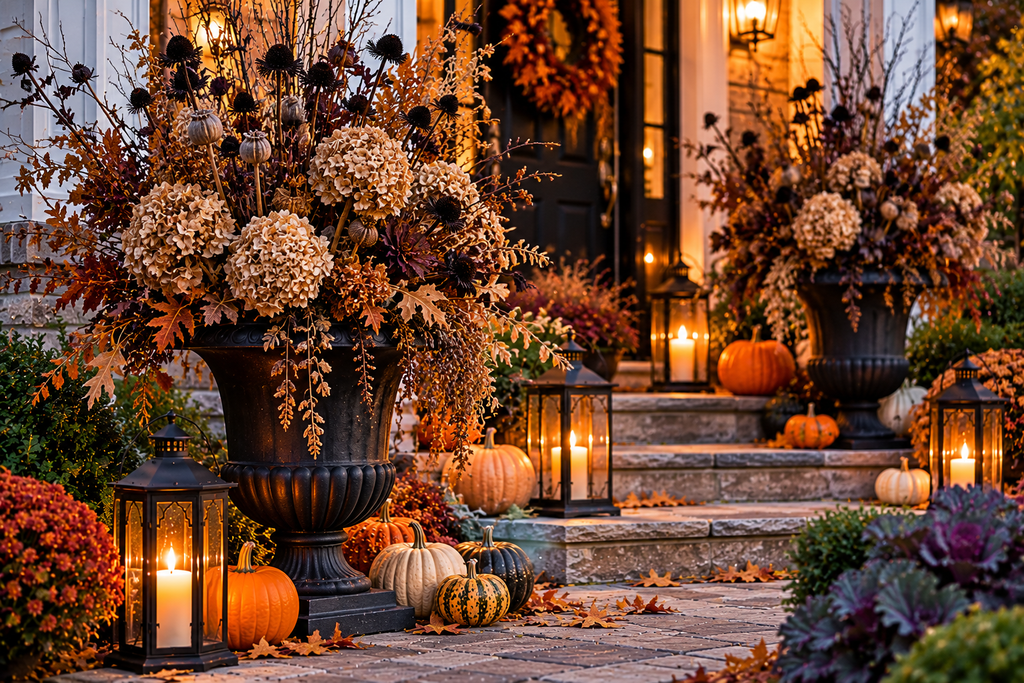
Seed heads are already hauntingly textural. Good candidates include dried hydrangea blooms, sedum seed heads, celosia, strawflowers, globe amaranth, ornamental grass plumes, and poppy pods. Cut stems on a dry day, bundle them, and hang them upside down somewhere dry and dark for two to three weeks before displaying them.
Set the arrangements in black or charcoal urns, and put them under a roof overhang. Rain turns dried flowers to mush, and wind can scatter delicate heads. For a more gothic look, spray a few seed pods with matte black paint outdoors and let them dry fully before arranging.
Lighting and Long-Term Planting
16. Low, Warm, Slightly Uneven Lighting
Halloween looks best when the yard is lit unevenly. A single floodlight flattens everything, while low lights tucked at the base of grasses, pumpkins, and tombstones create pools of light and shadow. Warm amber or orange LED bulbs suit pumpkins and grasses, and a purple or green uplight on a single tree adds an eerie touch.
Solar stakes are convenient, but fall days are short and the sun sits low, so many solar lights run dim or die early in the evening. A plug-in or battery option is more reliable. If you use plug-in lights, choose outdoor-rated products and cords, plug them into a GFCI-protected outlet, check for damaged insulation, and keep connections off wet ground. Fire safety groups like the National Fire Protection Association recommend flameless candles over real flames, especially around costumes and dry decorations. Keep the path itself at least three feet wide, well lit, and free of cords and props, since visitors will be walking it in the dark.
17. Dark-Leaved Shrubs to Plant Now for Next Year
If you want this look every autumn without buying new plants, dark-leaved shrubs build it into the landscape. Good options include ninebark such as ‘Diabolo’ (Physocarpus opulifolius), smoke bush (Cotinus coggygria ‘Royal Purple’), and ‘Black Lace’ elderberry (Sambucus nigra). They also provide a dark backdrop for pumpkins and flowers.
Fall is a good planting time for shrubs in many regions because the soil is still warm and the air is cooler, but the roots need several weeks to establish before the ground freezes, so check your local timing. These shrubs keep the deepest color in full sun and often turn greener in shade. Many reach 6 to 10 feet at maturity, so check the plant tag and leave room.
Safety Notes Worth Reading Before You Set Up
- Pets and children: Chrysanthemums are listed as toxic to dogs and cats, and several classic “witchy” plants are dangerous. If anyone eats a plant, call Poison Control at 1-800-222-1222 in the U.S.
- Fake spider webbing: Synthetic webbing can trap birds, bats, and small animals, and wildlife rehabilitators regularly warn about it. Use it sparingly, keep it low-risk, and take it down promptly.
- Open flame: Use LED or flameless candles in pumpkins and lanterns, especially around straw, corn shocks, and costumes.
- Electrical: Use outdoor-rated lights and cords, GFCI outlets, and keep cords out of walking areas.
- Walkway: Keep decorations off the path and steps, and light the steps clearly.
Questions Readers Actually Ask
Do black flowers actually exist?
Not really. Flowers sold as black, such as ‘Black Knight’ scabiosa or certain dahlias, tulips, and petunias, are very deep burgundy, maroon, or purple that look black in low light. Plant breeders and nurseries use “black” as a shorthand.
When should pumpkins go out?
In cooler regions, late September to mid-October works for uncarved pumpkins. In warm climates, heat speeds up rot, so wait until closer to the date. Carved pumpkins last only a few days, so carve them within a few days of Halloween.
How do I stop squirrels and deer from eating them?
Elevated porch spots and tight clusters near the house help. Hot pepper sprays are a common deterrent, although effectiveness varies and rain washes them off, so treat this as unproven. Using fake pumpkins for the yard edge and real ones close to the door is a dependable workaround.
What can I do with pumpkins after Halloween?
Plain, unpainted pumpkins can be broken up and composted or left in a spot away from the house for wildlife. Remove candle wax, paint, glue, and glitter first. Do not eat pumpkins that were left outdoors for decoration.
Key Takeaways
Start by checking your first frost date and choose plants that will last until Halloween. Dark foliage, deep burgundy flowers, and varied heirloom pumpkins create a moody look more convincingly than props alone. Use foam tombstones, branch trees, and dried seed-head arrangements for low-cost DIY impact, and light everything low and warm. Keep fire, cords, toxic plants, and wildlife in mind throughout. If you want next year’s yard to look haunted without the effort, plant a dark-leaved shrub or two now.

About Syprose Kiche
Syprose Kiche is the creator and writer behind My Besuited Home, a practical home and garden website covering DIY projects, gardening, lawn care, landscaping, home improvement, and outdoor living. She focuses on turning everyday homeowner questions into clear, practical guides backed by careful research and useful real-world considerations.