
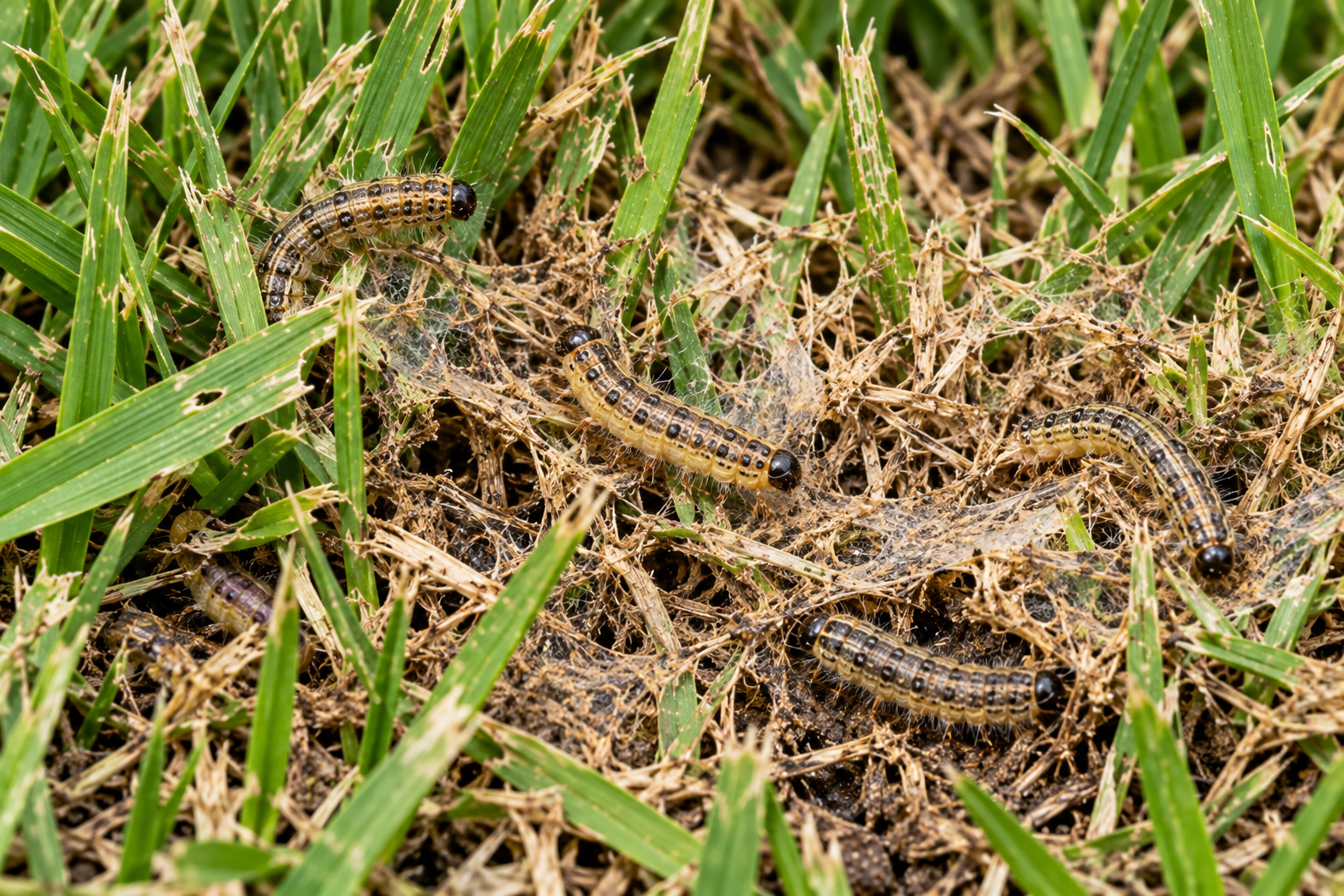
A brown, ragged patch appears in the lawn. The grass looks chewed or scalped rather than dried out. Birds keep landing there to peck at it, and watering doesn’t help. Many homeowners treat this as drought or fungus, and it can go on for weeks before anyone looks closely at the ground.
When the cause is sod webworms, the damage is done by small caterpillars. They hide in the thatch all day and feed on grass blades at night. Because they feed above ground, they are one of the few lawn pests you can manage with biological tools instead of broad-spectrum insecticides. That only works if you identify them correctly, time the treatment to their life stage, and set realistic expectations about what “natural” can do.
What Sod Webworms Actually Are
“Sod webworm” is a group name. It covers about 20 species of lawn moths in the US, including the bluegrass webworm, the larger sod webworm, and Sperry’s and western lawn moths. A related species, the tropical sod webworm, attacks warm-season grasses in the South. They look alike and behave similarly, so you don’t need to name the species to manage them.
The adult moth is harmless to the lawn. It is small and buff or tan, and it folds its wings tightly around its body when resting. At dusk, moths flutter in a zigzag pattern low over the turf and drop eggs as they go. That flight is the earliest warning sign you will get. It does not mean you have an infestation, since many moths can pass over a lawn without producing enough caterpillars to matter.
The caterpillars cause the damage. Fully grown, they are roughly half an inch to an inch long, depending on the species. Their color ranges from greenish to beige, brown, or gray, and most have dark spots scattered along the body. They build silk-lined tunnels in the thatch and upper soil, where they shelter during the day. At night they come out to clip grass blades near the base and pull them back into the tunnel.
Sod webworms overwinter as partly grown larvae in those silk-lined chambers in the thatch. This explains why the same lawn can have trouble in consecutive years. Larvae that survive winter resume feeding on new growth in spring, then pupate and emerge as moths that lay the next generation’s eggs. Many regions see two generations a year, and warmer climates can see more. In the mid-Atlantic, for example, the most visible damage generally falls between mid-July and the end of September, which is also when the summer generation is feeding hardest.
Webworms favor grasses. Kentucky bluegrass, fescues, bentgrass, and zoysia are all on the menu, and in the South so are bermudagrass, St. Augustinegrass, centipedegrass, and other warm-season turf. They tend to avoid heavily shaded lawns, so a patch in full sun is a better suspect than one under a maple.
Is It Really Sod Webworms? Telling Them Apart From Other Lawn Problems
A wrong diagnosis wastes treatment time, and a few lawn problems look surprisingly similar. The comparison below covers the usual suspects.
| Problem | What the damage looks like | Key clue |
| Sod webworms | Irregular brown or tan patches with chewed, clipped-looking blades; may spread over weeks | Green pellet droppings, fine silk webbing in thatch, caterpillars surfacing in a soap flush, moths at dusk |
| White grubs | Turf that feels spongy and peels back like a carpet | Roots are severed; C-shaped white larvae in the soil |
| Chinch bugs | Yellowing, then straw-colored patches, often in hot sunny spots, often along pavement edges | Tiny black insects with white wings found at the grass-soil line |
| Armyworms and cutworms | Fast-spreading chewed areas; larger caterpillars | Caterpillars much bigger than webworms and sometimes visible near dusk |
| Drought stress | Gray-green color first, then brown across a broad area; footprints stay visible | Recovers within days of deep watering |
| Dog urine | Dead circular spots, often with a darker green ring around the edge | Pattern matches where the dog goes |
| Fungal disease | Spots, rings, or lesions on blades, often after humid weather | Blades show lesions or a fuzzy growth |
Sod webworm damage often starts as scattered small spots. These expand and merge as the caterpillars grow, since larger larvae eat more. Early on, the first-stage larvae only skeletonize leaf surfaces, which is easy to miss unless you look closely.
One feature separates webworms from grubs: the roots remain intact. Webworms eat blades and leave the root system alone, so a heavily damaged lawn usually does not lift away from the soil, which is what happens with grub damage. That makes the lawn’s prospects for recovery much better.
Two Tests That Settle the Question
The tug test. Grab a handful of damaged turf and pull gently. If it lifts like a mat with almost no resistance, roots have been cut and you are probably dealing with grubs. If the turf stays firmly anchored, webworms or another surface feeder are more likely.
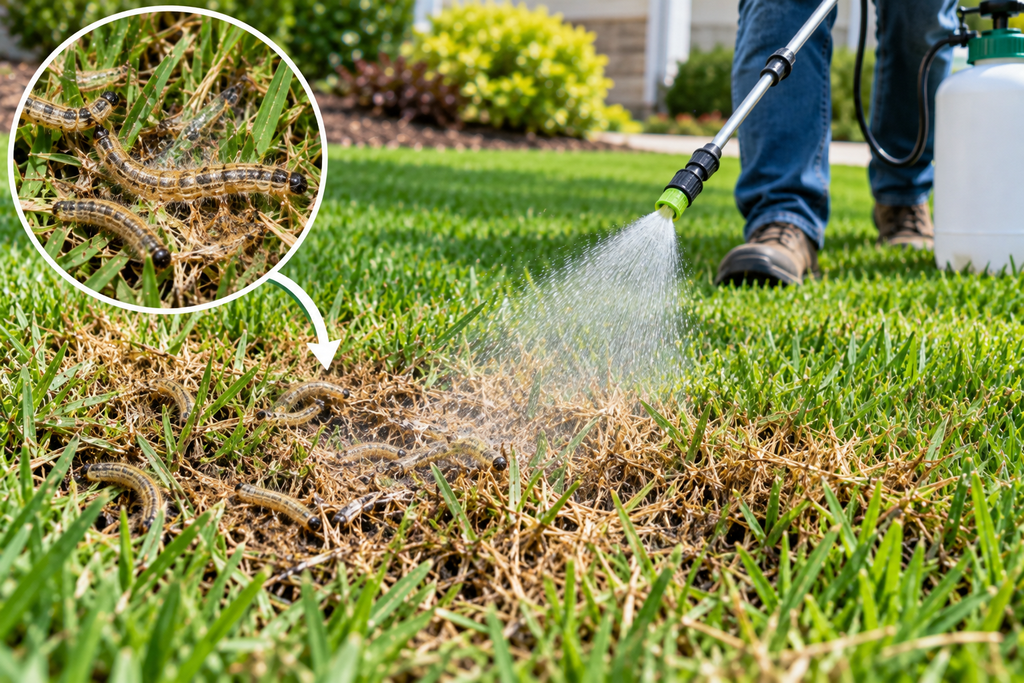
The soap flush. This is the standard field test for surface-feeding insects. Mix a couple of tablespoons of liquid dish soap into a gallon of water. Many extension guides give roughly one to two tablespoons, though some sources use slightly more. Pour it over about one square yard of turf at the edge of a damaged area, where the insects are still active. The soap irritates the caterpillars, and within several minutes they wriggle to the surface. Count them. Do this in the morning or evening, not under hot midday sun, and rinse the area with plain water afterward because concentrated soap can scorch the grass. Try a small patch first if you are unsure how your lawn will react.
If nothing surfaces after about ten minutes, try a second spot closer to the edge of the damage. If still nothing comes up, the cause is likely something other than webworms.
How Many Caterpillars Does It Take to Justify Treatment?
A lawn can host a few caterpillars without suffering visible damage, and a healthy, well-watered lawn can usually tolerate a modest number. Treating every one wastes effort and can remove helpful insects that keep the population in check.
Published thresholds vary by state and by how much damage the lawn has already sustained. Figures in the 10 to 15 caterpillars per square yard range turn up in extension guidance, but your local extension service is the better authority because climate, grass species, and lawn use all shift the number. Lower thresholds make sense for high-value turf such as a showpiece front lawn, and higher ones are reasonable for a utility lawn that gets limited care.
Damage that has already happened is also worth weighing. If the grass has been eaten down but is still green at the base, it can often regrow without any treatment. If the caterpillars are still feeding and the patches are expanding week to week, treatment makes sense.
Timing: When Natural Treatments Work Best
Timing matters more for natural methods than for conventional insecticides, because most biological options work best against young larvae.
- Summer generation (most important in northern regions): Treat when the soap flush turns up small, actively feeding caterpillars. This typically falls in midsummer, following the dusk moth flights you noticed a few weeks earlier. Eggs hatch and the young larvae begin feeding fairly soon after the flights.
- Spring: Overwintered larvae resume feeding on new growth. Damage at this time is usually modest and the lawn is growing vigorously, so it often outgrows the problem.
- Fall: Larvae from the late summer generation feed until cold weather pushes them into the thatch for winter. If you find late-stage caterpillars in fall, treatments aimed at young larvae will be less effective.
- Warm-season lawns in the South: Feeding can run from summer well into fall, and the tropical sod webworm can produce several overlapping generations. Watch for new feeding rather than assuming one treatment window.
An evening flashlight check is worth doing regularly during peak season. Caterpillars feed at night, so a quick walk around the lawn after dark on a warm evening will show whether they are active. Caterpillars feeding in full daylight are more likely a different insect, since sod webworms hide during the day.
Biological Controls That Have Real Evidence Behind Them
Two natural controls come up repeatedly in university extension publications: the bacterium Bacillus thuringiensis (Bt) and beneficial nematodes. They work differently, and each fits certain situations better.
Bacillus thuringiensis (Bt)
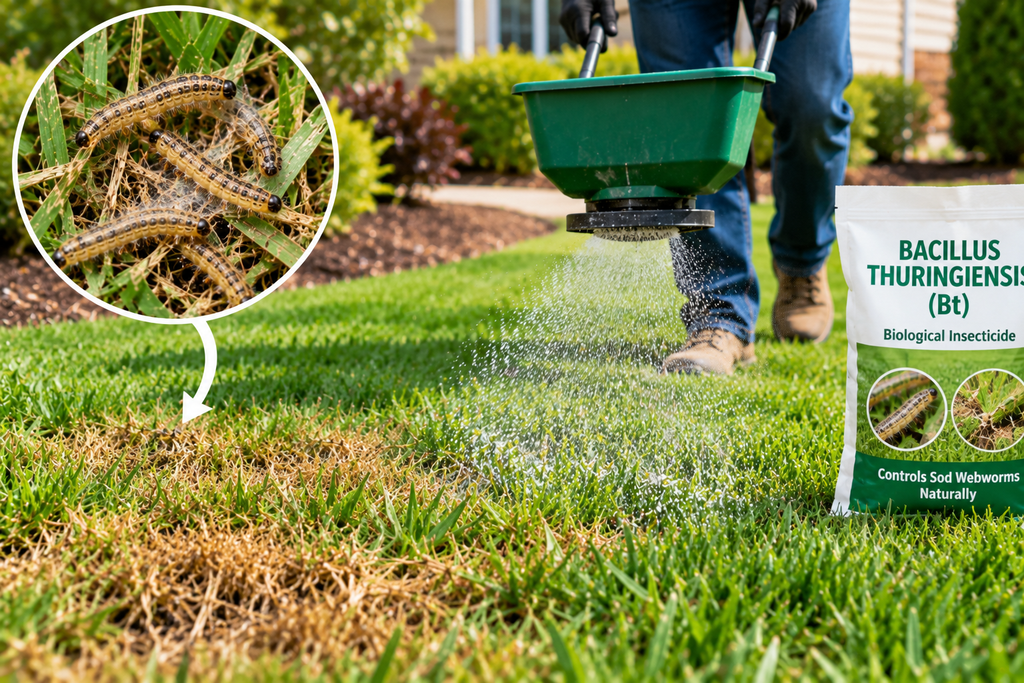
Bt is a naturally occurring soil bacterium. The variety most often used against lawn caterpillars is Bacillus thuringiensis kurstaki. When a caterpillar eats grass treated with it, the bacterial toxin disrupts the gut, the larva stops feeding, and it dies within a few days. It targets caterpillars specifically and doesn’t harm beneficial insects such as bees and ladybugs.
Limits worth knowing before you buy it:
- It must be eaten. Bt does nothing to larvae that are hiding in the thatch and not feeding. Apply it in the evening, when caterpillars are most active.
- Sunlight breaks it down. Bt degrades quickly under ultraviolet light and rinses off blades easily, so an evening application gives it the best chance of being eaten before it degrades.
- It works best on young larvae. University of California guidance notes that Bt is ineffective against late-stage larvae. This is why finding the problem early matters.
- Rain and irrigation matter. California guidance advises mowing and irrigating before application and holding off irrigation for about two days after applying Bt, so the product stays on the blades long enough to be eaten.
Read the product label for the application rate, since concentrations differ between brands and formulations. Not every Bt product is labeled for turf, so confirm that yours is.
Beneficial Nematodes
Beneficial nematodes are microscopic roundworms that seek out and infect insects in soil and thatch. For sod webworms, the species most often cited is Steinernema carpocapsae. UC’s turfgrass guidelines note that this species is a valuable control because webworms spend so much time in contact with thatch and soil. Utah State University Extension gives an application rate of about 25 million nematodes per 1,000 square feet of turf. Follow whichever rate your product’s label specifies, since formulations vary.
Nematodes are living organisms, which creates a few practical rules:
- Order them fresh and apply promptly. Store them as the supplier directs, usually refrigerated, and don’t let the package sit.
- Keep them out of the sun. UV exposure kills them quickly, so apply in the early morning or evening.
- Water before and after. The soil needs to be moist so they can move through it, and irrigating afterward carries them down into the thatch where larvae shelter.
- Mow beforehand. Cutting the grass first improves penetration.
- Mind the soil temperature. Nematodes need warm enough soil to be active. Check the product label for a minimum temperature, since I haven’t verified a specific figure to give you.
Nematodes cost more than Bt, but they reach larvae that are sheltering instead of feeding. They make the most sense for infestations that persist year after year, or when Bt has already failed because larvae grew past the susceptible stage.
Spinosad and Neem: Where “Natural” Gets Complicated
Spinosad is derived from a soil bacterium and appears on lists of reduced-risk turf products. Utah State Extension names it, with Bt, as a reduced-risk option for sod webworm control. It is more broadly active than Bt, which means it can harm non-target insects. Spinosad is toxic to bees when wet, so avoid applying it to a lawn with flowering clover or dandelions, and mow flowers off beforehand if you must treat. Check the label for rules about pollinators and aquatic areas.
Neem (azadirachtin) is plant-derived and appears on some extension lists of products labeled for sod webworms. I couldn’t confirm how consistently it performs in lawns, and neem generally works more slowly and less predictably than Bt. If you try it, treat it as a supplement and not your main tool, and check whether your product is labeled for turf.
Whether to call either of these “natural” is a judgment call. They come from natural sources but still act as insecticides, and the label requirements apply.
Hand Methods: Soap Drenches and Collecting Larvae
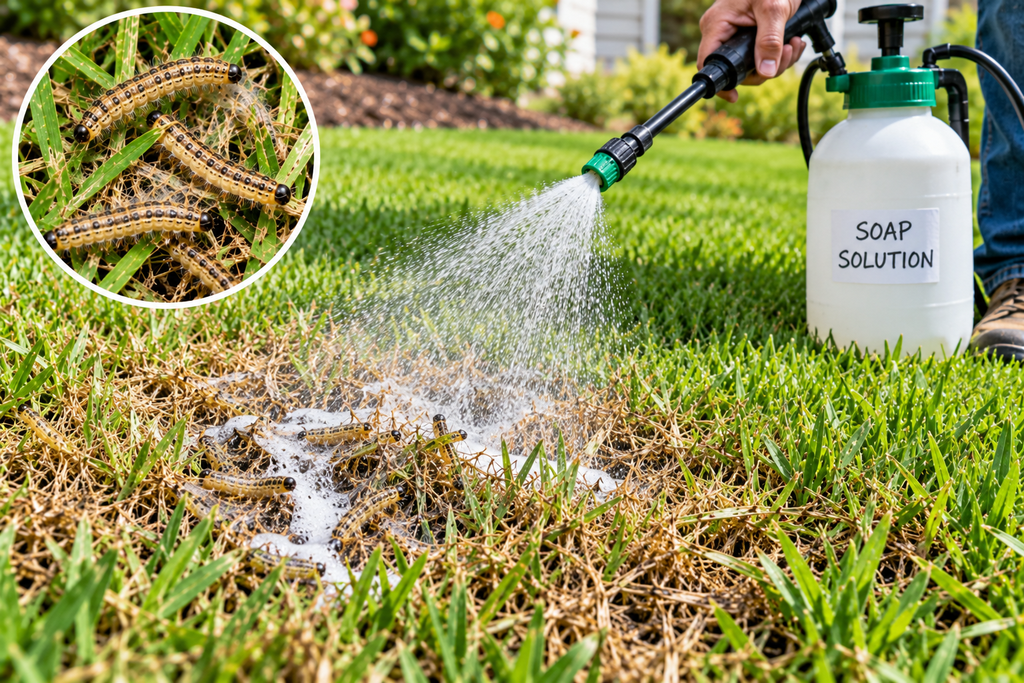
The soap flush doubles as a treatment for small, localized problems. Caterpillars that surface can be scooped up and dropped into a bucket of soapy water. For a patch a few feet across, this can remove a meaningful share of the population.
The limits are obvious. Many caterpillars stay in the thatch where soap can’t reach them, and the method is impractical for a large lawn. Think of it as a way to knock back a small, early infestation while you wait for Bt or nematodes to work, not a standalone cure.
Home Remedies That Don’t Hold Up
Several remedies show up on gardening forums with little evidence behind them.
- Diatomaceous earth. It is effective against some crawling insects in dry conditions, but it works poorly on a damp lawn, and sprinkling it across turf kills beneficial insects along with pests.
- Garlic or hot pepper sprays. These may briefly deter some insects on ornamental plants. I found no solid evidence that they control sod webworms in turf.
- Milky spore. It targets Japanese beetle grubs, not caterpillars, so it won’t help here.
- Bleach, gasoline, kerosene, or other household chemicals. These are dangerous to you, your pets, the soil, and groundwater, and they kill grass. Don’t use them under any circumstances.
- Dish soap used as a pesticide at strong concentrations. The soap flush works because the diluted soap irritates caterpillars so they come to the surface. A stronger mix can damage the turf.
Changing the Lawn Conditions That Favor Webworms
Treatment deals with the caterpillars you have now. Lawn care determines how hospitable the lawn is to the next generation.
Keep Thatch in Check
Thatch gives larvae a place to shelter and overwinter. A thin layer under about half an inch is normal and healthy. When thatch gets thicker than that, it becomes a hiding place for pests. If you find a thick layer, dethatching in the appropriate season for your grass can help. UC guidance notes that dethatching may help when webworms are present. Core aeration also helps by encouraging microbial breakdown of thatch.
Mow at the Right Height
Taller grass shades the soil, supports deeper roots, and tolerates feeding better than closely clipped turf. Mow at the height recommended for your species. Many cool-season lawns do well at around three inches, while bermudagrass and zoysia are kept much shorter. Don’t remove more than about a third of the blade at once.
Water Deeply, Not Often
Frequent shallow watering encourages shallow roots and thatch buildup. Deep, infrequent watering in the morning builds a more resilient lawn that recovers faster from feeding damage.
Go Easy on Nitrogen
Heavy summer nitrogen pushes lush growth and thatch accumulation, which can increase pest pressure. Fertilize based on a soil test and your grass type, and avoid late spring or midsummer applications that force fast growth when caterpillars are most active.
Overseed With Endophyte-Enhanced Grasses
Some perennial ryegrasses, tall fescues, and fine fescues carry endophytic fungi that make the grass less palatable to surface-feeding insects like sod webworms. The University of Maryland suggests reseeding damaged areas with high-endophyte tall fescue. This is a long-term strategy rather than a quick fix, and it only applies to cool-season lawns. Check seed labels, since endophyte content varies between cultivars, and note that endophytes in some grasses can be harmful to grazing livestock.
Manage Clover and Weeds
UC guidance notes that controlling clover and dichondra may help limit damage in affected areas. Weedy lawns can host more caterpillars, but thinning broadleaf weeds should be done carefully, since flowering weeds also feed pollinators.
Protect the Natural Enemies Already Working for You
Birds, parasitic wasps, and flies prey on sod webworm larvae. Utah State Extension notes that unnecessary insecticide use reduces these natural enemies. Birds pecking at a lawn may be doing some of the work for you, even though it can look alarming.
This is the strongest reason to avoid broad-spectrum insecticides unless an infestation is serious. Killing the caterpillars with a persistent product also kills the predators and parasitoids that would otherwise keep the next generation in check, and can lead to a rebound.
Repairing the Damage
If the roots are intact, the grass often recovers on its own once feeding stops. Water the lawn through dry periods and give it a few weeks. Light fertilization consistent with your soil test can help recovery.
Where patches are truly dead, rake out the debris, loosen the surface, and reseed or patch with sod. Do this in the right season for your grass: early fall for cool-season grasses, late spring to early summer for warm-season grasses. Seeding while caterpillars are still active feeds them new seedlings, so make sure the infestation is under control first. Keep new seed consistently moist until it establishes.
When Natural Methods Are Not Enough
Natural methods have limits. Bt fails on mature larvae, nematodes take time and careful handling, and a large or persistent infestation may overwhelm both. You may need a conventional product or a professional if:
- the infestation recurs year after year despite good lawn care
- damage is spreading quickly across a large area
- the lawn is high-value turf, such as a sports field or showpiece lawn, with little tolerance for damage
- earlier treatments have failed
Utah State Extension notes there are more than 200 registered products for sod webworm control, so check the label for your lawn type and local rules. A licensed applicator or your local extension service can recommend options suited to your region. Always read and follow the label, since the label is the legal instruction for use.
Safety Around Children, Pets, and Wildlife
Natural does not mean harmless, and no lawn treatment should be called completely safe.
- Read every label and follow it exactly, including rates, restricted entry times, and pet and child guidance.
- Keep children and pets off treated areas until the product has dried or the label says it is safe.
- Wear gloves and avoid breathing dust or spray from powders and concentrates.
- Avoid applying anything before heavy rain, which can wash products into storm drains and waterways.
- Keep spinosad away from flowering plants, pollinators, and water.
- Store products as directed and keep them out of reach of children and pets.
Questions Readers Often Ask
Will the grass grow back?
Usually, yes, if the roots are intact. Webworms eat blades but leave roots alone, so lawns often recover with water and time. Areas that are truly dead need reseeding.
Do I need to treat every year?
Not necessarily. A single season of damage doesn’t guarantee a repeat. Watch for moths at dusk in summer and do a soap flush if you see signs of damage. If the problem returns in consecutive years, a structured plan with nematodes, endophyte-enhanced seed, and thatch management is worth considering.
Can I just wait it out?
Sometimes. A mild infestation in a healthy, actively growing lawn may not need treatment. If patches keep expanding, act early, since young larvae are easier to control.
Do the moths themselves cause damage?
No. Adult moths don’t feed on grass. They matter because they lay eggs in your lawn.
Could it be chinch bugs instead?
It is a common mix-up. Chinch bugs favor hot, sunny areas and leave yellowing patches, often along pavement. Check the grass-soil line for tiny black-and-white insects, and use the soap flush to see which pest comes up.
Key Takeaways
Confirm the pest before treating: use the tug test to check the roots and the soap flush to find the caterpillars. Treat only if the count and the spreading damage justify it. Bt works best on young larvae applied in the evening, and nematodes reach larvae hiding in the thatch if the soil is moist and they’re kept out of sunlight. Over the long run, thatch control, proper mowing, deep watering, and endophyte-enhanced grass seed reduce how appealing the lawn is. If the problem keeps returning, call your local extension office.

About Syprose Kiche
Syprose Kiche is the creator and writer behind My Besuited Home, a practical home and garden website covering DIY projects, gardening, lawn care, landscaping, home improvement, and outdoor living. She focuses on turning everyday homeowner questions into clear, practical guides backed by careful research and useful real-world considerations.